How to Score 120+ in GS Paper 1 is one of the most common questions asked by UPSC aspirants preparing for the Civil Services Mains Examination. While many candidates focus heavily on GS Paper 2, GS Paper 3, and Ethics, GS Paper 1 offers a significant scoring opportunity for those who prepare strategically. With the right combination of standard books, answer-writing practice, revision techniques, and current affairs integration, scoring 120+ marks in GS Paper 1 is an achievable goal.
GS Paper 1 covers Indian Heritage & Culture, Modern Indian History, World History, Indian Society, and Geography. In this comprehensive guide, we will discuss a proven strategy, section-wise preparation plan, recommended books, answer-writing techniques, and practical tips used by successful candidates to score 120+ marks.
Scoring 120+ marks in GS Paper 1 is not a dream—it is a realistic target if you prepare smartly and focus on high-yield topics. While many aspirants struggle to cross 90–100 marks, a structured approach to History, Geography, Indian Society, and Art & Culture can significantly improve your score.
In this comprehensive guide, you’ll learn:
- The exact GS Paper 1 syllabus
- Section-wise preparation strategy
- Best books and resources
- Answer-writing framework
- Common mistakes to avoid
- A practical roadmap to score 120+ marks
How to Score 120+ in GS Paper 1: Understanding the Exam Pattern
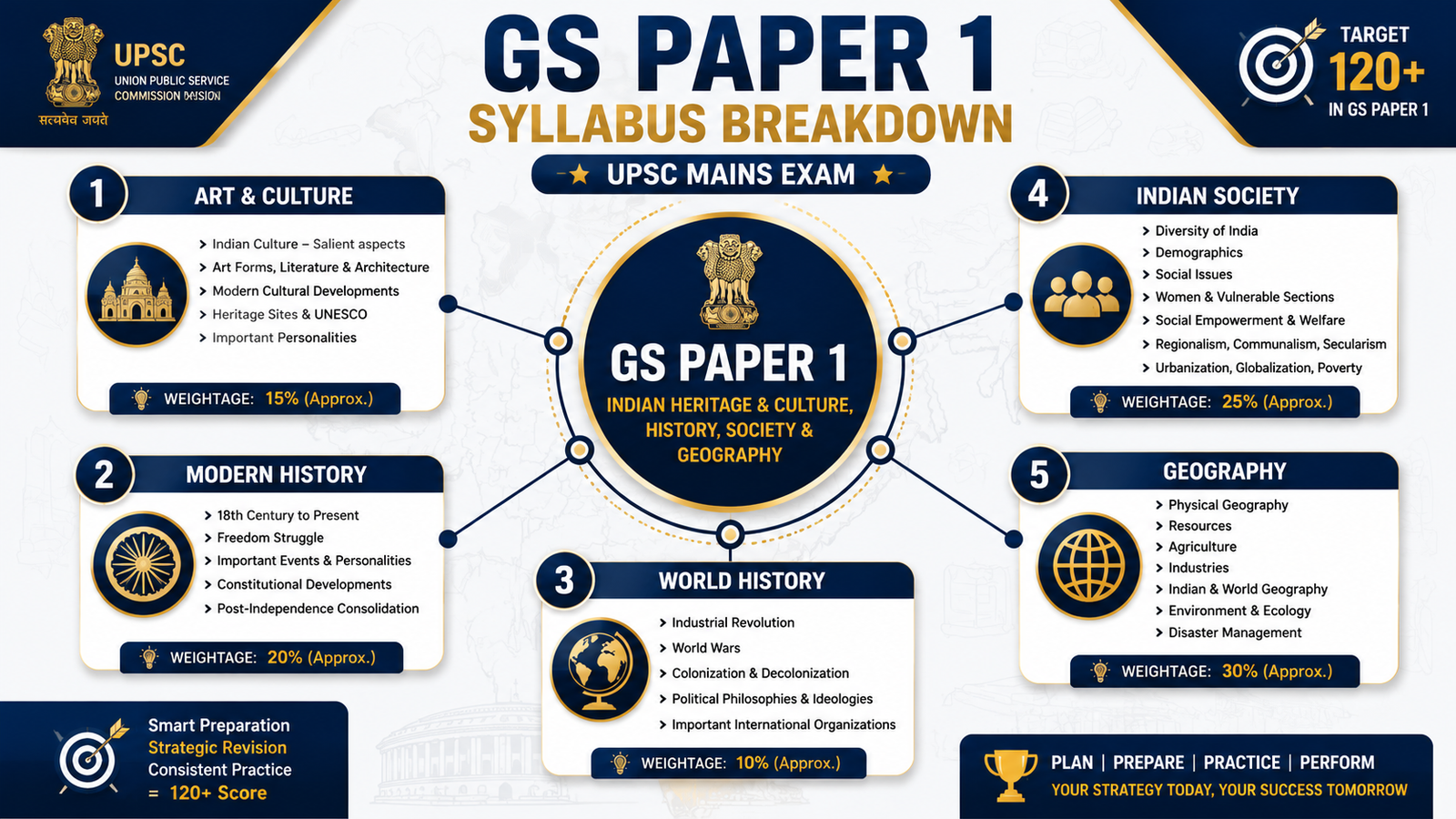
GS Paper 1 covers:
- Indian Heritage & Culture
- Modern Indian History
- World History
- Indian Society
- Geography (Indian & World)
Many aspirants underestimate GS-1 because it lacks the glamour of Ethics or Governance. However, candidates who consistently score 120+ often treat GS-1 as a high-return paper because much of the syllabus is static and predictable.
UPSC GS Paper 1: Section-wise Marks Distribution (Based on Syllabus & Recent Trends)
Understanding the syllabus thoroughly is the first step in learning How to Score 120+ in GS Paper 1.
Official UPSC GS Paper 1 Marks = 250 (20 Questions: 10 markers + 15 markers) covering Indian Heritage & Culture, History, Society, and Geography.
Since UPSC does not officially prescribe section-wise marks, the following is based on PYQ trends and syllabus weightage analysis.
| Section | Approx. Marks in Exam | Target Score for 120+ |
|---|---|---|
| Art & Culture | 20–40 | 12–20 |
| Modern History | 40–60 | 25–35 |
| World History | 15–30 | 10–15 |
| Indian Society | 50–70 | 30–40 |
| Geography | 70–90 | 40–50 |
| Total | 250 | 120+ |
Understanding the 120+ Benchmark
A score of 120+ generally means:
| Section | Target Marks |
|---|---|
| History | 30–35 |
| Art & Culture | 15–20 |
| Society | 20–25 |
| Geography | 35–40 |
| Presentation Bonus | 10–15 |
| Total | 120+ |
The key is not knowing everything.
The key is writing quality answers in every section.
Study Time Allocation for 120+
| Subject | Study Share |
|---|---|
| Geography | 35% |
| Society | 25% |
| Modern History | 20% |
| Art & Culture | 12% |
| World History | 8% |
Topic-wise Syllabus Weightage
1. Art & Culture (8–16%)
Syllabus
- Art Forms
- Literature
- Architecture
- Ancient to Modern Cultural Developments
Typical Questions
- Temple Architecture
- Bhakti Movement
- Classical Dances
- Paintings
- UNESCO Heritage
Safe Preparation Time
15–20 days
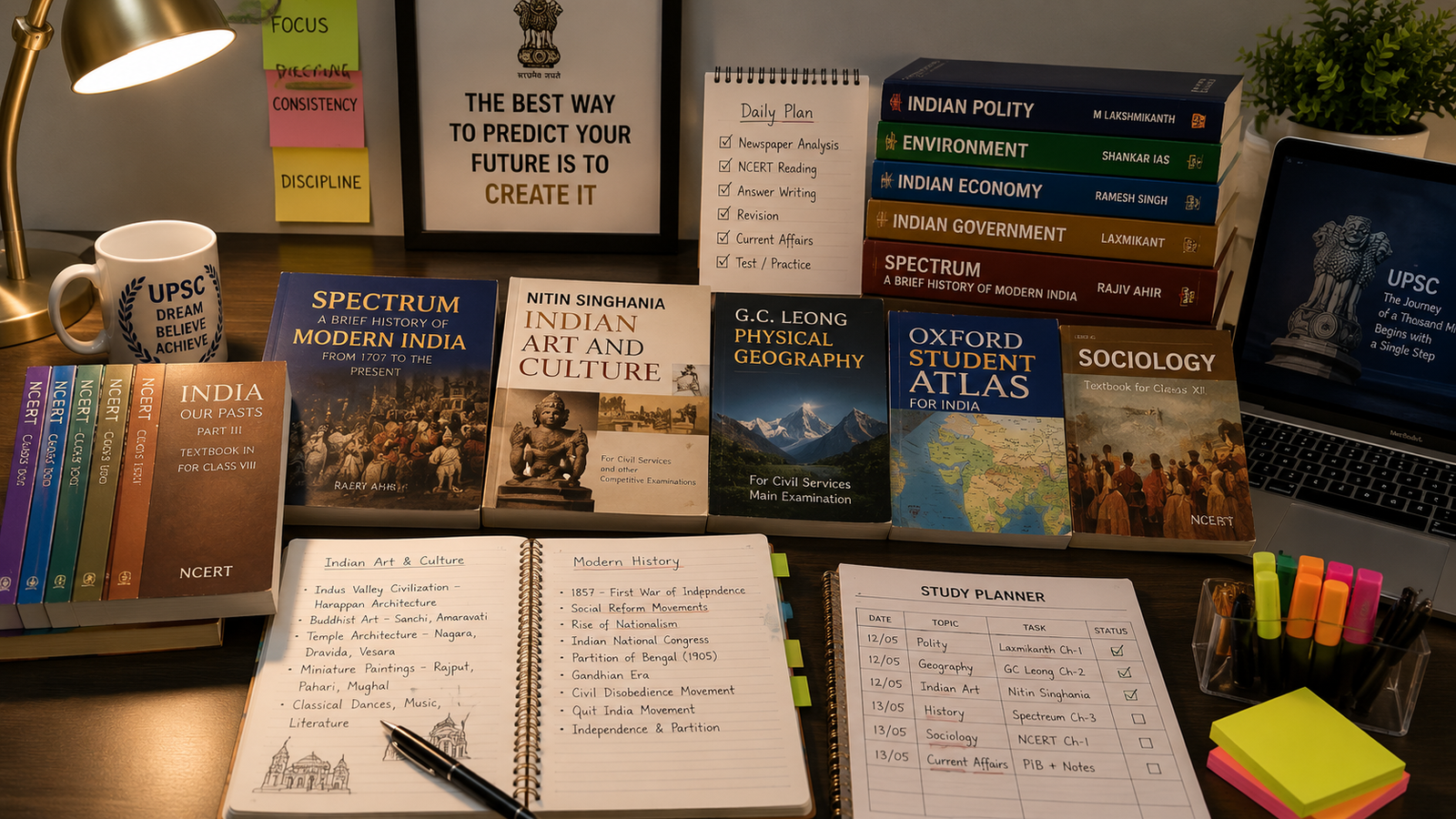
Best Books: Indian Art and Culture by Nitin Singhania (IAS)
A strong command of Art & Culture can make a noticeable difference when preparing How to Score 120+ in GS Paper 1.
2. Modern Indian History (16–24%)
Syllabus
- 18th Century onwards
- Freedom Struggle
- Important Personalities
- Significant Events
- Post-Independence Consolidation
Typical Questions
- Gandhi
- Moderate vs Extremist
- Revolt of 1857
- Constitutional Developments
- Integration of Princely States
Best Book: A Brief History of Modern India (Latest 2026 Edition) — Spectrum
Modern History remains one of the most important pillars of How to Score 120+ in GS Paper 1.
Modern History forms the backbone of GS Paper 1 and contributes significantly to the final score. For topic-wise preparation, books, PYQs, and answer-writing guidance, read our detailed Modern History Strategy for UPSC Mains GS Paper 1 Guide.
3. World History (6–12%)
Syllabus
- Industrial Revolution
- World Wars
- Colonization
- Decolonization
- Political Philosophies
High-Yield Topics
- French Revolution
- Russian Revolution
- WW-I
- WW-II
- Socialism & Communism
Best Book: Mastering Modern World History — Norman Lowe
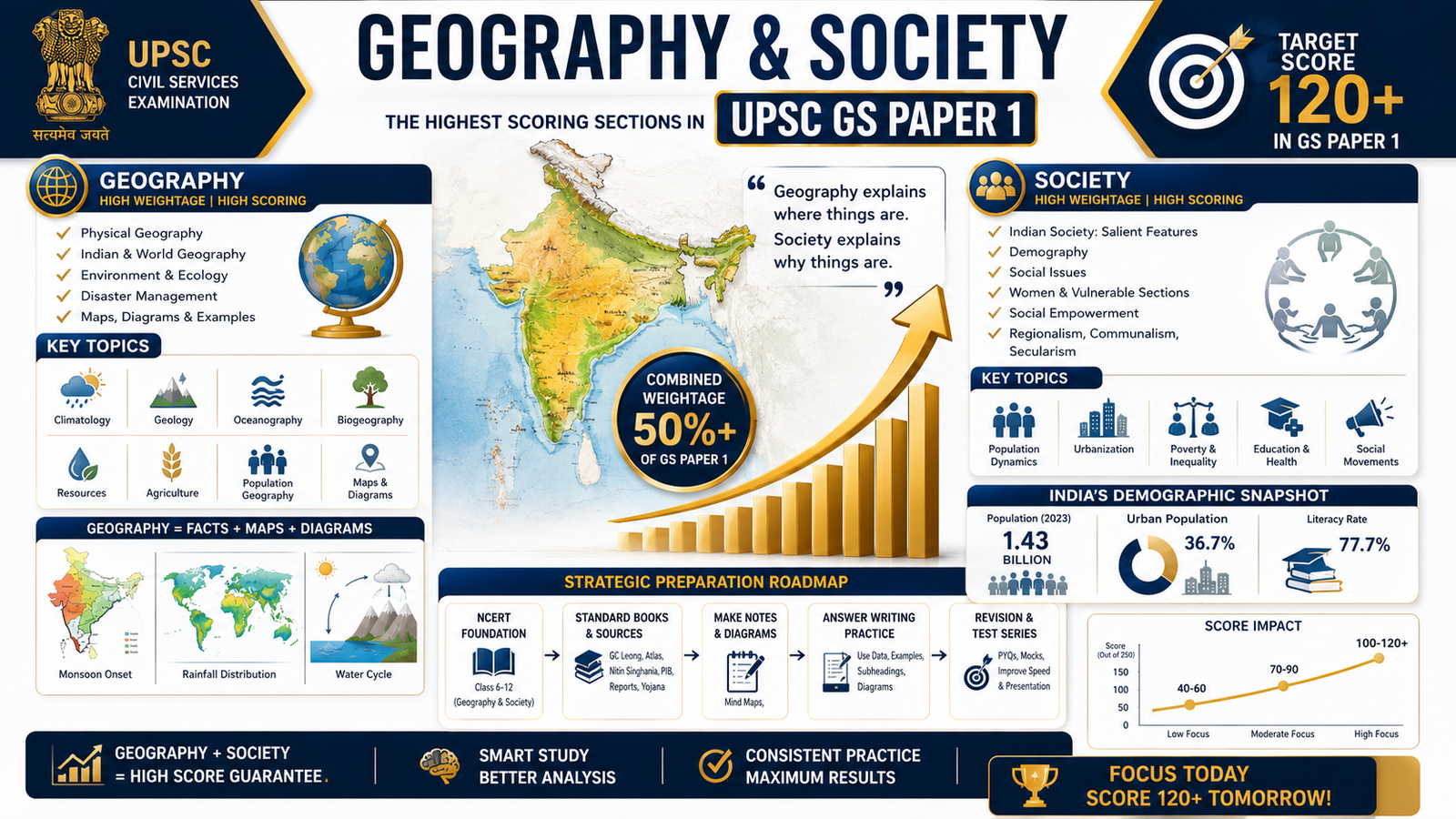
4. Indian Society (20–28%)
Syllabus
- Diversity
- Women Issues
- Population
- Urbanization
- Globalization
- Poverty
- Social Empowerment
- Communalism
- Regionalism
- Secularism
Most Scoring Area
Society answers become powerful with:
- NCRB Data
- NITI Aayog Reports
- SDGs
- Government Schemes
Best Book: Indian Society for UPSC CSE 2026 by Ayushi Singh (IAS) & Nityanand Jha (IPS)
Candidates aiming to understand How to Score 120+ in GS Paper 1 should never underestimate the importance of Society questions.
5. Geography (28–36%)
Physical Geography
- Earthquakes
- Volcanoes
- Cyclones
- Ocean Currents
Indian Geography
- Resources
- Agriculture
- Industries
- Water Resources
World Geography
- Distribution of Resources
- Industrial Location
Why Geography Matters
This section generally contributes the highest marks in GS-1. Maps and diagrams can increase scores significantly.
Geography often contributes the largest share of marks for aspirants targeting How to Score 120+ in GS Paper 1.
Topics to Focus On
Section 1: Art & Culture Strategy
Architecture
- Buddhist Architecture
- Temple Architecture
- Indo-Islamic Architecture
Performing Arts
- Classical Dances
- Music Traditions
- Theatre
Painting
- Mughal Paintings
- Rajput Paintings
- Pahari Schools
Literature
- Sangam Literature
- Bhakti Movement
- Sufi Traditions
Best Books for Art & Culture
Beginner
Indian Art and Culture – Nitin Singhania
Why buy:
- UPSC-oriented
- Well-structured
- Covers almost entire syllabus
Advanced
CCRT Website Notes
Excellent for factual enrichment.
Book Recommendation
📖 Indian Art and Culture by Nitin Singhania
Ideal for:
- UPSC
- State PCS
- BPSC
A must-have book for GS Paper 1 preparation.
Aspirants can also explore the Ministry of Culture website for authentic information on Indian heritage, monuments, art forms, and cultural traditions.
Section 2: Modern Indian History
Freedom Struggle
- Revolt of 1857
- Moderates
- Extremists
- Gandhian Movements
Constitutional Developments
- Acts
- Reforms
- Round Table Conferences
Post-Independence
- Integration of States
- Reorganization of States
- Nation Building
Best Books
Foundation
Spectrum Modern History
Why it works:
- Concise
- UPSC-focused
- PYQ-friendly
Additional Reading
Bipan Chandra – India’s Struggle for Independence
For conceptual depth.
Book Recommendation
📖 Spectrum Modern History
Almost every successful candidate relies on this book.
Section 3: World History
Revolutions
- French Revolution
- American Revolution
- Russian Revolution
Industrial Revolution
- Causes
- Consequences
World Wars
- WW-I
- WW-II
Political Ideologies
- Capitalism
- Socialism
- Communism
Best Book
Vision IAS World History Notes
or
Norman Lowe (Selective Reading)
Don’t spend excessive time here.
Focus on PYQ-based preparation.
Section 4: Indian Society
Why Society Is a Game Changer
Society questions are often current-affairs linked.
Good examples can dramatically improve marks.
Important Themes
Women
- Empowerment
- Workforce Participation
- Political Representation
Urbanization
- Migration
- Smart Cities
Globalization
- Impact on Society
- Cultural Changes
Diversity
- Regionalism
- Communalism
- Secularism
Best Sources
NCERT Sociology
Class XI & XII
Vision IAS Society Notes
Current Affairs
Government Reports
NITI Aayog
UN Reports
Score Booster Tip
Use examples:
- SHGs
- Digital India
- Beti Bachao Beti Padhao
- Aspirational District Programme
Real examples impress evaluators.
Reports published by NITI Aayog can be used to enrich Society answers with contemporary data and policy insights.
Section 5: Geography
Indian Geography
Focus on:
- Monsoon
- Agriculture
- Resources
- Water Management
World Geography
Focus on:
- Ocean Currents
- Climatic Regions
- Geomorphology
Environment Linkages
Many questions now overlap with:
- Climate Change
- Disasters
- Sustainability
Best Books
NCERT
Class 6–12
Non-negotiable.
G.C. Leong
Essential for physical geography.
Oxford School Atlas
Mandatory.
Book Recommendations
📖 Certificate Physical and Human Geography by G.C. Leong
📖 Oxford School Atlas
These two resources significantly improve answer quality.
Census data and official government reports help in substantiating Geography and population-related answers.
How to Score 120+ in GS Paper 1 with Effective Answer Writing: How Toppers Write GS Paper 1 Answers
Most aspirants know content.
Few know presentation.
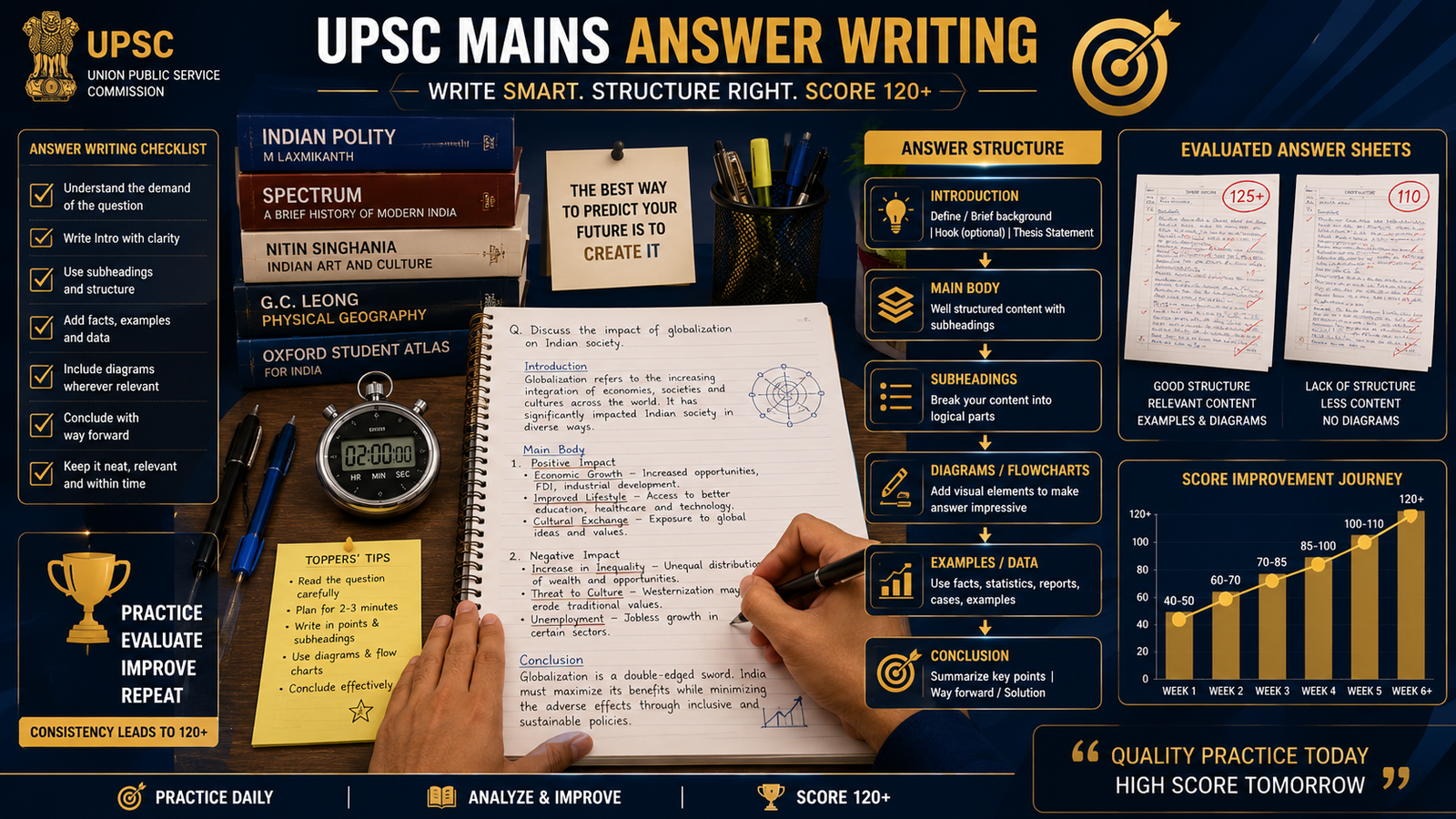
Ideal Structure
Introduction
2–3 lines
Main Body
Use:
- Subheadings
- Bullet Points
- Examples
Conclusion
Forward-looking
Positive
Balanced
Example Framework
Question:
“Discuss the impact of globalization on Indian society.”
Introduction
Define globalization.
Body
Positive impacts
Negative impacts
Challenges
Way Forward
Conclusion
Balanced assessment.
Use Maps, Flowcharts & Diagrams
In Geography answers:
✅ Maps
✅ Sketches
✅ Flowcharts
These improve evaluator engagement.
Answer writing is the single most important factor in How to Score 120+ in GS Paper 1.
Common Mistakes That Stop Aspirants from Learning How to Score 120+ in GS Paper 1
Mistake 1
Ignoring Art & Culture
Mistake 2
Reading too many books
Mistake 3
No answer writing
Mistake 4
Poor introductions
Mistake 5
No current affairs integration
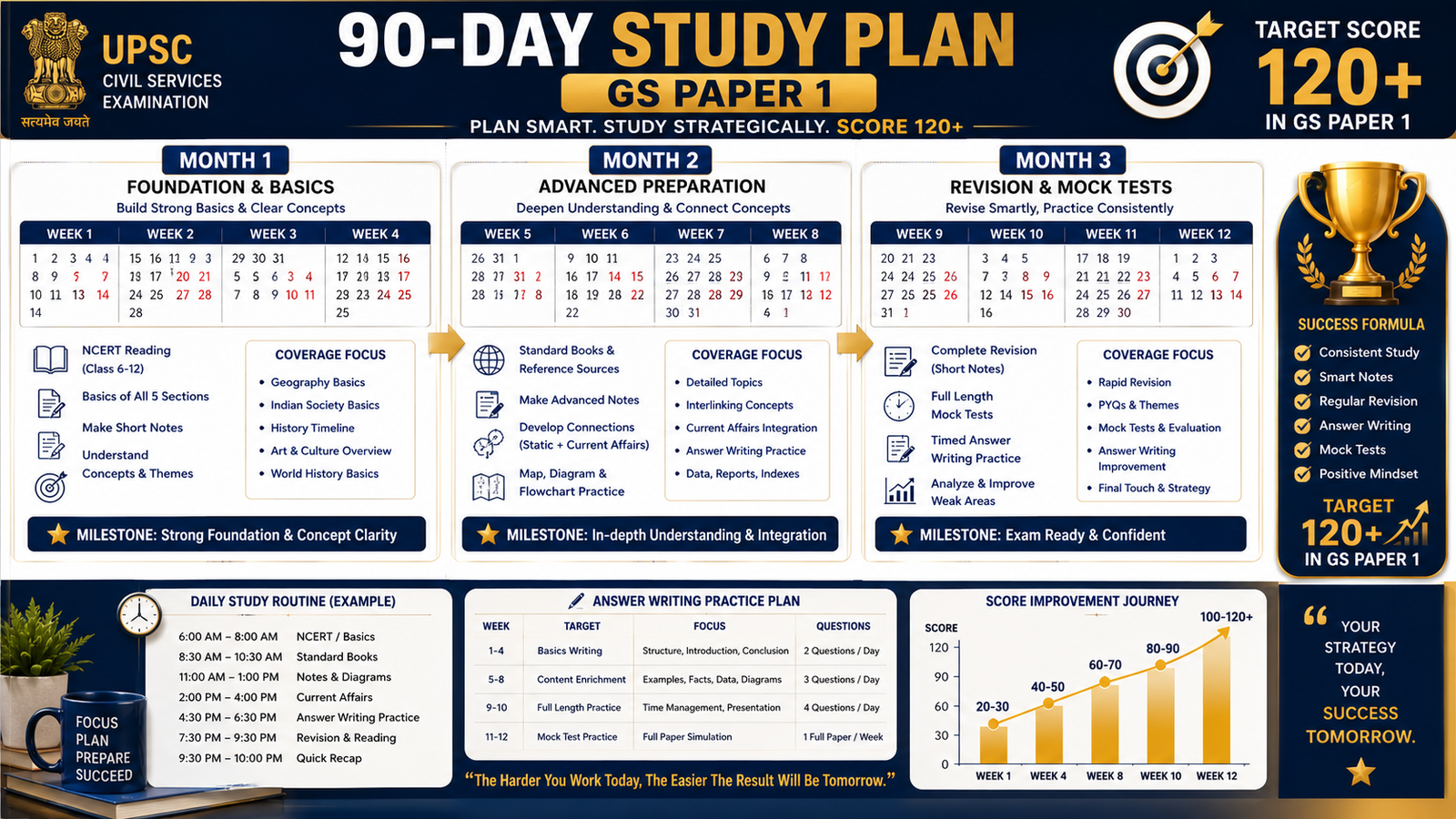
90-Day Plan Before UPSC Mains: How to Score 120+ in GS Paper 1
Month 1
- NCERTs
- Spectrum
- Nitin Singhania
Month 2
- Geography Advanced
- Society Notes
- PYQs
Month 3
- Daily Answer Writing
- Revision
- Mock Tests
If you are serious about How to Score 120+ in GS Paper 1, a structured 90-day revision plan is essential.
PIB remains one of the most reliable sources for government initiatives, schemes, and policy developments.
How to Score 120+ in GS Paper 1 Through Smart Book Selection
History
- Spectrum Modern History
- Bipan Chandra
Art & Culture
- Nitin Singhania
- CCRT
Society
- NCERT Sociology
- Vision IAS Notes
Geography
- NCERTs
- G.C. Leong
- Oxford Atlas
Practice
- Previous Year Questions
- Test Series
NCERT textbooks remain the foundation of UPSC preparation across History, Geography, and Society.
Final Thoughts
Scoring 120+ in GS Paper 1 is not about reading dozens of books or memorizing every fact. It is about mastering core sources, understanding themes, practicing answer writing, and presenting answers effectively.
If you consistently revise Spectrum, Nitin Singhania, NCERTs, G.C. Leong, Society Notes, and Previous Year Questions, while writing answers regularly, crossing the 120-mark barrier in GS Paper 1 becomes an achievable target rather than an aspiration.
The aspirants who score 120+ are rarely the ones who study the most—they are usually the ones who revise the smartest, write the clearest, and present the best answers on exam day.
The journey of How to Score 120+ in GS Paper 1 is not about studying more books; it is about mastering limited resources, revising regularly, and writing high-quality answers consistently.
FAQs: How to Score 120+ in GS Paper 1
Q1. Is it possible to score 120+ in GS Paper 1?
Yes, with strong preparation in Geography, Society, History, and regular answer writing, scoring 120+ is achievable.
Q2. What are the best books for How to Score 120+ in GS Paper 1?
Spectrum, Nitin Singhania, NCERTs, G.C. Leong, Oxford Atlas, and Sociology NCERTs are among the most recommended resources.
Q3. How many answers should I practice to score 120+ in GS Paper 1?
Most successful candidates write 150–300 answers before the Mains examination.
Q4. What is the most important factor in How to Score 120+ in GS Paper 1?
Consistent answer writing combined with revision and current affairs integration.
Recommended Reading
- Powerful UPSC Mains 2026 Strategy: Step-by-Step Roadmap for Success
- World Current Affairs MCQs UPSC 2027 with Answers
- UPSC CSE Prelims 2027 GS Syllabus
- 100 Modern History MCQs with Answers
- 100 Medieval History MCQs with Answers
- Indian Art Forms: Dance, Music and Painting
- Indian Classical and Folk Music Notes
36 thoughts on “How to Score 120+ in GS Paper 1: Powerful UPSC Mains Strategy, Books & Study Plan 2026”