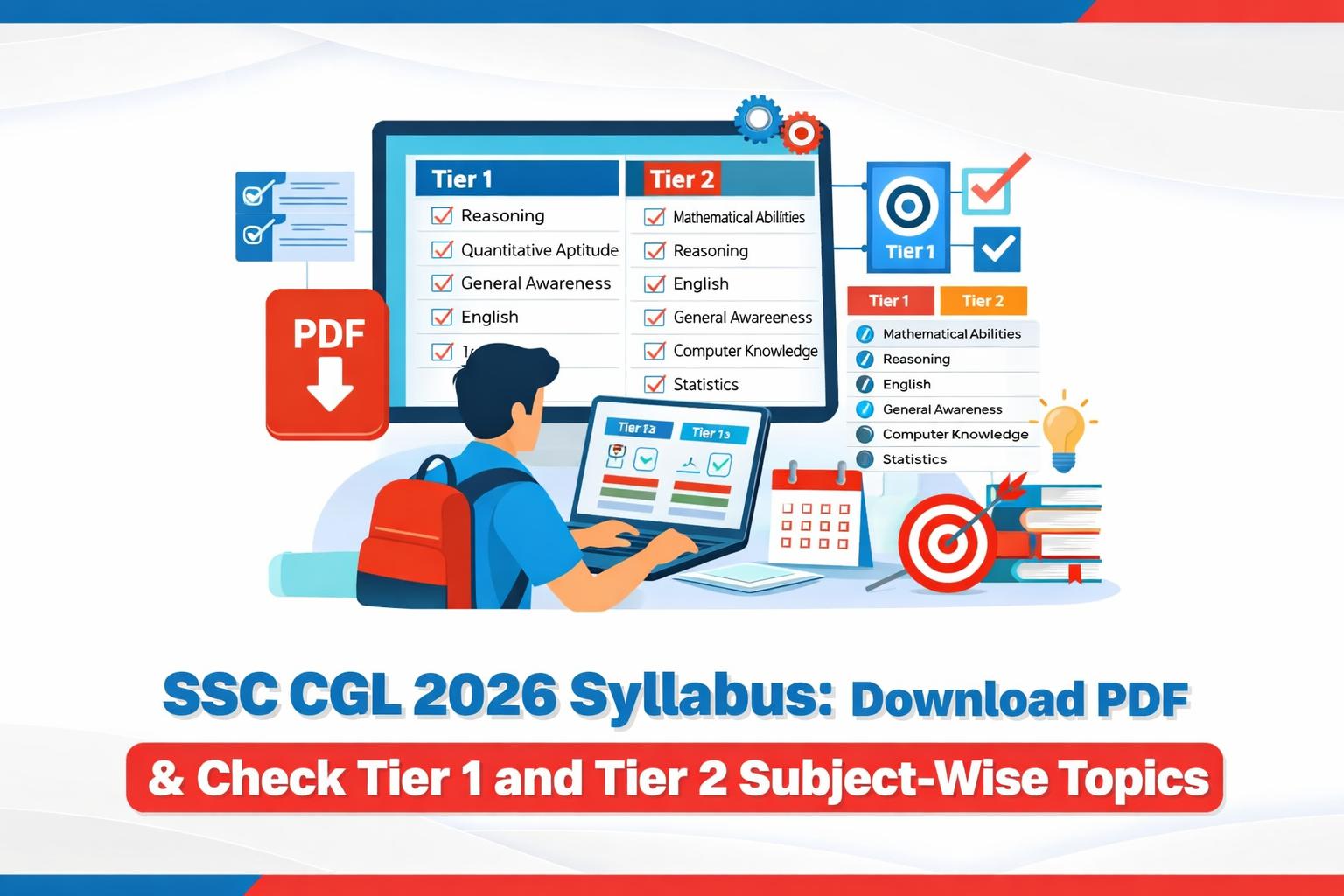
The Staff Selection Commission has officially updated the structural blueprint for the Combined Graduate Level examination. To ace this highly competitive exam, understanding the exact SSC CGL Syllabus 2026 along with the latest Tier 1 and Tier 2 exam pattern is your single greatest asset. This absolute guide breaks down the section-wise topics and marking matrix to streamline your selection roadmap.
This blueprint breaks down the exact exam pattern, structural updates, and exhaustive section-by-section syllabus for both Tier 1 and Tier 2 to streamline your absolute roadmap to selection.
To get more details about Tier 1 you can read our Excellent SSC CGL 2026 Tier 1 Exam Process: Step-by-Step Success Guide
SSC CGL 2026 Exam Process Overview
The SSC CGL selection pipeline is structured into two primary computer-based testing cycles:
| Stage | Process Phase | Evaluation Type & Impact |
| Step 1 | Tier 1: Qualifying Screening | Preliminary screening gateway. Marks do not count toward final merit, but clearing cutoffs is mandatory. |
| Step 2 | Tier 2: Final Merit Matrix | Decisive competitive exam phase. Absolute merit allocation and final rank placement rest entirely on this score. |
| Step 3 | Document Verification & Medicals | Final administrative validation phase to verify original credentials, physical eligibility, and medical fitness. |
📌 Crucial Strategic Note: Tier 1 serves strictly as a qualifying screening gateway. The marks accumulated in Tier 1 will not dictate your final rank placement; your absolute merit allocation rests entirely upon the aggregate execution score achieved during the Tier 2 examination.
Phase 1: SSC CGL Syllabus 2026 Tier 1 Exam Pattern
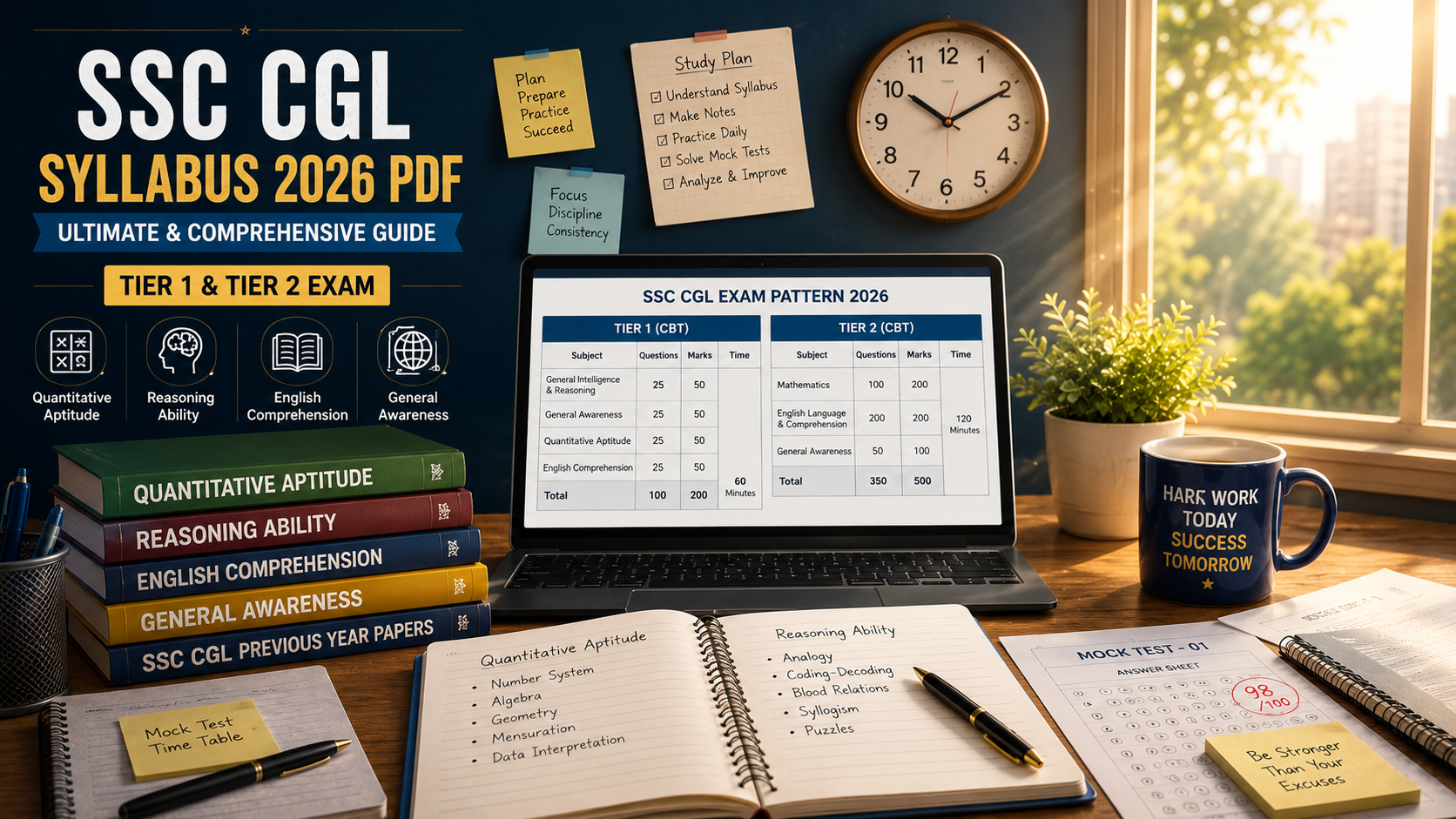
The Tier 1 structure acts as an objective, preliminary screening containing 100 multiple-choice questions totaling 200 marks, to be wrapped up within a strict 60-minute window.
To cover the SSC CGL Syllabus 2026 for Tier 1 effectively, candidates must balance speed with accuracy across all four core modules.
Before diving into the detailed preparation strategy, candidates must ensure their application is submitted without errors. You can follow our step-by-step guide on How SSC CGL 2026 Apply Online Complete Registration Process to seamlessly complete your form alignment.
Tier 1 Numerical Layout
| Assessment Domain | Questions | Maximum Marks | Evaluation Window | Negative Penalty |
| General Intelligence & Reasoning | 25 | 50 | 60 Minutes Aggregate | -0.50 Marks |
| General Awareness | 25 | 50 | 60 Minutes Aggregate | -0.50 Marks |
| Quantitative Aptitude | 25 | 50 | 60 Minutes Aggregate | -0.50 Marks |
| English Comprehension | 25 | 50 | 60 Minutes Aggregate | -0.50 Marks |
Detailed Section-Wise Tier 1 Syllabus
1. General Intelligence & Reasoning
This segment benchmarks cognitive logic and spatial analysis.
Verbal Reasoning: Analogy, Classification, Series (Number & Alphabetical), Coding-Decoding, Blood Relations, Direction Sense, Syllogism, Venn Diagrams, Matrix, Clock & Calendar.
Non-Verbal Reasoning: Paper Folding & Cutting, Mirror & Water Images, Embedded Figures, Pattern Completion, Dice & Cubes.
Candidates looking to strengthen their reasoning preparation should also explore Excellent SSC CGL 2026 Reasoning Syllabus Guide for topic-wise coverage of verbal and non-verbal reasoning.
2. General Awareness
Evaluates static knowledge banks alongside evolving geopolitical events.
Static GK: Indian History (Ancient, Medieval, Modern), Geography (Physical & Indian), Indian Polity & Constitution, Economics (Macro, Micro, Five-Year Plans).
General Science: Everyday Physics, Fundamental Chemistry, Cellular & Human Biology.
Current Affairs: Global summits, structural economic revisions, sports awards, and regional geopolitical developments.
3. Quantitative Aptitude
Designed to evaluate numeric competence and calculation speed.
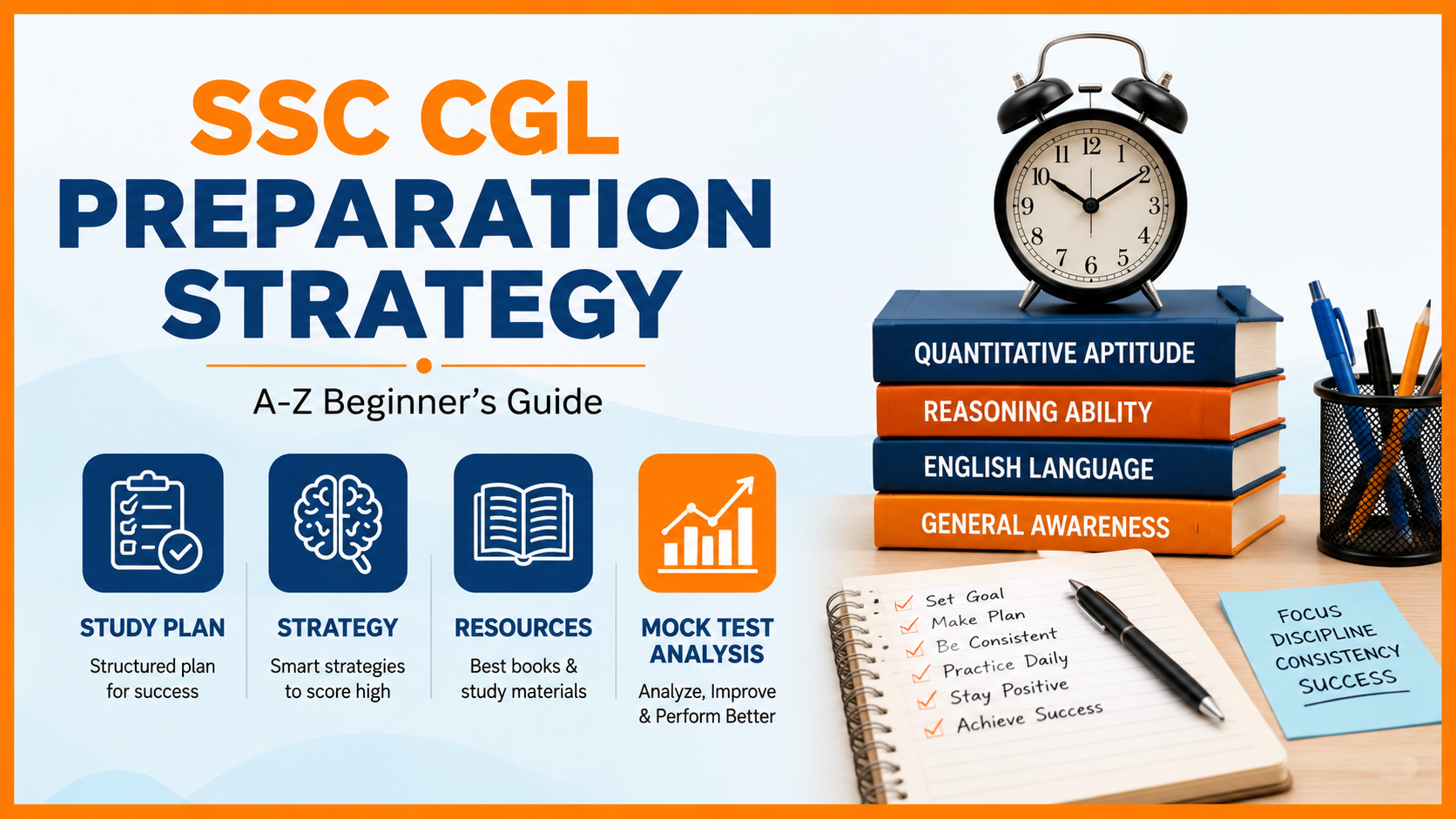
Arithmetic Proficiency: Number Systems, LCM & HCF, Percentages, Profit, Loss & Discount, Simple & Compound Interest, Ratio & Proportion, Time, Speed & Distance, Work & Time, Mixtures & Alligations.
Advanced Mathematics: Algebra (Linear Equations, Identities), Geometry (Triangles, Circles, Polygons), Coordinate Geometry, Trigonometry (Ratios, Identities, Heights & Distances), Mensuration (2D and 3D surface areas/volumes), Data Interpretation (Bar charts, Pie diagrams, Histograms).
4. English Comprehension
Benchmarks basic grammar principles and lexical command.
Grammatical Command: Error Spotting, Sentence Improvement, Active/Passive Voice, Direct/Indirect Speech.
Vocabulary Matrix: Synonyms & Antonyms, Idioms & Phrases, One-Word Substitutions, Spelling Correction errors.
Reading Mechanics: Cloze Test, Paragraph Jumbles (PQRS), Reading Comprehension passages.
Phase 2: SSC CGL Syllabus 2026 Tier 2 Structural Breakdown
Tier 2 is conducted across distinct specialized Papers. Paper I is mandatory across all designated technical and non-technical posts, whereas Paper II applies exclusively to Junior Statistical Officer (JSO) candidates.
Tier 2: Paper I Structural Breakdown
The advanced core concepts of the SSC CGL Syllabus 2026 for Tier 2 require a deeper analytical approach, especially in the mathematical and statistical domains.
Paper I is executed across multiple timed sessions on a unified day:
| Structure | Session Components | Questions | Marks per Item | Total Sectional Marks | Time Allocation | Negative Penalty |
| Section I | Module-1: Mathematical Abilities
Module-2: Reasoning & General Intelligence | 30
30 | 3
3 | 180 Marks Total | 1 Hour Aggregate | -1.00 Mark |
| Section II | Module-1: English Language & Comp.
Module-2: General Awareness | 45
25 | 3
3 | 210 Marks Total | 1 Hour Aggregate | -1.00 Mark |
| Section III | Module-1: Computer Knowledge Module
Module-2: Data Entry Skill Test (DEST) | 20
1 Task | 3
Qualifying | 60 Marks
Qualifying | 15 Minutes
15 Minutes | -1.00 Mark
Error % Limit |
Candidates preparing for government examinations can also explore our detailed guide to the SSC CPO 2026 Exam, which covers eligibility, syllabus, examination pattern, physical requirements and selection process.
Advanced Tier 2 Paper I Core Concepts
While Tier 2 retains the foundational framework of Tier 1, it significantly scales up algorithmic complexity and structural evaluation depth:
1. Mathematical Abilities (Advanced Layout)
Mathematical Operations: Complex number theory, decimals, fractions, and relationships between numbers.
Algebraic Manipulations: Advanced graphs of linear equations, elementary surds, and quadratic expressions.
Geometry & Mensuration: Formal proofs of congruence and similarity of triangles, properties of circles, chords, tangents, right prisms, regular right circular cones, cylinders, spheres, and hemispheres.
Probability & Statistical Analysis: Calculation of Mean, Median, Mode, Standard Deviation, and fundamental Probability event occurrences.
2. Reasoning & General Intelligence (High Cognitive Level)
Critical puzzle parameters, seating arrangements (linear, circular), complex input-output flows, critical coding matrices, statement-assumption matrices, and multi-tier logical deductions.
3. English Language and Comprehension
Advanced reading comprehension processing (analytical, fact-based, and inferential tone questions), contextual word choice adjustments, complex spot-the-error sentences, and advanced narrative transformations.
4. General Awareness
Highly targeted questions emphasizing current policy impacts, global economic shifts, scientific research updates, and detailed analytical deep-dives into Indian Constitutional amendments.
5. Computer Knowledge Module (Mandatory Qualifying)
Hardware Fundamentals: Central Processing Unit (CPU), input/output configurations, memory devices, and backup systems.
Software Mechanics: Operating system frameworks, MS Word, MS Excel, and MS PowerPoint configurations.
Networking & Security: Internet protocols, web browsing tools, email structures, network topologies, anti-virus programs, and modern cyber threat mitigation.
Tier 2: Paper II (Specialized Domain)
Target Post: Junior Statistical Officer (JSO)
Layout Structure: 100 Multiple Choice Questions | 200 Total Marks | 2-Hour Duration.
Core Domains: Collection, Classification, and Presentation of Statistical Data, Measures of Central Tendency, Measures of Dispersion, Moments, Skewness and Kurtosis, Correlation and Regression, Probability Theory, Random Variables, Theoretical Distributions, Sampling Theory, and Index Numbers.
For more depth in SSC preparation, read our National News Current Affairs MCQs for SSC CGL 2026 and give an extra boost to your preparation
Strategic Execution Blueprint
Prioritize Advanced Mathematics Foundations: Shift from basic arithmetic processing to handling statistics, probability matrices, and geometric properties systematically.
Refine Section III Competencies Early: Do not delay the Computer Knowledge and Data Entry Skill Test (DEST) modules until after Tier 1. Given their mandatory qualifying status, a failing grade here disqualifies an otherwise stellar performance in Sections I and II.
Master the 3-Mark Penalty Dynamic: Tier 2 enforces a strict -1.00 negative penalty for wrong answers. Educated guessing can severely compromise your rank placement; build an accurate, high-fidelity mock test strategy.
You can also track notifications directly on the official SSC Portal alongside mastering the exact SSC CGL Syllabus 2026 is your single greatest asset.
With thousands of administrative seats up for grabs, tracking the seat distribution matrix is crucial. Check out the complete breakdown of the SSC CGL 2026 Notification Details to understand the department-wise cutoff weightage.
FAQs
Q1. Is there any major change in the SSC CGL Syllabus 2026?
Ans: No, there are no structural changes to the core syllabus domains. However, the Staff Selection Commission has significantly increased the logical complexity of the Mathematical Abilities and Reasoning modules in Tier 2. Additionally, the Computer Knowledge Module and Data Entry Skill Test (DEST) remain mandatory qualifying segments that you must clear to be eligible for final post-allocation.
Q2. Do Tier 1 marks count toward the final SSC CGL merit list ranking?
Ans: No, Tier 1 serves strictly as a qualifying screening gateway. The marks accumulated in Tier 1 will not dictate your final rank or department allocation. Your absolute merit placement rests entirely upon the aggregate execution score achieved during the Tier 2 examination. However, clearing the Tier 1 category-wise cutoff is mandatory to qualify for the Tier 2 phase.
Q3. Where can I access the official SSC CGL Syllabus 2026 PDF Download link?
Ans: You can immediately download the complete, updated SSC CGL Syllabus 2026 PDF by clicking the verified download button provided in the download section of this article given above the FAQ Section. For seamless offline preparation, you can also save this entire structured guide on your mobile device or desktop browser by pressing Ctrl + P (or Cmd + P on Mac) and selecting “Save as PDF”.
2 thoughts on “SSC CGL Syllabus 2026: Tier-Wise Syllabus & Exam Pattern Unbelievable Review”