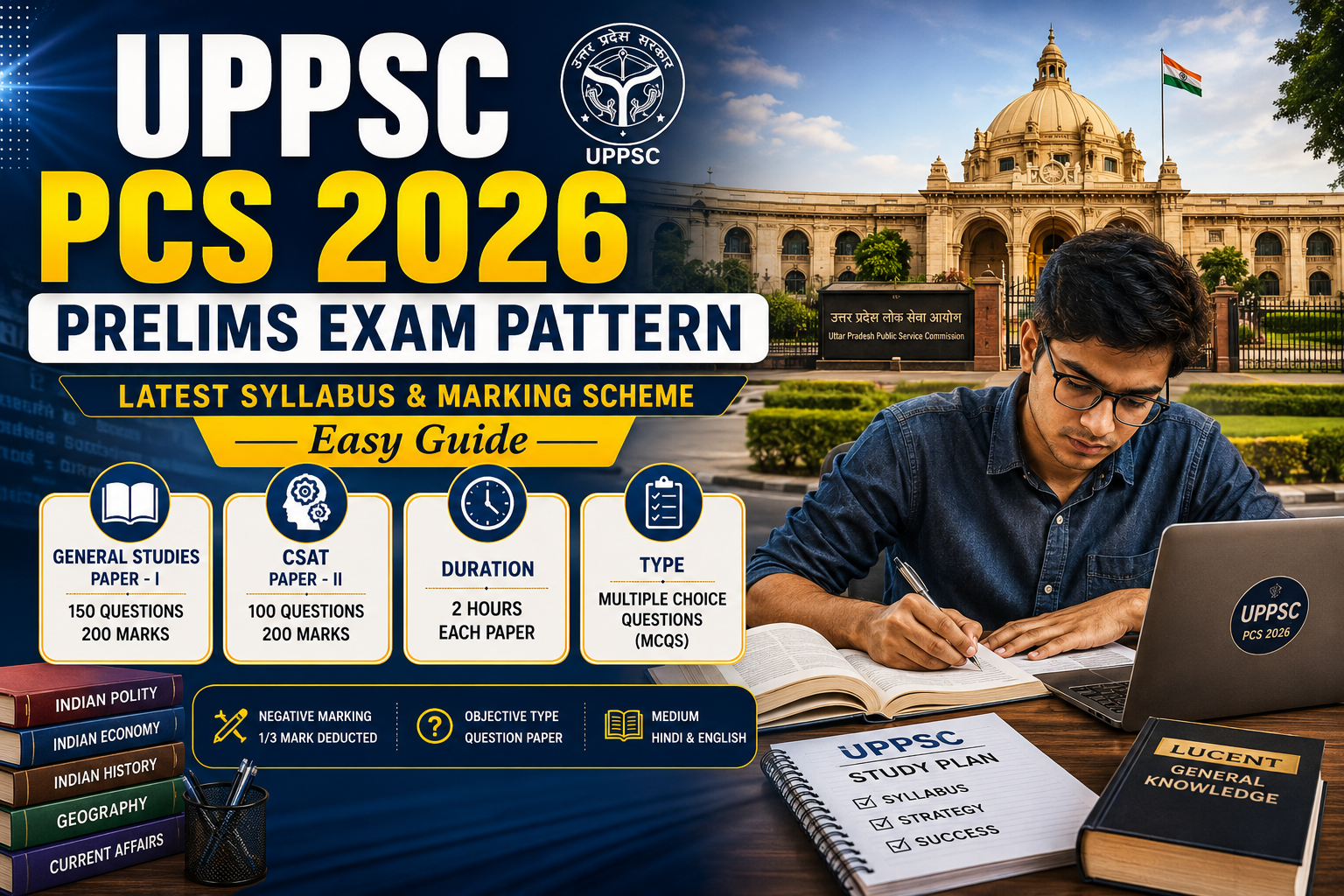
The UPPCS Preliminary Examination serves as an objective screening mechanism to shortlist candidates for the Mains phase. It requires a balanced combination of extensive general awareness and sharp aptitude.
Aspiring civil servants looking to clear the state services must thoroughly understand the UPPCS 2026 Prelims Exam Pattern before diving deep into their preparation.
A complete structural breakdown of the 2026 Prelims details the official exam pattern, core topics, and specific rules of the marking scheme.
1. Overview of the UPPCS 2026 Prelims Exam Pattern
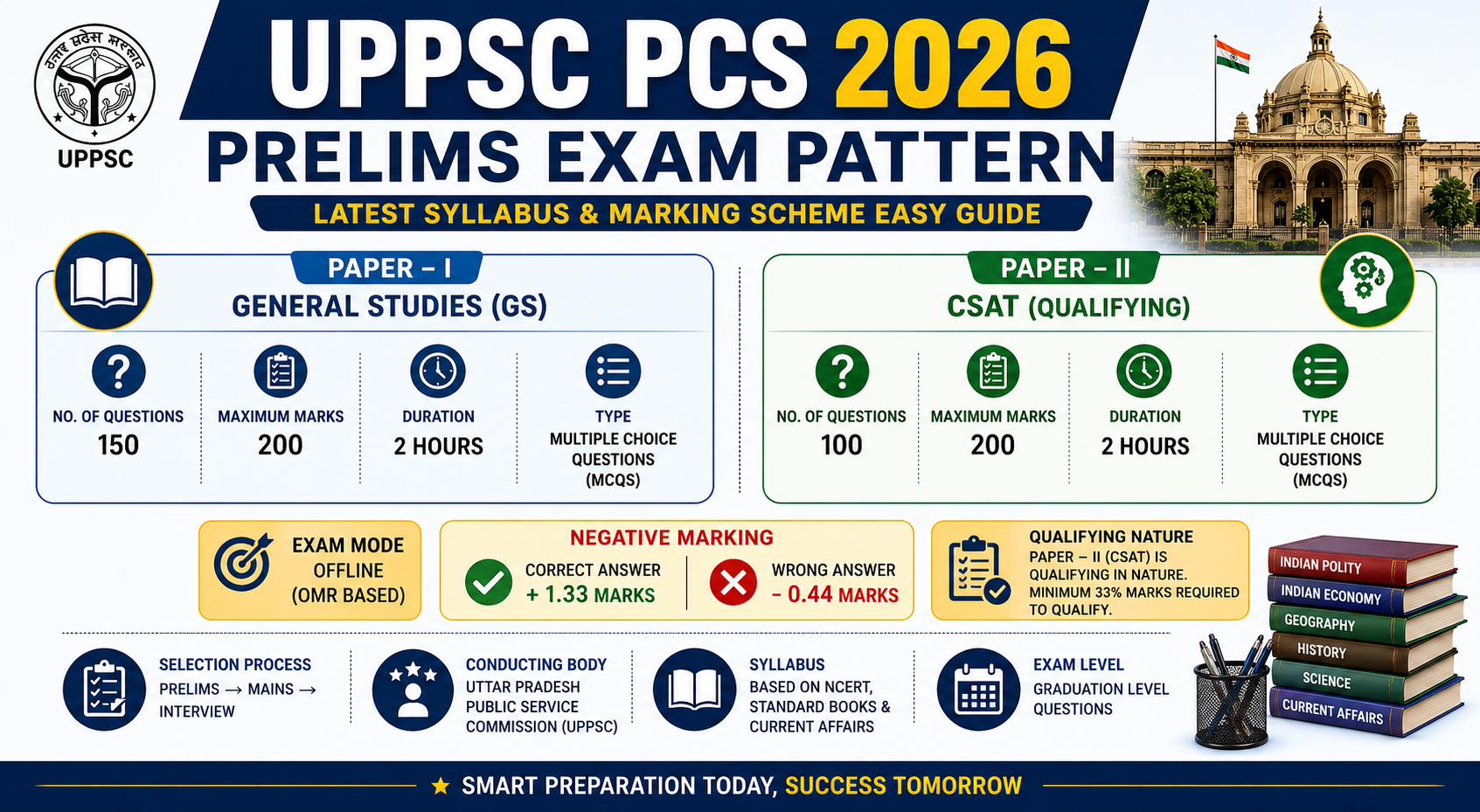
The Preliminary stage is conducted offline via OMR sheets on a single day. It is split into two mandatory sessions:
| Structural Parameter | Paper I: General Studies (GS) | Paper II: Civil Services Aptitude Test (CSAT) |
| Number of Questions | 150 Multiple Choice Questions | 100 Multiple Choice Questions |
| Total Marks Maxima | 200 Marks | 200 Marks |
| Time Allotted | 2 Hours (9:30 AM to 11:30 AM) | 2 Hours (2:30 PM to 4:30 PM) |
| Core Objective | Merit Determination: Marks score here decide the cutoff tier to qualify for Mains. | Qualifying Barrier: Mandatory minimum score of 33% required to pass. |
2. Detailed Marking Scheme & Evaluation Rules
Per-Question Weightage Math:
Each question in Paper I (GS) carries +1.33 marks ($200 \text{ marks} / 150 \text{ questions}$).
Each question in Paper II (CSAT) carries +2.0 marks ($200 \text{ marks} / 100 \text{ questions}$).
Negative Marking Clause: A strict penalty of one-third (33.33%) of the marks assigned to a question is applied for every wrong answer.
An incorrect answer in GS Paper I deducts -0.44 marks.
An incorrect answer in CSAT Paper II deducts -0.66 marks.
The Dual-Shading Trap: Marking more than one option for a single question on the OMR sheet is automatically categorized as an incorrect answer, invoking the regular negative marking penalty.
Unattempted Questions: Blank responses receive neutral treatment (0 marks). No marks are awarded or subtracted.
The Evaluation Order Rule: Your GS Paper I sheet will only be evaluated if you successfully hit the 33% clear line (minimum 66 out of 200 marks) in the CSAT paper.
3. High-Yield Topic Details & Core Syllabus: Overview of the UPPCS 2026 Prelims Exam Pattern
Paper I: General Studies (GS)
The core GS syllabus is distributed across 7 major thematic pillars, with a heavy emphasis on state-specific dynamics.
Current Events: National and International importance, major bilateral summits, sports, awards, indexes, and comprehensive UP-specific Current Affairs/Schemes (e.g., ODOP developments, UP Budget updates).
History of India & Indian National Movement: Ancient (Indus Valley, Maurya, Gupta eras), Medieval (Delhi Sultanate, Mughals, and regional dynasties like Awadh), and Modern history (1757–1947, freedom struggle stages, and UP’s pivotal role in the 1857 Revolt).
India and World Geography: Physical, social, and economic geography of India and the globe. High priority is placed on UP geography (major river systems like Ganga, Yamuna, Betwa; minerals, and regional soil types).
Indian Polity and Governance: Indian Constitution (Preamble, Fundamental Rights, DPSPs, Amendments), Parliament, Judiciary, and the implementation of the Panchayati Raj Act in Uttar Pradesh.
Economic and Social Development: Sustainable development indicators, poverty metrics (MPI, NFHS data), demographics, banking, Union Budget, and major social sector initiatives.
General Issues on Environment & Climate Change: Biodiversity hotspots, food chains, international agreements (Kyoto/Paris), and UP Eco-updates (Forest cover reports, Ramsar sites, and key National Parks like Dudhwa).
General Science: Everyday applications of Physics, Chemistry, and Biology, alongside emerging fields like Space technology (ISRO missions) and Artificial Intelligence.
Paper II: CSAT (Aptitude)
The aptitude paper targets fundamental logical reasoning, linguistic skill sets, and basic mathematical capability.
Interpersonal Skills & Decision Making: Strategic problem-solving, situational judgment, conflict resolution scenarios, and analytical communication.
Logical Reasoning & Mental Ability: Series completion (number/letter), coding-decoding, blood relations, direction tests, syllogisms, and statement-assumption puzzles.
Elementary Mathematics (Class 10 Level):
Arithmetic: Percentages, Profit & Loss, Ratio & Proportion, Averages, Time & Work, Speed & Distance, Simple/Compound Interest.
Algebra & Set Theory: Factors of Polynomials, Remainder Theorem, Linear/Quadratic equations, Venn Diagrams.
Geometry & Mensuration: Areas, perimeters, and volumes of circles, triangles, cylinders, and spheres.
Statistics: Central tendency calculation (Mean, Median, Mode) and interpretation of pie charts, bar diagrams, or histograms.
General English (Class 10 Level): Active/Passive voice, Direct/Indirect speech, Reading comprehension passages, transformation of sentences, vocabulary, and idioms.
General Hindi (Class 10 Level – सामान्य हिंदी): संधि, समास, तत्सम-तद्भव शब्द, पर्यायवाची, विलोम शब्द, मुहावरे और लोकोक्तियां, वाक्य संशोधन, और उत्तर प्रदेश की मुख्य बोलियां।
Recommended Post
Top 100 Art & Culture MCQs UPPCS Prelims 2026 | Complete Practice Set
Uttar Pradesh History for UPPCS Prelims 2026: Important Topics & Facts
UPPCS Prelims PYQs: Most Important Guide 2026-27
UPPCS Prelims Exam Date 2026 Officially Announced
FAQs: Overview of the UPPCS 2026 Prelims Exam Pattern
Q1: What is the exact UPPCS 2026 Prelims Exam Pattern?
A: The UPPCS 2026 Prelims Exam Pattern consists of two mandatory, objective-type (MCQ) papers conducted offline on the same day via OMR sheets. Paper I covers General Studies (150 questions, 200 marks) and Paper II covers CSAT (100 questions, 200 marks).
Q2: Is there a negative marking penalty in the UPPCS Prelims 2026 exam?
A: Yes, a strict 1/3rd (33.33%) negative marking rule applies to both papers. An incorrect answer in GS Paper I results in a deduction of 0.44 marks, while a wrong answer in CSAT Paper II deducts 0.66 marks.
Q3: What are the minimum qualifying marks for UPPCS CSAT Paper II?
A: As per the official UPPCS 2026 Prelims Exam Pattern, Paper II (CSAT) is purely qualifying. Candidates must score a minimum of 33% (which equals 66 marks out of 200) for their General Studies Paper I to be evaluated for the final merit list.
Mastering the official UPPCS 2026 Prelims Exam Pattern is half the battle won when planning your daily revision schedule.
For a comprehensive overview of how to plan your timeline around these parameters, you can watch this UPPCS 2026 Notification Update and Pattern Breakdown which decodes the official timeline, expected vacancies, and structural updates for this exam cycle.
8 thoughts on “UPPCS 2026 Prelims Exam Pattern : Latest Syllabus & Marking Scheme Easy Guide”