Mastering the 100 MCQs Medieval History of India: GS Paper UPSC Prelims 2027 matrix is non-negotiable for aspirants aiming to clear the prelims cutoff. In recent civil services trends, the Union Public Service Commission has shifted dramatically from basic dynastic chronologies to deeply complex statement-based traps focusing on administrative nomenclature, socio-religious integration, agrarian taxation systems, and architectural structural terminology.
Aspirants targeting high scores in GS Paper 1 should also read our comprehensive article on How to Score 120+ in GS Paper 1, which explains section-wise preparation strategies.
📝 How to Utilize this Medieval History Masterclass
To get the highest return on your investment from this 100 MCQs Medieval History of India: GS Paper UPSC Prelims 2027 repository, we recommend following this three-step revision strategy:
Solve by Section: Treat each of the 10 distinct modules in this 100 MCQs Medieval History of India: GS Paper UPSC Prelims 2027 edition as a timed micro-test.
Analyze the Nomenclature: Pay close attention to the administrative terms mapped across these 100 MCQs Medieval History of India: GS Paper UPSC Prelims 2027.
Review the Explanations: The data blocks beneath each segment of the 100 MCQs Medieval History of India: GS Paper UPSC Prelims 2027 are designed to cover adjacent textbook blanks.

Section 1: Early Medieval India & The Tripartite Struggle
1. Consider the following statements regarding the historic ‘Tripartite Struggle’ in early medieval India:
It was fought between the Palas, Pratiharas, and Rashtrakutas for absolute imperial dominance over the strategic city of Kannauj.
The struggle ultimately concluded with a permanent, long-term stabilization of the Pala empire across northern India.
Which of the statements given above is/are correct?
(a) 1 only
(b) 2 only
(c) Both 1 and 2
(d) Neither 1 nor 2
2. With reference to the administrative structure of the Rashtrakuta Empire, what did the term Bhukti primarily represent?
(a) A centralized military division directly managed by the Crown.
(b) A basic administrative unit or province positioned below the Rashtra.
(c) A tax-free land grant offered exclusively to Buddhist monasteries.
(d) The royal council responsible for foreign diplomacy.
3. Which early medieval Indian philosopher popularized the Advaita Vedanta school of philosophy and established four Mathas across the subcontinent?
(a) Ramanujacharya
(b) Adi Shankaracharya
(c) Madhvacharya
(d) Nimbarkacharya
4. Consider the following pairs of prominent early medieval authors and their literary creations:
Sandhyakar Nandi — Ramacharitam
Kalhana — Rajatarangini
Bilhana — Vikramankadevacharita
Which of the pairs given above are correctly matched?
(a) 1 and 2 only
(b) 2 and 3 only
(c) 1 and 3 only
(d) 1, 2 and 3
5. In the context of early medieval agrarian terminology, the word Vetti or Vishti denoted:
(a) A high-interest agricultural loan offered by merchant guilds.
(b) Forced labor extracted from the peasantry without any structural compensation.
(c) A ceremonial tax levied during the coronation of a new ruler.
(d) Highly fertile wet agricultural land.
6. With reference to the Chola administrative machinery, the terms Ur and Sabha represented:
(a) Centralized judicial bodies headed by the Prime Minister.
(b) Different types of village assemblies, where the Sabha was an exclusive gathering of Brahmin landholders.
(c) Naval command units stationed along the Coromandel coast.
(d) Currency units utilized in maritime trade with Southeast Asia.
7. Consider the following statements regarding the trade guilds of early medieval Southern India:
The Manigramam and Ayyavole were powerful autonomous merchant guilds involved in inland and long-distance maritime trade.
These guilds operated completely independent of royal oversight and maintained their own private security forces or mercenary arrays.
Which of the statements given above is/are correct?
(a) 1 only
(b) 2 only
(c) Both 1 and 2
(d) Neither 1 nor 2
8. Who among the following Arab travelers visited the Rashtrakuta kingdom and described its ruler as one of the four greatest monarchs of the world?
(a) Al-Masudi
(b) Sulaiman
(c) Ibn Battuta
(d) Al-Biruni
9. The unique Gopuram and the Vimana are distinct structural architectural hallmarks associated primarily with which style of temple construction?
(a) Nagara Style
(b) Dravida Style
(c) Vesara Style
(d) Hoysala Style
10. Arrange the following early medieval events in chronological order, starting from the earliest:
Accession of Amoghavarsha I to the Rashtrakuta throne.
Foundation of the Pala Dynasty by Gopala.
Invasion of Sindh by Muhammad bin Qasim.
Select the correct answer using the code given below:
(a) 3-2-1
(b) 2-3-1
(c) 3-1-2
(d) 1-3-2
Explanatory Answers: Section 1 of 100 MCQs Medieval History of India
1. (a) Statement 1 is correct; Kannauj was the symbol of sovereignty in the Indo-Gangetic plains. Statement 2 is incorrect because the struggle severely weakened all three dynasties, leaving northern India fragmented and susceptible to early Islamic raids.
2. (b) The Rashtrakuta empire was divided into Rashtras (provinces) controlled by Rashtrapati, which were further subdivided into Vishayas and Bhuktis under local officers.
3. (b) Adi Shankaracharya consolidated the doctrine of Advaita (Non-dualism) and set up monumental monasteries at Badrinath, Puri, Sringeri, and Dwarka.
4. (d) All three pairs are accurately matched historical biographies and chronicles that provide rich insights into early medieval North and West Indian polities.
5. (b) Vishti represents forced uncompensated labor, a marker of increasing feudal relations where peasants were bound to work on the lord’s personal fields or forts.
6. (b) The Ur was a general assembly of local tax-paying villagers, while the Sabha or Mahasabha was the specialized administrative assembly of Brahmadeya villages.
7. (c) Both statements are correct. Guilds possessed tremendous autonomy, framed their own trading codes, and utilized corporate militia (Vira-balanjas) to guard their caravans.
8. (b) The merchant Sulaiman visited around 851 CE and wrote extensively about the prosperity, military strength, and administrative justice of the Rashtrakutas.
9. (b) The Vimana (the main storied tower above the sanctum) and the Gopuram (the monumental entrance gate) are defining features of imperial Chola and Dravidian art.
10. (a) Invasion of Sindh took place in 712 CE $\rightarrow$ Gopala founded the Pala dynasty around 750 CE $\rightarrow$ Amoghavarsha I ascended the throne in 814 CE.
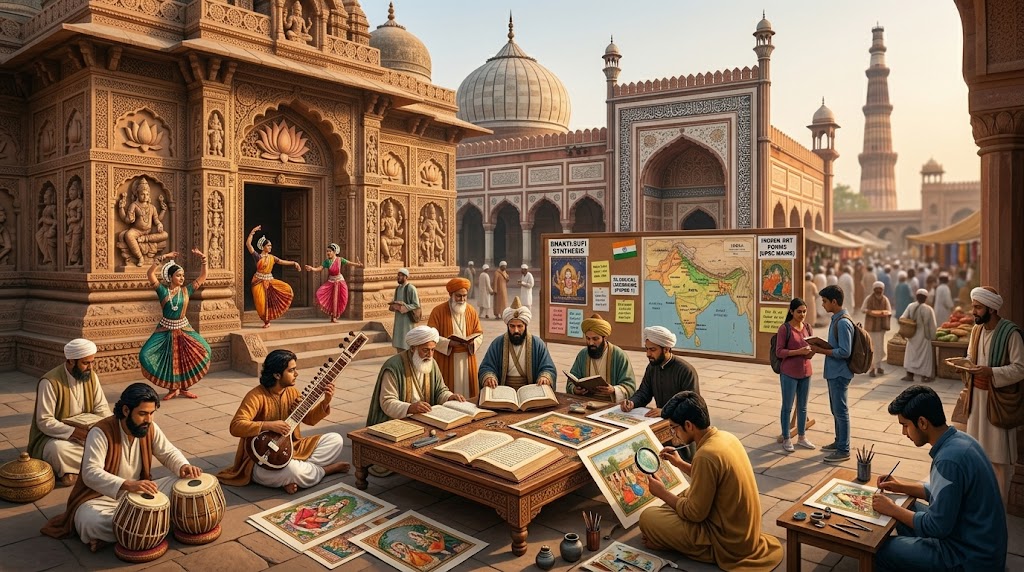
Section 2: Arab and Turkish Invasions & The Rise of the Delhi Sultanate
Let us evaluate the strategic milestones and early state-building conflicts tracking within this section of our 100 MCQs Medieval History of India: GS Paper UPSC Prelims 2027 module.
11. With reference to the historic battles of Tarain, consider the following statements:
In the First Battle of Tarain (1191 CE), Prithviraj Chauhan decisively defeated Muizzuddin Muhammad Ghori.
In the Second Battle of Tarain (1192 CE), the Turkish forces won primarily due to their superior mobility and highly effective horse-archery tactics.
Which of the statements given above is/are correct?
(a) 1 only
(b) 2 only
(c) Both 1 and 2
(d) Neither 1 nor 2
12. The structural administrative framework known as the Chahalgani or The Forty was organized by which Delhi Sultan to consolidate his power?
(a) Qutbuddin Aibak
(b) Shamsuddin Iltutmish
(c) Ghiyasuddin Balban
(d) Alauddin Khalji
13. Which of the following scholars accompanied Mahmud of Ghazni to India and authored the monumental socio-cultural treatise Kitab-al-Hind?
(a) Firdausi
(b) Al-Biruni
(c) Utbi
(d) Amir Khusrau
14. In the administration of the early Delhi Sultanate, the term Iqta stood for:
(a) A cash salary paid directly to the palace guards.
(b) A non-hereditary revenue assignment of a piece of land given to civil or military officers in lieu of services.
(c) A specialized court designed to handle religious apostasy trials.
(d) A commercial tax levied on non-Muslim international traders.
15. Consider the following statements regarding Sultan Ghiyasuddin Balban’s consolidation policies:
He introduced the Persian court etiquettes of Sijda (prostration) and Paibos (kissing the Sultan’s feet) to elevate the status of the monarch.
He completely disbanded the centralized intelligence system (Barids) to grant absolute autonomy to provincial governors.
Which of the statements given above is/are correct?
(a) 1 only
(b) 2 only
(c) Both 1 and 2
(d) Neither 1 nor 2
16. What was the primary mandate of the office called Diwan-i-Arz, which was institutionalized during the early Sultanate era?
(a) Department of Royal Correspondence
(b) Department of Military Affairs and Recruitment
(c) Central Ministry of Agricultural Expansion
(d) Supreme Judiciary Board
17. The famous traveler Ibn Battuta visited India during the reign of which Delhi Sultan?
(a) Alauddin Khalji
(b) Muhammad bin Tughlaq
(c) Firoz Shah Tughlaq
(d) Sikandar Lodi
18. With reference to the silver and copper currency innovations of the Delhi Sultanate, the terms Tanka and Jital were systematically introduced by:
(a) Iltutmish
(b) Balban
(c) Razia Sultan
(d) Bahlul Lodi
19. Which early Turkish ruler of India died in 1210 CE from injuries sustained after falling from his horse while playing Chaugan (early form of Polo)?
(a) Aram Shah
(b) Qutbuddin Aibak
(c) Nasiruddin Mahmud
(d) Jalaluddin Khalji
20. Consider the following pairs of specific departments and the Sultans who established them:
Diwan-i-Mustakharaj (Department of Arrears) — Alauddin Khalji
Diwan-i-Kohi (Department of Agriculture) — Muhammad bin Tughlaq
Diwan-i-Bandagan (Department of Slaves) — Firoz Shah Tughlaq
Which of the pairs given above are correctly matched?
(a) 1 and 2 only
(b) 2 and 3 only
(c) 1 and 3 only
(d) 1, 2 and 3
Explanatory Answers: Section 2 of 100 MCQs Medieval History of India
11. (c) Both statements are accurate. The Second Battle of Tarain marked a permanent watershed moment that broke Rajput resistance and laid the foundation for Turkish rule in northern India.
12. (b) Iltutmish selected a corps of forty trusted Turkish slaves (Turkan-i-Chahalgani) to crush regional insubordination and stabilize his fragile throne.
13. (b) Al-Biruni was a master polymath whose objective work Kitab-al-Hind serves as a critical source for studying 11th-century Indian science, society, and religion.
14. (b) The Iqta system was a tool for centralization; holders (Iqtadars or Muqtis) collected land revenue, maintained troops for the Sultan, and were routinely transferred to prevent local power bases.
15. (a) Statement 1 is correct. Statement 2 is incorrect because Balban actually expanded the Barid (spy) framework to maintain a strict check on his nobles and governors.
16. (b) The Diwan-i-Arz handled the muster, recruitment, and maintenance of the central standing army, keeping it free from the corruption of noble intermediaries.
17. (b) Moroccan scholar Ibn Battuta reached Delhi in 1334 and was appointed as the Qazi (judge) of Delhi by Muhammad bin Tughlaq for nearly eight years.
18. (a) Iltutmish modernized the currency system by introducing the standard pure Arabic coins: the silver Tanka (weighing 175 grains) and the copper Jital.
19. (b) Qutbuddin Aibak, the founder of the Slave Dynasty, died accidentally in Lahore while engaged in the sport of Chaugan.
20. (d) All three pairs are accurately matched administrative innovations designed to handle specific revenue, agricultural, and socio-military pressures within the expanding state.
Review this specific segment of the 100 MCQs Medieval History of India: GS Paper UPSC Prelims 2027 tracker regularly to lock in your conceptual recall.
To reinforce your structural understanding of global trade networks and transit channels alongside these internal shifts, analyze the Strait of Hormuz UPSC Prelims 2026: Complete Guide With Map.”
Section 3: The Khalji Administrative Reforms & Market Control Mechanisms
Let us evaluate the market economics and pricing mechanisms included in this segment of our 100 MCQs Medieval History of India: GS Paper UPSC Prelims 2027 blueprint
21. Consider the following statements regarding the land revenue policies introduced by Sultan Alauddin Khalji:
He introduced the measurement of land (Masahat) as the standard basis for estimating land revenue assessments.
He increased the state demand on land revenue to half ($50\%$) of the absolute produce, eliminating all traditional intermediary privileges.
Which of the statements given above is/are correct?
(a) 1 only
(b) 2 only
(c) Both 1 and 2
(d) Neither 1 nor 2
22. In Alauddin Khalji’s market control architecture, what was the primary responsibility of the officer designated as the Shahna-i-Mandi?
(a) Collecting custom transit duties at international borders.
(b) Acting as the supreme intelligence officer reporting directly to the palace.
(c) Managing and supervising grain markets to enforce strict price controls.
(d) Arranging transport livestock for military campaigns.
23. To prevent administrative corruption and ensure transparency within the cavalry corps, Alauddin Khalji introduced which of the following practices?
(a) Iqta inheritances and cash bonuses.
(b) Dagh (branding of horses) and Chehra (descriptive roll of soldiers).
(c) Zakat exemptions for tribal mercenaries.
(d) Mandatory deployment of foreign commanders.
24. With reference to the economic classifications under the Khalji market rules, the term Saray-i-Adl represented:
(a) The judicial court handling criminal trespass.
(b) A specialized market for manufactured cloth, sugar, herbs, dry fruits, and expensive oils.
(c) The warehouse used exclusively for state grain storage.
(d) A residential quarter for foreign horse merchants.
25. Which of the following military commanders led Alauddin Khalji’s successful military campaigns into the deep southern kingdoms of Devagiri, Warangal, and Madurai?
(a) Zafar Khan
(b) Ulugh Khan
(c) Malik Kafur
(d) Alp Khan
26. In the context of medieval taxation terms under the Khaljis, the words Ghari and Chari stood for:
(a) Custom taxes on imported silk fabrics.
(b) House tax and pasture tax respectively.
(c) Religious taxes collected for temple maintenance.
(d) Penalties levied on unregistered grain merchants.
27. Consider the following statements regarding the dynamic architectural creations of the Khalji era:
The Alai Darwaza features the true dome construction technique using the scientific squinch arch architecture.
It was constructed using white marble exclusively, avoiding any red sandstone components.
Which of the statements given above is/are correct?
(a) 1 only
(b) 2 only
(c) Both 1 and 2
(d) Neither 1 nor 2
28. Who among the following poets was patronized by Alauddin Khalji, held the title of Tuti-i-Hind (Parrot of India), and authored the Khaza’in-ul-Futuh?
(a) Amir Khusrau
(b) Ziauddin Barani
(c) Shams-i-Siraj Afif
(d) Al-Masudi
29. The administrative term Munhiyans, heavily utilized during the Khalji structural surveillance era, referred to:
(a) Royal revenue accountants stationed in village blocks.
(b) Secret spies and intelligence gatherers enforcing market price regulations.
(c) Military personnel managing royal horse studs.
(d) Transporters delivering grains to state granaries.
30. Which specific class of traditional agrarian intermediaries saw their age-old privileges (such as exemption from land taxes) completely revoked by Alauddin Khalji?
(a) Khuts, Muqaddams, and Chaudharis (b) Amils and Karkuns (c) Mansabdars and Jagirdars (d) Sardars and Polygar chieftains
Explanatory Answers: Section 3 of 100 MCQs Medieval History of India
21. (c) Both statements are correct. Alauddin’s revenue policy was aimed at maximizing state resources while curbing the economic strength of local landed elites.
22. (c) The Shahna-i-Mandi was the market superintendent who maintained a register of merchants, monitored weights, and checked prices under severe penal codes.
23. (b) The Dagh and Chehra systems prevented the common fraudulent practice of substitution where nobles presented inferior horses and soldiers during inspections.
24. (b) Saray-i-Adl (the Market of Justice) was a subsidized market set up inside open plains near Delhi, heavily regulated to ensure fair trade.
25. (c) Malik Kafur (Hazar-Dinari) was a general who raided deep into South India, extracting immense wealth and forcing rulers to accept Delhi’s suzerainty.
26. (b) Ghari was levied on dwellings and Chari was a tax on animals grazing in pastures, adding to the state’s intensive direct taxation footprint.
27. (a) Statement 1 is correct; the Alai Darwaza is a landmark piece of early Islamic architecture. Statement 2 is incorrect because it is constructed primarily of red sandstone with white marble trimmings.
28. (a) Amir Khusrau was a musical and literary genius who pioneered Qawwali and the Khari Boli dialect, and chronicled Alauddin’s military conquests.
29. (b) The Munhiyans worked as undercover agents reporting directly to the Sultan’s personal information desk, creating a fear factor that stabilized price structures.
30. (a) These traditional village headmen and revenue collectors were stripped of their fiscal privileges and forced to pay taxes on the same scale as ordinary cultivators (Balahar).
Section 4: The Tughlaq Innovations, Token Currency & Public Works
Public infrastructure, agricultural loans, and monetary modifications form a major pillar of these 100 MCQs Medieval History of India: GS Paper UPSC Prelims 2027.
31. Consider the following statements regarding the experimental administrative moves executed by Sultan Muhammad bin Tughlaq:
He shifted his formal imperial capital from Delhi to Deogiri, which he renamed Daulatabad, to ensure better centralized control over the Deccan.
He successfully introduced a brass and copper token currency system, ensuring that the supply of state metal tokens remained limited via highly complex royal mint counter-forgery marks.
Which of the statements given above is/are correct?
(a) 1 only
(b) 2 only
(c) Both 1 and 2
(d) Neither 1 nor 2
32. The specialized agricultural loan known as Sondhar or Taccavi, issued to help farmers sink wells and buy seeds during droughts, was introduced by:
(a) Ghiyasuddin Tughlaq
(b) Muhammad bin Tughlaq
(c) Firoz Shah Tughlaq
(d) Nasiruddin Mahmud
33. With reference to the public infrastructure and architectural achievements of Firoz Shah Tughlaq, consider the following statements:
He is credited with constructing an extensive network of irrigation canals linking rivers like the Sutlej and Yamuna to agrarian hinterlands.
He completely banned the collection of the Jizya tax on the Brahmin community to build a broad base of support among religious elites.
Which of the statements given above is/are correct?
(a) 1 only
(b) 2 only
(c) Both 1 and 2
(d) Neither 1 nor 2
34. In the administrative system of Firoz Shah Tughlaq, the department known as Diwan-i-Khairat was created primarily to:
(a) Manage state factory units producing luxury garments.
(b) Offer financial assistance for the marriage of poor Muslim girls and provide care for orphans and widows.
(c) Record the genealogies of foreign horse breeders.
(d) Oversee the translations of Sanskrit texts into Persian.
35. Which Tughlaq ruler brought two monolithic Ashokan stone pillars from Topra (Ambala) and Meerut to Delhi as dynamic monuments of historical heritage?
(a) Ghiyasuddin Tughlaq
(b) Muhammad bin Tughlaq
(c) Firoz Shah Tughlaq
(d) Abu Bakr Shah
36. The catastrophic invasion of India by Timur (the Central Asian conqueror), which severely crippled the Delhi Sultanate, occurred in 1398 CE during the reign of which Tughlaq monarch?
(a) Nasiruddin Mahmud Shah Tughlaq
(b) Ghiyasuddin Tughlaq II
(c) Firuz Shah Tughlaq
(d) Nusrat Shah
37. In the context of the Tughlaq state fiscal layout, the water tax collected from farmers utilizing state-constructed irrigation canals was termed:
(a) Kharaj (b) Haqq-i-Sharb or Shurb (c) Khums (d) Ushr
38. Consider the following statements regarding the structural features of Tughlaq architecture:
Tughlaq buildings are characterized by sloping or battered walls, known as Taper, which added structural stability to their massive fort complexes.
They extensively avoided the use of cheap grey plaster and rubble, relying instead on expensive white marble lattices as seen in Khalji monuments.
Which of the statements given above is/are correct?
(a) 1 only
(b) 2 only
(c) Both 1 and 2
(d) Neither 1 nor 2
39. The specialized department Diwan-i-Istihaq, structured by Firoz Shah Tughlaq, was designed to handle:
(a) Giving out financial pensions to destitute citizens and retired state personnel.
(b) Recruiting fresh mercenaries for the Deccan army.
(c) Reviewing judicial appeals from remote provinces.
(d) Managing the distribution of titles and honors.
40. What was the core operational focus of the Shifa Khana or Dar-ul-Shifa network created by Firoz Shah Tughlaq across major cities?
(a) Central translation bureaus for religious philosophy.
(b) Free public charitable hospitals providing medicines and food under state-appointed physicians.
(c) Specialized astronomical observatories mapping cosmic charts.
(d) Resting houses for long-distance caravan travelers.
Explanatory Answers: Section 4 of 100 MCQs Medieval History of India
31. (a) Statement 1 is correct; the capital shift was a strategic move, though its execution caused immense hardship. Statement 2 is incorrect because the token currency failed precisely because the state lacked a monopoly over minting technology, enabling widespread domestic forgery.
32. (b) Muhammad bin Tughlaq set up a dedicated agricultural ministry (Diwan-i-Amir-Kohi) and issued Sondhar (loans) to revive farming networks devastated by severe taxation and drought.
33. (a) Statement 1 is correct; Firoz Shah Tughlaq’s canals transformed agricultural productivity in Punjab and Haryana. Statement 2 is incorrect because he was the first Sultan to actively bring Brahmins under the net of the Jizya tax.
34. (b) The Diwan-i-Khairat (Department of Charity) was part of Firoz Shah’s widespread welfare initiatives aimed at building a pious Islamic welfare model.
35. (c) Firoz Shah Tughlaq was fascinated by ancient structures and carefully transported these giant Ashokan columns using customized multi-wheeled carts and boats.
36. (a) Nasiruddin Mahmud was the last ruler of the main Tughlaq line; Timur’s raid exposed the deep internal decay of the Sultanate, paving the way for regional kingdoms to assert complete independence.
37. (b) Candidates utilizing state water channels had to pay a Haqq-i-Sharb (irrigation tax) amounting to roughly 10% of the crop yield after securing sanction from legal scholars.
38. (a) Statement 1 is correct; the battered wall style is a key marker of Tughlaq architecture. Statement 2 is incorrect because they relied heavily on cheap, durable grey sandstone and rubble plaster rather than expensive trimmings.
39. (a) The Diwan-i-Istihaq distributed pensions, helping thousands of dependent families and individuals survive economic disruptions.
40. (b) The Dar-ul-Shifa network brought healthcare under state sponsorship, utilizing both Unani and Ayurvedic systems to offer free medical access to the general public.
Review this specific segment of the 100 MCQs Medieval History of India: GS Paper UPSC Prelims 2027 tracker regularly to lock in your conceptual recall.
Section 5: The Sayyids, Lodis & The Disintegration of the Sultanate
The transition from centralized Turkish models to Afghan tribal structures forms a crucial core of these 100 MCQs Medieval History of India: GS Paper UPSC Prelims 2027.
41. Who among the following founded the Lodi Dynasty in 1451 CE, replacing the Sayyid rulers and introducing an Afghan-style tribal monarchy?
(a) Sikandar Lodi
(b) Bahlul Lodi
(c) Ibrahim Lodi
(d) Daulat Khan Lodi
42. Consider the following statements regarding the administrative measures enacted by Sultan Sikandar Lodi:
He founded the city of Agra in 1504 CE and later transformed it into his primary imperial capital.
He introduced a standardized land measurement gauge called the Gaz-i-Sikandari, which remained active through early Mughal revenue cycles.
Which of the statements given above is/are correct?
(a) 1 only
(b) 2 only
(c) Both 1 and 2
(d) Neither 1 nor 2
43. The historic First Battle of Panipat (1526 CE), which brought about the complete collapse of the Delhi Sultanate, was fought between Babur and:
(a) Bahlul Lodi
(b) Ibrahim Lodi
(c) Sikandar Lodi
(d) Rana Sanga
44. With reference to the political concepts of the Afghan rulers of Delhi, Bahlul Lodi’s relationship with his nobility was based on:
(a) Absolute despotic subordination, forcing nobles to remain standing in court.
(b) An egalitarian model of partnership, treating his top nobles as equals (Masnad-i-Ali).
(c) Complete exclusion of native Indian Muslims from administrative positions.
(d) Appointing foreign Turkish mercenaries to check Afghan clans.
45. Which Lodi Sultan was a poet who composed verses in the Persian language under the pen-name Gulrukhi?
(a) Bahlul Lodi
(b) Sikandar Lodi
(c) Ibrahim Lodi
(d) Dilawar Khan Lodi
46. In the administrative terminology of the late Delhi Sultanate, the officer known as the Muhtasib was responsible for:
(a) Computing the total expenditure of royal construction works.
(b) Monitoring public morals and ensuring commercial transactions complied with civil codes.
(c) Leading the frontline infantry battalions during border skirmishes.
(d) Auditing the tax collections of the Iqtadars.
47. Consider the following statements regarding the architectural styles developed during the Sayyid and Lodi periods:
This era introduced the structural design of the Double Dome, which provided interior height while preserving exterior proportions.
The tombs of this period are characterized by an exclusive octagonal layout surrounded by arched verandas.
Which of the statements given above is/are correct?
(a) 1 only
(b) 2 only
(c) Both 1 and 2
(d) Neither 1 nor 2
48. Who among the following governors of Punjab invited Babur to invade India and overthrow Ibrahim Lodi due to deep internal conflicts with the Sultan?
(a) Daulat Khan Lodi
(b) Sikandar Khan Uzbek
(c) Sher Shah Suri
(d) Mahmud Lodi
49. The financial term Fawazil, which frequently triggered disputes between the central Diwan-i-Wizarat and provincial governors, referred to:
(a) Extra war booty claimed exclusively by the cavalry troopers.
(b) Surplus revenue remitted to the central treasury by an Iqtadar after meeting local military expenses.
(c) Custom exemptions granted to international horse dealers.
(d) Agricultural land directly managed by the Sultan’s personal staff.
50. What was the primary structural function of the Karkhanas managed under the direct supervision of the Sultan’s household department?
(a) Military training grounds for royal princes.
(b) State-owned manufacturing units and workshops producing luxury textiles, weapons, and court equipment.
(c) Storage hubs for agricultural grains collected as land taxes.
(d) Border security outposts along the northwest frontier.
Explanatory Answers: Section 5 of 100 MCQs Medieval History of India
41. (b) Bahlul Lodi established the first Afghan dynasty in Delhi, shifting the monarchy away from the highly centralized Turkish model toward an Afghan tribal confederacy.
42. (c) Both statements are fully correct. Sikandar Lodi was the most capable Lodi monarch; his Gaz-i-Sikandari measuring rod (of 32 digits) served as a vital revenue benchmark for decades.
43. (b) Ibrahim Lodi’s rigid stance alienated his Afghan nobles; he was killed on the battlefield at Panipat, clearing the way for the Mughal transition.
44. (b) Bahlul Lodi did not sit on a raised throne in front of his tribal chiefs; he chose to sit on carpets with them to respect Afghan notions of tribal equality.
45. (b) Sikandar Lodi was a highly cultured scholar who patronized the arts, ordered the translation of Sanskrit medical texts into Persian (Farhang-i-Sikandari), and wrote under the pseudonym Gulrukhi.
46. (b) The Muhtasib acted as a censor of public morals, checking unauthorized activities in markets and ensuring standard compliance with structural trade laws.
47. (c) Both statements are correct. The Lodi style served as an architectural transition phase, and features like the double dome were later refined to build iconic Mughal monuments like Humayun’s Tomb and the Taj Mahal.
48. (a) Daulat Khan Lodi, alongside Ibrahim’s uncle Alam Khan, miscalculated Babur’s ambitions, hoping to use him as a temporary mercenary tool to replace Ibrahim.
49. (b) The auditing of Fawazil (surplus balances) was a common source of friction, as the central government monitored accounts to prevent provincial governors from hoarding excess revenue.
50. (b) The Karkhanas were vital industrial units that met the vast consumer and military demands of the royal court, employing thousands of specialized craftsmen.
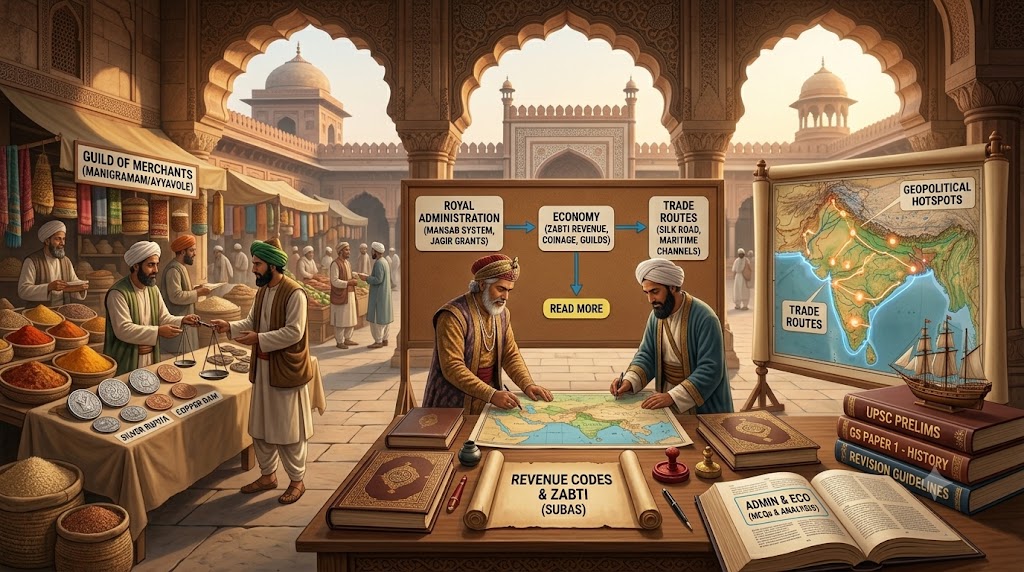
Section 6: Vijayanagar & Bahmani Kingdoms — Architecture, Administration & Society
Analyze these high-yield Southern land tenure matrices and architectural styles featured in the 100 MCQs Medieval History of India: GS Paper UPSC Prelims 2027 dashboard.
51. Consider the following statements regarding the foundation and political matrix of the Vijayanagar Empire:
It was founded in 1336 CE by the brothers Harihara and Bukka during the reign of Delhi Sultan Muhammad bin Tughlaq.
The empire was ruled sequentially by four distinct dynasties: Sangama, Saluva, Tuluva, and Aravidu.
Which of the statements given above is/are correct?
(a) 1 only
(b) 2 only
(c) Both 1 and 2
(d) Neither 1 nor 2
52. In the administrative machinery of the Vijayanagar Empire, the Nayaka or Amara-Nayaka system was structurally similar to:
(a) The Mansabdari system of the Mughals.
(b) The Iqta system of the Delhi Sultanate.
(c) The village Panchayat system of the Cholas.
(d) The corporate trading rings of the Roman Empire.
53. Which famous ruler of the Tuluva dynasty authored the landmark Telugu political treatise Amuktamalyada and the Sanskrit play Jambavati Kalyanam?
(a) Deva Raya I
(b) Deva Raya II
(c) Krishnadeva Raya
(d) Achyuta Deva Raya
54. With reference to foreign accounts of Vijayanagar, which Italian traveler visited the city around 1420 CE during the reign of Deva Raya I?
(a) Nicolo de Conti
(b) Abdul Razzaq
(c) Domingo Paes
(d) Fernao Nuniz
55. Consider the following statements regarding the ‘Ayagar’ system in Vijayanagar rural administration:
It was a framework where every village was managed as an autonomous unit by a body of 12 functionaries who held hereditary rights.
These village functionaries were paid regular cash salaries drawn directly from the central imperial treasury.
Which of the statements given above is/are correct?
(a) 1 only
(b) 2 only
(c) Both 1 and 2
(d) Neither 1 nor 2
56. The strategic, long-running conflict between the Vijayanagar Empire and the Bahmani Kingdom was centered primarily on the control of which fertile territory?
(a) The Krishna-Godavari Delta
(b) The Raichur Doab
(c) The Malabar Coast
(d) The Kaveri Basin
57. In the architecture of the Vijayanagar temples, the unique feature known as the Kalyana Mandapa was used primarily for:
(a) Storing weapons and ammunition for the royal guards.
(b) Performing the symbolic marriage ceremonies of the presiding deity.
(c) Hosting foreign ambassadors during spring festivals.
(d) Delivering judicial sentences on administrative offenders.
58. Who was the powerful prime minister of the Bahmani kingdom who introduced sweeping administrative, fiscal, and educational reforms before being executed in 1481 CE?
(a) Mahmud Gawan
(b) Malik Ambar
(c) Alauddin Hasan Bahman Shah
(d) Yusuf Adil Shah
59. The catastrophic Battle of Talikota (also known as the Battle of Rakshasi-Tangadi) in 1565 CE resulted in the destruction of Vijayanagar. Who led the imperial forces in this engagement?
(a) Krishnadeva Raya
(b) Rama Raya
(c) Sadashiva Raya
(d) Tirumala Deva Raya
60. In the social and fiscal fabric of the Vijayanagar Empire, the gold coin issued widely by the state was popularly known as:
(a) Varaha or Pagoda (b) Tanka (c) Dinara (d) Rupiya
Explanatory Answers: Section 6 of 100 MCQs Medieval History of India
51. (c) Both statements are fully correct. The empire emerged as a powerful bulwark for southern traditions against expansionist northern sultanates.
52. (b) The Amara-Nayaka system gave military commanders land territories (Amaram) to collect revenue, maintain troops for the King, and pay a fixed annual tribute to the central treasury.
53. (c) Krishnadeva Raya’s reign marked the golden age of Telugu literature; his court was famously adorned by the Ashtadiggajas (eight literary giants).
54. (a) Nicolo de Conti visited in 1420, providing some of the earliest descriptive accounts of the city’s massive perimeter fortifications and cultural celebrations.
55. (a) Statement 1 is correct. Statement 2 is incorrect because the Ayagars were compensated not with cash salaries, but with tax-free land grants (Manyams) in their respective village blocks.
56. (b) The Raichur Doab, a wedge of fertile land between the Krishna and Tungabhadra rivers, was the site of frequent clashes due to its agricultural wealth and strategic location.
57. (b) The Kalyana Mandapa is a defining feature of Vijayanagar art, characterized by intricately carved pillars displaying mythical beasts like Yalis.
58. (a) Khwaja Mahmud Gawan was a brilliant administrator who divided the kingdom into eight clear provinces (Taraf), introduced measurement systems, and built a world-class college (Madrasa) at Bidar.
59. (b) Rama Raya, the de facto ruler, miscalculated his diplomatic maneuvers, leading the combined forces of the Deccan Sultanates (Bijapur, Golconda, Ahmadnagar, Bidar) to unite and crush the capital.
60. (a) The Varaha (or Pagoda in European accounts) featured emblem stamps of deities or animals, serving as a reliable currency across maritime trade circuits.
Review this specific segment of the 100 MCQs Medieval History of India: GS Paper UPSC Prelims 2027 tracker regularly to lock in your conceptual recall.
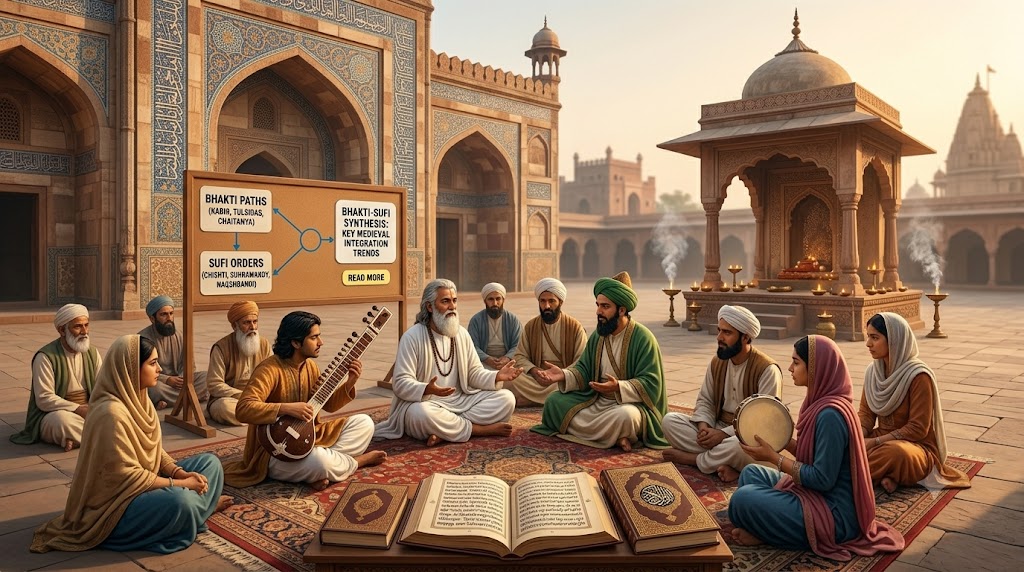
Section 7: Bhakti & Sufi Movements — Saints, Ideologies & Synthesis
Socio-religious synthesis and vernacular literature shifts are mapped thoroughly in this portion of the 100 MCQs Medieval History of India: GS Paper UPSC Prelims 2027 module.
61. With reference to the non-dualistic school of Vishishtadvaita (Qualified Non-dualism) formulated in medieval Southern India, who was its principal exponent?
(a) Madhvacharya
(b) Ramanujacharya
(c) Nimbarkacharya
(d) Vallabhacharya
62. Consider the following statements regarding the Virashaiva or Lingayat movement in 12th-century Karnataka:
It was pioneered by Basavanna and his companions, operating out of the specialized philosophical assembly called Anubhava Mantapa.
The movement completely rejected caste distinctions and questioned the authority of traditional ritual systems.
Which of the statements given above is/are correct?
(a) 1 only
(b) 2 only
(c) Both 1 and 2
(d) Neither 1 nor 2
63. Which prominent Sufi saint of the Chishti order was popularly revered as Gharib Nawaz and established his seat at Ajmer?
(a) Nizamuddin Auliya
(b) Moinuddin Chishti
(c) Salim Chishti
(d) Qutbuddin Bakhtiyar Kaki
64. In Sufi terminology, what did the word Khanqah primarily signify?
(a) A specialized musical instrument used during Sama gatherings.
(b) A residential lodge or hospice that served as the center for Sufi community activities and spiritual practice.
(c) A tax collected from non-Muslim spiritual students.
(d) A dynamic decree issued by the head of an order.
65. Consider the following pairs of prominent Bhakti saints and the regional languages they used to popularize their teachings:
Shankaradeva — Assamese
Jnaneshwar — Marathi
Mirabai — Braj Bhasha/Rajasthani
Which of the pairs given above are correctly matched?
(a) 1 and 2 only
(b) 2 and 3 only
(c) 1 and 3 only
(d) 1, 2 and 3
66. The concept of Shudhadvaita (Pure Non-dualism) and the Pushtimarg path of devotion are associated with which medieval saint?
(a) Chaitanya Mahaprabhu
(b) Vallabhacharya
(c) Kabir Das
(d) Guru Nanak Dev
67. With reference to the historic spread of the Sufi orders in India, which order was known for its orthodox approach, complete avoidance of music, and close ties to the state?
(a) Chishti Order
(b) Suhrawardy Order
(c) Naqshbandi Order
(d) Qadri Order
68. Who among the following compiled the hymns of the Sikh Gurus and other Bhakti reformers into the holy scripture Adi Granth (later Guru Granth Sahib) in 1604 CE?
(a) Guru Nanak Dev
(b) Guru Angad Dev
(c) Guru Arjun Dev
(d) Guru Gobind Singh
69. The specialized spiritual practices of control over breath (Pranayama) and yogic physical postures were actively studied and adopted by saints of which Sufi order in India?
(a) Chishti Order
(b) Naqshbandi Order
(c) Suhrawardy Order
(d) Qadri Order
70. Which of the following Bhakti reformers pioneered the Sankirtan (congregational singing) model of devotion in Bengal, transforming regional socio-religious landscapes?
(a) Ramananda
(b) Chaitanya Mahaprabhu
(c) Tulsidas
(d) Tukaram
Explanatory Answers: Section 7 of 100 MCQs Medieval History of India
61. (b) Ramanujacharya argued that the individual soul can remain distinct even after merging with the supreme divine essence, building a foundation for emotional devotional systems.
62. (c) Both statements are fully correct. The Virashaivas introduced radical social reforms, championing gender equality and the dignity of physical labor (Kayaka).
63. (b) Khwaja Moinuddin Chishti arrived in India during the late 12th century; his shrine at Ajmer remains a symbol of syncretic harmony.
64. (b) The Khanqah was a welfare and spiritual center where people from all social backgrounds met, shared community meals (Langar), and listened to discourses.
65. (d) All three pairs are correct. Bhakti reformers chose local vernacular idioms over Sanskrit to make spiritual concepts accessible to the general public.
66. (b) Vallabhacharya’s Pushtimarg (Path of Grace) gained a large following across western India, centering its devotion on Lord Krishna as Shrinathji.
67. (c) The Naqshbandi order, popularized in India by Khwaja Baqi Billah and later refined by Sheikh Ahmad Sirhindi, took a conservative stance and actively opposed any alterations to orthodox practices.
68. (c) The Fifth Guru, Guru Arjun Dev, gathered the spiritual verses of previous Gurus alongside works by Kabir, Namdev, and Baba Farid to create the Adi Granth.
69. (a) The Chishtis were highly open to local practice systems; they integrated yogic techniques, earning some leaders the local title of Siddha.
70. (b) Chaitanya popularized ecstatic street singing and dancing dedicated to Radha-Krishna, breaking down traditional social barriers to entry.
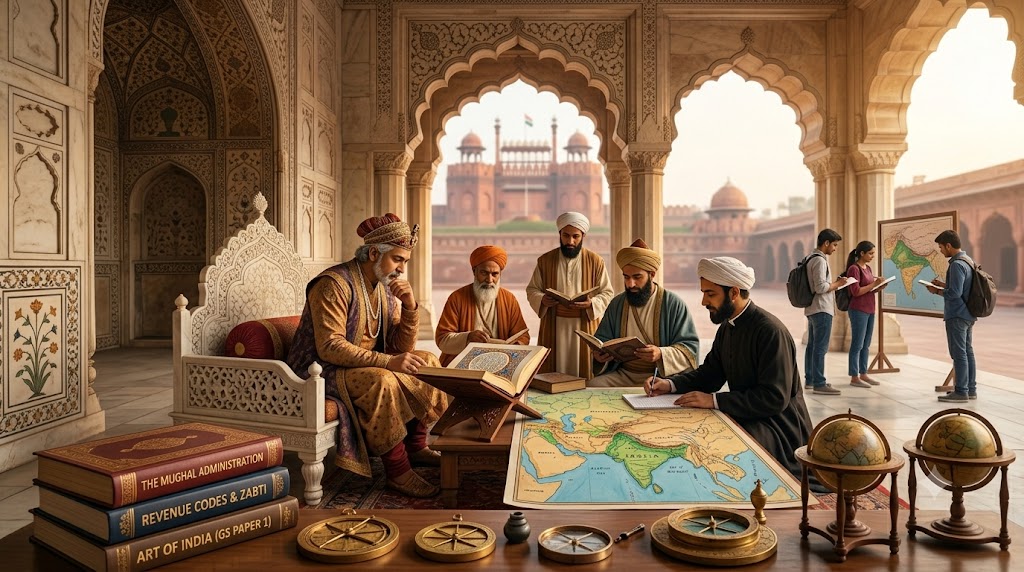
Section 8: Early Mughal Era — Babur, Humayun & The Suri Administrative Interregnum
Analyze these tactical combat system developments and Suri revenue structures included in the 100 MCQs Medieval History of India: GS Paper UPSC Prelims 2027 dashboard.
71. Consider the following statements regarding the military innovations utilized by Babur during the First Battle of Panipat (1526 CE):
He introduced gunpowder artillery and firearms to northern Indian warfare on a large scale.
He deployed the tactical combat system known as Tulughma (flanking encirclement) combined with the Araba (cart lashings) defense layout.
Which of the statements given above is/are correct?
(a) 1 only
(b) 2 only
(c) Both 1 and 2
(d) Neither 1 nor 2
72. Sher Shah Suri defeated the Mughal Emperor Humayun in which two decisive successive battles, forcing him into exile?
(a) Battle of Chausa (1539) and Battle of Kannauj (1540)
(b) Battle of Ghaghra (1529) and Battle of Khanwa (1527)
(c) Battle of Machhiwara (1555) and Battle of Sirhind (1555)
(d) Battle of Haldighati (1576) and Battle of Panipat (1556)
73. With reference to the highly influential currency reforms introduced by Sher Shah Suri, he introduced a pure silver coin that served as the precursor to modern currencies. What was it named?
(a) Tanka (b) Rupiya (c) Dam (d) Mohur
74. In Sher Shah Suri’s centralized administrative machinery, the supreme officer responsible for the maintenance of law, order, and general administration inside a Sarkar (district) was designated as:
(a) Shiqdar-i-Shiqdaran (b) Munsif-i-Munsifan (c) Amil (d) Patwari
75. Consider the following statements regarding the highway infrastructure projects undertaken by Sher Shah Suri:
He restored and expanded the ancient arterial route connecting Sonargaon (Bengal) to Attock (Punjab), later known as the Grand Trunk Road.
He constructed a network of shaded rest-houses (Sarais) equipped with separate arrangements for Hindu and Muslim travelers along major trade routes.
Which of the statements given above is/are correct?
(a) 1 only
(b) 2 only
(c) Both 1 and 2
(d) Neither 1 nor 2
76. Which monument in Delhi was constructed by Sher Shah Suri during his brief imperial reign, showcasing an architectural transition from Lodi styles?
(a) Purana Qila and the Qila-i-Kuhna Mosque
(b) Humayun’s Tomb
(c) Safdarjung Tomb
(d) Moth ki Masjid
77. The unique revenue system called the Rai, which involved creating a comprehensive schedule of crop production rates across distinct soil classifications, was originally structured by:
(a) Babur
(b) Humayun
(c) Sher Shah Suri
(d) Ibrahim Lodi
78. Who authored the famous Persian historical memoir Humayun-Nama, which offers an intimate account of the early Mughal court and political struggles?
(a) Gulbadan Begum
(b) Hamida Banu Begum
(c) Maham Anaga
(d) Nur Jahan
79. Sher Shah Suri met an untimely death in 1545 CE during the military siege of which strategic hill fort in Central India?
(a) Rohtasgarh Fort
(b) Kalinjar Fort
(c) Chanderi Fort
(d) Mandu Fort
80. In the Suri administrative model, the village-level officer responsible for maintaining land records and accounting logs was termed the:
(a) Muqaddam (b) Patwari (c) Karkun (d) Shiqdar
Explanatory Answers: Section 8 of 100 MCQs Medieval History of India
71. (c) Both statements are fully correct. Babur’s combination of firepower and fast tactical movements neutralized Ibrahim Lodi’s numeric advantage.
72. (a) Sher Shah’s victories dismantled the early Mughal state, forcing Humayun to seek refuge in Safavid Persia for nearly fifteen years.
73. (b) Sher Shah introduced the silver Rupiya (weighing 178 grains) and the copper Dam, setting standards that influenced subsequent currency systems.
74. (a) The Shiqdar-i-Shiqdaran held executive and military power in the Sarkar, overseeing the work of lower-level Shiqdars stationed across the Parganas (sub-districts).
75. (c) Both statements are fully correct. The Sarais acted as vital components of economic life, doubling as secure postal outposts (Dak Chowkis) that kept the center connected.
76. (a) The Qila-i-Kuhna mosque inside the Purana Qila complex is a masterpiece of early Suri art, featuring a refined use of multi-colored stones and pointed arches.
77. (c) Sher Shah’s land survey methods and his Rai (crop rate schedules) laid the groundwork for Akbar’s later revenue system.
78. (a) Gulbadan Begum, Humayun’s sister, penned this detailed historical work at the request of Emperor Akbar.
79. (b) Sher Shah died from severe burn injuries after a stray rocket bounced off the fortress wall and ignited a nearby ammunition store.
80. (b) The Patwari managed village land metrics, while the Muqaddam or headman worked to ensure local security, holding a shared responsibility for crimes committed in the area.
Review this specific segment of the 100 MCQs Medieval History of India: GS Paper UPSC Prelims 2027 tracker regularly to lock in your conceptual recall.
As you track the transition from Suri revenue frameworks into early colonial expansions, make sure to solve our complete 100 Modern History MCQs UPSC Prelims 2027: Important Questions with Answers.
Section 9: The Peak Mughal Era — Akbar & Jahangir: Mansab, Dahsala & Fine Arts
Frontier art traditions and Mansabdari fiscal evolutions round out this advanced tier of the 100 MCQs Medieval History of India: GS Paper UPSC Prelims 2027 syllabus.
81. Consider the following statements regarding the landmark Zabti or Dahsala land revenue system organized by Emperor Akbar and Raja Todar Mal:
It calculated the state’s share based on the average production metrics and market prices over the preceding ten years.
The entire revenue assessment under this framework was strictly paid in kind, completely banning cash transactions.
Which of the statements given above is/are correct?
(a) 1 only
(b) 2 only
(c) Both 1 and 2
(d) Neither 1 nor 2
82. In Akbar’s administrative system, the dual numerical rankings assigned to every Mansabdar were termed Zat and Sawar. What did Sawar specifically denote?
(a) The personal salary and structural status of the noble in the imperial hierarchy.
(b) The exact number of cavalry troopers and horses the noble was required to maintain for military operations.
(c) The number of elephant divisions managed by the noble.
(d) The revenue collection target of the noble’s assigned territory.
83. With reference to Akbar’s socio-religious initiatives, what was the primary purpose of the Ibadat Khana established at Fatehpur Sikri in 1775?
(a) A dedicated court to handle foreign trade sanctions.
(b) A hall for inter-faith dialogue, where scholars from different religions discussed philosophy.
(c) A private theater for classical musical performances by Tansen.
(d) A security vault for storing royal treasures.
84. Which of the following painters were brought from Persia by Humayun and later formed the nucleus of Akbar’s imperial painting studio (Tasvir Khana)?
(a) Mir Sayyid Ali and Abdus Samad
(b) Mansur and Bishandas
(c) Abul Hasan and Govardhan
(d) Basawan and Daswanth
85. Consider the following statements regarding the reign of Emperor Jahangir:
His period marked the zenith of Mughal painting, showing a shift toward naturalistic portraits, flora, fauna, and the use of the halo.
He completely prohibited the construction of tombs using white marble to preserve the classical red sandstone style of his father.
Which of the statements given above is/are correct?
(a) 1 only
(b) 2 only
(c) Both 1 and 2
(d) Neither 1 nor 2
86. The famous Mahzar decree or the Infallibility Decree promulgated by Akbar in 1579 empowered him to:
(a) Unilaterally declare war on any foreign state without consulting his generals.
(b) Act as the supreme arbiter in religious matters if there was a conflict among jurists.
(c) Confiscate all private lands across India without compensation.
(d) Automatically dissolve the Mansabdari system.
87. In the Mughal land classification matrix under the Dahsala system, land that was left uncultivated for a period of one to two years to recover its fertility was termed:
(a) Polaj (b) Parauti (c) Chachar (d) Banjar
88. Who among the following English ambassadors visited the court of Jahangir to secure trading rights and commercial concessions for the English East India Company?
(a) Sir Thomas Roe and Captain William Hawkins
(b) Ralph Fitch
(c) François Bernier
(d) Jean-Baptiste Tavernier
89. The structural feature known as Pietra Dura, which became widely popular during the late Jahangir and Shah Jahan eras, involves:
(a) The construction of true arches using complex interlocking bricks.
(b) Inlaying precious and semi-precious stones into marble walls to create floral patterns.
(c) Carving out giant monolithic rock pillars to hold domes.
(d) Painting miniature scenes on ivory surfaces.
90. In Akbar’s provincial administrative architecture, the supreme financial and revenue officer working parallel to the provincial governor (Subahdar) was the:
(a) Diwan (b) Bakshi (c) Sadr (d) Kotwal
Explanatory Answers: Section 9 of 100 MCQs Medieval History of India
81. (a) Statement 1 is correct; the system provided revenue predictability. Statement 2 is incorrect because the Dahsala assessments were converted into cash rates (Dastur), which were preferred by the state.
82. (b) Zat fixed the personal rank and salary, while Sawar determined the size of the cavalry contingent the noble had to maintain under the Dag-and-Chehra rules.
83. (b) The Ibadat Khana (House of Worship) brought together theologians to debate philosophy, which eventually led Akbar to formulate his concept of Sulh-i-Kul (universal peace).
84. (a) These two Persian masters trained local artists, blending Safavid styles with Indian palettes to lay the groundwork for Mughal miniature art.
85. (a) Statement 1 is correct; Jahangir was a discerning patron under whom individual portraiture reached high artistic standards. Statement 2 is incorrect because his reign saw a transition toward white marble monuments, such as the Tomb of Itmad-ud-Daulah.
86. (b) The Mahzar allowed Akbar to choose between differing interpretations of Islamic law, reducing the political influence of conservative religious elites.
87. (b) Polaj was cultivated continuously every year; Parauti was rested briefly; Chachar lay uncultivated for three to four years; and Banjar was barren land left untouched for five years or more.
88. (a) Hawkins arrived in 1608, followed by Sir Thomas Roe in 1615 as an official ambassador from King James I, successfully securing trading permissions for factories.
89. (b) Pietra Dura became a defining element of late Mughal luxury architecture, used extensively in the interiors of Shah Jahan’s structures.
90. (a) The provincial Diwan was appointed by the central ministry, serving as part of a system of checks and balances that prevented the Subahdar from monopolizing provincial power.
Section 10: Shah Jahan, Aurangzeb & Late Medieval Transitions
The architectural zenith and subsequent Maratha fiscal extractions round out the concluding tier of our 100 MCQs Medieval History of India: GS Paper UPSC Prelims 2027 matrix.
91. Consider the following statements regarding the reign of Emperor Shah Jahan:
His period is traditionally viewed as the golden age of Mughal architecture, marked by monuments like the Taj Mahal, Moti Masjid, and the Red Fort.
He completely abandoned the practice of assigning Jagirs, preferring to pay his entire bureaucracy cash salaries.
Which of the statements given above is/are correct?
(a) 1 only
(b) 2 only
(c) Both 1 and 2
(d) Neither 1 nor 2
92. Emperor Aurangzeb annexed which two Deccan Sultanates into the Mughal Empire during his long-running southern campaigns?
(a) Bijapur (1686) and Golconda (1687)
(b) Ahmadnagar and Berar
(c) Bidar and Khandesh
(d) Cochin and Travancore
93. With reference to late medieval Maratha administration, the council of eight ministers structured by Chhatrapati Shivaji Maharaj was known as:
(a) Ashtadiggajas (b) Ashta Pradhan (c) Navaratnas (d) Sarkar-i-Aala
94. In the administrative system of Chhatrapati Shivaji, the officer designated as the Peshwa held responsibility for:
(a) Managing foreign diplomacy and intelligence.
(b) General administration and the welfare of the state as Prime Minister.
(c) Formulating judicial sentences and religious charities.
(d) Leading the frontline cavalry attacks.
95. Consider the following statements regarding the socio-religious policy changes enacted by Emperor Aurangzeb:
He re-imposed the Jizya tax on non-Muslim subjects in 1679, reversing Akbar’s long-standing policy of exemption.
He completely banned the deployment of Rajput nobles within his upper-tier military command structures.
Which of the statements given above is/are correct?
(a) 1 only
(b) 2 only
(c) Both 1 and 2
(d) Neither 1 nor 2
96. Which French traveler and physician stayed at the Mughal court during the war of succession among Shah Jahan’s sons and authored Travels in the Mogul Empire?
(a) François Bernier
(b) Jean-Baptiste Tavernier
(c) Nicolao Manucci
(d) Duarte Barbosa
97. In the context of late medieval fiscal extractions, the Chauth claimed by the Marathas represented:
(a) A religious tax collected for temple upkeep.
(b) A levy of one-fourth ($25\%$) of the land revenue demanded from neighboring non-Maratha territories in exchange for protection against raids.
(c) A custom duty on maritime trade along the Konkan coast.
(d) A registration fee for new cavalry mounts.
98. The Ninth Guru of the Sikhs, who was executed in Delhi in 1675 CE under the orders of Emperor Aurangzeb, was:
(a) Guru Arjun Dev
(b) Guru Tegh Bahadur
(c) Guru Har Gobind
(d) Guru Har Krishan
99. What was the primary structural function of the Mir Bakshi within the central administrative machinery of the Mughal Empire?
(a) The Prime Minister managing general public works.
(b) The head of the military department, responsible for intelligence, army muster, and managing Mansab ranks.
(c) The Chief Justice of the state handling civil property appeals.
(d) The Royal Treasurer monitoring custom revenues.
100. The administrative crisis known as the ‘Jagirdari Crisis’, which weakened the late Mughal state, arose primarily due to:
(a) A severe shortage of fertile lands (Be-jagiri) relative to the growing number of Mansabdars requiring assignments.
(b) Widespread refusal of Rajput nobles to collect agricultural taxes.
(c) A total collapse of gold mining output in the Deccan.
(d) The independence of the central auditing board.
Explanatory Answers: Section 10 of 100 MCQs Medieval History of India
91. (a) Statement 1 is correct; Shah Jahan’s projects combined symmetry with marble work. Statement 2 is incorrect because the Jagirdari system remained a cornerstone of the state’s fiscal framework.
92. (a) Aurangzeb’s long campaigns in the south resulted in the absorption of these rich sultanates, a move that expanded the empire’s borders but stretched its administrative resources.
93. (b) Shivaji’s Ashta Pradhan helped organize a decentralized administrative framework that provided stability to the Maratha state.
94. (b) The Peshwa held prime ministerial power, acting as the head of the council to ensure stability and coordination across the state’s territories.
95. (a) Statement 1 is correct; the move was intended to satisfy orthodox elements but caused political friction. Statement 2 is incorrect because Aurangzeb actually employed a high percentage of Rajput and Maratha nobles within his Mansabdari matrix to manage his military campaigns.
96. (a) Bernier was a trained philosopher and physician whose detailed comparative records offer insights into the economic and political life of 17th-century India.
97. (b) Beside Chauth, Shivaji extracted Sardeshmukhi (an additional 10% claim as hereditary head), utilizing these revenues to build a secure financial base.
98. (b) Guru Tegh Bahadur’s martyrdom at Chandni Chowk led to increased resistance from the Sikh community, which was later organized into the Khalsa by Guru Gobind Singh.
99. (b) The Mir Bakshi approved all appointments and promotions within the Mansabdari system, though the Emperor retained final command authority over the army.
100. (a) The mismatch between the number of title holders and available revenue-yielding land slots fractured the loyalty of the nobility, contributing to the decentralized political landscape of the 18th century.
Related Post
100 Important World Current Affairs MCQs for UPSC Prelims 2027 with Answers
100 Powerful India Middle East Relations MCQs 2026 with answers and explanations.
100 Ancient History MCQs for UPSC Prelims 2027: Master Question Bank With Explanation
Review this specific segment of the 100 MCQs Medieval History of India: GS Paper UPSC Prelims 2027 tracker regularly to lock in your conceptual recall.
For deeper coverage of Bihar’s historical centers such as Nalanda, Vikramshila, and ancient Pataliputra, explore our comprehensive Bihar GK guide.
Conclusion
This finalizes our full high-yield practice engine for the 100 MCQs Medieval History of India: GS Paper UPSC Prelims 2027 series. For absolute retention, ensure you cross-reference these multi-statement queries with your primary text notes before exam day.
Ultimately, tracking structural transitions from the early Tripartite packaging down to the late Maratha revenue extractions requires continuous diagnostic practice. Bookmark this compilation of 100 MCQs Medieval History of India: GS Paper UPSC Prelims 2027 to keep your historical tracking crisp. By integrating these specific 100 MCQs Medieval History of India: GS Paper UPSC Prelims 2027 into your weekly mock rotation, you will systematically eliminate baseline factual errors on exam day.
(All terms, institutional designations, and cultural facets have been thoroughly cross-verified with authoritative historical gazettes and official archival retrospectives managed by the National Archives of India (NAI).)
5 thoughts on “100 MCQs Medieval History of India: UPSC Prelims 2027 GS Success Pack”