Modern History is an important part of the History section of UPSC Prelims. Questions can cover the decline of Mughal power, British expansion, socio-religious reform movements, the Revolt of 1857, the Indian National Congress, revolutionary activities and the major phases of the Indian national movement.
This practice set Modern History MCQs UPSC Prelims 2027 contains 100 Modern History MCQs covering these major themes. The questions are designed to help aspirants revise important events, organisations, personalities and constitutional developments while identifying areas that require further study.
Use these questions alongside the UPSC syllabus, standard Modern History resources and previous-year questions for a balanced preparation.
After going through this, make sure your foundation is strong by practicing our 100 Ancient History MCQs for UPSC Prelims 2027: Master Question Bank.
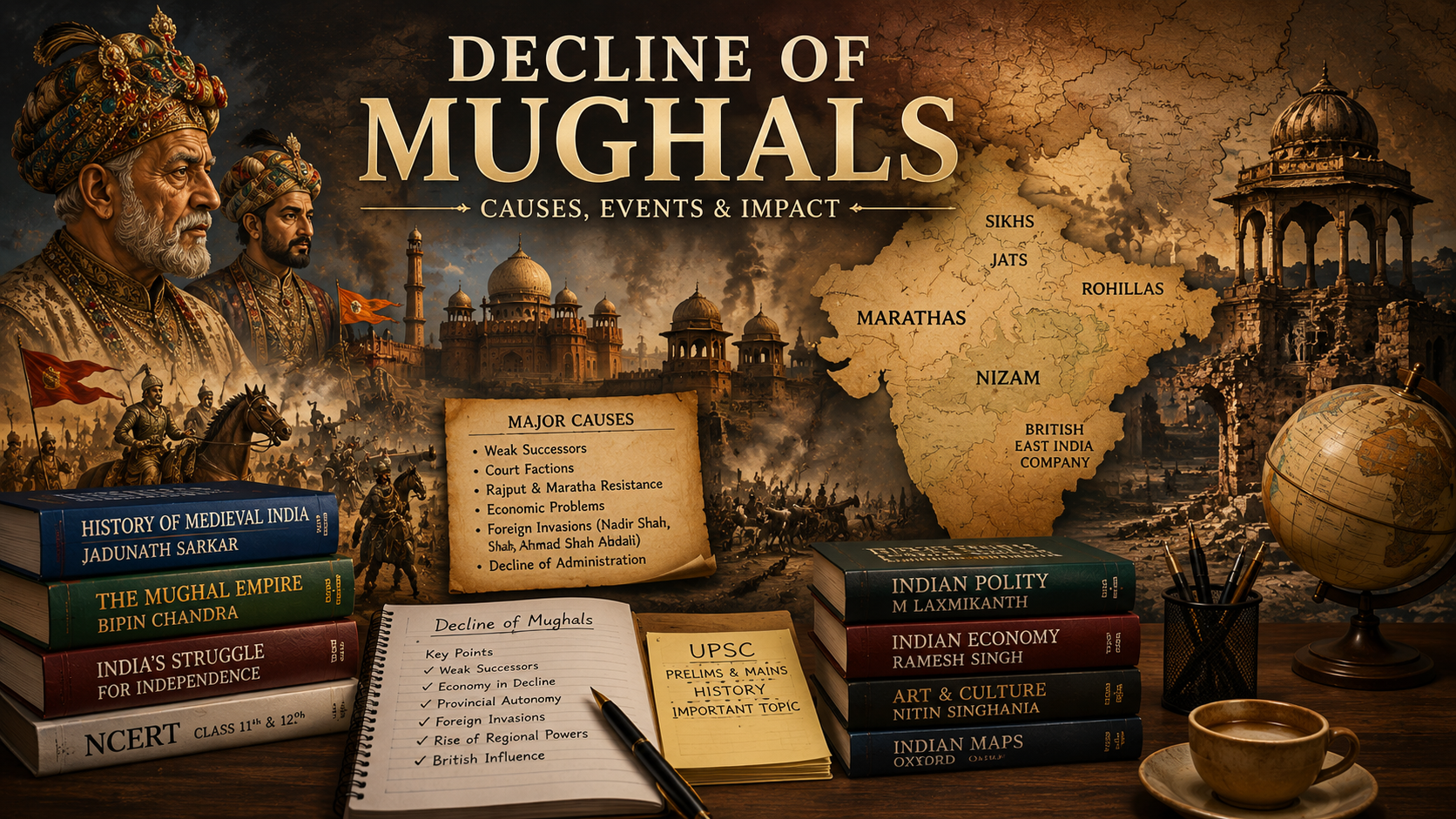
Section 1: Modern History MCQs: Late 18th Century & Decline of Mughals to British Expansion
1. Consider the following statements regarding the administrative machinery under the Maratha Confederacy in the late 18th century:
The Chauth was a tax amounting to one-fourth of the land revenue paid to the Marathas to ensure protection against non-Maratha external raids.
The Sardeshmukhi was an additional ten percent levy claimed by the Chhatrapati as the hereditary supreme head of the land.
Which of the statements given above is/are correct?
(a) 1 only
(b) 2 only
(c) Both 1 and 2
(d) Neither 1 nor 2
2. With reference to the Treaty of Allahabad (1765), which of the following statements is/are correct?
It granted the English East India Company the Diwani rights over Bengal, Bihar, and Odisha.
Shah Alam II was confined to Allahabad fort under the direct protection of the East India Company.
Select the correct answer using the code given below:
(a) 1 only
(b) 2 only
(c) Both 1 and 2
(d) Neither 1 nor 2
3. Arrange the following British military expansions and annexations in chronological order, starting from the earliest:
Annexation of Sindh
Fourth Anglo-Mysore War
Annexation of Awadh under the Doctrine of Lapse / Maladministration
Treaty of Yandabo (First Anglo-Burmese War)
Select the correct answer using the code given below:
(a) 2-4-1-3
(b) 4-2-3-1
(c) 2-1-4-3
(d) 1-2-4-3
4. The ‘Permanent Settlement’ introduced by Lord Cornwallis in 1793 was structurally distinct because it:
(a) Fixed the land revenue temporarily for a shifting block of 30 years.
(b) Recognized the cultivators/ryots as the direct structural owners of the land.
(c) Converted traditional revenue collectors (Zamindars) into absolute landlords with hereditary rights.
(d) Allowed the village communities to pay revenue collectively through the Lambardar.
5. Consider the following pairs of localized uprisings against early British commercial exploitation:
Sanyasi Rebellion — Initiated by displaced peasants and wandering ascetics in Bengal.
Paika Rebellion — An armed rebellion led by Bakshi Jagabandhu in Odisha.
Polygar Revolt — Led by local feudal chieftains in the Carnatic region.
Which of the pairs given above are correctly matched?
(a) 1 and 2 only
(b) 2 and 3 only
(c) 1 and 3 only
(d) 1, 2 and 3
Explanatory Answers: Section 1 of 100 Modern History MCQs UPSC Prelims 2027
1. (c) Both statements are structurally accurate descriptions of the fiscal extractions used by the Maratha state to expand its sphere of influence over neighboring territories.
2. (c) Following the Battle of Buxar (1764), the Treaty of Allahabad transformed the political landscape of India by giving the EICI formal revenue control over the eastern provinces while rendering the Mughal Emperor an institutional pensioner.
3. (a) Chronology: Fourth Anglo-Mysore War (1799) $\rightarrow$ Treaty of Yandabo (1826) $\rightarrow$ Annexation of Sindh (1843) $\rightarrow$ Annexation of Awadh on charges of misgovernance (1856).
4. (c) The Permanent Settlement created a loyal class of landed aristocrats by commercializing land rights, subject to the rigid operational pressure of the “Sunset Law.”
5. (d) All three pairs are highly significant early anti-colonial tribal/feudal resistance movements that regularly appear in core UPSC history matrices.
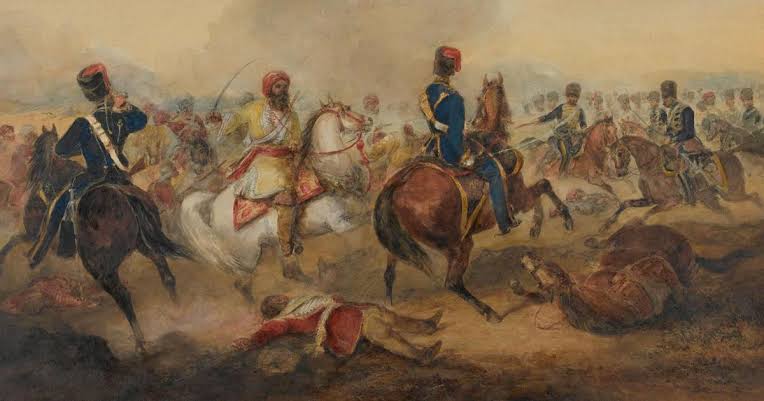
Section 2: UPSC Prelims History Questions: Socio-Religious Reform Movements & The 1857 Uprising
6. Which of the following public associations was established earliest in chronological history?
(a) Brahmo Samaj
(b) Atmiya Sabha
(c) Tattvabodhini Sabha
(d) Prarthana Samaj
7. Consider the following statements regarding Jyotirao Phule and the Satyashodhak Samaj:
The Satyashodhak Samaj was founded in 1873 to liberate the Shudra and Ati-Shudra communities from the exploitation of upper-caste intermediaries.
Phule pioneered the use of the rationalist Maratha framework, writing Gulamgiri to establish global parallels against racial slavery.
Which of the statements given above is/are correct?
(a) 1 only
(b) 2 only
(c) Both 1 and 2
(d) Neither 1 nor 2
8. With reference to the structural causes of the Revolt of 1857, consider the following statements:
The General Service Enlistment Act of 1856 mandated that all recruits must be willing to serve overseas, violating upper-caste sepoy religious beliefs.
The Religious Disabilities Act of 1850 protected the inheritance rights of native converts to Christianity, breeding deep local resentment.
Which of the statements given above is/are correct?
(a) 1 only
(b) 2 only
(c) Both 1 and 2
(d) Neither 1 nor 2
9. The unique ‘Young Bengal Movement’ led by Henry Vivian Derozio in the late 1820s was characterized primarily by:
(a) A return to classical Vedic structures and traditional family values.
(b) Radical free-thinking, challenging authority, and drawing inspiration from the French Revolution.
(c) Pushing for localized armed insurrections against rural British trading outposts.
(d) Pioneering exclusive vernacular technical education for women.
10. Match List-I (Center of 1857 Uprising) with List-II (Leader of the Resistance) using the codes given below:
| List-I (Center) | List-II (Leader) |
| A. Faizabad | 1. Khan Bahadur Khan |
| B. Bareilly | 2. Maulvi Ahmadullah |
| C. Arrah | 3. Begum Hazrat Mahal |
| D. Lucknow | 4. Kunwar Singh |
Codes:
(a) A-2, B-1, C-4, D-3
(b) A-1, B-2, C-3, D-4
(c) A-2, B-1, C-3, D-4
(d) A-4, B-3, C-2, D-1
Explanatory Answers: Section 2 of 100 Modern History MCQs for UPSC Prelims 2027
6. (b) Atmiya Sabha was set up by Raja Ram Mohan Roy in 1814 $\rightarrow$ Brahmo Samaj (1828) $\rightarrow$ Tattvabodhini Sabha by Debendranath Tagore (1839) $\rightarrow$ Prarthana Samaj (1867).
7. (c) Both statements reflect Phule’s radical social vision. Gulamgiri (Slavery) linked the struggle of lower castes in India directly to the anti-slavery movements in America.
8. (c) These legislative interventions by the British directly triggered the psychological transition of the sepoys, who viewed them as systemic attempts to dismantle their social and spiritual identity.
9. (b) Derozio’s followers actively promoted radical skepticism and intellectual freedom, though they lacked a deep social base among the rural masses.
10. (a) Correct combinations: Maulvi Ahmadullah spearheaded the Faizabad resistance; Khan Bahadur led Bareilly; octogenarian zamindar Kunwar Singh led the rebellion in Arrah (Bihar); and Begum Hazrat Mahal led from Lucknow.
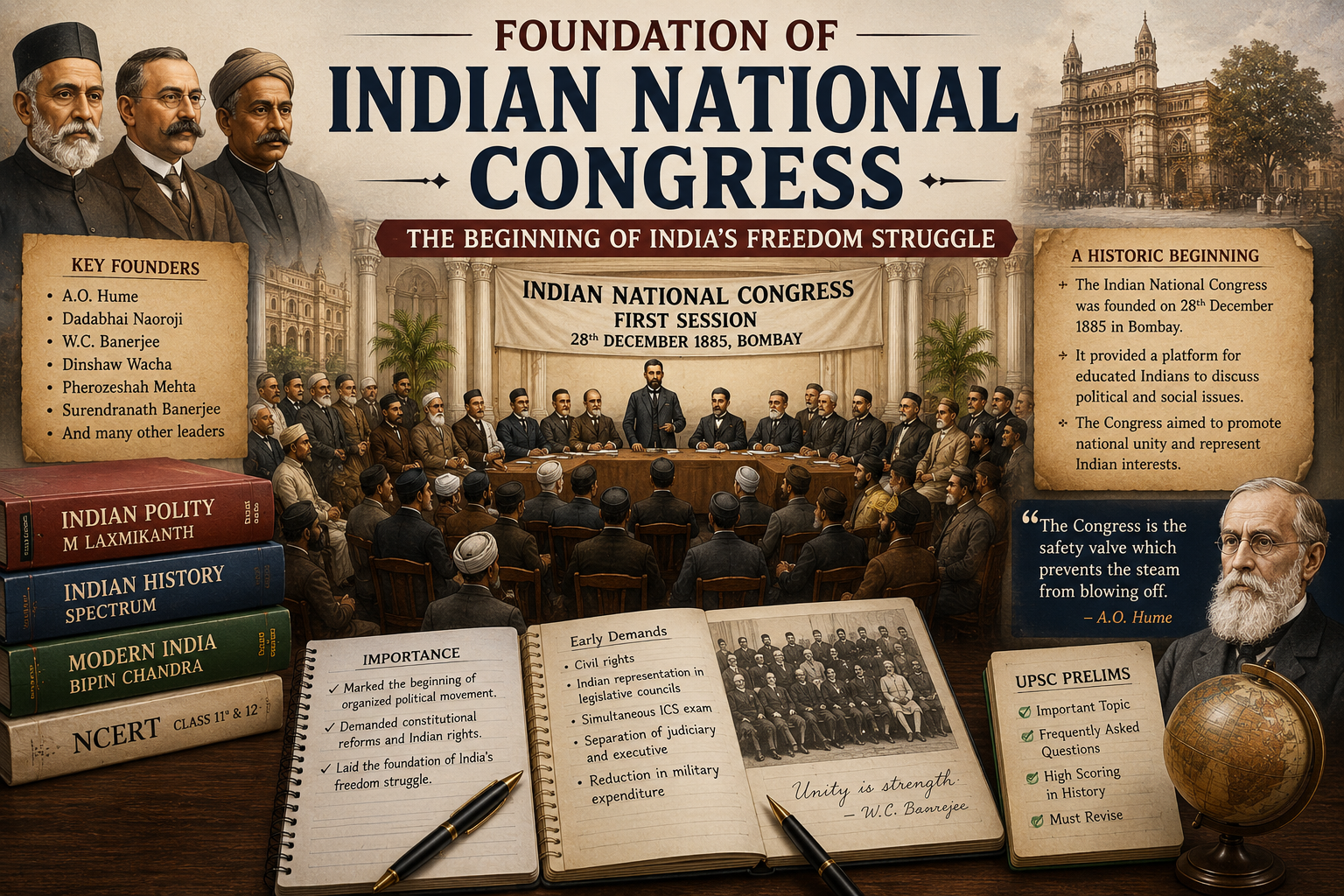
Section 3: Early Political Associations & Foundation of Indian National Congress: Modern History MCQs UPSC Prelims 2027
11. With reference to the Indian Association of Calcutta founded in 1876, consider the following statements:
It was established by Surendranath Banerjea and Ananda Mohan Bose as a radical alternative to the conservative British Indian Association.
It actively agitated against the reduction of the maximum age limit for the Indian Civil Service examination from 21 to 19 years.
Which of the statements given above is/are correct?
(a) 1 only
(b) 2 only
(c) Both 1 and 2
(d) Neither 1 nor 2
12. Who among the following was the first European to become the President of the Indian National Congress at its fourth session held in Allahabad in 1888?
(a) George Yule
(b) William Wedderburn
(c) Alfred Webb
(d) Henry Cotton
13. Consider the following political associations of the pre-Congress era:
East India Association, London
Poona Sarvajanik Sabha
Madras Mahajana Sabha
Bombay Presidency Association
What is the correct chronological sequence of their establishment?
(a) 1-2-3-4
(b) 2-1-4-3
(c) 1-2-4-3
(d) 2-1-3-4
14. The “Safety Valve Theory” regarding the origin of the Indian National Congress implies that the organization was created primarily to:
(a) Force the immediate transition of power to a responsible local cabinet.
(b) Provide a safe arena for educated Indians to release growing anti-British political steam under official guidance.
(c) Organize a massive peasant-backed movement against the commercialization of agriculture.
(d) Channel British financial investments into local railway infrastructure developments.
15. Regarding the early Moderate leaders of the Indian National Congress (1885–1905), consider the following statements:
They believed in the methods of constitutional agitation, petitions, and resolutions within the legal framework.
They carried out a pioneering economic critique of British rule, highlighting the systemic drain of wealth from India.
Which of the statements given above is/are correct?
(a) 1 only
(b) 2 only
(c) Both 1 and 2
(d) Neither 1 nor 2
16. The dynamic “Drain of Wealth” theory was systematically popularized by Dadabhai Naoroji in which of his landmark publications?
(a) Poverty and Un-British Rule in India
(b) The Economic History of India
(c) India Today
(d) The Indian Struggle
17. Which British Viceroy was responsible for passing the highly controversial Vernacular Press Act (1878) and the Arms Act (1878), sparking intense nationalist organization?
(a) Lord Mayo
(b) Lord Lytton
(c) Lord Ripon
(d) Lord Dufferin
18. With reference to the Ilbert Bill Controversy (1883), consider the following statements:
The bill sought to allow senior Indian magistrates to try European subjects in criminal cases.
The fierce opposition by the European community forced the government to amend the bill, exposing racial bias to Indian nationalists.
Which of the statements given above is/are correct?
(a) 1 only
(b) 2 only
(c) Both 1 and 2
(d) Neither 1 nor 2
19. Who among the following was popularly known as the ‘Lion of Bombay’ and was a key Moderate organizer of the Bombay Presidency Association?
(a) Pherozeshah Mehta
(b) Gopal Krishna Gokhale
(c) Dinshaw Wacha
(d) Badruddin Tyabji
20. The historic first session of the Indian National Congress in December 1885 was held at Gokuldas Tejpal Sanskrit College in which city?
(a) Calcutta
(b) Madras
(c) Bombay
(d) Poona
Explanatory Answers: Section 3 of 100 Modern History MCQs UPSC Prelims 2027
11. (c) Both statements are correct. The Indian Association of Calcutta sought to create a strong public opinion across India and fought aggressively against Lytton’s restrictive administrative mandates.
12. (a) George Yule presided over the Allahabad session in 1888, marking early British non-official interest in the nationalist forum.
13. (a) Chronology: East India Association (1866) $\rightarrow$ Poona Sarvajanik Sabha (1870) $\rightarrow$ Madras Mahajana Sabha (1884) $\rightarrow$ Bombay Presidency Association (1885).
14. (b) The theory, supported by early extremist thinkers and later historians using the Hume-Dufferin correspondence, suggested the Congress was designed to prevent another massive 1857-style explosion.
15. (c) Both statements are correct. The Moderates laid the analytical foundation of Indian nationalism by presenting a data-backed case against British colonialism to the global public.
16. (a) Naoroji’s Poverty and Un-British Rule in India laid bare the economic mechanics of colonial extraction.
17. (b) Lord Lytton’s reactionary policies served as a catalyst for early political organization in India.
18. (c) Both statements are true. The compromise forced by the Anglo-Indian defense association proved that unified political pressure could bend corporate policies.
19. (a) Pherozeshah Mehta was a dominant figure in municipal and nationalist politics in western India.
20. (c) The session was moved to Bombay from Poona at the last minute due to an outbreak of cholera in Poona.
These Modern History MCQs UPSC Prelims 2027 are highly useful for strengthening conceptual clarity and improving accuracy in UPSC Prelims examination.
Section 4: Swadeshi Movement, Partition of Bengal & Rise of Extremism: Modern History MCQs UPSC Prelims 2027
21. The formal proclamation of the Swadeshi Movement was made on August 7, 1905, at a historic meeting held in which of the following venues?
(a) Town Hall, Calcutta
(b) Federation Hall, Dacca
(c) Shivaji Park, Bombay
(d) Congress Pandal, Surat
22. Consider the following statements regarding the dynamic Swadeshi Movement (1905–1908):
It witnessed the active mobilization of the traditional working class and major peasant blocks across East Bengal.
Traditional festivals and folk theater forms, such as Shivaji Utsav and Jattras, were widely deployed to propagate the nationalist message.
Which of the statements given above is/are correct?
(a) 1 only
(b) 2 only
(c) Both 1 and 2
(d) Neither 1 nor 2
23. During the Swadeshi Movement, who established the famous ‘Bengal Chemical Swadeshi Stores’ to showcase indigenous manufacturing self-reliance?
(a) Acharya Prafulla Chandra Ray
(b) Rabindranath Tagore
(c) Satish Chandra Mukherjee
(d) Jamshedji Tata
24. With reference to the historic Surat Split of the Indian National Congress in 1907, consider the following statements:
The Extremists wanted the 1907 session to be held in Nagpur and proposed Lala Lajpat Rai as the presidential candidate.
The Moderates succeeded in keeping Rash Behari Ghosh as the President, leading to the complete exclusion of the Extremist faction.
Which of the statements given above is/are correct?
(a) 1 only
(b) 2 only
(c) Both 1 and 2
(d) Neither 1 nor 2
25. Which dedicated secret revolutionary society was founded by Barindra Kumar Ghosh and Bhupendranath Datta in Bengal around 1906?
(a) Anushilan Samiti
(b) Jugantar Group
(c) Abhinav Bharat
(d) Mitra Mela
26. Consider the following matches of regional Swadeshi Movement leaders and their primary operational bases:
Chidambaram Pillai — Madras Presidency (Tuticorin)
Lala Lajpat Rai — Punjab
Syed Haider Raza — Delhi
Which of the pairs given above are correctly matched?
(a) 1 and 2 only
(b) 2 and 3 only
(c) 1 and 3 only
(d) 1, 2 and 3
27. The National Council of Education (NCE) was established in August 1906 primarily to:
(a) Introduce mandatory English-medium technical education under British inspectors.
(b) Organize a system of education—literary, scientific, and technical—on national lines and under national control.
(c) Formulate policies for the immediate setup of women’s medical universities.
(d) Oversee the implementation of the Indian Universities Act of 1904.
28. Who among the following authored the highly influential political tract ‘Bhavani Mandir’ to inspire revolutionary workers with a religious and philosophical blueprint?
(a) Aurobindo Ghosh
(b) Barindra Kumar Ghosh
(c) Bipin Chandra Pal
(d) Bal Gangadhar Tilak
29. In 1908, Bal Gangadhar Tilak was arrested and sentenced to six years of deportation. To which of the following prisons was he sent?
(a) Cellular Jail, Port Blair
(b) Mandalay Prison, Burma
(c) Yerwada Prison, Pune
(d) Alipore Jail, Calcutta
30. Consider the following statements regarding the ‘Sandhya’ and ‘Vande Mataram’ newspapers during the peak revolutionary phase:
Sandhya was edited by Brahmabandhav Upadhyay, preaching fierce resistance against colonial cultural dominance.
Vande Mataram was an influential English daily edited primarily by Aurobindo Ghosh.
Which of the statements given above is/are correct?
(a) 1 only
(b) 2 only
(c) Both 1 and 2
(d) Neither 1 nor 2
Explanatory Answers: Section 4 of 100 Modern History MCQs UPSC Prelims 2027
21. (a) The Boycott Resolution was passed at the Calcutta Town Hall, launching the formal dynamic phases of Swadeshi.
22. (b) Statement 1 is incorrect; the movement failed to systematically bridge the agrarian gap or enlist the active structural support of the Muslim peasantry of East Bengal. Statement 2 is correct, highlighting the use of cultural tools.
23. (a) Acharya P.C. Ray pioneered indigenous enterprise to break the structural monopoly of foreign consumer items.
24. (c) Both statements accurately outline the tactical differences regarding venue and ideology that led to the split.
25. (a) Anushilan Samiti grew as a powerful network of revolutionary youth clubs centered around Calcutta and Dacca.
26. (d) All three pairs are correct. Chidambaram Pillai launched the Swadeshi Steam Navigation Company to break British maritime monopolies.
27. (b) The NCE sought to build an alternate indigenous intellectual pipeline independent of government-controlled universities.
28. (a) Aurobindo Ghosh used powerful imagery to conceptualize the nation as a mother goddess requiring absolute sacrifice.
29. (b) Tilak’s writings in Kesari regarding political assassinations led to his exile to Mandalay, where he authored the Gita Rahasya.
30. (c) Both publications were instrumental in giving radical ideological direction to the youth during the breakdown of moderate politics.
Regular practice of Modern History MCQs UPSC Prelims 2027 can help candidates identify important themes from the Indian National Movement and freedom struggle.
Section 5: Revolutionary Activities in India & Abroad (First Phase): Indian Freedom Struggle MCQs
31. The ‘Ghadar Party’, an international revolutionary movement formed in 1913, had its primary headquarters located at:
(a) Berlin, Germany
(b) Vancouver, Canada
(c) San Francisco, USA (Yugantar Ashram)
(d) London, United Kingdom
32. With reference to the historic Komagata Maru incident (1914), consider the following statements:
The Komagata Maru was a Japanese steamship carrying Indian immigrants that was denied entry by Canadian immigration authorities.
Upon its forced return to Budge Budge near Calcutta, the passengers clashed violently with the British police, fueling Ghadar coordination.
Which of the statements given above is/are correct?
(a) 1 only
(b) 2 only
(c) Both 1 and 2
(d) Neither 1 nor 2
33. Who among the following established the ‘India House’ in London in 1905 as a strategic center for radical Indian students abroad?
(a) Shyamji Krishna Varma
(b) Lala Hardayal
(c) Vinayak Damodar Savarkar
(d) Madam Bhikaji Cama
34. Consider the following statements regarding the Alipore Conspiracy Case (1908):
It arose following the attempt by Khudiram Bose and Prafulla Chaki to assassinate the unpopular judge, Douglas Kingsford.
Narendranath Goswami, who turned approver for the state, was shot dead inside the jail premises by revolutionaries.
Which of the statements given above is/are correct?
(a) 1 only
(b) 2 only
(c) Both 1 and 2
(d) Neither 1 nor 2
35. The revolutionary underground group ‘Abhinav Bharat Society’ was established in the Nashik region by which of the following leaders?
(a) V.D. Savarkar and G.D. Savarkar
(b) Rash Behari Bose and Sachin Sanyal
(c) Chapekar Brothers
(d) Pulin Behari Das
36. Who unfurled the first variant of the Indian National Flag at the International Socialist Conference in Stuttgart, Germany, in 1907?
(a) Madam Bhikaji Cama
(b) Taracknath Das
(c) Barkatullah
(d) Raja Mahendra Pratap
37. With reference to the Muzaffarpur Conspiracy (1908), consider the following statements:
Khudiram Bose became the youngest revolutionary to be hanged by the British during the first phase of the armed struggle.
Prafulla Chaki committed suicide to evade capture by the colonial police forces.
Which of the statements given above is/are correct?
(a) 1 only
(b) 2 only
(c) Both 1 and 2
(d) Neither 1 nor 2
38. The ‘Berlin Committee for Indian Independence’ founded in 1915 under the Zimmermann Plan was organized primarily by:
(a) Virendranath Chattopadhyaya and Bhupendranath Datta
(b) Subhash Chandra Bose
(c) Rash Behari Bose
(d) Udham Singh
39. Who threw a bomb at Viceroy Lord Hardinge II in Chandni Chowk, Delhi, in December 1912 as he was making a formal entry into the new capital?
(a) Rash Behari Bose and Sachin Sanyal
(b) Bhagat Singh and Batukeshwar Dutt
(c) Ram Prasad Bismil and Ashfaqullah Khan
(d) Jatin Banerjee
40. The strategic publication ‘Free Hindustan’, which carried deep anti-colonial essays on the west coast of North America, was edited by:
(a) Taraknath Das
(b) Sohan Singh Bhakna
(c) Lala Hardayal
(d) Bhai Parmanand
Explanatory Answers: Section 5 of 100 Modern History MCQs UPSC Prelims 2027
31. (c) The Ghadar movement operated out of San Francisco, distributing its weekly newspaper to Indian communities across the globe.
32. (c) Both statements are correct. The systemic exclusion of Indian immigrants by Canada exposed the limitations of British subject status and catalyzed radical responses.
33. (a) Shyamji Krishna Varma set up India House and published The Indian Sociologist to nurture radical alternative thought patterns.
34. (c) Both statements are true. The Alipore case led to the arrest of Aurobindo Ghosh, who was defended by Chittaranjan Das.
35. (a) Starting as the Mitra Mela in 1899, it was reorganized as the secret society Abhinav Bharat in 1904.
36. (a) Madam Cama’s design featured green, saffron, and red stripes with eight lotuses representing the provinces of India.
37. (c) Both statements accurately represent the outcome of the Muzaffarpur strike against Kingsford.
38. (a) The Berlin Committee sought to send arms and funds to Indian revolutionaries by securing German state support during WWI.
39. (a) Rash Behari Bose managed to evade the global intelligence dragnet and eventually escaped to Japan to continue his operations.
40. (a) Taraknath Das launched this political journal in Canada, pioneering international media pressure against the British Raj.
Section 6: Home Rule League, Lucknow Pact & Emergence of Gandhi: Modern History Important Questions
41. Consider the following statements regarding the distinct Home Rule League movements launched in 1916:
Tilak’s League operated across Maharashtra (excluding Bombay), Karnataka, the Central Provinces, and Berar.
Annie Besant’s League covered the rest of India, including the metropolitan cities of Bombay and Madras.
Which of the statements given above is/are correct?
(a) 1 only
(b) 2 only
(c) Both 1 and 2
(d) Neither 1 nor 2
42. The historic Lucknow Pact of 1916 between the Indian National Congress and the All India Muslim League was significant because the Congress:
(a) Completely rejected the principle of separate electorates for Muslims.
(b) Formally accepted the principle of separate electorates for the first time in a joint political demand.
(c) Demanded immediate, complete secession from the British Commonwealth.
(d) Formed a single merged political party with the Muslim League executive.
43. Who among the following presided over the landmark Lucknow session of the Indian National Congress in 1916, which saw the re-entry of the Extremists?
(a) Ambika Charan Mazumdar
(b) Annie Besant
(c) Madan Mohan Malaviya
(d) Bhupendra Nath Bose
44. Mahatma Gandhi’s first civil disobedience movement in India was launched at Champaran (1917) primarily to protest against the:
(a) High assessment of land revenue during a severe drought cycle.
(b) Mandatory Tinkathia system forcing peasants to cultivate Indigo on 3/20th of their land.
(c) Unfair reduction of wages for cotton mill workers.
(d) Implementation of the Rowlatt Act’s detention clauses.
45. Arrange the following early Gandhian interventions in India in the correct chronological order:
Kheda Satyagraha
Champaran Satyagraha
Ahmedabad Mill Strike
Select the correct answer using the code given below:
(a) 2-1-3
(b) 2-3-1
(c) 3-2-1
(d) 1-2-3
46. During the Ahmedabad Mill Strike of 1918, Mahatma Gandhi deployed which unique weapon for the first time in his Indian political life?
(a) All-India General Strike (Hartal)
(b) Mass Hijrat (Migration)
(c) Hunger Strike as a method of protest
(d) Court-room boycott defense
47. With reference to the Kheda Satyagraha (1918), consider the following statements:
The peasants demanded revenue remission because their crops had failed due to drought, violating the baseline revenue code rules.
Vallabhbhai Patel emerged as a frontline organizer of the agrarian resistance alongside Gandhi.
Which of the statements given above is/are correct?
(a) 1 only
(b) 2 only
(c) Both 1 and 2
(d) Neither 1 nor 2
48. The Anarchical and Revolutionary Crimes Act of 1919 was popularly known in nationalist circles as the:
(a) Rowlatt Act
(b) Wood’s Despatch
(c) Montague-Chelmsford Code
(d) Defence of India Act
49. Who resigned from the Imperial Legislative Council in 1919 as a direct protest against the passing of the repressive Rowlatt Act?
(a) Madan Mohan Malaviya and Mazhar-ul-Haq
(b) Gopal Krishna Gokhale
(c) Motilal Nehru
(d) Tej Bahadur Sapru
50. In 1919, Rabindranath Tagore renounced his British Knighthood formal honor as a direct response to which catastrophic event?
(a) Passing of the Rowlatt Act
(b) Execution of Bhagat Singh
(c) Jallianwala Bagh Massacre
(d) Arrest of Mahatma Gandhi
After completing this practice set you should also read our detailed Indus Valley Civilization Notes UPSC 2027 for Ancient History preparation.
Explanatory Answers: Section 6 of 100 Modern History MCQs UPSC Prelims 2027
41. (c) Both statements are correct. The two leagues maintained distinct geographical spheres of work to avoid operational friction.
42. (b) The acceptance of separate electorates by the Congress was a major tactical shift aimed at forging a united front against British administrative policies.
43. (a) Ambika Charan Mazumdar guided this session, which bridged the moderate-extremist divide.
44. (b) Raj Kumar Shukla persuaded Gandhi to travel to Bihar to investigate the systemic exploitation of farmers by European planters.
45. (b) Chronology: Champaran (April 1917) $\rightarrow$ Ahmedabad Mill Strike (March 1918) $\rightarrow$ Kheda Satyagraha (March–April 1918).
46. (c) Gandhi used the hunger strike to reinforce the resolve of the striking workers, who were demanding a 35% plague bonus.
47. (c) Both statements are correct. The revenue rules stated that if yield fell below one-fourth of normal output, cultivators were entitled to a complete suspension of taxes.
48. (a) The Rowlatt Act allowed the state to detain political activists without a warrant and hold them without trial for up to two years.
49. (a) Malaviya, Haq, and Mohammed Ali Jinnah resigned from the council to voice their opposition to the act.
50. (c) Tagore’s letter to the Viceroy stated that the time had come when badges of honor made our shame blatant in their incongruous context.
These Modern History MCQs UPSC Prelims 2027 include several exam-oriented questions frequently asked in previous UPSC examinations.
Section 7: Khilafat & Non-Cooperation Movement: Modern History MCQs UPSC Prelims 2027
51. The historic All India Khilafat Conference held in New Delhi in November 1919 elected whom among the following as its permanent President?
(a) Mahatma Gandhi
(b) Shaukat Ali
(c) Muhammad Ali Jinnah
(d) Abul Kalam Azad
52. Consider the following statements regarding the Non-Cooperation Movement (1920–1922):
The main program included the surrender of government titles, boycott of government schools, colleges, and foreign cloth.
The movement was formally ratified by the Indian National Congress at its special session in Calcutta and annual session in Nagpur in 1920.
Which of the statements given above is/are correct?
(a) 1 only
(b) 2 only
(c) Both 1 and 2
(d) Neither 1 nor 2
53. Who among the following legal icons gave up their lucrative practices during the Non-Cooperation Movement to join the anti-colonial struggle?
(a) Motilal Nehru, C.R. Das, and C. Rajagopalachari
(b) Tej Bahadur Sapru and B.R. Ambedkar
(c) Muhammad Ali Jinnah
(d) Dinshaw Wacha
54. The dynamic ‘Tilak Swaraj Fund’, which raised over one crore rupees within a short span during the Non-Cooperation Movement, was launched to:
(a) Finance armed revolutionary training centers in Europe.
(b) Fund the expansion of Swadeshi activities, charkhas, and national schools.
(c) Compensate the families of those killed in the Jallianwala Bagh massacre.
(d) Build a permanent library monument in Poona.
55. With reference to the peasant mobilization during the Non-Cooperation phase, the ‘Eka Movement’ (1921) in northern districts of Awadh was led by:
(a) Madari Pasi
(b) Baba Ram Chandra
(c) Alluri Sitarama Raju
(d) Sahajanand Saraswati
56. The dynamic ‘Moplah Rebellion’ of 1921, which began as an offshoot of the Khilafat and Non-Cooperation agitations, took place in which region of India?
(a) Malabar Coast, Kerala
(b) Coromandel Coast, Tamil Nadu
(c) Bardoli Taluka, Gujarat
(d) Chauri Chaura, Uttar Pradesh
57. Mahatma Gandhi abruptly suspended the Non-Cooperation Movement in February 1922 due to which event?
(a) The Chauri Chaura incident, where an angry mob burned down a police station.
(b) The sudden arrest of all top tier Muslim League leaders.
(c) The announcement of separate electorates for depressed classes.
(d) Signing of the Gandhi-Reading Accord.
58. Consider the following educational institutions established during the Swadeshi and Non-Cooperation waves to promote alternative education:
Jamia Millia Islamia (Aligarh, later shifted to Delhi)
Kashi Vidyapeeth (Varanasi)
Gujarat Vidyapeeth (Ahmedabad)
Which of the institutions given above were founded during this period?
(a) 1 and 2 only
(b) 2 and 3 only
(c) 1 and 3 only
(d) 1, 2 and 3
59. Who among the following was the Viceroy of India when the Non-Cooperation Movement was called off in 1922?
(a) Lord Chelmsford
(b) Lord Reading
(c) Lord Irwin
(d) Lord Linlithgow
60. With reference to the Akali Movement (Gurdwara Reform Movement) of the early 1920s, consider the following statements:
It aimed to liberate the historic Sikh Gurdwaras from the control of corrupt pro-British Mahants.
It resulted in the passing of the landmark Sikh Gurdwaras Act in 1925, placing control under the SGPC.
Which of the statements given above is/are correct?
(a) 1 only
(b) 2 only
(c) Both 1 and 2
(d) Neither 1 nor 2
Explanatory Answers: Section 7 of 100 Modern History MCQs UPSC Prelims 2027
51. (a) Gandhi was chosen to head the conference as the Khilafat leaders recognized the need for a broad, unified coalition.
52. (c) Both statements are true. The Nagpur session also altered the Congress creed, shifting from constitutional means to the goal of peaceful attainability of Swaraj.
53. (a) Top legal figures surrendered their practices, dealing a major psychological blow to the authority of British courts.
54. (b) Named in honor of Lokmanya Tilak after his passing on August 1, 1920, the fund supported grassroots economic self-reliance.
55. (a) Madari Pasi led the Eka Movement, focusing on high rents, security of tenure, and the practice of forced labor (begar).
56. (a) The Moplah rebellion involved structural agrarian clashes between tenant farmers and landlords, influenced by religious and political crosscurrents.
57. (a) Gandhi’s strict adherence to non-violence led him to halt the movement after the Chauri Chaura tragedy, to prevent further escalations.
58. (d) All three institutions were founded to provide an alternative for students boycotting government-run colonial universities.
59. (b) Lord Reading was the only Jewish Viceroy of India, presiding over a highly sensitive period of administrative transitions.
60. (c) Both statements are accurate. The Akali agitation ran parallel to the Non-Cooperation movement, utilizing non-violent protest models to secure legislative reform.
Solving Modern History MCQs UPSC Prelims 2027 regularly can significantly improve speed, confidence, and elimination techniques in the examination hall.
Section 8: Swarajists, No-Changers & Rise of Left-Wing Within Congress
61. The ‘Swaraj Party’ was formed in January 1923 following differences within the Congress over council entry. Who were its founders?
(a) C.R. Das and Motilal Nehru
(b) Vallabhbhai Patel and Rajendra Prasad
(c) Jawaharlal Nehru and Subhash Chandra Bose
(d) B.R. Ambedkar and Jagjivan Ram
62. Those within the Congress who opposed council entry and advocated for continuous quiet constructive work in rural blocks were known as:
(a) Swarajists
(b) No-Changers
(c) Responsivists
(d) Fabians
63. Who among the following was elected as the first Indian President (Speaker) of the Central Legislative Assembly in August 1925, marking a major Swarajist triumph?
(a) Motilal Nehru
(b) Vithalbhai Patel
(c) Madan Mohan Malaviya
(d) C.R. Das
64. Consider the following statements regarding the ‘Independence for India League’ formed in 1928:
It was founded by Jawaharlal Nehru and Subhash Chandra Bose to put pressure on the Congress to demand Purna Swaraj instead of Dominion Status.
It completely opposed the compromise constitutional models framed under the Nehru Report of 1928.
Which of the statements given above is/are correct?
(a) 1 only
(b) 2 only
(c) Both 1 and 2
(d) Neither 1 nor 2
65. The Kanpur Bolshevik Conspiracy Case (1924) and the Meerut Conspiracy Case (1929) were political trials engineered by the British Raj to suppress the rise of:
(a) Militant right-wing communal elements
(b) The early Communist and Socialist workers’ organizations
(c) Swarajist council obstructionists
(d) Alternate Home Rule factions
66. Who among the following was the first formal President of the All India Trade Union Congress (AITUC) established in Bombay in 1920?
(a) Lala Lajpat Rai
(b) N.M. Joshi
(c) Joseph Baptista
(d) Diwan Chaman Lall
67. Consider the following statements about the ‘Congress Socialist Party’ (CSP) formed in 1934:
It was established by leaders like Acharya Narendra Deva, Jayaprakash Narayan, and Minoo Masani inside the parent Congress organization.
It advocated for a complete break from the Congress, preferring an armed underground alliance with global Marxist syndicates.
Which of the statements given above is/are correct?
(a) 1 only
(b) 2 only
(c) Both 1 and 2
(d) Neither 1 nor 2
68. The unique dynamic ‘Bardoli Satyagraha’ (1928) against unjustified land revenue hikes was successfully led by:
(a) Mahatma Gandhi
(b) Vallabhbhai Patel
(c) Kunvarji Mehta
(d) Swami Sahajanand
69. Which Swarajist faction group, led by Madan Mohan Malaviya and N.C. Kelkar, advocated for cooperation with the government to protect Hindu interests?
(a) Responsivists
(b) No-Changers
(c) Militant Akalis
(d) Liberal Federation
70. The influential ‘All India Kisan Sabha’ was founded in Lucknow in April 1936. Who was elected as its first President?
(a) Swami Sahajanand Saraswati
(b) N.G. Ranga
(c) E.M.S. Namboodiripad
(d) Indulal Yagnik
Explanatory Answers: Section 8 of 100 Modern History MCQs for UPSC Prelims 2027
61. (a) C.R. Das (as President) and Motilal Nehru (as Secretary) formed the Swaraj Party to contest elections and disrupt colonial legislative machinery from within.
62. (b) No-Changers, including Rajendra Prasad, C. Rajagopalachari, and Vallabhbhai Patel, focused on building grassroots networks via ashrams, Khadi promotion, and social reform.
63. (b) Vithalbhai Patel’s election demonstrated the Swarajists’ mastery of parliamentary procedures to challenge administrative authority.
64. (c) Both statements are correct. The younger generation of nationalists viewed the Nehru Report’s goal of Dominion status as a step backward.
65. (b) Alarmed by the growing influence of Marxist ideas among textile and railway workers, the state launched high-profile conspiracy trials to detain labor leaders.
66. (a) Lala Lajpat Rai presided over the inaugural session of AITUC, emphasizing that labor rights were deeply linked to the broader anti-imperialist struggle.
67. (a) Statement 1 is correct. Statement 2 is incorrect because the CSP sought to work within the institutional framework of the Indian National Congress to steer its policies toward a socialist perspective.
68. (b) Patel’s organizational work during the Bardoli campaign earned him the title of ‘Sardar’ from the women of the region.
69. (a) The Responsivists caused a split within the Swaraj Party over their willingness to accept executive offices in the provinces.
70. (a) Swami Sahajanand led the frontline peasant organization, with N.G. Ranga serving as the General Secretary to channel rural agrarian grievances into mainstream politics.
Section 9: Revolutionary Activities (Second Phase) & Simon Commission: Modern History MCQs UPSC Prelims 2027
71. The Hindustan Republican Association (HRA), formed in 1924 to organize an armed revolution against the Raj, was founded in which city?
(a) Kanpur
(b) Delhi
(c) Calcutta
(d) Lahore
72. With reference to the Kakori Train Robbery Case (1925), which of the following revolutionaries were sentenced to death by hanging?
(a) Ram Prasad Bismil, Ashfaqullah Khan, Roshan Singh, and Rajendra Lahiri
(b) Bhagat Singh, Sukhdev, and Rajguru
(c) Sachin Sanyal and Jogesh Chandra Chatterji
(d) Chandrashekhar Azad and Bhagwati Charan Vohra
73. In September 1928, the HRA was reorganized as the Hindustan Socialist Republican Association (HSRA) under the leadership of Chandrashekhar Azad at which historic venue?
(a) Feroz Shah Kotla Ground, Delhi
(b) Shalimar Gardens, Lahore
(c) Alfred Park, Allahabad
(d) Jallianwala Bagh, Amritsar
74. Consider the following statements regarding the dynamic legislative protest by Bhagat Singh and Batukeshwar Dutt in April 1929:
They threw harmless smoke bombs into the Central Legislative Assembly to protest against the Public Safety Bill and the Trade Disputes Bill.
Their primary goal was to kill the visiting members of the Simon Commission seated in the royal box.
Which of the statements given above is/are correct?
(a) 1 only
(b) 2 only
(c) Both 1 and 2
(d) Neither 1 nor 2
75. The ‘Simon Commission’ appointed by the British government in 1927 was completely boycotted by almost all Indian political parties because:
(a) It recommended the immediate partition of Punjab and Bengal.
(b) It was an all-white commission without a single Indian member.
(c) It proposed the complete abolition of provincial autonomy.
(d) It refused to examine the financial drain of wealth metrics.
76. Who among the following died in November 1928 due to severe injuries sustained during a brutal police lathi charge while leading a peaceful anti-Simon Commission protest in Lahore?
(a) Lala Lajpat Rai
(b) Lala Hardayal
(c) Madan Lal Dhingra
(d) Kartar Singh Sarabha
77. The daring ‘Chittagong Armoury Raid’ of April 1930, which temporarily disrupted British communications in eastern India, was organized under the leadership of:
(a) Surya Sen (Masterda)
(b) Jatin Das
(c) Pritilata Wadedar
(d) Kalpana Dutt
78. Consider the following statements regarding the Lahore Conspiracy Case trial:
Jatin Das died on a historic 63-day hunger strike demanding treatment for political prisoners.
Bhagat Singh, Sukhdev, and Rajguru were executed on March 23, 1931.
Which of the statements given above is/are correct?
(a) 1 only
(b) 2 only
(c) Both 1 and 2
(d) Neither 1 nor 2
79. The unique, radical ‘Naujawan Bharat Sabha’ was founded in 1926 to foster a socialist spirit among the youth of Punjab by:
(a) Bhagat Singh
(b) Sachin Sanyal
(c) Sohan Singh Josh
(d) Saifuddin Kitchlew
80. Which revolutionary woman shot at the British Governor Stanley Jackson while receiving her degree at the Convocation of Calcutta University in 1932?
(a) Bina Das
(b) Suniti Chowdhury
(c) Santi Ghosh
(d) Matangini Hazra
Explanatory Answers: Section 9 of 100 Modern History MCQs UPSC Prelims 2027
71. (a) The HRA was established in Kanpur by Sachin Sanyal, Ram Prasad Bismil, and Jogesh Chatterjee to create a federal Republic of the United States of India.
72. (a) The Kakori trial was a major blow to the first phase of the HRA, leading to the execution of its core ideological leaders.
73. (a) The reorganization added a socialist identity to the group, shifting its focus from individual actions to mass revolutionary organizing.
74. (a) Statement 1 is correct. Statement 2 is incorrect because the flyers they dropped stated their intent was “to make the deaf hear,” rather than to cause casualties.
75. (b) The exclusion of Indian members from a body tasked with deciding India’s constitutional future was seen as a clear challenge to nationalist leaders.
76. (a) Rai’s death sparked deep anger across India, leading to retaliatory actions by the HSRA against police officer Saunders.
77. (a) Surya Sen led the Indian Republican Army’s Chittagong branch, cutting off rail and telegraph links to declare a provisional revolutionary government.
78. (c) Both statements are correct. The dignity maintained by the young revolutionaries during the trial built immense public support across the country.
79. (a) Bhagat Singh established the Sabha to clear communal divides and organize youth, laborers, and peasants around a secular platform.
80. (a) Bina Das’s action highlighted the active and dangerous roles assumed by women during the intense second phase of the revolutionary movement.
Section 10: Civil Disobedience Movement, Round Table Conferences & Government of India Act 1935
81. Mahatma Gandhi broke the salt law to launch the Civil Disobedience Movement on April 6, 1930. He began his historic Dandi March from Sabarmati Ashram on which date?
(a) March 12, 1930
(b) January 26, 1930
(c) April 13, 1930
(d) May 1, 1930
82. Consider the following pairs of localized Civil Disobedience Salt Satyagraha centers and their primary leaders:
Salt March from Trichinopoly to Vedaranyam — C. Rajagopalachari
Salt March from Calicut to Payyanur — K. Kelappan
Dharsana Salt Works Raid — Sarojini Naidu, Imam Sahib, and Manilal Gandhi
Which of the pairs given above are correctly matched?
(a) 1 and 2 only
(b) 2 and 3 only
(c) 1 and 3 only
(d) 1, 2 and 3
83. The unique ‘Khudai Khidmatgar’ (Servants of God) movement, also known as the Red Shirts, which actively backed the Civil Disobedience Movement in the North-West Frontier Province, was organized by:
(a) Khan Abdul Ghaffar Khan
(b) Khan Sahib
(c) Mohammad Ali Jinnah
(d) Liaquat Ali Khan
84. With reference to the historic Gandhi-Irwin Pact signed in March 1931, consider the following statements:
The Congress agreed to suspend the Civil Disobedience Movement and participate in the Second Round Table Conference.
The government agreed to release all political prisoners, including those convicted of violent revolutionary actions.
Which of the statements given above is/are correct?
(a) 1 only
(b) 2 only
(c) Both 1 and 2
(d) Neither 1 nor 2
85. Who among the following legal and political icons represented the depressed classes at all three Round Table Conferences held in London?
(a) B.R. Ambedkar
(b) Mahatma Gandhi
(c) Tej Bahadur Sapru
(d) B.R. Ambedkar and Tej Bahadur Sapru
86. The controversial ‘Communal Award’ announced by British Prime Minister Ramsay MacDonald in August 1932 sought to extend separate electorates to:
(a) Muslims and Sikhs only
(b) Depressed Classes (Dalits)
(c) Anglo-Indians and Indian Christians only
(d) European trade cartels exclusively
87. The historic Poona Pact (September 1932) signed between B.R. Ambedkar and Mahatma Gandhi resulted in:
(a) The complete integration of separate electorates for the depressed classes.
(b) The abandonment of separate electorates for depressed classes in exchange for increased reserved seats in joint electorates.
(c) Creating a dual voting power matrix for rural laborers.
(d) Merging the Depressed Classes Federation directly into the Congress core.
88. Consider the following statements regarding the ‘Government of India Act 1935’:
It provided for the establishment of an All India Federation comprising British Indian Provinces and Princely States.
It completely abolished Diarchy at the center and introduced Diarchy in the provinces.
Which of the statements given above is/are correct?
(a) 1 only
(b) 2 only
(c) Both 1 and 2
(d) Neither 1 nor 2
89. During the Civil Disobedience Movement, the ‘Rani Gaidinliu’ led a fierce anti-British tribal resistance movement in which frontier region of India?
(a) Manipur and Nagaland hills
(b) Khasi and Jaintia hills
(c) Chota Nagpur plateau
(d) Malabar hills
90. The famous ‘August Offer’ of 1940 was issued by which British Viceroy to secure Indian cooperation during World War II?
(a) Lord Linlithgow
(b) Lord Wavell
(c) Lord Mountbatten
(d) Lord Willingdon
91. Who among the following was chosen by Mahatma Gandhi as the first Individual Satyagrahi to offer protest against the war in October 1940?
(a) Acharya Vinoba Bhave
(b) Jawaharlal Nehru
(c) Brahma Dutt
(d) Sarojini Naidu
92. With reference to the ‘Cripps Mission’ of 1942, the proposal was rejected by the Congress primarily because it offered:
(a) Immediate complete independence after the war without any conditions.
(b) Dominion Status with a provision allowing provinces the right to secede from the Indian Union.
(c) A permanent seat for the British Crown in the constituent assembly.
(d) The separation of Balochistan from British India.
93. The iconic slogan “Do or Die” (Karo ya Maro) was given by Mahatma Gandhi during the launch of which historic mass movement?
(a) Non-Cooperation Movement
(b) Civil Disobedience Movement
(c) Quit India Movement
(d) Anti-Rowlatt Satyagraha
94. Consider the following leaders who established independent “Parallel Governments” (Prati Sarkar) during the peak of the Quit India Movement in 1942:
Chittu Pandey — Ballia (Uttar Pradesh)
Nana Patil — Satara (Maharashtra)
Matangini Hazra — Tamluk (Midnapore, Bengal)
Which of the pairs given above are correctly matched?
(a) 1 and 2 only
(b) 2 and 3 only
(c) 1 and 3 only
(d) 1, 2 and 3
95. The ‘Azad Hind Fauj’ (Indian National Army) was initially conceptualized and founded in Malaya by which officer?
(a) Mohan Singh
(b) Subhash Chandra Bose
(c) Rash Behari Bose
(d) Shah Nawaz Khan
96. Who among the following prominent legal luminaries defended the INA prisoners during the famous Red Fort Trials in late 1945?
(a) Bhulabhai Desai, Jawaharlal Nehru, and Tej Bahadur Sapru
(b) B.R. Ambedkar
(c) Muhammad Ali Jinnah
(d) C. Rajagopalachari
97. The violent mutiny of the Royal Indian Navy (RIN Strike) broke out in February 1946 on board which of the following ships?
(a) HMIS Talwar
(b) HMIS Vikrant
(c) HMIS Akbar
(d) HMIS Cheetah
98. Consider the following statements regarding the ‘Cabinet Mission Plan’ of 1946:
It recommended a weak federal center controlling Foreign Affairs, Defence, and Communications.
It explicitly accepted the Muslim League’s demand for the sovereign partition of Pakistan.
Which of the statements given above is/are correct?
(a) 1 only
(b) 2 only
(c) Both 1 and 2
(d) Neither 1 nor 2
99. British Prime Minister Clement Attlee made a historic declaration in Parliament announcing the final deadline for the British withdrawal from India. What was the declared deadline date?
(a) June 30, 1948
(b) August 15, 1947
(c) January 26, 1950
(d) December 31, 1947
100. The boundary line demarcating the borders between India and Pakistan in 1947 was drawn under the chairmanship of which British legal officer?
(a) Sir Cyril Radcliffe
(b) Sir Stafford Cripps
(c) Lord Pethick-Lawrence
(d) Alexander Avant
Explanatory Answers: Section 10 of 100 Modern History MCQs for UPSC Prelims 2027
81. (a) Accompanied by 78 chosen marchers, Gandhi walked 240 miles to challenge the government’s monopoly on a basic commodity.
82. (d) All three pairs are correct. The salt satyagraha triggered localized peaceful resistance campaigns across India’s coastline.
83. (a) Khan Abdul Ghaffar Khan (Frontier Gandhi) promoted absolute non-violence among the Pathans, building a strong base for nationalist activities.
84. (a) Statement 1 is correct. Statement 2 is incorrect because Irwin refused to commute the death sentences of Bhagat Singh and his comrades, creating internal friction within the Congress base.
85. (a) Ambedkar utilized the conferences to present an independent political path for the untouchables, challenging the monopoly of the Congress.
86. (b) The award treated depressed classes as a distinct minority community, a step Gandhi opposed via a fast unto death, viewing it as a move to fragment Hindu society.
87. (b) The pact preserved joint electorates while increasing the representation of depressed classes from 71 to 147 seats in provincial legislatures.
88. (a) Statement 1 is correct. Statement 2 is incorrect because the 1935 Act introduced Provincial Autonomy, abolishing diarchy in the provinces and introducing it at the center.
89. (a) Jawaharlal Nehru gave Gaidinliu the title of ‘Rani’ to honor her role in leading a youthful resistance in the northeastern hills.
90. (a) Linlithgow offered Dominion status and the expansion of the Governor-General’s Executive Council in exchange for war support, a proposal the Congress rejected as out of date.
91. (a) Vinoba Bhave was selected to launch the Individual Satyagraha, with Jawaharlal Nehru following as the second satyagrahi.
92. (b) The Congress opposed the “provinces’ option to opt out,” viewing it as an administrative blueprint for balkanizing India.
93. (c) Gandhi’s speech at the Gowalia Tank Maidan launched a decisive civil disobedience campaign, telling the nation to either free India or die in the attempt.
94. (a) Pairs 1 and 2 are correct. Matangini Hazra was a martyr shot while holding the flag aloft during a march on Tamluk police station, but the parallel government there was the Tamluk Jatiya Sarkar, led by Satish Chandra Samanta.
95. (a) Captain Mohan Singh initialised the force with Indian prisoners of war before control was transferred to Subhash Chandra Bose.
96. (a) The defense of officers Prem Sahgal, Gurbaksh Dhillon, and Shah Nawaz Khan united political parties and generated widespread public interest across the country.
97. (a) The ratings on HMIS Talwar went on strike to protest against poor food quality and racial discrimination, an action that quickly spread to shore establishments.
98. (a) Statement 1 is correct. Statement 2 is incorrect because the Cabinet Mission rejected a sovereign partition, proposing instead a three-tier grouping system.
99. (a) Attlee’s declaration sought to push Indian factions toward a constitutional settlement by setting a clear deadline for withdrawal.
100. (a) The Boundary Commissions, chaired by Radcliffe, completed the partition lines within a tight timeframe, leading to massive population movements across the new borders.
By practicing these Modern History MCQs UPSC Prelims 2027, candidates can strengthen their preparation for Ancient, Medieval, and Modern History sections together.
Candidates can also visit the official UPSC website for syllabus and exam updates.
Recommended Posts
- 100 Ancient History MCQs for UPSC Prelims 2027
- Indus Valley Civilization Notes UPSC 2027
- 100 Most Important Indus Valley Civilization MCQs
- History Syllabus for UPSC Prelims 2027
External Resources
Conclusion
These 100 questions provide a structured revision of major themes in Modern Indian History, including British expansion, socio-religious reform movements, the Revolt of 1857, the Indian National Congress, revolutionary activities and the major phases of the national movement.
Use the questions to test your understanding and identify topics that require deeper study. For better preparation, combine MCQ practice with standard Modern History resources, the UPSC syllabus and previous-year questions..
These Modern History MCQs UPSC Prelims 2027 are extremely useful for quick revision before the examination. Regular MCQ practice can significantly improve accuracy and confidence in UPSC Prelims.
13 thoughts on “100 Modern History MCQs UPSC Prelims 2027: Important Questions with Answers”