Introduction
Government Policies and Programs 100 MCQs are the most critical component for any aspirant aiming for the Civil Services Examination. As the commission shifts toward a “saturation-based” governance model, mastering these Government Policies and Programs 100 MCQs for UPSC 2026 becomes essential to handle the analytical and “twisted” questions seen in recent Prelims cycles.
This guide provides a deep dive into the July 2025 – May 2026 policy landscape, ensuring that your preparation for Government Policies and Programs 100 MCQs is both comprehensive and result-oriented.
If you are preparing for UPSC Mains, don’t miss our detailed guide on How to Score 120+ in GS Paper 1: Powerful UPSC Mains Strategy, Books & Study Plan 2026, which covers books, answer writing, and a 90-day preparation roadmap.
“To ensure the highest level of accuracy, these questions are formulated based on the official press releases and notifications provided by the Official Press Information Bureau (PIB) – Government of India, which remains the primary source for all Union Cabinet decisions.”
Section 1: Agriculture & Rural Transformation: Government Policies And Programs 100 MCQs
1. Consider the following statements regarding the “VB–G RAM G 2025” (Viksit Bharat – Guarantee for Rozgar & Ajeevika Mission – Gramin), which saw major implementation updates in early 2026:
It replaces the MGNREGA (2005) framework by shifting from a demand-based wage guarantee to a normative, asset-creation-first model.
The mission legally guarantees 125 days of wage employment per rural household, up from the previous 100-day limit.
It introduces a “Skill-Ladder” component where workers are mandatorily transitioned to semi-skilled projects after 50 days of work.
Which of the statements given above are correct?
(a) 1 and 2 only
(b) 2 and 3 only
(c) 1 and 3 only
(d) 1, 2, and 3
2. The “PM Dhan-Dhaanya Krishi Yojana” (PMDDKY), launched in late 2025, represents a paradigm shift in agricultural support. What is its primary objective?
(a) Providing interest-free short-term credit to all marginal farmers via UPI-linked Kisan Credit Cards.
(b) Transforming 100 low-productivity districts through the convergence of 36 existing schemes across 11 ministries.
(c) Creating a price-deficiency payment system that compensates farmers directly when market prices fall below 15% of the MSP.
(d) Establishing a mandatory “Land Bank” for corporate leasing to ensure 100% utilization of fallow lands.
3. Regarding the “Digital Agriculture Mission” (2025–2030), which achieved a major data-linking milestone in March 2026, consider the following:
The ‘AgriStack’ creates a unique digital identity (Aadhaar-linked) for every farmer, known as the ‘F-ID’.
The ‘Krishi Decision Support System’ (Krishi-DSS) uses remote sensing data to provide real-time crop-cutting estimates for insurance settlements.
Which of the statements given above is/are correct?
(a) 1 only
(b) 2 only
(c) Both 1 and 2
(d) Neither 1 nor 2
4. With reference to the “PM-AASHA” (Pradhan Mantri Annadata Aay Sanrakschan Abhiyan) updates in late 2025, which of the following sub-schemes was newly integrated to support oilseeds?
(a) Price Support Scheme (PSS)
(b) Price Deficiency Payment Scheme (PDPS)
(c) Pilot of Private Procurement & Stockist Scheme (PPPS)
(d) National Oilseed Edibility Security (NOES)
5. Consider the following statements regarding the “YES-TECH” (Yield Estimation System based on Technology) implementation in PMFBY during the 2025-26 Kharif season:
It replaces manual ‘Crop Cutting Experiments’ (CCE) with satellite-derived yield estimates for faster insurance payouts.
The system is mandatory for all states opting for the Pradhan Mantri Fasal Bima Yojana.
Which of the statements given above is/are correct?
(a) 1 only
(b) 2 only
(c) Both 1 and 2
(d) Neither 1 nor 2
6. The “M-CADWM” (Modernized Command Area Development & Water Management) scheme, frequently in the news in early 2026, focuses on:
(a) Interlinking of all major Himalayan and Peninsular rivers by 2030.
(b) Bridging the gap between ‘Irrigation Potential Created’ (IPC) and ‘Irrigation Potential Utilized’ (IPU).
(c) Privatizing the maintenance of canal networks to international water management firms.
(d) Replacing all flood irrigation systems with mandatory drip irrigation in sugar-growing belts.
7. In the context of “Natural Farming,” the Government of India expanded the ‘National Mission on Natural Farming’ (NMNF) in 2025. A core component, ‘Gobar-Dhan,’ aims to:
(a) Distribute indigenous cows to landless laborers.
(b) Convert cattle dung and solid waste into Bio-CNG and compost for organic clusters.
(c) Mandate the use of cow urine as the primary pesticide for all cereal crops.
(d) Provide an export subsidy for organic manure to EU nations.
8. With reference to “Lakhpati Didi” scheme performance reports of May 2026, consider the following:
The scheme aims to enable 3 crore women in Self-Help Groups (SHGs) to earn an annual income of at least ₹1 lakh.
It primarily focuses on traditional handicrafts and excludes modern tech-based skills like drone operation or plumbing.
Which of the statements given above is/are correct?
(a) 1 only
(b) 2 only
(c) Both 1 and 2
(d) Neither 1 nor 2
9. The “Agriculture Accelerator Fund,” which became operational in early 2026, is specifically designed to:
(a) Provide immediate relief to farmers affected by ‘La Niña’ related floods.
(b) Encourage agri-startups by young entrepreneurs in rural areas to bring innovative solutions for crop health.
(c) Subsidize the purchase of heavy machinery like combine harvesters for small cooperatives.
(d) Finance the construction of cold-storage chains exclusively in the North-Eastern states.
10. “NAM-Mobile First,” a policy shift in the e-NAM (National Agriculture Market) platform in late 2025, aims to:
(a) Ban physical trading in Mandis and shift 100% transactions to mobile apps.
(b) Empower farmers to trade directly from their farm-gate using a unified mobile interface, bypassing traditional intermediaries.
(c) Provide free 5G smartphones to all registered traders on the e-NAM platform.
(d) Use mobile location data to track the movement of food trucks to prevent hoarding.
Explanatory Solutions for Section 1: Government Policies And Programs 100 MCQs
(d) Explanation: All statements are correct. The 2025-26 reform of rural labor law focuses on “Asset Creation” (like check dams) and “Skill Upgradation” rather than just manual digging.
(b) Explanation: PMDDKY follows the “Aspirational Districts” model. Instead of launching a new scheme, it forces existing ones (Water, Electricity, Seed, Road) to converge in specific low-performing districts.
(c) Explanation: Both are correct. AgriStack is the ‘Aadhaar for Farms,’ and Krishi-DSS is the technology back-end using ISRO satellite data to settle insurance claims without waiting for manual reports.
(c) Explanation: PPPS was expanded to involve private players in the procurement of oilseeds to reduce the government’s storage burden while ensuring farmers get the remunerative price.
(c) Explanation: To solve the delay in insurance claims, YES-TECH has been made the standard for yield estimation, removing the human error/corruption in manual crop cutting.
(b) Explanation: This is a classic UPSC “analytical” concept. India has built many dams (IPC), but the water doesn’t reach the last mile (IPU). M-CADWM fixes this “last-mile” canal connectivity.
(b) Explanation: GOBAR-Dhan (Galvanizing Organic Bio-Agro Resources Dhan) is part of the Swachh Bharat Mission (Gramin) and NMNF, focusing on waste-to-wealth.
(a) Explanation: Statement 2 is false. A major part of the “Lakhpati Didi” program in 2025-26 is the “Namo Drone Didi” initiative, which trains women to fly drones for agricultural mapping.
(b) Explanation: The fund acts as a venture capital support for agri-tech startups, focusing on bringing high-tech to the fields.
(b) Explanation: Farm-gate trading allows farmers to sell their produce without spending money on transport to a physical Mandi, using digital quality checks.
The second section covers the critical landscape of Health, Nutrition, and Social Security, reflecting the major policy shifts of late 2025 and early 2026, including the expansion of universal coverage and digital health interventions.
To understand education-related governance initiatives, read RTE Act 2009 Social Inclusion Explained: Powerful Strategy & Key Insights for UPSC 2026.
Section 2: Health, Nutrition & Social Security: Government Policies And Programs 100 MCQs
11. With reference to the “Ayushman Vay Vandana Yojana” (AVVY), which saw massive enrollment in late 2025, consider the following statements:
It provides a distinct health cover of ₹5 lakh per year to all senior citizens aged 70 and above, regardless of their socio-economic status.
Senior citizens belonging to families already covered under AB-PMJAY will receive a shared top-up of ₹5 lakh, rather than an individual cover.
The scheme excludes senior citizens who are currently beneficiaries of the Central Government Health Scheme (CGHS).
Which of the statements given above is/are correct?
(a) 1 only
(b) 1 and 2 only
(c) 1 and 3 only
(d) 1, 2, and 3
12. The “Poshan Abhiyaan 3.0” framework, implemented during the 2025-26 fiscal, introduces the concept of “Nutri-Trackers.” These are primarily used for:
(a) Real-time GPS tracking of fortified rice shipments from silos to fair price shops.
(b) Wearable devices for pregnant women to monitor hemoglobin levels automatically.
(c) Digital tools for Anganwadi workers to map the growth milestones of children and detect ‘wasting’ early.
(d) Blockchain-based tokens given to lactating mothers to buy organic produce.
13. Regarding the “U-WIN” platform, which was fully universalized in early 2026, consider the following:
It is the digital backbone for the Universal Immunization Programme (UIP), similar to the Co-WIN platform used for COVID-19.
It tracks every pregnant woman and child for their immunization status across both public and private health facilities.
Which of the statements given above is/are correct?
(a) 1 only
(b) 2 only
(c) Both 1 and 2
(d) Neither 1 nor 2
14. The “Sickle Cell Anaemia Elimination Mission 2047,” which achieved its first phase target in early 2026, focuses on:
Universal screening of all individuals aged 0–40 years in high-burden tribal areas.
Providing “Sickle Cell Status Cards” that are used for pre-marital genetic counseling to prevent the transmission of the disease.
Which of the statements given above is/are correct?
(a) 1 only
(b) 2 only
(c) Both 1 and 2
(d) Neither 1 nor 2
15. With reference to the “Pradhan Mantri Bhartiya Janaushadhi Pariyojana” (PMBJP) updates in 2026, consider the following:
The government has achieved the target of opening 15,000 Janaushadhi Kendras across the country.
The basket of medicines now includes specialized “Nutraceuticals” and cancer drugs at 50–90% lower prices than branded versions.
Which of the statements given above is/are correct?
(a) 1 only
(b) 2 only
(c) Both 1 and 2
(d) Neither 1 nor 2
16. The “Mission Shakti” umbrella scheme, revisited in the 2026 policy review, contains the ‘Sambal’ sub-scheme. ‘Sambal’ is primarily concerned with:
(a) Economic empowerment of women through large-scale industrial credit.
(b) Safety and security of women, including One Stop Centres and Women Helplines.
(c) Digital literacy for girls in rural primary schools.
(d) Providing drones to women’s cooperatives for “Agri-Enterprise.”
17. In the context of the “National Digital Health Mission” (NDHM) 2.0, the “Health Repository” initiative launched in late 2025 aims to:
(a) Store physical blood samples of all citizens in a centralized genomic bank.
(b) Create a unified, interoperable digital ecosystem where an athlete’s or citizen’s health records are accessible across any hospital in India via their ABHA ID.
(c) Mandatory DNA profiling for all newborns to detect congenital disabilities.
(d) A government-run online pharmacy that replaces all private e-pharmacy platforms.
18. Regarding the “PM-SURYA GHAR: Muft Bijli Yojana,” consider its impact on social security and health:
(a) It reduces indoor air pollution by providing solar-powered induction cookstoves to all BPL households.
(b) It provides free electricity for 24/7 operation of oxygen concentrators in rural primary health centers.
(c) It primarily aims to reduce the financial burden on low-income households by providing 300 units of free electricity via rooftop solar.
(d) It mandates that all government hospitals must be 100% solar-powered by May 2026.
19. The “Atal Pension Yojana” (APY) saw a specific regulatory change in late 2025. Which of the following is correct?
(a) The maximum pension limit was increased from ₹5,000 to ₹10,000 per month for new subscribers.
(b) Income taxpayers are now permanently excluded from joining the scheme.
(c) The entry age was increased to 50 years to accommodate the gig-economy workforce.
(d) Government co-contribution was extended to all subscribers regardless of their profession.
20. With reference to the “National Social Assistance Programme” (NSAP) 2026 reforms, the “Direct-to-Pension” (D2P) model aims to:
(a) Use facial recognition technology to eliminate ghost beneficiaries in old-age pension schemes.
(b) Transfer pension funds directly from the Prime Minister’s Office to the beneficiary’s Jan Dhan account.
(c) Automatically enroll every citizen into a pension scheme once they cross the age of 60 based on SECC data.
(d) Pay pensions in the form of digital currency (e-Rupee) to promote a cashless economy.
Explanatory Solutions for Section 2: Government Policies And Programs 100 MCQs
(d) Explanation: All statements are correct. Statement 3 is a key detail; CGHS or ECHS beneficiaries have the choice to either continue their existing scheme or switch to AVVY, but they cannot hold both.
(c) Explanation: Under Poshan 2.0/3.0, the focus is on the “First 1000 Days.” Nutri-Trackers are the evolution of the ICDS-CAS software used to prevent malnutrition.
(c) Explanation: Both are correct. U-WIN was the “dark horse” of the digital health stack, finally bridging the gap in routine immunization tracking that existed before 2024.
(c) Explanation: This mission is a major tribal health initiative. The “Status Cards” (Statement 2) are controversial but seen as a mechanical necessity for elimination by 2047.
(c) Explanation: Both are correct. The inclusion of high-value drugs (cancer, cardiovascular) in Janaushadhi Kendras in 2025 has significantly reduced “Out-of-Pocket Expenditure” (OOPE).
(b) Explanation: Remember: Sambal is for Safety/Security; Samarthya is for Empowerment (like Pradhan Mantri Matru Vandana Yojana).
(b) Explanation: NDHM 2.0 (Ayushman Bharat Digital Mission) focuses on the “Consent Manager” framework, allowing citizens to share records securely using their ABHA (Ayushman Bharat Health Account).
(c) Explanation: While it has health benefits (clean energy), its primary policy classification is an energy-poverty and economic support scheme.
(b) Explanation: This was a major policy move to ensure the subsidy reaches only the unorganized sector. Income tax payers are ineligible to join.
(a) Explanation: To stop the leakage of funds, the 2025-26 updates emphasize “Aadhaar-based Life Certificates” and facial recognition to ensure the person is alive and the correct beneficiary.
The third section covers the Education and Skill Development sector, which is currently undergoing a massive transformation under the National Education Policy (NEP) 2020 and the new “PM-SETU” framework introduced in the 2025-26 period.
Note for Aspirants: When studying these Government Policies and Programs 100 MCQs, notice how the questions link health initiatives with digital technology. This “convergence” is a recurring theme in the 2026 Prelims.
Section 3: Education & Skill Development: Government Policies And Programs 100 MCQs
21. With reference to the “PM-SETU” (Skills Excellence Through Universalization) mission launched in late 2025, consider the following statements:
It aims to modernize 1,000 Industrial Training Institutes (ITIs) into “Centres of Excellence” through a Hub-and-Spoke model.
The mission is an entirely Centrally Sponsored Scheme where State Governments are responsible for 40% of the recurring infrastructure costs.
It specifically prioritizes training in “Green Skills” like solar PV manufacturing and Green Hydrogen electrolysis.
Which of the statements given above are correct?
(a) 1 and 2 only
(b) 2 and 3 only
(c) 1 and 3 only
(d) 1, 2, and 3
22. Regarding the “NIPUN Bharat 2.0” framework (updated for 2026), consider the following:
The mission targets that every child in India achieves foundational literacy and numeracy (FLN) by the end of Grade 3.
The 2.0 version introduces “Digital Fluency” as a mandatory competency alongside literacy and numeracy.
Which of the statements given above is/are correct?
(a) 1 only
(b) 2 only
(c) Both 1 and 2
(d) Neither 1 nor 2
23. The “APAAR” (Automated Permanent Academic Account Registry) ID, which achieved 100% saturation in schools in early 2026, is best described as:
(a) A biometric-based attendance system for teachers in rural areas.
(b) A “One Nation, One Student ID” that tracks an individual’s academic journey from pre-primary to higher education.
(c) A digital locker specifically for storing competitive exam admit cards.
(d) A government portal for applying for international student visas.
24. In the context of the “PM-SHRI” (Schools for Rising India) scheme, consider the following statements:
These schools are designed to showcase the implementation of NEP 2020 and act as mentors to other schools in their vicinity.
The scheme allows private schools to apply for “PM-SHRI” status if they meet 80% of the infrastructure benchmarks.
Which of the statements given above is/are correct?
(a) 1 only
(b) 2 only
(c) Both 1 and 2
(d) Neither 1 nor 2
25. The “National Apprenticeship Promotion Scheme (NAPS) 2.0,” frequently in the news in early 2026, introduces which major structural change?
(a) Mandatory apprenticeship for all students graduating from Humanities streams.
(b) Shifting the stipend payment from a “Reimbursement Model” to a “Direct Benefit Transfer” (DBT) to the apprentice.
(c) Doubling the government’s contribution to the apprentice’s stipend to 50%.
(d) Limiting apprenticeships to the manufacturing sector only to boost ‘Make in India.’
26. With reference to “Project ODISERV,” a specialized skill-training initiative launched recently, its primary focus is:
(a) Training youth in Odisha for jobs in the deep-sea mining sector.
(b) Preparing graduates for careers in the Financial Services (Banking and Insurance) sector.
(c) Reviving traditional Odia handicrafts through international e-commerce.
(d) Digital literacy for elderly citizens in the North-Eastern states.
27. The “National Higher Education Qualification Framework” (NHEQF), fully operationalized in 2026, aims to:
(a) Standardize the syllabus of all Central Universities to ensure a single exam for all subjects.
(b) Provide a common reference point for all higher education qualifications, facilitating student mobility and international equivalence.
(c) Mandate that every university degree must include a one-year stint in the Indian Army.
(d) Replace the existing 3-year degree with a mandatory 5-year integrated Master’s program.
28. Regarding “SWAYAM Plus,” the 2025 extension of the MOOCs platform, which of the following is a new feature?
(a) Courses are now offered in 22 regional languages instead of just English and Hindi.
(b) Inclusion of industry-recognized certifications from companies like Microsoft, Google, and L&T.
(c) It allows students to earn 100% of their university credits through online courses.
(d) Both (a) and (b).
29. The “Prerana” program, highlighted in the Ministry of Education’s 2026 annual report, is an experiential learning program aimed at:
(a) Training primary teachers in Sanskrit as a medium of instruction.
(b) Developing leadership qualities in students through a week-long residential program at a historic site.
(c) Providing coding workshops for children in juvenile homes.
(d) Promoting sports as a career in Aspirational Districts.
30. With reference to the “SHREYAS” (Scheme for Higher Education Youth in Apprenticeship and Skills) portal, consider the following:
It provides industry-apprenticeship opportunities to fresh graduates of general degree (non-technical) programs.
It is a joint initiative of the Ministry of Education and the Ministry of Skill Development and Entrepreneurship.
Which of the statements given above is/are correct?
(a) 1 only
(b) 2 only
(c) Both 1 and 2
(d) Neither 1 nor 2
Explanatory Solutions for Section 3: Government Policies And Programs 100 MCQs
(c) Explanation: Statement 2 is false. PM-SETU is a Central Sector Scheme (100% funded by the Centre) for the infrastructure part, though States manage the day-to-day operations.
(c) Explanation: Both are correct. Foundational Literacy and Numeracy (FLN) is the most critical pillar of NEP 2020. The 2.0 update emphasizes that children must also be “Digital Savvy” (Digital Fluency) by the same age.
(b) Explanation: APAAR is a lifelong ID. It stores all academic credits earned via the Academic Bank of Credits (ABC).
(a) Explanation: Statement 2 is false. PM-SHRI is strictly for Government Schools (Central, State, UT, and Local Body schools).
(b) Explanation: NAPS 2.0 solved the issue of delayed stipends by bypassing the employer and sending the government’s share of the stipend directly to the student’s Aadhaar-linked bank account.
(b) Explanation: Launched in collaboration with private banks, it aims to make youth “Industry-Ready” for the services sector, which has the highest job absorption rate.
(b) Explanation: NHEQF allows a degree from an Indian university to be easily “translated” or compared with international standards, making it easier for Indian students to pursue higher studies or jobs abroad.
(d) Explanation: SWAYAM Plus is the “Industrial version” of SWAYAM, bringing in corporate giants to bridge the industry-academia gap.
(b) Explanation: It is a unique initiative where students spend time at a venue like the vernacular school in Vadnagar to learn about India’s heritage and leadership.
(c) Explanation: SHREYAS is the bridge for BA/B.Sc/B.Com students who traditionally lacked access to structured apprenticeships compared to Engineering (B.Tech) students.
The fourth section focuses on Economy and Industrial Policy, specifically highlighting the Production Linked Incentive (PLI) schemes, MSME support frameworks, and the logistics overhaul that dominated the 2025–2026 economic landscape.
Section 4: Economy & Industrial Policy (PLI & MSME): Government Policies And Programs 100 MCQs
“The expansion of the Production Linked Incentive (PLI) scheme is monitored by the Department for Promotion of Industry and Internal Trade (DPIIT), which provides detailed guidelines on the value-addition requirements for Indian MSMEs.”
31. The “ADEETIE Scheme,” which became a cornerstone of India’s industrial strategy in late 2025, is primarily aimed at:
(a) Automating the tax filing process for micro-enterprises.
(b) Providing financial support to MSMEs for the adoption of energy-efficient technologies to meet global “Green Trade” standards.
(c) Creating a centralized digital database for the “One District One Product” (ODOP) initiative.
(d) Subsidizing the entry of Indian startups into the semiconductor manufacturing supply chain.
32. With reference to the “Production Linked Incentive (PLI) 2.0” framework (2026), consider the following statements:
Unlike PLI 1.0, the 2.0 version shifts focus from “Volume of Production” to “Value Addition” within India.
It mandates that companies must source at least 50% of their raw materials from local MSMEs to be eligible for incentives.
Which of the statements given above is/are correct?
(a) 1 only
(b) 2 only
(c) Both 1 and 2
(d) Neither 1 nor 2
33. The “MSME Team Initiative,” launched in early 2026, focuses on which specific aspect of small business growth?
(a) Providing legal aid to MSMEs in international trade disputes.
(b) Integrating 5 lakh micro-enterprises into the Open Network for Digital Commerce (ONDC).
(c) Mandatory inclusion of MSMEs in the defense procurement supply chain.
(d) A government-backed insurance scheme for MSME employees in the unorganized sector.
34. Regarding the “National Logistics Policy (NLP) 2026 Updates,” consider the following:
The goal is to reduce the cost of logistics in India from 13–14% of GDP to a single-digit figure by 2030.
The policy introduced the “Unified Logistics Interface Platform” (ULIP) to integrate data from 30+ different government systems.
Which of the statements given above is/are correct?
(a) 1 only
(b) 2 only
(c) Both 1 and 2
(d) Neither 1 nor 2
35. The “PM-SVA Nidhi” scheme extension (2025–2026) has introduced a new “Credit-Plus” feature. This feature primarily provides:
(a) Automatic insurance coverage for the street vendor’s family.
(b) Digital literacy and “On-boarding” support to help vendors sell on food-delivery apps.
(c) Interest-free loans for the purchase of electric vending carts.
(d) Higher credit limits for vendors who have repaid their first three loans on time.
36. With reference to the “PM-DevINE” (Prime Minister’s Development Initiative for North East Region), which achieved a major milestone in early 2026, consider the following:
It is a 100% Central Sector Scheme that funds infrastructure and social development projects in the NER.
The projects under this scheme are implemented by the Ministry of DONER, bypassing State Governments to ensure speed.
Which of the statements given above is/are correct?
(a) 1 only
(b) 2 only
(c) Both 1 and 2
(d) Neither 1 nor 2
37. The “RAISE” scheme (Raising and Accelerating MSME Performance), a World Bank-supported initiative, saw its second phase launch in late 2025. It specifically targets:
(a) Improving the credit rating of MSMEs to help them list on the Stock Exchange.
(b) Strengthening the institutions and governance at the State and Central levels to support MSMEs.
(c) Providing 100% export subsidies for MSMEs in the textile sector.
(d) Replacing traditional machinery with AI-driven robotics.
38. The “Unified Filing Process” (UFP) introduced in the 2026 Economic Survey as a major policy achievement aims to:
(a) Merge the Income Tax and GST portals into a single “One-Click” filing system.
(b) Allow businesses to submit information to different government agencies only once, instead of multiple times.
(c) Mandate that all citizens file their taxes via a mobile app.
(d) Standardize the filing of land records across all 28 states.
39. Regarding the “Credit Guarantee Fund Trust for Micro and Small Enterprises” (CGTMSE) 2026 reforms, which of the following is correct?
(a) The credit guarantee limit was increased to ₹10 crore per borrower.
(b) Guarantee fees were reduced for loans up to ₹1 crore to lower the cost of credit for tiny units.
(c) Collateral-free loans are now only available for women-led MSMEs.
(d) The trust now covers losses for loans given to the cryptocurrency sector.
40. The “India AI Mission,” approved with a ₹10,000 crore outlay in late 2025, includes a “Safe AI” pillar. This pillar focuses on:
(a) Banning the use of AI in government recruitment.
(b) Developing indigenous guardrails and ethical standards to prevent deepfakes and algorithmic bias.
(c) Providing free antivirus software to all MSMEs.
(d) Creating a government-only AI that is not accessible to the private sector.
Explanatory Solutions for Section 4: Government Policies And Programs 100 MCQs
(b) Explanation: As global markets (like the EU) introduce “Carbon Border Adjustment Mechanisms,” Indian MSMEs need to be energy-efficient. ADEETIE provides the financial push for this transition.
(a) Explanation: Statement 2 is false. While PLI 2.0 encourages MSME participation, there is no blanket “50% mandatory sourcing” rule; instead, it uses a weighted score system for local value addition.
(b) Explanation: TEAM stands for Technology Enabled Alliance for MSMEs. It focuses on digital market access via ONDC to break the monopoly of large e-commerce players.
(c) Explanation: Both are core pillars of India’s logistics overhaul. ULIP is the “National Data Highway” for the movement of goods.
(d) Explanation: The scheme has been successful in creating a “Credit History” for vendors. The 2026 update focuses on rewarding “Repeat Borrowers” with significantly higher credit limits to expand their business.
(a) Explanation: Statement 2 is false. While it is a Central Sector Scheme (100% funded by Center), it is implemented through the North Eastern Council or State Agencies, not by bypassing them.
(b) Explanation: RAMP (often called RAISE in policy discussions) is about “Institutional Strengthening.” It fixes the “System” that supports MSMEs at the state level.
(b) Explanation: This is the “Submit Once” principle. It uses the PAN as a common identifier to reduce the compliance burden on companies.
(b) Explanation: By reducing fees, the government has made it cheaper for small shops and units to get loans without having to provide land or jewelry as collateral.
(b) Explanation: Safe AI is about “Integrity.” In the July 2025–May 2026 period, the rise of deepfakes led the government to prioritize ethical AI frameworks within the mission.
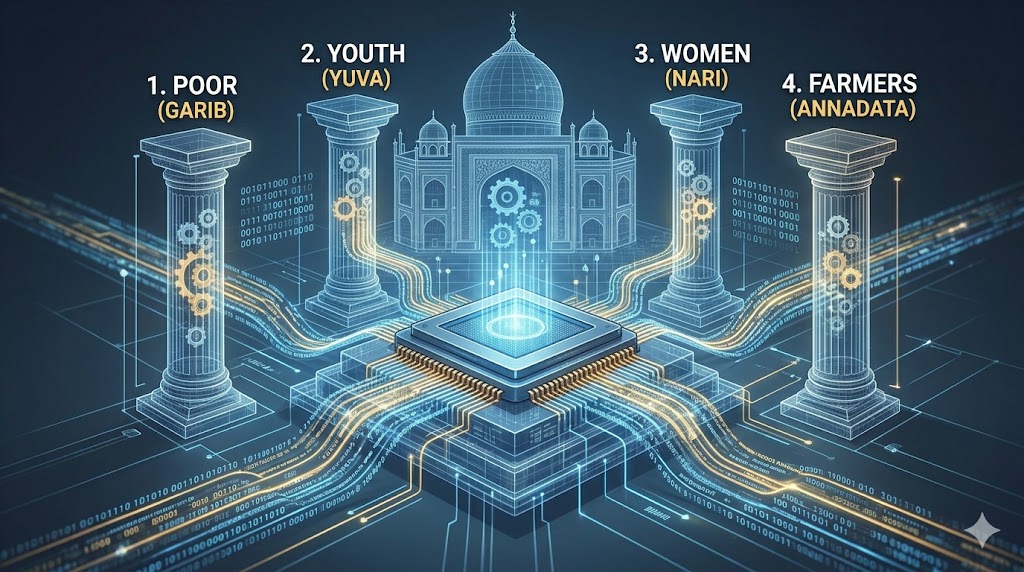
The fifth section focuses on Inclusive Development, highlighting the government’s “saturation” approach to social justice, specifically targeting the upliftment of the “Four Castes” as identified in recent policy—the Poor, Youth, Women, and Farmers (Gyan, Yuva, Mahila, and Annadata).
Section 5: Inclusive Development (Women, SC/ST & Tribals): Government Policies And Programs 100 MCQs
41. The “NAVYA Initiative,” which gained momentum in the first quarter of 2026, is a specialized sub-component of Mission Shakti. What is its primary focus?
(a) Providing interest-free home loans to single mothers in urban areas.
(b) Holistic health, menstrual hygiene, and financial literacy for adolescent girls in Aspirational Districts.
(c) Mandatory 33% reservation for women in the executive boards of all Maharatna PSUs.
(d) Training women in the semiconductor industry to increase the female labor force participation rate (LFPR).
42. Regarding the “Pradhan Mantri Janjatiya Unnat Gram Abhiyan” (PM-JUGA), which underwent a large-scale rollout in late 2025, consider the following statements:
It aims to achieve “saturation” of essential services in over 63,000 tribal-majority villages across India.
It is implemented through a “Whole-of-Government” approach involving 17 different ministries.
The mission includes a “Tribal Home Stay” component to promote eco-tourism and generate local livelihood.
Which of the statements given above are correct?
(a) 1 and 2 only
(b) 2 and 3 only
(c) 1 and 3 only
(d) 1, 2, and 3
43. With reference to the “PM Vishwakarma” scheme updates in 2026, consider the following:
The scheme provides end-to-end support to artisans and craftspeople who work with their hands and tools.
The 2026 update includes “Digital Incentives” where artisans receive a cashback for every digital transaction they perform.
The age limit for joining the scheme has been removed to accommodate elderly master-craftspersons.
Which of the statements given above is/are correct?
(a) 1 and 2 only
(b) 2 only
(c) 1 and 3 only
(d) 1, 2, and 3
44. The “SRESTHA” scheme (Scheme for Residential Education for Students in High Schools in Targeted Areas) is specifically designed for:
(a) Meritorious students belonging to Scheduled Castes (SCs) to provide them access to high-quality private residential schools.
(b) Children of migrant laborers to ensure continuity of education across state borders.
(c) Transgender students pursuing higher education in medical and engineering fields.
(d) Tribal athletes selected for the “Target Olympic Podium Scheme” (TOPS).
45. Regarding the “Namo Drone Didi” initiative, which saw its first large-scale graduation ceremony in March 2026, consider the following:
It aims to provide 15,000 drones to Women Self-Help Groups (SHGs) for agricultural purposes like liquid fertilizer and pesticide application.
The drones are provided as a 100% grant by the Central Government to the SHGs.
Which of the statements given above is/are correct?
(a) 1 only
(b) 2 only
(c) Both 1 and 2
(d) Neither 1 nor 2
46. The “SMILE” scheme (Support for Marginalized Individuals for Livelihood and Enterprise), revisited in 2025-26, contains two sub-schemes. These target which groups?
(a) Persons engaged in the act of Begging and Transgender persons.
(b) Manual scavengers and Rag-pickers.
(c) Victims of human trafficking and War widows.
(d) Differently-abled youth and HIV-positive individuals.
47. With reference to the “PM-JANMAN” (PM Janjati Adivasi Nyaya Maha Abhiyan) performance in early 2026, consider the following:
It focuses specifically on the socio-economic upliftment of Particularly Vulnerable Tribal Groups (PVTGs).
It aims to provide 11 critical interventions (like permanent housing and clean water) through a dedicated fund of over ₹24,000 crore.
Which of the statements given above is/are correct?
(a) 1 only
(b) 2 only
(c) Both 1 and 2
(d) Neither 1 nor 2
48. The “Vigyan Jyoti” program, which reached its Phase-VI in 2026, aims to:
(a) Provide solar lamps to students in non-electrified rural schools.
(b) Encourage meritorious girls to pursue a career in STEM (Science, Technology, Engineering, and Mathematics) fields.
(c) Fund space research for undergraduate students in collaboration with ISRO.
(d) Digitalize all ancient scientific manuscripts available in Indian monasteries.
49. Regarding the “Stand-Up India” scheme extension through May 2026, which of the following changes was implemented?
(a) The loan limit was increased to ₹5 crore for deep-tech startups.
(b) The “Margin Money” requirement was reduced from 25% to 15% to make credit more accessible.
(c) Loans are now exclusively reserved for women entrepreneurs only, excluding SC/ST men.
(d) The scheme was merged with the MUDRA yojana to create a “Single-Window” credit portal.
50. The “Pradhan Mantri Adarsh Gram Yojana” (PMAGY) is a scheme aimed at the integrated development of villages having:
(a) More than 50% Scheduled Caste (SC) population.
(b) More than 50% Scheduled Tribe (ST) population.
(c) A 100% literacy rate among the female population.
(d) Zero carbon emissions through renewable energy use.
Explanatory Solutions for Section 5: Government Policies And Programs 100 MCQs
(b) Explanation: NAVYA is a health and empowerment initiative. It addresses the “silent” barriers to inclusive development like menstrual hygiene and financial dependency among young girls.
(d) Explanation: All statements are correct. PM-JUGA is a massive extension of the tribal welfare philosophy, moving from PVTGs (JANMAN) to all tribal villages.
(a) Explanation: Statement 3 is false; the scheme is for the working-age population (18+), though there is no rigid upper cap that prevents traditional masters from teaching, the financial benefits are linked to active production units.
(a) Explanation: SRESTHA bridges the quality gap in education by allowing SC students to study in the best private residential schools at the government’s expense.
(a) Explanation: Statement 2 is false. The government provides an 80% subsidy (up to ₹8 lakh) for the drone, while the remaining cost is covered through a loan or SHG funds.
(a) Explanation: SMILE is a landmark scheme for social dignity. It provides comprehensive rehabilitation for those often excluded from the formal economy.
(c) Explanation: Both are correct. PVTGs are the “last of the last” in terms of development, and JANMAN is a mission-mode approach to bring them into the mainstream.
(b) Explanation: To fix the gender gap in science, Vigyan Jyoti provides exposure to girls from Grade 9 onwards to STEM careers.
(b) Explanation: By reducing the margin money, the government has lowered the “entry barrier” for SC/ST and Women entrepreneurs who may not have large initial savings.
(a) Explanation: While JUGA is for tribal-majority villages, PMAGY is the primary vehicle for achieving saturation in SC-majority villages.
The sixth section focuses on Infrastructure and Urban Governance, highlighting the evolution of the PM Gati Shakti framework, the “Saturation” phase of urban missions, and the transition toward “Climate Resilient” cities in the 2025–2026 period.
Revision Tip: Use these Government Policies and Programs 100 MCQs as a diagnostic tool. If you find yourself missing questions on ‘PM-JUGA’ or ‘NAVYA’, revisit the inclusive development chapters of the India Year Book.
Related MCQs
100 Essential Sports Current Affairs MCQs UPSC 2026: Comprehensive Guide
IMEC 100 MCQs UPSC 2026: Powerful Practice Set
Section 6: Infrastructure & Urban Governance: Government Policies And Programs 100 MCQs
51. With reference to the “PM Gati Shakti National Master Plan” (NMP) as of May 2026, consider the following statements:
The NMP is a GIS-based platform that integrates data layers from various ministries to facilitate integrated planning of infrastructure.
It has been made mandatory for all State Governments to align their “State Master Plans” with the NMP to receive “Special Assistance” for capital investment.
The platform now includes social infrastructure layers, such as the locations of all PM-SHRI schools and Ayushman Arogya Mandirs.
Which of the statements given above are correct?
(a) 1 and 2 only
(b) 2 and 3 only
(c) 1 and 3 only
(d) 1, 2, and 3
52. Regarding the “AMRUT 2.0” (Atal Mission for Rejuvenation and Urban Transformation) targets for 2026, the mission aims to achieve:
(a) 100% saturation of tap water connections in all 4,700+ Urban Local Bodies (ULBs).
(b) Conversion of all urban sewage treatment plants (STPs) to zero-liquid discharge units.
(c) Mandatory 5G connectivity in all municipal offices.
(d) Replacement of all public transport buses with hydrogen-fueled vehicles.
53. The “City Investments to Innovate, Integrate and Sustain” (CITIIS) 2.0 program, which saw major project approvals in late 2025, focuses primarily on:
(a) Building high-speed rail corridors between tier-2 cities.
(b) Promoting a “Circular Economy” with a focus on integrated waste management and climate-resilient urban infrastructure.
(c) Privatizing the collection of property taxes in metropolitan areas.
(d) Constructing low-cost housing specifically for IT sector employees.
54. In the context of the “Pradhan Mantri Awas Yojana – Urban (PMAY-U) 2.0,” launched in late 2025, consider the following:
The new phase aims to address the housing needs of 1 crore urban poor and middle-class families through interest subsidies and outright grants.
For the first time, “Working Women Hostels” and “Industrial Housing” for factory workers have been included as eligible components.
Which of the statements given above is/are correct?
(a) 1 only
(b) 2 only
(c) Both 1 and 2
(d) Neither 1 nor 2
55. The “PM-eBus Sewa” scheme, which achieved its target of deploying 10,000 electric buses in early 2026, follows which business model?
(a) Fully owned and operated by the Municipal Corporation.
(b) Public-Private Partnership (PPP) based on a “Gross Cost Contract” (GCC) model.
(c) 100% grant from the Central Government with no state contribution.
(d) Monthly subscription model for citizens similar to ride-hailing apps.
56. With reference to the “Smart Cities Mission” (SCM) sunset clause in mid-2026, consider the following:
The mission has transitioned from a “Project-Mode” to a “Service-Mode,” focusing on the Integrated Command and Control Centers (ICCCs) as the city’s brain.
All 100 Smart Cities have been mandated to become “Water Secure” under the new “Blue-Green” urban guidelines.
Which of the statements given above is/are correct?
(a) 1 only
(b) 2 only
(c) Both 1 and 2
(d) Neither 1 nor 2
57. The “Vikasit Bharat Selfie Points” and “Urban Plazas” developed in late 2025 under the ‘City Beauty Competition’ aim to:
(a) Generate revenue through high-priced entry tickets.
(b) Reclaim public spaces and improve the “Liveability Index” by focusing on aesthetics and community bonding.
(c) Provide designated areas for political rallies.
(d) Serve as temporary shelters for the homeless during winter.
58. Regarding the “National Common Mobility Card” (NCMC), which saw 100% integration across all Metro systems in India by March 2026:
It is an “Inter-operable Transport Card” that can be used for travel, toll, and retail shopping across the country.
It operates on the “One Nation One Card” principle and is based on the RuPay platform.
Which of the statements given above is/are correct?
(a) 1 only
(b) 2 only
(c) Both 1 and 2
(d) Neither 1 nor 2
59. The “Unified Urban Logistics Policy” (UULP) introduced in early 2026 targets the “Last Mile” problem in cities by:
(a) Banning all heavy trucks from entering city limits 24/7.
(b) Promoting “Multi-modal Cargo Hubs” and EV-based freight delivery in congested urban centers.
(c) Subsidizing the construction of underground tunnels for parcel delivery.
(d) Mandatory use of drones for all food and grocery deliveries.
60. The “Urban Infrastructure Development Fund” (UIDF), managed by the National Housing Bank (NHB), is specifically used for:
(a) Constructing luxury apartments in Mumbai and Delhi.
(b) Creating urban infrastructure in Tier-2 and Tier-3 cities through priority sector lending shortfalls.
(c) Funding the expansion of international airports.
(d) Providing bailouts to municipal corporations facing bankruptcy.
Explanatory Solutions for Section 6: Government Policies And Programs 100 MCQs
(d) Explanation: All statements are correct. PM Gati Shakti has evolved from a pure “logistics” tool into a “social planning” tool. Integrating schools and health centers (Statement 3) helps in identifying “infrastructure gaps” in rural and urban areas.
(a) Explanation: AMRUT 2.0 is the “saturation” mission. While sewage and transport are parts of urban governance, the primary legal and physical target for 2026 is universal water coverage.
(b) Explanation: CITIIS 2.0 is a “Waste-to-Wealth” mission. It focuses on the circular economy to ensure that the infrastructure built is sustainable and does not add to urban heat islands.
(c) Explanation: Both are correct. PMAY-U 2.0 is a major shift—it recognizes that “Urban Housing” isn’t just about owning a flat; it’s about providing safe rental options (Hostels) for the moving workforce.
(b) Explanation: The GCC model means the private operator owns and maintains the bus, while the city pays them per kilometer. This reduces the financial risk for municipalities.
(c) Explanation: Both are correct. The ICCCs are now being used for disaster management, traffic control, and health monitoring. The “Blue-Green” strategy involves reviving urban lakes and increasing tree cover.
(b) Explanation: This is part of the “Soft Infrastructure” strategy to improve the happiness index and the visual appeal of Indian cities.
(c) Explanation: Both are correct. It was developed indigenously and ensures that a commuter doesn’t need to buy different tokens for the Delhi Metro, Mumbai local, or a city bus in Bengaluru.
(b) Explanation: UULP is the city-level version of the National Logistics Policy. It focuses on reducing “Logistics Heat” in cities.
(b) Explanation: UIDF is designed to ensure that development isn’t just limited to “Mega Cities.” It uses the money that banks didn’t lend to farmers/MSMEs to build roads and parks in smaller towns.
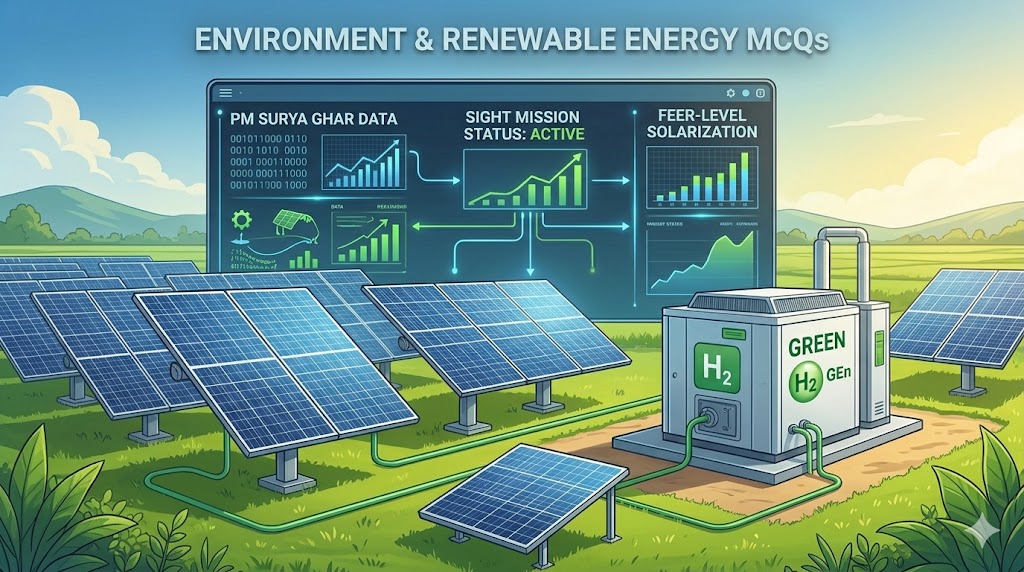
The seventh section focuses on Environment and Renewable Energy, specifically the rapid implementation of solar initiatives, the “Green Hydrogen” transition, and India’s evolving carbon market as of mid-2026.
Section 7: Environment & Renewable Energy: Government Policies And Programs 100 MCQs
61. With reference to the “PM Surya Ghar: Muft Bijli Yojana,” which achieved a 10-million-household milestone in early 2026, consider the following statements:
The scheme provides a 100% Central Government grant for solar installations up to 3kW for all rural households.
It allows households to sell “surplus” electricity back to the grid, creating an additional source of income.
All registered houses must be linked to a “National Online Portal” for real-time monitoring of power generation.
Which of the statements given above are correct?
(a) 1 and 2 only
(b) 2 and 3 only
(c) 1 and 3 only
(d) 1, 2, and 3
62. Regarding the “National Green Hydrogen Mission” (NGHM) and its progress by May 2026, consider the following:
The SIGHT (Strategic Interventions for Green Hydrogen Transition) program has successfully auctioned incentives for 1.5 million tonnes of annual Green Hydrogen production.
The mission has mandated a “Green Hydrogen Consumption” target for the fertilizer and refinery sectors starting from the 2026-27 fiscal.
Which of the statements given above is/are correct?
(a) 1 only
(b) 2 only
(c) Both 1 and 2
(d) Neither 1 nor 2
63. The “Carbon Credit Trading Scheme” (CCTS), fully operationalized in late 2025, is managed by which of the following bodies?
(a) The Ministry of Environment, Forest and Climate Change (MoEFCC)
(b) The Bureau of Energy Efficiency (BEE)
(c) The Securities and Exchange Board of India (SEBI)
(d) The National Carbon Registry of India (NCRI)
64. In the context of “Mission LiFE” (Lifestyle for Environment) 2.0 (2026), the “Green Credit Program” (GCP) differs from traditional carbon trading because:
(a) It only applies to individuals and not to corporate entities.
(b) It incentivizes voluntary environmental actions (like water conservation and afforestation) that go beyond just carbon emissions.
(c) The credits earned can only be used to pay income tax and cannot be traded.
(d) It is mandatory for all citizens to earn at least 10 Green Credits per year.
65. Consider the following regarding the “PM-KUSUM” scheme extension through 2026:
Component-C of the scheme involves the solarization of 15 lakh grid-connected agriculture pumps.
The scheme has transitioned to a “Feeder-Level Solarization” model to ensure 24/7 power for farmers during daytime.
Which of the statements given above is/are correct?
(a) 1 only
(b) 2 only
(c) Both 1 and 2
(d) Neither 1 nor 2
66. The “Ekowari” movement, highlighted in early 2026 environmental reports, is an initiative focused on:
(a) Cleaning the high-altitude glacial lakes in the Himalayas.
(b) Promoting indigenous and eco-friendly practices during traditional Indian pilgrimages.
(c) Using AI to track the migration patterns of Olive Ridley turtles.
(d) Banning the use of single-use plastics in the luxury hospitality sector.
67. With reference to the “National Biofuel Policy” 2026 updates, the target for 20% Ethanol Blending in Petrol (E20) has been:
(a) Pushed back to 2030 due to supply chain issues.
(b) Achieved ahead of schedule, with the new target being 30% blending (E30) by 2030.
(c) Replaced with a “Flex-Fuel Only” mandate for all new vehicles.
(d) Restricted to only non-food grain feedstocks like bamboo and agricultural residue.
68. Regarding “Project GIB” (Great Indian Bustard) and the 2026 conservation efforts, the Supreme Court of India mandated:
(a) The relocation of the entire GIB population to the African savannah.
(b) The undergrounding of all high-voltage power lines in “Priority GIB habitats” to prevent collisions.
(c) A complete ban on solar and wind energy projects in the states of Rajasthan and Gujarat.
(d) The creation of a “Trans-national Corridor” between India and Pakistan.
69. The “Blue Economy 2.0” framework, launched in late 2025, focuses on:
(a) Constructing high-speed sea-links between Mumbai and Maldives.
(b) Promoting climate-resilient coastal aquaculture and “Integrated Coastal Zone Management.”
(c) Increasing the extraction of Deep-Sea minerals to 100 million tonnes per year.
(d) Privatizing all major ports to international shipping conglomerates.
70. The “International Solar Alliance” (ISA) launched the “Global Solar Facility” in early 2026 to:
(a) Provide insurance and capital for solar projects in “least developed countries” and small island nations.
(b) Construct a single global grid connecting all continents via undersea solar cables.
(c) Standardize the price of solar panels globally to prevent Chinese dominance.
(d) Fund space-based solar power research.
Explanatory Solutions for Section 7: Government Policies And Programs 100 MCQs
61. (b)
Explanation: Statement 1 is incorrect. While the PM Surya Ghar: Muft Bijli Yojana provides high subsidies (up to 60-70%), it is not a 100% grant. Households often bridge the remaining cost through collateral-free, low-interest loans. Statements 2 and 3 are correct as the scheme focuses on “Prosumers” (Producers + Consumers) and digital monitoring.
62. (c)
Explanation: Both statements are correct. The SIGHT program is the financial incentive arm of the Green Hydrogen Mission. By May 2026, the government has transitioned from just supporting production to mandating consumption in heavy industries like refineries to ensure market stability.
63. (b)
Explanation: The Bureau of Energy Efficiency (BEE) is the nodal agency for the Carbon Credit Trading Scheme (CCTS) under the Energy Conservation Act. It develops the trajectories and targets for “Obligated Entities.”
64. (b)
Explanation: Unlike traditional carbon markets that focus strictly on $CO_2$ emissions, the Green Credit Program (GCP) is holistic. It allows individuals and cooperatives to earn credits for voluntary actions like water conservation, waste management, and mangrove restoration.
65. (c)
Explanation: Both are correct. The 2026 extension of PM-KUSUM emphasizes Feeder-level Solarization. This is more efficient than solarizing individual pumps because it allows an entire agricultural electricity line to be powered by a local solar plant.
66. (b)
Explanation: The Ekowari movement is a cultural-environmental initiative. It promotes sustainable, zero-waste practices during major traditional pilgrimages (like the Wari in Maharashtra), aligning religious traditions with modern environmental goals.
67. (b)
Explanation: India achieved the E20 (20% Ethanol Blending) target ahead of schedule in late 2025. Consequently, the 2026 policy update has set an ambitious new roadmap for E30 (30% blending) by 2030 to further reduce oil import bills.
68. (b)
Explanation: In a landmark balancing act between renewable energy and biodiversity, the Supreme Court mandated the undergrounding of power lines in the Great Indian Bustard (GIB) priority habitats in Rajasthan and Gujarat to prevent bird-hit mortalities.
69. (b)
Explanation: Blue Economy 2.0 shifts the focus from “resource extraction” to “restoration and resilience.” It prioritizes the socio-economic upliftment of coastal communities through sustainable aquaculture and carbon-sequestering “Integrated Coastal Zone Management.”
70. (a)
Explanation: The Global Solar Facility (GSF) was launched by the ISA to provide “Payment Guarantee Funds” and insurance. Its goal is to unlock private investment in solar projects specifically within the Least Developed Countries (LDCs) and Small Island Developing States (SIDS).
The eighth section covers the Digital India and Governance 2.0 landscape. As of mid-2026, the focus has shifted from mere connectivity to Artificial Intelligence (AI) sovereignty, ethical data governance, and the integration of the “India Stack” into daily administrative life.
Section 8: Digital India & Governance 2.0: Government Policies And Programs 100 MCQs
71. With reference to the “India AI Mission,” which received its first major implementation phase in late 2025, consider the following statements:
The mission aims to establish a “Sovereign AI Compute Capacity” of 10,000 GPUs to support startups and academia.
It includes a “Bhashini” component which focuses on real-time AI-based translation for all 22 scheduled Indian languages.
The “AI Innovation Centre” under this mission is a private-sector body that operates without government oversight to ensure speed.
Which of the statements given above are correct?
(a) 1 and 2 only
(b) 2 and 3 only
(c) 1 and 3 only
(d) 1, 2, and 3
72. Regarding the “Digital Personal Data Protection (DPDP) Act” implementation rules notified in late 2025, consider the following:
It introduces the concept of a “Data Fiduciary” who must obtain “Free, Specific, Informed, and Unambiguous” consent from the Data Principal.
The Act provides for a “Right to Erasure,” allowing individuals to demand the deletion of their personal data once the purpose of collection is served.
Which of the statements given above is/are correct?
(a) 1 only
(b) 2 only
(c) Both 1 and 2
(d) Neither 1 nor 2
73. The “Bhashini” app, which was integrated into several government portals in early 2026, primarily utilizes:
(a) Satellite imagery to map linguistic boundaries in India.
(b) Crowdsourced voice data (Bhasha Daan) to train AI models in local dialects.
(c) Blockchain to encrypt government circulars in regional languages.
(d) Manual translators employed at the district level for real-time help.
74. In the context of the “National Data Governance Policy” (NDGP) 2026, the “India Datasets Platform” (IDP) serves as:
(a) A centralized server to store the banking passwords of all Indian citizens.
(b) A platform that provides anonymized, non-personal data to Indian startups and researchers for AI training.
(c) A mandatory backup for all private social media companies operating in India.
(d) A surveillance tool used to monitor international digital transactions.
75. The “Agri-Stack” and “Health-Stack,” which achieved interoperability in May 2026, are part of the broader “Digital Public Infrastructure” (DPI). The core philosophy of India’s DPI is:
(a) Proprietary software owned by a few licensed corporations.
(b) Open-source, interoperable, and scalable digital building blocks.
(c) Mandatory hardware subsidies for all smartphone users.
(d) Banning all international digital platforms to promote local alternatives.
76. With reference to the “Digital Intelligence Unit” (DIU), a specialized cell highlighted in early 2026 for cyber-security, its primary role is to:
(a) Manufacture indigenous microchips for defense purposes.
(b) Investigate and prevent the fraudulent use of telecom resources (e.g., spam and financial fraud).
(c) Provide 24/7 technical support for the “DigiLocker” app.
(d) Monitor the internet speed across rural broadband networks.
77. The “Sanchar Saathi” portal, expanded in late 2025, allows a citizen to:
Check the number of mobile connections registered in their name.
Block lost or stolen mobile handsets across the country.
Report “International Calls” that appear as Indian numbers (CLI spoofing).
Which of the statements given above are correct?
(a) 1 and 2 only
(b) 2 and 3 only
(c) 1 and 3 only
(d) 1, 2, and 3
78. Regarding the “E-Rupee” (Central Bank Digital Currency – CBDC) progress by May 2026, which of the following is true?
(a) It has completely replaced physical cash for all transactions above ₹10,000.
(b) It allows for “Programmable Payments,” where funds (like subsidies) can be restricted for a specific use (e.g., only for fertilizers).
(c) It requires a constant internet connection for both the sender and the receiver (no offline mode).
(d) It is only available for inter-bank wholesale transactions and not for retail users.
79. The “Digital India Bhashini” mission’s “Voice-to-Voice” translation was used during the 2025-26 Parliament sessions to:
(a) Automatically transcribe speeches into the Official Gazette.
(b) Provide real-time audio translation of speeches to MPs in their preferred regional language.
(c) Identify the emotional tone of the speaker to predict disruptions.
(d) Limit the speaking time of members automatically.
80. The “Jan Vishwas (Amendment of Provisions) Act,” fully enforced in early 2026, aims to improve the “Ease of Living” and “Ease of Doing Business” by:
(a) Granting free legal aid to all startups.
(b) Decriminalizing minor offenses across 42 central Acts, replacing imprisonment with monetary penalties.
(c) Removing the requirement for an Aadhaar card for all government services.
(d) Standardizing the GST rates for all digital services.
Explanatory Solutions for Section 8: Government Policies And Programs 100 MCQs
(a) Explanation: Statement 3 is false. The AI Innovation Centre is a government-anchored body (under MeitY) designed to ensure that AI development follows the “Safe & Trusted” principles of the India AI Mission.
(c) Explanation: Both are correct. The DPDP Act 2023 (implemented in 2025-26) is India’s first comprehensive privacy law, balancing individual rights with lawful data processing.
(b) Explanation: Bhashini relies on “Bhasha Daan,” where citizens contribute their voice and text in their mother tongue to help AI understand diverse Indian accents and nuances.
(b) Explanation: IDP is about “Data Empowerment.” By providing high-quality non-personal data (like weather patterns or traffic flow), the government enables startups to build AI models without violating personal privacy.
(b) Explanation: India’s DPI (Aadhaar, UPI, DigiLocker) is unique because it is “Public” and “Open,” unlike the private-silo models seen in the US or the state-monopoly model in China.
(b) Explanation: DIU is the “Enforcement” arm of the Department of Telecommunications, specifically targeting the rise in AI-voice cloning and digital arrest scams prevalent in 2025-26.
(d) Explanation: All are correct. Sanchar Saathi is a “Citizen-Centric” digital security tool that empowers users to manage their own digital identity.
(b) Explanation: “Programmability” is the killer feature of CBDC. For example, the government can send “Education E-Rupee” that can only be spent at a bookstore or school.
(b) Explanation: This was a major technological milestone for Indian democracy, effectively removing the language barrier in the house.
(b) Explanation: This is about “Trust-based Governance.” It reduces the “fear of the law” for small errors (like clerical mistakes), fostering a better business environment.
The ninth section focuses on Defense and Strategic Policy, emphasizing India’s push for “Aatmanirbharta” (Self-Reliance), the integration of deep-tech in warfare through the iDEX framework, and the evolving geopolitical posture in the Indo-Pacific as of mid-2026.
Digital Governance: These Government Policies and Programs 100 MCQs highlight the transition toward AI sovereignty. Understanding the ‘Bhashini’ and ‘DPDP Act’ frameworks is crucial for scoring high this year.
Section 9: Defense & Strategic Policy: Government Policies And Programs 100 MCQs
81. With reference to the “iDEX-ADITI” (Acing Development of Innovative Technologies with iDEX) scheme, which saw its second phase launch in late 2025, consider the following statements:
It specifically targets the development of “Deep-Tech” strategic areas like Space-Tech, Quantum Computing, and Anti-Drone systems.
Under this scheme, startups are eligible for a grant-in-aid of up to ₹25 crore to develop prototypes for the Armed Forces.
It is managed by the Defense Innovation Organisation (DIO) under the Ministry of Defence.
Which of the statements given above are correct?
(a) 1 and 2 only
(b) 2 and 3 only
(c) 1 and 3 only
(d) 1, 2, and 3
82. Regarding the “Positive Indigenisation Lists” (PILs), the 6th list released in early 2026 reached a significant milestone. This implies that:
(a) The listed items can only be manufactured by Public Sector Undertakings (PSUs).
(b) The Armed Forces are prohibited from importing the items on this list, mandating procurement from domestic industry.
(c) The items on the list are exported to friendly foreign countries to increase defense revenue.
(d) Private companies on this list are granted a “tax-free” status for 10 years.
83. In the context of “Integrated Theatre Commands” (ITCs), which moved toward full operationalization in mid-2026, the primary goal is:
(a) To replace all civilian bureaucrats in the Ministry of Defence with military officers.
(b) To create unified commands where assets of the Army, Navy, and Air Force are pooled under a single commander for a specific geographical region.
(c) To ensure that every state in India has a dedicated military regiment.
(d) To automate the process of border surveillance using AI without human intervention.
84. The “Project Akashteer,” which achieved 100% deployment across India’s northern borders in early 2026, is best described as:
(a) A high-altitude mountain warfare training center in Ladakh.
(b) An automated Air Defence Control and Reporting System that integrates all radars and sensors into a single network.
(c) A deep-sea submarine cable connecting the Andaman Islands to the Australian coast.
(d) A government-funded project to build underground bunkers for civilians in border villages.
85. With reference to the “Agnipath Scheme” 4-year review conducted in late 2025, which of the following updates was implemented?
(a) The technical entry age was increased to 25 years to attract engineering graduates.
(b) The percentage of ‘Agniveers’ to be retained in the permanent cadre was increased from 25% to up to 50% for specialized technical wings.
(c) The “Seva Nidhi” package was made tax-exempt but non-transferable to family members.
(d) The scheme was expanded to include mandatory 1-year service for all IAS and IPS officers.
86. The “MILAN 2026” exercise, held in the Indian Ocean, was notable for:
(a) Being the first-ever joint exercise between India, USA, Russia, and China.
(b) Its focus on “Submarine Rescue Operations” and “Maritime Domain Awareness” among 50+ participating navies.
(c) The use of only indigenously developed warships and drones.
(d) Both (b) and (c).
87. Regarding “Mission DefSpace,” consider the following:
It aims to develop innovative solutions for the three Services in the space domain through startups and industry.
One of its key 2026 challenges involves the development of “Satellite-to-Satellite” communication for tactical battlefield data.
Which of the statements given above is/are correct?
(a) 1 only
(b) 2 only
(c) Both 1 and 2
(d) Neither 1 nor 2
88. The “Ugram” (Fierce), which entered mass production in early 2026, is:
(a) India’s first indigenously developed 7.62 x 51mm Assault Rifle.
(b) A high-speed stealth drone designed for long-range surveillance.
(c) A heavy-lift transport aircraft manufactured in collaboration with Airbus.
(d) An anti-tank guided missile with a range of 10 km.
89. With reference to the “Indo-Pacific Oceans Initiative” (IPOI) progress in 2025-26, India’s role as the “Net Security Provider” primarily involves:
(a) Charging a “security fee” from all merchant ships passing through the Malacca Strait.
(b) Capacity building, disaster relief (HADR), and anti-piracy operations in the Indian Ocean Region.
(c) Establishing permanent military bases in the South China Sea.
(d) Acting as the sole mediator for all maritime border disputes in Asia.
90. The “Prachand” (Light Combat Helicopter – LCH), which saw the induction of its first full squadron in 2026, is unique because:
(a) It is the only combat helicopter in the world that can land and take off at an altitude of 5,000 meters (Siachen Glacier).
(b) It is powered by a hybrid-electric engine that makes it invisible to heat-seeking missiles.
(c) It can be operated entirely via a satellite link from Delhi without a pilot on board.
(d) It is made entirely of recycled carbon fiber from decommissioned warships.
Explanatory Solutions for Section 9: Government Policies And Programs 100 MCQs
(d) Explanation: All statements are correct. ADITI is the “Deep-Tech” arm of iDEX, designed to fund the extremely expensive R&D needed for futuristic warfare (Statement 2 grant amount is correct).
(b) Explanation: PILs are the most powerful tool for “Aatmanirbharta.” Once an item is on the list, the MoD is legally bound to buy it from an Indian vendor (Private or PSU), effectively banning imports of those items.
(b) Explanation: ITCs represent the biggest reform in Indian military history, moving away from “Silo-based” operations (where Army/Navy/Air Force acted separately) to a “Joint” approach.
(b) Explanation: Akashteer is the “Digital Eye” of India’s Air Defence. It allows the Army to see all aircraft, drones, and missiles in a unified digital map to prevent “friendly fire” and ensure rapid response.
(b) Explanation: Following feedback, the 2025 review adjusted the retention percentage to ensure that high-skill technical personnel (needed for modern electronic warfare) stay in the force longer.
(d) Explanation: MILAN is India’s premier “Naval Diplomacy” event. The 2026 edition was a showcase of Indian-made frigates and destroyers, emphasizing India’s lead in the “Blue Economy” and security.
(c) Explanation: Both are correct. DefSpace is to “Space” what iDEX is to “Land/Air/Sea.” It focuses on making space assets “Battle-Ready.”
(a) Explanation: Developed by DRDO in collaboration with a private firm, Ugram is meant to replace the ageing INSAS rifles, proving India’s capability in small-arms manufacturing.
(b) Explanation: Being a “Net Security Provider” means India takes the lead in ensuring the “Global Commons” (seas) stay open and safe for everyone, without being an expansionist power.
(a) Explanation: High-altitude performance is the LCH’s “USP.” It was specifically designed for the challenges of the Himalayan borders, where Western helicopters often struggle to operate.
The final section covers Reports, Indices, and Miscellaneous Policies, focusing on how India’s domestic policies translate into global rankings and the analytical frameworks used by NITI Aayog to measure progress toward Viksit Bharat 2047.
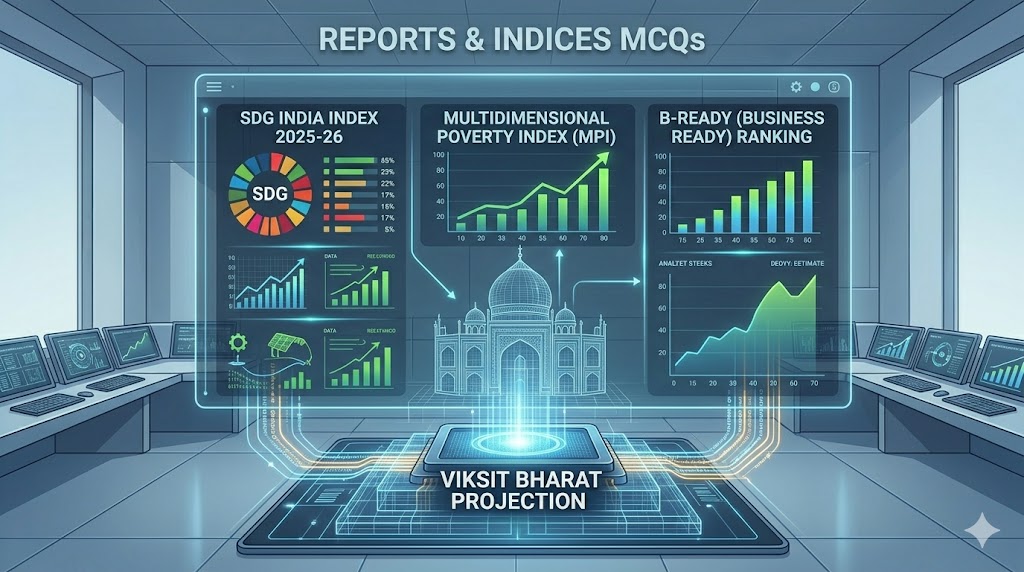
Section 10: Reports, Indices & Miscellaneous: Government Policies And Programs 100 MCQs
“The measurement of India’s progress toward the 2030 global goals is meticulously documented in the NITI Aayog Official Reports and SDG India Index, which provides the statistical backbone for our analytical questions.”
91. With reference to the “SDG India Index 2025-26” released by NITI Aayog, consider the following statements:
It tracks the progress of all States and UTs on 113 indicators aligned with the UN Sustainable Development Goals.
For the first time, “Climate Resilience” has been added as a standalone thematic pillar with a weightage of 20%.
The index classifies States into four categories: Aspirant, Performer, Front Runner, and Achiever.
Which of the statements given above are correct?
(a) 1 and 2 only
(b) 1 and 3 only
(c) 2 and 3 only
(d) 1, 2, and 3
92. The “B-READY” (Business Ready) report, which replaced the “Ease of Doing Business” index, released its 2025-26 edition. In this context, India’s performance was notably high in:
(a) The “Market Entry” pillar due to the digitalization of business registrations via the Unified Filing Process (UFP).
(b) The “Labor Flexibility” pillar due to the complete abolition of all labor unions.
(c) The “Environmental Regulations” pillar by mandating 100% solar power for all MSMEs.
(d) The “International Trade” pillar by banning all imports from non-quad nations.
93. The “State Food Safety Index (SFSI) 2025-26,” published by FSSAI, introduced a new parameter called:
(a) “Pesticide-Free Certification” for all street food hubs.
(b) “Consumer Empowerment” through digital transparency and the ‘Eat Right’ movement.
(c) “Export Readiness” of state-level food processing units.
(d) “Calorie Mapping” of all school mid-day meals.
94. Regarding the “National Multidimensional Poverty Index (MPI): A Progress Review 2026,” consider the following:
It uses the three equally weighted dimensions of Health, Education, and Standard of Living.
The 2026 report highlights that India has successfully moved 25 crore people out of multidimensional poverty over the last decade.
Which of the statements given above is/are correct?
(a) 1 only
(b) 2 only
(c) Both 1 and 2
(d) Neither 1 nor 2
95. The “Logistics Ease Across Different States (LEADS) 2025-26” report classifies states into three categories based on their logistics ecosystem. These are:
(a) Achievers, Fast Movers, and Aspirants.
(b) Leaders, Followers, and Beginners.
(c) Global Hubs, National Links, and Local Units.
(d) Coastal, Landlocked, and Himalayan.
96. With reference to the “Global Innovation Index (GII) 2025,” where India maintained its upward trajectory, which “Innovation Output” pillar contributed most to India’s rank?
(a) Information and Communication Technology (ICT) services exports.
(b) The number of PhD graduates in Sanskrit literature.
(c) The total volume of physical books printed in regional languages.
(d) The number of international film awards won by Indian directors.
97. The “Panchayat Development Index” (PDI), which saw its first national-scale ranking in early 2026, aims to:
(a) Select the “Best Sarpanch” for a Rajya Sabha nomination.
(b) Measure the “Localization of SDGs” at the grassroots level across 2.5 lakh Gram Panchayats.
(c) Digitize the land records of only those villages that have a 100% literacy rate.
(d) Replace the existing PRIs with a direct digital democracy model.
98. Regarding the “Viksit Bharat @2047” ideation portal and policy paper (2026), the “Middle-Income Trap” is discussed as a challenge. This trap refers to:
(a) A situation where a country’s population stops growing, leading to a labor shortage.
(b) A stage where a country gets stuck at a certain income level and fails to transition to a high-income economy.
(c) A tax system where the middle class pays more than the ultra-wealthy.
(d) A condition where citizens prefer government subsidies over private-sector jobs.
99. The “World Press Freedom Index 2026” and India’s response to it focused on the “methodological transparency” of the report. Geopolitically, India’s stand on such global indices is that:
(a) They should be ignored completely as they are “Western Propaganda.”
(b) They should incorporate “local context” and use “objective data” rather than “subjective perceptions.”
(c) India should launch its own global index and ban all other international rankings.
(d) India should only accept rankings where it is in the Top 10.
100. The “National Manifesto for Circular Economy” (2026) covers 11 priority sectors. Which of the following is NOT a core focus of this manifesto?
(a) Lithium-ion battery recycling.
(b) Scrap metal utilization in steel production.
(c) Increasing the production of single-use plastic for medical tourism.
(d) E-waste management and precious metal recovery.
Explanatory Solutions for Section 10: Government Policies And Programs 100 MCQs
(b) Explanation: Statement 2 is false. While climate is a focus, the NITI Aayog index follows the 17 UN SDGs; “Climate Action” is Goal 13. It does not have a 20% standalone weightage override. Statements 1 and 3 are correct.
(a) Explanation: India’s digital transformation (UFP, PAN as a single ID, and Jan Vishwas Act decriminalization) made it a “top improver” in the Business Entry and Business Operations pillars of the World Bank’s B-READY framework.
(b) Explanation: SFSI 2025-26 emphasized that food safety is not just a regulatory job but requires “Consumer Empowerment” (training consumers to check for adulteration).
(c) Explanation: Both are correct. The MPI is a critical “twisted” topic for UPSC. India’s steep decline in poverty is largely attributed to “Standard of Living” improvements (Sanitation, Cooking Fuel, Electricity).
(a) Explanation: This is the standard nomenclature used by the Ministry of Commerce. “Achievers” are states like Gujarat and Haryana with established logistics backbones.
(a) Explanation: India is a global leader in ICT services exports. Our GII rank is driven by our digital economy and the massive number of science and engineering graduates.
(b) Explanation: PDI is about “Granular Development.” It ensures that the Global Goals (SDGs) are not just discussed in Delhi or New York but are measured at the village level.
(b) Explanation: This is a major economic hurdle. To avoid this, the 2026 policy focuses on moving from “Low-skill manufacturing” to “High-tech innovation.”
(b) Explanation: India has consistently argued at international forums that “perception-based” indices are flawed and has called for a “Sovereign Rating” framework that is data-driven.
(c) Explanation: Circular economy is the opposite of single-use. It focuses on the “Reduce, Reuse, Recycle” model to ensure resources stay in the economy longer.
Recommended Reading-
UPSC Science and Technology Syllabus 2027: Powerful Topic-Wise Guide
100 Important World Current Affairs MCQs for UPSC Prelims 2027
100 Powerful CSAT Percentage MCQs 2026
CSAT 2026 Strategy to Clear UPSC Prelims Paper 2
100 Powerful Iran Israel War MCQs 2026
Conclusion: Government Policies and Programs 100 MCQs
“Staying updated with Government Policies and Programs 100 MCQs is the most efficient way to secure marks in the GS Paper 1. We hope this comprehensive set of Government Policies and Programs 100 MCQs for UPSC 2026 helps clarify the complex implementation details of the July 2025–May 2026 cycle. For more analytical content and mock tests, keep following Knowledge Chronicles Plus.”
6 thoughts on “Government Policies and Programs 100 MCQs for Proven UPSC 2026 Success”