
Introduction
Ancient Indian History is an important part of the History section of the UPSC Civil Services Preliminary Examination. It provides valuable insights into the development of early Indian civilizations, political institutions, religious traditions, social structures, economic activities, art, architecture and literature.
For effective preparation, candidates should develop a clear understanding of the major historical periods, important dynasties, archaeological discoveries, religious movements and cultural developments. From the prehistoric period and the Indus Valley Civilization to the Mauryan and Gupta Empires, ancient India witnessed several significant transformations that shaped the country’s historical and cultural identity.
This comprehensive guide on Ancient Indian History for UPSC Prelims 2027 covers the important topics in a systematic manner. It includes prehistoric cultures, Harappan civilization, the Vedic period, Mahajanapadas, Buddhism, Jainism, major ancient empires, South Indian kingdoms and important contributions to Indian art, architecture, science and literature.
Whether you are beginning your preparation or revising important historical developments, these notes will help you build a strong foundation in Ancient Indian History.
Ancient Indian History for UPSC Prelims 2027 is an important part of the General Studies syllabus, covering the evolution of Indian civilization, political developments, religious movements and cultural achievements.
For a broader understanding of India’s historical development, including Ancient, Medieval and Modern History, explore our comprehensive guide on History of India UPSC 2027: Complete Study Guide, Key Facts & Important Topics.
Ancient Indian History for UPSC Prelims 2027: Important Topics and Syllabus
Ancient Indian History covers a long period of human development, from early prehistoric settlements to the emergence and expansion of powerful kingdoms and empires.
For systematic UPSC preparation, candidates should organise the subject into the following major areas:
- Prehistoric Period: Paleolithic, Mesolithic and Neolithic Ages
- Indus Valley Civilization and Harappan Culture
- Vedic Period: Early and Later Vedic Age
- Mahajanapadas and Rise of Magadha
- Buddhism and Jainism
- Mauryan Empire and Ashoka
- Post-Mauryan Period: Indo-Greeks, Shakas, Kushanas and Satavahanas
- Gupta Empire and Post-Gupta Period
- Harshavardhana and Regional Kingdoms
- Sangam Age and Ancient South Indian Kingdoms
- Ancient Indian Art, Architecture and Literature
- Ancient Science, Mathematics and Education
These topics provide a useful framework for studying the Ancient History of India for UPSC. Candidates should also connect historical events with archaeological evidence, inscriptions, literary sources and geographical locations.
After completing these comprehensive Ancient Indian History notes, test your knowledge and revise important historical facts with our practice resource featuring 100 Ancient Indian History MCQs for UPSC Prelims 2027: Important Questions with Answers.

Prehistoric Period in India: Paleolithic, Mesolithic and Neolithic Ages
The prehistoric period refers to the time before the development of written historical records. Information about this period is mainly obtained through archaeological discoveries, stone tools, fossils, cave paintings and other material remains.
The prehistoric period in India is generally studied through three major stages: Paleolithic, Mesolithic and Neolithic.
Paleolithic Age (Old Stone Age)
The Paleolithic Age represents the earliest phase of human development in the Indian subcontinent.
Important characteristics include:
- Humans mainly depended on hunting and gathering.
- Stone tools were generally large and relatively crude.
- People lived in caves, rock shelters and temporary settlements.
- Knowledge of agriculture and settled farming was not yet developed.
Important archaeological sites:
- Bhimbetka – Madhya Pradesh
- Hunsgi – Karnataka
- Attirampakkam – Tamil Nadu
- Soan Valley – Present-day Pakistan
The Bhimbetka rock shelters are particularly important for their prehistoric archaeological remains and rock paintings.
Mesolithic Age (Middle Stone Age)
The Mesolithic period represents a transitional stage between the Paleolithic and Neolithic periods.
Its major features include:
- Use of microliths or small stone tools.
- Increased use of hunting, fishing and gathering.
- Evidence of semi-settled lifestyles.
- Early evidence of animal domestication in some regions.
- Development of rock paintings and artistic expressions.
Important Mesolithic sites include Bagor in Rajasthan, Adamgarh in Madhya Pradesh and Langhnaj in Gujarat.
Neolithic Age (New Stone Age)
The Neolithic period witnessed significant changes in human life through the development of agriculture and settled communities.
Important characteristics include:
- Beginning of food production and agriculture.
- Domestication of animals.
- Use of polished stone tools.
- Development of permanent settlements.
- Pottery and improved storage practices.
Important Neolithic sites include Burzahom in Kashmir, Mehrgarh in present-day Pakistan, Chirand in Bihar and Daojali Hading in Assam.
UPSC Important Fact: Burzahom is known for its pit dwellings, while Mehrgarh provides important evidence of early agriculture and animal domestication in the northwestern subcontinent.
Understanding the Prehistoric Period is essential for building a strong foundation in Ancient Indian History for UPSC Prelims 2027.
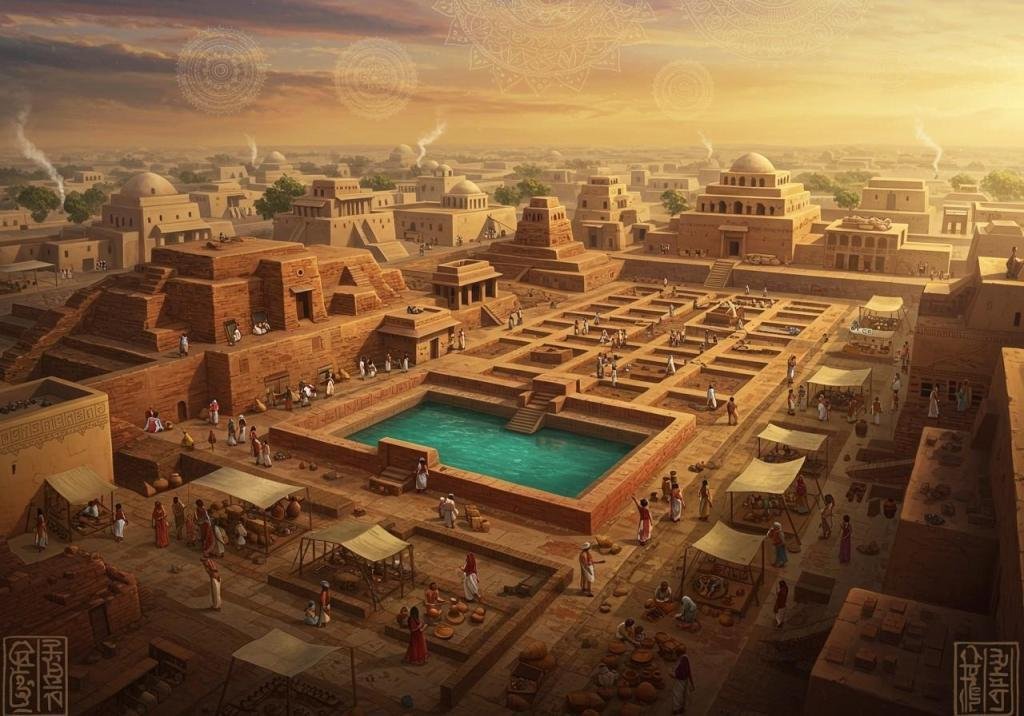
Indus Valley Civilization UPSC: Harappan Culture and Important Features
The Indus Valley Civilization, also known as the Harappan Civilization, was one of the earliest urban civilizations of the Indian subcontinent.
It developed around the Indus River system and its neighbouring regions. The Mature Harappan phase is generally dated to approximately 2600–1900 BCE.
The civilization is known for its planned cities, drainage systems, standardised weights, craft production, trade networks and distinctive material culture.
Major Features of Harappan Culture
The important features of Harappan culture include:
1. Town Planning
Harappan cities displayed remarkable urban planning. Streets were often laid out in an organised pattern, and many settlements had carefully constructed residential areas.
2. Drainage System
Covered drains, bathing areas and household wastewater arrangements indicate an advanced approach to urban sanitation.
3. Great Bath
The Great Bath at Mohenjo-daro is one of the most famous structures associated with the Harappan Civilization.
4. Agriculture and Animal Domestication
Agriculture formed an important part of the economy. Wheat, barley and other crops were cultivated, while cattle, sheep and goats were among the domesticated animals.
5. Trade and Commerce
Harappan communities maintained internal and external trade networks. Archaeological evidence suggests commercial connections with Mesopotamia and other regions.
6. Seals and Script
Harappan seals frequently contained animal motifs and inscriptions. The Harappan script remains undeciphered.
7. Crafts and Technology
The people produced pottery, beads, ornaments, metal objects and other craft items. The use of bronze, copper and specialised craft techniques demonstrates their technological skills.
The Indus Valley Civilization remains one of the most important topics in Ancient Indian History for UPSC Prelims 2027 because of its urban planning, trade networks and archaeological significance.
To explore the distinctive characteristics of Harappan society, including town planning, trade, crafts, seals and pottery, check out 10 Powerful Key Features of Harappan Culture (UPSC Prelims 2027 Guide).
Important Harappan Sites and Their Features
| Harappan Site | Important Feature |
|---|---|
| Harappa | One of the earliest excavated Harappan sites |
| Mohenjo-daro | Great Bath |
| Dholavira | Sophisticated water management and reservoirs |
| Lothal | Dockyard-related structure and trade |
| Kalibangan | Evidence of a ploughed field and fire altars |
| Rakhigarhi | One of the largest known Harappan settlements |
| Banawali | Harappan settlement in Haryana |
| Chanhudaro | Important craft-production centre |
The study of Harappan urban planning, trade, pottery, seals and archaeological sites is particularly useful for UPSC preparation.
For a more detailed understanding of Harappan cities, town planning, drainage systems, important sites and archaeological discoveries, read our comprehensive guide on Indus Valley Civilization Notes UPSC 2027: Complete & Important Guide.
Vedic Period in Ancient India: Early and Later Vedic Age
The Vedic period is an important phase in Ancient Indian History because it provides information about early Indian society, religious traditions, political institutions, literature and economic activities.
The period is generally divided into two stages: the Early Vedic Period and the Later Vedic Period.
Early Vedic Period (c. 1500–1000 BCE)
The Early Vedic Period is primarily associated with the Rigveda, the oldest among the four Vedas.
Important characteristics include:
- Society was largely pastoral.
- Cattle were an important measure of wealth.
- Agriculture was known but was not the dominant economic activity.
- Tribal political organisation was prominent.
- Sabha and Samiti were important assemblies.
- Religious practices involved the worship of natural forces.
The Rigveda contains hymns dedicated to deities such as Indra, Agni, Varuna and Soma.
Later Vedic Period (c. 1000–600 BCE)
During the Later Vedic Period, significant changes occurred in social, political and economic organisation.
Important developments included:
- Expansion of agriculture, particularly towards the Ganga-Yamuna region.
- Greater use of iron in some regions.
- Growth of territorial kingdoms.
- Increasing complexity of social organisation.
- Development of elaborate religious rituals.
- Expansion of Vedic literature.
The Later Vedic literature includes the Samhitas, Brahmanas, Aranyakas and Upanishads.
Four Vedas and Their Importance
| Veda | Important Association |
|---|---|
| Rigveda | Hymns and prayers |
| Samaveda | Melodies and chants |
| Yajurveda | Sacrificial rituals |
| Atharvaveda | Spells, prayers and everyday concerns |
Important UPSC Fact: The Rigveda is the oldest of the four Vedas. The Upanishads are important philosophical texts associated with the development of ideas about Brahman, Atman and liberation.
The Early and Later Vedic Periods help explain the social, political and religious transformation of ancient Indian society, making them essential topics for Ancient Indian History for UPSC Prelims 2027.

Mahajanapadas and the Rise of Magadha
Around the sixth century BCE, northern India witnessed the emergence of large territorial states known as the Mahajanapadas.
Buddhist and Jain literary traditions refer to sixteen major Mahajanapadas. Their emergence reflected changes in agriculture, trade, urbanisation and political organisation.
Sixteen Mahajanapadas
The commonly listed sixteen Mahajanapadas include:
- Anga
- Magadha
- Kashi
- Kosala
- Vajji
- Malla
- Chedi
- Vatsa
- Kuru
- Panchala
- Matsya
- Surasena
- Assaka (Ashmaka)
- Avanti
- Gandhara
- Kamboja
Why Did Magadha Become Powerful?
Magadha gradually emerged as one of the most powerful kingdoms in ancient India.
Several factors contributed to its expansion:
- Fertile agricultural land in the Ganga valley.
- Access to iron resources in nearby regions.
- Availability of elephants for military purposes.
- Strategic geographical location.
- Important trade and communication routes.
- Strong rulers and administrative organisation.
Important rulers associated with the rise of Magadha included Bimbisara, Ajatashatru and Mahapadma Nanda.
UPSC Important Fact: Rajagriha was an early capital of Magadha, while Pataliputra later became an important political and administrative centre.

Buddhism and Jainism UPSC: Teachings, Councils and Important Facts
Buddhism and Jainism are frequently studied topics in Ancient Indian History for UPSC Prelims 2027, particularly their teachings, councils, symbols and historical contributions.
The sixth century BCE witnessed the emergence of important religious and philosophical traditions in India.
Buddhism and Jainism developed in a period of significant social, economic and intellectual change. Both traditions emphasised ethical conduct, self-discipline and liberation from the cycle of birth and death.
Buddhism: Life and Teachings of Gautama Buddha
Gautama Buddha, traditionally known as Siddhartha Gautama, was the founder of Buddhism.
He was born at Lumbini, attained enlightenment at Bodh Gaya, delivered his first sermon at Sarnath and attained Mahaparinirvana at Kushinagar according to traditional Buddhist accounts.
Four Noble Truths
The Four Noble Truths form the foundation of Buddhist teachings:
- Life involves suffering (Dukkha).
- Suffering has a cause, commonly associated with craving.
- Suffering can cease.
- The path leading to the cessation of suffering is the Noble Eightfold Path.
Noble Eightfold Path
The Noble Eightfold Path includes right understanding, intention, speech, action, livelihood, effort, mindfulness and concentration.
Other important Buddhist concepts include the Middle Path, the Sangha, Karma and Nirvana.
Buddhist Councils
Buddhist councils are important for understanding the development and organisation of Buddhist traditions.
| Council | Traditional Association |
|---|---|
| First Council | Rajagriha, associated with Ajatashatru |
| Second Council | Vaishali, associated with Kalashoka |
| Third Council | Pataliputra, associated with Ashoka |
| Fourth Council | Kashmir, traditionally associated with Kanishka |
Different Buddhist traditions preserve varying accounts of some councils, particularly the Fourth Buddhist Council.
Jainism: Life and Teachings of Mahavira
Jainism recognises twenty-four Tirthankaras. Rishabhanatha is traditionally regarded as the first Tirthankara, while Mahavira was the twenty-fourth.
Mahavira was born at Kundagrama near Vaishali according to traditional accounts.
Important Jain teachings include:
- Ahimsa (Non-violence)
- Satya (Truth)
- Asteya (Non-stealing)
- Aparigraha (Non-possession)
- Brahmacharya (Celibacy or disciplined conduct)
The Five Great Vows are particularly important in understanding Jain philosophy.
Difference Between Buddhism and Jainism
| Basis | Buddhism | Jainism |
|---|---|---|
| Founder/Key Teacher | Gautama Buddha | Mahavira as the 24th Tirthankara |
| Main Emphasis | Middle Path and cessation of suffering | Strict ethical discipline and non-violence |
| Important Concept | Four Noble Truths | Three Jewels |
| Liberation | Nirvana | Moksha |
| Ethical Principle | Compassion and right conduct | Ahimsa and self-restraint |
Both Buddhism and Jainism influenced Indian philosophy, literature, art, architecture and society.

Mauryan Empire and Ashoka: Administration, Expansion and Dhamma
The Mauryan Empire, especially Ashoka’s administration and Dhamma policy, deserves special attention while preparing Ancient Indian History for UPSC Prelims 2027.
The Mauryan Empire was one of the earliest large imperial states in Indian history. It was established by Chandragupta Maurya around 322 BCE.
The empire expanded under subsequent rulers and reached a significant extent during the reign of Ashoka.
Important Mauryan Rulers
Chandragupta Maurya
Chandragupta Maurya founded the Mauryan Empire with the guidance traditionally associated with Chanakya or Kautilya. He established a powerful centralised political system.
Bindusara
Bindusara succeeded Chandragupta and continued the expansion and consolidation of the Mauryan Empire.
Ashoka
Ashoka is among the most important rulers in Ancient Indian History. His reign is especially associated with the Kalinga War and the development of Dhamma as an ethical policy of governance.
Kalinga War and Ashoka’s Dhamma
The Kalinga War, generally dated to around 261 BCE, had a major impact on Ashoka.
After the war, Ashoka emphasised moral conduct, compassion, tolerance and concern for the welfare of his subjects.
His Dhamma was not simply another name for Buddhism. It was an ethical approach to governance that promoted values such as respect, non-violence and tolerance.
Mauryan Administration
The Mauryan Empire had a highly organised administrative structure.
Important features included:
- Centralised kingship.
- Provincial administration.
- Officials responsible for revenue collection.
- Military organisation.
- Roads and communication networks.
- Administrative supervision and public welfare measures.
The Arthashastra, traditionally attributed to Kautilya, is an important source for understanding ancient Indian political and economic thought. It should be studied alongside inscriptions and other historical evidence.
Ashokan Inscriptions
Ashoka’s inscriptions are important historical sources.
They provide information about his policies, Dhamma, administration and relationship with his subjects.
Most of Ashoka’s major inscriptions were written in Prakrit using the Brahmi script, while regional variations and other scripts were also used.
UPSC Important Fact: Ashoka’s inscriptions are among the most valuable sources for reconstructing the political and administrative history of the Mauryan period.
Post-Mauryan Period: Indo-Greeks, Shakas, Kushanas and Satavahanas
After the decline of the Mauryan Empire, several regional powers and foreign-origin ruling groups emerged in different parts of the Indian subcontinent.
This period witnessed important developments in trade, coinage, art, religion and political organisation.
Indo-Greeks
The Indo-Greek rulers established kingdoms in parts of northwestern India.
Menander, also known as Milinda, was one of the most famous Indo-Greek rulers. The Buddhist text Milindapanho records a philosophical dialogue between King Milinda and the monk Nagasena.
Shakas
The Shakas, also known as Indo-Scythians, established political authority in different parts of northwestern and western India.
Rudradaman I was an important Shaka ruler. His Junagadh inscription is a significant example of an early long Sanskrit inscription.
Kushanas
The Kushana Empire played an important role in connecting India with Central Asia and other regions through trade and cultural exchange.
Kanishka is among the most notable Kushana rulers.
Important developments associated with the Kushanas include:
- Expansion of trade networks.
- Patronage of Buddhism.
- Development of Gandhara and Mathura art traditions.
- Growth of international commercial connections.
- Circulation of gold coins.
Satavahanas
The Satavahanas were an important ruling dynasty in the Deccan.
They contributed to political organisation, trade, religious patronage and cultural developments.
Gautamiputra Satakarni was one of their prominent rulers.
The Nasik inscriptions associated with Gautami Balashri provide important historical information about the dynasty.
Gupta Empire: Golden Age of Ancient India
The Gupta Empire emerged as a major political power in northern India during the fourth century CE.
The period is frequently described as the Golden Age of Ancient India, particularly because of important developments in literature, mathematics, astronomy, sculpture and other cultural fields.
However, the extent of these achievements varied across regions and social groups, so the term should be understood as a broad historical description rather than a claim that every aspect of society experienced equal prosperity.
Important Gupta Rulers
Chandragupta I
Chandragupta I helped establish the political foundation of the Gupta Empire.
Samudragupta
Samudragupta is known for his military campaigns and political expansion. The Allahabad Pillar inscription, composed by Harisena, provides important information about his achievements.
Chandragupta II
Chandragupta II, also known as Vikramaditya, presided over a period of significant political and cultural development.
Contributions of the Gupta Period
Important contributions include:
- Development of Sanskrit literature.
- Growth of mathematics and astronomy.
- Progress in sculpture and temple architecture.
- Expansion of trade and commercial activity.
- Important developments in religious and cultural traditions.
Notable personalities associated with this period include Kalidasa, Aryabhata and Varahamihira, although the precise chronology of some scholars requires careful consideration.
Important UPSC Fact: The Allahabad Pillar inscription is an important source for the achievements of Samudragupta.
Post-Gupta Period and Harshavardhana
After the decline of Gupta political authority, several regional kingdoms emerged in different parts of India.
Harshavardhana became an important ruler in northern India during the seventh century CE.
He belonged to the Pushyabhuti or Vardhana dynasty and established his political centre at Kannauj.
Important areas to study include:
- Harshavardhana’s political expansion.
- His relationship with regional rulers.
- His patronage of religious and cultural activities.
- The accounts of the Chinese traveller Xuanzang.
- The literary works traditionally associated with Harsha.
The post-Gupta period also witnessed the rise of several regional dynasties and the development of important political centres.
Sangam Age and Ancient South Indian Kingdoms
The Sangam Age is an important period in the history of ancient South India. It is particularly associated with early Tamil literature and the political, economic and social developments of the region.
The three major Tamil ruling powers were:
- Cheras
- Cholas
- Pandyas
Important Features of the Sangam Age
Sangam literature provides valuable information about:
- Political organisation.
- Trade and maritime activities.
- Agriculture and pastoral life.
- Social customs.
- Warfare and military traditions.
- Poetry and literary development.
Important Sangam texts include the Ettuthokai and Pattuppattu collections.
Ancient South Indian Kingdoms
The Cholas, Cheras and Pandyas played significant roles in the political and cultural development of southern India.
The early Chola tradition should be distinguished from the later imperial Cholas, who became particularly powerful during the medieval period.
The study of ancient South Indian history also includes the development of ports, overseas trade, temple traditions and regional literary cultures.
Ancient Indian Art, Architecture and Literature
Ancient Indian art, architecture and literature reflect the religious, cultural and intellectual achievements of different historical periods.
These subjects are important for understanding the cultural dimensions of Ancient Indian History for UPSC Prelims.
Ancient Indian Architecture
Important architectural traditions include:
- Buddhist stupas.
- Rock-cut caves.
- Early Hindu temples.
- Buddhist monasteries.
- Ancient pillars and sculptures.
The Great Stupa at Sanchi, the rock-cut caves of Ajanta and Ellora, and early temple structures are important examples of India’s architectural heritage.
Schools of Sculpture
Three important ancient Indian art traditions are:
Gandhara School
The Gandhara tradition developed in the northwestern region and displayed strong Greco-Roman artistic influences.
Mathura School
The Mathura tradition developed around the Mathura region and is known for its distinctive sculptural style.
Amaravati School
The Amaravati tradition is particularly associated with Buddhist art and sculptural reliefs in the lower Krishna Valley.
Ancient Indian Literature
Ancient Indian literature includes religious, philosophical, scientific and literary works.
Important texts include:
- Vedas.
- Upanishads.
- Brahmanas.
- Ramayana.
- Mahabharata.
- Puranas.
- Buddhist Tripitaka.
- Jain Agamas.
- Arthashastra.
- Ashtadhyayi.
Candidates should connect important texts with their language, subject matter, authorship traditions and historical context.
Ancient Indian Science, Mathematics and Education
Ancient India made important contributions to mathematics, astronomy, medicine, metallurgy and education.
Mathematics and Astronomy
Important scholars include:
- Aryabhata – Mathematics and astronomy.
- Brahmagupta – Mathematical developments.
- Varahamihira – Astronomy and related sciences.
The development of the decimal place-value system and the use of zero are important themes in the history of Indian mathematics. Their development took place over time and should not be attributed to a single individual without qualification.
Medicine and Ayurveda
Ancient Indian medical traditions are associated with important texts and scholars.
- Charaka Samhita – Traditionally associated with Ayurveda and internal medicine.
- Sushruta Samhita – Particularly associated with surgery and medical practices.
Ancient Centres of Learning
Important centres of learning included:
- Takshashila.
- Nalanda.
- Vikramashila.
- Valabhi.
These institutions and centres attracted students and scholars from different regions and contributed to the development of education and intellectual traditions.
Important Sources for Studying Ancient Indian History
Historical reconstruction depends on different types of evidence. Candidates should understand the distinction between archaeological, literary and foreign accounts.
Archaeological Sources
Archaeological evidence includes:
- Excavated settlements.
- Pottery and tools.
- Coins.
- Inscriptions.
- Sculptures.
- Monuments.
- Burial remains.
These sources provide information about material culture, technology, economy, political authority and religious practices.
Literary Sources
Literary sources include:
- Vedic literature.
- Buddhist and Jain texts.
- Epics and Puranas.
- Sangam literature.
- Political and scientific works.
These texts provide information about religious beliefs, society, administration, philosophy and cultural traditions. However, their historical value should be assessed in the context of their date, purpose and composition.
Foreign Accounts
Accounts written by foreign travellers and visitors provide additional information about ancient Indian society and political conditions.
Important examples include:
- Megasthenes – Greek ambassador traditionally associated with Chandragupta Maurya’s court.
- Fa-Hien – Chinese Buddhist traveller associated with the Gupta period.
- Xuanzang – Chinese Buddhist pilgrim who visited India during Harshavardhana’s reign.
Best Books for Ancient Indian History UPSC Preparation
Choosing reliable books and study material is essential for building a strong foundation.
The following resources are commonly used by aspirants:
1. NCERT History Textbooks
NCERT textbooks are useful for understanding basic historical concepts, chronology, archaeological evidence and major developments.
2. Ancient India by R.S. Sharma
This book is widely used for understanding the political, social and economic developments of ancient India.
3. India’s Ancient Past by R.S. Sharma
It provides a systematic overview of ancient Indian history and is useful as a reference resource.
4. Old NCERT Ancient India Textbook
The older NCERT text by R.S. Sharma is also used by many aspirants for its structured historical coverage.
5. Previous Year UPSC Question Papers
Previous year papers are essential for understanding the nature of questions and the importance of different historical themes.
Candidates should avoid collecting too many books. A limited set of reliable resources, regular revision and conceptual clarity are more useful than repeatedly switching between study materials.
How to Prepare Ancient Indian History for UPSC Prelims 2027
Before planning your History preparation, review the complete topic-wise syllabus through our guide on History Syllabus for UPSC Prelims 2027: Important Topics You Should Not Miss.
A systematic study of timelines, important dynasties, religious movements and cultural developments can make your preparation for Ancient Indian History for UPSC Prelims 2027 more effective.
A systematic approach can make Ancient Indian History easier to understand and revise.
1. Start with NCERT Textbooks
Begin with basic history textbooks and develop an understanding of prehistoric cultures, ancient civilizations, major dynasties and religious traditions.
2. Prepare a Historical Timeline
Create a chronological sequence covering the prehistoric period, Harappan Civilization, Vedic Age, Mahajanapadas, Mauryan Empire, Gupta Empire and important regional kingdoms.
Remember that many ancient dates are approximate and different sources may use different chronological ranges.
3. Focus on Important Archaeological Sites
Prepare short notes on Harappa, Mohenjo-daro, Dholavira, Lothal, Kalibangan, Rakhigarhi, Sanchi, Nalanda and other important sites.
Connect each site with its geographical location and major archaeological findings.
4. Compare Religious Traditions
Study the major similarities and differences between Buddhism and Jainism, including their teachers, teachings, texts, symbols and historical contributions.
5. Understand Major Dynasties
Focus on the political achievements, administration, inscriptions, art and cultural contributions of the Mauryas, Kushanas, Satavahanas and Guptas.
6. Connect Art and Culture with History
Study monuments, sculptures, paintings, literature and religious traditions alongside their historical periods.
7. Revise Previous Year Questions
Analyse previous UPSC Prelims papers to understand how historical concepts, archaeological discoveries, religious traditions and cultural developments are examined.
After completing Ancient Indian History, expand your preparation to the medieval period and test your knowledge with 100 MCQs Medieval History of India: UPSC Prelims 2027 GS Success Pack.
Frequently Asked Questions About Ancient Indian History for UPSC Prelims 2027
1. What are the important topics in Ancient Indian History for UPSC Prelims 2027?
Important topics include the prehistoric period, Indus Valley Civilization, Vedic Age, Mahajanapadas, Buddhism and Jainism, Mauryan Empire, Post-Mauryan kingdoms, Gupta Empire, Sangam Age and Ancient Indian Art and Culture.
2. How should I prepare Ancient Indian History for UPSC Prelims?
Start with NCERT textbooks and develop a clear understanding of historical chronology. Focus on important archaeological sites, major dynasties, religious traditions, inscriptions, literature and cultural developments. Revise regularly and analyse previous year UPSC questions.
3. Which book is best for Ancient Indian History for UPSC Prelims?
NCERT History textbooks provide a useful foundation. R.S. Sharma’s Ancient India and India’s Ancient Past are commonly used reference books for understanding ancient Indian political, social and economic developments.
4. What are the major features of the Indus Valley Civilization?
The major features include planned cities, advanced drainage systems, standardised weights, trade networks, craft production, seals, pottery and organised residential structures. Important sites include Harappa, Mohenjo-daro, Dholavira, Lothal and Kalibangan.
5. What is the difference between the Early Vedic and Later Vedic Period?
The Early Vedic Period was largely pastoral and was associated with the Rigveda and tribal political organisation. The Later Vedic Period witnessed agricultural expansion, territorial kingdoms, increasing social complexity and the development of additional Vedic literature.
6. What were the sixteen Mahajanapadas of ancient India?
The sixteen Mahajanapadas were Anga, Magadha, Kashi, Kosala, Vajji, Malla, Chedi, Vatsa, Kuru, Panchala, Matsya, Surasena, Assaka, Avanti, Gandhara and Kamboja.
7. What are the main differences between Buddhism and Jainism?
Buddhism is based on the teachings of Gautama Buddha, including the Four Noble Truths and the Noble Eightfold Path. Jainism follows the teachings of its twenty-four Tirthankaras, with Mahavira as the last Tirthankara, and emphasises Ahimsa, self-discipline and the Three Jewels.
8. What were the major contributions of the Mauryan Empire?
The Mauryan Empire contributed to political unification, centralised administration, trade, infrastructure and governance. Ashoka’s inscriptions provide important evidence of his policies, while his Dhamma emphasised ethical conduct, tolerance and public welfare.
9. Why is the Gupta Period known as the Golden Age of Ancient India?
The Gupta period is often described as a Golden Age because of significant developments in literature, mathematics, astronomy, sculpture and temple architecture. However, these achievements were not uniform across every region or social group.
10. Which Ancient Indian History topics are most important for UPSC Prelims?
Important areas include Harappan Civilization, Vedic literature, Mahajanapadas, Buddhism and Jainism, Mauryan administration, Ashokan inscriptions, Post-Mauryan kingdoms, Gupta contributions, Sangam literature and ancient Indian art and architecture.
Continue your preparation with Modern Indian History by practising 100 Modern History MCQs UPSC Prelims 2027: Important Questions with Answers
Conclusion: Strengthen Your Ancient Indian History Preparation for UPSC 2027
Ancient Indian History is a broad and interconnected subject that requires an understanding of chronology, archaeology, political developments, religious traditions and cultural achievements.
For effective Ancient Indian History for UPSC Prelims 2027 preparation, candidates should focus on the major historical periods, important archaeological sites, dynasties, rulers, inscriptions, religious movements and literary sources.
Begin with NCERT textbooks, refer to reliable history resources, prepare concise revision notes and connect historical facts with their geographical and cultural context.
A consistent approach to studying the Ancient History of India for UPSC Prelims 2027 can help aspirants build a strong foundation and understand the historical roots of Indian civilization.
Keep learning with Knowledge Chronicles Plus for more UPSC Prelims 2027 study guides, subject-wise notes and important examination preparation resources.
Recommended Posts
The Ultimate Roadmap on How to Prepare for UPSC 2027-28 Successfully
7 Best Books for UPSC Prelims 2027: The Ultimate Topper’s List
UPSC Prelims Paper 1 PYQ Analysis : Powerful Topic-Wise Trends (2013–2025)
Explore More UPSC Resources
Current Affairs For UPSC Prelims 2027
Recommended External Resources
For further study and authentic information on Ancient Indian History, UPSC aspirants can refer to the following trusted resources:
1. NCERT History Textbooks – For a clear understanding of Ancient Indian History, archaeological developments, early societies and historical events.
2. Archaeological Survey of India (ASI) – Explore archaeological discoveries, ancient monuments, excavation reports and India’s historical heritage.
3. Indian Culture Portal – Access information about India’s ancient art, architecture, traditions, cultural heritage and historical collections.
4. National Archives of India – Explore historical records, archival collections and documentary resources related to India’s past.
5. UPSC Official Website – Check the Civil Services Examination syllabus, previous year question papers, examination notifications and official updates.
Note: These resources can help aspirants strengthen their conceptual understanding, verify historical information and prepare more effectively for UPSC Prelims 2027.
Get Daily Current Affairs MCQs, GK Quizzes and study resources for UPSC, State PCS and SSC examinations.
✈️ Join our Telegram channel "Knowledge Chronicles Plus" for free
10 thoughts on “Ancient Indian History for UPSC Prelims 2027: Complete Notes & Important Facts for Prelims”