For Civil Services Examination (CSE) aspirants, classical dance forms are highly volatile yet critical topics under the Art and Culture segment of General Studies Paper 1 (GS-1). Within UPSC Mains 2026 GS Paper 1 Syllabus , a deep understanding of India’s oldest classical dance frequently unlocks high scores in both direct questions and analytical essays.
These concise Bharatanatyam UPSC Notes deliver a structured, exam-ready repository precisely aligned with the core demands of the UPSC Mains evaluation.
Before studying Bharatanatyam in detail, aspirants should understand the complete Art & Culture syllabus through Indian Art Forms (Dance, Music, Painting) UPSC Mains 2026 GS Paper 1 Ultimate Success Guide, which covers all major cultural topics relevant for UPSC Mains.
1. Historical Evolution in our Bharatanatyam UPSC Notes
Tracing the transition of Bharatanatyam from sacred spaces to secular global stages is essential for framing a mature, analytical answer in your GS-1 paper.
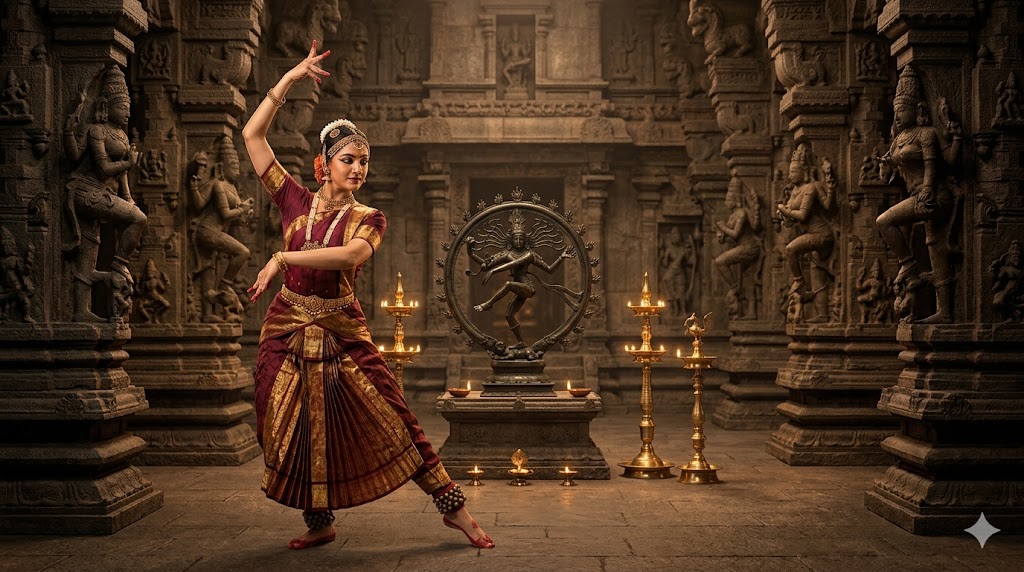
Origin: It originated in the temples of Tamil Nadu and traces its philosophical roots back to the Natya Shastra—the foundational Sanskrit text on performing arts attributed to Sage Bharata.
The Devadasi Tradition: Historically, it was nurtured as Sadir Attam or Dasi Attam by Devadasis (temple dancers dedicated to deities). It was essentially a solo dance performance.
The Anti-Nautch Movement: During the British colonial era, Victorian puritanism led to the legal banning of the art form, pushing it to the brink of extinction through socio-religious stigma.
The 20th-Century Revival: Pioneers like E. Krishna Iyer and Rukmini Devi Arundale (who founded the Kalakshetra Foundation) institutionalized, purified, and globalized the art form, renaming it Bharatanatyam.
Candidates interested in India’s cultural heritage should also read Master Guide: Indian Classical and Folk Music UPSC Mains 2026 (GS 1) to understand the evolution of India’s rich performing arts traditions.
2. Anatomical Structure Highlighted in Bharatanatyam UPSC Notes
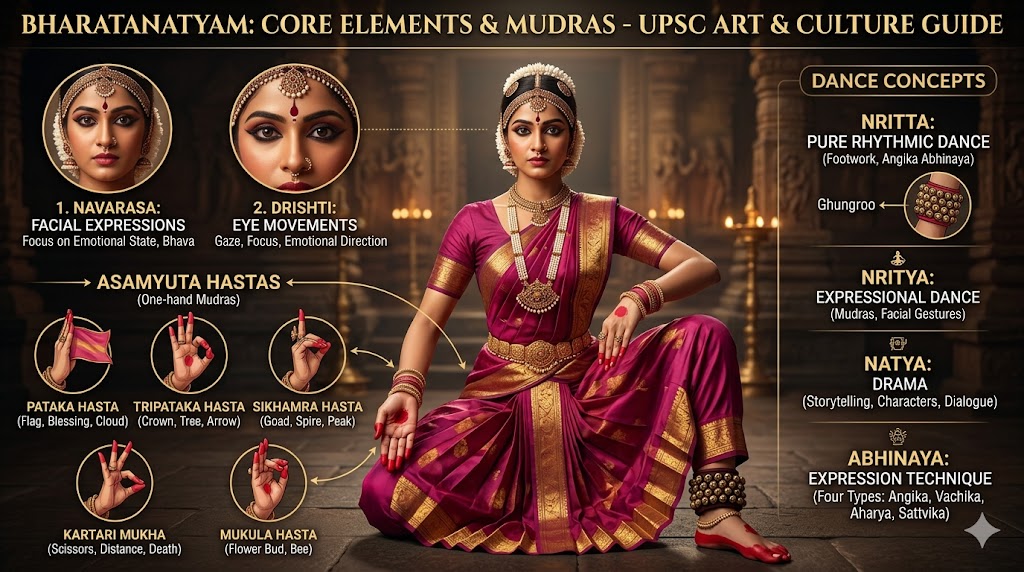
A high-yield answer requires exact technical terminology. Bharatanatyam is structurally anchored by the interplay of three core components: Nritta (pure technical dance), Nritya (expressive dance with sentiment), and Natya (dramatic narrative element).
The Fire Dance Concept: It is philosophically considered a manifestation of the fire element (Agni) within the human body, characterized by continuous, geometric movements resembling flickering flames.
Spatial Geometry: The dancer’s body breaks space into crisp, linear geometries. The basic stance is the Araimandi (a half-sitting, demi-plié posture) which lowers the center of gravity.
The Trio of Expression: It relies heavily on Abhinaya (expression), specifically using Hasta Mudras (stylistic hand gestures) and Eye-Movements governed by the famous dictum: “Where the hand goes, the eyes follow; where the eyes go, the mind follows; where the mind goes, emotion is created.”
Many social issues discussed in GS Paper 1 have roots in the colonial period. To understand this evolution, read our comprehensive Modern History Strategy for UPSC Mains GS Paper 1 article.
3. Traditional Performance Sequence: Core Core Study Material on Bharatanatyam UPSC Notes
For Civil Services Examination (CSE) aspirants, classical dance forms are highly volatile yet critical topics under the Art and Culture segment of General Studies Paper 1 (GS-1). Within the comprehensive UPSC GS 1 Syllabus, a deep understanding of India’s oldest classical dance frequently unlocks high scores in both direct questions and analytical essays.
These concise Bharatanatyam UPSC Notes deliver a structured, exam-ready repository precisely aligned with the core demands of the UPSC Mains evaluation.
Ancient Indian cultural traditions often developed alongside early civilizations. Aspirants can strengthen their historical understanding through Indus Valley Civilization Notes UPSC 2027: Complete & Important Guide.
If you are preparing for UPSC Mains, don’t miss our detailed guide on How to Score 120+ in GS Paper 1: Powerful UPSC Mains Strategy, Books & Study Plan 2026, which covers books, answer writing, and a 90-day preparation roadmap.
The Canonical Order of Elements:
Alarippu: An invocatory piece of pure technical dance (Nritta) without music, using basic body movements and eye coordination to seek blessings.
Jatiswaram: Pure technical movement set to musical notes (swaras) and rhythm (tala) cycles, showcasing absolute footwork precision.
Shabdam: The first item where Abhinaya (expression) is introduced. The dancer interprets short mythological stories or words of praise.
Varnam: The centerpiece of the performance. It is the most complex and demanding segment, seamlessly synthesizing Nritta and Nritya.
Padam & Tillana: The finale. Padam focuses on deep, slow lyricism expressing spiritual love (Bhakti), while Tillana concludes the performance with fast-paced, intricate footwork and striking statuesque poses.
4. Associated Music and Accompanying Elements
| Component | Technical Detail for Mains |
| Musical Style | Exclusively accompanied by Carnatic Classical Music. |
| Language | Lyrics are traditionally composed in Tamil, Telugu, Kannada, or Sanskrit. |
| The Conductor | Led by the Nattuvanar, who plays the cymbals (Calam) and recites rhythmic syllables (Sollukattu). |
| Instruments | Mridangam (primary percussion), Violin, Veena, and Flute. |
5. Critical Analytical Perspectives of Bharatanatyam UPSC Notes
When organizing your thoughts for evaluation, implementing a structured answer writing strategy will help move your presentation past simple factual recitation. Consider incorporating these cross-cutting analytical dimensions:
Secularization and Democratization of Sacred Art
The transformation of Bharatanatyam from an exclusive temple ritual into a global theater art represents a major socio-cultural transition. While institutionalization saved the art form from colonial destruction, critics point out that this process also led to its “sanitization,” shifting its custody away from traditional marginalized communities to upper-class urban spaces.
Heritage Preservation
Unlike monolithic structural monuments, classical dance forms are fragile, oral lineages. Protecting these living art forms requires safeguarding the entire ecosystem—including instrument makers, costume weavers, and traditional Nattuvanars—against economic precarity in a market-driven world.
To understand the broader cultural significance of Indian heritage and traditions, read History Syllabus for UPSC Prelims 2027: Important Topics You Should Not Miss, which highlights key culture and history themes.
Bharatanatyam is an important topic in UPSC Art & Culture. To strengthen your overall preparation, read our detailed UPSC Mains 2026 GS1 Art and Culture Notes: Complete Study Guide for Success.
6. Model Practice Question for UPSC Mains Based on
Bharatanatyam UPSC Notes
Q. “The revival of Bharatanatyam in twentieth-century India was not merely an artistic resurrection, but a socio-cultural reconfiguration.” Critically evaluate this statement. (15 Marks, 250 Words)
Strategic Answer Blueprint:
Introduction (30-40 words): Define Bharatanatyam’s roots as Sadir Attam and briefly note the severe decline it suffered due to colonial legislation and social stigma.
Body Paragraph 1: The Social Dimension (70-80 words): Explain how the anti-nautch campaign displaced traditional Devadasi practitioners. Highlight how the subsequent rescue by the urban elite redefined the social class of the dancers but also led to exclusion.
Body Paragraph 2: The Artistic Reconstruction (70-80 words): Discuss the contributions of Rukmini Devi Arundale at Kalakshetra—such as removing overtly sensual elements, introducing classical costume sensibilities, and anchoring it strictly within a structured, Sanskritized aesthetic.
Conclusion (30-40 words): Conclude by stating that Bharatanatyam reflects India’s soft power globally, showing how ancient traditions continue to adapt to modern sensibilities.
To gain a broader understanding of Ancient Indian society and culture, practice our 100 Ancient History MCQs for UPSC Prelims 2027: Master Question Bank.
Once you have revised Bharatanatyam thoroughly, practice related questions through Top 100 Art & Culture MCQs UPPCS Prelims 2026 | Complete Practice Set to strengthen your Art & Culture preparation.
For a complete UPSC preparation framework beyond Art & Culture, aspirants should explore The Ultimate Roadmap on How to Prepare for UPSC 2027-28 Successfully.
13 thoughts on “The Ultimate Guide to Bharatanatyam UPSC Notes: Master GS 1 Art & Culture”