Decoding Indian Culture
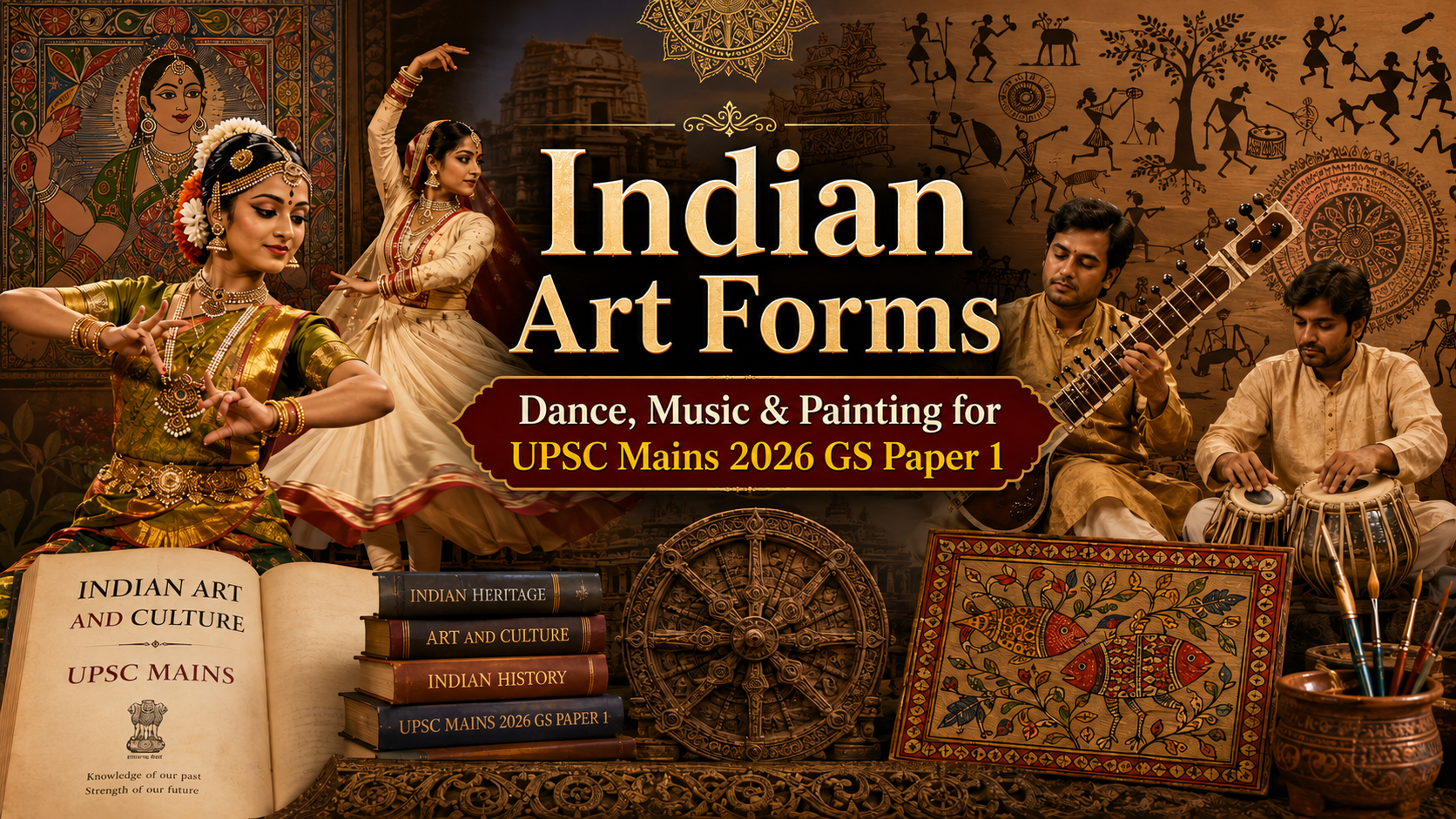
Mastering the Indian Art Forms Guide (Dance, Music, Painting) is non-negotiable for UPSC Mains GS Paper 1. While Prelims tests factual recall, the Mains exam demands an understanding of evolution, socio-religious impact, and regional variations. This high-yield guide, optimized for the 2026 cycle, analyzes the July 2025–May 2026 cultural landscape, ensuring you can answer both historical and contemporary application questions.
Ancient Indian civilization and cultural traditions are closely connected. Test your historical understanding with our 100 Ancient History MCQs for UPSC Prelims 2027: Master Question Bank.
To gain deeper insights into Indian cultural heritage, read Master Guide: Indian Classical and Folk Music UPSC Mains 2026 (GS 1), which covers important music traditions relevant for UPSC Mains.
For a complete understanding of the UPSC Art & Culture syllabus, you should also explore our comprehensive UPSC Mains 2026 GS1 Art and Culture Notes: Complete Study Guide for Success, covering architecture, dance, music, paintings, literature, and cultural heritage in detail.
The Strategic Importance of Indian Art Forms in GS Paper 1
In UPSC GS Paper 1, the “Indian Heritage and Culture” syllabus explicitly lists: Salient aspects of Art Forms, Literature, and Architecture from ancient to modern times.
Historically, questions in this section have a reliable pattern:
Direct Analytical: Assessing specific features of an art form (e.g., ‘Evaluate the spiritual aspects of Hindustani Classical Music.’).
Evolutionary: Tracking changes over time (e.g., ‘Discuss the development of Indian painting from murals to miniatures.’).
Contemporary Relevance: Linking traditional arts to modern society (e.g., ‘Analyze the role of classical dance in India’s cultural diplomacy.’).
This Indian Art Forms (Dance, Music, Painting) guide provides the crucial cross-sectoral analysis, integrating NITI Aayog reports on cultural preservation and data from the Ministry of Culture, essential for adding value to your 250-word answers.
If you want an in-depth understanding of Bharatanatyam, including its historical evolution, mudras, performance sequence, Carnatic music, and UPSC answer-writing approach, read The Ultimate Guide to Bharatanatyam UPSC Notes: Master GS 1 Art & Culture.
Indian Classical and Folk Dances: Indian Art Forms
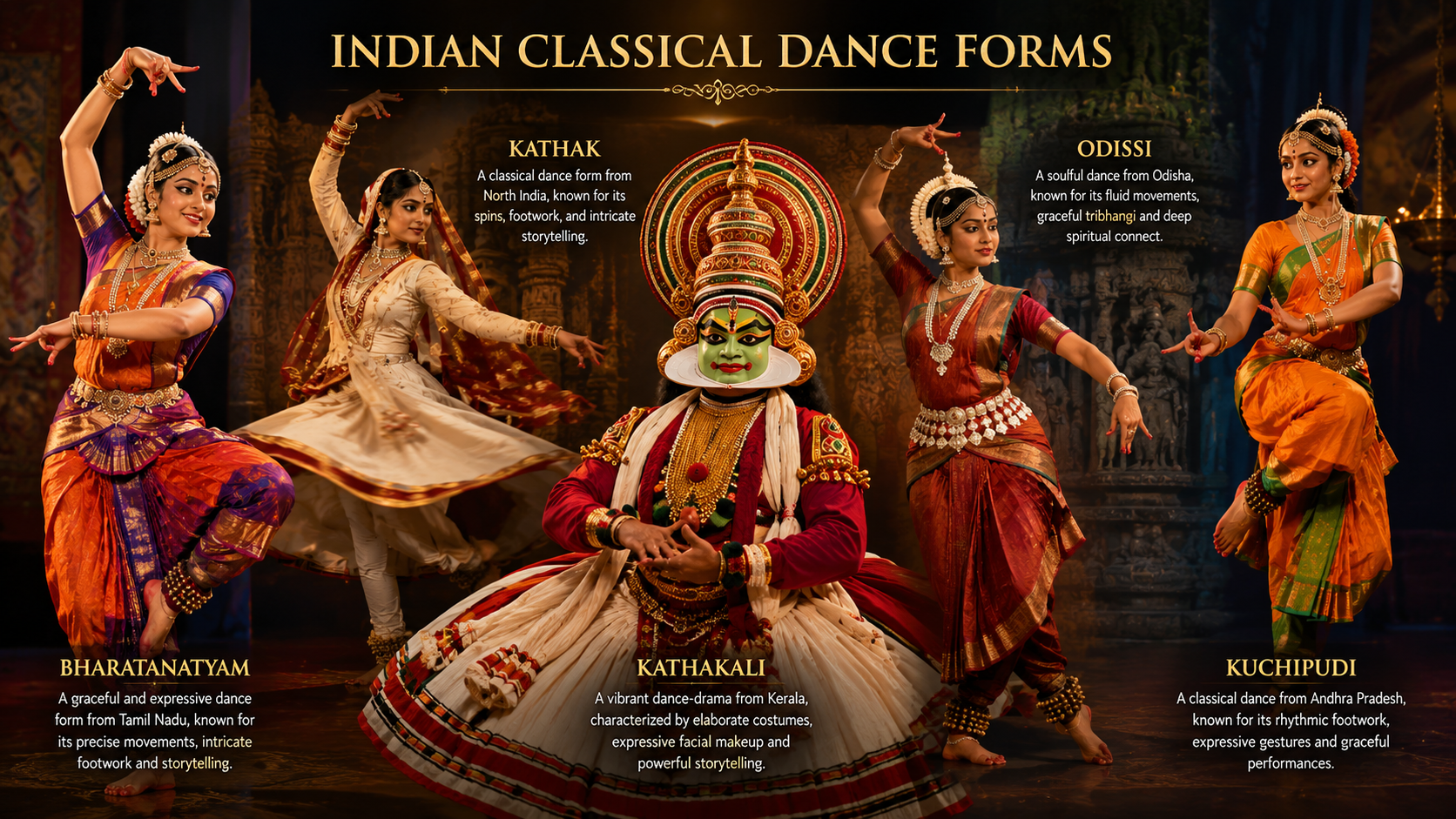
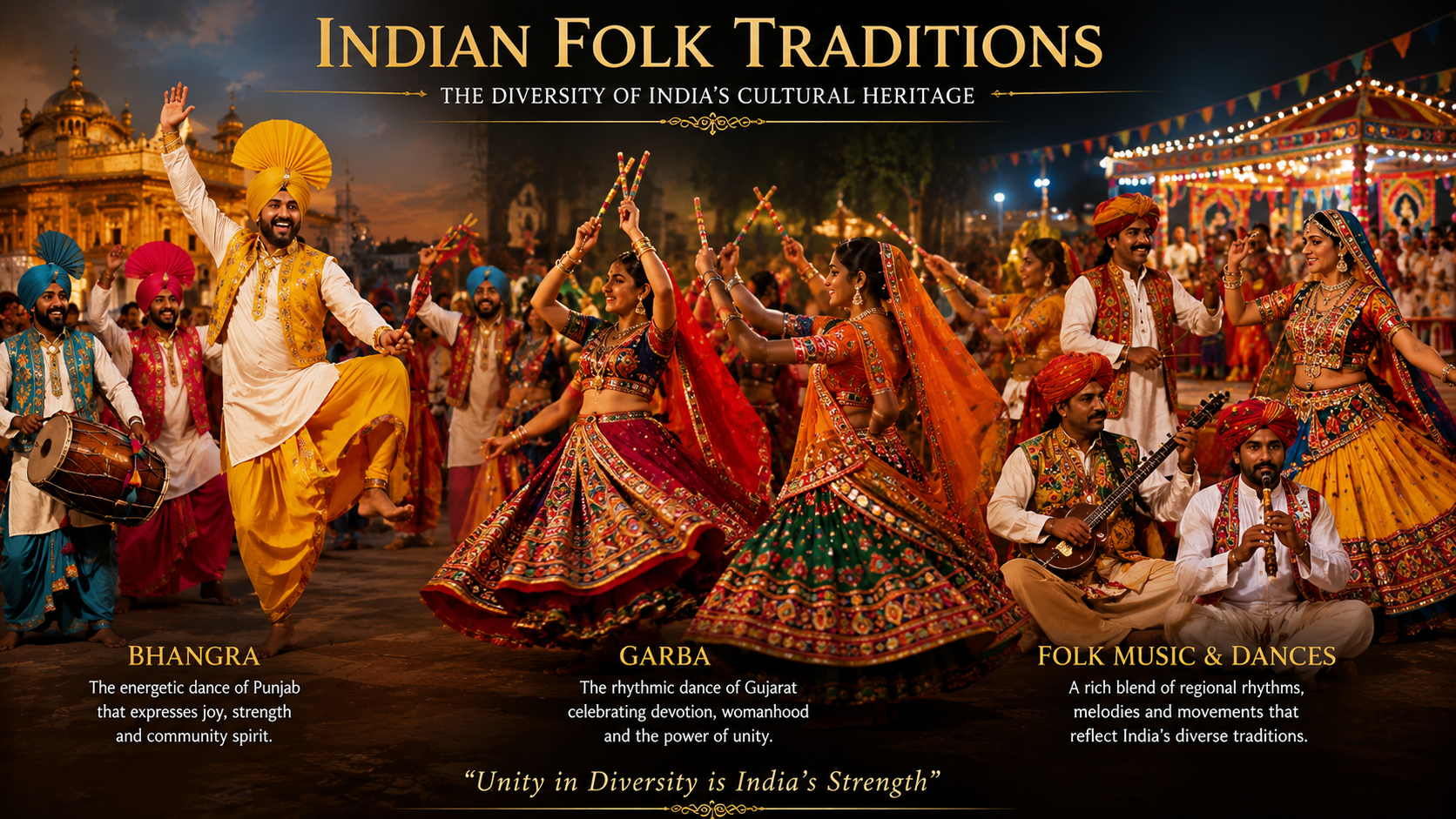
Indian dance is not just movement; it is Nitya (pure dance) and Nritya (expressive dance), deeply rooted in regional identities. Understanding this distinction is vital for UPSC Mains GS Paper 1.
High-Yield Mains Points of Indian Classical and Folk Dances for UPSC Mains 2026:
Regional Synthesis: Do not just list the 8 classical dances recognized by the Sangeet Natak Akademi. Group them by geographical relevance (e.g., East India: Odissi, Sattriya, Manipuri; South India: Bharatnatyam, Kuchipudi, Kathakali, Mohiniyattam). Analyze how Sattriya (Assam) is uniquely embedded in the Vaishnavite Bhakti tradition, versus Kathakali (Kerala), which focuses on intense masculine characterization from the Puranas.
Aspirant Alert on ‘Fusion’: A likely question in 2026 concerns the rise of ‘Chhau’ and its integration with classical forms. Note that Chhau (found in Jharkhand, WB, Odisha) is a semi-classical/martial art form. Your answers must distinguish between fusion (risky, if not authentic) and synthesis (organic evolution).
Answer Snippet Strategy:
Q: “Evaluate the spiritual aspects embedded in Indian Classical Dance forms.”
Snippet (Introduction): “Indian classical dances are fundamentally spiritual acts, designed as visual sacrifices to the divine rather than mere entertainment. The ‘Bhakti Rasa’ (devotional sentiment) is the unifying soul of these varied forms…”
Indian Classical Music: Hindustani and Carnatic Traditions
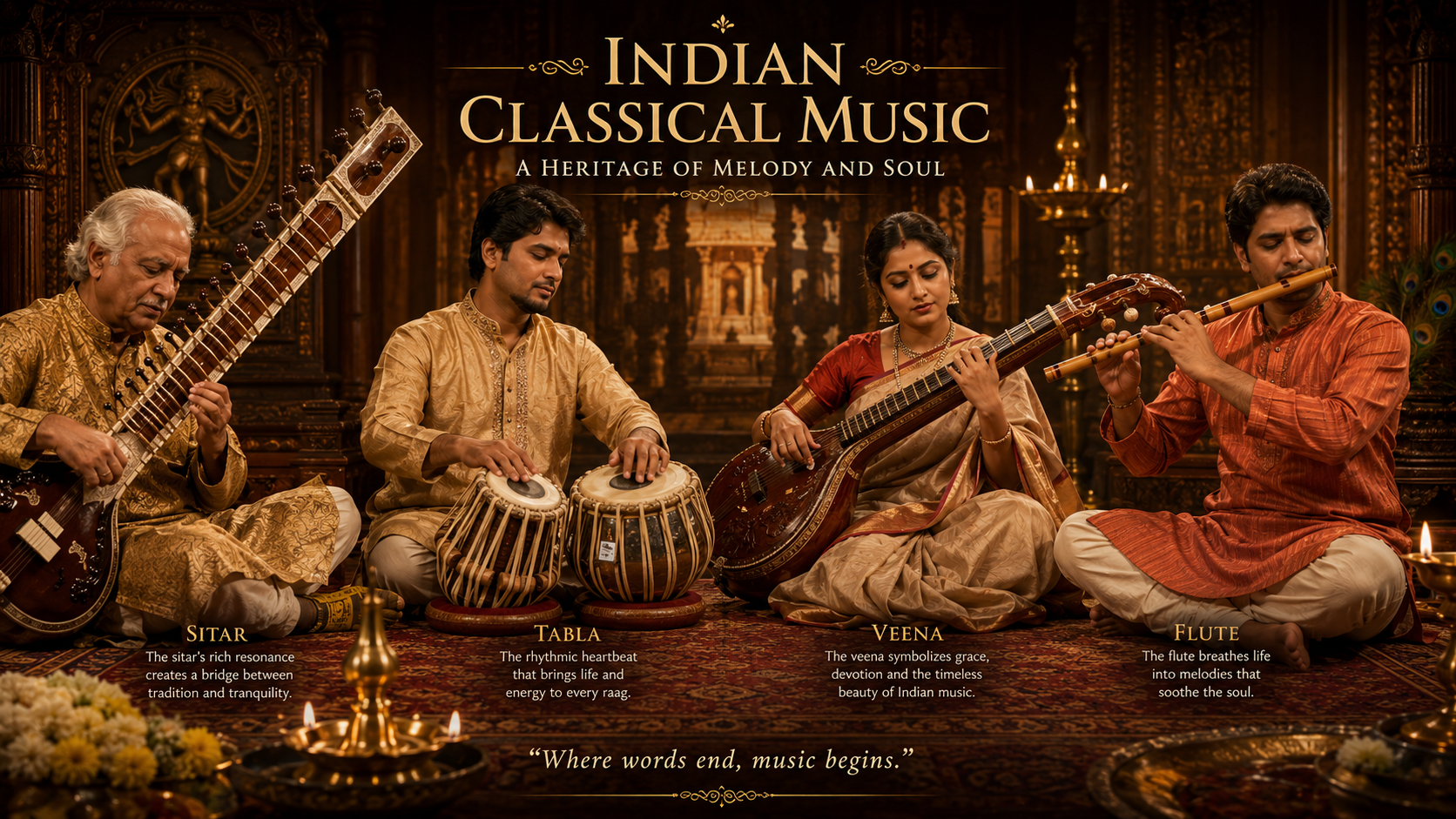
The 2026 cultural ecosystem places significant emphasis on preserving the purity of both North Indian (Hindustani) and South Indian (Carnatic) systems. This is a crucial area of Indian Art Forms (Dance, Music, Painting) for UPSC Mains GS Paper 1.
High-Yield Mains Points of Indian Classical Music for UPSC Mains 2026: Indian Art Forms
The Raga-Tala Link: Go beyond definitions. Analyze how Hindustani music’s Raga system is deeply tied to the Time Theory of Music (specific Ragas for early morning, evening, seasons), reflecting a connection to nature. Contrast this with Carnatic music’s rigorous, fixed Tala (rhythm patterns), which emphasizes mathematical complexity and composition.
Contemporary Relevance: A key debate in early 2026 focuses on the role of digital streaming in popularizing complex classical music. NITI Aayog discussion papers (May 2026) highlight the Bhashini translation project’s role in making the lyrics of regional classical compositions globally accessible. Integrate this into your answers for extra marks.
Indian Painting: From Murals to Miniatures and Beyond
Indian painting represents a continuous visual history of the subcontinent. This section of Indian Art Forms (Dance, Music, Painting) for UPSC Mains GS Paper 1 is highly visual and demands concise geographical and chronological accuracy.
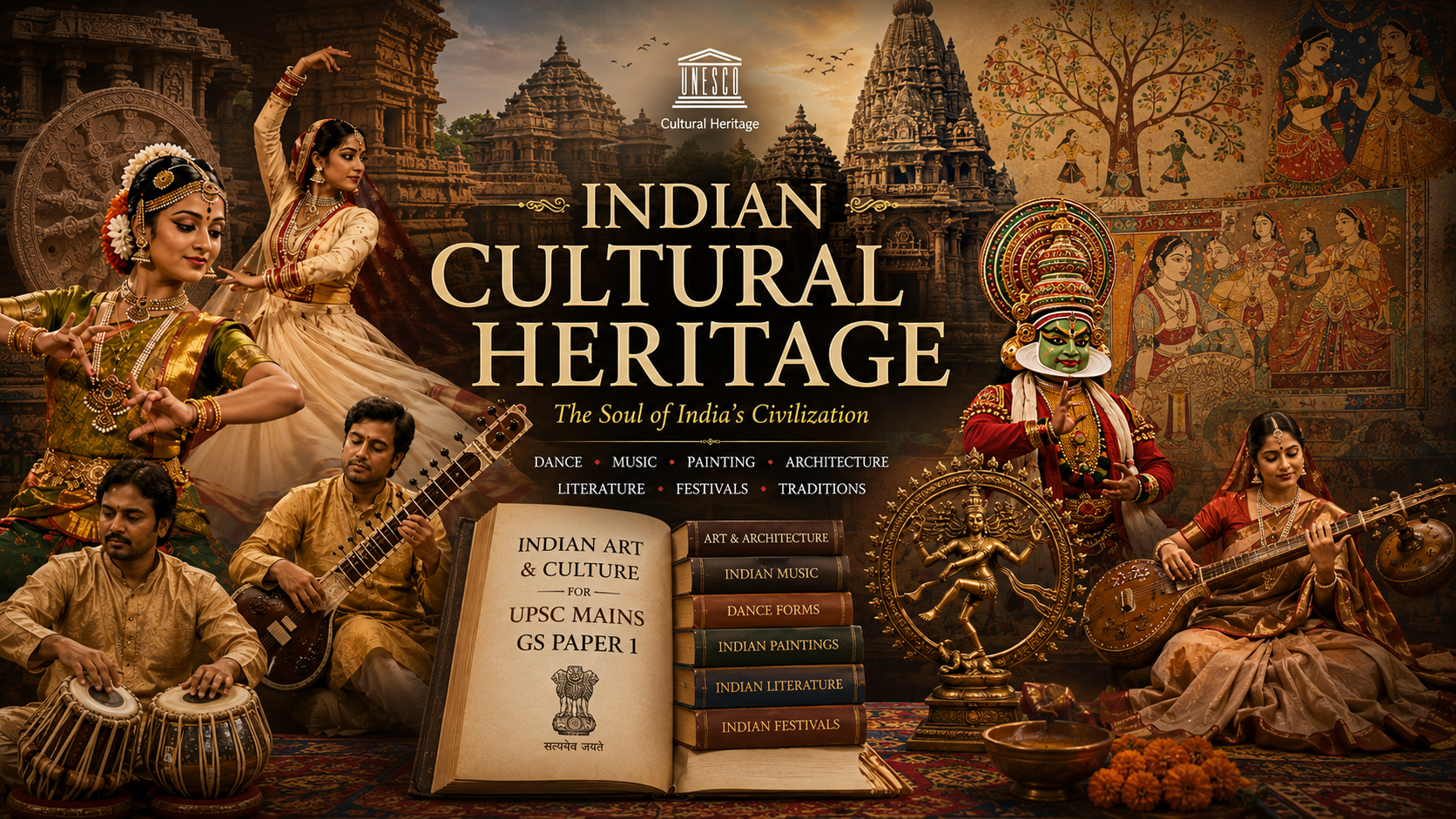
High-Yield Mains Points of Indian Painting for UPSC Mains 2026:
Scale and Subject Shift: Analyze the profound shift from ancient Mural Paintings (large scale, religious themes, found in Ajanta/Bagh/Sittanavasal) to Miniature Paintings (small scale, intimate, royal themes like Ragamala and court life). Your analysis should explain this shift as a change in patronage from monastic orders to localized royal courts (Pala, Mughal, Rajput).
Folk and Tribal Integration: Expect questions on the integration of traditional motifs into modern branding (e.g., use of Warli, Madhubani, or Gond art on commercial packaging). This tests your understanding of art as an economic resource—a core theme for UPSC Mains GS Paper 1. Reference the Ministry of Tribal Affairs’ ‘Marketing and Logistics Development for Promoting Tribal Products’ scheme in this context.
Practice Question for GS Paper 1 Mains 2026: Indian Art Forms
“Indian classical dance is much more than mere bodily movement; it is a profound exploration of spirituality and devotion.” Evaluate this statement with reference to two distinct regional examples.
After completing the theoretical concepts of Indian dance, music, and painting traditions, test your preparation with Top 100 Art & Culture MCQs UPPCS Prelims 2026 | Complete Practice Set, which contains exam-oriented practice questions with explanations.
For a complete understanding of Bihar’s culture, history, geography, economy, and exam-oriented facts, explore our Powerful Bihar GK for BPSC 2026–27: Complete Notes, MCQs, One-Liners & PYQs Guide.
Conclusion: Indian Art Forms
Mastering Indian Art Forms (Dance, Music, Painting) for UPSC Mains GS Paper 1 requires analyzing why an art form developed as it did. By using the structured high-yield points, the strategic answer snippet, and the essential custom visual guide provided above, you can approach these questions with confidence and technical precision for the 2026 examination cycle.
Recommended Post
UPSC Science and Technology Syllabus 2027: Powerful Topic-Wise Guide for Prelims & Mains
Powerful UPSC Mains 2026 Strategy: Step-by-Step Roadmap for Success
15 thoughts on “Indian Art Forms (Dance, Music, Painting) UPSC Mains 2026 GS Paper 1: Ultimate Success Guide”