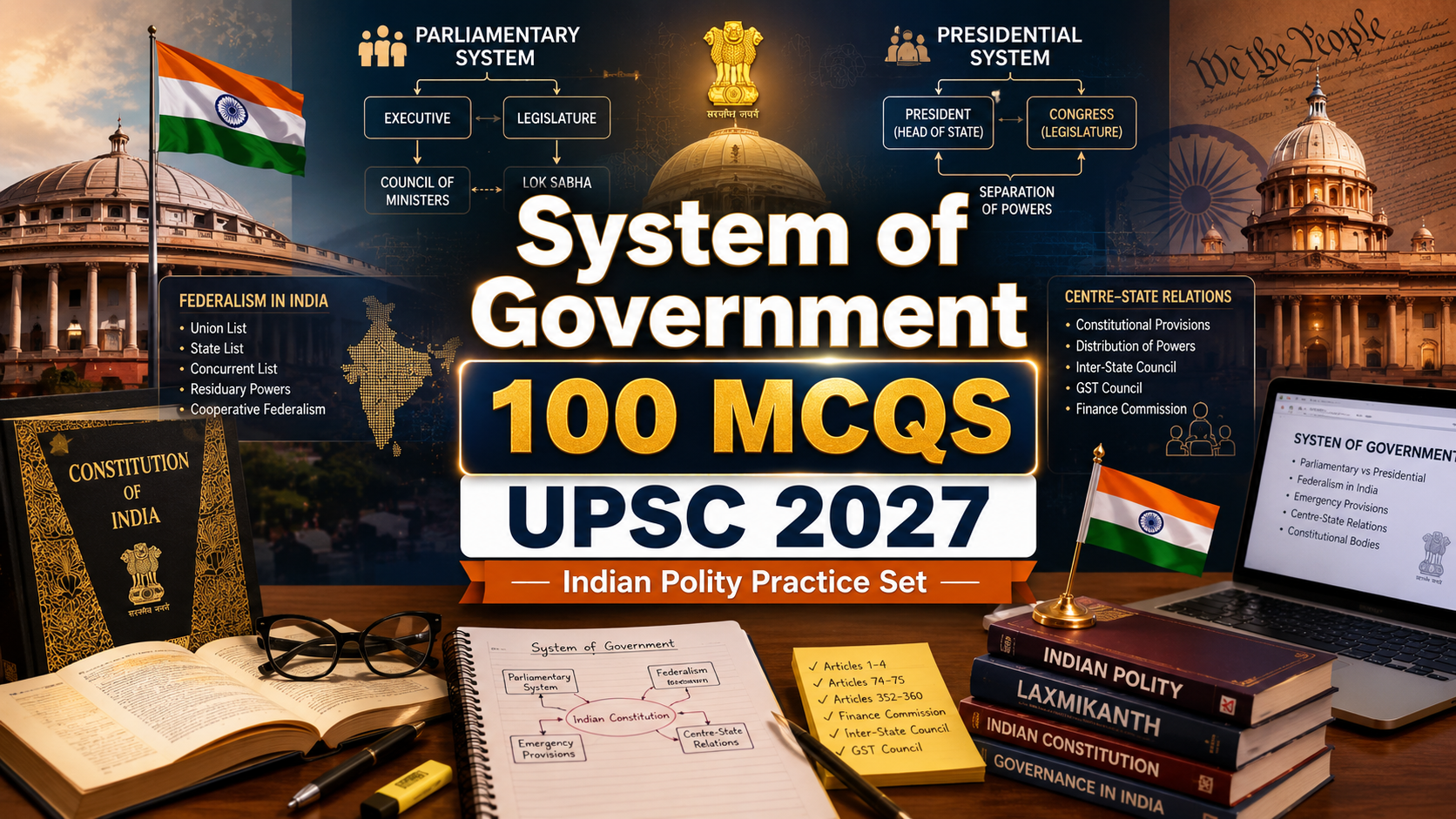
Preparing Indian Polity for UPSC Prelims 2027? These System of Government 100 MCQs UPSC 2027 cover Parliamentary and Presidential Systems, Federalism, Centre-State Relations, Emergency Provisions, Cooperative Federalism, GST Council, Finance Commission, and other high-yield constitutional topics frequently asked in UPSC examinations.
This article on System of Government 100 MCQs UPSC 2027 is designed to help aspirants strengthen their understanding of Parliamentary Government, Presidential Government, Federalism, and Emergency Provisions.
The questions are divided into five sections with detailed explanations to strengthen conceptual understanding and improve accuracy in the UPSC Prelims examination.
Before solving these System of Government MCQs, aspirants should build a strong conceptual foundation by understanding the basic structure of the Indian Constitution and its evolution.
Along with Polity, UPSC aspirants should regularly revise current affairs. Practice our 100 Powerful Sports Current Affairs MCQs June 2026 for UPSC, UPPCS & SSC Exams for exam-oriented sports updates.
Before attempting this practice set, aspirants should familiarize themselves with the official text of the Constitution of India to better understand the constitutional provisions discussed throughout the article.
System of Government 100 MCQs UPSC 2027
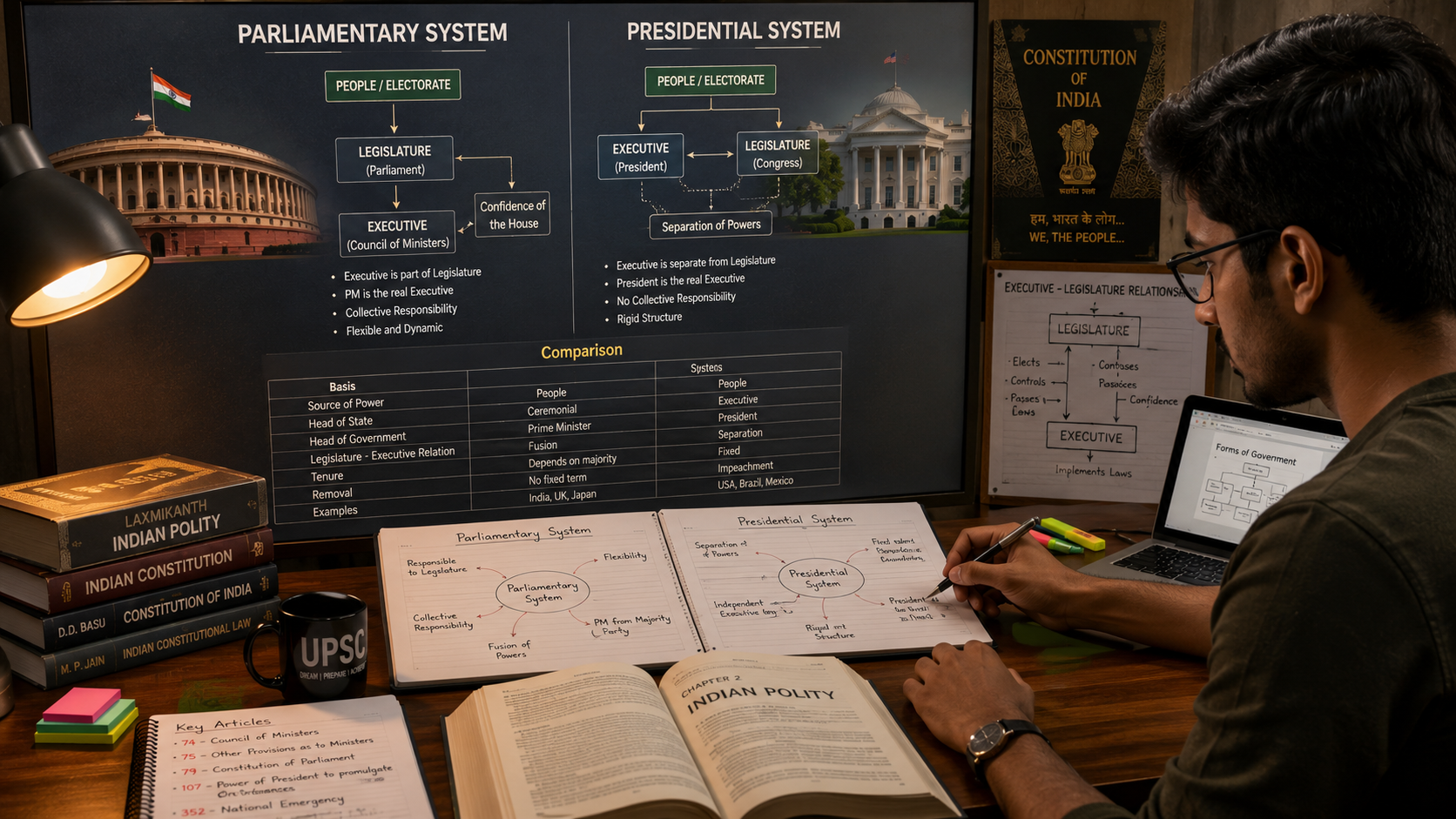
Section 1: Parliamentary System and Constitutional Foundations (Questions 1–20)
The following System of Government 100 MCQs UPSC 2027 cover the most important constitutional and governance concepts frequently asked in UPSC examinations.
Candidates should attempt the System of Government 100 MCQs UPSC 2027 questions section-wise for better conceptual understanding.
Q1. Which feature is considered the most distinctive characteristic of the Parliamentary System of Government in India?
A. Separation of Powers
B. Collective Responsibility
C. Judicial Review
D. Federal Structure
Q2. Article 75 of the Indian Constitution primarily deals with:
A. Appointment of Governors
B. Council of Ministers
C. Supreme Court Judges
D. Emergency Provisions
Q3. In the Indian Parliamentary System, the real executive authority rests with:
A. President
B. Chief Justice of India
C. Prime Minister and Council of Ministers
D. Parliament
Q4. The principle of collective responsibility means that:
A. Ministers are individually responsible to the President
B. Council of Ministers is collectively responsible to Lok Sabha
C. Prime Minister is responsible to Rajya Sabha
D. Governors are responsible to State Legislatures
Q5. Which constitutional provision establishes collective responsibility?
A. Article 74
B. Article 75(3)
C. Article 356
D. Article 368
Q6. The Parliamentary form of government in India was adopted mainly from:
A. USA
B. France
C. United Kingdom
D. Canada
Q7. Who appoints the Prime Minister of India?
A. Chief Justice of India
B. Lok Sabha Speaker
C. President of India
D. Rajya Sabha Chairman
Q8. A vote of no-confidence can be moved against:
A. President only
B. Individual Minister only
C. Council of Ministers
D. Governor
Q9. The Council of Ministers remains in office so long as it enjoys:
A. Confidence of Rajya Sabha
B. Confidence of Lok Sabha
C. Confidence of Supreme Court
D. Confidence of President
Q10. Which one of the following is NOT a feature of a Parliamentary Government?
A. Dual Executive
B. Collective Responsibility
C. Fusion of Executive and Legislature
D. Fixed Tenure of Executive
Q11. The President of India exercises most powers:
A. Independently
B. Through Governors
C. On the aid and advice of the Council of Ministers
D. Through Parliament
Q12. Which Amendment made the President bound by ministerial advice?
A. 24th Amendment
B. 42nd Amendment
C. 44th Amendment
D. 52nd Amendment
Q13. In India, ministers must become members of Parliament within:
A. 3 months
B. 6 months
C. 9 months
D. 12 months
Q14. The term “Cabinet Government” implies:
A. Government by Judiciary
B. Government by Parliament alone
C. Government by Cabinet Ministers
D. Government by President
Q15. Who is regarded as the “Keystone of the Cabinet Arch”?
A. President
B. Speaker
C. Prime Minister
D. Vice President
Q16. The Prime Minister is appointed by:
A. Chief Justice
B. President
C. Lok Sabha Speaker
D. Rajya Sabha
Q17. Which House can remove the Council of Ministers through a No-Confidence Motion?
A. Rajya Sabha
B. Lok Sabha
C. Both Houses
D. Joint Sitting
Q18. The concept of “Nominal Executive” refers to:
A. Prime Minister
B. Cabinet Secretary
C. President
D. Lok Sabha Speaker
Q19. The actual executive authority in India is exercised by:
A. President
B. Vice President
C. Prime Minister and Cabinet
D. Parliament
Q20. The Parliamentary System is generally praised because it:
A. Ensures complete separation of powers
B. Provides rigid executive tenure
C. Promotes accountability of executive to legislature
D. Eliminates coalition governments
Answers and Explanations (Questions 1–20): System of Government 100 MCQs UPSC 2027
- B — Collective Responsibility
Collective responsibility is the cornerstone of parliamentary government, ensuring cabinet unity and accountability.
- B — Council of Ministers
Article 75 deals with appointment, tenure, and responsibility of the Council of Ministers.
- C — Prime Minister and Council of Ministers
The President is the constitutional head, while actual executive powers are exercised by the Prime Minister and Council of Ministers.
- B — Council of Ministers is collectively responsible to Lok Sabha
The ministry remains in office only while it enjoys the confidence of the Lok Sabha.
- B — Article 75(3)
Article 75(3) explicitly establishes collective responsibility.
- C — United Kingdom
India adopted the Westminster model of parliamentary government from Britain.
- C — President of India
The President appoints the leader who commands majority support in the Lok Sabha.
- C — Council of Ministers
A No-Confidence Motion is directed against the entire Council of Ministers.
- B — Confidence of Lok Sabha
The Council of Ministers remains in office as long as it enjoys the confidence of the Lok Sabha.
- D — Fixed Tenure of Executive
Fixed tenure is a characteristic of presidential government, not parliamentary government.
- C — On the aid and advice of the Council of Ministers
The President generally acts according to ministerial advice under Article 74.
- B — 42nd Amendment
The 42nd Constitutional Amendment made ministerial advice binding on the President.
- B — 6 months
A minister who is not a Member of Parliament must become one within six months.
- C — Government by Cabinet Ministers
The Cabinet forms the core decision-making body within the Council of Ministers.
- C — Prime Minister
The Prime Minister coordinates and leads the Cabinet and is therefore called the “Keystone of the Cabinet Arch.”
- B — President
The President formally appoints the Prime Minister.
- B — Lok Sabha
Only the Lok Sabha can remove the Council of Ministers through a No-Confidence Motion.
- C — President
The President is the nominal executive head of the Union.
- C — Prime Minister and Cabinet
The real executive authority is exercised by the Prime Minister and Cabinet.
- C — Promotes accountability of executive to legislature
The System of Government 100 MCQs UPSC 2027 series helps aspirants compare different forms of government from an examination perspective.
In this System of Government 100 MCQs UPSC 2027 series, aspirants will also learn the differences between Parliamentary and Presidential forms of government.
Candidates who want to strengthen their understanding of constitutional governance should also practice 75 Important Polity Questions for UPSC Prelims 2027 (PYQs + Practice MCQs With Answers)
Indian Polity plays a crucial role in both UPSC and BPSC examinations. Learn more about the Latest BPSC Exam Pattern 2026 to plan your preparation more effectively.
Candidates seeking a deeper understanding of the functioning of the Lok Sabha, Rajya Sabha, and parliamentary procedures can refer to official parliamentary resources.
Section 2: Presidential System & Parliamentary vs Presidential Comparison (Questions 21–40)
Q21. Which country is regarded as the classic example of a Presidential System of Government?
A. India
B. United Kingdom
C. United States of America
D. Canada
Q22. In a Presidential System, the President is:
A. Nominal Executive only
B. Real Executive only
C. Both Head of State and Head of Government
D. Head of Legislature
Q23. Which feature distinguishes a Presidential System from a Parliamentary System?
A. Bicameral Legislature
B. Written Constitution
C. Separation of Powers
D. Judicial Review
Q24. The President of the United States is elected by:
A. Congress
B. Supreme Court
C. Electoral College
D. Senate
Q25. Which of the following is NOT a feature of the Presidential System?
A. Fixed Tenure
B. Separation of Powers
C. Collective Responsibility
D. Single Executive
Q26. In a Presidential System, members of the executive are generally:
A. Members of Legislature
B. Judges
C. Independent of Legislature
D. Governors
Q27. The impeachment process in the USA is meant for removing:
A. Governors
B. President
C. Senators
D. Judges only
Q28. Which one of the following best describes the executive-legislative relationship in a Presidential System?
A. Fusion of Powers
B. Collective Responsibility
C. Separation of Powers
D. Legislative Supremacy
Q29. The fixed tenure of the executive is considered an advantage because it:
A. Enhances stability
B. Increases legislative control
C. Eliminates judiciary
D. Weakens administration
Q30. In India, the President can be removed through:
A. No-Confidence Motion
B. Impeachment
C. Judicial Review
D. Cabinet Resolution
Q31. Which feature is common to both Parliamentary and Presidential Systems?
A. Collective Responsibility
B. Fixed Executive Tenure
C. Democratic Accountability
D. Fusion of Powers
Q32. Who among the following can dissolve the Lower House in a Parliamentary System?
A. Judiciary
B. Executive Head acting constitutionally
C. Election Commission
D. Cabinet Secretary
Q33. Which system generally provides greater political stability?
A. Parliamentary System
B. Presidential System
C. Military Government
D. Direct Democracy
Q34. In a Presidential System, cabinet members are primarily accountable to:
A. Legislature
B. Judiciary
C. President
D. Governor
Q35. The Indian Constitution rejected the Presidential System mainly because:
A. It was unconstitutional
B. It lacked democratic features
C. Parliamentary accountability was preferred
D. It prohibited federalism
Q36. Which constitutional expert described the Parliamentary System as a “government by discussion”?
A. B.R. Ambedkar
B. Walter Bagehot
C. K.C. Wheare
D. Ivor Jennings
Q37. Which of the following is an advantage of the Parliamentary System?
A. Executive Stability
B. Quick Decision-Making without Debate
C. Continuous Legislative Accountability
D. Complete Separation of Powers
Q38. Deadlock between Legislature and Executive is more common in:
A. Parliamentary System
B. Presidential System
C. Monarchy
D. Direct Democracy
Q39. The Constituent Assembly preferred the Parliamentary System because:
A. It was unfamiliar to Indians
B. It had already functioned under colonial institutions
C. It prohibited coalition politics
D. It reduced accountability
Q40. Which statement is correct?
A. Parliamentary System emphasizes stability over accountability.
B. Presidential System emphasizes accountability over stability.
C. Parliamentary System emphasizes accountability, while Presidential System emphasizes stability.
D. Both systems emphasize exactly the same institutional principles.
Answers and Explanations (Questions 21–40)
- C — United States of America
The USA is the most prominent example of a Presidential System of Government.
- C — Both Head of State and Head of Government
In a Presidential System, the President combines both ceremonial and executive roles.
- C — Separation of Powers
A strict separation between executive and legislature is the defining feature of presidential government.
- C — Electoral College
The President of the United States is indirectly elected through the Electoral College.
- C — Collective Responsibility
Collective responsibility is a feature of parliamentary government, not presidential government.
- C — Independent of Legislature
Executive officials generally function independently of the legislature.
- B — President
Impeachment is the constitutional mechanism for removing the President.
- C — Separation of Powers
The executive and legislature operate separately under a Presidential System.
- A — Enhances Stability
Fixed tenure protects the executive from frequent legislative challenges.
- B — Impeachment
The Indian President can only be removed through the impeachment process.
- C — Democratic Accountability
Both systems are democratic and incorporate mechanisms of accountability.
- B — Executive Head acting constitutionally
In parliamentary systems, the lower house may be dissolved by the constitutional head of state.
- B — Presidential System
The fixed tenure of the executive often results in greater political stability.
- C — President
Cabinet members are accountable directly to the President.
- C — Parliamentary accountability was preferred
The framers favored a system that ensured continuous executive accountability to Parliament.
- B — Walter Bagehot
Walter Bagehot famously described parliamentary government as “government by discussion.”
- C — Continuous Legislative Accountability
The executive remains answerable to the legislature throughout its tenure.
- B — Presidential System
Institutional separation may result in legislative-executive deadlocks.
- B — It had already functioned under colonial institutions
India already had considerable experience with parliamentary institutions before independence.
- C — Parliamentary System emphasizes accountability, while Presidential System emphasizes stability
This is the classic distinction made by political scientists while comparing the two systems.
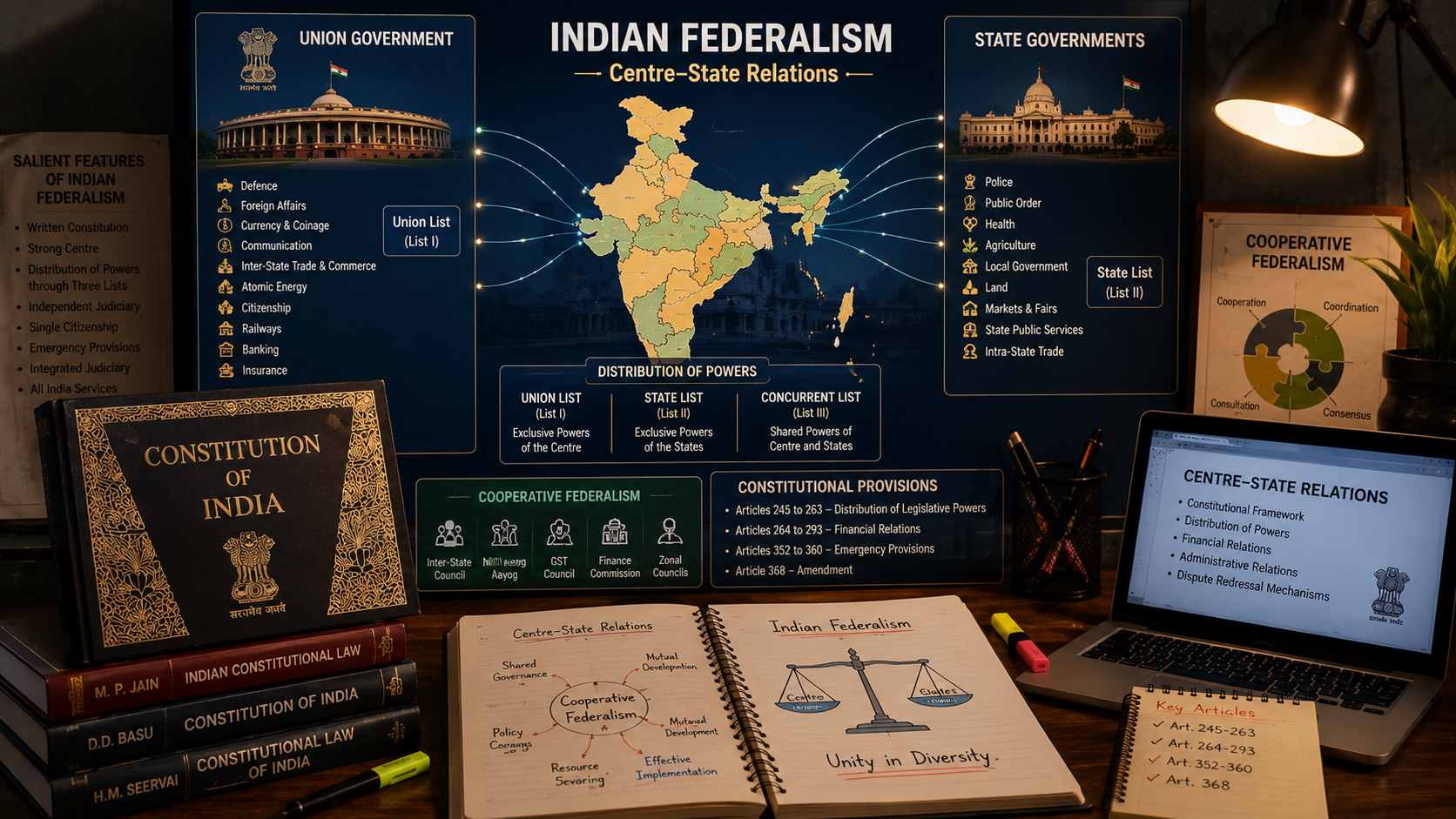
A major focus of these System of Government 100 MCQs UPSC 2027 is the concept of Indian Federalism and its unique constitutional structure.
A clear understanding of governance systems becomes even more useful when combined with current constitutional and political developments frequently discussed in UPSC preparation.
If you are preparing for UPSC Mains, don’t miss our detailed guide on How to Score 120+ in GS Paper 1: Powerful UPSC Mains Strategy, Books & Study Plan 2026, which covers books, answer writing, and a 90-day preparation roadmap.
Federalism is an important component of the System of Government 100 MCQs UPSC 2027 practice set.
Section 3: Federalism vs Unitary Dynamics in India (Questions 41–60)
Q41. India is described in Article 1 of the Constitution as:
A. Federation of States
B. Confederation of States
C. Union of States
D. Federal Republic
Q42. The term “Union of States” was preferred because:
A. States have the right to secede
B. Federation resulted from an agreement among states
C. Indian federation is indestructible
D. States are sovereign units
Q43. Which scholar described India as a “Quasi-Federal State”?
A. Walter Bagehot
B. K.C. Wheare
C. Dicey
D. Granville Austin
Q44. Which feature is essential for a federal system?
A. Unitary Executive
B. Single Citizenship only
C. Division of Powers
D. Parliamentary Government
Q45. The division of legislative powers between Centre and States is provided under:
A. Part III
B. Part V
C. Seventh Schedule
D. Tenth Schedule
Q46. The Seventh Schedule contains:
A. Two Lists
B. Three Lists
C. Four Lists
D. Five Lists
Q47. Which List includes subjects such as Defence and Foreign Affairs?
A. State List
B. Concurrent List
C. Union List
D. Residuary List
Q48. Police and Public Order are included in:
A. Union List
B. State List
C. Concurrent List
D. Residuary Powers
Q49. Education presently falls under:
A. Union List
B. State List
C. Concurrent List
D. Residuary List
Q50. Residuary legislative powers in India are vested in:
A. States
B. Supreme Court
C. Parliament
D. President
Q51. Which one of the following is NOT generally considered a federal feature?
A. Written Constitution
B. Independent Judiciary
C. Unicameral Legislature
D. Distribution of Powers
Q52. The authority to adjudicate Centre-State disputes rests primarily with:
A. Election Commission
B. Parliament
C. Supreme Court
D. President
Q53. Single Citizenship in India is considered a:
A. Federal Feature
B. Unitary Feature
C. Judicial Feature
D. Emergency Feature
Q54. Who can alter the boundaries of a State?
A. Supreme Court
B. Governor
C. State Legislature
D. Parliament
Q55. Which Article empowers Parliament to form new States?
A. Article 3
B. Article 32
C. Article 123
D. Article 368
Q56. Which feature gives the Indian Federation a unitary bias?
A. Independent Judiciary
B. Written Constitution
C. Strong Centre
D. Bicameralism
Q57. The Inter-State Council was established under:
A. Article 280
B. Article 263
C. Article 356
D. Article 368
Q58. Which body is considered an important instrument of Cooperative Federalism?
A. UPSC
B. Election Commission
C. NITI Aayog
D. CAG
Q59. The GST Council is an example of:
A. Judicial Federalism
B. Cooperative Federalism
C. Unitary Governance
D. Presidential Federalism
Q60. Which statement best describes Indian Federalism?
A. Purely Federal
B. Purely Unitary
C. Federal with Strong Unitary Features
D. Confederation
Federalism-related questions in the System of Government 100 MCQs UPSC 2027 practice set are based on frequently tested UPSC concepts.
Answers and Explanations (Questions 41–60): System of Government 100 MCQs UPSC 2027
- C — Union of States
Article 1 of the Constitution describes India as a “Union of States.” The framers deliberately chose this expression to emphasize the indestructible nature of the Union.
- C — Indian federation is indestructible
Dr. B.R. Ambedkar clarified that Indian states do not possess a constitutional right to secede from the Union.
- B — K.C. Wheare
Constitutional scholar K.C. Wheare famously described India as a quasi-federal state because it combines federal and unitary characteristics.
- C — Division of Powers
A constitutional distribution of powers between different levels of government is the foundation of federalism.
- C — Seventh Schedule
The Seventh Schedule distributes legislative subjects among the Union List, State List, and Concurrent List.
- B — Three Lists
The Seventh Schedule consists of the Union List, State List, and Concurrent List.
- C — Union List
Defence, foreign affairs, atomic energy, and national security fall under the Union List.
- B — State List
Police and Public Order are primarily matters for state governments.
- C — Concurrent List
Education was transferred from the State List to the Concurrent List through the 42nd Constitutional Amendment.
- C — Parliament
Unlike many federations such as the USA, residuary powers in India belong to Parliament.
- C — Unicameral Legislature
Federal systems generally favor bicameral legislatures to provide representation to constituent units.
- C — Supreme Court
Under Article 131, the Supreme Court has original jurisdiction over Centre-State disputes.
- B — Unitary Feature
Single citizenship strengthens national unity and reflects the unitary tendencies of the Constitution.
- D — Parliament
Parliament has the authority to alter state boundaries, names, and territories under constitutional provisions.
- A — Article 3
Article 3 empowers Parliament to create new states and alter existing state boundaries.
- C — Strong Centre
A powerful Union Government is one of the most important unitary features of the Indian Constitution.
- B — Article 263
Article 263 provides for the establishment of the Inter-State Council to promote coordination among states and the Union.
- C — NITI Aayog
NITI Aayog promotes cooperative federalism by involving states in policy formulation and implementation.
- B — Cooperative Federalism
The GST Council functions through consensus-building and cooperation between the Centre and the States.
- C — Federal with Strong Unitary Features
India is generally described as a federation with a strong central government and several unitary characteristics.
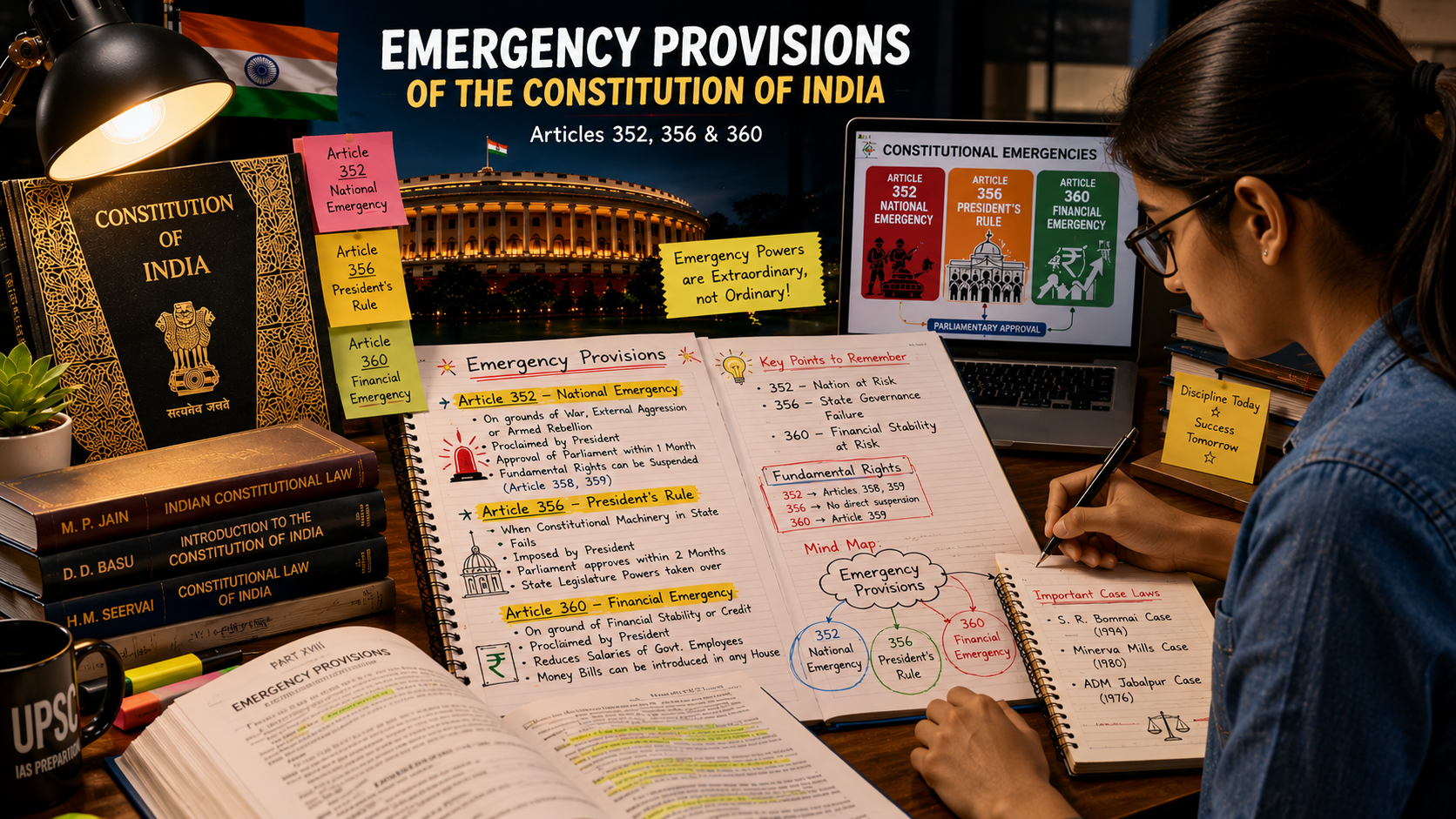
The Emergency Provisions included in these System of Government 100 MCQs UPSC 2027 are highly important from the examination perspective.
Federalism and Centre-State relations form an important part of Indian Polity and often appear alongside governance and administrative questions in UPSC examinations.
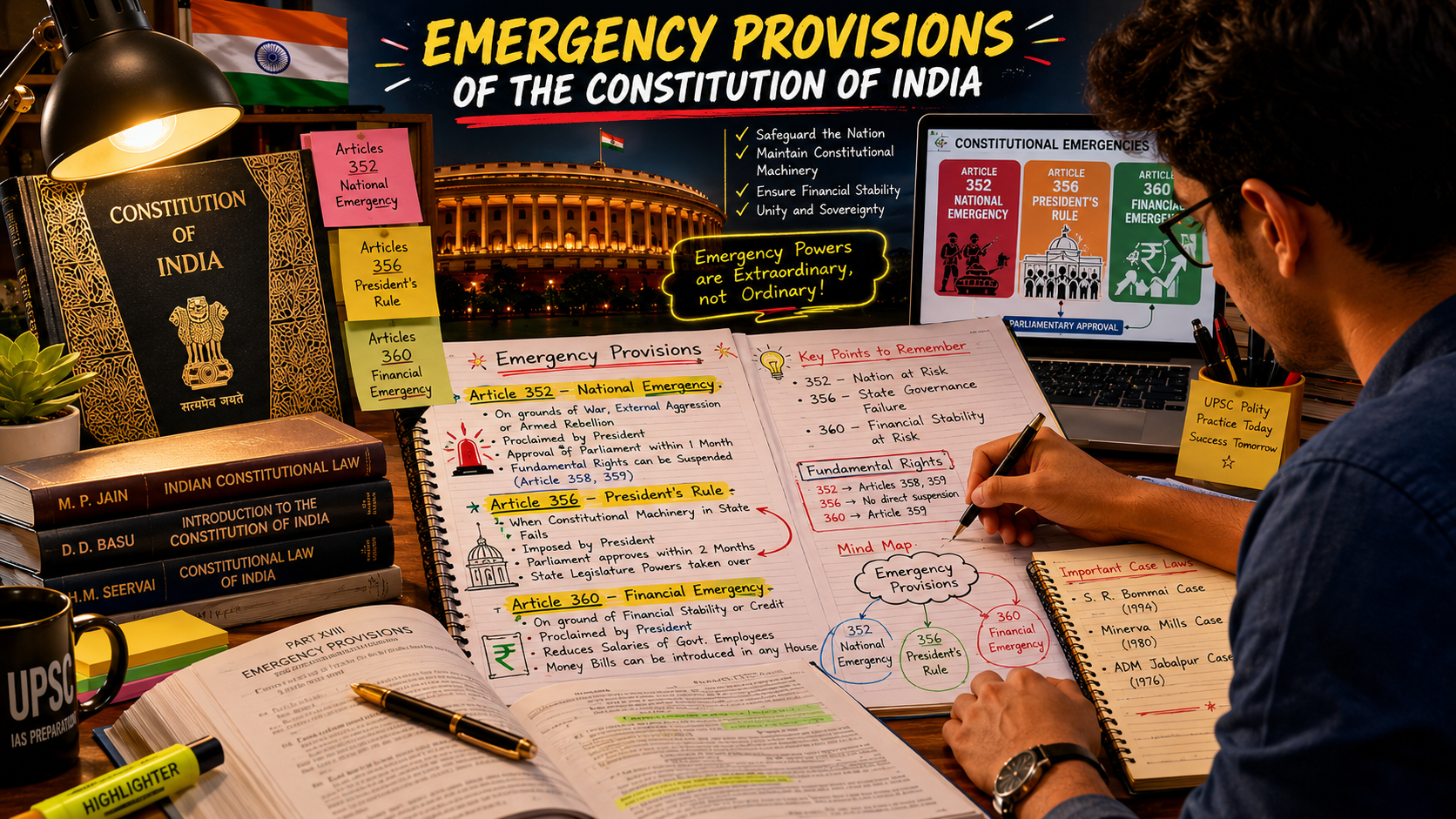
Section 4: Centre–State Relations and Emergency Provisions (Questions 61–80)
Many questions in the System of Government 100 MCQs UPSC 2027 examination set focus on Centre-State relations and constitutional provisions.
Q61. Which Part of the Indian Constitution deals with Emergency Provisions?
A. Part XV
B. Part XVIII
C. Part XX
D. Part XXI
Q62. The Constitution of India provides for how many types of emergencies?
A. One
B. Two
C. Three
D. Four
Q63. National Emergency can be proclaimed under:
A. Article 352
B. Article 356
C. Article 360
D. Article 365
Q64. A National Emergency can be declared on the grounds of:
A. War, External Aggression, or Armed Rebellion
B. Internal Disturbance only
C. Failure of Constitutional Machinery
D. Financial Crisis only
Q65. The term “Armed Rebellion” was introduced by:
A. 24th Amendment
B. 42nd Amendment
C. 44th Amendment
D. 52nd Amendment
Q66. Who has the authority to proclaim a National Emergency?
A. Prime Minister
B. Parliament
C. President
D. Supreme Court
Q67. A proclamation of National Emergency must be approved by Parliament within:
A. One month
B. Two months
C. Three months
D. Six months
Q68. During a National Emergency, the legislative powers of Parliament:
A. Remain unchanged
B. Extend over State List subjects
C. Are suspended entirely
D. Shift to the Judiciary
Q69. Article 356 deals with:
A. National Emergency
B. Financial Emergency
C. President’s Rule in States
D. Judicial Emergency
Q70. President’s Rule can be imposed when:
A. Lok Sabha is dissolved
B. Constitutional machinery in a State fails
C. Rajya Sabha passes a resolution
D. Supreme Court advises the President
Q71. The report of which constitutional authority is commonly used for imposing President’s Rule?
A. Chief Minister
B. Chief Justice
C. Governor
D. Speaker
Q72. Article 365 is related to:
A. Financial Emergency
B. Failure of State compliance with Union directions
C. Judicial Review
D. Constitutional Amendments
Q73. The maximum duration of President’s Rule in a State is generally:
A. One year
B. Two years
C. Three years
D. Four years
Q74. Which landmark judgment imposed restrictions on misuse of Article 356?
A. Kesavananda Bharati Case
B. Golaknath Case
C. S.R. Bommai Case
D. Minerva Mills Case
Q75. Financial Emergency is provided under:
A. Article 352
B. Article 356
C. Article 360
D. Article 368
Q76. Which of the following emergencies has never been proclaimed in India?
A. National Emergency
B. President’s Rule
C. Financial Emergency
D. State Emergency
Q77. During Financial Emergency, the President may:
A. Suspend Parliament
B. Reduce salaries of government officials
C. Dissolve State Legislatures
D. Suspend Elections
Q78. Which of the following rights can be suspended during a National Emergency?
A. Right to Constitutional Remedies (subject to constitutional provisions)
B. Right against Exploitation only
C. Right to Equality only
D. All rights automatically
Q79. The Constitution becomes more unitary during:
A. Constitutional Amendments only
B. Elections only
C. Emergency situations
D. Judicial Review proceedings
Q80. Which statement best reflects the impact of Emergency Provisions on Indian Federalism?
A. Federalism is abolished permanently.
B. States become independent.
C. The Constitution temporarily assumes a unitary character.
D. Parliament loses legislative powers.
Answers and Explanations (Questions 61–80)
- B — Part XVIII
Part XVIII of the Constitution (Articles 352 to 360) contains provisions relating to various emergencies.
- C — Three
The Constitution provides for National Emergency, President’s Rule (State Emergency), and Financial Emergency.
- A — Article 352
Article 352 empowers the President to proclaim a National Emergency.
- A — War, External Aggression, or Armed Rebellion
These are the three constitutional grounds on which a National Emergency may be declared.
- C — 44th Amendment
The 44th Constitutional Amendment replaced the term “Internal Disturbance” with “Armed Rebellion.”
- C — President
The President proclaims Emergency on the written advice of the Union Cabinet.
- A — One month
A National Emergency must be approved by both Houses of Parliament within one month.
- B — Extend over State List subjects
During National Emergency, Parliament gains the power to legislate on matters in the State List.
- C — President’s Rule in States
Article 356 deals with the failure of constitutional machinery in a State.
- B — Constitutional machinery in a State fails
President’s Rule is imposed when a State Government cannot function according to constitutional provisions.
- C — Governor
The Governor’s report often forms the basis for imposing President’s Rule.
- B — Failure of State compliance with Union directions
Article 365 allows the Union to act when a State fails to comply with constitutional directions.
- C — Three years
Under specific constitutional conditions, President’s Rule can continue for a maximum of three years.
- C — S.R. Bommai Case
The Supreme Court in the S.R. Bommai case placed significant restrictions on the misuse of Article 356.
- C — Article 360
Article 360 provides for the declaration of Financial Emergency.
- C — Financial Emergency
No Financial Emergency has ever been proclaimed in India since independence.
- B — Reduce salaries of government officials
During a Financial Emergency, the President may direct reductions in salaries, including those of judges.
- A — Right to Constitutional Remedies
Certain Fundamental Rights and remedies may be restricted during an Emergency, subject to constitutional safeguards.
- C — Emergency situations
India’s federal structure acquires a more unitary character during emergencies.
- C — The Constitution temporarily assumes a unitary character
Emergency provisions strengthen the powers of the Union Government and temporarily shift the balance toward a unitary system.
The final part of the System of Government 100 MCQs UPSC 2027 covers Cooperative Federalism, GST Council, Finance Commission, and Centre-State Relations.
Understanding Cooperative Federalism requires awareness of contemporary governance issues, public policy initiatives, and Centre-State coordination mechanisms.
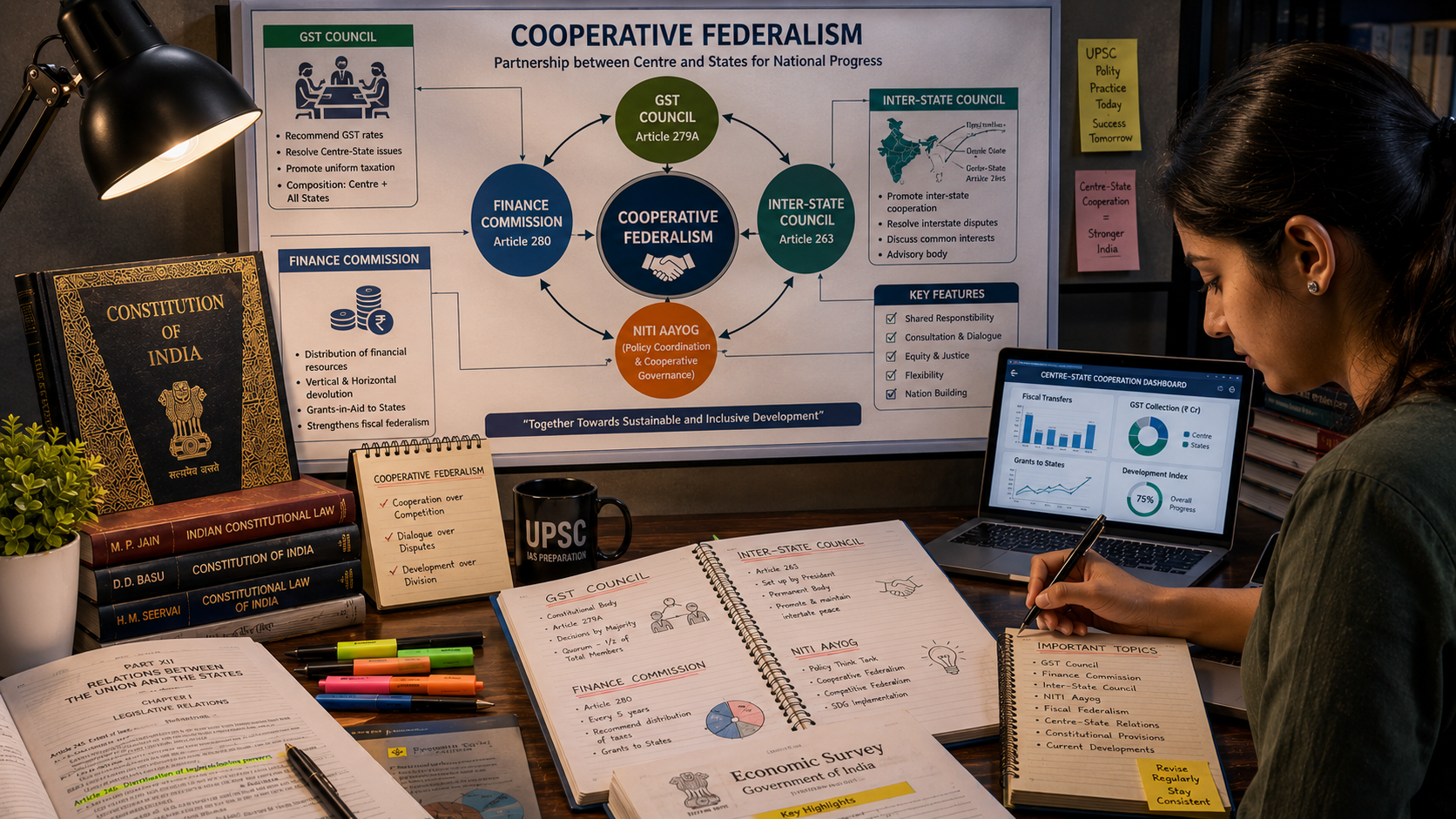
Section 5: Centre–State Relations, Cooperative Federalism & Advanced Constitutional Concepts (Questions 81–100)
Q81. The Inter-State Council is established under:
A. Article 263
B. Article 280
C. Article 356
D. Article 368
Q82. The primary objective of the Inter-State Council is:
A. Judicial Review
B. Coordination between Centre and States
C. Conducting Elections
D. Constitutional Amendments
Q83. Which body recommends the distribution of tax revenues between Centre and States?
A. GST Council
B. NITI Aayog
C. Finance Commission
D. Election Commission
Q84. The Finance Commission is constituted under:
A. Article 263
B. Article 280
C. Article 324
D. Article 356
Q85. The GST Council is chaired by:
A. Prime Minister
B. Union Home Minister
C. Union Finance Minister
D. Vice President
Q86. The GST Council is an example of:
A. Competitive Federalism
B. Judicial Federalism
C. Cooperative Federalism
D. Administrative Federalism
Q87. Which institution replaced the Planning Commission?
A. Finance Commission
B. GST Council
C. NITI Aayog
D. Inter-State Council
Q88. The concept of “Competitive Federalism” encourages:
A. State secession
B. Healthy competition among States
C. Judicial supremacy
D. Presidential governance
Q89. Which Schedule of the Constitution contains provisions relating to local self-government after the 73rd and 74th Amendments?
A. Seventh Schedule
B. Eighth Schedule
C. Eleventh and Twelfth Schedules
D. Tenth Schedule
Q90. The Rajya Sabha is considered a federal chamber because:
A. It represents the Judiciary
B. It represents States in the Union Legislature
C. It appoints Governors
D. It controls local governments
Q91. Which Article empowers Parliament to legislate on State List subjects in national interest through a Rajya Sabha resolution?
A. Article 249
B. Article 352
C. Article 356
D. Article 368
Q92. Under Article 249, the Rajya Sabha resolution must be passed by:
A. Simple Majority
B. Special Majority of Total Membership
C. Two-thirds of Members Present and Voting
D. Unanimous Vote
Q93. Which constitutional body audits the accounts of both Centre and States?
A. UPSC
B. Election Commission
C. Comptroller and Auditor General (CAG)
D. Finance Commission
Q94. The All India Services are often regarded as instruments of:
A. Judicial Federalism
B. Administrative Integration
C. State Autonomy
D. Direct Democracy
Q95. Which of the following is a unitary feature of the Indian Constitution?
A. Division of Powers
B. Written Constitution
C. Single Constitution for most States
D. Independent Judiciary
Q96. Which statement regarding Indian Federalism is correct?
A. States can secede from the Union.
B. Parliament cannot alter State boundaries.
C. India combines federal and unitary features.
D. Residuary powers belong to States.
Q97. Which body promotes policy cooperation between Centre and States through Governing Council meetings?
A. Election Commission
B. NITI Aayog
C. Supreme Court
D. UPSC
Q98. Which constitutional principle best explains Centre-State cooperation in GST implementation?
A. Separation of Powers
B. Collective Responsibility
C. Cooperative Federalism
D. Judicial Activism
Q99. Dr. B.R. Ambedkar described the Indian Constitution as:
A. Purely Federal
B. Purely Unitary
C. Flexible enough to be both Federal and Unitary according to circumstances
D. A Confederation
Q100. Which of the following best summarizes India’s System of Government?
A. Presidential, Unitary, and Rigid
B. Parliamentary, Federal with Unitary Bias, and Cooperative in Practice
C. Parliamentary and Completely Unitary
D. Presidential and Federal with State Sovereignty
The final portion of the System of Government 100 MCQs UPSC 2027 article focuses on advanced constitutional institutions and cooperative federalism.
Answers and Explanations (Questions 81–100): System of Government 100 MCQs UPSC 2027
- A — Article 263
Article 263 provides for the establishment of the Inter-State Council to facilitate coordination between the Union and the States.
- B — Coordination between Centre and States
The Inter-State Council promotes consultation, cooperation, and coordination among different levels of government.
- C — Finance Commission
The Finance Commission recommends how tax revenues should be distributed between the Union and the States.
- B — Article 280
Article 280 mandates the President to constitute a Finance Commission every five years.
- C — Union Finance Minister
The Union Finance Minister serves as the Chairperson of the GST Council.
- C — Cooperative Federalism
The GST Council exemplifies cooperative decision-making between the Centre and the States.
- C — NITI Aayog
NITI Aayog replaced the Planning Commission in 2015 and promotes collaborative policy-making.
- B — Healthy competition among States
Competitive Federalism encourages states to improve governance, infrastructure, and public service delivery.
- C — Eleventh and Twelfth Schedules
These schedules contain provisions relating to Panchayats and Municipalities respectively.
- B — It represents States in the Union Legislature
Rajya Sabha serves as the chamber through which states participate in national law-making.
- A — Article 249
Article 249 allows Parliament to legislate on State List subjects if the Rajya Sabha declares it necessary in the national interest.
- C — Two-thirds of Members Present and Voting
A special majority of two-thirds of members present and voting is required for such a resolution.
- C — Comptroller and Auditor General (CAG)
The CAG audits the accounts of both the Union and State Governments and safeguards public finances.
- B — Administrative Integration
The All India Services help maintain administrative uniformity and national integration.
- C — Single Constitution for most States
A single constitutional framework for the entire country reflects a unitary feature.
- C — India combines federal and unitary features
India is neither purely federal nor purely unitary; it blends characteristics of both systems.
- B — NITI Aayog
The Governing Council of NITI Aayog includes Chief Ministers and Lieutenant Governors, promoting cooperative governance.
- C — Cooperative Federalism
GST implementation depends on consensus and collaboration between the Centre and States.
- C — Flexible enough to be both Federal and Unitary according to circumstances
Dr. Ambedkar emphasized that the Constitution could operate with federal or unitary characteristics depending on the situation.
- B — Parliamentary, Federal with Unitary Bias, and Cooperative in Practice
This description best captures the nature of India’s constitutional and political system.
For additional revision, candidates can explore more UPSC Prelims practice sets covering History, Polity, Environment, and Current Affairs.
Related Posts
Important World Current Affairs MCQs for UPSC Prelims 2027 with Answers
Conclusion
These System of Government 100 MCQs UPSC 2027 provide comprehensive practice for one of the most important areas of Indian Polity.
By regularly revising these System of Government 100 MCQs UPSC 2027, aspirants can improve both conceptual clarity and question-solving accuracy.
Candidates preparing for Civil Services should bookmark this System of Government 100 MCQs UPSC 2027 resource for future revision.
This section covered important UPSC themes such as the Finance Commission, GST Council, Inter-State Council, NITI Aayog, Cooperative Federalism, Competitive Federalism, All India Services, and advanced concepts relating to Centre–State Relations. These topics are frequently tested in UPSC Prelims and are equally relevant for Mains examination answers.
Aspirants are encouraged to revise the System of Government 100 MCQs UPSC 2027 multiple times before the examination.
FAQs
1. What are the most important System of Government topics for UPSC Prelims?
Parliamentary System, Presidential System, Federalism, Centre-State Relations, Emergency Provisions, GST Council, Finance Commission, and Cooperative Federalism are among the most important topics.
2. Are System of Government questions frequently asked in UPSC Prelims?
Yes. Questions related to Parliamentary Government, Federalism, Emergency Provisions, and Constitutional Bodies appear regularly in UPSC Prelims.
3.Is this MCQ set useful for State PCS exams?
Yes. These MCQs are highly useful for UPPCS, BPSC, MPPSC, RPSC, and other State PCS examinations.
4. Which Constitution articles are important from this topic?
Articles 1, 3, 74, 75, 249, 263, 280, 352, 356, and 360 are particularly important.
5. How should I revise Indian Polity for UPSC Prelims?
Combine NCERTs, Laxmikanth, previous year questions, and topic-wise MCQ practice for effective revision.
2 thoughts on “Indian Polity Practice Set: System of Government 100 MCQs UPSC 2027”