
Inroduction
Modern History Strategy for UPSC Mains GS Paper 1 is one of the most searched topics among Civil Services aspirants because Modern Indian History consistently contributes a significant share of questions in both UPSC Prelims and Mains. A strong command of Modern History can help aspirants score well in GS Paper 1 while also strengthening their preparation for Essay, Ethics, and Interview stages.
In this comprehensive guide, we will discuss the syllabus, topic-wise strategy, best books, answer-writing techniques, PYQ trends, and a practical study plan for mastering Modern Indian History.
Preparing Modern History alone is not enough for a high GS Paper 1 score. Aspirants should also read our detailed guide on How to Score 120+ in GS Paper 1 to understand the overall preparation strategy, answer-writing techniques, and revision framework.
Modern History Strategy for UPSC Mains GS Paper 1: Why It Matters
Modern Indian History is considered one of the most scoring sections because:
- Questions are predictable.
- Sources are limited.
- Topics overlap with UPSC Prelims.
- Historical events are interconnected.
- Answer writing becomes easier with proper timelines.
Generally, UPSC asks questions related to:
- Freedom Struggle
- National Movement
- Important Personalities
- Constitutional Developments
- Social and Religious Reforms
- Post-Independence Consolidation
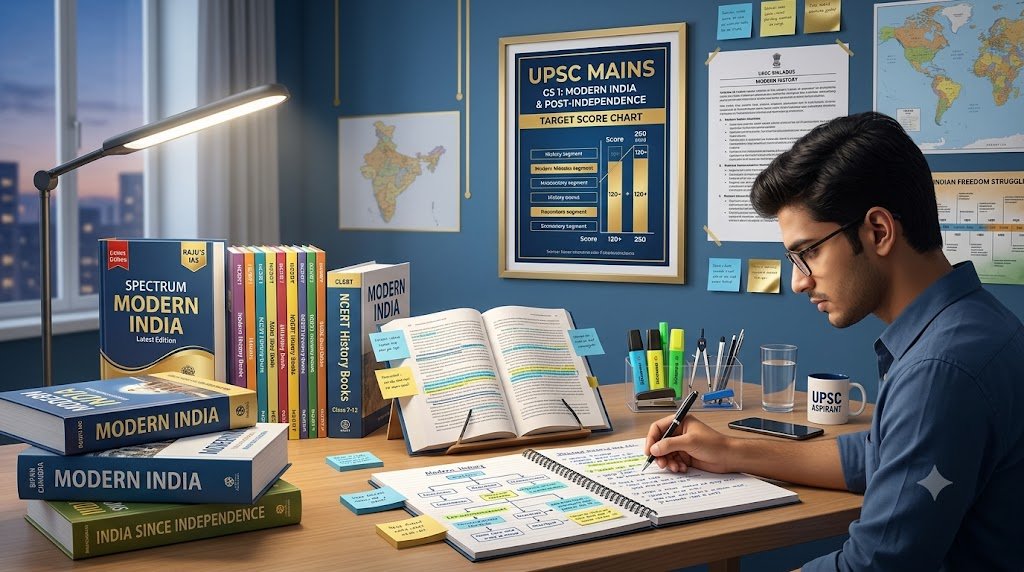
UPSC GS Paper 1 Modern History Syllabus
According to the UPSC syllabus, candidates should prepare:
Modern Indian History from about the middle of the eighteenth century until the present, significant events, personalities, issues, freedom struggle, various stages and contributors from different parts of the country, and post-independence consolidation and reorganization.
Weightage Analysis of Modern History
| Topic | Importance |
|---|---|
| Freedom Struggle | Very High |
| Gandhian Era | Very High |
| Social Reform Movements | High |
| Constitutional Developments | High |
| Post-Independence India | Medium |
| Important Personalities | High |
Modern History generally contributes 40–60 marks in GS Paper 1.
Before starting topic-wise preparation, it is important to understand the complete structure of GS Paper 1. Refer to our detailed UPSC GS Paper 1 Syllabus 2027 guide for a section-wise syllabus breakdown.
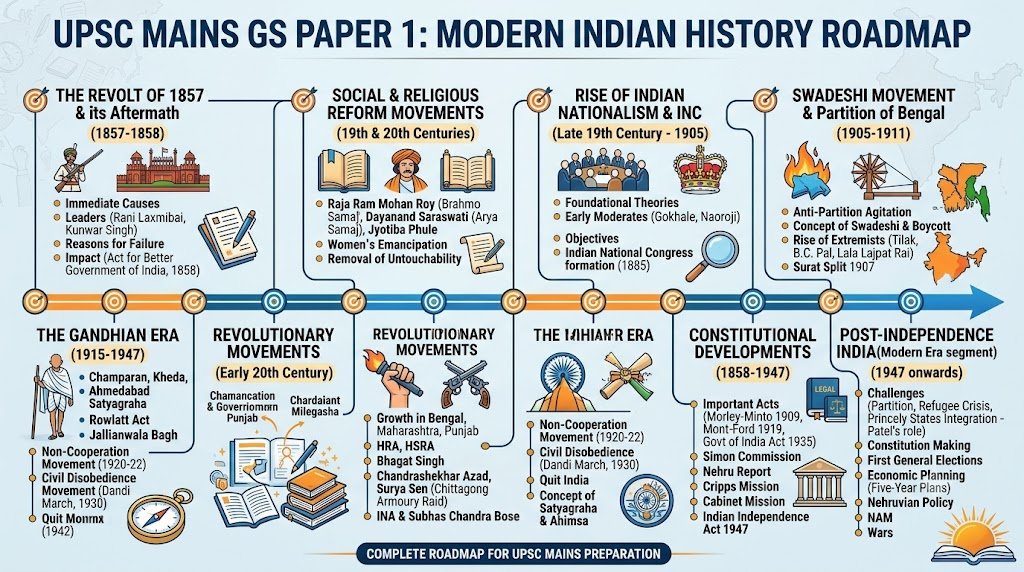
Best Books for Modern History Strategy for UPSC Mains GS Paper 1
1. Spectrum Modern History
Why It Is Important
- Concise
- Exam-oriented
- Easy revision
- Covers almost entire syllabus
Best For
- Prelims
- Mains
- Revision
Why Read It
- Conceptual clarity
- Analytical understanding
- Mains-oriented perspective
Best For
- Advanced preparation
- Answer enrichment
3. NCERT History Textbooks
Recommended:
- Class 8 History
- Class 12 Themes in Indian History
Useful for building foundations.
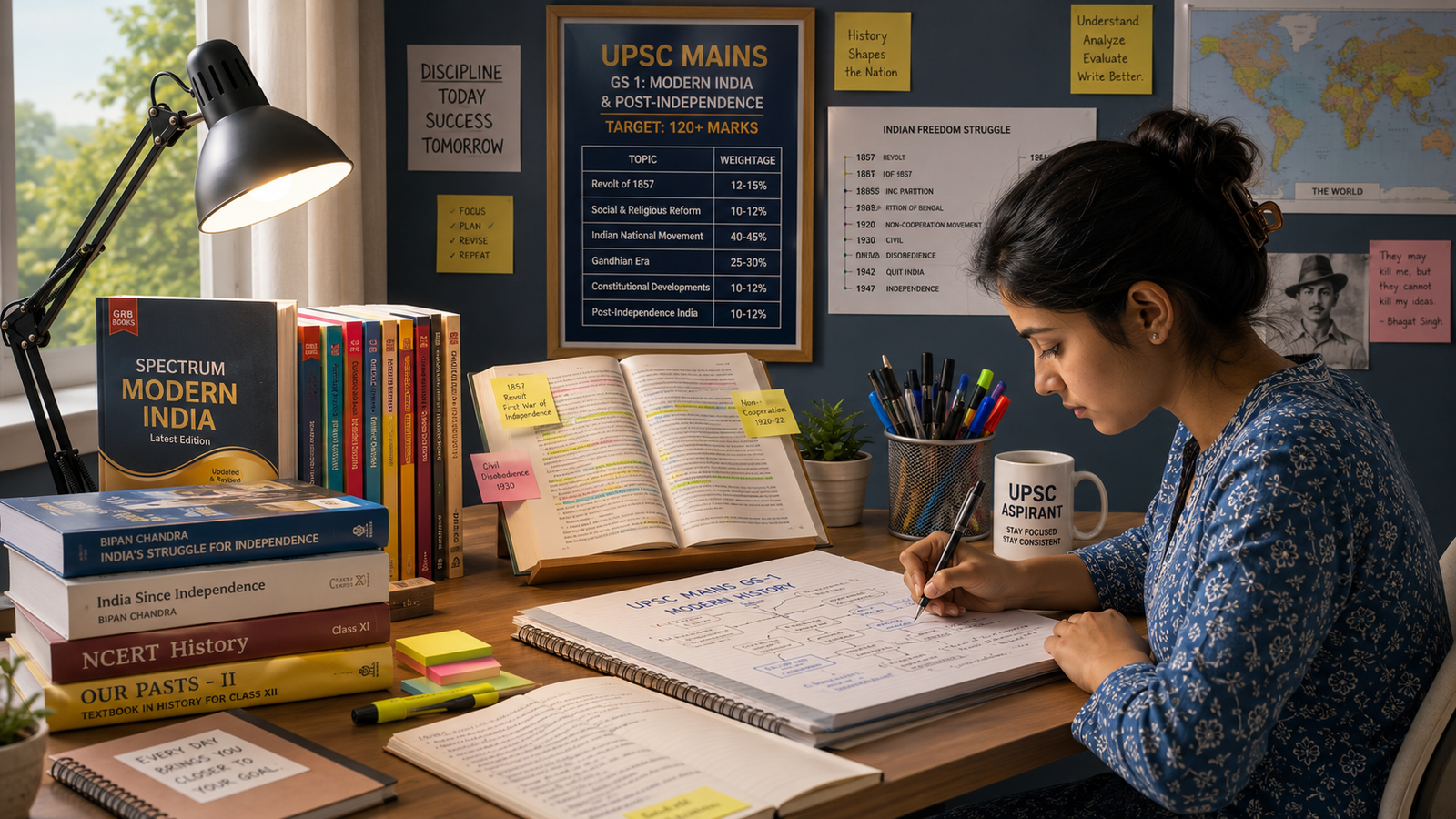
Topic-Wise Preparation Strategy
Decline of Mughal Empire
Focus Areas:
- Causes of decline
- Regional powers
- Political fragmentation
Do not spend excessive time here.
Advent of Europeans
Prepare:
- Portuguese
- Dutch
- French
- British
Important Areas:
- Trade policies
- Carnatic Wars
- Battle of Plassey
- Battle of Buxar
British Expansion in India
Focus on:
- Subsidiary Alliance
- Doctrine of Lapse
- Annexation Policies
Frequently linked with colonial administration questions.
Revolt of 1857
A perennial favorite of UPSC.
Study:
- Causes
- Nature
- Consequences
- Historiographical interpretations
Answer Writing Tip
Always mention multiple viewpoints:
- Nationalist View
- Marxist View
- British View
Social and Religious Reform Movements
Important Personalities:
- Raja Ram Mohan Roy
- Ishwar Chandra Vidyasagar
- Swami Dayanand Saraswati
- Swami Vivekananda
- Jyotirao Phule
- Narayana Guru
Frequently asked in Mains.
Questions on reform movements are often linked with Indian culture and heritage. To strengthen this area, explore our comprehensive Art & Culture Strategy for UPSC Mains guide.
Indian National Movement
Moderate Phase
Topics:
- Congress Formation
- Objectives
- Contributions
Extremist Phase
Topics:
- Lal-Bal-Pal
- Swadeshi Movement
- Partition of Bengal
UPSC often asks comparative questions.
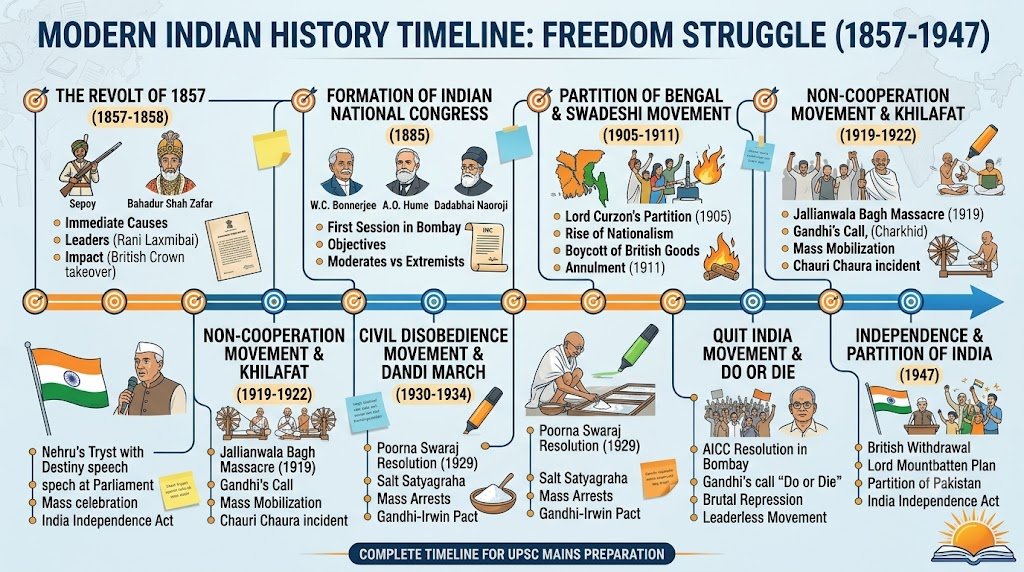
Gandhian Era
Most Important Topics for Modern Indian History
Champaran Satyagraha
Kheda Movement
Ahmedabad Mill Strike
Non-Cooperation Movement
Civil Disobedience Movement
Quit India Movement
Round Table Conferences
Cripps Mission
Cabinet Mission
Many Modern History themes are connected with broader UPSC preparation. If your target is a top score, check our complete How to Score 120+ in GS Paper 1 roadmap.
Prepare Freedom Struggle Chronologically
Suggested Timeline
| Year | Event |
|---|---|
| 1885 | INC Formation |
| 1905 | Partition of Bengal |
| 1907 | Surat Split |
| 1917 | Champaran |
| 1919 | Jallianwala Bagh |
| 1920 | Non-Cooperation |
| 1930 | Dandi March |
| 1942 | Quit India |
| 1947 | Independence |
Timelines improve retention and answer quality.
Important Personalities for UPSC Mains
Prepare contributions of:
- Mahatma Gandhi
- Bal Gangadhar Tilak
- Bipin Chandra Pal
- Lala Lajpat Rai
- Gopal Krishna Gokhale
- Subhash Chandra Bose
- Bhagat Singh
- Sardar Patel
- Jawaharlal Nehru
- Dr. B.R. Ambedkar
Post-Independence India Strategy
Many aspirants ignore this section.
Topics:
Integration of Princely States
Reorganization of States
Linguistic Movements
Nation Building
Early Economic Planning
Important source:
- Bipan Chandra’s India Since Independence
How to Make Notes for Modern History
Use Three Layers
Layer 1
Basic Facts
Layer 2
Important Events
Layer 3
Analysis and Historiography
This structure helps in Mains answer writing.
PYQ-Based Preparation Strategy
Analyze previous year questions from:
- 2013
- 2014
- 2015
- 2016
- 2017
- 2018
- 2019
- 2020
- 2021
- 2022
- 2023
- 2024
- 2025
Observe patterns:
- Freedom Struggle
- Gandhi
- Reform Movements
- Constitutional Developments
These themes repeat frequently.
Answer Writing Strategy for Modern History
Introduction
Start with:
- Historical context
- Event significance
- Timeline reference
Main Body
Use:
Causes
Features
Significance
Impact
Criticism
Subheadings improve readability.
Conclusion
Conclude with:
- Legacy
- Historical significance
- Relevance to modern India
Sample Framework
Question
“Evaluate the role of Gandhian movements in India’s freedom struggle.”
Introduction
Briefly explain Gandhi’s arrival and leadership.
Main Body
- Non-Cooperation
- Civil Disobedience
- Quit India
- Mass Mobilization
Critical Analysis
- Strengths
- Limitations
Conclusion
Long-term contribution to Indian nationalism.
Common Mistakes to Avoid
Reading Too Many Books
Stick to limited sources.
Ignoring Timelines
History becomes easier through chronology.
No Answer Writing
Knowledge alone does not fetch marks.
Excessive Fact Memorization
Focus on analysis and interpretation.
Ignoring Post-Independence India
UPSC frequently asks questions from this section.
30-Day Modern History Strategy for UPSC Mains GS Paper 1
Week 1
- Europeans in India
- British Expansion
- Revolt of 1857
Week 2
- Reform Movements
- INC Formation
- Moderate Phase
Week 3
- Extremist Phase
- Gandhian Era
- Revolutionary Activities
Week 4
- Constitutional Developments
- Post-Independence India
- Revision & PYQs
Quick Revision Checklist
✅ Revolt of 1857
✅ Reform Movements
✅ Moderate Phase
✅ Extremist Phase
✅ Gandhian Era
✅ Revolutionary Movement
✅ Constitutional Developments
✅ Partition & Independence
✅ Post-Independence Consolidation
Final Thoughts
A well-planned Modern History Strategy for UPSC Mains GS Paper 1 can significantly boost your overall score. The key is to focus on limited resources, revise multiple times, prepare timelines, practice answer writing, and analyze previous year questions. If you master Spectrum, understand Bipan Chandra’s analysis, and regularly practice Mains answers, Modern History can become one of the most rewarding sections of GS Paper 1.
By following this Modern History Strategy for UPSC Mains GS Paper 1, aspirants can build conceptual clarity, improve answer-writing quality, and maximize their GS Paper 1 score.
Recommended Reading
- 100 Important World Current Affairs MCQs for UPSC Prelims 2027 with Answers
- UPSC Mains 2026 GS1 Art and Culture Notes: Complete Study Guide for Success
- The Ultimate Guide to Bharatanatyam UPSC Notes: Master GS 1 Art & Culture
- PM KISAN Scheme UPSC Mains 2026: Complete Guide, Benefits, Challenges & Analysis
- Indus Valley Civilization Notes UPSC 2027: Complete & Important Guide
- Master Guide: Indian Classical And Folk Music UPSC Mains 2026 (GS 1)
- Indian Art Forms (Dance, Music, Painting) UPSC Mains 2026 GS Paper 1: Ultimate Success Guide
- US-China Summit 2026: Shocking Global Power Shift & India’s Powerful Strategic Future
Recommended Official Resources for UPSC Aspirants
For authentic information and official updates, aspirants should regularly refer to the following resources:
- Union Public Service Commission (UPSC) – Official UPSC notifications, syllabus, and examination updates.
- NCERT Official Website – Download NCERT textbooks essential for Modern History preparation.
- Press Information Bureau (PIB) – Government releases useful for current affairs and answer enrichment.
- NITI Aayog – Reports and policy documents useful for analytical answers.
- National Archives of India – Historical records and documents related to Modern Indian History.
24 thoughts on “Modern History Strategy for UPSC Mains GS Paper 1: Complete Guide & Study Plan”