
Master the Executive and Legislature 100 MCQs for UPSC CSE Prelims 2027 General Studies Paper-1. 100 strategic MCQs divided into 5 thematic sections with detailed, cross-referenced explanations.
The Executive and Legislature form the core engine of Indian Polity, consistently accounting for 40% to 50% of all Polity questions in the UPSC Civil Services Preliminary Examination. As UPSC shifts toward testing subtle nuances, constitutional provisions, and procedural distinctions, a superficial reading is no longer enough.
These Executive and Legislature 100 MCQs are designed to help UPSC CSE Prelims 2027 aspirants master constitutional provisions related to the President, Governor, Parliament, State Legislature, Council of Ministers, ordinances, Money Bills and other high-frequency polity concepts.
Before attempting these Executive and Legislature 100 MCQs, aspirants should understand how UPSC frames conceptual and statement-based questions by reviewing our UPSC Prelims Previous Year Trends (2015–2026).
This comprehensive guide breaks down the topic into 5 systematic sections featuring 100 practice MCQs crafted on standard UPSC CSE Prelims patterns.
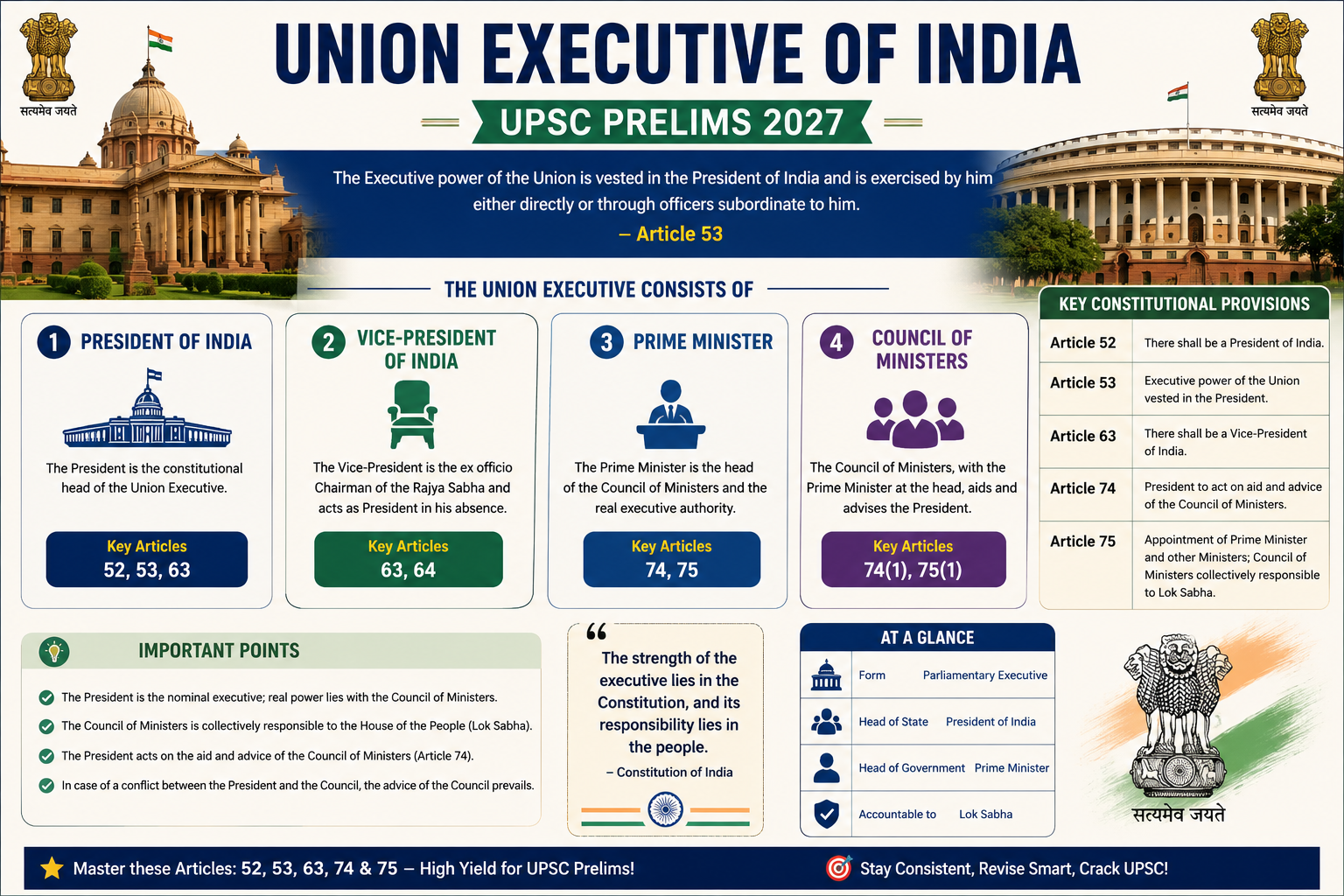
Section 1 : The Union Executive (President, Vice-President, PM & Council of Ministers)
Questions
Q1. Consider the following statements regarding the election of the President of India:
Nominated members of both Houses of Parliament do not participate in the election of the President.
Elected members of the Legislative Assemblies of Union Territories with legislatures participate in the presidential election.
The value of the vote of an MLA varies from state to state depending on the population.
Which of the statements given above are correct?
(a) 1 and 2 only
(b) 2 and 3 only
(c) 1 and 3 only
(d) 1, 2, and 3
Q2. With reference to the impeachment of the President of India, consider the following:
An impeachment motion can be initiated in either House of Parliament.
Nominated members of Parliament can participate in the impeachment process.
Elected members of State Legislative Assemblies participate in the impeachment of the President.
Which of the statements given above is/are correct?
(a) 1 and 2 only
(b) 2 only
(c) 1 and 3 only
(d) 1, 2, and 3
Q3. Consider the following statements regarding the Ordinance-making power of the President under Article 123:
An Ordinance can be issued when only one House of Parliament is in session.
The President’s power to issue an Ordinance is subject to judicial review.
An Ordinance must be approved by Parliament within six weeks from its promulgation.
Which of the statements given above is/are correct?
(a) 1 and 2 only
(b) 2 and 3 only
(c) 1 only
(d) 1, 2, and 3
Q4. Regarding the Pardoning Power of the President under Article 72, which of the following statements is INCORRECT?
(a) The President exercises this power independently of the advice of the Union Council of Ministers.
(b) The power extends to sentences awarded by a Court Martial.
(c) The petitioner has no right to an oral hearing by the President.
(d) The exercise of pardoning power is subject to limited judicial review.
Q5. Consider the following statements regarding the Vice-President of India:
The Vice-President is elected by an electoral college consisting of both elected and nominated members of Parliament.
State Legislative Assemblies have no role in the election of the Vice-President.
A resolution for the removal of the Vice-President must be passed by a special majority in both Houses of Parliament.
Which of the statements given above are correct?
(a) 1 and 2 only
(b) 2 and 3 only
(c) 1 and 3 only
(d) 1, 2, and 3
Q6. Which of the following constitutional provisions reflects the principle of Collective Responsibility of the Council of Ministers?
(a) Article 74(1)
(b) Article 75(3)
(c) Article 77(1)
(d) Article 78(a)
Q7. Consider the following statements regarding the Prime Minister of India:
The Constitution requires that the person appointed as Prime Minister must prove their majority in the Lok Sabha before taking office.
A person who is not a member of either House of Parliament can be appointed as Prime Minister for a maximum period of six months.
Which of the statements given above is/are correct?
(a) 1 only
(b) 2 only
(c) Both 1 and 2
(d) Neither 1 nor 2
Q8. According to the Constitution of India, the total number of ministers, including the Prime Minister, in the Union Council of Ministers shall not exceed:
(a) 10% of the total number of members of Parliament
(b) 15% of the total number of members of the Lok Sabha
(c) 15% of the total strength of Parliament
(d) 20% of the total number of members of the Lok Sabha
Q9. Consider the following statements regarding the Attorney General for India:
The Attorney General is appointed by the President and holds office during the pleasure of the President.
The Attorney General has the right to speak and take part in the proceedings of either House of Parliament but without the right to vote.
The Attorney General is a full-time counsel for the Government and cannot engage in private legal practice.
Which of the statements given above are correct?
(a) 1 and 2 only
(b) 2 and 3 only
(c) 1 and 3 only
(d) 1, 2, and 3
Q10. Which of the following statements is correct regarding the absolute veto of the President of India?
(a) It is exercised when the President returns a bill for reconsideration of Parliament.
(b) It can be exercised with respect to private members’ bills.
(c) It can be exercised on constitutional amendment bills passed by Parliament.
(d) It is mandatory for the President to exercise absolute veto on money bills.
Q11. Consider the following statements about the discretionary powers of the President:
Appointment of Prime Minister when no political party has a clear majority in the Lok Sabha.
Dismissal of the Council of Ministers when it cannot prove the confidence of the Lok Sabha.
Dissolution of the Lok Sabha if the Council of Ministers has lost its majority.
Which of the statements given above are correct?
(a) 1 and 2 only
(b) 2 and 3 only
(c) 1 and 3 only
(d) 1, 2, and 3
Q12. If the President of India wants to resign, to whom must the letter of resignation be addressed?
(a) The Chief Justice of India
(b) The Prime Minister of India
(c) The Vice-President of India
(d) The Speaker of the Lok Sabha
Q13. Consider the following statements regarding Article 74 of the Constitution:
There shall be a Council of Ministers with the Prime Minister at the head to aid and advise the President.
The advice tendered by Ministers to the President shall not be inquired into in any court.
The President can require the Council of Ministers to reconsider such advice only once.
Which of the statements given above are correct?
(a) 1 and 2 only
(b) 2 and 3 only
(c) 1 and 3 only
(d) 1, 2, and 3
Q14. Which of the following constitutional amendments made the advice of the Council of Ministers binding on the President of India?
(a) 24th Constitutional Amendment Act, 1971
(b) 42nd Constitutional Amendment Act, 1976
(c) 44th Constitutional Amendment Act, 1978
(d) 86th Constitutional Amendment Act, 2002
Q15. Consider the following statements regarding the oath of office of the Prime Minister and other Union Ministers:
The oath of secrecy is administered by the Chief Justice of India.
The forms of oaths of office and secrecy are contained in the Third Schedule of the Constitution.
Which of the statements given above is/are correct?
(a) 1 only
(b) 2 only
(c) Both 1 and 2
(d) Neither 1 nor 2
Q16. With reference to the caretaker government at the Centre, consider the following statements:
The Constitution explicitly provides for a caretaker government during the dissolution of the Lok Sabha.
A caretaker government cannot take major policy decisions that bind the incoming executive.
Which of the statements given above is/are correct?
(a) 1 only
(b) 2 only
(c) Both 1 and 2
(d) Neither 1 nor 2
Q17. Who among the following does NOT hold office during the pleasure of the President?
(a) Attorney General of India
(b) Comptroller and Auditor General of India
(c) Governor of a State
(d) Union Ministers
Q18. What is the term of office of the Vice-President of India?
(a) 5 years from the date on which they enter upon office
(b) 6 years or until reaching 65 years of age
(c) Co-terminus with the duration of the Lok Sabha
(d) Subject to the pleasure of the President
Q19. Consider the following statements regarding the duties of the Prime Minister under Article 78:
To communicate to the President all decisions of the Council of Ministers relating to administration.
To furnish such information relating to administration as the President may call for.
To submit for consideration of the Council of Ministers any matter on which a decision has been taken by a minister but not considered by the Council.
Which of the statements given above are correct?
(a) 1 and 2 only
(b) 2 and 3 only
(c) 1 and 3 only
(d) 1, 2, and 3
Q20. Which Constitutional Amendment cap on the size of the Council of Ministers was introduced?
(a) 86th Amendment Act
(b) 91st Amendment Act
(c) 93rd Amendment Act
(d) 97th Amendment Act
Answers & Explanations: Section 1( Executive and Legislature 100 MCQs: UPSC Prelims 2027 GS)
Q1. (d) All three statements are correct. Nominated members do not participate in presidential elections. Elected members of Assemblies (including UTs of Delhi, Puducherry, and Jammu & Kashmir) participate. MLA vote value depends on state population per the formula in Article 55.
Q2. (a) Statements 1 and 2 are correct. Nominated members of Parliament can participate in presidential impeachment (unlike in elections). State Legislative Assembly members do NOT participate in impeachment.
Q3. (a) Statements 1 and 2 are correct. An Ordinance can be issued if either House is not in session. In Krishna Kumar Singh (2017), SC confirmed ordinance power is subject to judicial review. Statement 3 is incorrect: it must be approved within six weeks from the assembly of Parliament (not from promulgation).
Q4. (a) Statement (a) is incorrect. The President exercises pardoning power under Article 72 on the advice of the Union Cabinet, not independently.
Q5. (a) Statements 1 and 2 are correct. The electoral college for the Vice-President comprises all MPs (elected + nominated). States have no role. Resolution for removal needs passage in Rajya Sabha by effective majority and agreed to by Lok Sabha by simple majority (not special majority in both).
Q6. (b) Article 75(3) explicitly states that the Council of Ministers shall be collectively responsible to the House of the People (Lok Sabha).
Q7. (b) Statement 1 is incorrect: Delhi High Court (1980) held that the PM can be appointed first and prove majority within a reasonable time. Statement 2 is correct per Article 75(5).
Q8. (b) The 91st Amendment Act, 2003 capped the total ministers at 15% of the total strength of the Lok Sabha.
Q9. (a) Statements 1 and 2 are correct. Statement 3 is incorrect: The AG is not a whole-time counsel for the government and is not debarred from private legal practice, subject to certain conditions.
Q10. (b) Absolute veto (withholding assent completely) is exercised regarding private members’ bills or when the cabinet resigns before assent. President cannot exercise veto on Constitutional Amendment bills (24th Amendment).
Q11. (d) All three represent situational discretionary powers of the President where the Council of Ministers’ advice is unavailable or invalid.
Q12. (c) Article 56(1)(a) specifies that the President resigns by writing under their hand addressed to the Vice-President.
Q13. (d) All statements are correct. Article 74 mandates advice, bars court inquiry, and allows the President to request a one-time reconsideration (44th Amendment).
Q14. (b) The 42nd Amendment Act, 1976 made advice binding. The 44th Amendment Act, 1978 added the provision allowing the President to send advice back for one reconsideration.
Q15. (b) Statement 1 is incorrect: Oath is administered by the President. Statement 2 is correct: Oaths are listed in the Third Schedule.
Q16. (d) Neither statement is correct. The Constitution does not explicitly use or define “caretaker government.” Under constitutional convention, a caretaker government acts on conventions but maintains full legal executive powers.
Q17. (b) CAG is appointed by the President but can only be removed in the manner and on grounds similar to a Judge of the Supreme Court (Article 148).
Q18. (a) Per Article 67, term is 5 years from entering office.
Q19. (d) Article 78 explicitly lists all three duties of the Prime Minister toward the President.
Q20. (b) The 91st Constitutional Amendment Act, 2003 added Article 75(1A) setting the 15% cap.
If you are building your Polity foundation from scratch, you must revise the constitutional background through our Making of Constitution 100 MCQs for UPSC Prelims 2027, which complements the Executive and Legislature topics covered below.
Once you are comfortable with the President, Vice-President and Union Executive, strengthen your broader constitutional preparation with our 75 Important Polity Questions for UPSC Prelims 2027, featuring additional concept-based and PYQ-style practice.

Section 2: Parliament — Structure, Composition & Conduct of Business
Questions
Q21. Consider the following statements regarding the Rajya Sabha:
It is a permanent body and not subject to dissolution.
One-third of its members retire every second year.
The constitutional term of office of a member of the Rajya Sabha is six years.
Which of the statements given above are correct?
(a) 1 and 2 only
(b) 2 and 3 only
(c) 1 and 3 only
(d) 1, 2, and 3
Q22. With reference to the Speaker of the Lok Sabha, consider the following statements:
The Speaker vacates their office immediately upon the dissolution of the Lok Sabha.
The resolution for removal of the Speaker requires a special majority of members present and voting.
The Speaker casts a vote only in the case of an equality of votes.
Which of the statements given above is/are correct?
(a) 3 only
(b) 1 and 2 only
(c) 2 and 3 only
(d) 1, 2, and 3
Q23. Who presides over a Joint Sitting of both Houses of Parliament in the absence of the Speaker of the Lok Sabha?
(a) Chairman of the Rajya Sabha
(b) Deputy Chairman of the Rajya Sabha
(c) Deputy Speaker of the Lok Sabha
(d) A member chosen by the President
Q24. Consider the following statements regarding the constitutional qualification for becoming a member of Parliament:
Must be a citizen of India.
Must not be less than 25 years of age for Rajya Sabha and 30 years for Lok Sabha.
Must subscribe to an oath before a person authorized by the Election Commission.
Which of the statements given above are correct?
(a) 1 and 2 only
(b) 1 and 3 only
(c) 2 and 3 only
(d) 1, 2, and 3
Q25. Decisions on disqualification of a member of Parliament under the Anti-Defection Law (Tenth Schedule) are taken by:
(a) President on advice of Election Commission
(b) Supreme Court of India
(c) Presiding Officer of the respective House
(d) Union Ministry of Law and Justice
Q26. Consider the following statements regarding Parliamentary Sessions:
The gap between two sessions of Parliament cannot exceed six months.
“Adjournment sine die” terminates a session of Parliament.
Prorogation of the House is done by the Presiding Officer of that House.
Which of the statements given above is/are correct?
(a) 1 only
(b) 1 and 2 only
(c) 2 and 3 only
(d) 1, 2, and 3
Q27. What is “Quorum” required to constitute a meeting of either House of Parliament?
(a) One-tenth of the total number of members of the House
(b) One-fifth of the total number of members of the House
(c) Fifty members in Lok Sabha and twenty-five in Rajya Sabha
(d) One-third of the total membership
Q28. Consider the following statements regarding Question Hour in Parliament:
A Starred Question requires an oral answer, and supplementary questions can follow.
An Unstarred Question requires a written answer, and supplementary questions cannot follow.
A Short Notice Question is asked by giving notice of less than ten clear days and is answered orally.
Which of the statements given above are correct?
(a) 1 and 2 only
(b) 2 and 3 only
(c) 1 and 3 only
(d) 1, 2, and 3
Q29. Which motion is moved by a member when they feel that a minister has committed a breach of privilege of the House?
(a) Censure Motion
(b) Privilege Motion
(c) Calling Attention Motion
(d) Adjournment Motion
Q30. Consider the following statements regarding the Adjournment Motion:
It is introduced to draw the attention of the House to a definite matter of urgent public importance.
It involves an element of censure against the government.
It can be introduced in both the Lok Sabha and the Rajya Sabha.
Which of the statements given above are correct?
(a) 1 and 2 only
(b) 2 and 3 only
(c) 1 and 3 only
(d) 1, 2, and 3
Q31. The power to create or abolish an All-India Service lies exclusively with:
(a) Lok Sabha by simple majority
(b) Rajya Sabha by passing a resolution supported by not less than two-thirds of members present and voting
(c) Union Public Service Commission
(d) President of India through an executive order
Q32. Under which Article can Rajya Sabha authorize Parliament to make a law on a subject in the State List in the national interest?
(a) Article 248
(b) Article 249
(c) Article 250
(d) Article 252
Q33. Consider the following statements regarding the Secret Sitting of the House:
It is held on the request of the Leader of the House.
Visitors are not allowed into the galleries during a secret sitting.
Proceedings of a secret sitting can be published without restrictions.
Which of the statements given above is/are correct?
(a) 1 and 2 only
(b) 2 and 3 only
(c) 1 only
(d) 1, 2, and 3
Q34. What is the maximum period for which an MP can remain absent from all meetings of the House without permission before their seat is declared vacant?
(a) 30 days
(b) 60 days
(c) 90 days
(d) 180 days
Q35. Consider the following statements regarding the Leader of the Opposition (LoO):
The position of LoO was given statutory recognition in 1977.
To be recognized as LoO, the party must have at least 10% of the total strength of the House.
Which of the statements given above is/are correct?
(a) 1 only
(b) 2 only
(c) Both 1 and 2
(d) Neither 1 nor 2
Q36. Which of the following devices is an Indian innovation in parliamentary procedures since 1962?
(a) Question Hour
(b) Zero Hour
(c) Adjournment Motion
(d) Calling Attention Motion
Q37. Consider the following statements regarding the “Whip” in Indian Parliamentary system:
The office of Whip is mentioned in the Rules of the House.
Every political party, whether ruling or opposition, has its own whip in Parliament.
Which of the statements given above is/are correct?
(a) 1 only
(b) 2 only
(c) Both 1 and 2
(d) Neither 1 nor 2
Q38. A member of Parliament incurs disqualification under the Tenth Schedule if:
An independent member joins any political party after election.
A nominated member joins any political party after six months from taking their seat.
Which of the statements given above is/are correct?
(a) 1 only
(b) 2 only
(c) Both 1 and 2
(d) Neither 1 nor 2
Q39. Which Article of the Constitution contains provisions regarding parliamentary privileges of Houses and MPs?
(a) Article 102
(b) Article 105
(c) Article 110
(d) Article 112
Q40. Which body is responsible for preparing the official legislative calendar and allocating time for business in Lok Sabha?
(a) Rules Committee
(b) Business Advisory Committee
(c) General Purposes Committee
(d) Steering Committee
Answers & Explanations: Section 2(Executive and Legislature 100 MCQs: UPSC Prelims 2027 GS)
Q21. (a) Statements 1 and 2 are correct. Statement 3 is incorrect: The Constitution does not fix the term of Rajya Sabha members; it was fixed as six years by the Representation of the People Act, 1951.
Q22. (a) Statement 3 is correct (casting vote under Article 100). Statement 1 is incorrect: Speaker does not vacate office on dissolution; stays until first meeting of new Lok Sabha. Statement 2 is incorrect: requires a majority of ALL the then members (effective majority).
Q23. (c) Sequence of presiding over Joint Sitting: Speaker $\rightarrow$ Deputy Speaker $\rightarrow$ Deputy Chairman of Rajya Sabha. (Chairman of RS NEVER presides).
Q24. (b) Statements 1 and 3 are correct. Statement 2 is incorrect: Minimum age is 30 for Rajya Sabha and 25 for Lok Sabha.
Q25. (c) Tenth Schedule disqualification is decided by the Presiding Officer (Speaker/Chairman).
Q26. (a) Statement 1 is correct (Article 85). Statement 2 is incorrect: Adjournment sine die terminates a sitting, not a session. Statement 3 is incorrect: Prorogation is done by the President, not the Presiding Officer.
Q27. (a) Article 100(3) sets quorum at 1/10th of total membership of the House.
Q28. (d) All statements accurately describe Question Hour types.
Q29. (b) Privilege motion is moved against a minister who has withheld facts or given wrong info.
Q30. (a) Statements 1 and 2 are correct. Statement 3 is incorrect: Adjournment motion is permitted only in Lok Sabha as it censures the government.
Q31. (b) Article 312 empowers Rajya Sabha to pass a resolution by 2/3rd present & voting to create All-India Services.
Q32. (b) Article 249 allows Rajya Sabha to pass a resolution authorizing Parliament to legislate on State List matters in national interest.
Q33. (a) Statements 1 and 2 are correct. Statement 3 is incorrect: Secret sitting proceedings cannot be published without Speaker’s permission.
Q34. (b) Article 101(4): 60 consecutive days of absence without leave leads to seat being declared vacant.
Q35. (c) Both statements are correct. LoO got statutory status in 1977; 1/10th strength rule comes from the Salary and Allowances of Leaders of Opposition in Parliament Act, 1977.
Q36. (b) Zero Hour is an informal Indian parliamentary innovation operating since 1962.
Q37. (b) Statement 1 is incorrect: Office of Whip is based on parliamentary conventions (not in Constitution, Rules of House, or Statute). Statement 2 is correct.
Q38. (c) Both criteria under 10th Schedule cause disqualification. Nominated members can join a party within 6 months; after 6 months, they face disqualification.
Q39. (b) Article 105 deals with powers, privileges, and immunities of Parliament and its members.
Q40. (b) Business Advisory Committee allocates time for government and private business.
UPSC often connects static Polity with contemporary governance developments, so supplement these questions with our 100 Essential Current Affairs MCQs for UPSC Prelims for more integrated Prelims practice.
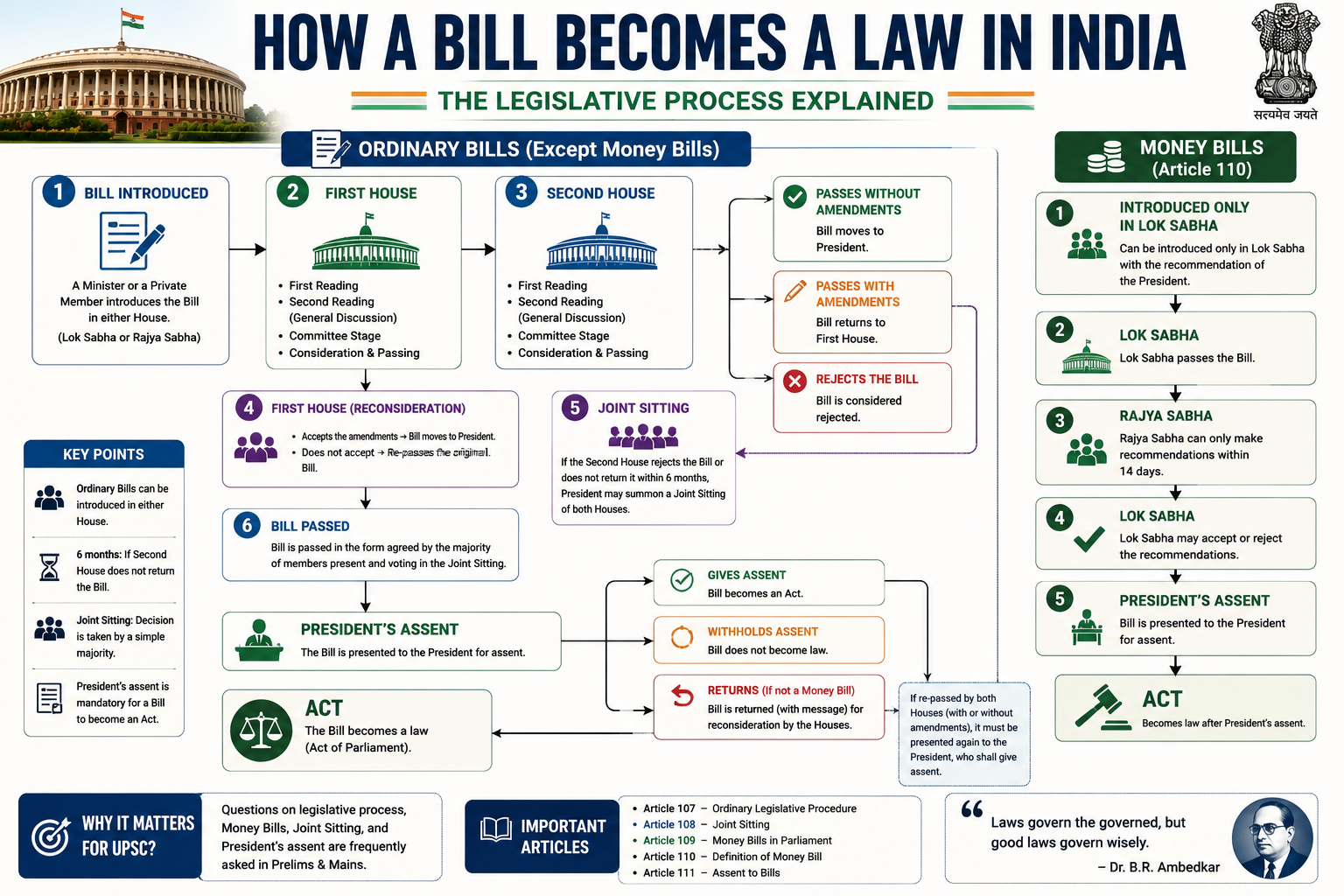
Section 3: Legislative Procedures & Financial Bills
Questions
Q41. Consider the following statements regarding an Ordinary Bill in Parliament:
It can originate in either House of Parliament.
It can be introduced either by a Minister or by a Private Member.
If a deadlock occurs, a Joint Sitting can be summoned by the President.
Which of the statements given above are correct?
(a) 1 and 2 only
(b) 2 and 3 only
(c) 1 and 3 only
(d) 1, 2, and 3
Q42. With reference to a Money Bill, consider the following statements:
It can be introduced only in the Lok Sabha with the prior recommendation of the President.
The decision of the Speaker as to whether a bill is a Money Bill or not is final and cannot be questioned in court under any circumstances.
Rajya Sabha must return a Money Bill within 14 days with or without recommendations.
Which of the statements given above are correct?
(a) 1 and 2 only
(b) 1 and 3 only
(c) 2 and 3 only
(d) 1, 2, and 3
Q43. Which of the following conditions constitutes a Money Bill under Article 110?
Imposition, abolition, remission, alteration, or regulation of any tax.
Regulation of the borrowing of money by the Union Government.
Imposition of fines or pecuniary penalties.
Select the correct answer:
(a) 1 and 2 only
(b) 2 and 3 only
(c) 1 and 3 only
(d) 1, 2, and 3
Q44. Consider the following statements regarding Financial Bills (Type I) under Article 117(1):
It can be introduced only in the Lok Sabha.
It requires the prior recommendation of the President for introduction.
In all other respects, it is governed by the same legislative procedure as an Ordinary Bill, including Joint Sittings.
Which of the statements given above are correct?
(a) 1 and 2 only
(b) 2 and 3 only
(c) 1 and 3 only
(d) 1, 2, and 3
Q45. Regarding Financial Bills (Type II) under Article 117(3), which statement is correct?
(a) It can only be introduced in the Lok Sabha.
(b) It requires prior presidential recommendation for its introduction.
(c) It can be introduced in either House, but requires presidential recommendation for consideration.
(d) Joint Sitting is not permissible for resolving deadlocks over it.
Q46. What happens to a bill pending in the Rajya Sabha which has NOT been passed by the Lok Sabha, upon the dissolution of the Lok Sabha?
(a) It lapses.
(b) It does not lapse.
(c) It is sent to the President for assent.
(d) It is referred to a Joint Sitting automatically.
Q47. In which of the following cases does a bill pending in Parliament NOT lapse upon dissolution of the Lok Sabha?
(a) A bill passed by Lok Sabha but pending in Rajya Sabha.
(b) A bill originating and pending in Lok Sabha.
(c) A bill passed by both Houses but pending assent of the President.
(d) A bill passed by Lok Sabha and rejected by Rajya Sabha.
Q48. Consider the following statements regarding Constitutional Amendment Bills under Article 368:
Can be introduced in either House of Parliament.
Requires prior permission of the President.
In case of deadlock between Lok Sabha and Rajya Sabha, a Joint Sitting is summoned.
Which of the statements given above is/are correct?
(a) 1 only
(b) 1 and 2 only
(c) 2 and 3 only
(d) 1, 2, and 3
Q49. Consider the following statements regarding the Annual Financial Statement (Budget) under Article 112:
It shows estimated receipts and expenditure of the Government of India for that financial year.
Expenditure ‘Charged’ upon the Consolidated Fund of India is non-votable by Parliament.
Demands for Grants are presented to both Houses of Parliament for voting.
Which of the statements given above are correct?
(a) 1 and 2 only
(b) 2 and 3 only
(c) 1 and 3 only
(d) 1, 2, and 3
Q50. Match the following Cut Motions with their specific objectives:
List I:
A. Policy Cut Motion
B. Economy Cut Motion
C. Token Cut Motion
List II:
Reduce demand by Rs. 100 to vent a specific grievance.
State that the amount of the demand be reduced to Re. 1.
State that the amount of the demand be reduced by a specified amount.
Codes:
(a) A-2, B-3, C-1
(b) A-1, B-2, C-3
(c) A-3, B-1, C-2
(d) A-2, B-1, C-3
The second half of these Executive and Legislature 100 MCQs moves towards more analytical and statement-based questions that test conceptual understanding and elimination skills required for UPSC Prelims.
Q51. What is “Guillotine” in parliamentary budget procedure?
(a) Expunging unparliamentary language from proceedings
(b) Putting all remaining demands for grants to vote without discussion due to time constraints
(c) Suspending a member for disorderly conduct
(d) Passing an interim budget during election years
Q52. Consider the following statements regarding the Consolidated Fund of India (Article 266):
All revenues received by the Government of India flow into this fund.
No money out of this fund can be appropriated except in accordance with a law.
Which of the statements given above is/are correct?
(a) 1 only
(b) 2 only
(c) Both 1 and 2
(d) Neither 1 nor 2
Q53. Money can be advanced out of the Contingency Fund of India to meet unforeseen expenditure by the:
(a) Parliament of India
(b) Prime Minister of India
(c) President of India
(d) Comptroller and Auditor General
Q54. Public Account of India (Article 266(2)) includes:
(a) Tax revenues collected by Central Government
(b) Loans raised by Central Government
(c) Provident fund deposits, judicial deposits, and savings bank deposits
(d) Grants-in-aid received from international institutions
Q55. What is the purpose of a “Vote on Account”?
(a) To meet unexpected demands upon the resources of India.
(b) To make a grant for enabling the government to carry on until the voting of Demands for Grants.
(c) To grant money for exceptional purposes forming no part of current service.
(d) To regularize an excess grant spend during a previous financial year.
Q56. Which of the following expenditures is NOT charged on the Consolidated Fund of India?
(a) Salary and allowances of the Speaker of Lok Sabha
(b) Salary and allowances of Judges of Supreme Court
(c) Pensions of Judges of High Courts
(d) Salaries and allowances of High Court Judges
Q57. An Appropriation Bill is required to:
(a) Levy new taxes
(b) Withdraw money from the Consolidated Fund of India for meeting grants passed by Lok Sabha
(c) Raise emergency loans from external sources
(d) Direct funds from Contingency Fund to Public Account
Q58. What happens if the Annual Financial Statement (Budget) is defeated in the Lok Sabha?
(a) The President asks for a re-vote.
(b) The Finance Minister alone resigns.
(c) The Prime Minister submits the resignation of the Council of Ministers.
(d) The budget is sent automatically to Rajya Sabha for approval.
Q59. Consider the following statements regarding Private Member Bills:
A Private Member is any MP who is not a Minister.
It can be introduced only on Fridays in Parliament.
Notice period for introduction of a Private Member bill is one month.
Which of the statements given above are correct?
(a) 1 and 2 only
(b) 2 and 3 only
(c) 1 and 3 only
(d) 1, 2, and 3
Q60. The provisions for Joint Sitting under Article 108 apply to:
Ordinary Bills
Money Bills
Constitutional Amendment Bills
Financial Bills
Select the correct answer:
(a) 1 and 4 only
(b) 1, 2, and 4 only
(c) 1 and 3 only
(d) 1, 2, 3, and 4
Answers & Explanations:Section 3 (Executive and Legislature 100 MCQs: UPSC Prelims 2027 GS)
Q41. (d) All statements are correct regarding Ordinary Bills under Articles 107 and 108.
Q42. (b) Statements 1 and 3 are correct. Statement 2 is incorrect: Speaker’s certification under Article 110 is final in Parliament, but in KS Puttaswamy (2018), SC held Speaker’s certification is subject to judicial review for gross constitutional infractions.
Q43. (a) Statements 1 and 2 fall under Article 110(1). Statement 3 is specifically EXCLUDED from being a Money Bill under Article 110(2).
Q44. (d) All three statements are correct. Financial Bill (I) combines money bill features for introduction with ordinary bill procedure for passage.
Q45. (c) Financial Bill (II) under 117(3) contains expenditure provisions. It can originate in either House, but cannot be passed by either House unless President recommends consideration.
Q46. (b) Under Article 107(4), a bill pending in Rajya Sabha which has not been passed by Lok Sabha does NOT lapse upon dissolution.
Q47. (c) A bill passed by both Houses awaiting Presidential assent does not lapse.
Q48. (a) Statement 1 is correct. Statement 2 is incorrect: No prior permission of President is needed. Statement 3 is incorrect: No Joint Sitting is allowed for Constitutional Amendments.
Q49. (a) Statements 1 and 2 are correct. Statement 3 is incorrect: Demands for Grants are voted only by the Lok Sabha (Rajya Sabha only discusses).
Q50. (a) Policy Cut = reduce to Re. 1; Economy Cut = reduce by specific amount; Token Cut = reduce by Rs. 100.
Q51. (b) Guillotine clusters un-discussed demands for grants and puts them to vote immediately when allotted budget time ends.
Q52. (c) Both statements accurately define the Consolidated Fund of India under Article 266(1).
Q53. (c) Contingency Fund (Article 267) is held at the disposal of the President for meeting unexpected expenditure.
Q54. (c) Public Account handles moneys like provident funds, small savings, and judicial deposits where govt acts as a banker.
Q55. (b) Vote on Account provides executive funding for two months to cover spending during the budget passage process.
Q56. (d) Salaries of High Court Judges are charged on the Consolidated Fund of the State. However, their pensions are charged on the Consolidated Fund of India.
Q57. (b) Article 114: Appropriation Bill legalizes statutory withdrawal of funds voted via demands for grants.
Q58. (c) Budget defeat signifies loss of majority support, forcing cabinet resignation.
Q59. (d) All three statements correctly state rules governing Private Members’ Bills.
Q60. (a) Joint Sitting applies only to Ordinary and Financial Bills; Money Bills and Constitutional Amendment Bills do NOT allow joint sittings.
After completing this Polity section, diversify your GS preparation with our 100 Physical Geography of India MCQs for UPSC 2027, covering physiography, rivers, climate, soils and vegetation through UPSC-style questions.
Section 4: Parliamentary Committees & Parliamentary Privileges
Questions
Q61. Consider the following statements regarding the Public Accounts Committee (PAC):
It consists of 22 members (15 from Lok Sabha and 7 from Rajya Sabha).
Members are elected every year according to the principle of proportional representation.
A Minister can be elected as a member of the PAC.
Which of the statements given above are correct?
(a) 1 and 2 only
(b) 2 and 3 only
(c) 1 and 3 only
(d) 1, 2, and 3
Q62. The Chairman of the Public Accounts Committee is appointed by:
(a) The President of India
(b) The Prime Minister
(c) The Speaker of Lok Sabha
(d) The Chairman of Rajya Sabha
Q63. Consider the following statements regarding the Estimates Committee:
It consists of 30 members, all drawn from the Lok Sabha.
Rajya Sabha has no representation on this committee.
The Chairman of the Estimates Committee is appointed by the Speaker invariably from the ruling party.
Which of the statements given above are correct?
(a) 1 and 2 only
(b) 2 and 3 only
(c) 1 and 3 only
(d) 1, 2, and 3
Q64. Which committee acts as the “Friend, Philosopher, and Guide” to the Public Accounts Committee?
(a) Finance Commission
(b) Comptroller and Auditor General (CAG) of India
(c) NITI Aayog
(d) Estimates Committee
Q65. Consider the following statements regarding Departmentally Related Standing Committees (DRSCs):
There are currently 24 DRSCs in Parliament.
Each committee consists of 31 members (21 from Lok Sabha and 10 from Rajya Sabha).
Ministers are ex-officio members of these committees.
Which of the statements given above are correct?
(a) 1 and 2 only
(b) 2 and 3 only
(c) 1 and 3 only
(d) 1, 2, and 3
Q66. Which of the following is NOT a Standing Committee (Permanent Committee) of Parliament?
(a) Committee on Public Undertakings
(b) Business Advisory Committee
(c) Joint Parliamentary Committee (JPC) on a specific scam
(d) Committee on Subordinate Legislation
Q67. Consider the following statements regarding Parliamentary Privileges under Article 105:
Freedom of speech in Parliament is subject to the provisions of the Constitution and to the rules and standing orders of Parliament.
No member of Parliament shall be liable to any proceedings in any court in respect of anything said or any vote given by them in Parliament.
Which of the statements given above is/are correct?
(a) 1 only
(b) 2 only
(c) Both 1 and 2
(d) Neither 1 nor 2
Q68. Freedom from arrest for Members of Parliament is available:
(a) In both civil and criminal cases
(b) In civil cases only, 40 days before and 40 days after a session
(c) In criminal cases only
(d) Under preventive detention cases
Q69. What action can Parliament take against a non-member who commits breach of parliamentary privileges?
(a) Cannot take action as parliamentary authority extends only to members
(b) Can reprimand, admonish, or imprison the offender
(c) Can only request the Supreme Court to take legal action
(d) Can impose fine up to Rs. 10 lakhs
Q70. Consider the following statements regarding the Committee on Privileges in Lok Sabha:
It consists of 15 members.
It examines cases of breach of privileges referred to it by the Speaker.
Which of the statements given above is/are correct?
(a) 1 only
(b) 2 only
(c) Both 1 and 2
(d) Neither 1 nor 2
Q71. Which of the following committees deals with delegating law-making powers to the executive?
(a) Committee on Government Assurances
(b) Committee on Subordinate Legislation
(c) Business Advisory Committee
(d) Rules Committee
Q72. The Committee on Public Undertakings was established in 1964 on the recommendation of which committee?
(a) Krishna Menon Committee
(b) Balwantrai Mehta Committee
(c) Sarkaria Commission
(d) ARC Commission
Q73. Which of the following Parliamentary Committees is chaired by the Speaker of the Lok Sabha?
Business Advisory Committee
Rules Committee
General Purposes Committee
Committee on Absence of Members
Select the correct answer:
(a) 1 and 2 only
(b) 1, 2, and 3 only
(c) 3 and 4 only
(d) 1, 2, 3, and 4
Q74. Consider the following statements regarding Joint Parliamentary Committees (JPCs):
A JPC is an ad-hoc committee set up for a specific purpose.
It is dissolved after presenting its report to Parliament.
Its recommendations are binding on the Government.
Which of the statements given above are correct?
(a) 1 and 2 only
(b) 2 and 3 only
(c) 1 and 3 only
(d) 1, 2, and 3
Q75. What is the term of office of members of DRSCs?
(a) 1 year
(b) 2 years
(c) 5 years
(d) Co-terminus with Lok Sabha
Q76. Which parliamentary committee acts as a watchdog over the execution of executive promises given on the floor of the House?
(a) Committee on Petitions
(b) Committee on Government Assurances
(c) Ethics Committee
(d) Committee on Subordinate Legislation
Q77. Consider the following statements regarding Ethics Committees in Parliament:
First constituted in Rajya Sabha in 1997 and in Lok Sabha in 2000.
It enforces the code of conduct for MPs and examines complaints of unethical conduct.
Which of the statements given above is/are correct?
(a) 1 only
(b) 2 only
(c) Both 1 and 2
(d) Neither 1 nor 2
Q78. Members of which of the following committees are chosen ONLY from the Lok Sabha?
(a) Public Accounts Committee
(b) Committee on Public Undertakings
(c) Estimates Committee
(d) Committee on Welfare of SCs and STs
Q79. Parliamentary Privileges are classified into individual and collective privileges. Which of the following is a COLLECTIVE privilege of the House?
(a) Right to exclude strangers from secret sittings
(b) Freedom of speech in Parliament
(c) Freedom from arrest in civil cases during session
(d) Exemption from jury service as witness
Q80. In which famous judicial case did the Supreme Court examine the boundary between Parliamentary Privileges and Fundamental Rights?
(a) Golaknath Case (1967)
(b) M.S.M. Sharma Case (Searchlight Case, 1959)
(c) Minerva Mills Case (1980)
(d) Maneka Gandhi Case (1978)
Answers & Explanations: Section 4 (Executive and Legislature 100 MCQs: UPSC Prelims 2027 GS)
Q61. (a) Statements 1 and 2 are correct. Statement 3 is incorrect: A Minister cannot be elected a member of PAC.
Q62. (c) Speaker of Lok Sabha appoints the Chairman of PAC (since 1967, by convention chosen from Opposition).
Q63. (d) All three statements correctly describe the Estimates Committee.
Q64. (b) CAG assists PAC in examining audit reports, functioning as its “friend, philosopher, and guide.”
Q65. (a) Statements 1 and 2 are correct. Statement 3 is incorrect: Ministers cannot be members of DRSCs.
Q66. (c) JPC is an Ad-Hoc (temporary) committee, whereas others are permanent Standing Committees.
Q67. (c) Both statements accurately capture free speech protections under Article 105.
Q68. (b) Freedom from arrest applies only in civil cases (40 days before, during, and 40 days after session). It does NOT apply to criminal or preventive detention cases.
Q69. (b) Houses of Parliament hold penal powers to reprimand, admonish, or commit non-members to prison for contempt/breach of privilege.
Q70. (c) Privilege Committee in Lok Sabha has 15 members and handles breach referrals.
Q71. (b) Committee on Subordinate Legislation examines rules made by executive via delegated legislation.
Q72. (a) Committee on Public Undertakings was created in 1964 on recommendations of Krishna Menon Committee.
Q73. (b) Speaker directly chairs BAC, Rules Committee, and General Purposes Committee.
Q74. (a) Statements 1 and 2 are correct. Statement 3 is incorrect: JPC recommendations are advisory, not legally binding.
Q75. (a) Term of members of DRSCs is 1 year.
Q76. (b) Committee on Government Assurances tracks fulfillments of executive assurances made in the House.
Q77. (c) Both statements are correct regarding Ethics Committees.
Q78. (c) Estimates Committee consists solely of 30 members from Lok Sabha.
Q79. (a) Excluding strangers is a collective right of the House; others are individual rights of MPs.
Q80. (b) Searchlight Case (1959) dealt with privilege of the House versus Article 19(1)(a) freedom of speech.
As you move into the final and more challenging questions, use our UPSC Prelims Mock Test Strategy 2027 to improve elimination techniques, time management and accuracy under actual examination conditions.
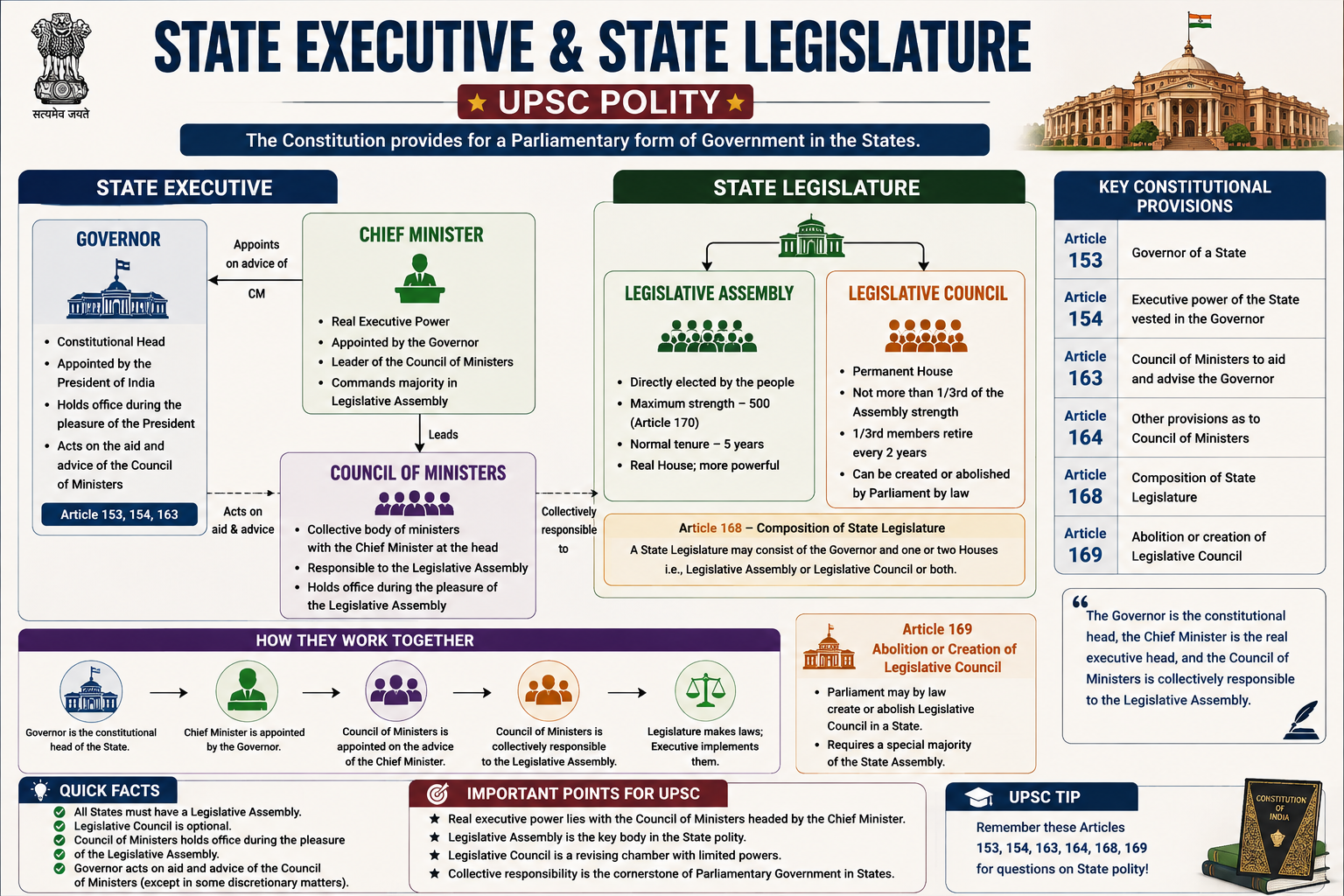
Section 5: State Executive & State Legislature
Questions
Q81. Consider the following statements regarding the appointment of a Governor:
The Governor of a state is appointed by the President by warrant under hand and seal.
The same person can be appointed as Governor for two or more states.
The qualification requires that a person must have completed 30 years of age.
Which of the statements given above are correct?
(a) 1 and 2 only
(b) 2 and 3 only
(c) 1 and 3 only
(d) 1, 2, and 3
Q82. Which of the following represents a CONSTITUTIONAL discretionary power of the Governor under Article 163?
(a) Reserving a bill for the consideration of the President
(b) Recommendation for imposition of President’s Rule in the state
(c) Seeking information from Chief Minister regarding administrative matters
(d) All of the above
Q83. Consider the following statements regarding Article 200 (Assent to Bills by Governor):
Governor may give assent to the bill.
Governor may withhold assent to the bill.
Governor may return an ordinary bill for reconsideration of the Assembly.
If returned bill is passed again by the Assembly, the Governor must give assent.
Which of the statements given above are correct?
(a) 1, 2, and 3 only
(b) 2, 3, and 4 only
(c) 1, 3, and 4 only
(d) 1, 2, 3, and 4
Q84. What happens when a Governor reserves a State Bill for the consideration of the President?
(a) The Governor remains involved in the future legislative course of that bill.
(b) The Governor’s role ends, and direct interaction takes place between the President and State Legislature.
(c) The bill must be cleared by the President within 14 days.
(d) Parliament must ratify the bill by simple majority.
Q85. Consider the following statements regarding the creation or abolition of Legislative Councils (Vidhan Parishad) under Article 169:
Parliament can create or abolish a Legislative Council by law.
State Legislative Assembly must pass a resolution by a special majority requesting such creation/abolition.
Such a law passed by Parliament is considered an amendment of the Constitution under Article 368.
Which of the statements given above are correct?
(a) 1 and 2 only
(b) 2 and 3 only
(c) 1 and 3 only
(d) 1, 2, and 3
Q86. What is the maximum permitted strength of a State Legislative Assembly (Vidhan Sabha)?
(a) 400
(b) 500
(c) 550
(d) 600
Q87. The total strength of a State Legislative Council shall not exceed:
(a) One-third of the total strength of the Legislative Assembly of that State
(b) Half of the total strength of the Legislative Assembly
(c) 100 members
(d) 15% of total assembly strength
Q88. Consider the composition of State Legislative Council:
1/3rd elected by local authorities (municipalities, district boards).
1/12th elected by graduates of three years standing.
1/12th elected by teachers of three years standing.
1/3rd elected by MLAs from amongst non-members.
Remaining 1/6th nominated by Governor (literature, science, art, cooperative movement, social service).
Which of the allocations above are correct?
(a) 1, 2, and 3 only
(b) 1, 3, 4, and 5 only
(c) 2, 4, and 5 only
(d) All 1, 2, 3, 4, and 5
Q89. In which of the following areas does the State Legislative Council have EQUAL powers with the Legislative Assembly?
(a) Introduction and passage of Money Bills
(b) Voting on Demands for Grants
(c) Approval of Ordinances issued by Governor
(d) Introduction and passage of Ordinary Bills
Q90. What is the maximum duration for which a Legislative Council can delay an Ordinary Bill passed by the Legislative Assembly?
(a) 1 month
(b) 3 months at first instance, 1 month at second instance (Total 4 months)
(c) 6 months
(d) Indefinitely
Q91. Can a Joint Sitting be called to resolve a deadlock between Legislative Assembly and Legislative Council?
(a) Yes, provided Governor summons it
(b) No, there is no provision for Joint Sitting in state legislatures
(c) Yes, if Assembly approves by special majority
(d) Yes, for ordinary bills only
Q92. Consider the following statements regarding the Pardoning Power of the Governor under Article 161:
Governor can pardon, reprieve, respite, or remit punishment of any person convicted of any offense against a state law.
Governor cannot pardon a death sentence.
Governor cannot pardon sentences awarded by a Court Martial.
Which of the statements given above are correct?
(a) 1 and 2 only
(b) 2 and 3 only
(c) 1 and 3 only
(d) 1, 2, and 3
Q93. Regarding the Advocate General for the State (Article 165), consider the following:
Appointed by the Governor.
Must be qualified to be appointed a Judge of a High Court.
Holds office during the pleasure of the Governor.
Which of the statements given above are correct?
(a) 1 and 2 only
(b) 2 and 3 only
(c) 1 and 3 only
(d) 1, 2, and 3
Q94. Which state listed below does NOT have a bicameral legislature (Legislative Council)?
(a) Andhra Pradesh
(b) Bihar
(c) Madhya Pradesh
(d) Karnataka
Q95. Consider the following statements regarding Ordinance making power of Governor under Article 213:
Promulgated only when both Houses (in bicameral) or Assembly (in unicameral) are not in session.
Governor can withdraw ordinance at any time.
Has the same force as an Act of State Legislature.
Which of the statements given above are correct?
(a) 1 and 2 only
(b) 2 and 3 only
(c) 1 and 3 only
(d) 1, 2, and 3
Q96. Money Bill in a State Legislature can be introduced:
(a) In either House of State Legislature
(b) Only in Legislative Assembly on recommendation of Governor
(c) Only in Legislative Council
(d) In Legislative Assembly without Governor’s recommendation
Q97. Who decides disqualification of state legislators on grounds of defection?
(a) Governor on advice of Election Commission
(b) High Court of the State
(c) Presiding Officer of the respective House
(d) State Election Commissioner
Q98. Who administers the oath of office to the Governor of a State?
(a) President of India
(b) Chief Justice of India
(c) Chief Justice of the concerned State High Court
(d) Outgoing Governor
Q99. If the office of Chief Minister falls vacant due to sudden death, what happens immediately?
(a) Senior-most minister automatically becomes Chief Minister.
(b) Council of Ministers automatically dissolves.
(c) Governor takes over state administration under Article 356.
(d) Speaker becomes Acting Chief Minister.
Q100. Under Article 167, whose duty is it to communicate administrative decisions of the state to the Governor?
(a) Speaker of Assembly
(b) Chief Secretary of State
(c) Chief Minister
(d) Advocate General
Answers & Explanations (Section 5)
Q81. (a) Statements 1 and 2 are correct. Statement 3 is incorrect: Minimum age requirement is 35 years (not 30).
Q82. (d) All three are explicitly recognized constitutional discretionary actions of the Governor under Article 163.
Q83. (d) All four options list constitutional choices available under Article 200.
Q84. (b) Once reserved for President, Governor’s constitutional involvement in that bill ceases.
Q85. (a) Statements 1 and 2 are correct. Statement 3 is incorrect: Article 169(3) states such a law is not deemed an amendment under Article 368.
Q86. (b) Article 170 sets maximum assembly strength at 500 (minimum 60, subject to specific state exceptions).
Q87. (a) Article 171(1) caps council strength at 1/3rd of Assembly strength (minimum size 40).
Q88. (d) All 5 proportional components accurately represent Article 171 composition rules.
Q89. (c) Approval of Ordinances requires equal concurrence of both Houses in a bicameral legislature.
Q90. (b) Maximum delay power of Legislative Council over ordinary bills is 4 months (3 months initial + 1 month secondary pass).
Q91. (b) Unlike Union Parliament, no provision for Joint Sitting exists for resolving deadlocks in State Legislatures. Legislative Assembly holds ultimate authority.
Q92. (d) All three statements correctly define Article 161 scope vs Presidential power under Article 72.
Q93. (d) All statements accurately describe the Advocate General for State under Article 165.
Q94. (c) Six states currently have bicameral legislatures: UP, Bihar, Maharashtra, Karnataka, Andhra Pradesh, and Telangana. Madhya Pradesh is unicameral.
Q95. (d) All statements accurately state Article 213 terms.
Q96. (b) State money bills require prior Governor recommendation and can originate only in the Legislative Assembly.
Q97. (c) Speaker/Chairman of the state house decides defection under 10th Schedule.
Q98. (c) Article 159: Oath is administered by the Chief Justice of the state High Court (or senior-most available judge).
Q99. (b) Death or resignation of CM automatically collapses and dissolves the Council of Ministers.
Q100. (c) Article 167 places the duty on the Chief Minister to inform the Governor on state administration affairs.
Before checking the answers, evaluate your attempt using the approach discussed in our UPSC Prelims 2027 Strategy & Study Plan and identify whether your mistakes came from weak concepts, factual gaps or incorrect elimination.
After completing all Executive and Legislature 100 MCQs, revise the explanations carefully and identify the constitutional Articles and concepts where you made mistakes.
Gear Up for UPSC CSE 2027!
Consistent revision and active MCQ solving are critical for mastering Indian Polity. Bookmark this post and test yourself regularly to keep these high-frequency facts and concepts fresh!
Completing these Executive and Legislature 100 MCQs should be part of a broader revision cycle; also explore our Best Books for UPSC Prelims 2027 to choose reliable resources for Polity and other General Studies subjects.
For authoritative reference while solving these Executive and Legislature MCQs, aspirants should also consult the Official Constitution of India published by the Legislative Department, Government of India.
20 thoughts on “The Executive and Legislature 100 MCQs: UPSC Prelims 2027 GS Comprehensive Guide”