
Preparing for UP Special GK for UPPCS 2026 requires a focused understanding of Uttar Pradesh’s history, geography, culture, economy, administration and important state-specific developments. These topics are useful for candidates preparing for the UPPSC Combined State/Upper Subordinate Services Preliminary Examination.
This guide provides topic-wise UP Special GK revision notes for UPPCS Prelims 2026, covering important facts about Uttar Pradesh, including its rivers, agriculture, historical places, cultural heritage, wildlife, government institutions, economy and administrative structure. It also includes practice MCQs with answers and explanations to help aspirants revise important facts and assess their preparation.
This UP Special GK for UPPCS 2026 guide is organised for systematic revision. Candidates preparing for UPPCS, UPPSC RO/ARO and other Uttar Pradesh competitive examinations can use this guide to review state-specific topics. For changing information, such as government schemes, official statistics and current developments, always refer to the latest reliable sources.
For a broader understanding of the examination, read our UPPCS Prelims 2026: Ultimate Revision Guide, MCQs & Free PDF.

2. Uttar Pradesh: Important Basic Facts
Uttar Pradesh is one of India’s most populous and politically significant states. It has a rich historical legacy, diverse cultural traditions, fertile agricultural regions and an important role in national politics and the economy.
Important Facts about Uttar Pradesh
| Particular | Information |
|---|---|
| State | Uttar Pradesh |
| Capital | Lucknow |
| High Court | Allahabad High Court |
| Principal seat of High Court | Prayagraj |
| Additional bench | Lucknow |
| State formation | 24 January 1950 |
| Earlier name | United Provinces |
| State language | Hindi |
| Additional official language | Urdu |
| Number of districts | 75 |
| Number of divisions | 18 |
| Lok Sabha seats | 80 |
| Rajya Sabha seats | 31 |
| Legislative Assembly seats | 403 |
| Legislative Council seats | 100 |
| State animal | Swamp Deer (Barasingha) |
| State bird | Sarus Crane |
| State tree | Ashoka |
| State flower | Palash |
| State sport | Hockey is commonly associated with the state; verify current official status before quoting it as a formally notified state sport |
Exam Note: Uttar Pradesh Day is celebrated on 24 January. The state was known as the United Provinces before being renamed Uttar Pradesh in 1950.
3. Geography of Uttar Pradesh
Geography is an important topic in UP Special GK for UPPCS 2026. Uttar Pradesh is located in northern India. It shares boundaries with Uttarakhand, Himachal Pradesh, Haryana, Rajasthan, Madhya Pradesh, Chhattisgarh, Jharkhand and Bihar. It also shares an international boundary with Nepal.
Major Geographical Regions
Uttar Pradesh can broadly be divided into the following geographical regions:
- Terai Region: Located along the Nepal border. It is characterised by fertile soil, high moisture and forests.
- Gangetic Plain: The largest geographical region of the state. It is highly fertile and supports intensive agriculture.
- Bundelkhand Region: Located in the southern part of the state. It is known for rocky terrain, water scarcity and drought-prone conditions.
- Vindhyan Region: Found mainly in the southeastern part of Uttar Pradesh, including parts of Mirzapur and Sonbhadra.
For a deeper understanding of the state’s physical features, rivers, climate, soils, and geographical regions, read our detailed guide on Uttar Pradesh Geography for UPPCS: Complete Notes, Important Facts & 50 MCQs.

Major Rivers of Uttar Pradesh
| River | Important Information |
|---|---|
| Ganga | The most important river of Uttar Pradesh |
| Yamuna | Meets the Ganga at Prayagraj |
| Gomti | Flows through Lucknow |
| Ghaghara | Important river of the eastern plains |
| Rapti | Flows through the Gorakhpur region |
| Ramganga | Tributary of the Ganga |
| Betwa | Important river of the Bundelkhand region |
| Ken | Flows through Bundelkhand |
| Son | Important river in the southeastern region |
| Chambal | Tributary of the Yamuna |
For effective UPSC Prelims preparation, strengthen your knowledge of India’s river systems by practising 100 Powerful Himalayan Peninsular Rivers MCQs for UPSC: Master Your Prelims!, featuring important questions with answers and brief explanations.
Important River Confluence
The confluence of the Ganga, Yamuna and the traditionally recognised Saraswati is known as Triveni Sangam, located at Prayagraj.
To strengthen your understanding of India’s drainage system, explore our detailed guide on Himalayan Rivers vs Peninsular Rivers UPSC: 15 Powerful Differences & Key Facts, covering their origins, characteristics, drainage patterns and major differences for UPSC preparation.
Climate
Climate is an important topic in UP Special GK for UPPCS 2026. Uttar Pradesh experiences a subtropical climate. The major seasons are:
- Summer: March to June
- Monsoon: June to September
- Winter: November to February
The monsoon is crucial for agriculture, especially in regions dependent on rainfall.
For effective preparation of UP Special GK for UPPCS 2026, candidates should practise map-based questions on Uttar Pradesh’s districts, rivers, neighbouring states, national parks and important geographical regions. Regular map revision can help aspirants remember the location and significance of major geographical features.
The drainage system is a key component of Uttar Pradesh’s physical geography. To study the major rivers, their tributaries, river maps, and important confluences in detail, read our dedicated article on Important Rivers of Uttar Pradesh: Powerful UPPCS Notes, Map & 100 MCQs.
4. District-wise Geography and Map Facts of Uttar Pradesh
District-wise geographical facts are an important part of UP Special GK for UPPCS 2026 and are useful for map-based revision. Aspirants should practise locating districts, rivers, neighbouring states, national parks, major cities and important geographical features on a map of Uttar Pradesh.
Important Districts and Their Geographical Features
| District / Region | Important Geographical Feature |
|---|---|
| Lucknow | Located in the central part of Uttar Pradesh; Gomti River flows through the city |
| Prayagraj | Located at the confluence of the Ganga and Yamuna |
| Varanasi | Located on the western bank of the Ganga |
| Gorakhpur | Important city in the eastern Terai-influenced region |
| Lakhimpur Kheri | Associated with the Terai region and Dudhwa National Park |
| Sonbhadra | Known for mineral resources and the Vindhyan region |
| Jhansi | Important city of Bundelkhand |
| Banda | Located in the Bundelkhand region |
| Agra | Located on the banks of the Yamuna |
| Mathura | Located on the banks of the Yamuna |
| Kanpur | Major industrial city situated on the Ganga |
| Mirzapur | Associated with the Vindhyan region |
Map-Based Revision Checklist
For effective map-based revision of UP Special GK for UPPCS 2026, practise locating the following on the map of Uttar Pradesh:
- All 75 districts
- 18 administrative divisions
- Ganga, Yamuna, Gomti, Ghaghara, Rapti, Betwa and Ken rivers
- Dudhwa National Park
- Pilibhit Tiger Reserve
- Katarniaghat Wildlife Sanctuary
- National Chambal Sanctuary
- Major cities such as Lucknow, Prayagraj, Varanasi, Kanpur, Agra and Gorakhpur
- The Nepal border and neighbouring Indian states
Practice Tip: Use a blank map of Uttar Pradesh and mark at least 10 districts, rivers or protected areas daily.
Before attempting practice questions, it is equally important to understand the examination structure, syllabus and marking scheme. Read our detailed guide on UPPCS 2026 Prelims Exam Pattern: Latest Syllabus & Marking Scheme Easy Guide to plan your preparation effectively.
For district profiles and official map information, refer to the Uttar Pradesh NRI Department district profiles.
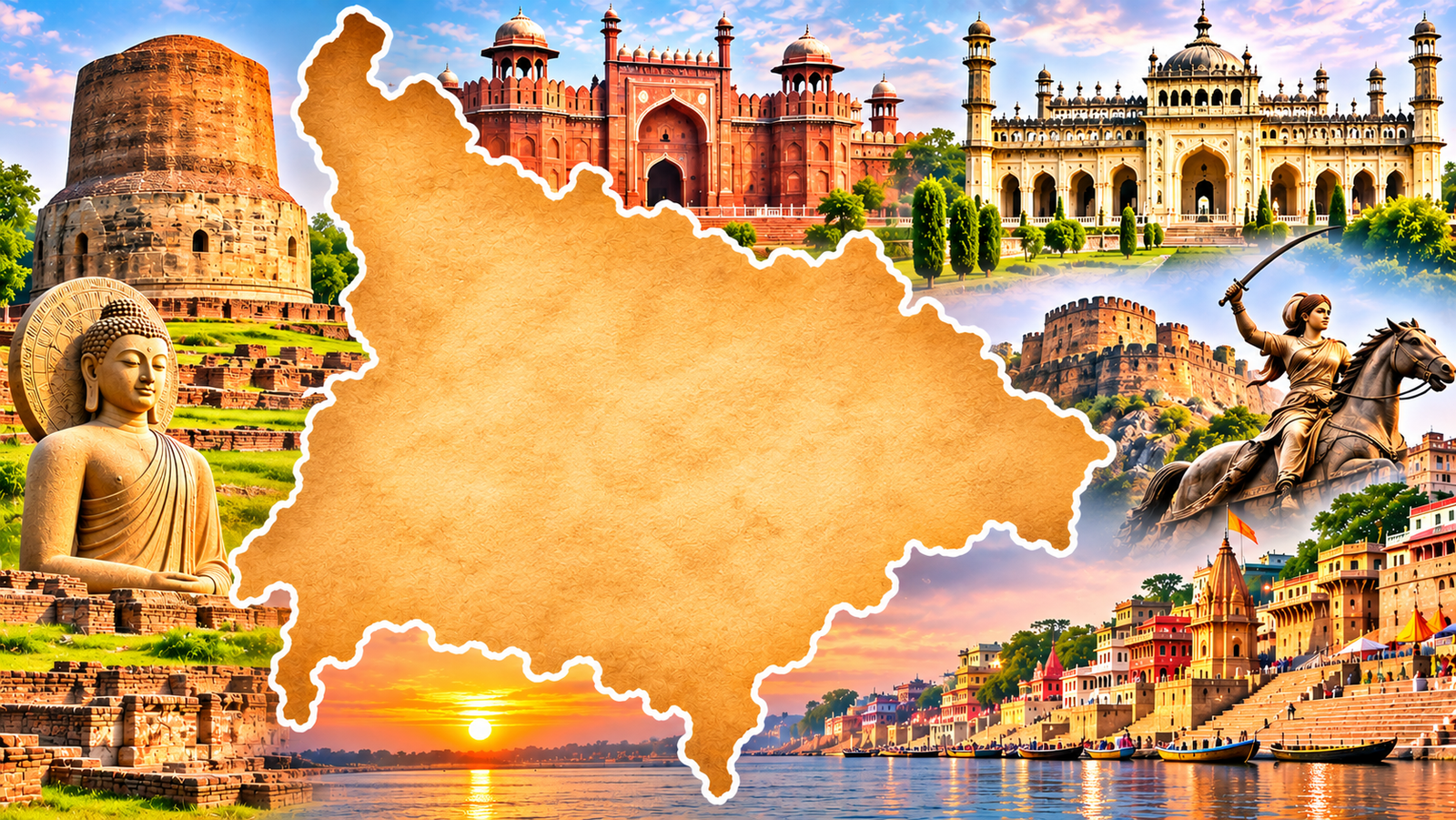
5. History of Uttar Pradesh
he history of Uttar Pradesh is an important part of UP Special GK for UPPCS 2026. The state has played a major role in ancient, medieval and modern Indian history. Several important kingdoms, religious movements and freedom struggle events are associated with the region.
Ancient History
- The region was an important centre of the Vedic civilisation.
- The ancient kingdoms of Kosala and Vatsa were located in parts of present-day Uttar Pradesh.
- Ayodhya was associated with the kingdom of Kosala.
- Kashi was an important ancient centre of learning and culture.
- Sarnath, near Varanasi, is associated with Gautama Buddha’s first sermon.
- Kushinagar is traditionally recognised as the place of Mahaparinirvana of Gautama Buddha.
- Mathura was an important centre of the ancient Indian cultural and religious landscape.
Medieval History
- Kannauj emerged as an important political centre during the early medieval period.
- The region was ruled by several dynasties, including the Gurjara-Pratiharas and other regional powers.
- The Delhi Sultanate and Mughal Empire had a significant influence on the region.
- Agra became an important Mughal capital.
- Fatehpur Sikri was developed by Emperor Akbar.
Modern History
- The Revolt of 1857 had important centres in Meerut, Kanpur, Lucknow, Jhansi and other places.
- Rani Lakshmibai of Jhansi became a prominent symbol of resistance.
- Begum Hazrat Mahal played an important role in the revolt at Lucknow.
- The Non-Cooperation Movement, Civil Disobedience Movement and Quit India Movement had a strong presence in the region.
- Chauri Chaura, located in present-day Gorakhpur district, is associated with the withdrawal of the Non-Cooperation Movement in 1922.
Important Historical Places
| Place | Historical Significance |
|---|---|
| Sarnath | First sermon of Gautama Buddha |
| Kushinagar | Mahaparinirvana of Gautama Buddha |
| Ayodhya | Ancient centre associated with Kosala |
| Prayagraj | Important political and cultural centre |
| Agra | Mughal capital and architectural heritage |
| Fatehpur Sikri | Mughal architectural complex |
| Jhansi | Associated with Rani Lakshmibai |
| Chauri Chaura | Important event during the Non-Cooperation Movement |
To revise the historical background in greater detail, explore Uttar Pradesh History for UPPCS Prelims 2026: Important Topics & Facts.

6. Art, Culture and Heritage of Uttar Pradesh
Art, culture and heritage are important topics in UP Special GK for UPPCS 2026. Uttar Pradesh is known for its classical music, dance, handicrafts, religious traditions, festivals and historical monuments.
Classical Music and Dance
- Kathak: A major classical dance form associated with North India and strongly linked with Lucknow.
- Hindustani Classical Music: Varanasi and other cultural centres have contributed significantly to its development.
- Thumri: A semi-classical vocal form associated with Awadh and other regions.
- Dhrupad: An important classical vocal tradition with historical links to North Indian royal and religious courts.
Major Handicrafts
| Craft | Important Centre |
|---|---|
| Chikankari | Lucknow |
| Brassware | Moradabad |
| Glassware and bangles | Firozabad |
| Perfume / Attar | Kannauj |
| Carpets | Bhadohi |
| Banarasi Silk | Varanasi |
| Wooden Craft | Saharanpur |
| Pottery | Khurja |
Important Festivals
- Kumbh Mela and Magh Mela at Prayagraj
- Dev Deepawali in Varanasi
- Holi in Mathura and Vrindavan
- Ram Leela traditions in several districts
- Ganga Mahotsav in Varanasi
UNESCO and Heritage-Related Facts
The Taj Mahal in Agra and Fatehpur Sikri are UNESCO World Heritage Sites. The state also contains important Buddhist heritage locations, including Sarnath and Kushinagar.
Candidates should distinguish between UNESCO World Heritage Sites, national monuments and religious pilgrimage sites.
For additional practice on Indian art and culture, attempt the Top 100 Art & Culture MCQs UPPCS Prelims 2026.
7. Economy of Uttar Pradesh
The economy of Uttar Pradesh is an important topic in UP Special GK for UPPCS 2026. The state has a large and diverse economy. Agriculture, manufacturing, services, infrastructure, tourism and small industries contribute to its economic activity.
Major Economic Sectors
Agriculture:
Agriculture remains an important source of livelihood. Major crops include wheat, rice, sugarcane, pulses, potato and mustard.
Manufacturing:
Important industrial activities include textiles, leather products, sugar, food processing, brassware, glassware, carpets and electronics.
Services:
Trade, transport, education, healthcare, tourism, financial services and information technology contribute to the service sector.
Important Industrial Centres
| Centre | Major Economic Activity |
|---|---|
| Kanpur | Leather, textiles and manufacturing |
| Noida | Electronics, IT and services |
| Greater Noida | Manufacturing and industrial development |
| Moradabad | Brassware |
| Firozabad | Glass and bangles |
| Bhadohi | Carpet industry |
| Kannauj | Perfume and attar |
| Varanasi | Silk textiles, tourism and handicrafts |
| Saharanpur | Wood carving |
One District One Product (ODOP)
The One District One Product (ODOP) initiative promotes traditional products and local industries associated with different districts of Uttar Pradesh.
Its objectives include:
- Promoting district-specific products
- Supporting artisans and small enterprises
- Improving marketing and branding
- Encouraging employment generation
- Expanding access to markets
Candidates should revise district-product associations using the latest official ODOP list.
8. UP Budget 2026–27: Important Figures
The Uttar Pradesh Budget 2026–27 is an important current-affairs topic in UP Special GK for UPPCS 2026. It was presented on 11 February 2026. The official budget highlights report a total budget size of approximately ₹9.13 lakh crore. Official Budget Highlights
Important budget concepts include:
- Budget Estimates (BE)
- Revised Estimates (RE)
- Revenue Receipts
- Revenue Expenditure
- Capital Expenditure
- Fiscal Deficit
- Revenue Surplus
- Gross State Domestic Product (GSDP)
Key Budget Concepts
Revenue Expenditure:
Expenditure that generally does not create physical assets, such as salaries, pensions, subsidies and routine administrative expenses.
Capital Expenditure:
Expenditure associated with asset creation, infrastructure and certain investments.
Fiscal Deficit:
The excess of total expenditure over total receipts, excluding borrowings.
Revenue Surplus:
The excess of revenue receipts over revenue expenditure.
Budget Revision Strategy
For UPPCS Prelims, prepare a one-page summary of the latest state budget with:
- Total budget size
- GSDP estimate
- Fiscal deficit target
- Revenue surplus or deficit
- Major sector-wise allocations
- New schemes
- Infrastructure announcements
- Agriculture and employment initiatives
Use the official Uttar Pradesh Budget portal for the latest documents. For independent budget analysis, refer to PRS Legislative Research.
9. Agriculture and Major Industries of Uttar Pradesh
Uttar Pradesh is one of India’s major agricultural states. Its fertile alluvial plains, river systems and irrigation facilities support the cultivation of several crops.
Major Crops
| Crop | Important Information |
|---|---|
| Wheat | Major Rabi crop |
| Rice | Major Kharif crop |
| Sugarcane | Important cash crop |
| Potato | Important horticultural crop |
| Pulses | Grown in several regions, including Bundelkhand |
| Mustard | Important oilseed crop |
Sugar Industry
Sugarcane cultivation supports a large sugar industry in Uttar Pradesh. Western and central regions have important sugar mills and sugarcane-growing areas.
Major Industries
- Sugar
- Leather
- Textiles
- Electronics
- Food processing
- Glassware
- Brassware
- Carpets
- Perfume
- Handicrafts
Agriculture-Related Topics for UPPCS
- Rabi and Kharif crops
- Major irrigation projects
- Crop seasons
- Agricultural marketing
- Minimum Support Price (MSP)
- Food processing
- Soil types
- Agricultural exports
- Farmer welfare schemes
10. UP Government Schemes
Government schemes are an important part of UP Special GK for UPPCS 2026, especially for state-specific current affairs. Candidates should understand each scheme’s objective, target beneficiaries, implementing department and important features.
Major Schemes to Revise
| Scheme | Broad Objective |
|---|---|
| One District One Product (ODOP) | Promote district-specific products and local industries |
| Mukhyamantri Kanya Sumangala Yojana | Support the welfare and education of girls |
| Mission Shakti | Women’s safety, dignity and empowerment |
| Mukhyamantri Abhyudaya Yojana | Provide competitive examination guidance |
| Mukhyamantri Samuhik Vivah Yojana | Support eligible couples through mass marriage programmes |
| UP Skill Development Mission | Improve employability through skill training |
| Mukhyamantri Yuva Udyami Vikas Abhiyan | Promote youth entrepreneurship |
| PM-Kisan | Central scheme providing income support to eligible farmers |
| Ayushman Bharat | Health coverage for eligible beneficiaries |
Important: Scheme names, eligibility conditions, benefits and funding limits may change. Verify them through official government notifications before publishing updated figures.
Government schemes are an important part of UP Special GK for UPPCS 2026. Candidates should revise the objectives, beneficiaries, implementing departments and major features of Uttar Pradesh government schemes. The latest official notifications should be consulted for updated eligibility conditions and financial benefits.
How to Prepare Scheme-Based Questions
For each scheme, remember:
- Launch year
- Department
- Target group
- Main objective
- Benefit or assistance
- State or centrally sponsored status
- Recent changes
For exam-oriented current affairs practice, read October 2026 Sports Current Affairs MCQs for UPSC, PCS & SSC.

11. Polity and Local Governance in Uttar Pradesh
Uttar Pradesh follows the parliamentary system of government under the Constitution of India.
State Executive
The state executive includes:
- Governor
- Chief Minister
- Council of Ministers
The Governor is the constitutional head of the state, while the Chief Minister heads the elected government.
State Legislature
Uttar Pradesh has a bicameral legislature consisting of:
- Legislative Assembly (Vidhan Sabha)
- Legislative Council (Vidhan Parishad)
The Legislative Assembly has 403 elected members. The Legislative Council has 100 members.
Local Governance
Local governance in Uttar Pradesh includes rural and urban institutions.
Rural Local Bodies:
- Gram Panchayat
- Kshetra Panchayat
- Zila Panchayat
Urban Local Bodies:
- Nagar Panchayat
- Nagar Palika Parishad
- Nagar Nigam
Constitutional Provisions
- 73rd Constitutional Amendment: Panchayati Raj Institutions
- 74th Constitutional Amendment: Urban Local Bodies
- Part IX of the Constitution: Panchayats
- Part IX-A of the Constitution: Municipalities
Candidates should revise the roles of Gram Sabha, Gram Panchayat, Panchayat Samiti / Kshetra Panchayat and Zila Panchayat.
To understand the examination trend and practise previous questions, visit UPPCS Prelims PYQs: Most Important Guide 2026–27.
12. Administration of Uttar Pradesh
Uttar Pradesh has a multi-level administrative structure for governance and public service delivery.
Administrative Structure
The state is organised into:
- State
- Divisions
- Districts
- Tehsils
- Blocks
- Gram Panchayats and urban local bodies
Important Administrative Officers
| Officer | Main Responsibility |
|---|---|
| Chief Secretary | Senior-most administrative officer of the state |
| Divisional Commissioner | Supervises administration at division level |
| District Magistrate (DM) | District administration and coordination |
| Superintendent of Police (SP) | District police administration |
| Sub-Divisional Magistrate (SDM) | Subdivision-level administration |
| Tehsildar | Revenue administration at tehsil level |
| Block Development Officer (BDO) | Development administration at block level |
Important Administrative Topics
- District administration
- Revenue administration
- Police administration
- Disaster management
- E-governance
- Public grievance redressal
- Local self-government
- Administrative reforms
Environmental conservation, biodiversity, wildlife protection and climate change are important areas of competitive examinations. For additional practice, explore our Environment MCQs 2027: 100 Most Important Questions for UPSC Prelims.
13. UP Current Affairs for UPPCS Prelims 2026
Current affairs preparation should focus on developments directly related to Uttar Pradesh.
Important Areas
- State government schemes
- Uttar Pradesh Budget and Economic Survey
- Infrastructure projects
- Agriculture and rural development
- Environment and wildlife
- Important appointments
- Awards and achievements
- Sports events
- State-level festivals and cultural events
- Important reports and rankings
Current Affairs Revision Table
| Topic | What to Note |
|---|---|
| Government scheme | Objective, department, beneficiaries |
| Budget | Allocation, new announcement, sector |
| Infrastructure | Project name, location, purpose |
| Environment | Protected area, species, conservation initiative |
| Sports | Event, venue, winner or achievement |
| Award | Recipient, award and field |
| Report | Publishing organisation, state ranking and key finding |
Revision Tip: Prepare monthly current affairs notes and revise them together with static UP GK. For a factual update, use the relevant official department, government press release or report.
14. Important Facts for UPPCS Prelims
Revise these facts regularly:
- Uttar Pradesh Day: 24 January
- Capital: Lucknow
- High Court: Allahabad High Court
- Principal High Court seat: Prayagraj
- Additional High Court bench: Lucknow
- State animal: Swamp Deer (Barasingha)
- State bird: Sarus Crane
- State tree: Ashoka
- State flower: Palash
- Ganga and Yamuna confluence: Prayagraj
- Gomti River flows through: Lucknow
- Chikankari: Lucknow
- Brassware: Moradabad
- Glassware: Firozabad
- Perfume: Kannauj
- Carpets: Bhadohi
- Banarasi Silk: Varanasi
- Kathak: Classical dance form associated with North India and Lucknow
- Dudhwa National Park: Lakhimpur Kheri region
- Sarnath: Associated with the first sermon of Gautama Buddha
- Kushinagar: Associated with Mahaparinirvana of Gautama Buddha
To strengthen your preparation, check the UPPCS 2026 Prelims Exam Pattern: Latest Syllabus & Marking Scheme.

15. UPPCS-Oriented Practice MCQs
The following practice questions are designed to support revision of UP Special GK for UPPCS 2026. They cover geography, history, culture, economy, agriculture, polity and administration of Uttar Pradesh. Attempt the questions first and then review the answer key with explanations.
Choose the correct answer for each question.
Questions 1–10: Geography
Q1. The confluence of the Ganga and Yamuna rivers is located at:
A. Varanasi
B. Prayagraj
C. Kanpur
D. Lucknow
Q2. Which river flows through Lucknow?
A. Yamuna
B. Gomti
C. Betwa
D. Ken
Q3. Dudhwa National Park is located in which district region?
A. Lakhimpur Kheri
B. Agra
C. Jhansi
D. Ballia
Q4. Which of the following is associated with the Bundelkhand region?
A. Betwa
B. Gomti
C. Rapti
D. Ghaghara
Q5. The Terai region of Uttar Pradesh is mainly located along the border with:
A. Nepal
B. Rajasthan
C. Madhya Pradesh
D. Haryana
Q6. Which city is situated on the banks of the Yamuna?
A. Mathura
B. Gorakhpur
C. Lucknow
D. Gonda
Q7. Which of the following rivers is a tributary of the Yamuna?
A. Betwa
B. Gomti
C. Ghaghara
D. Rapti
Q8. The Vindhyan region of Uttar Pradesh is mainly associated with:
A. Sonbhadra and Mirzapur
B. Meerut and Baghpat
C. Lucknow and Barabanki
D. Bijnor and Saharanpur
Q9. Which city is located on the western bank of the Ganga?
A. Varanasi
B. Jhansi
C. Agra
D. Mathura
Q10. Which of the following is an important river of eastern Uttar Pradesh?
A. Rapti
B. Chambal
C. Betwa
D. Ken
Questions 11–20: History and Culture
Q11. Sarnath is associated with:
A. Buddha’s first sermon
B. Mahavira’s birth
C. Ashoka’s coronation
D. Akbar’s capital
Q12. Kushinagar is associated with:
A. Buddha’s Mahaparinirvana
B. First Battle of Panipat
C. Revolt of 1857
D. Chauri Chaura incident
Q13. The Revolt of 1857 began at:
A. Meerut
B. Lucknow
C. Jhansi
D. Kanpur
Q14. Begum Hazrat Mahal is associated with the revolt at:
A. Lucknow
B. Agra
C. Varanasi
D. Mathura
Q15. Chauri Chaura is associated with which movement?
A. Non-Cooperation Movement
B. Swadeshi Movement
C. Quit India Movement
D. Home Rule Movement
Q16. Chikankari is a traditional craft of:
A. Lucknow
B. Moradabad
C. Kannauj
D. Bhadohi
Q17. The carpet industry is especially associated with:
A. Bhadohi
B. Firozabad
C. Jhansi
D. Gorakhpur
Q18. Kannauj is famous for:
A. Perfume and attar
B. Brassware
C. Glass bangles
D. Leather
Q19. Kathak is a:
A. Classical dance form
B. Folk painting
C. Martial art
D. Musical instrument
Q20. Fatehpur Sikri was developed prominently during the reign of:
A. Akbar
B. Babur
C. Aurangzeb
D. Shah Jahan
For comprehensive preparation and self-assessment, practise our specially curated set of 100 Ancient Indian History MCQs for UPSC Prelims 2027: Important Questions with Answers, covering important historical periods, dynasties, religious movements, art, architecture and cultural developments of ancient India.
Questions 21–30: Economy and Agriculture
Q21. Which is a major Rabi crop of Uttar Pradesh?
A. Wheat
B. Rice
C. Jute
D. Cotton
Q22. Which crop is an important cash crop in Uttar Pradesh?
A. Sugarcane
B. Tea
C. Coffee
D. Rubber
Q23. Moradabad is known for:
A. Brassware
B. Perfume
C. Carpets
D. Glassware
Q24. Firozabad is famous for:
A. Glassware and bangles
B. Leather
C. Brassware
D. Silk
Q25. Noida is an important centre for:
A. Electronics and IT
B. Tea plantations
C. Jute mills
D. Shipbuilding
Q26. The main objective of ODOP is to:
A. Promote district-specific products
B. Replace all agricultural crops
C. Create new districts
D. Regulate state elections
Q27. Which city is associated with the leather industry?
A. Kanpur
B. Kannauj
C. Bhadohi
D. Lakhimpur Kheri
Q28. Which of the following is a Kharif crop?
A. Rice
B. Wheat
C. Gram
D. Mustard
Q29. Which of the following is an example of capital expenditure?
A. Construction of a public road
B. Payment of routine salaries
C. Payment of pension
D. Office electricity bill
Q30. Fiscal deficit broadly represents:
A. Total expenditure minus total receipts, excluding borrowings
B. Revenue receipts minus revenue expenditure
C. Tax revenue minus non-tax revenue
D. Exports minus imports
Questions 31–40: Polity and Administration
Q31. Uttar Pradesh has how many elected Legislative Assembly members?
A. 400
B. 403
C. 404
D. 405
Q32. The principal seat of the Allahabad High Court is located at:
A. Prayagraj
B. Lucknow
C. Kanpur
D. Varanasi
Q33. The 73rd Constitutional Amendment is related to:
A. Panchayati Raj Institutions
B. Municipalities
C. Fundamental Duties
D. Emergency provisions
Q34. The 74th Constitutional Amendment is related to:
A. Urban Local Bodies
B. Panchayats
C. Parliament
D. Supreme Court
Q35. The constitutional head of a state is:
A. Governor
B. Chief Minister
C. Chief Secretary
D. Speaker
Q36. The District Magistrate primarily coordinates:
A. District administration
B. State legislature
C. Parliament
D. Supreme Court
Q37. Which is a rural local government institution?
A. Gram Panchayat
B. Nagar Nigam
C. Nagar Palika Parishad
D. Municipal Corporation
Q38. Which is an urban local body?
A. Nagar Nigam
B. Gram Sabha
C. Gram Panchayat
D. Kshetra Panchayat
Q39. The Chief Minister is appointed by the:
A. Governor
B. President directly
C. Chief Justice
D. Speaker
Q40. The state legislature of Uttar Pradesh is:
A. Bicameral
B. Unicameral
C. Federal Council only
D. Parliamentary committee
Questions 41–50: Mixed UP Special GK
Q41. Uttar Pradesh Day is celebrated on:
A. 24 January
B. 26 January
C. 15 August
D. 1 November
Q42. The state bird of Uttar Pradesh is:
A. Sarus Crane
B. Peacock
C. Great Indian Bustard
D. Hornbill
Q43. The state animal of Uttar Pradesh is:
A. Swamp Deer
B. Tiger
C. Elephant
D. Blackbuck
Q44. The state tree of Uttar Pradesh is:
A. Ashoka
B. Neem
C. Banyan
D. Peepal
Q45. The state flower of Uttar Pradesh is:
A. Palash
B. Lotus
C. Rose
D. Marigold
Q46. Which city is associated with Banarasi Silk?
A. Varanasi
B. Meerut
C. Bareilly
D. Basti
Q47. The One District One Product initiative primarily supports:
A. Local products and district-based industries
B. Only large multinational companies
C. Only government departments
D. Only agricultural land acquisition
Q48. Which of the following is a major Buddhist heritage site in Uttar Pradesh?
A. Sarnath
B. Fatehpur Sikri
C. Jhansi Fort
D. Agra Fort
Q49. Which city is associated with the Taj Mahal?
A. Agra
B. Lucknow
C. Prayagraj
D. Gorakhpur
Q50. Which river is associated with the Triveni Sangam at Prayagraj?
A. Ganga
B. Yamuna
C. Traditionally recognised Saraswati
D. All of the above
16. Answer Key with Explanations
Answers 1–10
| Q. | Answer | Explanation |
|---|---|---|
| 1 | B | The Ganga and Yamuna meet at Prayagraj. |
| 2 | B | The Gomti River flows through Lucknow. |
| 3 | A | Dudhwa National Park is located in the Lakhimpur Kheri region. |
| 4 | A | Betwa is an important river of Bundelkhand. |
| 5 | A | The Terai region lies along the Nepal border. |
| 6 | A | Mathura is situated on the banks of the Yamuna. |
| 7 | A | Betwa is a tributary of the Yamuna. |
| 8 | A | Sonbhadra and Mirzapur are associated with the Vindhyan region. |
| 9 | A | Varanasi is located on the western bank of the Ganga. |
| 10 | A | Rapti is an important river in eastern Uttar Pradesh. |
Answers 11–20
| Q. | Answer | Explanation |
|---|---|---|
| 11 | A | Buddha delivered his first sermon at Sarnath. |
| 12 | A | Kushinagar is associated with Buddha’s Mahaparinirvana. |
| 13 | A | The Revolt of 1857 began at Meerut. |
| 14 | A | Begum Hazrat Mahal played an important role in Lucknow. |
| 15 | A | The Chauri Chaura incident led to the withdrawal of the Non-Cooperation Movement. |
| 16 | A | Lucknow is famous for Chikankari. |
| 17 | A | Bhadohi is a major carpet-producing centre. |
| 18 | A | Kannauj is famous for perfume and attar. |
| 19 | A | Kathak is a classical dance form. |
| 20 | A | Akbar developed Fatehpur Sikri as an important Mughal centre. |
Answers 21–30
| Q. | Answer | Explanation |
|---|---|---|
| 21 | A | Wheat is a major Rabi crop. |
| 22 | A | Sugarcane is an important cash crop. |
| 23 | A | Moradabad is famous for brassware. |
| 24 | A | Firozabad is known for glassware and bangles. |
| 25 | A | Noida is a major electronics and IT centre. |
| 26 | A | ODOP promotes district-specific products. |
| 27 | A | Kanpur has an important leather industry. |
| 28 | A | Rice is generally cultivated as a Kharif crop. |
| 29 | A | Construction of a public road creates an asset. |
| 30 | A | Fiscal deficit is the excess of expenditure over receipts, excluding borrowings. |
Answers 31–40
| Q. | Answer | Explanation |
|---|---|---|
| 31 | B | Uttar Pradesh has 403 elected Legislative Assembly members. |
| 32 | A | The principal seat of the Allahabad High Court is at Prayagraj. |
| 33 | A | The 73rd Amendment concerns Panchayati Raj Institutions. |
| 34 | A | The 74th Amendment concerns Urban Local Bodies. |
| 35 | A | The Governor is the constitutional head of the state. |
| 36 | A | The District Magistrate coordinates district administration. |
| 37 | A | Gram Panchayat is a rural local government institution. |
| 38 | A | Nagar Nigam is an urban local body. |
| 39 | A | The Governor appoints the Chief Minister. |
| 40 | A | Uttar Pradesh has a bicameral legislature. |
Answers 41–50
| Q. | Answer | Explanation |
|---|---|---|
| 41 | A | Uttar Pradesh Day is celebrated on 24 January. |
| 42 | A | Sarus Crane is the state bird. |
| 43 | A | Swamp Deer, also known as Barasingha, is the state animal. |
| 44 | A | Ashoka is the state tree. |
| 45 | A | Palash is the state flower. |
| 46 | A | Varanasi is famous for Banarasi Silk. |
| 47 | A | ODOP supports district-specific products and local industries. |
| 48 | A | Sarnath is an important Buddhist heritage site. |
| 49 | A | The Taj Mahal is located in Agra. |
| 50 | D | The Triveni Sangam is traditionally associated with the Ganga, Yamuna and Saraswati. |
Apart from the historical heritage of Uttar Pradesh, aspirants should also develop a strong understanding of ancient Indian civilisation, religious traditions, important dynasties and archaeological sites. Practise our 100 Ancient History MCQs for UPSC Prelims 2027: Master Question Bank With Explanation to strengthen your preparation.
17. Frequently Asked Questions (FAQs)
Q1. What is UP Special GK for UPPCS Prelims?
UP Special GK covers state-specific topics related to Uttar Pradesh, including history, geography, culture, economy, polity, administration, government schemes and current affairs.
Q2. Which topics are important for UPPCS Prelims 2026?
Important topics include Uttar Pradesh’s rivers, districts, historical places, cultural heritage, agriculture, industries, government schemes, state budget and recent developments.
Q3. Is district-wise geography important for UPPCS?
Yes. District locations, rivers, protected areas, industrial centres and map-based facts are useful for state-specific revision.
Q4. How should I prepare UP Government Schemes?
Prepare each scheme through its objective, department, beneficiaries, important features and latest official updates. Avoid memorising outdated benefit amounts.
Q5. How can I prepare UP Budget questions?
Revise the budget size, GSDP estimate, fiscal deficit, revenue surplus, major sector-wise allocations and new announcements from the official budget documents.
Q6. Are MCQs useful for UPPCS Prelims preparation?
Yes. MCQs help candidates revise facts, identify weak areas and practise applying information under exam conditions. They should be combined with standard books and official sources.
Q7. Where can I find official information about Uttar Pradesh?
Candidates can refer to the Uttar Pradesh Government portal, UPPSC website, official budget portal, department websites and government publications.
For the latest examination schedule, refer to UPPCS Prelims Exam Date 2026 Officially Announced.
Conclusion
Uttar Pradesh-specific General Knowledge is an important part of preparation for state competitive examinations. A systematic revision of geography, history, culture, economy, polity, administration, schemes and current affairs can help candidates build a strong foundation.
Use this guide for topic-wise revision, practise the MCQs regularly and update current-affairs facts from reliable official sources. Consistent revision and map practice can improve familiarity with the state-specific topics relevant to UPPCS Prelims.
A systematic revision of UP Special GK for UPPCS 2026 can help candidates strengthen their understanding of Uttar Pradesh-specific topics. Revise important facts regularly, practise map-based questions, solve MCQs and keep updating current-affairs notes using reliable official sources.
Explore More Resources for UPSC Prelims 2027
Current Affairs For UPSC Prelims 2027
Science and Technology for UPSC Prelims 2027
Recommended Official Resources:
Get Daily Current Affairs MCQs, GK Quizzes and study resources for UPSC, State PCS and SSC examinations.
✈️ Join our Telegram channel "Knowledge Chronicles Plus" for free
8 thoughts on “UP Special GK for UPPCS 2026: Complete Notes, Important Facts & 50 MCQs”