UPSC Prelims Previous Year Trends 2015-26
If there is one resource every UPSC topper recommends, it is Previous Year Questions (PYQs). They reveal the Commission’s thinking far better than any coaching material.
An analysis of UPSC Prelims Previous Year Trends 2015-26 shows that while the syllabus remains the same, the style of questions has evolved significantly. The paper now emphasizes conceptual clarity, interdisciplinary understanding, and intelligent elimination rather than rote memorization. Recent analyses also suggest a tougher and more unpredictable paper in 2026, with greater emphasis on analytical thinking. This article provides a complete trend analysis to help aspirants prepare smarter for UPSC Prelims 2027.
Why Analyze UPSC Prelims Previous Year Trends 2015-26 ?
Studying trends helps you:
- Understand UPSC’s changing priorities
- Identify high-weightage subjects
- Learn the examiner’s mindset
- Improve elimination techniques
- Avoid wasting time on low-yield topics
- Build a realistic preparation strategy
UPSC Prelims Exam Pattern
| Paper | Questions | Marks |
|---|---|---|
| GS Paper I | 100 | 200 |
| CSAT | 80 | 200 (Qualifying) |
Negative marking:
- 1/3rd mark deduction for every incorrect answer.
Major Trends (2015–2026)
1. Conceptual Questions Have Increased
Earlier papers often asked direct factual questions.
Now UPSC prefers:
- Assertion-based questions
- Statement-based questions
- Multi-concept questions
- Applied knowledge
- Elimination-friendly options
Simply memorizing facts is no longer sufficient.
2. Static + Current Affairs Integration
Instead of asking:
“Where is Ramsar Site located?”
UPSC asks:
- ecological significance
- constitutional provisions
- international conventions
- environmental impact
Current Affairs now require strong static foundations.
3. Statement-Based Questions Dominate
Nearly every subject now includes questions like:
Which of the following statements are correct?
This tests:
- conceptual understanding
- attention to detail
- elimination skills
UPSC Prelims Previous Year Trends: Subject-wise Trend (2015–2026)
| Subject | Trend |
|---|---|
| Polity | High & Stable |
| Economy | Increasing |
| Environment | High Priority |
| Geography | Conceptual |
| History | Moderate |
| Art & Culture | Unpredictable |
| Science & Technology | Growing |
| International Relations | Moderate |
| Current Affairs | Integrated |
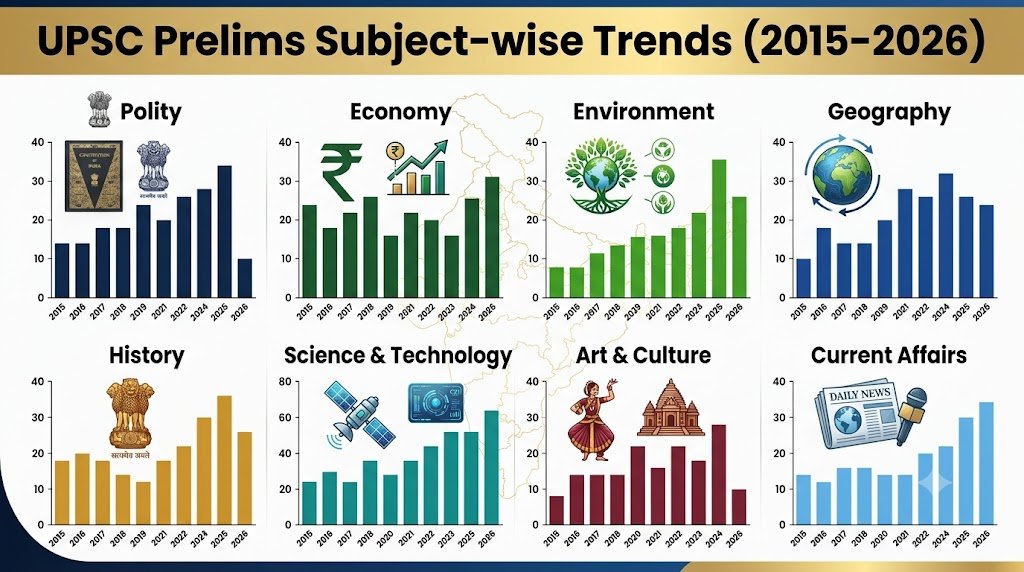
Overall, Polity, Economy, Environment, and Geography continue to account for a substantial share of questions, while Science & Technology has shown a rising presence in recent papers.
Polity Trend
Frequently Asked Areas
- Fundamental Rights
- DPSP
- Parliament
- Constitutional Bodies
- Local Government
- Judiciary
- Elections
- Constitutional Amendments
Preparation Sources
- Laxmikanth
- Constitution Articles
- PYQs
Economy Trend
Increasing focus on:
- Inflation
- Banking
- Monetary Policy
- RBI
- Fiscal Policy
- Budget
- External Sector
- Agriculture Economics
Questions now test application rather than definitions.
Environment & Ecology
One of the most important areas.
Frequently Asked Topics:
- National Parks
- Biosphere Reserves
- Ramsar Sites
- Biodiversity
- Climate Change
- IUCN Status
- Environmental Conventions
Geography Trend
Shift from factual to conceptual.
Examples:
- Ocean currents
- Climate
- Mapping
- Agriculture
- Rivers
- Mountains
- Monsoon
Map-based understanding is increasingly useful.
History Trend
Modern History remains important.
Topics include:
- Freedom Movement
- Revolts
- Congress Sessions
- Governor Generals
Ancient and Medieval questions continue to appear in smaller numbers.
Art & Culture
Most unpredictable subject.
Important Areas
- Temple Architecture
- Dance Forms
- Buddhism
- Jainism
- Literature
- Paintings
- UNESCO Heritage Sites
Science & Technology
Growing importance after 2020.
Focus Areas
- Biotechnology
- Space
- AI
- Quantum Computing
- Defence Technology
- Vaccines
- Nanotechnology
Recent analyses indicate Science & Technology occupied a larger share of the 2026 paper than its average over the previous decade, though exact classifications vary by analyst.
Current Affairs Trend
Current Affairs are no longer standalone.
UPSC links them with:
- Polity
- Geography
- Economy
- Environment
- International Relations
Read current affairs with background concepts.
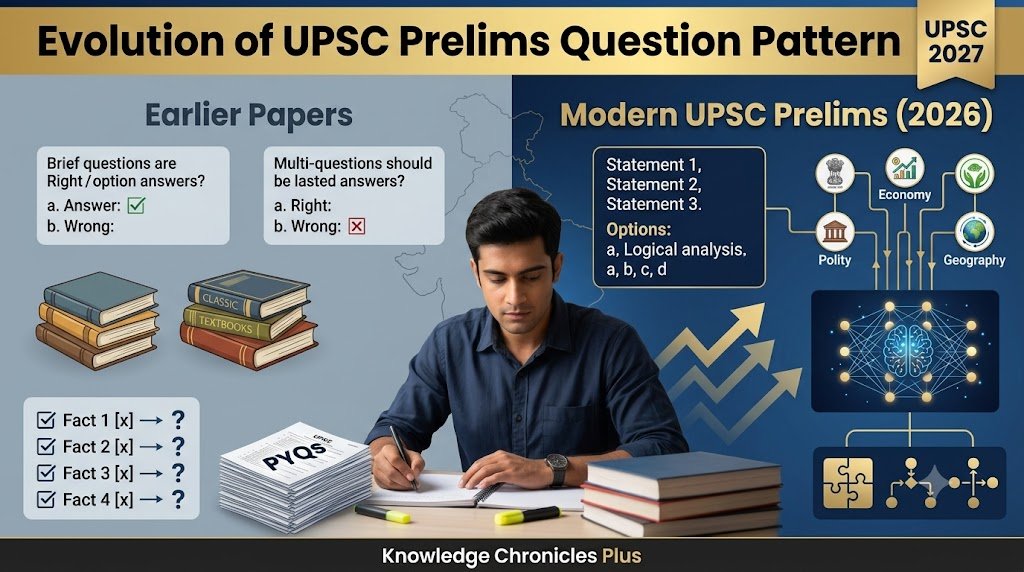
How Question Pattern Has Changed
Earlier
- Direct
- Fact-based
- One-line answers
Now
- Conceptual
- Analytical
- Interdisciplinary
- Statement-based
- Elimination-focused
What Changed in 2026?
Many experts observed that the 2026 Prelims paper was longer, more analytical, and less predictable than recent years. Static knowledge played a stronger role, while closely worded options made elimination more challenging. (The Times of India)
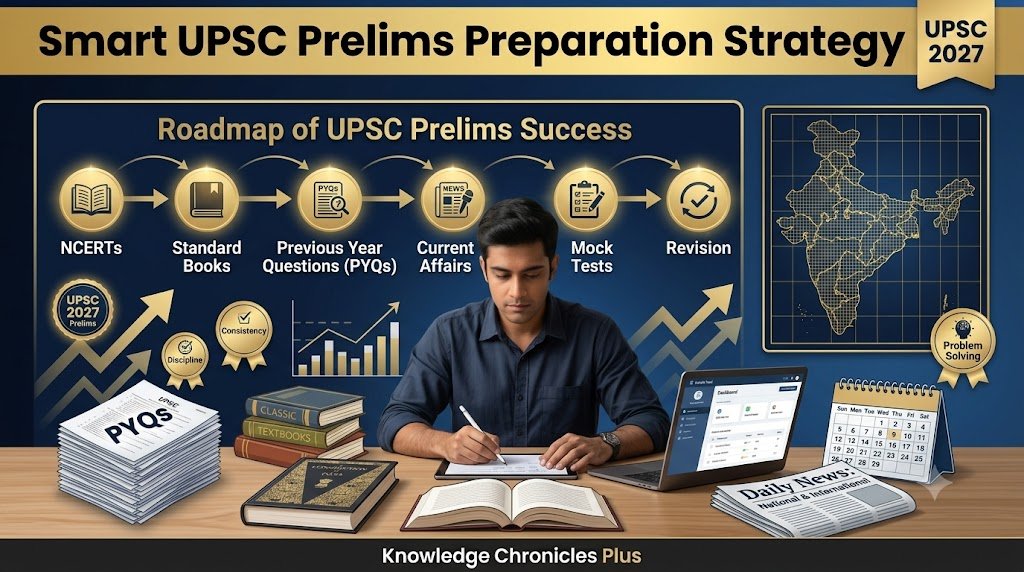
Smart Preparation Strategy With UPSC Prelims Previous Year Trends 2015-26
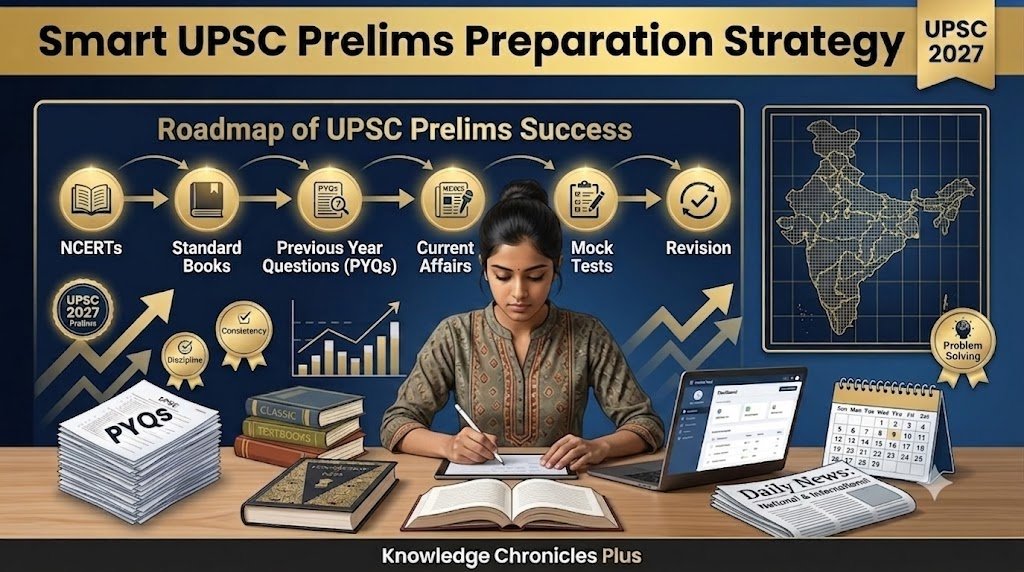
Step 1
Complete NCERTs
Step 2
Finish standard books.
Step 3
Solve PYQs from 2015 onwards.
Step 4
Prepare topic-wise notes.
Step 5
Practice statement-based MCQs daily.
Step 6
Revise multiple times.
Common Mistakes
❌ Ignoring PYQs
❌ Reading too many books
❌ Ignoring revision
❌ Over-dependence on Current Affairs
❌ Poor elimination practice
❌ No mock tests
Best Resources
- NCERT Books
- Indian Polity by M. Laxmikanth
- Spectrum Modern History
- GC Leong
- Economic Survey (relevant sections)
- Budget Highlights
- Environment notes
- Previous Year Question Papers
Key Takeaways from UPSC Prelims Previous Year Trends 2015-26
✔ PYQs are the best guide to UPSC preparation.
✔ Polity, Economy, Environment, and Geography consistently remain high-priority areas.
✔ The exam increasingly rewards conceptual understanding over memorization.
✔ Current affairs should always be studied with static subjects.
✔ Regular revision and MCQ practice are essential for success.
Frequently Asked Questions (FAQs) Related to UPSC Prelims Previous Year Trends 2015-26
Are PYQs enough for UPSC Prelims?
No. PYQs help identify patterns, but they should be combined with NCERTs, standard books, current affairs, and mock tests.
How many years of PYQs should I solve?
At least the last 10–12 years in detail.
Which subject has the highest weightage?
Polity, Economy, Environment, Geography, and Current Affairs generally carry the highest weightage, although the exact distribution varies from year to year.
Has UPSC become more analytical?
Yes. Recent papers emphasize conceptual clarity, interdisciplinary understanding, and statement-based questions.
How many times should I revise PYQs?
Aim to revise them at least three to five times, analyzing why each option is correct or incorrect.
Conclusion: UPSC Prelims Previous Year Trends 2015-26
The UPSC Prelims Previous Year Trends (2015–2026) clearly demonstrate that success comes from understanding patterns rather than chasing endless study material. Aspirants who consistently analyze PYQs, strengthen conceptual foundations, and revise strategically are better positioned to tackle the evolving nature of the examination.
By making previous year questions the core of your preparation and integrating them with current affairs and standard sources, you can significantly improve your chances of clearing the UPSC Prelims.
Recommended Posts
- Ultimate UPSC Prelims Mock Test Strategy (2027)
- UPSC Prelims Syllabus 2027
- Best Books for UPSC Prelims 2027
- Environment Notes for UPSC
- Important Polity Questions for UPSC Prelims 2027
- 100 Monetary Policy MCQs 2026
- 100 Essential Current Affairs MCQs UPSC Prelims
- 100 Most Important Indus Valley Civilization MCQs
- 100 Powerful Iran Israel War MCQs
8 thoughts on “Proven UPSC Prelims Previous Year Trends 2015-26: Complete Analysis”