Ultimate UPSC Prelims Mock Test Strategy (2027)
Mock tests are one of the most effective tools for UPSC Prelims preparation—but only if used correctly. Many aspirants take dozens of mock tests without improving their scores because they focus on quantity rather than quality.
A well-planned UPSC Prelims Mock Test Strategy helps you identify weak areas, improve accuracy, strengthen elimination techniques, and build confidence for the actual examination.
This Ultimate UPSC Prelims Mock Test Strategy is designed to help aspirants improve accuracy, time management, and confidence through systematic practice.
In this guide, you’ll learn how to use mock tests strategically to maximize your Prelims score.
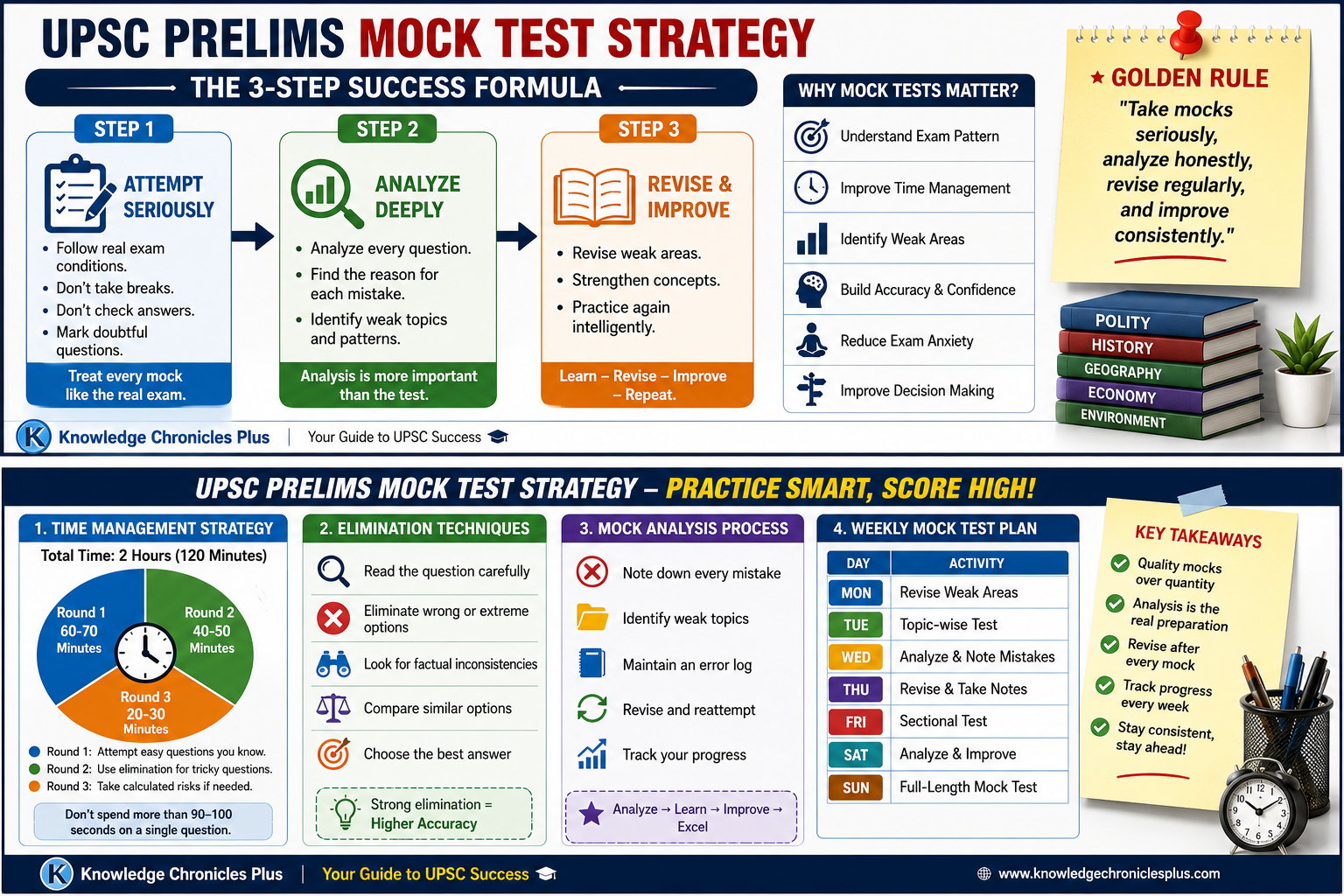
Why Are Mock Tests Important?
A well-planned UPSC Prelims Mock Test Strategy ensures that every mock test contributes meaningfully to your overall preparation.
Mock tests help you:
- Understand the UPSC exam pattern
- Improve time management
- Develop intelligent guessing techniques
- Identify weak subjects
- Reduce exam anxiety
- Build decision-making skills
The primary objective of a UPSC Prelims Mock Test Strategy is to identify weak areas and convert mistakes into learning opportunities.
When Should You Start Taking Mock Tests?
| Preparation Stage | Recommended Frequency |
|---|---|
| Foundation Phase | 1 Mock Every 2 Weeks |
| Intermediate Phase | 1 Mock Per Week |
| Final 2 Months | 2–3 Mocks Per Week |
| Final 30 Days | Full-Length Tests + Revision |
Avoid taking mock tests without completing the basic syllabus.
Types of Mock Tests
Every aspirant should customize their UPSC Prelims Mock Test Strategy according to their preparation level and available study time.
Topic-wise Tests
Best for:
- Polity
- Economy
- Geography
- History
- Environment
These strengthen individual subjects.
Sectional Tests
Combine related subjects like:
- History + Art & Culture
- Economy + Current Affairs
- Geography + Environment
Full-Length Mock Tests
Attempt exactly like the real UPSC Prelims.
Benefits:
- Time management
- Pressure handling
- Real exam simulation
How Many Mock Tests Should You Attempt?
A successful UPSC Prelims Mock Test Strategy focuses more on detailed analysis than on the total number of tests attempted.
There is no magic number.
Most successful aspirants attempt:
- 25–40 Quality Full-Length Tests
- 100+ Topic-wise Tests
The quality of analysis matters far more than the number of tests.
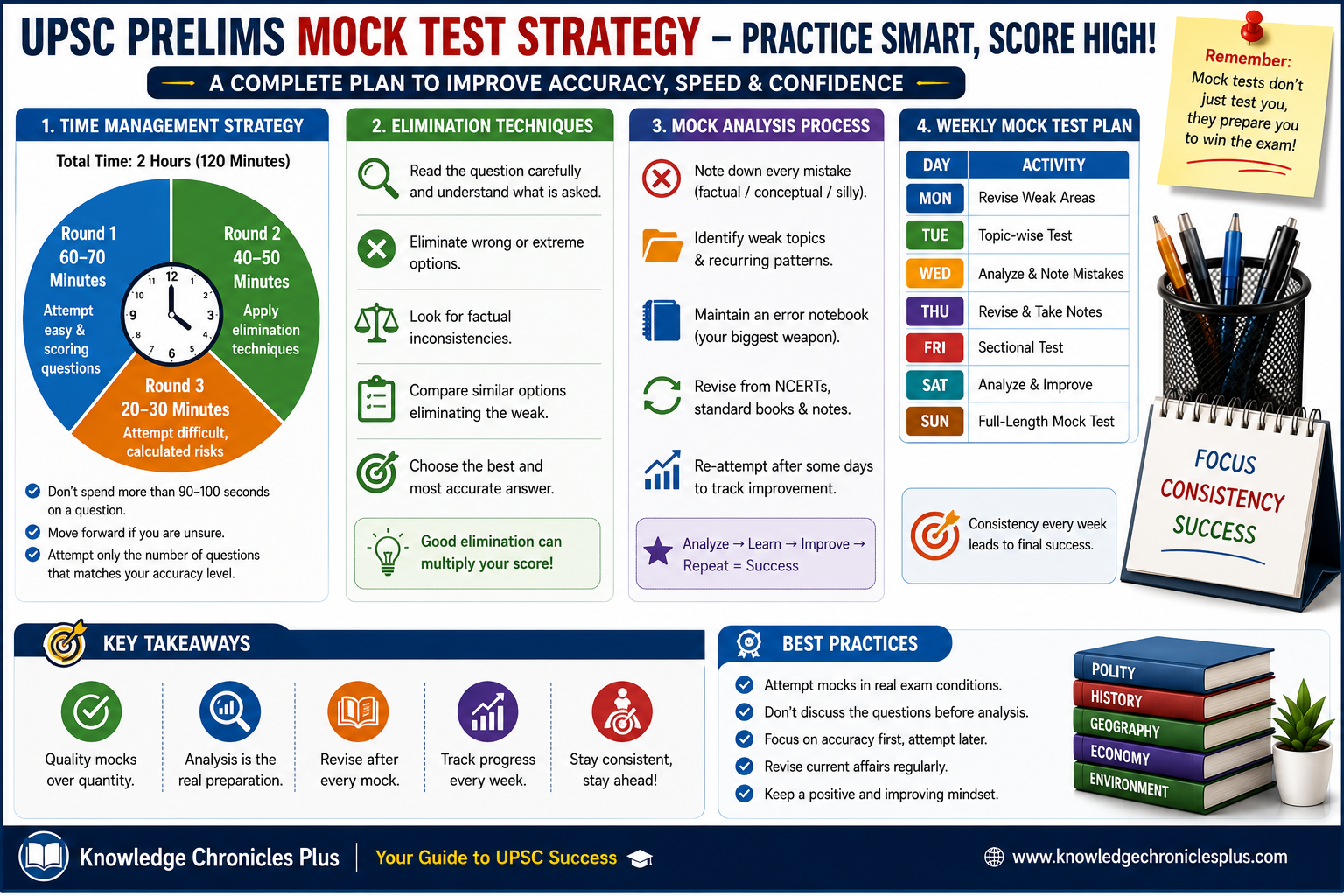
The 3-Step Mock Test Strategy
Step 1: Attempt Seriously
While taking the test:
- Follow the actual exam timing.
- Avoid interruptions.
- Don’t check answers during the test.
- Mark doubtful questions.
Treat every mock like the real UPSC exam.
Step 2: Analyze Every Question
The most important part of any UPSC Prelims Mock Test Strategy is analyzing every incorrect answer and understanding the reason behind it.
Spend more time analyzing than solving.
For every incorrect answer, ask:
- Why was it wrong?
- Which concept did I miss?
- Was it a factual mistake?
- Did I guess incorrectly?
- Was the question misread?
Maintain an error notebook.
Step 3: Revise Weak Areas
Use mock test analysis to revise:
- NCERTs
- Standard books
- Current affairs
- Short notes
Never move to the next mock without reviewing the previous one.
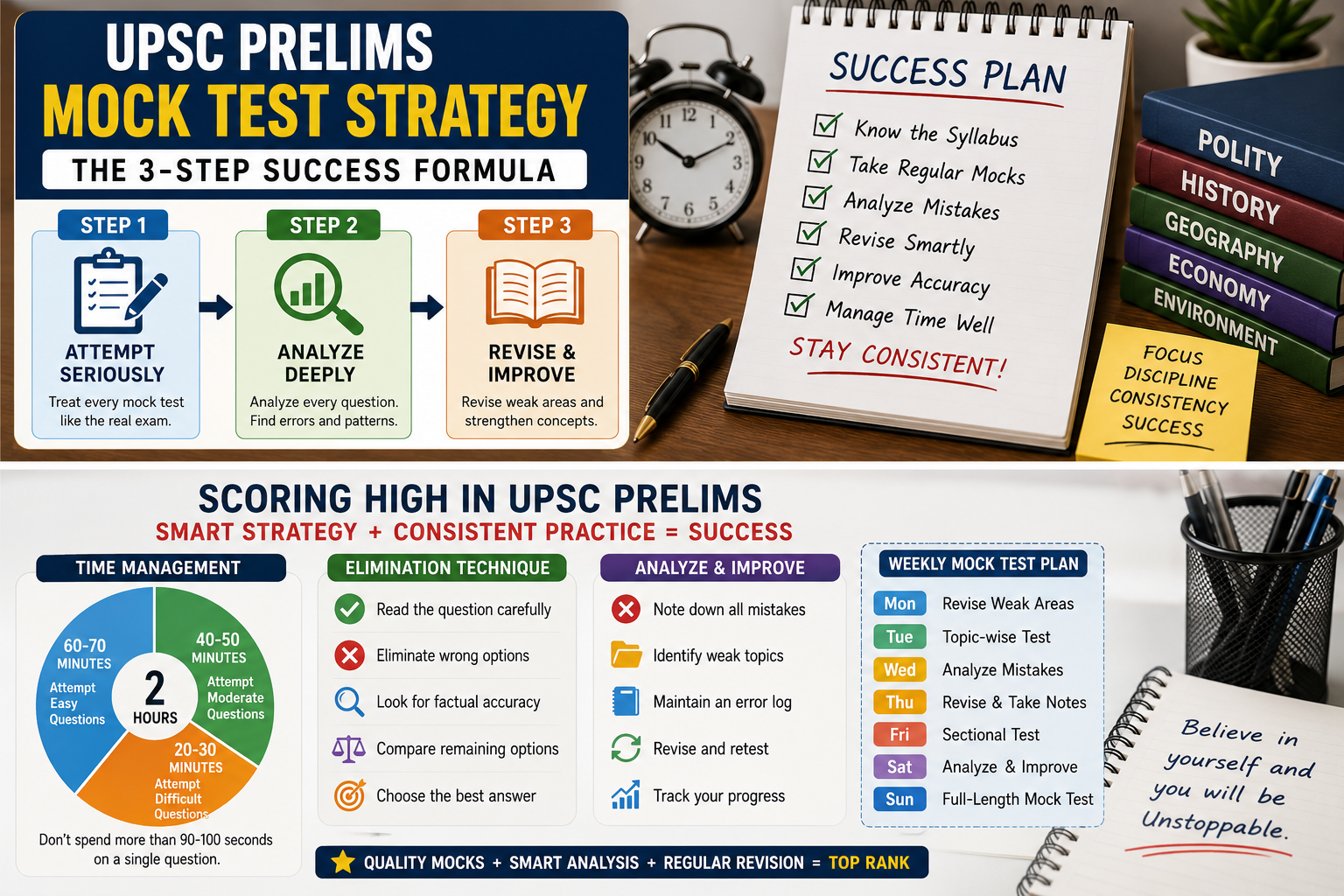
Time Management Strategy
Effective time management is one of the key pillars of a winning UPSC Prelims Mock Test Strategy.
During the exam:
Round 1
Solve questions you know immediately.
Round 2
Attempt questions that require elimination.
Round 3
Take calculated risks only if needed.
Avoid spending more than 90–100 seconds on a single question.
Improve Your Elimination Technique
A practical UPSC Prelims Mock Test Strategy includes regular practice of elimination techniques for statement-based questions.
UPSC often includes statement-based questions.
Practice:
- Eliminating extreme statements
- Identifying factual inconsistencies
- Comparing similar options
- Using conceptual understanding
Good elimination skills can significantly improve your score.
Maintain an Error Log
Record:
- Incorrect questions
- Guesswork mistakes
- Weak subjects
- Frequently forgotten facts
- Repeated conceptual errors
Review this notebook weekly.
Subject-wise Mock Test Strategy
Polity
Focus on:
- Constitutional Articles
- Parliament
- Fundamental Rights
- Judiciary
Economy
Practice:
- Inflation
- Budget
- RBI
- Fiscal Policy
Environment
Revise:
- National Parks
- Species
- Climate Change
- International Conventions
Geography
Improve:
- Mapping
- Physical Geography
- Agriculture
- Monsoon
History
Focus on:
- Modern India
- Freedom Movement
- Art & Culture
Common Mistakes to Avoid
❌ Taking too many tests without analysis
❌ Ignoring mistakes
❌ Changing strategy every week
❌ Blind guessing
❌ Comparing scores with others
❌ Skipping revision
Weekly Mock Test Plan
Following a disciplined UPSC Prelims Mock Test Strategy every week helps improve consistency and long-term performance.
| Day | Activity |
|---|---|
| Monday | Revise Weak Areas |
| Tuesday | Topic-wise Test |
| Wednesday | Analysis |
| Thursday | Revision |
| Friday | Sectional Test |
| Saturday | Analysis |
| Sunday | Full-Length Mock |
Final 30-Day Mock Strategy
Your UPSC Prelims Mock Test Strategy should become more revision-oriented during the final month before the examination.
- Attempt 2–3 full-length tests every week.
- Revise mistakes after each test.
- Avoid learning completely new sources.
- Focus on accuracy instead of attempting every question.
- Build confidence with consistent practice.
How to Analyze Your Score
Instead of asking:
“How many marks did I score?”
Ask:
- Which subject is weakest?
- Which mistakes are repeated?
- How can I improve accuracy?
- Which questions took too much time?
Continuous improvement is more important than individual test scores.
Best Practices
✔ Attempt mocks in exam conditions.
✔ Maintain an error notebook.
✔ Revise after every test.
✔ Practice elimination techniques.
✔ Focus on conceptual clarity.
✔ Track progress weekly.
Key Takeaways
- Mock tests should simulate the real UPSC examination.
- Analysis is more important than the number of tests attempted.
- Revision after every mock is essential.
- Maintain an error log to avoid repeating mistakes.
- Consistent practice improves confidence, speed, and accuracy.
Frequently Asked Questions (FAQs)
A structured UPSC Prelims Mock Test Strategy can significantly improve your confidence before the actual UPSC Prelims examination.
How many mock tests should I take before UPSC Prelims?
Most aspirants benefit from 25–40 quality full-length mock tests along with regular topic-wise practice.
When should I start taking mock tests?
Begin after completing the basic syllabus so that mock tests assess your preparation rather than expose gaps caused by incomplete study.
Is analyzing mock tests important?
Yes. Spending time reviewing mistakes and revising weak areas is often more valuable than attempting additional tests.
Should I attempt all 100 questions?
Not necessarily. Attempt only the number of questions that matches your accuracy level and risk appetite.
Can mock tests predict UPSC Prelims?
No. Mock tests are practice tools designed to improve preparation, not predict the actual paper.
Most Important Resources for UPSC Prelims Resources
- Current Affairs For UPSC Prelims 2027
- Polity for UPSC Prelims 2027
- Economy for UPSC Prelims 2027
- History for UPSC Prelims 2027
- Science and Technology for UPSC Prelims 2027
- Geography for UPSC Prelims 2027
Conclusion
A well-planned UPSC Prelims Mock Test Strategy is about learning from every test, not chasing high scores. By combining disciplined mock practice with detailed analysis, focused revision, and steady improvement, you can develop the confidence and accuracy needed to perform well in the UPSC Prelims.
Ultimately, the success of your UPSC Prelims Mock Test Strategy depends on disciplined practice, honest self-analysis, regular revision, and continuous improvement.
External Resources
Along with your mock test journey, carefully review the Official UPSC Civil Services Examination Pattern and Notification to understand the latest exam structure and eligibility requirements.
Since UPSC frequently asks questions based on government initiatives and policy developments, regularly reading official releases from the Press Information Bureau (PIB) can improve your current affairs preparation.
22 thoughts on “Ultimate UPSC Prelims Mock Test Strategy (2027): Proven Plan to Maximize Your Score”