📌 Introduction
UPSC Prelims Paper 1 PYQ Analysis is one of the smartest ways to understand UPSC trends, repeated topics, conceptual depth, and analytical question patterns for UPSC 2026 preparation.
UPSC Prelims Paper 1 Previous Year Papers (Solved) help aspirants understand:
- Exam trend and pattern
- Frequently asked topics
- Conceptual depth required by UPSC
- Elimination techniques
- Important subjects and recurring themes
In this comprehensive guide, we provide:
✔ Topic-wise analysis (2013–2025)
✔ Subject-wise question trends
✔ Important repeated themes
✔ Solved PYQs with explanations
✔ Smart preparation strategy for UPSC 2026

🔥 Why UPSC Prelims Paper 1 PYQ Analysis Is Important
UPSC repeats concepts more often than exact questions. PYQs help aspirants understand the “thinking pattern” of UPSC.
✅ Major Benefits of PYQs
- Improve conceptual clarity
- Understand UPSC difficulty level
- Identify high-weightage topics
- Improve elimination skills
- Enhance revision strategy
- Build exam temperament
📊 UPSC Prelims Paper 1 PYQ Analysis(2013–2025) for Smart Revision
Revision becomes more effective when aspirants focus on repeated concepts and high-probability areas. UPSC Prelims Paper 1 PYQ Analysis helps in creating a smart and targeted revision strategy.
📌 Overall Trend Observed
| Year | Nature of Paper | Key Focus Areas |
|---|---|---|
| 2013–2015 | Static-heavy | History, Polity, Geography |
| 2016–2018 | Analytical | Environment, Economy |
| 2019–2021 | Current affairs integrated | Science & Tech, International Relations |
| 2022–2023 | Conceptual + elimination-based | Environment, Mapping |
| 2024–2025 | Highly analytical | Governance, AI, Geopolitics |
📚 Subject-Wise Weightage Analysis
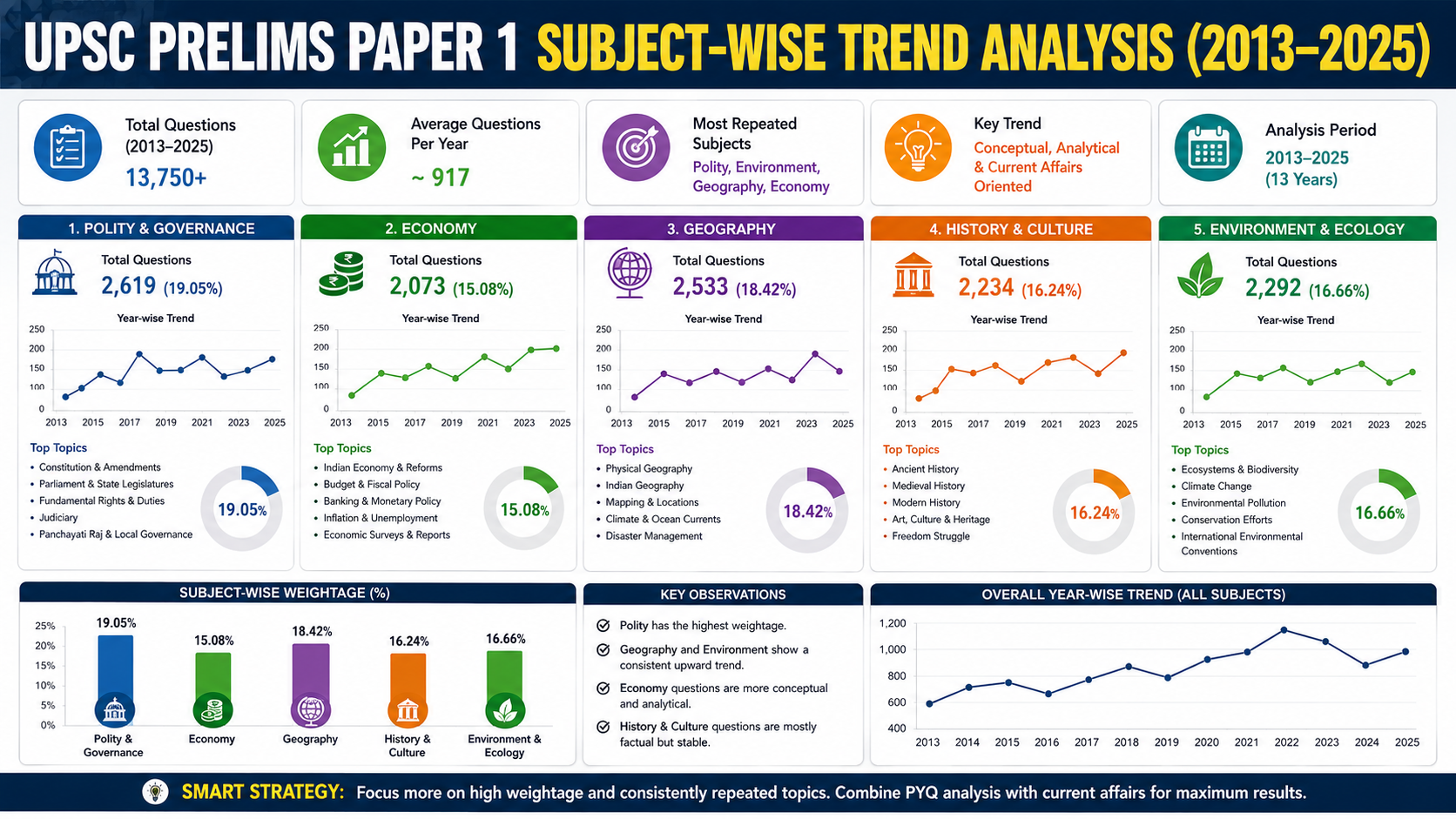
| Subject | Average Questions |
|---|---|
| Polity | 12–18 |
| History & Culture | 12–16 |
| Geography | 10–14 |
| Economy | 14–18 |
| Environment & Ecology | 12–17 |
| Science & Technology | 10–15 |
| Current Affairs | Integrated Across Subjects |
A proper UPSC Prelims Paper 1 PYQ Analysis not only improves conceptual understanding but also strengthens answer elimination skills.
🏛️ Indian Polity: UPSC Prelims Paper 1 PYQ Analysis
🔍 Important Themes Asked Repeatedly
- Fundamental Rights
- DPSP
- Constitutional Bodies
- Parliament
- Federalism
- Local Governance
- Constitutional Amendments
📝 Solved PYQ Example 1
Q. Which part of the Constitution deals with Fundamental Rights?
A. Part II
B. Part III
C. Part IV
D. Part V
👉 Answer: B
✅ Explanation:
Part III of the Indian Constitution contains Fundamental Rights (Articles 12–35).
📝 Solved PYQ Example 2
Q. Which constitutional body conducts elections in India?
A. UPSC
B. Finance Commission
C. Election Commission of India
D. NITI Aayog
👉 Answer: C
✅ Explanation:
The Election Commission of India is an autonomous constitutional authority responsible for conducting elections.
You can also practice our Making of Constitution 100 MCQs for UPSC 2026 to strengthen Indian Polity preparation.
🌍 Geography: UPSC Prelims Paper 1 PYQ Analysis
🔍 Repeated Topics
- Ocean currents
- Climate phenomena
- Mapping questions
- Indian rivers
- Mineral resources
- Agriculture geography
📝 Solved PYQ Example
Q. La Niña phenomenon is associated with:
A. Atlantic Ocean
B. Indian Ocean
C. Pacific Ocean
D. Arctic Ocean
👉 Answer: C
✅ Explanation:
La Niña is a climate phenomenon associated with cooling of the equatorial Pacific Ocean.
For Geography and mapping current affairs, also read our Important Places in News 100 MCQs for UPSC 2026.
💰Economy: UPSC Prelims Paper 1 PYQ Analysis
🔍 Frequently Asked Areas
- Inflation
- Monetary policy
- Banking system
- Fiscal deficit
- External sector
- Government schemes
📝 Solved PYQ Example
Q. Repo rate is decided by:
A. Ministry of Finance
B. RBI
C. NITI Aayog
D. SEBI
👉 Answer: B
✅ Explanation:
Repo rate is the rate at which RBI lends money to commercial banks.
🌱 Environment & Ecology: UPSC Prelims Paper 1 PYQ Analysis
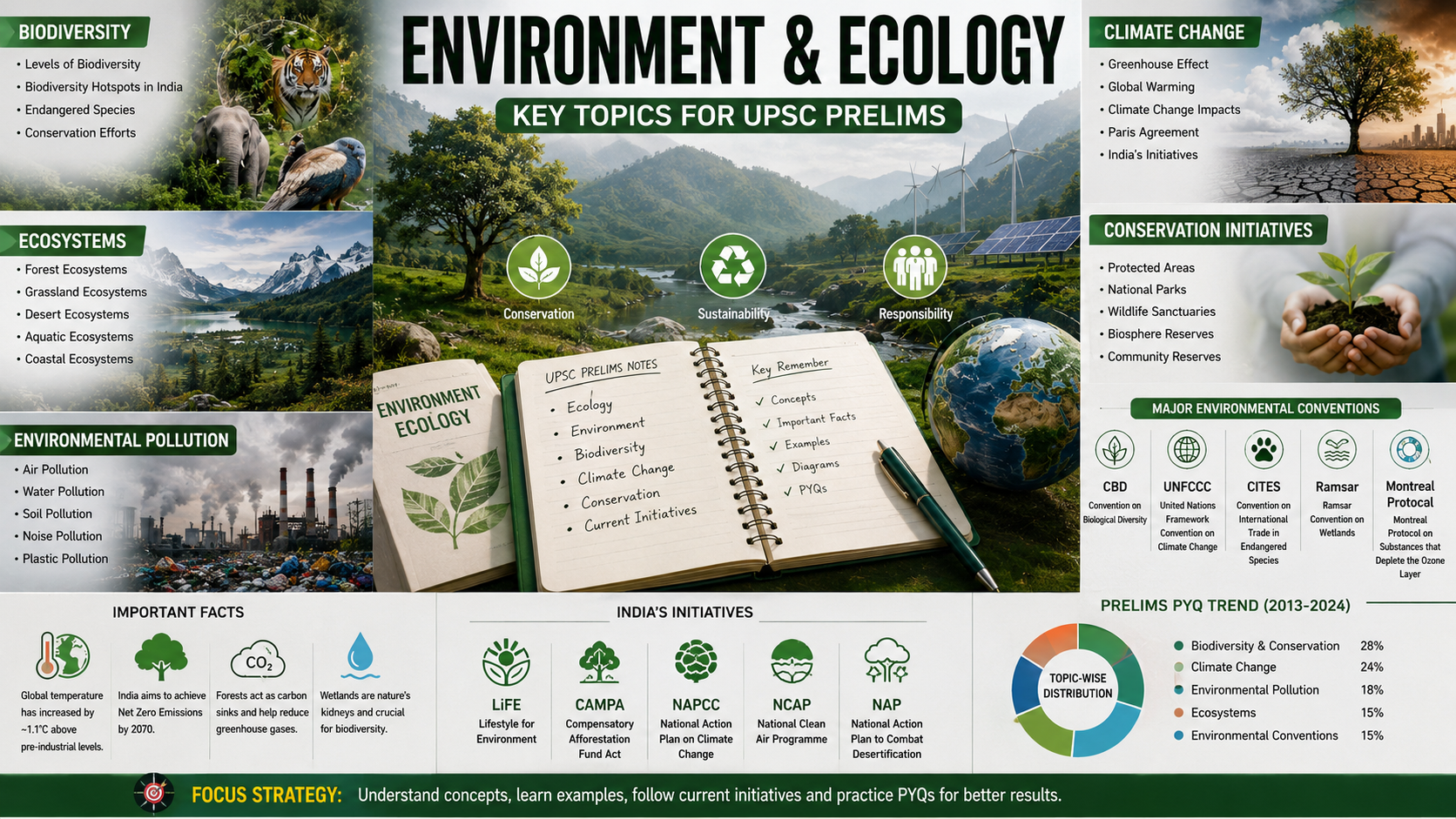
🔍 Important Themes
- National parks
- Biodiversity hotspots
- Climate change
- International conventions
- Species in news
- Pollution
📝 Solved PYQ Example
Q. Ramsar Convention is related to:
A. Forest conservation
B. Wetlands conservation
C. Desertification
D. Wildlife trade
👉 Answer: B
✅ Explanation:
Ramsar Convention focuses on conservation and wise use of wetlands.
For Environment related questions, also read our Environment MCQs 2026
🚀 Science & Technology: UPSC Prelims Paper 1 PYQ Analysis
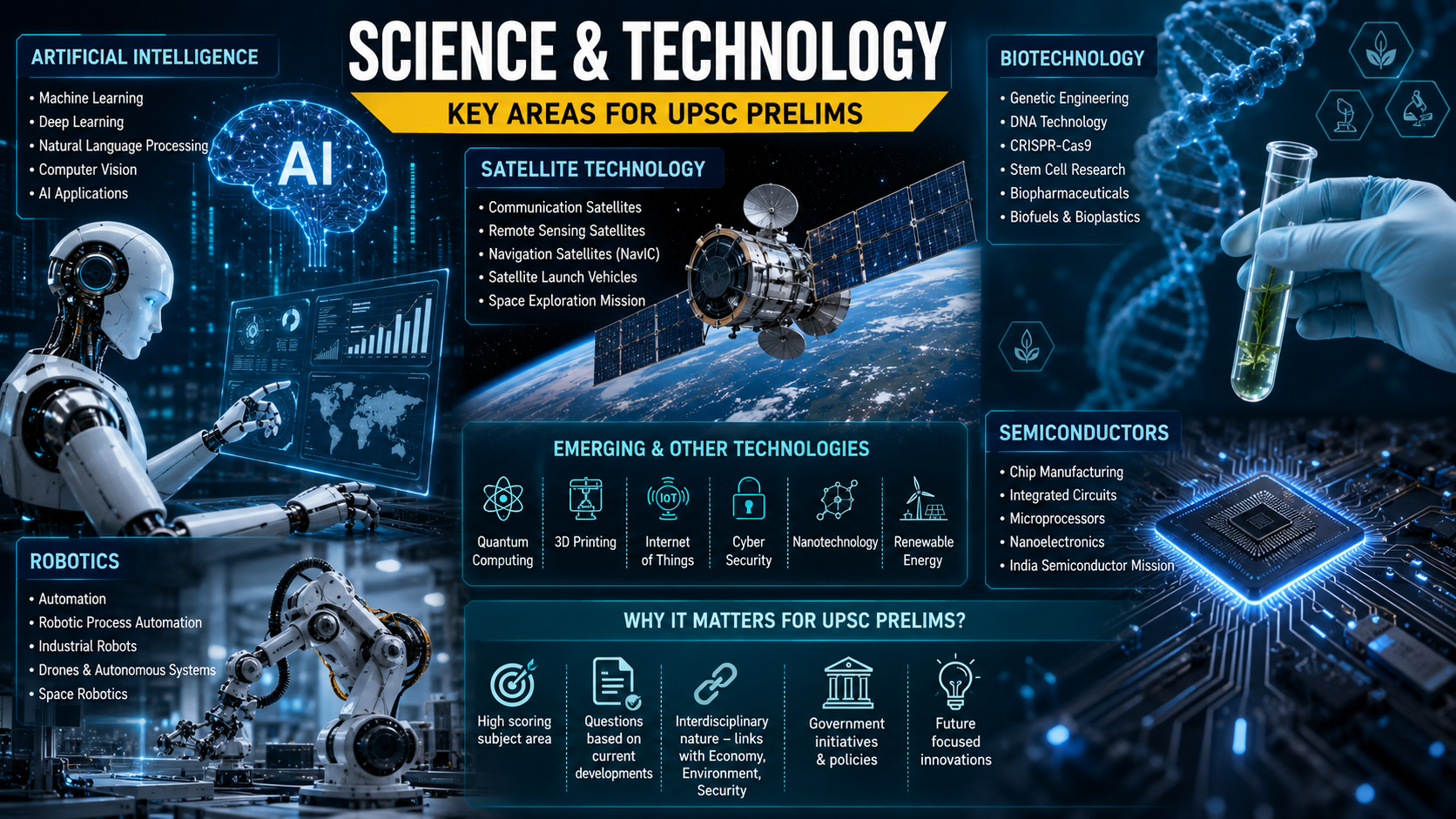
🔍 Frequently Asked Areas
- Biotechnology
- Space missions
- AI and emerging tech
- Nanotechnology
- Quantum computing
- Defence technology
📝 Solved PYQ Example
Q. CRISPR technology is related to:
A. Satellite communication
B. Gene editing
C. Quantum computing
D. Blockchain
👉 Answer: B
✅ Explanation:
CRISPR is a revolutionary gene-editing technology used in biotechnology.
To improve analytical preparation, practice our Science & Tech 100 MCQs for UPSC 2026.
🏺History & Culture: UPSC Prelims Paper 1 PYQ Analysis
🔍 Important Themes
- Buddhism & Jainism
- Freedom struggle
- Constitutional development
- Ancient architecture
- Literature & art forms
📝 Solved PYQ Example
Q. Who gave the slogan “Do or Die”?
A. Jawaharlal Nehru
B. Subhas Chandra Bose
C. Mahatma Gandhi
D. Bhagat Singh
👉 Answer: C
✅ Explanation:
Mahatma Gandhi gave the slogan “Do or Die” during the Quit India Movement (1942).
You can also practice our 100 Most Important Indus Valley Civilization MCQs to strengthen Indian History preparation.
🎯 UPSC Prelims Paper 1 PYQ Analysis:Most Repeated Topics(2013-25)
📌 Topics Repeated Frequently
✔ Climate change
✔ Constitutional bodies
✔ International organizations
✔ Biotechnology
✔ Mapping & places in news
✔ Government schemes
✔ Buddhism & ancient history
✔ Economy basics
✔ Environment conventions
✔ Science current affairs
📈 Smart Strategy to Use UPSC Prelims Paper 1 PYQ Analysis for UPSC 2026
✅ 1. Solve Subject-Wise PYQs
Practice questions topic-wise before full-length tests.
✅ 2. Analyze Mistakes
Focus more on:
- conceptual gaps
- factual confusion
- elimination errors
✅ 3. Maintain a PYQ Notebook
Write:
- repeated concepts
- tricky facts
- important themes
✅ 4. Revise Repeated Topics
UPSC often repeats concepts indirectly.
✅ 5. Practice Elimination Technique
Many UPSC questions can be solved by eliminating extreme options.
❌ Common Mistakes Aspirants Make
- Ignoring old PYQs
- Memorizing answers without understanding concepts
- Focusing only on current affairs
- Not analyzing trends
- Solving PYQs only once
Recommended Reading
100 Important World Current Affairs MCQs for UPSC Prelims 2027
100 Essential Current Affairs MCQs UPSC Prelims 2026
75 Important Polity Questions for UPSC Prelims 2026
Strait of Hormuz UPSC Prelims 2026
100 Powerful Iran Israel War MCQs 2026
📌 Best Sources for Why UPSC Prelims Paper 1 PYQ Analysis
Recommended Books & Sources
- UPSC official website
- Previous year question compilations
- NCERT books
- Standard reference books
- Mock test analysis
🔥 Conclusion: UPSC Prelims Paper 1 PYQ Analysis
UPSC Prelims Paper 1 Previous Year Papers (Solved) are one of the strongest tools for clearing the examination. PYQs help aspirants understand UPSC’s evolving pattern, improve analytical thinking, and identify important recurring themes.
Consistent practice of topic-wise solved PYQs combined with smart revision and current affairs integration can significantly improve your chances of success in UPSC Prelims 2026.
📌 FAQs: UPSC Prelims Paper 1 PYQ Analysis
Q1. How many years of UPSC PYQs should be solved?
At least 10–12 years of UPSC Prelims PYQs should be practiced thoroughly.
Q2. Are UPSC PYQs enough for Prelims?
PYQs are extremely important but should be combined with current affairs and conceptual study.
Q3. Which subjects are most important in UPSC Prelims?
Polity, Economy, Environment, Geography, History, and Science & Technology are highly important.
3 thoughts on “UPSC Prelims Paper 1 PYQ Analysis : Powerful Topic-Wise Trends (2013–2025) 🚀”