Introduction
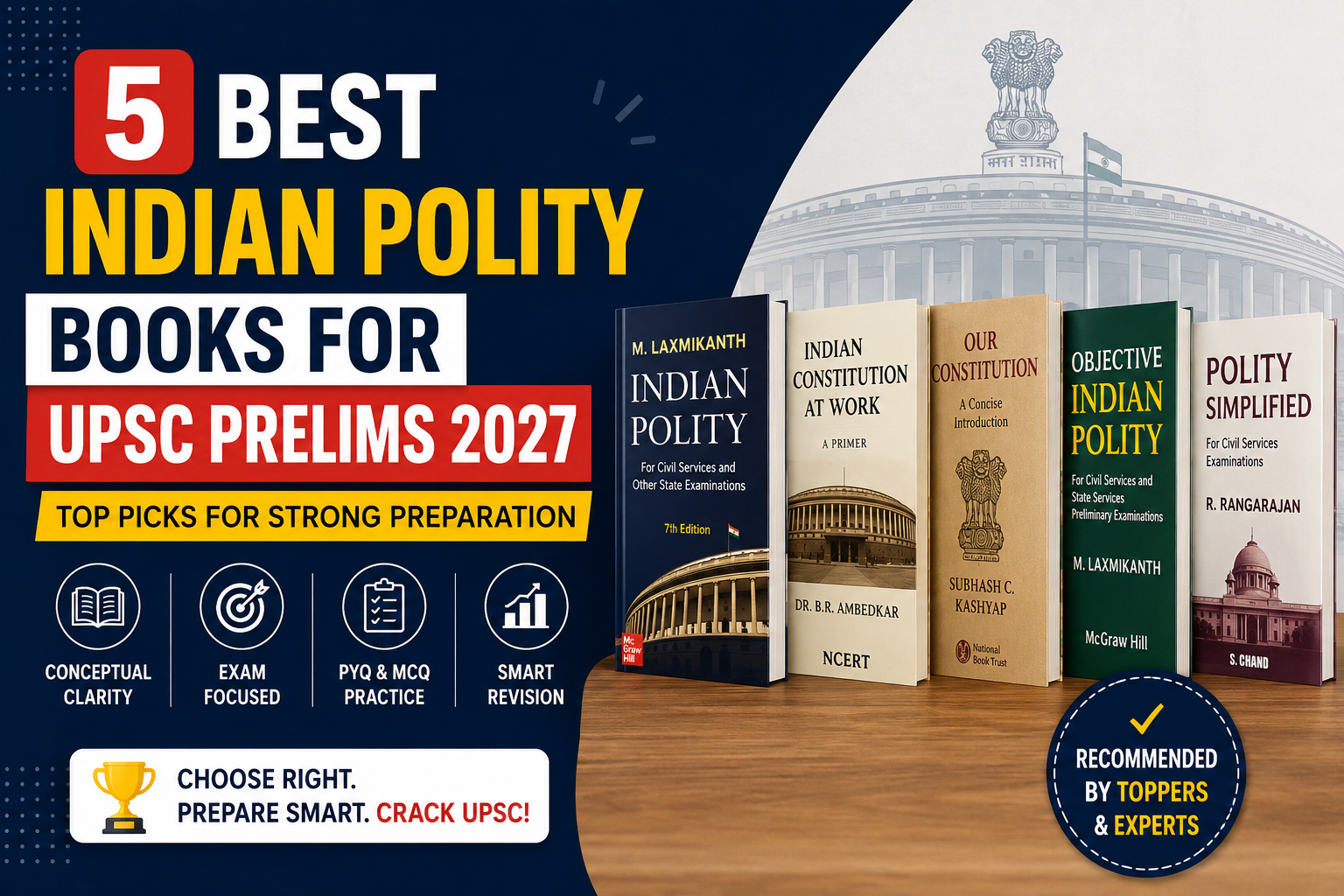
Choosing the right books can make Indian Polity preparation much more systematic for UPSC aspirants. The Best Indian Polity Books for UPSC Prelims 2027 should help you understand constitutional concepts, revise important provisions, analyse previous year questions and practise statement-based MCQs effectively.
Indian Polity remains an important part of UPSC CSE Prelims General Studies Paper I, covering areas such as the Constitution, Fundamental Rights, Parliament, President, Prime Minister, Judiciary, Centre-State Relations, constitutional bodies and local government.
In this guide, we have selected 5 Best Indian Polity Books for UPSC Prelims 2027 for different preparation needs—from beginners building their fundamentals to serious aspirants looking for revision and MCQ practice.
The current 8th edition of M. Laxmikanth’s Indian Polity, for example, contains 92 structured chapters, previous years’ UPSC questions and dedicated Prelims/Mains practice material.
Apart from choosing your Polity resources, test your current preparation level with our Executive and Legislature 100 MCQs for UPSC Prelims 2027, covering the President, Prime Minister, Parliament, Governor and State Legislature through exam-oriented questions.
Quick Recommendation: If you want only one primary reference book, start with M. Laxmikanth’s Indian Polity. Beginners can use NCERT’s Indian Constitution at Work first, while serious Prelims practice can be supplemented with Objective Indian Polity.

Best Indian Polity Books for UPSC Prelims 2027 – Quick Comparison
| Book | Author | Best For |
|---|---|---|
| Indian Polity – 8th Edition | M. Laxmikanth | Best Overall |
| Indian Constitution at Work | NCERT | Best for Beginners |
| Our Constitution | Subhash C. Kashyap | Best for Conceptual Understanding |
| Objective Indian Polity | M. Laxmikanth | Best for MCQ Practice |
| Polity Simplified – 2nd Edition | R. Rangarajan | Best Alternative Concept-Based Resource |
1. Indian Polity by M. Laxmikanth – Best Overall
Among the Best Indian Polity Books for UPSC Prelims 2027, M. Laxmikanth remains our top overall recommendation because of its comprehensive coverage and exam-oriented structure.
Why it ranks #1
For most UPSC aspirants, M. Laxmikanth’s Indian Polity should be the core book for Polity preparation.
McGraw Hill’s current English edition is the 8th Edition, published in July 2025. It has expanded into a courseware format containing 92 structured chapters, 8 appendices, 40+ conceptual videos, previous years’ UPSC Prelims questions and dedicated practice questions.
The coverage includes:
- Historical Background
- Making of the Constitution
- Preamble
- Fundamental Rights
- DPSP and Fundamental Duties
- Parliamentary System
- Federal System
- Centre-State Relations
- President and Vice-President
- Prime Minister and Council of Ministers
- Parliament
- Supreme Court and High Courts
- Governor and State Legislature
- Constitutional Bodies
- Elections
- Local Government
- Emergency Provisions
Best for
Almost every UPSC aspirant, particularly those looking for one primary Polity reference for repeated revision.
Strengths
The biggest advantage is its exam-oriented organization. Individual constitutional institutions and concepts are divided into manageable chapters, making revision relatively easy.
It is particularly useful during the final months before Prelims because aspirants can revise selected high-yield chapters repeatedly instead of reading an academic constitutional-law textbook from beginning to end.
Limitation
The sheer volume of material can overwhelm beginners. Reading it cover-to-cover without PYQs or revision may also lead to passive learning.
How to use it for UPSC 2027
Don’t read it once and move on.
First reading → understand concepts
Second reading → highlight key provisions
Third reading → connect chapters with PYQs
Final revisions → focus on weak/high-yield chapters
Verdict: ⭐ 5/5
Best choice if you want only one main Polity book.
After completing the constitutional background chapters in Laxmikanth, practise the concepts with our Making of Constitution 100 MCQs for UPSC Prelims 2027 to strengthen your understanding of constitutional development and framing.
2. NCERT Indian Constitution at Work – Best for Beginners
Many beginners jump directly into a large competitive-exam reference book without first understanding why constitutional institutions work the way they do.
Indian Constitution at Work can help solve that problem.
Why beginners should consider it
The book develops foundational understanding of topics such as:
- Constitution
- Fundamental Rights
- Elections
- Executive
- Legislature
- Judiciary
- Federalism
- Local Government
- Constitution as a living document
Unlike a pure fact-oriented examination manual, NCERT helps build the conceptual story behind Indian democracy and constitutional institutions.
Best for
- First-time UPSC aspirants
- Students without a Political Science background
- Aspirants finding Laxmikanth difficult
- Conceptual foundation before advanced revision
Strengths
The language is relatively accessible, and the book helps aspirants understand constitutional ideas rather than merely memorize Articles.
Limitation
NCERT alone is not sufficient for complete UPSC Prelims Polity preparation.
Use it as a foundation and then move to an exam-oriented resource.
Recommended combination
NCERT → Laxmikanth → PYQs → MCQs
Verdict: ⭐ 4.5/5 for beginners
While selecting the Best Indian Polity Books for UPSC Prelims 2027, aspirants should consider their preparation level instead of buying every recommended resource.
Once your NCERT fundamentals are clear, move from theory to application with our 75 Important Polity Questions for UPSC Prelims 2027, designed to test conceptual understanding and elimination skills.

3. Our Constitution by Subhash C. Kashyap – Best for Conceptual Understanding
Our Constitution by Subhash C. Kashyap is an excellent supplementary resource for aspirants who want to go beyond memorizing constitutional facts.
The National Book Trust describes the book as a factual, objective and analytical study of India’s Constitution, intended for readers seeking to understand both the Constitution and India’s political system.
Why this book is useful
UPSC increasingly rewards conceptual understanding.
You may know a constitutional provision but still get a statement-based question wrong because you haven’t understood the underlying relationship between institutions.
This book can help provide that depth.
Best for
- Aspirants wanting deeper constitutional understanding
- UPSC Mains GS-II preparation
- Students interested in Parliament and constitutional government
- Aspirants supplementing Laxmikanth
Strengths
It provides context and interpretation rather than functioning simply as a collection of exam facts.
Limitation
It should not replace your primary Prelims reference book if your preparation time is limited.
Think of it as an enrichment resource.
Recommended approach
Whenever a topic in your primary book feels mechanical—for example, parliamentary government, constitutional offices or institutional relationships—read the corresponding conceptual discussion here.
Verdict: ⭐ 4.5/5
4. Objective Indian Polity by M. Laxmikanth – Best for MCQ Practice
Knowing Polity and solving Polity questions under examination conditions are different skills.
That’s where Objective Indian Polity becomes useful.
McGraw Hill says the second edition contains 80 chapters, 10 appendices, 10 model tests and 1,650 questions, including chapter-wise practice covering India’s constitutional and political system.
What makes it useful for Prelims?
It allows you to test whether you can:
- distinguish between similar constitutional provisions,
- eliminate incorrect statements,
- recall institutional powers,
- identify exceptions,
- recognize constitutional vs statutory bodies,
- handle statement-based questions.
Best for
Aspirants who have already completed their basic Polity syllabus and now need systematic MCQ practice.
Strengths
Chapter-wise questions make it possible to study one topic and immediately test yourself.
Limitation
Don’t substitute MCQ solving for conceptual study.
If you’re consistently getting a topic wrong, return to your main reference rather than memorizing answers.
Best usage strategy
Complete one topic in Laxmikanth → solve related PYQs → attempt objective questions → note mistakes → revise the chapter.
Verdict: ⭐ 4.5/5 for Prelims practice
MCQ practice becomes much more effective when you analyse mistakes systematically, so also read our UPSC Prelims Mock Test Strategy 2027 for a practical approach to accuracy, elimination and time management.
5. Polity Simplified by R. Rangarajan – Best Alternative for Concept-Based Learning
Each of these Best Indian Polity Books for UPSC Prelims 2027 serves a different purpose, so your final choice should depend on whether you need conceptual clarity, comprehensive coverage, revision or MCQ practice.
For aspirants who find traditional Polity preparation too factual, Polity Simplified by R. Rangarajan provides a more concept-and-application-oriented alternative.
McGraw Hill’s current second edition was published in April 2025. Its contents include foundational concepts, constitutional history, Preamble, federalism, citizenship, Union Executive, State Executive, Parliament, State Legislature, Supreme Court, High Courts and Fundamental Rights.
The accompanying courseware also incorporates conceptual videos, PYQs, practice questions and current-affairs material.
Best for
- Visual/concept-oriented learners
- Beginners struggling with conventional textbooks
- Aspirants wanting integrated learning and practice
- Candidates seeking an alternative to Laxmikanth
Strengths
Its focus on concepts and application can help aspirants understand relationships between institutions rather than treating every chapter as an isolated set of facts.
Limitation
If you’re already comfortable with Laxmikanth and have limited time, adding another comprehensive Polity resource may create unnecessary duplication.
Verdict: ⭐ 4/5
Which Indian Polity Book Should You Buy?
Choosing among the Best Indian Polity Books for UPSC Prelims 2027 depends largely on your current preparation level, available time and conceptual foundation. Beginners and experienced aspirants should not necessarily follow the same booklist.
The answer depends on your preparation stage.
If you are a complete beginner
Start with:
NCERT Indian Constitution at Work → M. Laxmikanth
If you already understand basic Polity
Use:
M. Laxmikanth + PYQs
If your concepts are weak
Use:
NCERT + Laxmikanth + selected chapters from Our Constitution
If you have completed the syllabus
Move toward:
Laxmikanth revision + Objective Indian Polity + UPSC PYQs + mock tests
If you dislike fact-heavy preparation
Consider:
Polity Simplified + PYQs

Do You Need All 5 Books?
Even though we have listed the Best Indian Polity Books for UPSC Prelims 2027, you certainly do not need to purchase or read all five books.
This is perhaps the most important recommendation in this article.
Buying five Polity books does not mean you will score better.
For most candidates:
One primary book + NCERT/PYQs + repeated revision + MCQ practice is enough.
Your ability to revise the same reliable source multiple times is generally more valuable than continuously adding new books.
Best Polity Book Combination for UPSC Prelims 2027
For most aspirants, I recommend this three-stage approach:
Stage 1 – Build Concepts
NCERT: Indian Constitution at Work
Understand constitutional philosophy, institutions and basic terminology.
Stage 2 – Master the Syllabus
Indian Polity by M. Laxmikanth
Make this your principal revision source.
Stage 3 – Test Yourself
UPSC Previous Year Questions + Objective Indian Polity + quality mock tests
This converts knowledge into examination performance.
How to Study Indian Polity for UPSC Prelims 2027
Don’t study Polity as a collection of unrelated Articles.
Build connections.
For example:
President → Prime Minister → Council of Ministers → Parliament
Then:
Governor → Chief Minister → State Council of Ministers → State Legislature
Likewise:
Fundamental Rights → Supreme Court → Judicial Review → Writs
And:
Election Commission → Elections → Representation of the People Acts → Anti-Defection → Political Parties
This interconnected approach is especially useful for statement-based questions.
To understand how UPSC has changed the balance between factual and conceptual questions, examine our UPSC Prelims Previous Year Trends (2015–2026) before planning your final Polity revision strategy.
High-Priority Polity Topics for UPSC Prelims 2027
While the entire syllabus matters, candidates should pay particular attention to:
- Preamble
- Fundamental Rights
- DPSP
- Fundamental Duties
- President
- Vice-President
- Prime Minister
- Parliament
- Parliamentary Committees
- Supreme Court
- High Courts
- Governor
- State Legislature
- Centre-State Relations
- Emergency Provisions
- Constitutional Bodies
- Election Commission
- CAG
- Finance Commission
- Local Government
- Constitutional Amendments
- Schedules
- Important Supreme Court judgments
- Current constitutional and governance developments
UPSC’s official examination material remains the best place to verify the examination framework and access actual previous papers. The commission’s 2026 Prelims page, for example, provides both GS Paper I and GS Paper II question papers. (UPSC)
How Many Times Should You Revise Laxmikanth?
There is no magic number, but multiple focused revisions are essential.
A practical cycle is:
Reading 1: Understand
Reading 2: Mark important facts
Reading 3: Integrate PYQs
Reading 4: Revise weak chapters
Reading 5: Rapid Prelims revision
During the last phase, avoid reading every paragraph with equal intensity. Your PYQ analysis and mock-test mistakes should tell you where to spend more time.
Books vs Current Affairs: What Matters More for Polity?
You need both.
Static books teach the constitutional framework. Current affairs show how that framework operates.
For example, news involving a Governor, Speaker, Election Commission, Supreme Court judgment, ordinance, parliamentary committee or Centre-State dispute can have a static constitutional concept behind it.
Whenever an important Polity issue appears in current affairs:
Read the news → identify the static topic → revise the relevant chapter → solve related PYQs.
This makes current affairs much more useful.
To connect static Polity with contemporary developments, regularly practise our 100 Essential Current Affairs MCQs for UPSC Prelims, especially questions related to governance, constitutional bodies and important national developments.
Frequently Asked Questions
Q1. Which is the best Indian Polity book for UPSC Prelims 2027?
For most aspirants, Indian Polity by M. Laxmikanth is the strongest choice as the primary exam-oriented reference. The current 8th edition provides broad coverage along with PYQs and practice resources.
Q2. Is Laxmikanth enough for UPSC Prelims Polity?
It is an excellent core resource, but don’t rely on any single book in isolation. Combine it with UPSC PYQs, current affairs and repeated MCQ practice.
Q3. Should beginners read NCERT before Laxmikanth?
If you have difficulty understanding constitutional terminology, yes. Indian Constitution at Work can provide a much smoother conceptual entry into Polity.
Q4. Is D.D. Basu necessary for UPSC Prelims?
Usually, no. Introduction to the Constitution of India is a respected constitutional reference, but it can be more detailed than what most candidates need specifically for Prelims. Aspirants interested in deeper constitutional study can use it selectively.
Polity is only one part of General Studies preparation. For a complete subject-wise resource list, explore our 7 Best Books for UPSC Prelims 2027: The Ultimate Topper’s List, covering recommended books across the major Prelims subjects.
Q5. Should I buy both Indian Polity and Objective Indian Polity?
Not immediately. Complete your conceptual preparation first. Objective Indian Polity becomes more useful after you have covered the basic syllabus and want structured question practice.
Final Verdict: Best Indian Polity Books for UPSC Prelims 2027
The goal is not to finish the maximum number of books. It is to master a limited set of reliable resources and revise them repeatedly.
For most UPSC Prelims 2027 aspirants, NCERT + Laxmikanth + PYQs + MCQ practice + current affairs provides a strong and manageable Polity preparation framework.
Selecting the Best Indian Polity Books for UPSC Prelims 2027 does not mean building a large book collection. The objective should be to choose a limited number of reliable resources and revise them repeatedly.
18 thoughts on “5 Best Indian Polity Books for UPSC Prelims 2027: Top Picks for Strong Preparation”