Introduction
Preparing for UPSC Civil Services Preliminary Examination 2027 requires a strong understanding of Indian history, major historical developments, important personalities and the Indian National Movement. History is an important part of General Studies Paper I, and a systematic approach can help aspirants understand India’s political, social, economic and cultural evolution.
This comprehensive resource on History of India UPSC 2027 is designed to help aspirants understand important historical developments, major dynasties and the evolution of Indian society from ancient times to independence.
This History of India UPSC 2027 study guide covers Ancient Indian History, Medieval Indian History, Modern Indian History and the Indian National Movement. It also highlights important historical events, major dynasties, freedom fighters, British policies, socio-religious reform movements and important aspects of Indian art and culture.
Whether you are a beginner or revising your preparation, this comprehensive guide will help you organise the important topics of Indian History for UPSC Prelims 2027.
History of India for UPSC Prelims 2027: Understanding the Syllabus
The UPSC Civil Services Preliminary Examination includes History of India and the Indian National Movement in General Studies Paper I. The syllabus is broad and requires candidates to develop a clear understanding of different historical periods, important events, personalities and developments.
For systematic preparation, Indian history can be studied under four major areas:
- Ancient Indian History: Early human settlements, Indus Valley Civilization, Vedic period, Mahajanapadas, Buddhism, Jainism and major ancient empires.
- Medieval Indian History: Delhi Sultanate, Mughal Empire, regional kingdoms, Bhakti Movement and Sufi Movement.
- Modern Indian History: European arrival, British expansion, colonial administration, economic policies and socio-religious reform movements.
- Indian National Movement: Revolt of 1857, formation of the Indian National Congress, Gandhian movements, revolutionary activities and India’s independence.
Along with these areas, aspirants should also study relevant aspects of Indian art, architecture, literature and cultural traditions.
A well-planned History of India UPSC 2027 preparation strategy should cover historical chronology, important personalities, political developments and the major events that shaped India’s past.
Before beginning your preparation, review the complete topic-wise syllabus and identify the areas that require special attention through our guide on History Syllabus for UPSC Prelims 2027: Important Topics You Should Not Miss

Ancient Indian History UPSC: Important Topics and Developments
Ancient Indian History provides an understanding of the early development of Indian civilization, society, political institutions, religious traditions, trade and cultural practices. It is an important foundation for understanding the historical development of India.
For History of India UPSC 2027, candidates should focus on ancient civilizations, archaeological discoveries, religious developments and the contributions of major dynasties.
For a comprehensive understanding of Ancient Indian History, including the Prehistoric Period, Indus Valley Civilization, Vedic Age, Buddhism, Jainism, Mauryan and Gupta Empires, explore our detailed guide on Ancient Indian History for UPSC Prelims 2027: Complete Notes & Important Facts for Prelims.
Indus Valley Civilization
The Indus Valley Civilization, also known as the Harappan Civilization, was one of the earliest urban civilizations of the Indian subcontinent. Its major archaeological sites include Harappa, Mohenjo-daro, Dholavira, Lothal, Kalibangan and Rakhigarhi.
Important areas to study include:
- Town planning and drainage systems
- Great Bath and major structures
- Agriculture, trade and crafts
- Seals, weights and measurements
- Burial practices and religious beliefs
- Important Harappan sites and their geographical locations
- Decline and possible causes of the civilization’s transformation
Aspirants should pay particular attention to the distinguishing features of important Harappan sites and their archaeological findings.
To understand the unique characteristics of the Harappan Civilization in greater detail, explore our guide on 10 Powerful Key Features of Harappan Culture (UPSC Prelims 2027 Guide).
For a more detailed understanding of Harappan cities, archaeological discoveries, town planning and important historical facts, read our Indus Valley Civilization Notes UPSC 2027: Complete & Important Guide.
Vedic Period and Early Indian Society
The Vedic period is important for understanding the development of early Indian society, religion, political institutions and economic activities.
The period is generally studied in two phases:
- Early Vedic Period: Society described in the Rigveda, pastoral economy, tribal political institutions and religious practices.
- Later Vedic Period: Expansion of agriculture, changes in social organisation, development of political institutions and the emergence of more complex social structures.
Important topics include Vedic literature, the four Vedas, Sabha and Samiti, Varna system, religious practices and the transition from early to later Vedic society.
Mahajanapadas, Buddhism and Jainism
The emergence of the sixteen Mahajanapadas marked an important stage in the political development of ancient India. Among them, Magadha gradually became a powerful kingdom.
The rise of Buddhism and Jainism brought significant religious, philosophical and social developments.
Important topics include:
- Sixteen Mahajanapadas and their capitals
- Rise and expansion of Magadha
- Life and teachings of Gautama Buddha
- Important Buddhist councils
- Four Noble Truths and Eightfold Path
- Life and teachings of Mahavira
- Jain principles and philosophy
- Buddhist and Jain literature, symbols and architecture
These topics are useful for understanding ancient Indian religious traditions and their influence on society.
Mauryan and Gupta Empires
The Mauryan Empire and Gupta Empire were two major political powers in ancient Indian history.
The Mauryan Empire is particularly associated with Chandragupta Maurya, Bindusara and Ashoka. Important areas include Mauryan administration, Ashoka’s Dhamma, inscriptions, foreign relations and the spread of Buddhism.
The Gupta period is known for developments in administration, science, mathematics, literature, art and architecture.
Aspirants should study the following:
- Important Mauryan rulers and their contributions
- Arthashastra and the administration of the Mauryan Empire
- Ashokan inscriptions and edicts
- Gupta rulers and political expansion
- Developments in science, mathematics and literature
- Major ancient Indian temples, sculptures and monuments
- Post-Mauryan kingdoms, including the Kushanas and Satavahanas
Other important areas include Sangam literature, ancient South Indian kingdoms and early trade networks.
Once you have identified the important Ancient History topics from the UPSC syllabus, evaluate your preparation with 100 Ancient Indian History MCQs for UPSC Prelims 2027: Important Questions with Answers.

Medieval Indian History UPSC: Important Topics and Dynasties
Medieval Indian History covers the development of regional kingdoms, the Delhi Sultanate, the Mughal Empire, religious movements, administration, trade and cultural interactions.
Although the UPSC Prelims syllabus does not separately list Medieval Indian History as a heading, understanding this period is useful for comprehensive preparation of Indian history.
An important part of History of India UPSC 2027 preparation is understanding the political, administrative, religious and cultural developments of medieval India.
Delhi Sultanate
The Delhi Sultanate played an important role in the political and administrative history of medieval India.
It consisted of five major dynasties:
- Slave or Mamluk Dynasty
- Khalji Dynasty
- Tughlaq Dynasty
- Sayyid Dynasty
- Lodi Dynasty
Important topics include the major rulers, administrative reforms, military campaigns, market regulations, revenue systems and architectural developments.
Special attention should be given to rulers such as Qutb-ud-din Aibak, Iltutmish, Razia Sultan, Alauddin Khalji, Muhammad bin Tughlaq and Firoz Shah Tughlaq.
Mughal Empire
The Mughal Empire was one of the most influential political powers in Indian history. It made significant contributions to administration, architecture, painting, literature and cultural developments.
Important Mughal rulers include Babur, Humayun, Akbar, Jahangir, Shah Jahan and Aurangzeb.
Key topics for UPSC preparation include:
- Establishment of the Mughal Empire
- First Battle of Panipat
- Akbar’s administrative and religious policies
- Mansabdari and Jagirdari systems
- Mughal revenue administration
- Mughal architecture and paintings
- Important Mughal monuments
- Decline of the Mughal Empire
Aspirants should understand the administrative systems and major developments associated with different rulers rather than memorising names and dates alone.
Bhakti and Sufi Movements
The Bhakti Movement and Sufi Movement influenced the religious, social and cultural development of medieval India.
The Bhakti tradition emphasised devotion and personal connection with God. Important saints included Kabir, Guru Nanak, Mirabai, Tulsidas, Surdas and Chaitanya Mahaprabhu.
The Sufi tradition emphasised spiritual development, devotion, love and service. Important Sufi orders included Chishti, Suhrawardi, Qadiri and Naqshbandi.
For UPSC, focus on the teachings of important saints, their regional influence, major religious orders and their contributions to Indian society.
Vijayanagara, Bahmani and Regional Kingdoms
The Vijayanagara Empire and Bahmani Sultanate were important powers in medieval South India and the Deccan.
Important topics include the foundation of these kingdoms, major rulers, administration, economy, architecture, foreign travellers and important battles.
The rise of the Marathas under Chhatrapati Shivaji Maharaj and the later expansion under the Peshwas are also important areas of medieval and early modern Indian history.
After studying the major dynasties, rulers and cultural developments of medieval India, strengthen your preparation with our practice resource featuring 100 MCQs Medieval History of India: UPSC Prelims 2027 GS Success Pack.

Modern Indian History UPSC: British Rule and Colonial India
Modern Indian History is an important area of UPSC preparation because it explains the expansion of European influence, establishment of British rule, colonial policies and the emergence of Indian nationalism.
For effective preparation, aspirants should study the major events, personalities and issues associated with British rule in India.
While studying History of India UPSC 2027, aspirants should give special attention to British expansion, colonial administration, economic policies and the developments that encouraged Indian nationalism.
Arrival of Europeans in India
European trading companies arrived in India to establish commercial relations and gain control over valuable trade routes and resources.
The major European powers included:
- Portuguese
- Dutch
- English
- French
- Danish
The arrival of Vasco da Gama in Calicut in 1498 marked an important turning point in India’s maritime trade relations with Europe.
Study the establishment of European trading settlements, important trading centres, commercial activities and rivalry among European powers.
British Expansion in India
The expansion of British political control was gradual and involved military victories, treaties, diplomatic strategies and administrative policies.
Important events include:
- Battle of Plassey (1757)
- Battle of Buxar (1764)
- Treaty of Allahabad (1765)
- Subsidiary Alliance
- Doctrine of Lapse
- Anglo-Mysore Wars
- Anglo-Maratha Wars
- Anglo-Sikh Wars
Understanding the causes, consequences and historical significance of these developments is important for Indian History UPSC preparation.
Revolt of 1857
The Revolt of 1857 was a major uprising against British rule and is often described as the First War of Indian Independence.
Important areas include:
- Political, economic, military and social causes
- Immediate causes of the revolt
- Important centres and leaders
- Role of Bahadur Shah Zafar
- Rani Lakshmibai, Nana Sahib, Tantia Tope and Kunwar Singh
- Reasons for the failure of the revolt
- Consequences for British administration
The revolt resulted in the end of East India Company rule and the beginning of direct Crown administration in India under the Government of India Act, 1858.
British Governor Generals and Viceroys
British Governor Generals and Viceroys introduced several administrative, economic, educational and political changes in India.
Important personalities include Warren Hastings, Lord Cornwallis, Lord Wellesley, Lord William Bentinck, Lord Dalhousie, Lord Canning, Lord Curzon and Lord Mountbatten.
Aspirants should understand their important policies, reforms, wars, administrative decisions and contributions to colonial governance.
British Economic Policies and Land Revenue Systems
British economic policies transformed India’s traditional economic structure and had a significant impact on agriculture, industries and trade.
Important topics include:
- Permanent Settlement
- Ryotwari System
- Mahalwari System
- Commercialisation of agriculture
- Drain of Wealth theory
- Decline of traditional Indian industries
- Development of railways and communication
- Colonial trade policies
The economic impact of British rule is important for understanding the conditions that contributed to the growth of Indian nationalism.
Once you have covered the major developments of British rule and modern India, test your understanding through 100 Modern History MCQs UPSC Prelims 2027: Important Questions with Answers.
Indian National Movement UPSC: Freedom Struggle from 1857 to 1947
The Indian National Movement represents the long struggle of Indians against colonial rule and for political independence.
It involved political organisations, mass movements, revolutionary activities, social reformers, workers, peasants, tribal communities and leaders from different parts of India.
Understanding the major stages of the freedom struggle is essential for History of India UPSC 2027 preparation.
The Indian National Movement is a major component of History of India UPSC 2027, making it essential to understand the freedom struggle, its leaders, organisations and important political developments.
Formation of the Indian National Congress
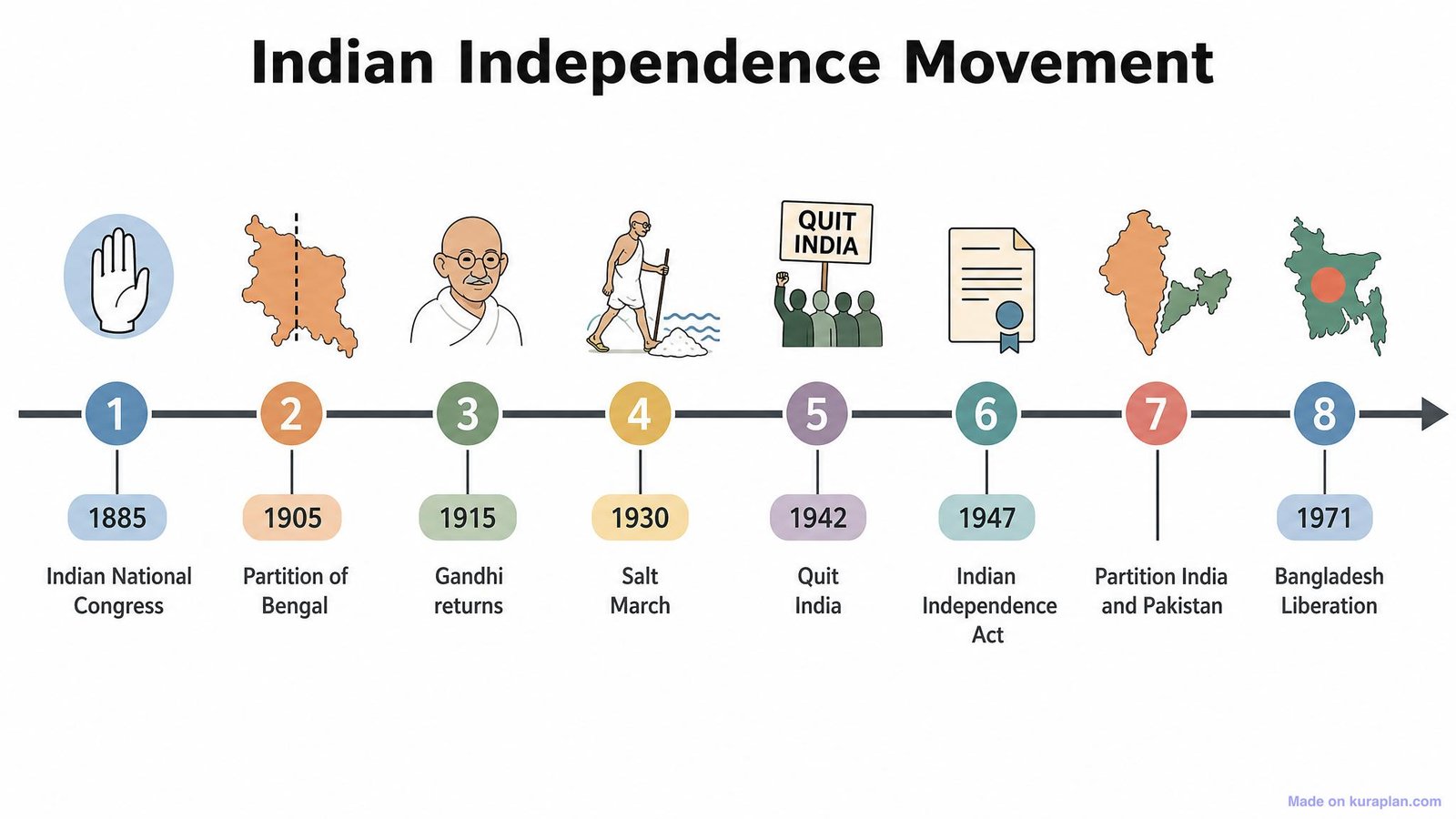
The Indian National Congress was established in 1885 and became a major platform for organised political activity in India.
Important topics include:
- Formation and early objectives of the Congress
- Role of A.O. Hume
- Important Congress sessions
- Moderate and Extremist phases
- Contributions of Dadabhai Naoroji, Gopal Krishna Gokhale, Bal Gangadhar Tilak and Lala Lajpat Rai
- Partition of Bengal in 1905
- Swadeshi and Boycott Movements
The differences between Moderates and Extremists and their methods of political struggle are important areas for revision.
Gandhian Movements in India
Mahatma Gandhi transformed the Indian National Movement into a mass-based struggle through non-violent resistance and Satyagraha.
His early movements in India included:
- Champaran Satyagraha (1917)
- Ahmedabad Mill Strike (1918)
- Kheda Satyagraha (1918)
These movements were followed by major national campaigns.
Non-Cooperation Movement (1920–1922): Launched against British rule in the context of the Rowlatt Act, the Jallianwala Bagh massacre and the Khilafat issue. It was withdrawn after the Chauri Chaura incident.
Civil Disobedience Movement (1930): Began with the Dandi March and Salt Satyagraha. It challenged British laws and encouraged mass participation.
Quit India Movement (1942): Launched during the Second World War, it demanded an immediate end to British rule in India.
Aspirants should understand the background, objectives, important events, leaders, methods and consequences of each movement.
Revolutionary Movement in India
The revolutionary movement represented another important stream of the freedom struggle.
Important personalities included Bhagat Singh, Chandrashekhar Azad, Ram Prasad Bismil, Ashfaqulla Khan and other revolutionaries.
Important organisations and developments include the Hindustan Socialist Republican Association (HSRA), the Kakori action, the Lahore Conspiracy Case and revolutionary activities in different parts of India.
Subhas Chandra Bose and Indian National Army
Subhas Chandra Bose played a significant role in the freedom struggle through his leadership and international efforts.
The Indian National Army (INA) and its activities during the Second World War are important topics for UPSC.
Study the formation and leadership of the INA, the role of the Azad Hind Government, the contributions of Indian soldiers and the impact of the INA trials.
Constitutional Development and India’s Independence
Constitutional developments under British rule gradually shaped India’s political institutions and the transfer of power.
Important Acts and developments include:
- Regulating Act, 1773
- Pitt’s India Act, 1784
- Charter Acts
- Government of India Act, 1858
- Indian Councils Acts
- Morley-Minto Reforms, 1909
- Government of India Act, 1919
- Government of India Act, 1935
- Indian Independence Act, 1947
Also study the Cabinet Mission Plan, Mountbatten Plan, Partition of India and the transfer of power in August 1947.
Socio-Religious Reform Movements in Modern India
The nineteenth and early twentieth centuries witnessed important social and religious reform movements. These movements challenged several social practices and encouraged education, social awareness and reform.
Important organisations and personalities include:
- Brahmo Samaj – Raja Ram Mohan Roy
- Arya Samaj – Swami Dayanand Saraswati
- Prarthana Samaj – Atmaram Pandurang
- Ramakrishna Mission – Swami Vivekananda
- Theosophical Society – Annie Besant and other leaders
- Aligarh Movement – Sir Syed Ahmad Khan
- Satyashodhak Samaj – Jyotirao Phule
Important areas include their objectives, major leaders, social contributions, educational initiatives and influence on Indian nationalism.
Peasant movements, tribal uprisings, labour movements and regional reform initiatives should also be studied to understand the wider social background of India’s freedom struggle.

Indian Art and Culture: Important Historical Connections
Indian art and culture are closely connected with the country’s historical development. Studying them alongside Ancient, Medieval and Modern Indian History helps aspirants understand the evolution of Indian society and cultural traditions.
Important areas include:
- Ancient Indian temple architecture
- Buddhist stupas and cave architecture
- Gandhara, Mathura and Amaravati schools of art
- Gupta art and sculpture
- Indo-Islamic architecture
- Mughal paintings and monuments
- Indian classical dances and music
- Ancient literature and important texts
- Religious traditions and philosophical schools
- Important historical monuments and cultural sites
Candidates should connect important art forms, monuments and literary works with their historical periods, rulers and regions.
Important Historical Personalities for UPSC Prelims 2027
Historical personalities are frequently relevant to understanding major political, social, religious and cultural developments.
Some important personalities to study include:
Ancient India: Chandragupta Maurya, Ashoka, Gautama Buddha, Mahavira, Kanishka, Samudragupta and Harshavardhana.
Medieval India: Alauddin Khalji, Muhammad bin Tughlaq, Akbar, Sher Shah Suri, Shivaji Maharaj, Kabir, Guru Nanak and Mirabai.
Modern India: Raja Ram Mohan Roy, Ishwar Chandra Vidyasagar, Swami Vivekananda, Jyotirao Phule, Dadabhai Naoroji, Bal Gangadhar Tilak, Mahatma Gandhi, Jawaharlal Nehru, Sardar Vallabhbhai Patel, Subhas Chandra Bose and Bhagat Singh.
While studying these personalities, focus on their historical contributions, organisations, important writings, policies and association with major events.
How to Prepare Indian History for UPSC Prelims 2027
A systematic preparation strategy is more effective than studying historical facts randomly. Candidates should divide the syllabus into manageable sections and revise them regularly.
1. Build a Strong Foundation
Start with basic textbooks and develop a clear understanding of historical periods, major events and important developments. Avoid memorising dates without understanding their historical context.
2. Prepare a Historical Timeline
Create separate timelines for Ancient, Medieval and Modern Indian History. For Modern India, pay particular attention to the sequence of British expansion, important Acts, national organisations and freedom movements.
3. Focus on Important Events and Personalities
Prepare short notes on major rulers, reformers, freedom fighters, political organisations and important historical developments.
4. Connect History with Art and Culture
Study monuments, architecture, literature, religious traditions and art forms along with their historical periods. This will help build a broader understanding of India’s cultural heritage.
5. Revise Important Facts Regularly
Maintain concise revision notes containing important dates, historical places, dynasties, inscriptions, organisations and major events.
6. Use Previous Year Question Papers
Analyse previous UPSC Prelims question papers to understand how historical themes and concepts have been tested. Focus on conceptual clarity and the relationship between different historical developments.
Best Books and Study Resources for Indian History UPSC Preparation
Choosing reliable study material is important for building a strong foundation.
The following resources can be useful:
- NCERT History Textbooks: Useful for understanding basic historical concepts and chronological developments.
- Ancient India by R.S. Sharma: A commonly used reference for Ancient Indian History.
- History of Medieval India by Satish Chandra: Useful for understanding major medieval political and social developments.
- A Brief History of Modern India by Spectrum: A popular reference for Modern Indian History and the freedom struggle.
- Indian Art and Culture by Nitin Singhania: Useful for studying important aspects of Indian art and culture.
- Previous Year UPSC Question Papers: Essential for understanding the nature and scope of questions.
Candidates should avoid collecting too many books. A limited number of reliable resources, regular revision and careful analysis of previous year questions can make preparation more effective.
For authentic historical information and textbooks, candidates can also refer to the official NCERT textbook portal.
Frequently Asked Questions About History of India UPSC 2027
1. What are the important topics in Indian History for UPSC Prelims 2027?
Important topics include the Indus Valley Civilization, Vedic period, Mahajanapadas, Buddhism and Jainism, Mauryan and Gupta Empires, Delhi Sultanate, Mughal Empire, British expansion, Revolt of 1857, socio-religious reform movements and the Indian National Movement.
2. How should I prepare Ancient Indian History for UPSC Prelims?
Begin with NCERT textbooks and study the Indus Valley Civilization, Vedic period, Mahajanapadas, Buddhism, Jainism, Mauryan Empire, Gupta Empire and important ancient cultural developments. Prepare concise notes and revise important archaeological sites, rulers and literary sources.
3. Which topics are important in Medieval Indian History for UPSC?
Focus on the Delhi Sultanate, Mughal Empire, Vijayanagara Empire, Bahmani Kingdom, Marathas, Bhakti Movement, Sufi Movement, medieval administration, architecture and important regional kingdoms.
4. What are the most important topics in Modern Indian History for UPSC?
Important topics include the arrival of Europeans, British expansion, Revolt of 1857, Governor Generals and Viceroys, British economic policies, land revenue systems, socio-religious reform movements and the Indian freedom struggle.
5. How important is the Indian National Movement for UPSC Prelims?
The Indian National Movement is explicitly mentioned in the UPSC Prelims General Studies Paper I syllabus. Aspirants should understand the major phases of nationalism, important Congress sessions, Gandhian movements, revolutionary activities, regional contributions and constitutional developments.
6. Which books are useful for preparing Indian History for UPSC?
NCERT History textbooks provide a useful foundation. R.S. Sharma is a commonly used reference for Ancient India, Satish Chandra for Medieval India and Spectrum’s A Brief History of Modern India for Modern Indian History. Nitin Singhania’s book can be used for Art and Culture.
7. How should beginners study Indian History for UPSC Prelims?
Beginners should start with basic NCERT textbooks, divide the syllabus into historical periods and prepare a timeline of major developments. After building conceptual clarity, they should revise important events and analyse previous year UPSC questions.
8. What are the major events of the Indian Freedom Struggle?
Major developments include the Revolt of 1857, formation of the Indian National Congress in 1885, Swadeshi Movement, Home Rule Movement, Non-Cooperation Movement, Civil Disobedience Movement, Quit India Movement and the final transfer of power in 1947.
9. Which historical dynasties and empires are important for UPSC Prelims?
Important dynasties and empires include the Mauryas, Guptas, Kushanas, Satavahanas, Cholas, Delhi Sultanate dynasties, Vijayanagara Empire, Bahmani Sultanate, Mughals and Marathas.
10. How can I remember important dates and events in Indian History for UPSC?
Prepare chronological timelines, group events by historical periods and connect important personalities with their contributions. Regular revision and comparison of related events can improve retention.
Conclusion: Strengthen Your History Preparation for UPSC Prelims 2027
Indian History is a broad subject that requires conceptual understanding, chronological awareness and regular revision. A structured study of Ancient Indian History, Medieval Indian History, Modern Indian History and the Indian National Movement can help aspirants develop a strong foundation.
Focus on understanding historical developments rather than memorising isolated facts. Study important rulers, dynasties, movements, personalities, administrative systems and cultural contributions in their proper historical context.
Use reliable textbooks, analyse previous year UPSC questions and revise important topics consistently. With a systematic approach, you can strengthen your preparation for History of India UPSC 2027 and improve your understanding of India’s rich historical heritage.
Consistent revision and conceptual understanding are essential for effective History of India UPSC 2027 preparation.
Keep learning with Knowledge Chronicles Plus for more UPSC Prelims 2027 study guides, subject-wise notes and important exam preparation resources.
Recommended Posts
100 Valuable September 2026 World Current Affairs MCQs for UPSC Prelims 2027
Powerful UPSC Prelims 2027 Strategy & Study Plan
Ultimate UPSC Prelims Mock Test Strategy (2027): Proven Plan to Maximize Your Score
Explore More UPSC Resources
Current Affairs For UPSC Prelims 2027
External Resources
3. Archaeological Survey of India (ASI)
4. Indian Culture Portal – Ministry of Culture
5. UPSC Official Website – Examination and Syllabus
Get Daily Current Affairs MCQs, GK Quizzes and study resources for UPSC, State PCS and SSC examinations.
✈️ Join our Telegram channel "Knowledge Chronicles Plus" for free
17 thoughts on “History of India UPSC 2027: Complete Study Guide, Key Facts & Important Topics”