Introduction
Uttar Pradesh History for UPPCS Prelims 2026 is an important part of Uttar Pradesh-focused preparation. The historical importance of the region extends from ancient cities and Buddhist sites to the Mughal and Awadh periods and the major events of India’s freedom struggle.
For Prelims preparation, candidates should not study Uttar Pradesh history only as a chronological narrative. They should connect places, dynasties, rulers, inscriptions, archaeological sites, religious traditions, movements, personalities and important dates.
The 2026 UPPCS Preliminary syllabus covers the history of India and the Indian National Movement and states that general awareness of the prescribed subjects is expected with special reference to Uttar Pradesh. This makes UP-linked historical facts an important area for focused revision.
This guide therefore concentrates on the most useful areas for UPPCS Prelims rather than attempting to reproduce an entire history textbook.
Apart from studying Uttar Pradesh-specific history, candidates should understand UPPCS 2026 Prelims Exam Pattern : Latest Syllabus & Marking Scheme Easy Guide to organize their preparation according to the official examination framework.
Uttar Pradesh History for UPPCS Prelims 2026: Ancient Period
Uttar Pradesh in the Vedic Age
The Ganga-Yamuna region became increasingly important during the later Vedic period. The expansion of settlements towards the middle and upper Ganga plain is important for understanding the emergence of larger territorial states.
For examination purposes, remember the connection of the region with:
- Kuru
- Panchala
- Kosala
- Kashi
- Vatsa
Archaeological evidence from western Uttar Pradesh is also important. Hastinapur, in present-day Meerut district, is a major archaeological site associated with the Painted Grey Ware (PGW) culture. Excavations at Hastinapur are particularly important in the study of the early Iron Age and the archaeological sequence of the upper Ganga-Yamuna region.
Prelims Fact
Hastinapur → Meerut → Kuru region → Painted Grey Ware
Do not confuse PGW with Northern Black Polished Ware (NBPW). The two represent different archaeological cultural phases.
Important Mahajanapadas Associated with Uttar Pradesh
The sixth century BCE was a major turning point in North Indian history.
Several important mahajanapadas were located wholly or partly in areas corresponding to present-day Uttar Pradesh.
| Mahajanapada | Important Centre/Association |
|---|---|
| Kashi | Varanasi |
| Kosala | Ayodhya/Shravasti |
| Vatsa | Kaushambi |
| Malla | Kushinagar region |
| Surasena | Mathura |
| Panchala | Western/Central Uttar Pradesh |
Kaushambi
Ancient Kaushambi was the capital of the Vatsa mahajanapada and developed as an important political and commercial centre. The present Kaushambi district’s official history also connects the ancient city with the Vatsa janapada.
Shravasti
Shravasti was an important ancient city associated with Kosala and became one of the major centres connected with the Buddha’s life and Buddhist tradition. The Uttar Pradesh government identifies Shravasti as the capital of the Kosala Kingdom during a long historical period beginning in the sixth century BCE.
Mathura
In the sixth century BCE, Mathura was the capital of the Surasena Kingdom. Later, it became an important centre under the Kushans and played a major role in the development of Mathura art.
Ayodhya
Ayodhya is an ancient city associated with the Kosala Kingdom and occupies an important place in India’s religious and cultural history. The district’s official website identifies Ayodhya as an ancient city and an important centre of the ancient Kosala tradition.
Buddhism and Jainism in Uttar Pradesh
Uttar Pradesh History for UPPCS Prelims 2026 gives special importance to Buddhism and Jainism because several major Buddhist sites are located in the state.
Sarnath
Sarnath, near Varanasi, is associated with the Buddha’s first sermon after enlightenment. The event is traditionally known as the Dhammacakkappavattana, or the turning of the Wheel of Dhamma.
Important Sarnath monuments and archaeological remains include:
- Dhamek Stupa
- Chaukhandi Stupa
- Dharmarajika Stupa
- Ashokan Pillar
- Archaeological remains of monasteries and viharas
Very Important 2026 Current Affairs Fact
The Ancient Buddhist Site of Sarnath was inscribed on the UNESCO World Heritage List in 2026. The inscribed serial property contains two components: Chaukhandi Stupa and the Archaeological Remains of Sarnath. UNESCO records the inscription under criteria (iii) and (vi).
This is particularly important for UPPCS Prelims 2026, because it connects static history, Buddhism, archaeology and a major current-affairs development.
Kushinagar
Kushinagar is associated with the Buddha’s Mahaparinirvana.
The present-day district’s official history identifies ancient Kushinara as the capital of the Mallas, one of the sixteen mahajanapadas. The site later formed part of the Mauryan, Shunga, Kushana, Gupta and Harsha spheres before its medieval decline.
Important monuments include:
- Mahaparinirvana Temple
- Mahaparinirvana Stupa
- Ramabhar Stupa
- Archaeological remains of monasteries
Prelims Connection
Sarnath → First Sermon
Kushinagar → Mahaparinirvana
This pair should be memorized together.
Shravasti
Shravasti is strongly associated with the Buddha and Buddhist monastic tradition. It was one of the major centres of Buddhism in ancient North India.
Kaushambi
Kaushambi was the capital of Vatsa and an important urban centre in ancient North India. Its archaeological importance makes it useful for questions connecting mahajanapadas + Buddhism + archaeology.
Candidates can further strengthen this topic by practicing our UPPCS Prelims PYQs, especially questions related to ancient cities, Buddhism, archaeology and Uttar Pradesh-specific history.
Mathura and the Kushan Period
For Uttar Pradesh History for UPPCS Prelims 2026, Mathura is particularly important because it connects ancient kingdoms, the Kushan period and the development of Indian art.
Its importance is particularly linked with:
- Sculpture
- Buddhist art
- Jain art
- Brahmanical images
- Red sandstone sculpture traditions
The Mathura school of art is an important topic for both Indian history and art-and-culture preparation. The Mathura district’s official historical account also notes the city’s importance under the Kushans.
Mauryan Influence in Uttar Pradesh
The Mauryan period is important because several sites in present-day Uttar Pradesh preserve evidence of the empire’s Buddhist and administrative legacy.
Important associations
Ashoka → Sarnath
Sarnath contains remains associated with the Ashokan period, including the famous Ashokan Pillar. The site has archaeological evidence spanning several periods from pre-Mauryan times through the Kushana and Gupta periods.
Ashoka → Kaushambi
Kaushambi is another major Uttar Pradesh site connected with the wider Mauryan archaeological landscape.
Ashoka → Sankisa
Sankisa, in present-day Farrukhabad district, is identified with Sankassa in Buddhist literature and is associated with the Buddhist tradition concerning the Buddha’s descent from the heavenly realm. This association is also noted in a Ministry of Culture/ASI account of Sarnath excavations.
Gupta Period and Uttar Pradesh
The Gupta period is especially important for:
- Art
- Sculpture
- Sanskrit culture
- Political history
- Inscriptions
Prayaga Prashasti
The Prayaga Prashasti, also known as the Allahabad Pillar Inscription, is a major source for the reign and achievements of Samudragupta.
For Prelims, remember:
Samudragupta → Prayaga Prashasti → Harishena
The inscription is one of the most important primary sources for reconstructing Samudragupta’s reign.
Gupta Art at Sarnath
Sarnath became a major centre of Buddhist art during the Gupta period. Archaeological excavations at the site have yielded important Gupta-period sculptures associated with the Sarnath school of art.
Harshavardhana and Kannauj
Kannauj is one of the most important cities for ancient and early medieval Uttar Pradesh history.
Harshavardhana’s association with Kannauj is central to North Indian history.
The official Kannauj district history records:
- The antiquity of Kanyakubja/Kannauj
- Harsha’s association with Kannauj
- Xuanzang’s visit in the seventh century
- The importance of Kannauj as a major political centre
Important Sequence
Maukharis → Harshavardhana → Kannauj’s political prominence
Later, Kannauj also became central to the political competition among major early-medieval powers.
Gurjara-Pratiharas and Kannauj
Kannauj continued to be a major political centre after Harsha.
The city became closely associated with the Gurjara-Pratihara Empire, particularly during the reign of Mihira Bhoja.
For UPPCS, remember:
Kannauj → Harsha → Gurjara-Pratiharas → Gahadavalas
This broad sequence is more useful for revision than memorizing isolated rulers without context.
Gahadavalas and Kannauj–Varanasi Region
The Gahadavala dynasty became prominent in the Kannauj-Varanasi region during the eleventh and twelfth centuries.
Govindachandra and Jayachandra are important names.
Kannauj’s historical importance continued into the period of interaction and conflict between regional kingdoms and the expanding powers of North India. The official Kannauj history records the Gahadavalas’ role in the region.
Uttar Pradesh History for UPPCS Prelims 2026: Medieval Period
Delhi Sultanate and Uttar Pradesh
Large parts of present-day Uttar Pradesh became important territories of the Delhi Sultanate.
Important centres included:
- Delhi’s eastern territories
- Awadh
- Kannauj
- Meerut
- Badaun
- Etawah
- Jaunpur
Sharqi Sultanate of Jaunpur
The Sharqi Sultanate is one of the most important UP-specific medieval topics.
Jaunpur emerged as an important independent centre under the Sharqis.
Key Facts
Founder associated with: Malik-ul-Sharq / Malik Sarwar
Major ruler: Ibrahim Shah Sharqi
Capital: Jaunpur
Major contribution: Architecture, music, literature and education
The Atala Masjid is one of the best-known monuments of Sharqi architecture. Its construction began in 1393 and it was completed under Ibrahim Shah Sharqi in 1408.
Prelims Pair
Jaunpur → Sharqi Sultanate → Atala Masjid
Mughal Period in Uttar Pradesh
Uttar Pradesh became one of the most important regions of the Mughal Empire.
Agra and Sikandar Lodi
The district’s official historical account states that Sikandar Lodi founded Agra in 1504, after which the city became increasingly important politically.
Agra under the Mughals
Agra became an imperial centre under the Mughals.
Important rulers associated with the city’s development include:
- Akbar
- Jahangir
- Shah Jahan
Agra Fort was rebuilt in red sandstone by Akbar beginning in 1565, and later received significant additions and embellishments under Shah Jahan.
Fatehpur Sikri
Fatehpur Sikri was developed by Akbar in the sixteenth century.
Important monuments include:
- Buland Darwaza
- Panch Mahal
- Jama Masjid
- Tomb of Salim Chishti
The Ministry of Culture records Fatehpur Sikri as a UNESCO World Heritage Site inscribed in 1986. It served as the Mughal capital for about a decade.
Prelims Pair
Akbar → Fatehpur Sikri
Akbar and Prayag/Allahabad
Prayag was an important strategic and religious centre under the Mughals.
The Uttar Pradesh government notes that Akbar developed the city and used the name Allahabad/Illahabas in the Mughal period.
The site is especially significant because of the Akbar-era fort and the ancient Ashokan pillar.
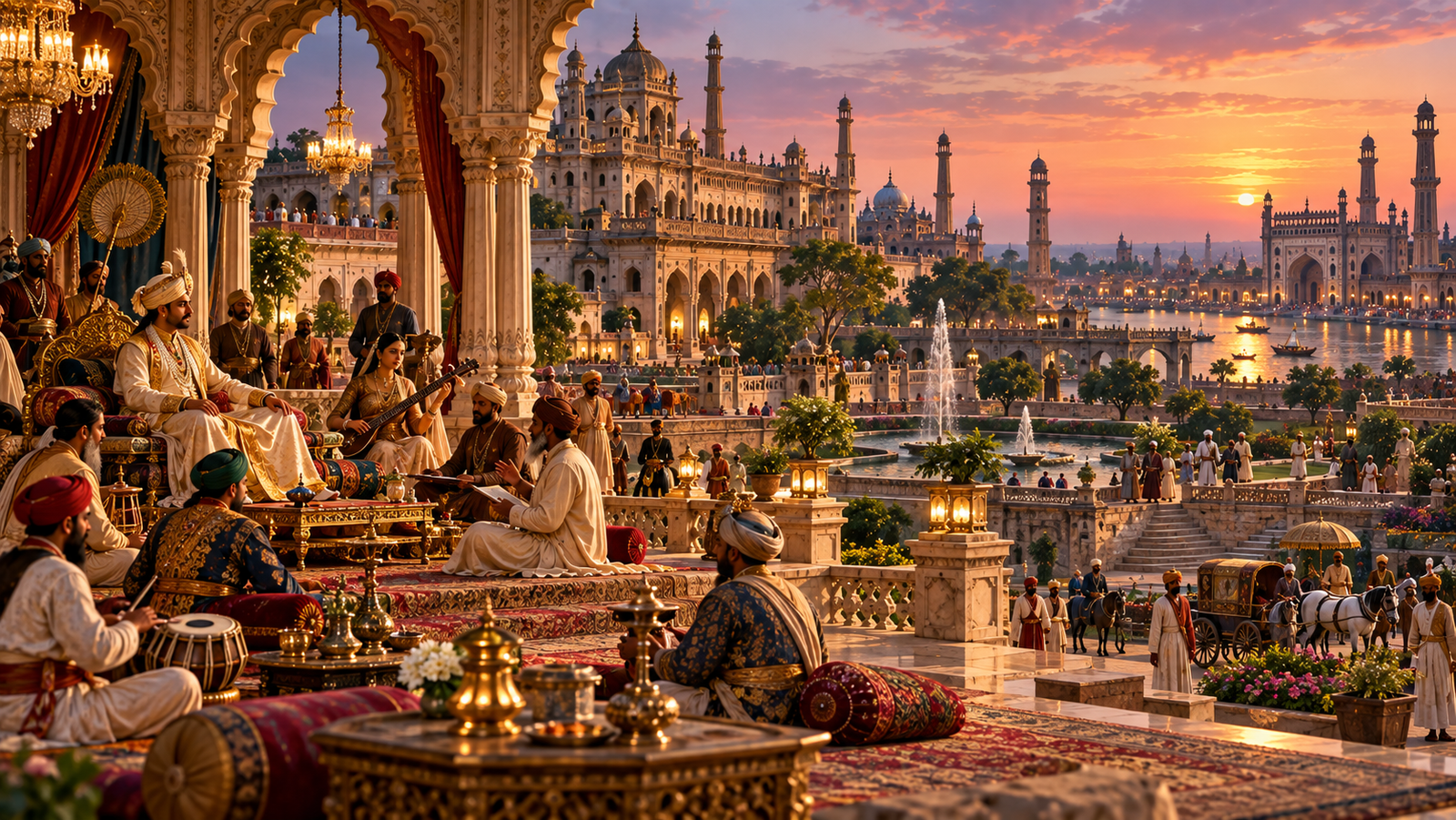
Awadh and the Nawabs
The history of Awadh is essential for UPPCS because it connects:
Mughal decline + regional states + British expansion + 1857
Beginning of Nawabi Rule
The appointment of Saadat Khan Burhan-ul-Mulk in 1722 is generally treated as the beginning of the autonomous Nawabi phase of Awadh.
The capital was initially at Faizabad.
Capital Shift to Lucknow
Asaf-ud-Daulah shifted the capital from Faizabad to Lucknow in 1775.
Lucknow subsequently emerged as an important centre of architecture, music, dance, literature and court culture.
Wajid Ali Shah and Annexation of Awadh
Wajid Ali Shah was the last Nawab-King of Awadh.
The Awadh kingdom was annexed by the East India Company in 1856. Wajid Ali Shah was removed from power and exiled to Calcutta.
Why is this important for Prelims?
Because the annexation of Awadh became one of the major political and socio-economic contexts of the 1857 uprising in North India.
Uttar Pradesh History for UPPCS Prelims 2026: Revolt of 1857
This is one of the highest-priority areas.
UP was one of the major centres of the uprising.
Meerut
The uprising at Meerut began on 10 May 1857.
The rebels then moved towards Delhi, where Bahadur Shah II was accepted as the symbolic emperor. Ministry of Culture’s historical repository records Meerut as a major starting point of the uprising and documents the revolt of Indian soldiers there.
Major UP Centres of the 1857 Uprising
| Place | Important Association |
|---|---|
| Meerut | Outbreak of the uprising on 10 May 1857 |
| Kanpur | Nana Sahib |
| Lucknow | Begum Hazrat Mahal |
| Faizabad | Maulavi Ahmadullah Shah |
| Bareilly | Khan Bahadur Khan |
| Prayagraj/Allahabad | Maulvi Liaqat Ali |
| Ballia and eastern UP | Wider later resistance traditions |
The Uttar Pradesh government history material documents the spread of the revolt across several regions, including Awadh, Doab and Bundelkhand.
Kanpur and Nana Sahib
Nana Sahib emerged as the principal rebel leader at Kanpur.
The 1857 Kanpur episode is an important UPPCS topic because it combines:
- Nana Sahib
- Bithoor
- British resistance
- Tatya Tope
- The wider Awadh-Kanpur theatre
Ministry of Culture records identify Kanpur as one of the major centres of the uprising.
Lucknow and Begum Hazrat Mahal
Begum Hazrat Mahal played a major role in the resistance in Lucknow and Awadh in 1857.
She led the resistance on behalf of her minor son Birjis Qadr.
After the British recaptured Lucknow in 1858, she moved towards Nepal rather than surrendering.
Prelims Pair
Lucknow → Begum Hazrat Mahal → Birjis Qadr
Maulavi Ahmadullah Shah
Maulavi Ahmadullah Shah was an important rebel leader in Awadh.
He centred his activities around Faizabad and participated in the wider armed resistance against British authority in the region. Ministry of Culture’s Digital District Repository documents his role in the Faizabad and Awadh theatre of the 1857 uprising.
Battle of Chinhat
The Battle of Chinhat was fought on 30 June 1857 near Lucknow.
The rebel forces defeated the British force led by Sir Henry Lawrence, after which Lawrence retreated towards the Lucknow Residency.
Prelims Fact
Chinhat → Lucknow → 30 June 1857 → Rebel victory
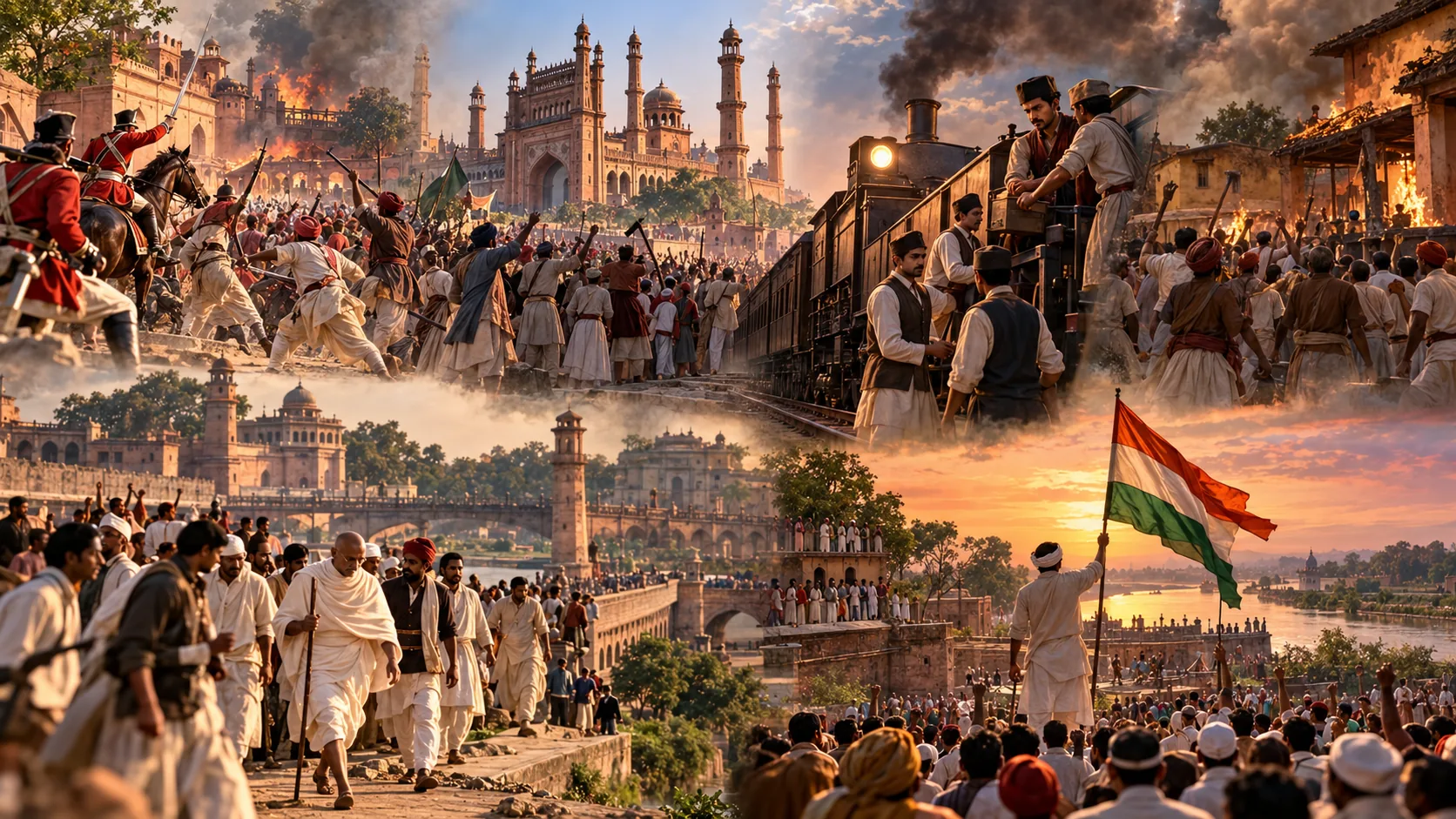
Uttar Pradesh and the Freedom Movement After 1857
The history of UP does not end with 1857. The region remained deeply connected with the Indian national movement.
In Uttar Pradesh History for UPPCS Prelims 2026, the Revolt of 1857 should be revised through important UP centres such as Meerut, Kanpur, Lucknow, Faizabad, Bareilly and Prayagraj.
Important areas include:
- Lucknow Pact
- Non-Cooperation Movement
- Awadh peasant movements
- Eka Movement
- Chauri Chaura
- Kakori
- Civil Disobedience
- Quit India Movement
- Revolutionary activities
- Congress politics
Lucknow Pact of 1916
The Lucknow Pact of 1916 is a major event of modern Indian history.
The Indian National Congress and the All-India Muslim League came together at Lucknow in 1916 and reached an agreement on constitutional demands. The Ministry of Culture’s Digital District Repository records the event and its political significance.
Prelims Pair
Lucknow → 1916 → Congress + Muslim League → Lucknow Pact
Baba Ram Chandra and the Awadh Peasant Movement
Peasant unrest in Awadh is an important UP-specific topic.
Baba Ram Chandra emerged as an important peasant leader in the Pratapgarh region in the early 1920s.
The movement focused on issues such as:
- High rents
- Cesses
- Exploitation of tenants
- Zamindari oppression
The Ministry of Culture’s Digital District Repository records Baba Ram Chandra’s role in organizing peasants in the Pratapgarh region.
Eka Movement
The Eka Movement was a peasant movement in Uttar Pradesh during 1921–1922.
Important name:
Madari Pasi
The movement spread across areas of Awadh and adjoining districts. Major demands included payment of only recorded rent, opposition to forced labour and resistance to exploitative practices.
Prelims Pair
Eka Movement → Madari Pasi → Peasant resistance → 1921–22
Chauri Chaura Incident
The Chauri Chaura incident took place in Gorakhpur district on 4 February 1922.
A clash between protesters and police led to the burning of the police station and deaths of policemen. The incident became a decisive factor in Gandhi’s withdrawal of the Non-Cooperation Movement.
Must Remember
Chauri Chaura → Gorakhpur → 4 February 1922 → Withdrawal of Non-Cooperation Movement
This is one of the most important UP-specific modern-history facts for Prelims.
Kakori Train Action, 1925
The Kakori Train Action took place on 9 August 1925 near Lucknow.
It was associated with revolutionaries of the Hindustan Republican Association (HRA).
Important names include:
- Ram Prasad Bismil
- Ashfaqulla Khan
- Rajendra Lahiri
- Roshan Singh
The action targeted government treasury funds being transported by train. Government sources document the role of Ram Prasad Bismil and the subsequent arrests and trials.
Prelims Pair
Kakori → 9 August 1925 → HRA → Ram Prasad Bismil and associates
Ram Prasad Bismil
Ram Prasad Bismil was born in Shahjahanpur and became one of the important revolutionary figures associated with the HRA.
He was also involved in the Mainpuri Conspiracy before the Kakori episode.
Important Association
Shahjahanpur → Ram Prasad Bismil
Uttar Pradesh and the Quit India Movement
UP also played an important role in the Quit India Movement of 1942.
Ballia and Chittu Pandey
Chittu Pandey, a leader from Ballia, headed a short-lived parallel government established during the Quit India Movement.
The National Archives/Ministry of Culture repository records that a National Government was declared in Ballia on 19 August 1942, headed by Chittu Pandey, before British military forces re-established control.
Prelims Pair
Ballia → Chittu Pandey → Quit India Movement → Parallel Government → 1942
For a systematic understanding of British expansion, the Revolt of 1857 and the national movement, aspirants should also revise our detailed Prelims History Preparation resources.
Important Personalities from Uttar Pradesh History
For Prelims, revise personalities together with their location or contribution.
| Personality | Important Association |
|---|---|
| Harshavardhana | Kannauj |
| Samudragupta | Prayaga Prashasti |
| Akbar | Agra, Fatehpur Sikri |
| Asaf-ud-Daulah | Lucknow; capital shifted in 1775 |
| Wajid Ali Shah | Last Nawab-King of Awadh |
| Begum Hazrat Mahal | 1857, Lucknow/Awadh |
| Nana Sahib | 1857, Kanpur |
| Maulavi Ahmadullah Shah | 1857, Faizabad/Awadh |
| Khan Bahadur Khan | 1857, Bareilly |
| Maulvi Liaquat Ali | 1857, Prayagraj/Allahabad |
| Baba Ram Chandra | Awadh peasant movement |
| Madari Pasi | Eka Movement |
| Ram Prasad Bismil | Kakori, Mainpuri Conspiracy |
| Chittu Pandey | Quit India Movement, Ballia |
The UP and Government of India historical repositories provide documentation for many of these UP-linked freedom fighters and movements.
Important Historical Cities of Uttar Pradesh
This is an excellent quick-revision section.
These cities form an important revision map for Uttar Pradesh History for UPPCS Prelims 2026, especially for questions based on places, personalities and historical events.
| City | What to Remember |
|---|---|
| Varanasi | Kashi; Sarnath; Buddha’s first sermon |
| Sarnath | First sermon; Buddhist archaeology; UNESCO World Heritage Site in 2026 |
| Kushinagar | Buddha’s Mahaparinirvana; Mallas |
| Shravasti | Kosala; Buddhist centre |
| Kaushambi | Capital of Vatsa |
| Mathura | Surasena; Kushan art |
| Ayodhya | Ancient Kosala |
| Kannauj | Harsha; early-medieval political centre |
| Jaunpur | Sharqi Sultanate |
| Agra | Lodi and Mughal political centre |
| Fatehpur Sikri | Akbar |
| Lucknow | Awadh; Nawabs; 1857 |
| Meerut | Opening of 1857 uprising |
| Kanpur | Nana Sahib; 1857 |
| Faizabad | Awadh; Maulavi Ahmadullah Shah |
| Prayagraj | Prayaga Prashasti; Mughal/colonial history; freedom movement |
| Ballia | Quit India; Chittu Pandey |
| Kakori | Revolutionary action, 1925 |
Uttar Pradesh and the Evolution of Its Administrative Identity
Understanding the changing administrative names of the region is useful for Prelims.
A simplified timeline is:
1834 → North-Western Provinces
1856 → Annexation of Awadh
1877 → North-Western Provinces and Oudh
1902 → United Provinces of Agra and Oudh
April 1937 → United Provinces
24 January 1950 → Uttar Pradesh
The UP Legislative Council’s official history records the changing administrative structure and explains that the state was renamed United Provinces in April 1937 and Uttar Pradesh in January 1950. The UP Government also observes 24 January as Uttar Pradesh Divas because the United Provinces was renamed Uttar Pradesh on that date in 1950.
Important Correction for Students
Do not write “Uttar Pradesh was created in 1937.”
The region underwent several administrative reorganizations before acquiring its present name in 1950.
Lucknow as the Capital
The movement of administrative importance from Allahabad/Prayagraj toward Lucknow is also worth remembering.
The Uttar Pradesh Legislative Council records that the provincial headquarters shifted progressively towards Lucknow and that by 1935 the capital had been shifted to Lucknow. In April 1937, the state was renamed United Provinces.
High-Yield Archaeological and Heritage Facts
Sarnath
Buddha → First Sermon → Dhammacakkappavattana
Kushinagar
Buddha → Mahaparinirvana
Kaushambi
Vatsa → Ancient urban centre
Hastinapur
Kuru region → Painted Grey Ware
Mathura
Surasena → Kushan period → Mathura School of Art
Kannauj
Harsha → Major early-medieval centre
Jaunpur
Sharqi Sultanate → Atala Masjid
Fatehpur Sikri
Akbar → Mughal capital → UNESCO 1986
Sarnath in 2026
Ancient Buddhist Site of Sarnath → UNESCO World Heritage List
The last point is a particularly important current-affairs + static-history integration for UPPCS Prelims 2026.
Most Important Dates for UPPCS Prelims
| Year/Date | Event |
|---|---|
| 6th century BCE | Major mahajanapada phase |
| 6th century BCE | Buddha’s first sermon at Sarnath |
| c. 6th century BCE | Kushinara associated with Mallas |
| 1500s | Major Mughal transformation of Agra region |
| 1722 | Beginning of autonomous Nawabi phase of Awadh |
| 1775 | Capital of Awadh shifted to Lucknow |
| 1856 | Annexation of Awadh |
| 10 May 1857 | Uprising at Meerut |
| 30 June 1857 | Battle of Chinhat |
| 1916 | Lucknow Pact |
| 1921–22 | Eka Movement |
| 4 February 1922 | Chauri Chaura |
| 9 August 1925 | Kakori Train Action |
| 19 August 1942 | Parallel government at Ballia |
| April 1937 | United Provinces |
| 24 January 1950 | Uttar Pradesh |
| July 2026 | Sarnath inscribed on UNESCO World Heritage List |
The historical dates above are supported by government and UNESCO records cited in the relevant sections.
Uttar Pradesh History for UPPCS Prelims 2026: 25 Quick Revision Facts
- Kaushambi was the capital of the Vatsa mahajanapada.
- Mathura was the capital of Surasena in the sixth century BCE.
- Shravasti was an important capital of Kosala.
- Kushinagar/Kushinara was associated with the Mallas.
- Sarnath is associated with Buddha’s first sermon.
- Kushinagar is associated with Buddha’s Mahaparinirvana.
- Hastinapur is an important Painted Grey Ware site.
- Prayaga Prashasti is associated with Samudragupta.
- Harshavardhana is strongly associated with Kannauj.
- Jaunpur became the centre of the Sharqi Sultanate.
- Atala Masjid is associated with Ibrahim Shah Sharqi.
- Sikandar Lodi founded Agra in 1504, according to the official Agra district history.
- Fatehpur Sikri is associated with Akbar.
- Saadat Khan is associated with the beginning of the autonomous Nawabi phase of Awadh in 1722.
- Asaf-ud-Daulah shifted the Awadh capital to Lucknow in 1775.
- Wajid Ali Shah was the last Nawab-King of Awadh.
- Awadh was annexed by the British in 1856.
- The uprising at Meerut began on 10 May 1857.
- Begum Hazrat Mahal played a leading role in the 1857 resistance in Lucknow/Awadh.
- Nana Sahib was a major rebel leader at Kanpur.
- Chauri Chaura occurred in Gorakhpur district in 1922.
- Madari Pasi is associated with the Eka Movement.
- Kakori Train Action took place on 9 August 1925.
- Chittu Pandey is associated with the 1942 Ballia parallel government.
- Ancient Buddhist Site of Sarnath became a UNESCO World Heritage Site in 2026.
How to Prepare Uttar Pradesh History for UPPCS Prelims 2026
A focused strategy for Uttar Pradesh History for UPPCS Prelims 2026 should combine timelines, maps, important personalities, archaeological sites and previous-year questions.
Do not read this subject only once.
Use a four-stage method:
Stage 1: Build the Timeline
First remember:
Ancient → Buddhist period → Maurya → Gupta → Harsha → Medieval kingdoms → Mughals → Awadh → 1857 → National Movement → 1947/1950
Stage 2: Map the Places
Make a single Uttar Pradesh map and mark:
Sarnath, Kushinagar, Shravasti, Kaushambi, Mathura, Ayodhya, Kannauj, Jaunpur, Agra, Lucknow, Meerut, Kanpur, Faizabad, Prayagraj, Ballia and Kakori.
Stage 3: Create “Place + Person + Event” Notes
For example:
Lucknow → Begum Hazrat Mahal → 1857
Kanpur → Nana Sahib → 1857
Pratapgarh → Baba Ram Chandra → Peasant Movement
Kakori → Ram Prasad Bismil → 1925
Ballia → Chittu Pandey → 1942
Stage 4: Solve PYQs
After studying the topic, solve UPPCS Prelims PYQs and classify each historical question by:
- Ancient
- Medieval
- Modern
- Art and culture
- UP-specific personality
- Important place
- Freedom movement
UPPSC’s official previous-question-paper repository currently lists the PCS Preliminary Examination 2025 General Studies-I and General Studies-II papers, making the official repository the appropriate starting point for PYQ practice.
Common Mistakes in UPPCS History Preparation
Mistake 1: Studying only national history
UPPCS requires you to connect national history with Uttar Pradesh-specific places and events.
Mistake 2: Memorizing isolated facts
Always connect:
Place → Ruler/Person → Event → Date → Significance
Mistake 3: Ignoring archaeology
Sarnath, Kaushambi, Hastinapur, Kushinagar and Mathura are not just tourist sites. They are important historical and archaeological centres.
Mistake 4: Ignoring peasant movements
The Awadh peasant movement and Eka Movement are valuable UP-specific areas.
Mistake 5: Ignoring 1857
The Uttar Pradesh region was a major theatre of the 1857 uprising, so the movement should be studied city-wise as well as chronologically.
Mistake 6: Ignoring current affairs connected with history
The 2026 UNESCO inscription of Sarnath is an excellent example of how a static historical site can become a current-affairs question.
UPPCS Prelims History: Final Revision Framework
For the final revision, remember these clusters:
Ancient UP
Kuru – Panchala – Kosala – Kashi – Vatsa – Surasena – Malla
Buddhism
Sarnath – Shravasti – Kushinagar – Kaushambi – Sankisa
Art & Archaeology
Hastinapur – PGW – Mathura School – Sarnath School
Early Medieval
Kannauj – Harsha – Gurjara-Pratiharas – Gahadavalas
Medieval UP
Jaunpur – Sharqis – Agra – Mughals – Fatehpur Sikri
Awadh
Saadat Khan – Faizabad – Asaf-ud-Daulah – Lucknow – Wajid Ali Shah – 1856
1857
Meerut – Kanpur – Lucknow – Faizabad – Bareilly – Prayagraj – Chinhat
National Movement
Lucknow Pact – Baba Ram Chandra – Eka – Chauri Chaura – Kakori – Ballia
State Formation
North-Western Provinces → North-Western Provinces and Oudh → United Provinces of Agra and Oudh → United Provinces → Uttar Pradesh
Conclusion
Uttar Pradesh History for UPPCS Prelims 2026 should be studied as a combination of chronology, geography, personalities, archaeological sites, dynasties and freedom movements.
The most effective revision approach is to connect every fact with a place and a historical event:
Sarnath → Buddha’s first sermon
Kushinagar → Mahaparinirvana
Kaushambi → Vatsa
Kannauj → Harsha
Jaunpur → Sharqis
Lucknow → Awadh + 1857
Chauri Chaura → Non-Cooperation
Kakori → Revolutionary movement
Ballia → Quit India
For the 2026 cycle, Sarnath deserves special attention because the Ancient Buddhist Site of Sarnath was inscribed on the UNESCO World Heritage List in 2026, providing a direct bridge between ancient history, Buddhism, archaeology and current affairs.
Aspirants should combine this static preparation with UPPSC Previous Year Question Papers, current affairs and regular mock-test practice. The official UPPSC repository provides the authentic previous papers needed for this analysis.
Recommended Reading
UPPCS Prelims Exam Date 2026 Officially Announced: Great News for Aspirants
Top 100 Art & Culture MCQs UPPCS Prelims 2026 | Complete Practice Set
Official Sources for Further Study
UNESCO – Ancient Buddhist Site of Sarnath: Official UNESCO record of the 2026 World Heritage inscription.
NRI Department Uttar Pradesh: Official state history material covering the major historical phases of Uttar Pradesh.
3 thoughts on “Uttar Pradesh History for UPPCS Prelims 2026: Important Topics & Facts”