
Mastering the foundational architecture of the UPSC Prelims GS-Detailed Syllabus for 2027 is the single most critical factor that separates successful civil services aspirants from the rest. As the Union Public Service Commission shifts away from predictable textbook definitions toward highly twisted, application-based multi-statement traps, relying on a superficial reading of standard subjects will inevitably result in failure.
Every serious aspirant should thoroughly understand the UPSC CSE Prelims 2027 GS Syllabus: Ultimate Success Blueprint before starting preparation.
Aspirants preparing for multiple competitive examinations should also review the Latest BPSC Exam Pattern 2026 to understand how Bihar’s premier state civil services examination is structured and evaluated.
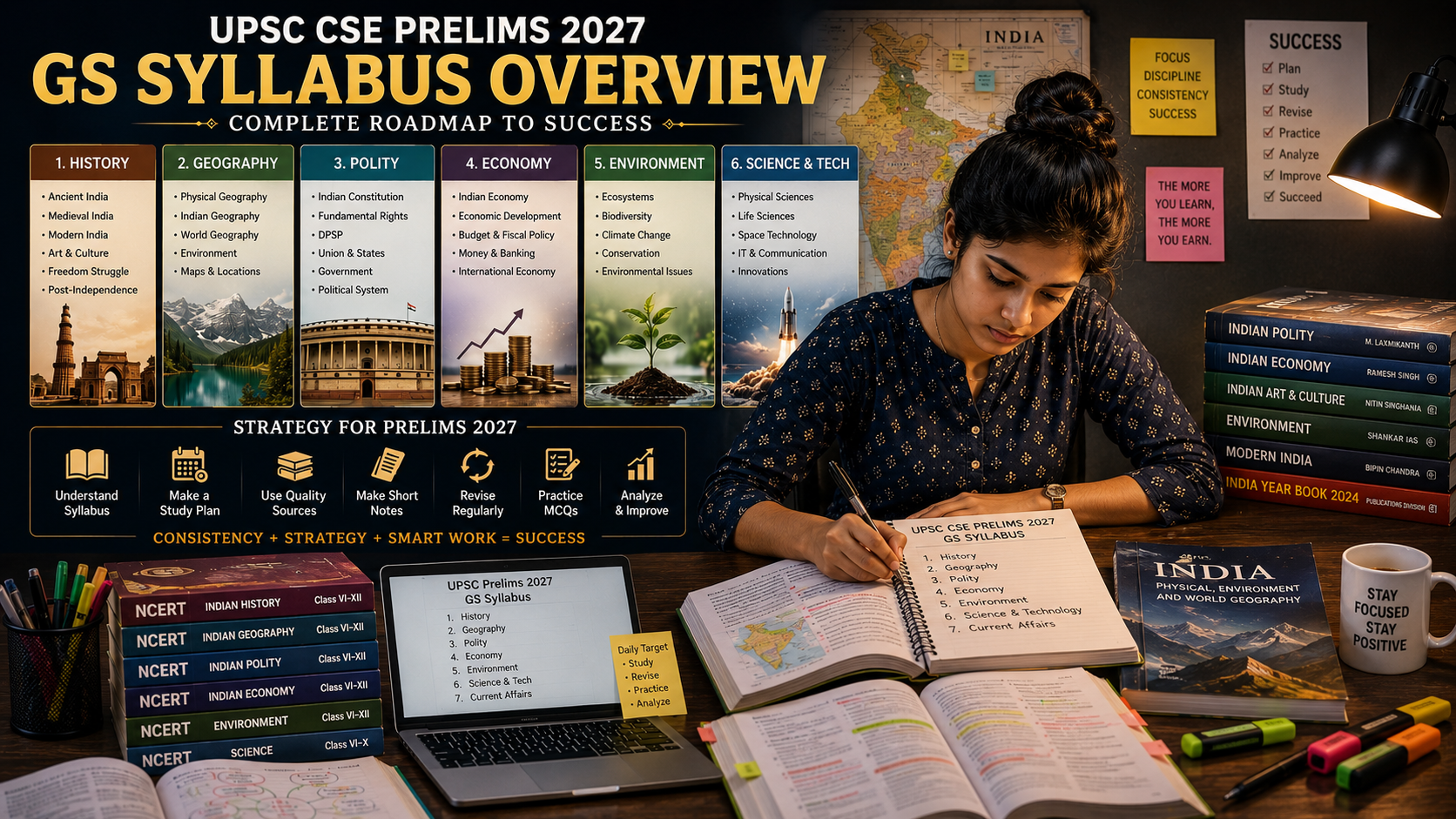
UPSC CSE Prelims 2027 GS Syllabus Overview
Before diving into the granular micro-topics, it is critical to keep the administrative parameters of General Studies Paper I in focus. This is a qualifying filter that directly determines your entry into the Civil Services Mains examination phase.
Total Marks: 200 Marks
Number of Questions: 100 Multiple-Choice Questions (MCQs)
Duration: 2 Hours
Negative Marking: One-third (33 %) of the marks assigned to that specific question will be deducted as a penalty for every incorrect response.
Merit Basis: The marks scored in GS Paper I are used exclusively to determine the preliminary cutoff line, provided the candidate scores a minimum of33% in the CSAT (Paper II) qualifier.
Topic Wise UPSC CSE Prelims 2027 GS Syllabus
The official syllabus published by the commission is notoriously brief. To help you build absolute operational clarity, we have broken down the 7 core pillars of the UPSC Prelims GS-Detailed Syllabus for 2027 into their high-yield, micro-topic equivalents.
1. Current Events of National and International Importance
This dynamic segment of UPSC Prelims 2027 Syllabus acts as an overarching umbrella that influences every other static subject. To score cleanly here, focus on:
Bilateral & Multilateral Pacts: High-level groupings (BRICS, G20, SCO, Quad) and strategic logistics sharing agreements.
Geopolitical Hotspots: Maritime chokepoints, international shipping corridors, border friction zones, and strategic resource pipelines.
Government Platforms & Frameworks: Newly operationalized union portals, citizen delivery tracking networks, and digital infrastructure stacks.
Global Armament & Security Indices: Strategic tracking metrics and comprehensive defense expenditure evaluations.
To strengthen your Current Affairs preparation, read our August 2026 Sports Current Affairs MCQs for UPSC, PCS, SSC & Other Competitive Exams

2. History of India and Indian National Movement in UPSC CSE Prelims 2027 GS Syllabus
Looking for practice questions? Attempt our 100 Ancient History MCQs for UPSC Prelims 2027: Master Question Bank to strengthen your Ancient India preparation.
The historical matrix commands a massive share of the UPSC GS Paper Syllabus , shifting significantly toward ideological transitions and localized sub-movements.
Ancient & Medieval History: Localized administration under the Cholas, Guptas, and Mauryas; socio-economic land tenure systems; major temple architectural lineages and coin designs.
Art & Culture: Regional classical dance forms, traditional painting schools, miniature traditions, and ancient philosophical schools (Sankhya, Yoga, Nyaya, etc.).
Modern Indian History: British corporate expansions, constitutional developments from the Regulating Act of 1773 to the Independence Act of 1947, and the complete evolution of the freedom struggle.
Nationalist Decoupling: Radical vs. Moderate factions, revolutionary secret societies abroad, localized peasant movements, and alternative independent governments.
Recommended Books for History
- Resource: Modern History (Spectrum) , Ancient/Medieval (Old NCERTs), and Art & Culture (Nitin Singhania).
To cement your timeline memory and practice high-yield, statement-based history problems built exactly on this pattern, ensure you thoroughly solve our comprehensive 100 Modern History MCQs UPSC Prelims 2027: Important Questions with Answers.
History forms an important component of the UPSC CSE Prelims 2027 GS Syllabus: Ultimate Success Blueprint and regularly contributes a significant number of questions.
Along with syllabus coverage, candidates should regularly solve Top 100 Art & Culture MCQs UPPCS Prelims 2026 | Complete Practice Set to improve retention and accuracy.
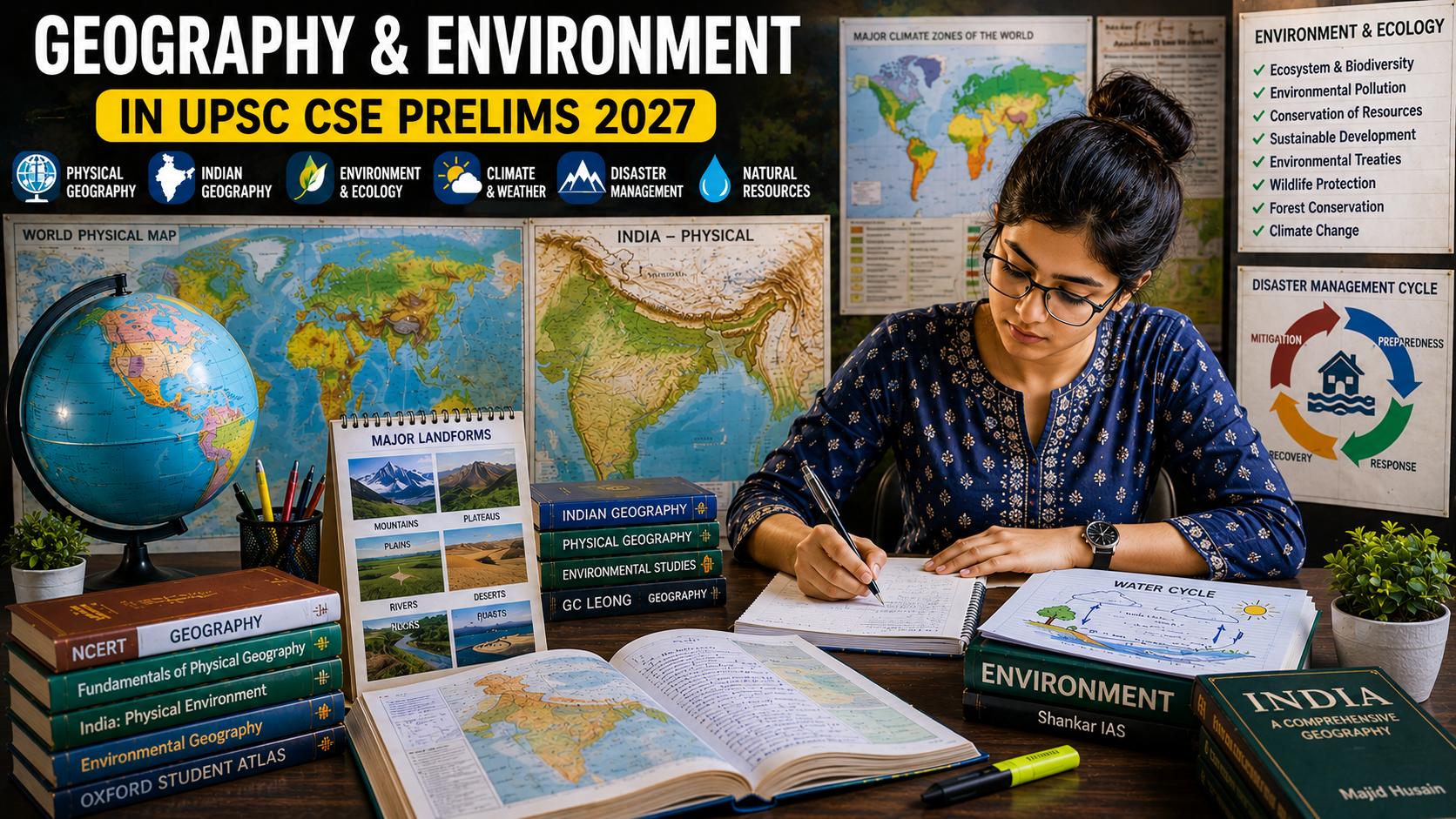
3. Indian and World Geography in UPSC CSE Prelims 2027 GS Syllabus
UPSC CSE 2027 Preparation heavily rewards conceptual physical geographic principles linked directly to current climatic shifts.
Physical Geography of India: Granular mapping of the Himalayan drainage system, peninsular river networks, soil distribution patterns, and monsoon vector dynamics.
Human & Economic Geography: Mineral ore distribution reserves (Lithium, Rare Earth Elements, Cobalt), critical industrial clusters, and shifting crop cultivation calendars.
World Physical Geography: Major pressure belts, volcanic and magmatic arcs, oceanic trenches, and deep-sea current interactions.
Places in News Mapping: Fissure eruptions, trans-national wetlands, endorheic lakes, and critical global canal lines.
Geography is one of the most scoring areas covered under the UPSC CSE Prelims 2027 GS Syllabus: Ultimate Success Blueprint.
Recommended Books for Geography
Indian & World Geography by Pallavi Saxena
Oswaal NCERT One For All Book for UPSC & State PSCs
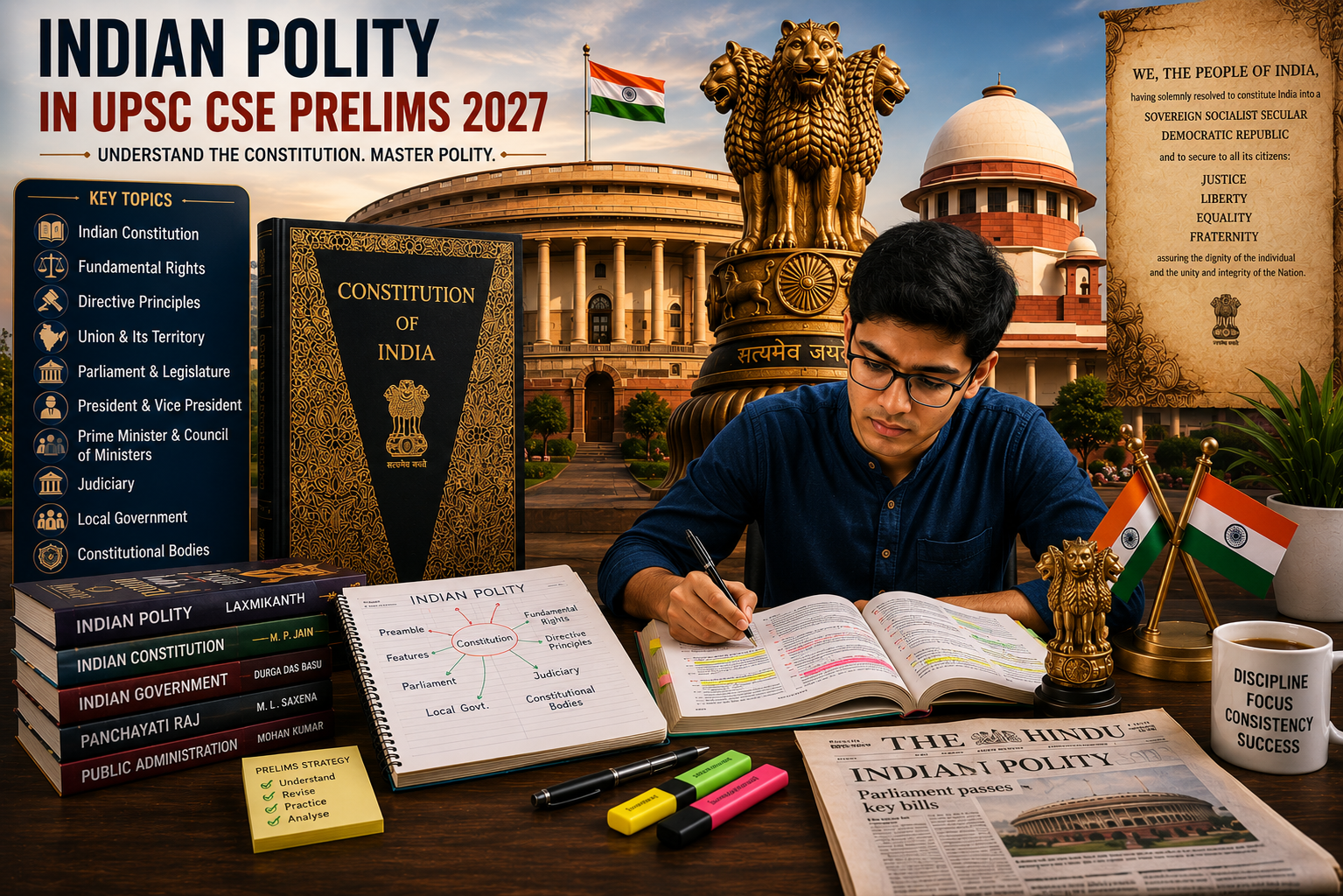
4. Indian Polity and Governance in UPSC CSE Prelims 2027 GS Syllabus
Questions in this segment test your ability to interpret constitutional clauses under extreme stress. Rote memorization of basic summaries is no longer sufficient.
Constitutional Foundations: Fundamental Rights, Directive Principles of State Policy (DPSPs), and Fundamental Duties.
System of Government: Parliamentary vs. Presidential structures, Federalism vs. Unitary dynamics, and Centre-State emergency dimensions.
The Executive and Legislature: Powers, immunities, and discretionary boundaries of the President and Governors; procedural mechanics of Parliament (Guillotine, Adjournment, Financial Bills).
Judiciary & Statutory Frameworks: Supreme Court judicial review limits, high court jurisdictions, and specialized tribunals.
Constitutional & Non-Constitutional Bodies: NITI Aayog, UPSC, CAG, Finance Commissions, and newly formed data protection boards.
Indian Polity remains a high-priority subject in the UPSC CSE Prelims 2027 GS Syllabus: Ultimate Success Blueprint.
Fundamental Rights and Directive Principles are core constitutional topics for Prelims preparation. To strengthen your practice in this area, solve our 100 Fundamental Rights and DPSP MCQs for UPSC Prelims 2027.
Recommended Books for Polity
M-Laxmikanth (Indian Polity) and PM Bakshi (Constitution).
5. Economic and Social Development in UPSC CSE Prelims 2027 GS Syllabus
The economic pillar tracks the structural and structural formalization of the Indian financial ecosystem.
Monetary Policy & Banking: Tools used by the Reserve Bank of India to manage liquidity (Repo Rate, CRR, SLR, prompt corrective action (PCA) parameters, and Central Bank Digital Currencies (CBDC).
Fiscal Policy & Budgeting: Taxation frameworks, GST Council dynamics, tracking medium-term fiscal deficit targets, and the horizontal devolution of funds.
External Sector & Global Integration: Inclusion of Indian bonds in sovereign indexes, managing foreign portfolio investments (FPIs), Participatory Notes (P-Notes), and international trade schemes (RoDTEP).
Inclusive Growth: Poverty indices, human development tracking arrays, and social sector health-locker integrations.
Recommended Books for Economy
Mrunal Patel’s Notes / Vivek Singh (Indian Economy)
For a deep, data-backed assessment of core banking frameworks, inflation parameters, and fiscal tracking, solve the benchmark 100 Monetary Policy MCQs
A clear understanding of economic concepts is essential for mastering the UPSC CSE Prelims 2027 GS Syllabus: Ultimate Success Blueprint.
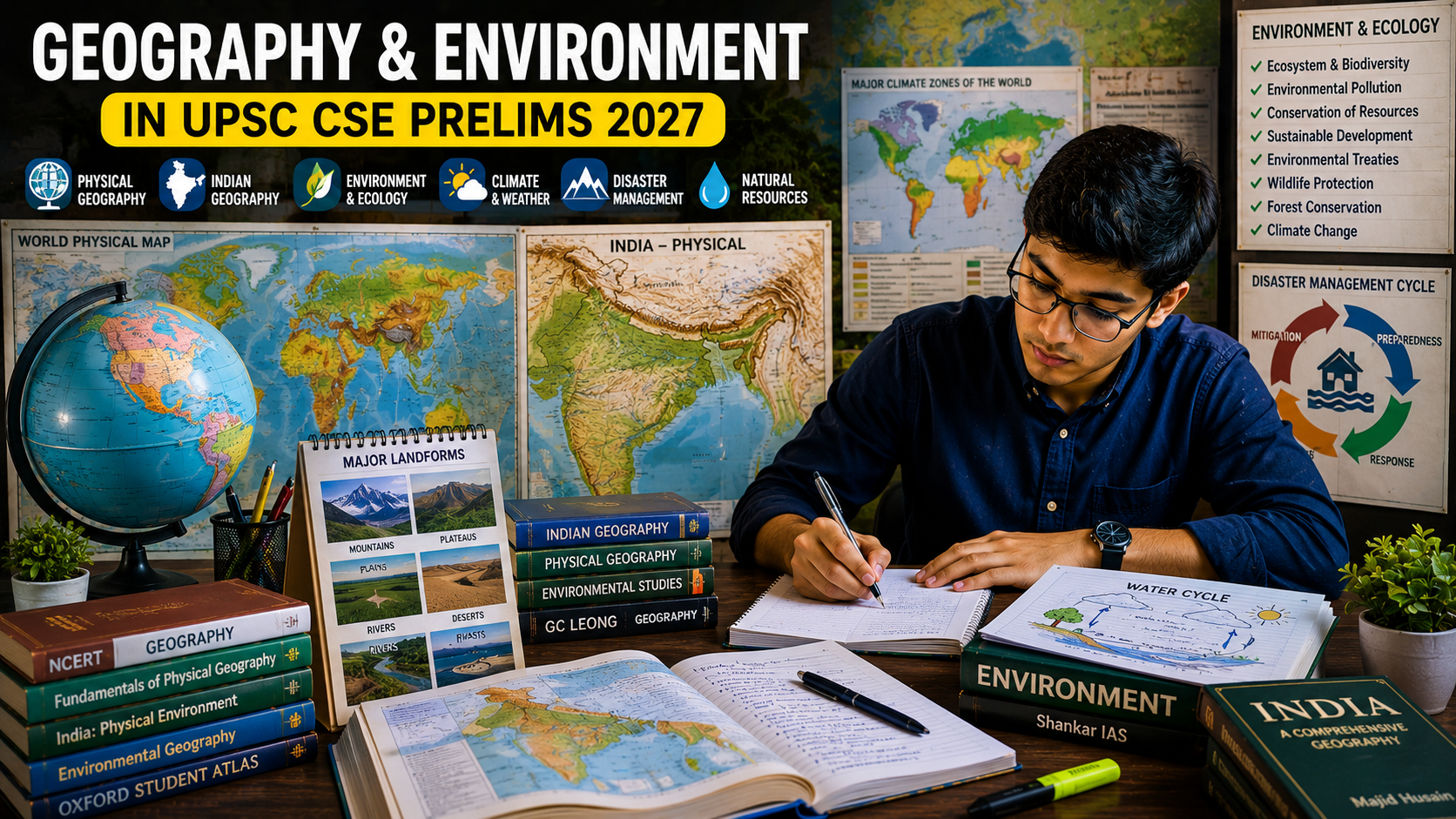
6. Environmental Ecology, Bio-diversity and Climate Change in UPSC CSE Prelims 2027 GS Syllabus
This segment requires a strong understanding of environmental law and scientific taxonomy closely linked with UPSC Prelims Strategy 2027.
Ecosystem Dynamics: Trophic level interactions, marine heatwaves, coral bleaching mechanics, and carbon cycle mutations.
International Frameworks: UN Climate Change Conference targets (COP presidency transitions), debt-for-nature swap mechanics, and carbon credit taxonomy protocols.
Domestic Legislation: Environmental Protection Act, Wildlife Protection Act (amended schedules), and Eco-Sensitive Zone (ESZ) notifications.
Conservation Hotspots: Ramsar wetlands, tiger reserves, national parks housing relocated species (e.g., Kuno National Park), and global biosphere networks.
Environment and Ecology have gained increasing importance in the UPSC CSE Prelims 2027 GS Syllabus: Ultimate Success Blueprint over recent years.
For a thorough practice of environment questions, solve the benchmark Environment MCQs 2027: 100 Most Important Questions for UPSC Prelims
7. General Science in UPSC CSE Prelims 2027 GS Syllabus
General Studies Syllabus UPSC completely ignores simple textbook definitions to focus exclusively on frontier industrial and research tech breakthroughs.
Space & Aerospace Tech: Semi-cryogenic rocket engine configurations, ISRO satellite payloads, private launch approvals (IN-SPACE), and global deep-space programs.
Defense Innovations: Canisterized medium-range ballistic missiles, beyond visual range air-to-air missiles (BVRAAM), anti-tank guided missiles (ATGM), and naval triads.
Biotechnology & Healthcare: Advanced cell therapies (CAR-T), gene editing applications, and global viral mutation patterns.
Frontier Telecom & AI Infrastructure: Terahertz spectrum operational dynamics (6G), high-performance computing clusters, Generative AI challenges, and ransomware cybersecurity frameworks (CERT-In).
Most Important Resources for UPSC Prelims 2027
- Current Affairs For UPSC Prelims 2027
- Polity for UPSC Prelims 2027
- Economy for UPSC Prelims 2027
- History for UPSC Prelims 2027
- Science and Technology for UPSC Prelims 2027
- Geography for UPSC Prelims 2027
After completing the Prelims syllabus, candidates should review UPSC Mains 2026 GS Paper 1 Syllabus: Comprehensive Guide for effective Mains-oriented preparation.
If you are preparing for UPSC Mains, don’t miss our detailed guide on How to Score 120+ in GS Paper 1: Powerful UPSC Mains Strategy, Books & Study Plan 2026, which covers books, answer writing, and a 90-day preparation roadmap.
Modern History forms the backbone of GS Paper 1 and contributes significantly to the final score. For topic-wise preparation, books, PYQs, and answer-writing guidance, read our detailed Modern History Strategy for UPSC Mains GS Paper 1 guide.
To cross-verify UPSC Exam Pattern 2027 and your strategic focus with the absolute highest tier of authoritative sources, this comprehensive blueprint maps the official directives from the Union Public Service Commission alongside critical operational updates from the Press Information Bureau (PIB).
14 thoughts on “UPSC CSE Prelims 2027 GS Syllabus: Ultimate Success Blueprint”