What UPSC Prelims Actually Tests from ISRO Missions
ISRO Missions for UPSC Prelims 2027 are an important part of Science and Technology preparation for the Civil Services Preliminary Examination. UPSC questions on India’s space programme can test mission objectives, launch vehicles, payloads, orbital characteristics, scientific applications, technological achievements and international collaborations. Therefore, aspirants should study important ISRO missions not merely by memorising their names and launch dates, but by understanding the scientific and technological purpose behind each mission.
Before preparing ISRO missions, it is important to understand the pattern of actual UPSC CSE Prelims questions. UPSC generally does not ask only direct questions such as “When was Chandrayaan-3 launched?” Instead, it often combines a mission with its objective, payload, launch vehicle, orbit, technological purpose, application or associated scientific concept.
The official UPSC archive provides the Civil Services Preliminary question papers, including recent papers and archived papers.
Science and Technology is one of the important areas of UPSC Prelims preparation. Aspirants can also strengthen their preparation through our Science And Technology 100 MCQs for UPSC 2027 with Answers, which covers important developments, concepts and practice material.
1. Mission identity + achievement
In UPSC Prelims 2016, a question on Mangalyaan tested whether candidates could distinguish between its popular name, India’s position among Mars missions and its first-attempt success. The correct combination was 1 and 3.
Lesson: For every important ISRO mission, remember:
- What is its other name?
- Which planet/celestial body does it study?
- What was India’s first/unique achievement?
- Which agency or country collaborated, if applicable?
2. Launch vehicle and mission purpose
In UPSC Prelims 2018, UPSC asked about the difference between PSLV and GSLV, including their typical satellite applications, orbital behaviour and the configuration of GSLV Mk III. The correct answer was 1 only.
This shows that merely memorising mission names is insufficient. Candidates should connect:
Mission → Satellite → Launch Vehicle → Orbit → Application
3. Satellite missions can be tested through their applications
In UPSC Prelims 2019, a question asked about applications of satellite images and remote-sensing data, including vegetation chlorophyll, greenhouse-gas emissions and land-surface temperature. All three were considered correct.
This indicates that UPSC can move from a specific mission to the technology/application behind the mission.
4. Mission architecture and failure/success can become statement-based questions
In UPSC Prelims 2020, Chandrayaan-2 was tested through statements concerning its launch, the Vikram lander and the landing outcome. The correct combination was 1 and 2 only.
Therefore, aspirants should know not only successful missions but also:
- What was attempted?
- Which component performed which role?
- What succeeded?
- What failed?
- What was subsequently demonstrated by a follow-up mission?
5. Space programme questions can combine launch vehicles, spaceport and technology
The 2022 Prelims included a statement-based question on India’s space programme involving PSLV, GSLV Mk III and the Satish Dhawan Space Centre.
Thus, UPSC preparation should not treat “ISRO Missions” and “Launch Vehicles” as completely separate topics.
6. Recent UPSC questions increasingly connect missions with emerging capabilities
The 2025 Prelims asked about Axiom-4, SpaDeX and Gaganyaan in the context of microgravity research. This is particularly important for UPSC 2027 preparation because it shows the shift toward newer space capabilities rather than only historical missions.
The key conceptual distinction is important: SpaDeX’s principal objective is rendezvous, docking, undocking and related technology, whereas microgravity experiments can be associated with broader orbital platforms and human-spaceflight programmes. ISRO describes SpaDeX primarily as a docking technology demonstration.
What the PYQ trend tells us
For UPSC Prelims 2027, focus particularly on:
- Mission objective
- Payload and instrument
- Launch vehicle
- Orbit/location
- Planet or celestial body studied
- Scientific application
- India-specific achievement
- International collaboration
- Technology demonstrated
- Difference between similarly named missions
For ISRO Missions for UPSC Prelims 2027, aspirants should focus on the relationship between mission objectives, scientific instruments, launch vehicles, orbits and practical applications rather than memorising isolated facts.
ISRO Missions for UPSC Prelims 2027: Core Preparation
ISRO’s space programme covers Earth observation, communication, navigation, meteorology, space science, planetary exploration and space-based applications. Its stated objectives also include development of launch vehicles, navigation systems, Earth-observation satellites and technologies for planetary exploration.
For Prelims 2027, the following missions and programmes deserve particular attention.
1. Chandrayaan Missions
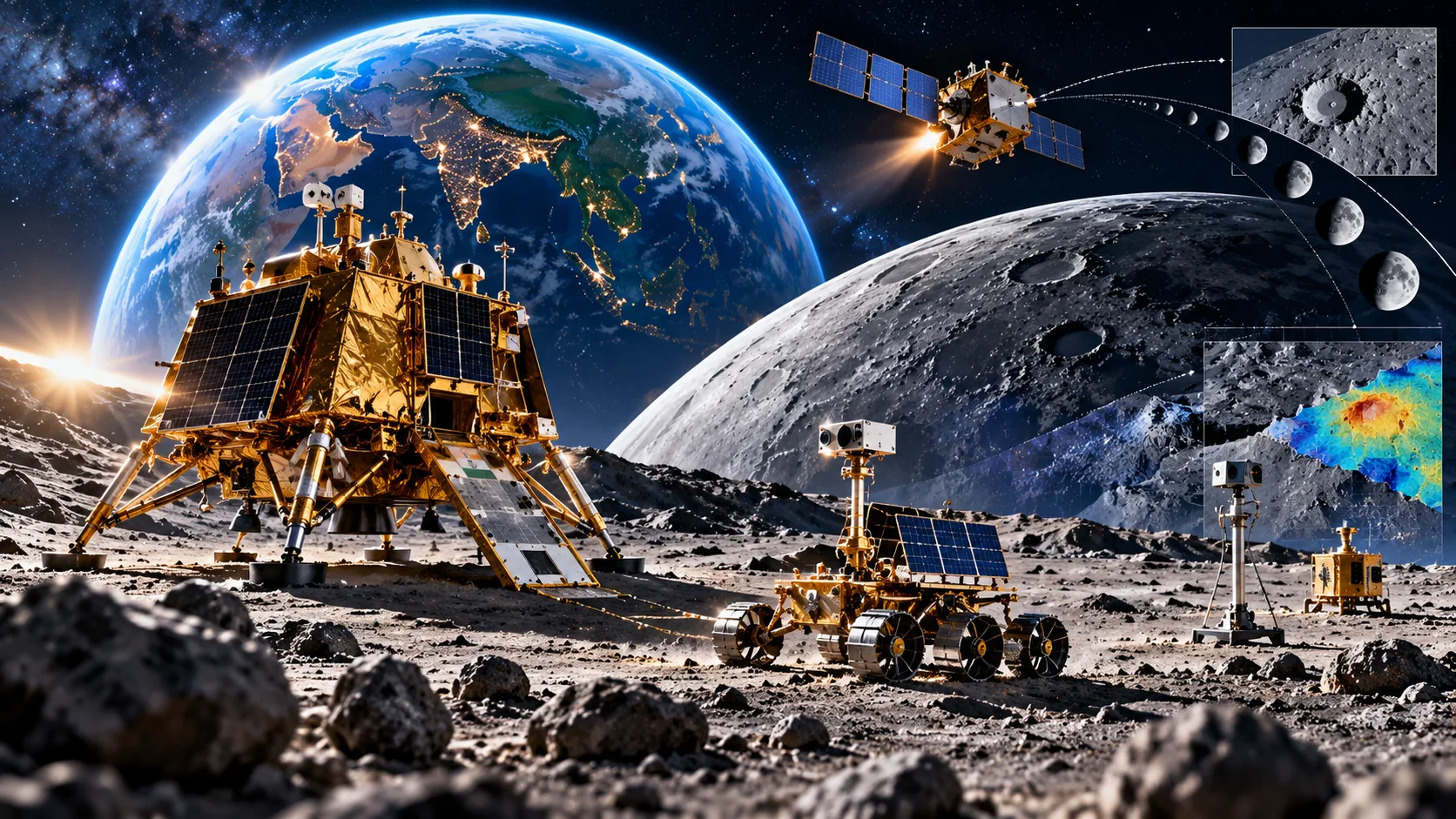
Among the most important ISRO Missions for UPSC Prelims 2027, the Chandrayaan series deserves special attention because UPSC can connect lunar missions with landing technology, scientific instruments, exploration objectives and India’s space capabilities.
Chandrayaan-1
Launch: 22 October 2008
Launch Vehicle: PSLV-C11
Target: Moon
Chandrayaan-1 was India’s first mission to the Moon. It carried scientific instruments for lunar exploration and made important contributions to the understanding of lunar surface composition.
One of its major scientific achievements was the detection of hydroxyl and water molecules on the lunar surface, along with evidence related to water-ice deposits in permanently shadowed regions.
Prelims facts:
- First Indian lunar mission.
- Launched by PSLV.
- Orbital mission.
- Important for lunar mineralogical and chemical studies.
- Associated with major evidence of water/hydroxyl on the Moon.
UPSC trap: Do not confuse Chandrayaan-1’s orbital exploration with Chandrayaan-3’s soft-landing and rover demonstration.
Chandrayaan-2
Launch: 22 July 2019
Launch Vehicle: GSLV Mk III M1
Components: Orbiter, Vikram Lander and Pragyan Rover
Chandrayaan-2 was designed as an integrated lunar mission involving an Orbiter, Lander and Rover, with the objective of studying the Moon’s surface, subsurface and exosphere, including the south-polar region.
The Vikram lander did not achieve the planned soft landing. However, the Orbiter continued to provide scientific observations, and ISRO lists Chandrayaan-2’s orbiter as operational in its spacecraft mission records.
Remember:
- Orbiter — continued lunar observations.
- Vikram — lander.
- Pragyan — rover.
- Chandrayaan-2 was launched by GSLV Mk III, now known as LVM3.
Chandrayaan-3
Launch: 14 July 2023
Launch Vehicle: LVM3-M4
Components: Propulsion Module, Lander Module and Rover
The primary objectives of Chandrayaan-3 were:
- Demonstrating safe and soft landing on the lunar surface.
- Demonstrating rover roving on the Moon.
- Conducting in-situ scientific experiments.
The lander carried ChaSTE, ILSA and Langmuir Probe, while the rover carried APXS and LIBS.
Important UPSC distinction:
- Chandrayaan-1: lunar orbiter/science mission.
- Chandrayaan-2: orbiter + lander + rover; planned soft landing was unsuccessful.
- Chandrayaan-3: successfully demonstrated soft landing and rover operations.
Chandrayaan-4
Chandrayaan-4 is a planned lunar sample-return mission. The Union Cabinet approved the mission in September 2024. Its objective is to collect lunar samples and bring them back to Earth for laboratory analysis.
The mission is particularly important because it requires technologies such as:
- Lunar surface sampling
- Drilling
- Sample storage
- Sample transfer
- Docking
- Lunar ascent
- Re-entry and recovery
ISRO’s approved mission architecture involves multiple modules and two launches, followed by docking in Earth orbit.
UPSC 2027 focus: Remember Chandrayaan-4 = Lunar Sample Return.
The Chandrayaan missions are closely connected with India’s wider space-technology preparation. For additional practice on this subject, aspirants can also explore our Space Technology Current Affairs MCQs for UPSC .
2. Mars Orbiter Mission — Mangalyaan
Launch: 5 November 2013
Launch Vehicle: PSLV-C25
Target: Mars
Mars Orbiter Mission (MOM), popularly known as Mangalyaan, was India’s first interplanetary mission to Mars. ISRO states that it was designed to demonstrate technologies required for an interplanetary mission and to study Mars using scientific payloads.
Its scientific objectives included studying:
- Martian surface features
- Morphology
- Mineralogy
- Martian atmosphere
It carried five scientific payloads, including the Mars Colour Camera (MCC) and Methane Sensor for Mars (MSM).
Why Mangalyaan matters for UPSC
The 2016 UPSC question specifically tested whether candidates knew that:
- Mangalyaan = Mars Orbiter Mission.
- India successfully entered Mars orbit on its first attempt.
- India was not the second country after the USA to orbit Mars.
Prelims trap:
Do not confuse first interplanetary mission with first planetary landing mission.
3. Aditya-L1 Mission
Another important area in ISRO Missions for UPSC Prelims 2027 is solar and space-weather research, particularly the Aditya-L1 mission and its scientific payloads.
Launch: 2 September 2023
Launch Vehicle: PSLV-C57
Target: Sun/Solar environment
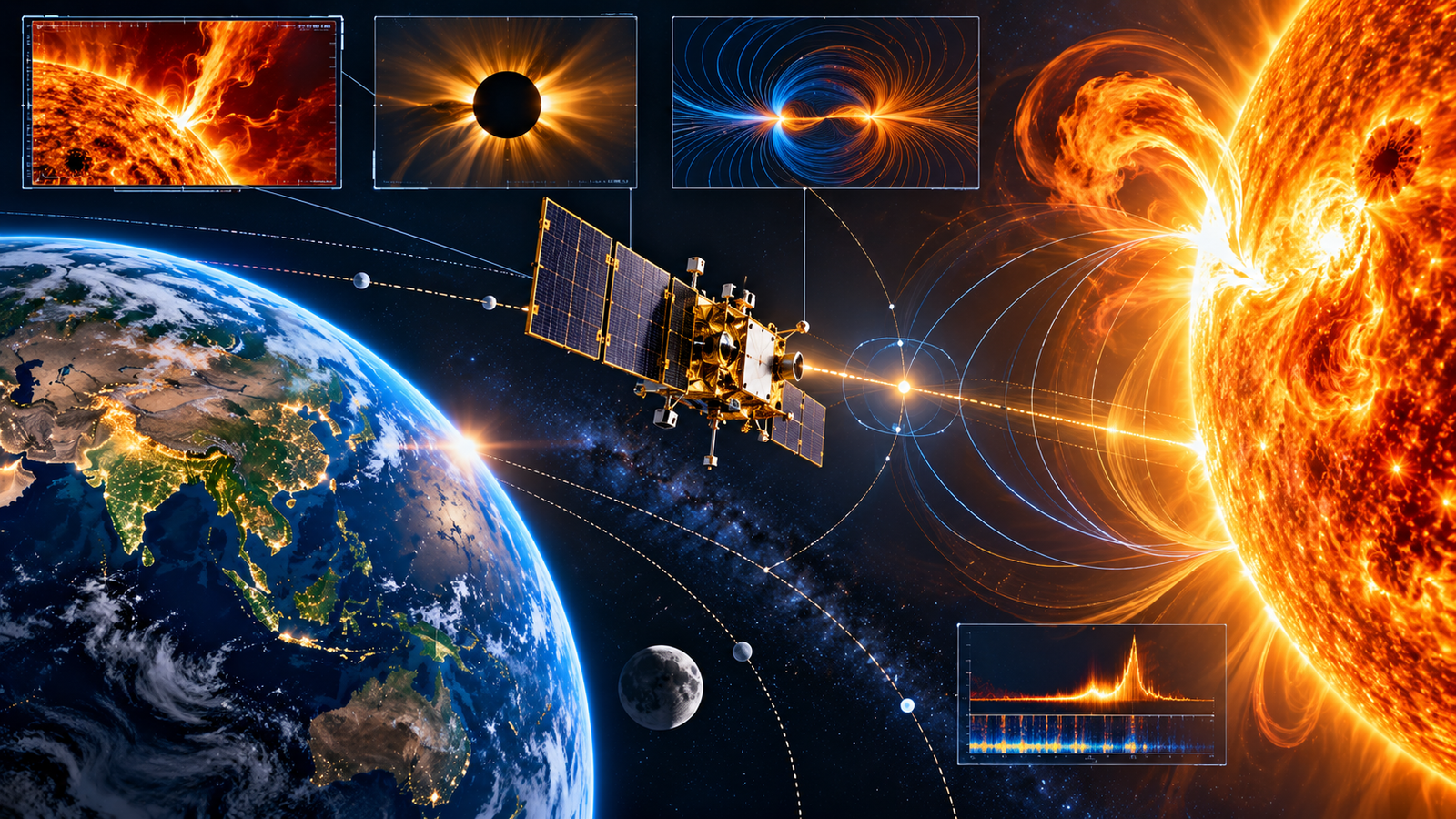
Aditya-L1 is India’s first space-based mission dedicated to studying the Sun. The spacecraft operates in a halo orbit around the Sun-Earth L1 point, approximately 1.5 million km from Earth.
The L1 location provides a major observational advantage because the spacecraft can continuously observe the Sun without regular occultation or eclipse by Earth.
Major objectives
Aditya-L1 studies:
- Solar corona
- Chromosphere
- Coronal heating
- Solar flares
- Coronal Mass Ejections (CMEs)
- Solar wind
- Space weather
- Solar magnetic fields
It carries seven payloads. Four are remote-sensing payloads and three conduct in-situ observations at L1.
Important payloads
- VELC — Visible Emission Line Coronagraph
- SUIT — Solar Ultraviolet Imaging Telescope
- SoLEXS — Solar Low Energy X-ray Spectrometer
- HEL1OS — High Energy L1 Orbiting X-ray Spectrometer
- ASPEX — Aditya Solar wind Particle Experiment
- PAPA — Plasma Analyser Package for Aditya
- Magnetometer
UPSC trap: Aditya-L1 does not travel to the surface of the Sun. It observes the Sun from the L1 region.
4. AstroSat
Launch: 28 September 2015
Launch Vehicle: PSLV-C30
Orbit: Approximately 650 km
AstroSat is India’s first dedicated astronomy mission and a multi-wavelength space observatory. It simultaneously observes celestial sources in ultraviolet, optical and X-ray wavelengths.
Its scientific objectives include studying:
- Neutron stars
- Black-hole systems
- Binary stars
- High-energy processes
- X-ray sources
- Star-forming regions
Its important payloads include:
- UVIT
- SXT
- LAXPC
- CZTI
- SSM
UPSC connection: AstroSat appeared in the 2016 Prelims, where UPSC tested factual knowledge concerning the observatory’s nature, mass and orbit.
Remember:
AstroSat = Multi-wavelength astronomy, not Earth observation.
5. XPoSat
Launch: 1 January 2024
Launch Vehicle: PSLV-C58
Purpose: X-ray polarimetry and spectroscopy
XPoSat is India’s first dedicated scientific mission for studying polarisation of X-rays from celestial sources. It carries two major payloads:
- POLIX — Polarimeter Instrument in X-rays
- XSPECT — X-ray Spectroscopy and Timing
POLIX studies X-ray polarisation mainly in the 8–30 keV range, while XSPECT performs spectroscopy and timing studies in the 0.8–15 keV range.
UPSC relevance
A recent UPSC-oriented revision question associated POLIX and XSPECT with XPoSat, reflecting the kind of mission-payload association that aspirants should know.
Easy memory trick:
XPoSat → X-rays → Polarisation + Spectroscopy
6. NISAR — NASA-ISRO Synthetic Aperture Radar
Earth-observation technology is another important component of ISRO Missions for UPSC Prelims 2027, with NISAR providing an important example of international cooperation and advanced radar-based observation.
Launch: 30 July 2025
Launch Vehicle: GSLV-F16
Partners: ISRO + NASA
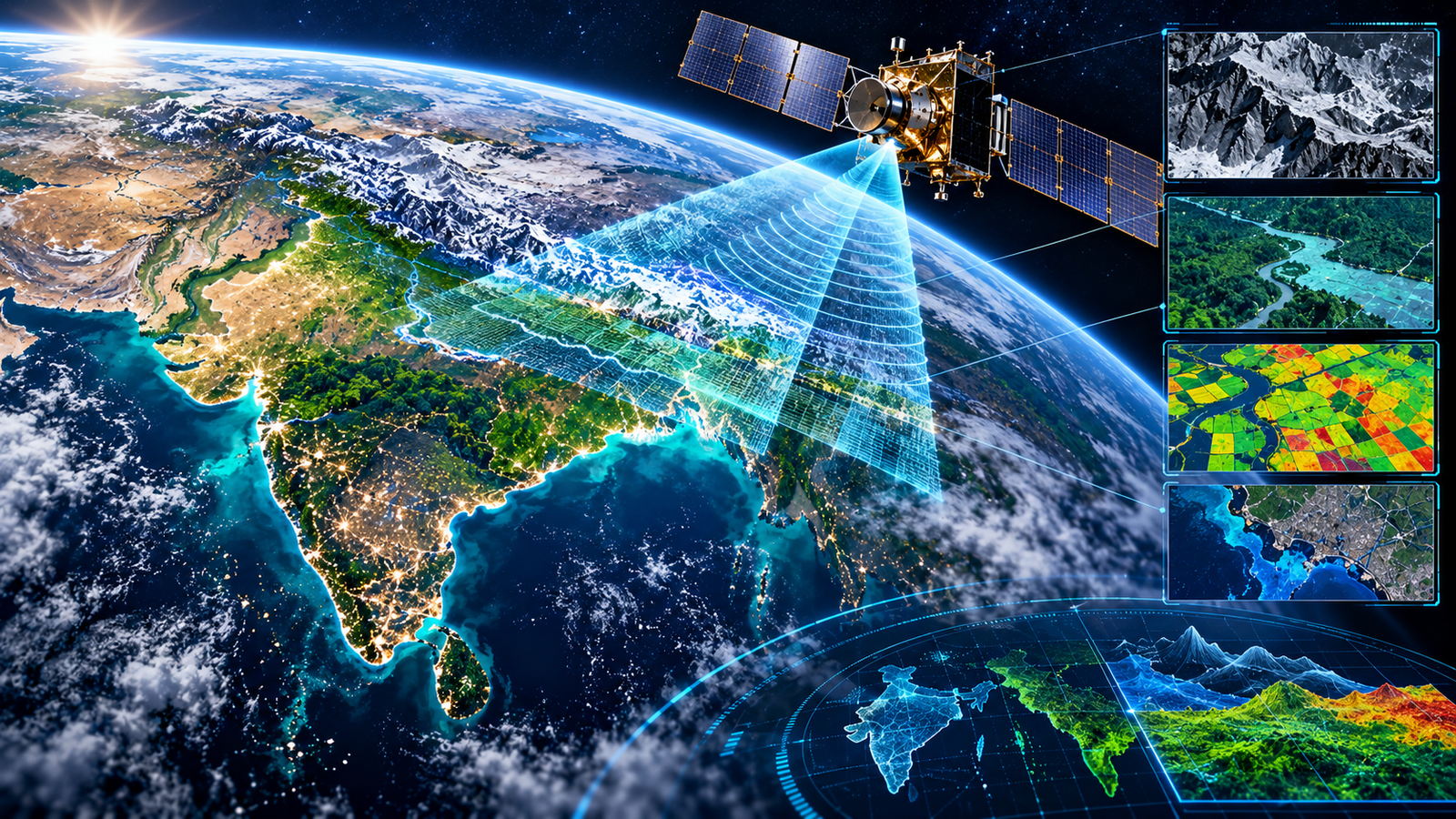
NISAR is a joint Earth-observation mission of NASA and ISRO. It uses dual-frequency Synthetic Aperture Radar:
- L-band SAR — NASA
- S-band SAR — ISRO
NISAR can image land and ice-covered surfaces globally and is designed to revisit them approximately every 12 days.
Major objectives
NISAR helps study:
- Land deformation
- Ice-sheet dynamics
- Sea ice
- Glaciers
- Ecosystems
- Cropland changes
- Wetlands
- Earthquake-related deformation
- Volcanism
- Landslides
- Subsidence and uplift
Very important UPSC point:
NISAR is based on radar, so it is not dependent on ordinary visible-light imaging and can provide observations useful under challenging illumination/weather conditions.
7. SpaDeX — Space Docking Experiment
Launch: 30 December 2024
Launch Vehicle: PSLV-C60
Main objective: Spacecraft rendezvous and docking
SpaDeX consists of two small spacecraft designed to demonstrate:
- Rendezvous
- Docking
- Undocking
- Control of docked spacecraft
- Power transfer between docked spacecraft
- Payload operations after undocking
ISRO’s annual report records successful docking of the two SpaDeX spacecraft on 16 January 2025.
Why SpaDeX is important
Docking technology is important for future missions involving:
- Space stations
- Satellite servicing
- Complex human-spaceflight missions
- Lunar missions
- Interplanetary missions
UPSC trap:
Do not describe SpaDeX primarily as a lunar or planetary exploration mission. Its core purpose is in-space rendezvous and docking technology demonstration.
8. Gaganyaan Mission
Gaganyaan is India’s human-spaceflight programme. Its core objective is to demonstrate India’s indigenous capability to undertake human spaceflight to Low Earth Orbit (LEO).
The programme includes uncrewed missions before the crewed mission so that technology, safety and reliability can be verified.
Important areas for Prelims
Study:
- Human-rated launch vehicle
- Crew Module
- Service Module
- Environmental Control and Life Support System
- Crew escape system
- Parachute recovery
- Astronaut training
- Microgravity experiments
- Splashdown and recovery
ISRO’s 2026 updates show continued qualification work on crew-module systems and parachute systems for the programme.
ISRO has also invited proposals for Indian Microgravity Experiments — IMEx-2026, connecting India’s human-spaceflight programme with scientific research in microgravity.
Full form: Navigation with Indian Constellation
Earlier name: Indian Regional Navigation Satellite System (IRNSS)
NavIC is India’s independent regional satellite navigation system. It provides Position, Navigation and Timing services over India and a region extending approximately 1,500 km beyond India’s landmass.
NavIC provides:
- Standard Positioning Service (SPS)
- Restricted Service (RS)
The system uses satellites in geostationary and geosynchronous orbits.
Why this is important
NavIC was directly tested in UPSC Prelims 2018, where the question focused on:
- Number and type of orbits
- Coverage
- Whether the system was regional or global
UPSC trap:
NavIC is a regional navigation system, unlike GPS, Galileo, GLONASS and BeiDou, which are global systems.
The NVS series is designed to strengthen India’s NavIC navigation infrastructure.
ISRO envisages five second-generation satellites:
NVS-01, NVS-02, NVS-03, NVS-04 and NVS-05
The NVS series adds the L1 band to widen NavIC services.
NVS-01
NVS-01 was launched on 29 May 2023 by GSLV-F12 and carried an indigenous atomic clock.
NVS-02
NVS-02 was launched on 29 January 2025 by GSLV-F15. The satellite was injected into its intended Geosynchronous Transfer Orbit, but orbit-raising operations could not be completed because of a propulsion-system-related issue.
Prelims lesson: UPSC can test not only successful missions but also the distinction between launch success, orbital injection and final operational status.
11. INSAT-3DS
INSAT-3DS is a meteorological satellite launched by GSLV-F14.
Its objectives include:
- Earth-surface monitoring
- Oceanic observations
- Atmospheric meteorological parameters
- Data collection and dissemination
- Satellite-aided search and rescue
It operates in geostationary orbit.
Remember:
INSAT-3DS → Meteorology + Atmosphere + Ocean + Search & Rescue
12. EOS-08
EOS-08 is an Earth-observation satellite launched by SSLV-D3 in August 2024. It was designed both for Earth observation applications and technology demonstration.
Its three major payloads are:
- EOIR — Electro Optical Infrared Payload
- GNSS-R — Global Navigation Satellite System-Reflectometry
- SiC UV Dosimeter
Applications include:
- Disaster monitoring
- Fire detection
- Environmental monitoring
- Ocean-surface wind analysis
- Soil-moisture assessment
- Flood detection
- Cryosphere studies
UPSC trap: EOS-08 was launched by SSLV-D3, not PSLV.
13. NISAR vs EOS-08 vs INSAT-3DS
These three missions should be distinguished carefully.
| Mission | Main area | Important technology/purpose |
|---|---|---|
| NISAR | Earth observation | Dual-frequency L & S-band SAR |
| EOS-08 | Earth observation + technology demonstration | EOIR, GNSS-R, SiC UV Dosimeter |
| INSAT-3DS | Meteorology | Imager, Sounder, data relay, search & rescue |
NISAR is a joint NASA-ISRO mission, whereas EOS-08 and INSAT-3DS are Indian missions.
14. Important Upcoming Missions for UPSC Prelims 2027
For ISRO Missions for UPSC Prelims 2027, upcoming missions are equally important because UPSC may ask about their proposed objectives, technologies and scientific significance.
UPSC frequently converts announced missions into current-affairs questions once their objectives, technology or international collaboration become relevant.
Venus Orbiter Mission
The Venus Orbiter Mission (VOM) was approved by the Union Cabinet in September 2024. ISRO describes it as a scientific mission to study Venus’s atmosphere, clouds, aerosols, lightning, ionosphere, solar-wind interaction and surface/subsurface characteristics.
ISRO held a national science meeting on the mission in October 2025 and stated that the mission is slated for launch in 2028.
Remember:
VOM → Venus
Chandrayaan-4
The major objective is lunar sample return.
Remember:
Chandrayaan-3 → Soft landing
Chandrayaan-4 → Sample return
Bharatiya Antariksh Station
India’s human-spaceflight roadmap includes development toward a sustained human presence in LEO through the Bharatiya Antariksh Station (BAS). ISRO’s 2026 IMEx announcement explicitly connects Gaganyaan with this longer-term objective.
Most Important ISRO Missions: One-Page Revision Table
| Mission/Programme | Main Purpose | Key Point for UPSC |
|---|---|---|
| Chandrayaan-1 | Lunar exploration | Water/hydroxyl evidence |
| Chandrayaan-2 | Lunar orbiter + lander + rover | Vikram landing attempt |
| Chandrayaan-3 | Soft landing + rover | Successful lunar soft landing |
| Chandrayaan-4 | Lunar sample return | Planned sample-return mission |
| Mangalyaan/MOM | Mars exploration | India’s first interplanetary mission |
| AstroSat | Astronomy | Multi-wavelength observatory |
| Aditya-L1 | Solar studies | Sun-Earth L1 halo orbit |
| XPoSat | X-ray astronomy | POLIX + XSPECT |
| NISAR | Earth observation | NASA-ISRO, L + S band SAR |
| SpaDeX | Docking technology | Rendezvous, docking, power transfer |
| Gaganyaan | Human spaceflight | LEO human-spaceflight capability |
| NavIC/IRNSS | Navigation | Regional PNT system |
| NVS series | Navigation | Second-generation NavIC satellites |
| INSAT-3DS | Meteorology | Atmospheric/ocean observations |
| EOS-08 | Earth observation/technology | EOIR + GNSS-R + UV Dosimeter |
| Venus Orbiter Mission | Venus exploration | Atmosphere + surface/subsurface |
Important Launch Vehicle–Mission Connections
One of the most important lessons from UPSC PYQs is that mission names should always be studied together with launch vehicles.
| Launch Vehicle | Important Missions to Remember |
|---|---|
| PSLV | Chandrayaan-1, Mangalyaan, AstroSat, Aditya-L1, XPoSat, SpaDeX |
| GSLV | NVS-02, INSAT-3DS, NISAR |
| LVM3 | Chandrayaan-2, Chandrayaan-3 |
| SSLV | EOS-08 |
The distinction between PSLV and GSLV/LVM3 has been directly tested by UPSC, making launch-vehicle knowledge an important part of space-mission preparation.
Important Payload–Mission Pairs
These pairs are particularly useful for statement-based Prelims questions:
- Chandrayaan-3 — ChaSTE
- Chandrayaan-3 — ILSA
- Chandrayaan-3 — LIBS
- Aditya-L1 — VELC
- Aditya-L1 — SUIT
- XPoSat — POLIX
- XPoSat — XSPECT
- AstroSat — UVIT
- NISAR — L-band + S-band SAR
- EOS-08 — GNSS-R
- INSAT-3DS — Imager + Sounder
The official ISRO mission descriptions confirm these major payload associations.
How UPSC Can Frame Questions on ISRO Missions
For UPSC Prelims 2027, do not restrict your preparation to dates and launch names. Practise questions in the following formats:
Statement-Based Questions
For example:
Consider the following statements regarding Aditya-L1:
- It is designed to study the Sun.
- It is positioned around the Sun-Earth L1 point.
- All its payloads directly observe the solar surface.
The key is to identify the subtle distinction between remote sensing and in-situ payloads.
Match-the-Following Questions
UPSC can connect:
Mission — Payload — Objective — Launch Vehicle
For example:
- XPoSat — POLIX — X-ray polarisation
- Aditya-L1 — VELC — Solar corona
- NISAR — SAR — Earth observation
“How Many of the Above” Questions
Recent UPSC style also includes questions asking how many statements or missions satisfy a particular condition. The 2025 space-mission question involving Axiom-4, SpaDeX and Gaganyaan is a useful example of this approach.
If you are preparing Science and Technology systematically, it is useful to combine mission-specific preparation with previous-question analysis. You can also practise Science and Technology PYQs for UPSC Prelims 2027 to identify recurring UPSC question patterns.
Most Important Facts to Memorise for UPSC Prelims 2027
- Chandrayaan-1 → First Indian lunar mission
- Chandrayaan-2 → Orbiter + Vikram + Pragyan
- Chandrayaan-3 → Soft landing + rover
- Chandrayaan-4 → Lunar sample return
- Mangalyaan → Mars Orbiter Mission
- AstroSat → Multi-wavelength astronomy
- Aditya-L1 → Solar observation from L1
- XPoSat → X-ray polarisation
- NISAR → NASA + ISRO
- NISAR → L-band + S-band SAR
- SpaDeX → Docking technology
- Gaganyaan → Human spaceflight to LEO
- NavIC → Regional navigation
- NVS → Second-generation NavIC satellites
- INSAT-3DS → Meteorological applications
- EOS-08 → SSLV-D3
- VOM → Venus
- BAS → Long-term human presence in LEO
Quick Revision: ISRO Missions for UPSC Prelims 2027
This quick revision list brings together the most important ISRO Missions for UPSC Prelims 2027 and their core objectives for last-minute preparation.
Moon: Chandrayaan-1, Chandrayaan-2, Chandrayaan-3, Chandrayaan-4
Mars: Mars Orbiter Mission/Mangalyaan
Sun: Aditya-L1
Astronomy: AstroSat, XPoSat
Earth Observation: NISAR, EOS-08
Meteorology: INSAT-3DS
Navigation: NavIC/IRNSS, NVS series
Human Spaceflight: Gaganyaan
Docking Technology: SpaDeX
Venus: Venus Orbiter Mission
Space Station Roadmap: Bharatiya Antariksh Station
Along with Science and Technology, candidates should maintain a balanced subject-wise preparation strategy. Our UPSC Prelims 2027 Strategy & Study Plan provides a broader framework for revision, current affairs and subject-wise preparation.
Most Important Resources for UPSC Prelims 2027
- Current Affairs For UPSC Prelims 2027
- Polity for UPSC Prelims 2027
- Economy for UPSC Prelims 2027
- History for UPSC Prelims 2027
- Science and Technology for UPSC Prelims 2027
- Geography for UPSC Prelims 2027
Conclusion
ISRO Missions for UPSC Prelims 2027 should be prepared as an interconnected topic rather than as a simple list of mission names and launch dates. Actual UPSC questions show a clear emphasis on mission objectives, payloads, launch vehicles, orbital characteristics, applications, technological capabilities and India’s specific achievements.
For effective revision, always connect each mission with four basic questions:
What is the mission? → What does it study/do? → Which technology or payload is important? → Which launch vehicle/orbit is associated with it?
This approach is particularly useful for newer missions such as Aditya-L1, XPoSat, NISAR, SpaDeX, Gaganyaan and Chandrayaan-4, while older missions such as Chandrayaan-1, Mangalyaan, AstroSat and NavIC remain important because UPSC has already tested related concepts.
Official Sources for Further Reading
For authentic mission information, candidates should refer primarily to the official ISRO mission pages and the UPSC previous-question-paper archive.