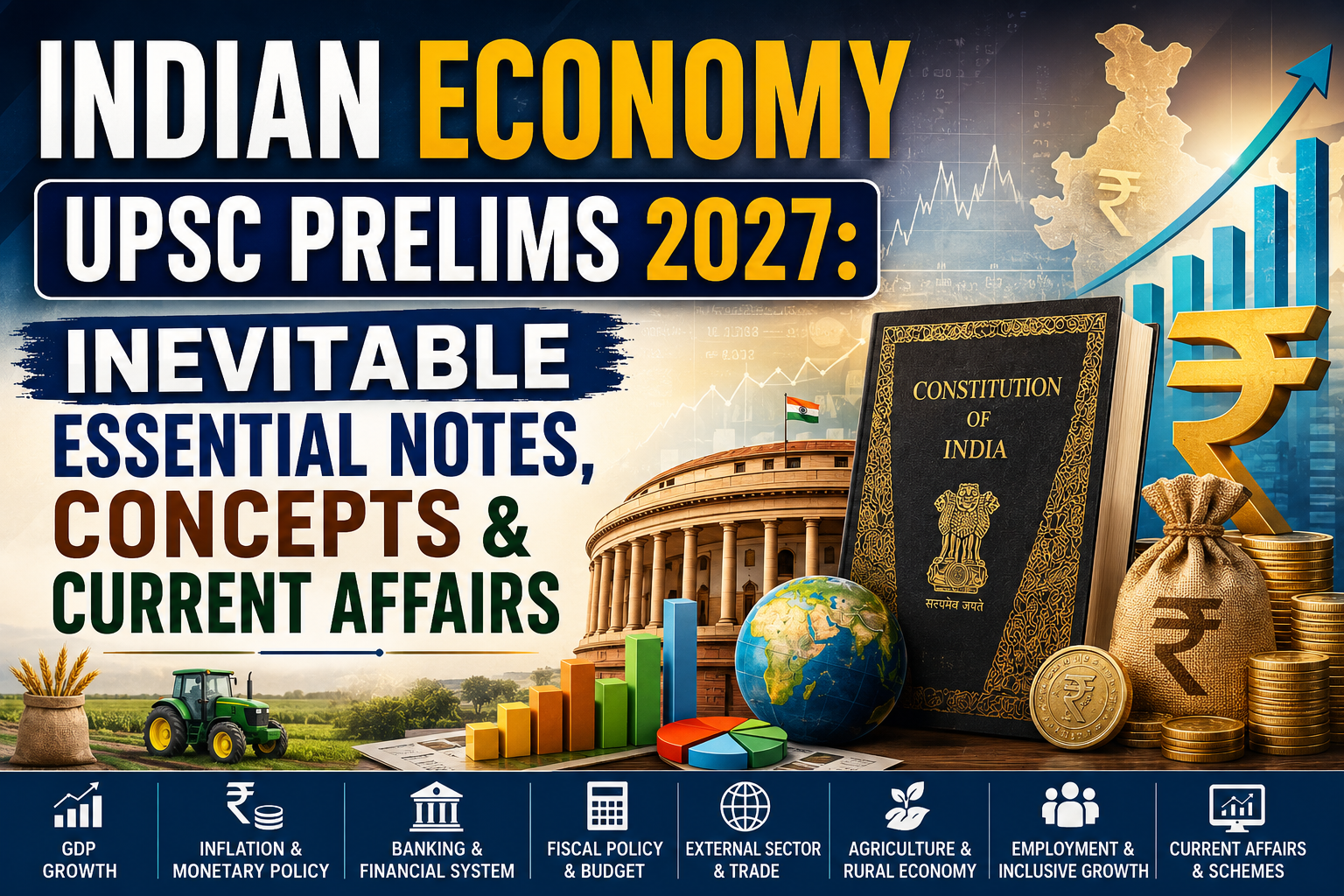
Indian Economy UPSC Prelims 2027 requires much more than memorising definitions, economic data and government schemes. UPSC increasingly tests conceptual understanding, relationships between economic variables, institutional roles and the application of economic concepts to current affairs.
The Economic and Social Development portion of the UPSC Civil Services Preliminary Examination includes areas such as sustainable development, poverty, inclusion, demographics and social-sector initiatives. Therefore, Economy preparation should combine static concepts with current developments and previous-year questions.
This complete guide covers the major Economy topics that UPSC aspirants should revise for UPSC Prelims 2027, including GDP, inflation, monetary policy, banking, fiscal policy, taxation, external sector, agriculture, employment, financial inclusion, digital economy and sustainable development.
Indian Economy UPSC Prelims 2027 preparation requires a combination of conceptual clarity, current affairs awareness and regular practice of statement-based questions.
For best preparation, aspirants should also understand the complete UPSC Prelims 2027 GS Syllabus and identify the areas covered under Economic and Social Development.
Why Indian Economy Is Important for UPSC Prelims 2027
Economy is one of the areas where static knowledge and current affairs are closely connected.
A question about a recent development may require knowledge of an underlying concept.
For example:
- A change in the repo rate requires knowledge of monetary policy.
- A movement in the rupee requires understanding of exchange rates.
- A rise in the fiscal deficit requires understanding of government borrowing.
- A new agricultural policy may require knowledge of MSP, subsidies or food security.
- A banking reform may involve NPAs, capital adequacy or financial stability.
Therefore, the best preparation strategy is:
Static Concept → Current Affairs → PYQ → MCQ Practice → Revision
Indian Economy UPSC Prelims 2027: Major Topics
The Indian Economy UPSC Prelims 2027 syllabus should be prepared through a combination of static concepts, economic institutions and current developments.
The Economy portion can be divided into the following major areas:
- National Income and GDP
- Inflation
- Monetary Policy
- Banking and Financial System
- Fiscal Policy
- Government Budget
- Taxation and GST
- External Sector
- Foreign Exchange
- Agriculture and Rural Economy
- Poverty and Inclusive Growth
- Employment and Labour
- Economic Reforms
- Infrastructure
- Digital Economy
- Financial Inclusion
- Sustainable Development
- Government Economic Schemes
- Economic Survey
- Union Budget
- Economy Current Affairs
These areas should not be studied in isolation because UPSC can connect two or more concepts in a single question.
National Income and GDP
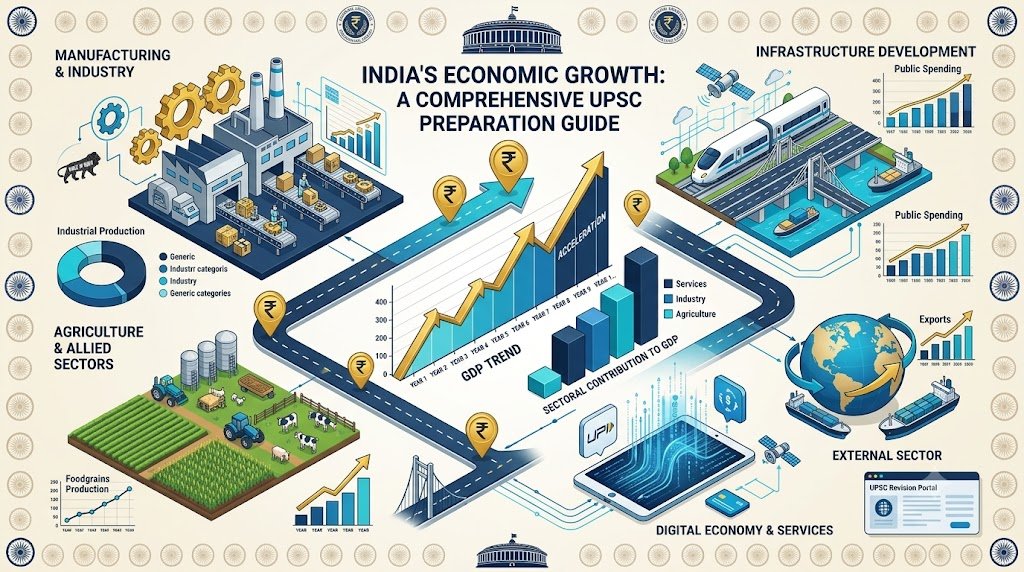
GDP and national income accounting form the foundation of Economy preparation.
Gross Domestic Product (GDP) represents the monetary value of final goods and services produced within the geographical boundaries of an economy during a specified period.
Important points include:
- GDP measures economic production.
- It considers production within the country’s territory.
- Intermediate goods are excluded to avoid double counting.
- GDP can be expressed at current or constant prices.
- Changes in GDP can reflect changes in production, prices or both.
Nominal GDP vs Real GDP
Nominal GDP is measured using current prices.
Real GDP adjusts for changes in prices and is therefore more useful for analysing changes in actual output.
For UPSC, remember:
A rise in nominal GDP does not necessarily mean that real economic output has increased by the same percentage.
GDP, GNP and Other National Income Concepts
Aspirants should clearly understand the difference between GDP and GNP.
GDP focuses on production within a country’s geographical territory.
GNP adjusts GDP for relevant income flows between residents and the rest of the world.
A simplified relationship is:
GNP = GDP + Net Factor Income from Abroad
Other concepts that deserve attention include:
- NDP
- NNP
- National Income
- Per Capita Income
- Gross Value Added
- GDP Deflator
UPSC may test the difference between these concepts through statement-based questions rather than direct definitions.
GDP and Economic Welfare
GDP is an important indicator of economic activity, but it is not a complete measure of human welfare.
GDP does not adequately capture:
- Income inequality
- Environmental degradation
- Unpaid household work
- Leisure
- Quality of public services
- Distribution of income
- Overall quality of life
Therefore:
Economic growth ≠ complete economic development
This distinction is important for both Prelims and Mains.
Inflation in India
Inflation refers to a sustained increase in the general price level of goods and services.
When prices rise, the purchasing power of money generally falls.
Important types include:
- Demand-pull inflation
- Cost-push inflation
- Core inflation
- Headline inflation
- Imported inflation
- Deflation
- Disinflation
- Stagflation
CPI and WPI
Consumer Price Index (CPI) measures changes in prices relevant to consumers.
Wholesale Price Index (WPI) measures price changes at the wholesale level across selected categories.
For UPSC, do not merely memorise the full forms.
Understand:
What is measured → Who is affected → What basket is used → Why the index matters
Monetary Policy in India
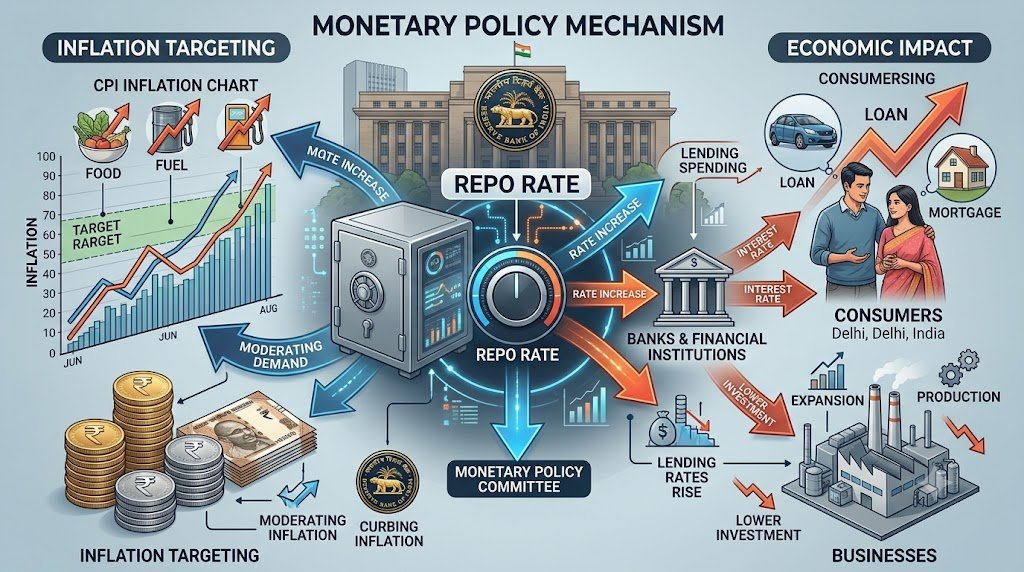
Monetary policy deals with the management of money, liquidity, interest rates and credit conditions in the economy.
The Reserve Bank of India (RBI) plays the central role in India’s monetary policy framework.
Important monetary policy instruments include:
- Repo Rate
- Standing Deposit Facility
- Marginal Standing Facility
- Cash Reserve Ratio
- Statutory Liquidity Ratio
- Open Market Operations
- Bank Rate
- Liquidity management operations
Once you understand inflation and monetary policy, you can strengthen your preparation further with our Monetary Policy MCQs 2026: Comprehensive Guide
Repo Rate and Interest Rates
The repo rate is one of the key policy rates used by the RBI.
When policy rates increase, borrowing can become more expensive, which may:
- Reduce credit demand
- Moderate consumption
- Affect investment
- Help control demand-side inflationary pressure
When policy rates decline, borrowing conditions may become easier and economic activity may receive support.
For Prelims, focus on the mechanism, not just the latest numerical rate.
Monetary Policy Committee
The Monetary Policy Committee, or MPC, is an important institution under India’s inflation-targeting framework.
For UPSC preparation, understand:
- Its composition
- Its role
- Inflation targeting
- Voting mechanism
- Monetary policy decisions
- Relationship between inflation and growth
A common conceptual distinction is:
Monetary Policy → RBI/MPC
Fiscal Policy → Government
Banking System in India
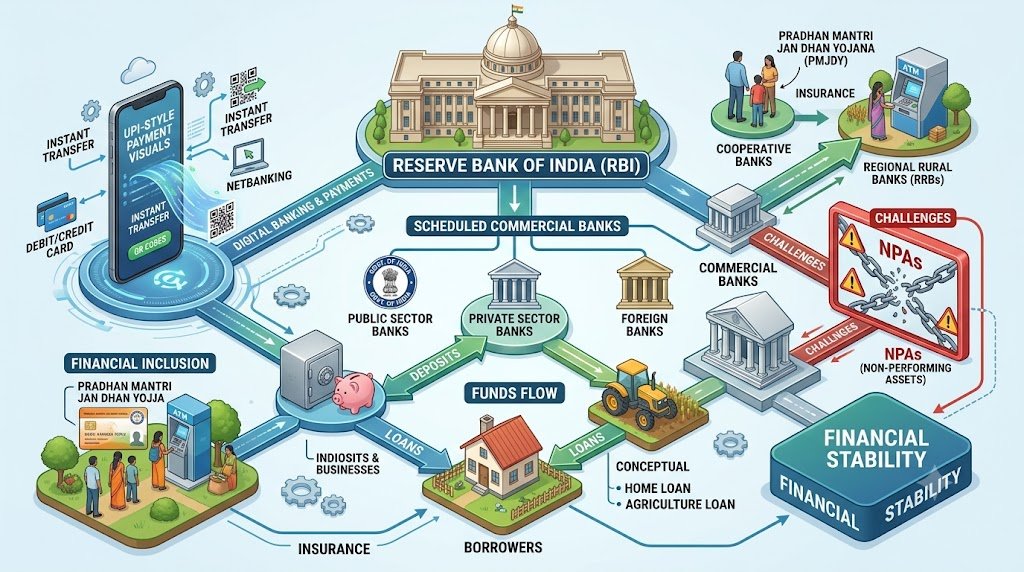
The Indian banking system includes several types of institutions.
Important categories include:
- Commercial Banks
- Regional Rural Banks
- Cooperative Banks
- Small Finance Banks
- Payments Banks
- Foreign Banks
- Development-oriented financial institutions
UPSC preparation should focus on the functions and distinguishing features of these institutions.
Non-Performing Assets and Banking Stress
A Non-Performing Asset (NPA) is a loan or advance that ceases to generate income for a bank according to applicable regulatory norms.
High NPAs can affect:
- Bank profitability
- Provisioning requirements
- Lending capacity
- Credit growth
- Investment
- Financial stability
The conceptual chain is important:
Bad Loans → Bank Balance Sheet → Credit Availability → Investment → Economic Growth
Financial Inclusion
Financial inclusion aims to make appropriate and affordable financial services accessible to a wider population.
It includes access to:
- Bank accounts
- Credit
- Insurance
- Pension
- Savings
- Digital payments
Financial inclusion is closely connected with:
- Poverty reduction
- Formalisation of the economy
- Direct Benefit Transfer
- Digital payments
- Women’s economic participation
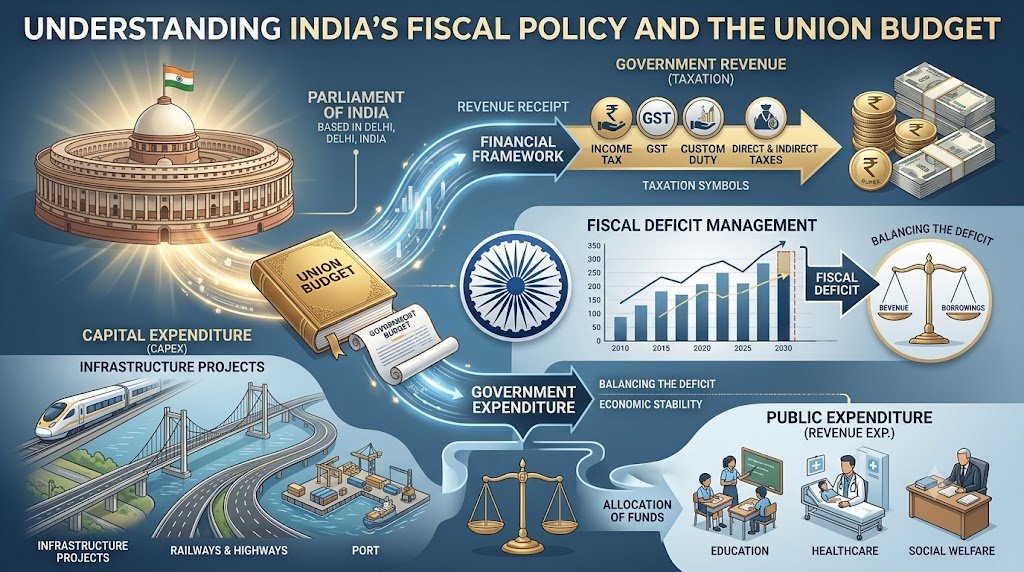
Fiscal Policy in India
Fiscal policy refers to government decisions concerning:
- Taxation
- Public expenditure
- Government borrowing
- Public debt
- Fiscal management
Fiscal policy can influence:
- Aggregate demand
- Economic growth
- Employment
- Inflation
- Income distribution
An expansionary fiscal approach may involve greater government spending or lower taxation, while fiscal consolidation focuses on improving the sustainability of public finances.
To strengthen their understanding of government revenue, taxation, expenditure and fiscal management, candidates can also practice our comprehensive Fiscal Policy UPSC Prelims 2027 MCQs.
Indian Economy UPSC Prelims 2027: Government Budget
The Union Budget is one of the most important sources for Economy current affairs.
Important concepts include:
- Revenue Receipts
- Capital Receipts
- Revenue Expenditure
- Capital Expenditure
- Fiscal Deficit
- Revenue Deficit
- Primary Deficit
- Public Debt
Fiscal Deficit, Revenue Deficit and Primary Deficit
These three concepts are extremely important for Prelims.
Fiscal Deficit
A simplified formula is:
Fiscal Deficit = Total Expenditure − Total Receipts excluding Borrowings
It indicates the government’s borrowing requirement.
Revenue Deficit
Revenue Deficit = Revenue Expenditure − Revenue Receipts
It indicates that revenue receipts are insufficient to meet revenue expenditure.
Primary Deficit
Primary Deficit = Fiscal Deficit − Interest Payments
It indicates the fiscal position after excluding interest payments on past debt.
UPSC Tip
Do not confuse:
Fiscal Deficit ≠ Revenue Deficit ≠ Primary Deficit
Taxation and GST
Taxes can broadly be classified as:
Direct Taxes
- Income Tax
- Corporate Tax
Indirect Taxes
- GST and other transaction-related taxes
The Goods and Services Tax (GST) is a major indirect-tax reform in India.
Important concepts include:
- GST Council
- CGST
- SGST
- IGST
- Input Tax Credit
- Destination-based taxation
- GST exemptions
- GST compensation-related issues
Aspirants should also understand that not every tax has been subsumed into GST.
Finance Commission and GST Council
The Finance Commission is a constitutional body dealing with important aspects of fiscal relations between the Union and the States.
Its recommendations include matters relating to:
- Distribution of tax revenues
- Grants-in-aid
- Measures concerning State resources
The GST Council is another important constitutional institution.
A useful Prelims comparison is:
Finance Commission → Fiscal transfers
GST Council → GST-related recommendations
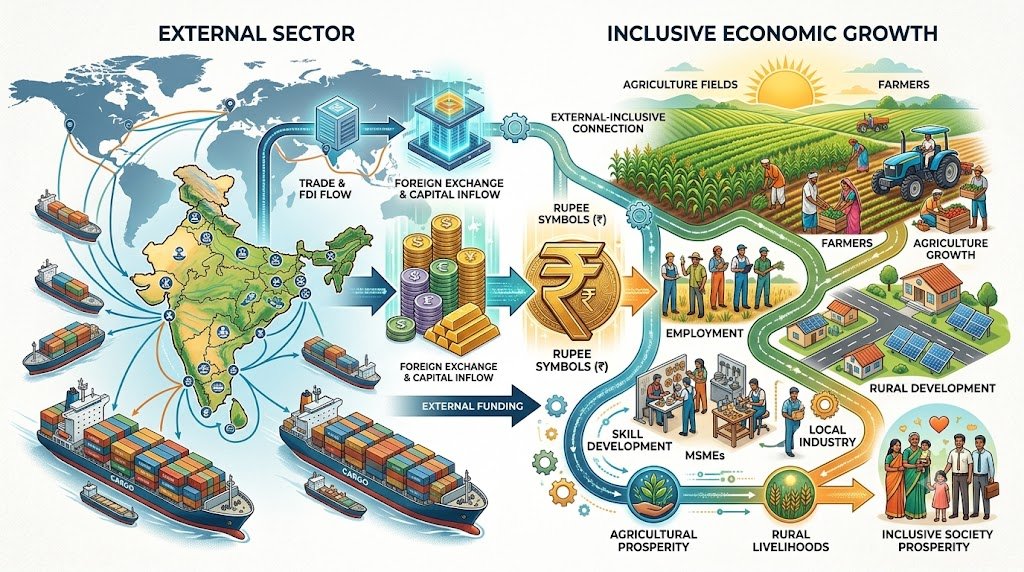
External Sector of the Indian Economy
The external sector covers India’s economic relationship with the rest of the world.
Important areas include:
- Balance of Payments
- Trade Balance
- Current Account
- Capital and financial flows
- Foreign Exchange Reserves
- Exchange Rate
- FDI
- FPI
- External Debt
- International Trade
These concepts frequently overlap with international economic current affairs.
Balance of Payments
The Balance of Payments (BoP) records economic transactions between residents of an economy and the rest of the world over a specified period.
Major components include:
- Current Account
- Capital/Financial Account
The current account broadly covers:
- Merchandise trade
- Services
- Primary income
- Secondary income
Understanding the structure is more important than memorising isolated figures.
Trade Deficit vs Current Account Deficit
A trade deficit occurs when the value of merchandise imports exceeds merchandise exports.
A Current Account Deficit (CAD) is broader and includes:
- Goods
- Services
- Income
- Transfers
Therefore, a merchandise trade deficit does not necessarily mean that the current account deficit will be of the same magnitude.
Strong services exports, for example, can affect the overall current-account position.
Foreign Exchange Reserves: Indian Economy UPSC Prelims 2027
Foreign exchange reserves are an important external-sector buffer.
They can help the economy by:
- Supporting external payment capacity
- Providing confidence during global financial stress
- Helping manage external shocks
- Supporting orderly functioning of foreign-exchange markets
For Prelims, understand the components and institutional role associated with India’s reserves.
Exchange Rate and Currency Movements
Currency Appreciation
A currency becomes stronger relative to another currency.
Currency Depreciation
A currency becomes weaker relative to another currency.
Currency depreciation can potentially:
- Make exports more competitive
- Make imports more expensive
- Increase imported inflation
- Affect external debt-servicing costs
However, the actual economic impact depends on several factors.
FDI vs FPI
Foreign Direct Investment (FDI) generally represents a relatively lasting interest and significant influence in an enterprise.
Foreign Portfolio Investment (FPI) generally involves investment in financial assets without the same degree of managerial influence associated with direct investment.
For UPSC, remember the broad distinction:
FDI → Direct/longer-term investment relationship
FPI → Portfolio investment in financial assets
Agriculture and the Indian Economy
Agriculture is closely connected with the broader economy through:
- Rural employment
- Food security
- Inflation
- Rural income
- Industrial demand
- Exports
- Poverty reduction
Important areas include:
- MSP
- Agricultural subsidies
- Procurement
- Food security
- PDS
- Agricultural credit
- Crop insurance
- Agricultural marketing
- Food processing
- Rural infrastructure
MSP and Agricultural Price Support
Minimum Support Price is an important agricultural policy instrument.
For UPSC, understand:
- Meaning of MSP
- Crops covered
- Role of CACP
- Procurement
- Relationship with market prices
- Food security implications
- Fiscal implications
A key conceptual point is:
Announcement of MSP does not mean unlimited procurement of every crop at MSP.
Poverty and Inclusive Growth
Economic growth becomes more meaningful when its benefits reach wider sections of society.
Important dimensions of inclusive growth include:
- Employment
- Financial inclusion
- Education
- Healthcare
- Infrastructure
- Social security
- Women’s participation
- Regional development
For UPSC, connect growth → employment → poverty → inequality → human development.
Unemployment and Labour Market
Important forms of unemployment include:
- Open unemployment
- Disguised unemployment
- Seasonal unemployment
- Structural unemployment
- Frictional unemployment
- Underemployment
Important labour-market indicators include:
- Labour Force Participation Rate
- Worker Population Ratio
- Unemployment Rate
These indicators should not be treated as interchangeable.
Demographic Dividend
A demographic dividend can emerge when a large proportion of the population is in the working-age group and the economy is capable of productively employing this workforce.
However, a large working-age population alone does not guarantee a demographic dividend.
It requires:
- Education
- Skills
- Healthcare
- Employment opportunities
- Productivity
- Labour-market participation
Economic Reforms Since 1991
The economic reforms initiated in 1991 are fundamental to understanding India’s modern economic structure.
Major themes include:
- Liberalisation
- Privatisation
- Globalisation
- Industrial deregulation
- Trade reforms
- Financial-sector reforms
- Foreign investment reforms
For UPSC, understand both:
Why were reforms introduced?
and
What structural changes did they produce?
Infrastructure and Capital Expenditure
Infrastructure plays an important role in long-term economic development.
Important sectors include:
- Roads
- Railways
- Ports
- Airports
- Energy
- Logistics
- Digital infrastructure
- Urban infrastructure
Capital expenditure is particularly important because it can create productive assets and improve long-term productive capacity.
This makes the distinction between capital expenditure and revenue expenditure important for Prelims.
Digital Economy and FinTech
India’s digital economy has become an increasingly important area of economic policy.
Important concepts include:
- UPI
- Digital payments
- FinTech
- Digital Public Infrastructure
- CBDC
- Digital lending
- Account Aggregator framework
- Blockchain
CBDC vs UPI vs Cryptocurrency
These three should never be treated as the same concept.
CBDC is digital sovereign money issued by a central bank.
UPI is a payment infrastructure/system facilitating bank-account-based digital payments.
Cryptocurrency refers to a different category of digital assets and should not be equated with sovereign central-bank money.
Sustainable Development and Green Economy
The Economy syllabus also connects with sustainable development.
Important concepts include:
- Green Economy
- Green GDP
- Carbon Markets
- Carbon Pricing
- Green Bonds
- Circular Economy
- Climate Finance
- Energy Transition
- Sustainable Infrastructure
The key question for UPSC is often how economic development can be achieved while reducing environmental costs.
Economic Survey for UPSC Prelims 2027
For Indian Economy UPSC Prelims 2027, the Economic Survey should be studied selectively, focusing on major trends, policy changes and important economic concepts.
The Economic Survey is an important source for understanding India’s economic performance, policy priorities and emerging challenges.
For Prelims, focus on:
- Economic growth
- Inflation
- Fiscal developments
- Banking
- External sector
- Agriculture
- Industry
- Services
- Employment
- Infrastructure
- Financial sector
- New economic trends
Do not try to memorise every statistic.
Instead, focus on:
New Term → Meaning → Trend → Reason → Government Response
The official Economic Survey portal should be used for the latest primary-source material. Economic Survey — Government of India
Union Budget and Economy Current Affairs
The Union Budget should be an important part of your current-affairs preparation.
Focus on:
- Fiscal deficit
- Public debt
- Capital expenditure
- Tax reforms
- Infrastructure
- Manufacturing
- Agriculture
- MSMEs
- Employment
- Financial sector
- Digital economy
- Energy
- New government initiatives
Do not attempt to memorise every budget allocation.
Instead ask:
What changed?
Why was it introduced?
Which institution is responsible?
What economic concept does it represent?
RBI Current Affairs for UPSC Prelims 2027
The RBI should be followed regularly during your preparation.
Important areas include:
- Monetary policy
- Inflation
- Banking regulations
- Liquidity
- Financial stability
- Digital payments
- CBDC
- Credit growth
- Financial-sector reforms
The most important RBI developments should always be connected with the underlying static concept.
For example:
Repo Rate Decision → Monetary Policy
Banking Regulation → Financial Stability
Rupee Movement → Exchange Rate
CBDC Update → Digital Economy
Government Schemes and Indian Economy
Many government schemes have a direct or indirect connection with Economy.
Important areas include:
- Financial inclusion
- Agriculture
- Rural development
- Employment
- Skill development
- Entrepreneurship
- Infrastructure
- Social security
- Manufacturing
For example, schemes related to financial inclusion should be studied alongside banking and digital payments rather than as isolated facts.
How UPSC Frames Economy Questions
UPSC Economy questions are often conceptual and statement-based.
Common patterns include:
Statement-Based Questions
Consider the following statements regarding inflation…
Institution-Based Questions
Which of the following functions are performed by the RBI?
Comparison Questions
Consider the following differences between FDI and FPI…
Cause-and-Effect Questions
Which of the following are likely consequences of currency depreciation?
Current Affairs-Based Questions
A recent economic development may be used to test a static concept.
Therefore, preparation should focus on:
- Concepts
- Relationships
- Institutions
- Causes
- Effects
- Policy mechanisms
- Current developments
Most Important Economy Topics for UPSC Prelims 2027
Very High Priority
- GDP
- National Income
- Inflation
- CPI and WPI
- Monetary Policy
- Repo Rate
- MPC
- Banking
- NPA
- Fiscal Deficit
- Revenue Deficit
- Primary Deficit
- Government Budget
- GST
- Balance of Payments
- Current Account Deficit
- Exchange Rate
- FDI and FPI
- Financial Inclusion
High Priority
- MSP
- Agricultural Subsidies
- Food Security
- Employment
- Poverty
- Inclusive Growth
- Infrastructure
- Economic Reforms
- Digital Economy
- CBDC
- Green Economy
Current Affairs Priority
- Union Budget
- Economic Survey
- RBI Monetary Policy
- Major tax reforms
- Banking regulations
- Government economic schemes
- Trade agreements
- Global economic developments
- Financial-sector reforms
Economy PYQ Strategy for UPSC Prelims 2027
A successful Indian Economy UPSC Prelims 2027 strategy should connect static Economy concepts with PYQs, Budget, Economic Survey and RBI updates.
Previous Year Questions should be used to understand how UPSC thinks.
Use this sequence:
Concept → PYQ → Analyse Options → Identify Trap → Revise Concept
Do not merely check whether your answer was right or wrong.
For every PYQ, ask:
- Why is the correct option correct?
- Why are the other options incorrect?
- Which concept is being tested?
- Can UPSC change the wording and ask the same concept again?
The official UPSC website provides previous Civil Services Preliminary question papers for systematic practice. UPSC Previous Year Question Papers — Official Website
Best Strategy to Study Economy for UPSC Prelims 2027
Follow a structured approach rather than reading everything randomly.
Step 1: Build the Conceptual Foundation
Start with:
- GDP
- Inflation
- Monetary Policy
- Banking
- Fiscal Policy
- Budget
- Taxation
- External Sector
Step 2: Solve Previous Year Questions
Analyse the concepts and patterns behind the questions.
Step 3: Add Current Affairs
Connect economic news with static concepts.
Step 4: Read the Economic Survey Selectively
Focus on major trends, terminology and policy developments.
Step 5: Study the Union Budget
Focus on economic policy rather than memorising every allocation.
Step 6: Follow RBI Updates
Pay special attention to monetary policy and banking developments.
Step 7: Practise Statement-Based MCQs
Focus on elimination, conceptual clarity and application.
Quick Revision: Indian Economy Concepts
| Topic | Key Concept |
|---|---|
| GDP | Domestic production |
| GNP | GDP adjusted for net factor income from abroad |
| Real GDP | Output measured after adjusting for price effects |
| Nominal GDP | Output measured at current prices |
| Inflation | Sustained rise in general price level |
| CPI | Consumer-level price changes |
| WPI | Wholesale-level price changes |
| Repo Rate | Important monetary-policy rate |
| MPC | Monetary policy decision-making body |
| NPA | Non-performing bank asset under regulatory norms |
| Fiscal Deficit | Government financing gap |
| Revenue Deficit | Revenue expenditure exceeds revenue receipts |
| Primary Deficit | Fiscal deficit minus interest payments |
| GST | Major indirect-tax framework |
| BoP | Transactions with the rest of the world |
| CAD | Current-account imbalance |
| FDI | Direct foreign investment |
| FPI | Portfolio investment |
| MSP | Agricultural price-support mechanism |
| CBDC | Digital sovereign currency issued by a central bank |
Common Mistakes in Economy Preparation
Memorising Numbers Without Understanding Concepts
Economic figures change regularly.
Concepts and mechanisms are more important for long-term preparation.
Studying Current Affairs in Isolation
Every important economic news item should be connected to a static concept.
Ignoring RBI Developments
Monetary policy and banking developments are important parts of Economy preparation.
Treating Every Budget Announcement as Equally Important
Focus on significant policy changes, institutions and economic implications.
Solving Only Factual MCQs
Practise statement-based and analytical questions because they better reflect the conceptual nature of UPSC Prelims.
Ignoring PYQs
PYQs reveal the level, wording and conceptual depth expected by UPSC.
Recommended Economy Study Resources
A complete preparation plan can combine this pillar article with dedicated topic-wise resources.
You can create separate articles for:
- GDP and National Income
- Inflation
- Monetary Policy
- Banking
- Fiscal Policy
- Government Budget
- GST
- Balance of Payments
- FDI and FPI
- Agriculture Economy
- Poverty and Employment
- Digital Economy
- Economy Current Affairs
- Economy MCQs
This creates a strong Economy content cluster and also allows students to move from basic concepts to advanced revision.
Frequently Asked Questions
Is Economy important for UPSC Prelims 2027?
Yes. Economic and Social Development is part of the UPSC Civil Services Preliminary examination syllabus, and Economy also overlaps with current affairs, agriculture, government schemes, environment and international developments.
Which Economy topics should I study first?
Start with GDP and National Income, Inflation, Monetary Policy, Banking, Fiscal Policy, Budget, Taxation and the External Sector.
Should I read the Economic Survey for Prelims?
Yes, but selectively. Focus on important concepts, economic trends, new terminology, policy developments and data that can potentially generate objective questions.
Is the Union Budget important for UPSC Prelims?
Yes. Focus on fiscal policy, taxation, capital expenditure, government initiatives, economic reforms and institutional changes.
How should I prepare Economy Current Affairs?
Connect every major economic development with a static concept.
For example:
RBI rate decision → Monetary Policy
Rupee movement → Exchange Rate
Trade development → Balance of Payments
Budget announcement → Fiscal Policy
Banking regulation → Financial System
Agricultural policy → Rural Economy
Final Revision Strategy for Indian Economy UPSC Prelims 2027
The most effective approach is to study Economy as an interconnected system.
Remember these relationships:
Inflation ↔ Monetary Policy
Fiscal Deficit ↔ Government Borrowing ↔ Public Debt
Exchange Rate ↔ Imports ↔ Exports ↔ Inflation
Banking ↔ Credit ↔ Investment ↔ Growth
Agriculture ↔ Food Prices ↔ Rural Income ↔ Inflation
Financial Inclusion ↔ Digital Economy ↔ Formalisation
Economic Growth ↔ Employment ↔ Poverty ↔ Inclusive Development
The objective should not be to memorise every economic fact. Instead, develop the ability to understand why an economic event occurs, which institution is responsible, what its consequences may be and how it connects with the broader economy.
These interconnected concepts form the core of Indian Economy UPSC Prelims 2027 preparation.
The UPSC Economy Formula
Learn the Concept → Understand the Mechanism → Solve PYQs → Connect Current Affairs → Practise MCQs → Revise
That approach can make Indian Economy for UPSC Prelims 2027 a much more manageable and scoring area of your preparation.
The official Union Budget portal should be used for authentic budget documents and fiscal-policy statements. Union Budget — Government of India
4 thoughts on “Indian Economy UPSC Prelims 2027: Inevitable Essential Notes, Concepts & Current Affairs”