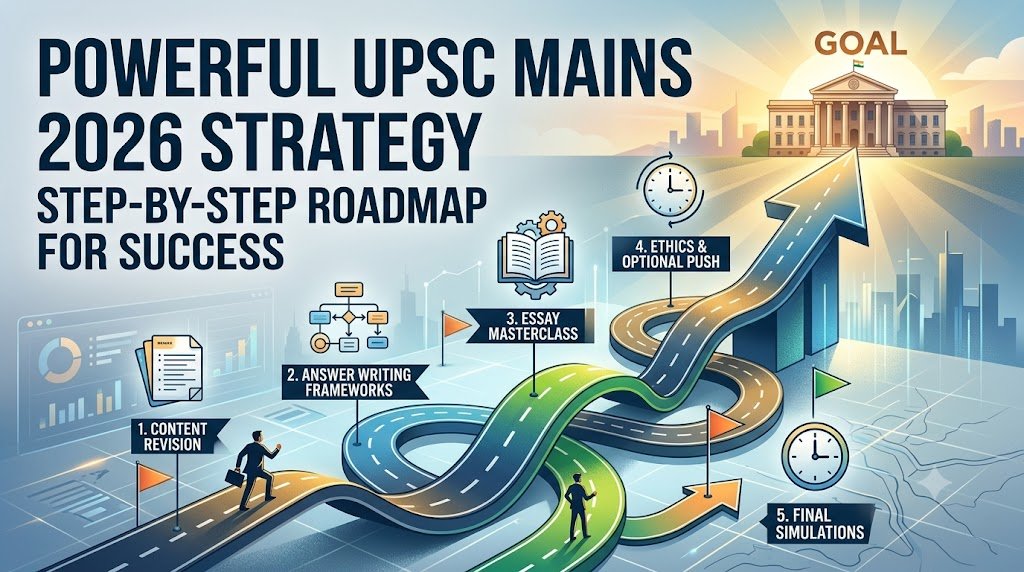
Looking for a high-scoring UPSC Mains 2026 Strategy to stand out in the written examination? Clearing the UPSC Prelims is merely a test of elimination, but UPSC Mains is a test of selection. Prelims demands recognition; Mains demands recollection, structure, and speed under extreme pressure.
With the exam officially set to begin on August 21, 2026 as per the official UPSC exam calendar, the clock is ticking This isn’t the time to digest new 500-page textbooks. It’s time to consolidate, refine your presentation, and turn static knowledge into high-scoring answer scripts using a battle-tested roadmap.
This UPSC Mains 2026 Strategy is designed to help aspirants maximize their scores through structured preparation, consistent answer writing, and smart revision.
UPSC Mains 2026 Time-Table at a Glance
Aligning your revision with this exam schedule is a critical component of any effective UPSC Mains 2026 strategy.
UPSC Mains 2026 is spread over two weekends, giving you crucial days in between to rest and do final micro-revisions:
| Date | Session 1 (9:00 AM – 12:00 PM) | Session 2 (2:30 PM – 5:30 PM) |
| Aug 21, 2026 (Fri) | Paper-I: Essay | No Paper |
| Aug 22, 2026 (Sat) | Paper-II: General Studies I | Paper-III: General Studies II |
| Aug 23, 2026 (Sun) | Paper-IV: General Studies III | Paper-V: General Studies IV (Ethics) |
| Aug 29, 2026 (Sat) | Paper-A: Indian Language (Qualifying) | Paper-B: English (Qualifying) |
| Aug 30, 2026 (Sun) | Paper-VI: Optional Paper 1 | Paper-VII: Optional Paper 2 |
🚀 The 4 Pillars of Mains Domination
                     ┌───────────────────────────────────────┐
                     │       4 PILLARS OF MAINS SUCCESS      │
                     └───────────────────┬───────────────────┘
                                         │
       ┌─────────────────┬───────────────┴───────────────┬─────────────────┐
       ▼                 ▼                               ▼                 ▼
┌──────────────┐  ┌──────────────┐               ┌──────────────┐  ┌──────────────┐
│  PILLAR 1    │  │  PILLAR 2    │               │  PILLAR 3    │  │  PILLAR 4    │
│  Content     │  │  Answer      │               │  The 500-Mark│  │  Optional    │
│ Condensation │  │  Framework   │               │  Rank Decider│  │  Subject     │
└──────────────┘  └──────────────┘               └──────────────┘  └──────────────┘
The four pillars together form a practical UPSC Mains 2026 Strategy that balances content mastery with effective answer presentation.
Pillar 1: Content Condensation (Micro-Notes)
Most candidates fail not because they lack knowledge, but because they can’t recall relevant facts in the 7 minutes allowed per question.
The 1-Page Rule: For every major syllabus topic (e.g., Urbanization, SHGs, Indo-Pacific, Disaster Management), compile a 1-page sheet containing:
1-2 standard definitions
3 key data points/statistics (NITI Aayog, NCRB, World Bank)
Relevant Constitutional Articles or Committee Recommendations
3 pros, 3 cons, and a forward-looking conclusion
Value-Addition Bank: Maintain a separate 10-page notebook dedicated purely to case studies, Supreme Court judgments, diagrams, schematic maps, and quotes.
A successful UPSC Mains 2026 Strategy begins with concise, revision-friendly notes prepared from reliable standard sources.
Pillar 2: The Master Answer Writing Framework
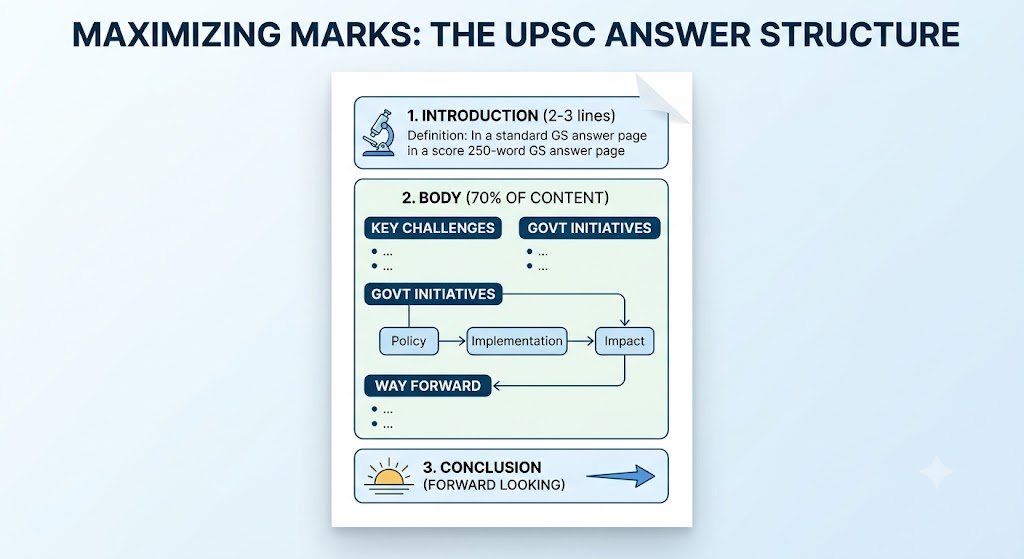
An answer sheet evaluated by an examiner gets roughly 2 to 3 minutes per question. Your layout must make marking effortless for them.
Mastering this formatting technique is an essential pillar of your UPSC Mains 2026 strategy if you want to maximize your marks per page.
Structure of a 250-Mark-Worthy Answer:
Introduction (15-20%): Define the core term, quote a recent event, or cite a statistic. Keep it under 3 lines.
Body (70%): Divide into clear subheadings directly reflecting the directive words in the prompt (Analyze, Evaluate, Critically Examine).
Use bullet points instead of long paragraphs.
Interspersing small flowcharts or hub-and-spoke diagrams increases scannability.
Conclusion (10-15%): Positive, forward-looking, and aligned with government policies (e.g., SDAI, Viksit Bharat @2047).
Daily answer writing is one of the most important components of any UPSC Mains 2026 Strategy for improving speed, structure, and clarity.
Pillar 3: The 500-Mark Rank Deciders (Essay & Ethics)
GS 1, GS 2, and GS 3 often see candidates scoring in a narrow range (80–100 marks). The real rank gaps (30–50+ marks) are created in Essay (250 Marks) and GS 4 Ethics (250 Marks).
Essay Strategy
Philosophical Essays: Practice deconstructing abstract themes (e.g., “Wisdom finds truth”). Structure them using the PESTLE approach (Political, Economic, Socio-Cultural, Technological, Legal, Environmental) to maintain depth across 1,000–1,200 words.
Topic Selection: Choose the essay prompt where you have concrete examples, not just emotional rhetoric.
Ethics (GS 4) Strategy
Theory Section: Memorize exact definitions and real-life examples for key terms (Integrity, Probity, Empathy, Accountability).
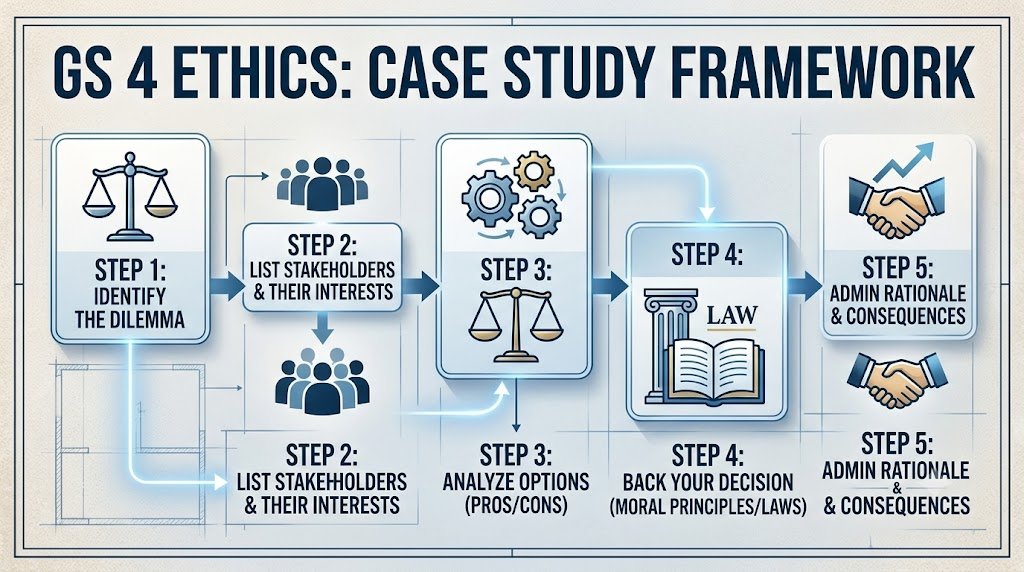
Case Studies: Always identify all stakeholders, list out ethical dilemmas explicitly, evaluate options along with their consequences, and back your final decision with administrative rationale and moral principles.
Essay and Ethics preparation should be integrated into your UPSC Mains 2026 Strategy rather than treated as separate subjects.
Pillar 4: Optional Subject Mastery
Your optional subject carries 500 marks (Papers VI & VII). Aiming for 280+ marks is non-negotiable if you want a top-100 AIR.
Paper 1 vs. Paper 2 Integration: Link theoretical frameworks from Paper 1 directly to real-world applied examples in Paper 2 (and vice versa).
Keywords Usage: Use subject-specific terminology heavily (e.g., Geomorphic cycles in Geography, Constitutionalism in PSIR, Structural-Functionalism in Sociology).
🗓️ Final 30-Day Countdown Execution Plan
┌────────────────────────────────────────────────────────────────────────┐
│ Days 30 to 21 | High-Yield Revision & Optional Push                    │
│ • Daily: 4 hrs Optional + 4 hrs GS (GS 1 & GS 2 focus)                 │
│ • Weekly: 1 Full-Length Essay Mock                                     │
├────────────────────────────────────────────────────────────────────────┤
│ Days 20 to 11 | Ethics, GS 3, GS 4 & Value Addition                    │
│ • Complete GS 3 & GS 4 rapid revision                                  │
│ • Memorize case studies, SC judgments, statistics                      │
│ • Practice 3-4 timed answers daily                                     │
├────────────────────────────────────────────────────────────────────────┤
│ Days 10 to 1 | Final Simulation & Sprint                               │
│ • Revise 1-page micro-notes ONLY                                       │
│ • Solve 1 qualifying language paper (Paper A & B) to ensure safety     │
│ • Rest well and simulate exam morning routines                         │
└────────────────────────────────────────────────────────────────────────┘
Following this UPSC Mains 2026 Strategy consistently during the final month can significantly improve confidence and revision efficiency.
Critical Errors That Cost Candidates Their Rank
Over-collecting Materials: Adding a new current affairs compilation 2 weeks before Mains creates panic. Trust your existing primary notes.
Ignoring Timed Practice: Writing 20 questions continuously for 3 hours twice a day requires muscle memory. Without full-length simulations, hands cramp by GS 3.
Neglecting Qualifying Papers: Every year, several high-performing candidates get disqualified because they took Paper A or Paper B (Languages) lightly. Solve at least 2 past-year papers.
Leaving Questions Unattempted: Leaving a 10-marker completely blank means 0 marks. Write a well-structured, logical answer using basic core principles rather than leaving it empty.
Recommended Posts
Modern History Strategy for UPSC Mains GS Paper 1: Complete Guide & Study Plan
How to Score 120+ in GS Paper 1: Powerful UPSC Mains Strategy
UPSC Mains 2026 GS1 Art and Culture Notes: Complete Study Guide for Success
The Ultimate Guide to Bharatanatyam UPSC Notes: Master GS 1 Art & Culture
Master Guide: Indian Classical And Folk Music UPSC Mains 2026 (GS 1)
Indian Art Forms (Dance, Music, Painting) UPSC Mains 2026 GS Paper 1: Ultimate Success Guide
❓ Frequently Asked Questions (FAQs)
Q1. How many full-length mock tests should I write before Mains 2026?
Writing 8 to 12 FLTs (Full-Length Tests)—including 2 Essays, 4 GS, and 4 Optional tests—is ideal. More importantly, analyze your evaluated copies to identify structural flaws.
Q2. Is current affairs more important than static syllabus in Mains?
Mains relies on an interlingual blend. Pure current affairs questions are rare; instead, recent news serves as the context, while the core syllabus forms the base of the answer.
Q3. How do I manage time between Paper 1 and Paper 2 on the same day?
Use the 2.5-hour break between shifts to eat a light lunch, stay hydrated, and quickly skim your 1-page formula/keyword sheets. Avoid discussing the morning paper with peers.
If implemented with discipline, this UPSC Mains 2026 Strategy can help aspirants avoid common mistakes and perform better under exam pressure.
Final Thought
Ultimately, the success of your UPSC Mains 2026 Strategy depends on regular revision, mock practice, and disciplined execution every day.
UPSC Mains is not an examination of perfection; it is an examination of consistency across all 9 papers. Stay disciplined, stick to your micro-notes, and execution will follow.
By executing this structured UPSC Mains 2026 strategy, stay disciplined, stick to your micro-notes, and confidence will follow.
4 thoughts on “Powerful UPSC Mains 2026 Strategy: Step-by-Step Roadmap for Success”