Ancient History is an important part of the History section of UPSC Prelims. Questions can cover prehistoric cultures, the Indus Valley Civilization, Vedic society, Buddhism and Jainism, the Mauryan period, Sangam traditions, the Gupta period and early medieval developments.
This practice set contains 100 Ancient History MCQs for UPSC Prelims 2027 covering these major themes. The questions are designed to help aspirants revise important concepts, test factual understanding and identify areas that require further study.
Use these questions alongside the UPSC syllabus, standard Ancient History resources and previous-year questions for a balanced preparation.
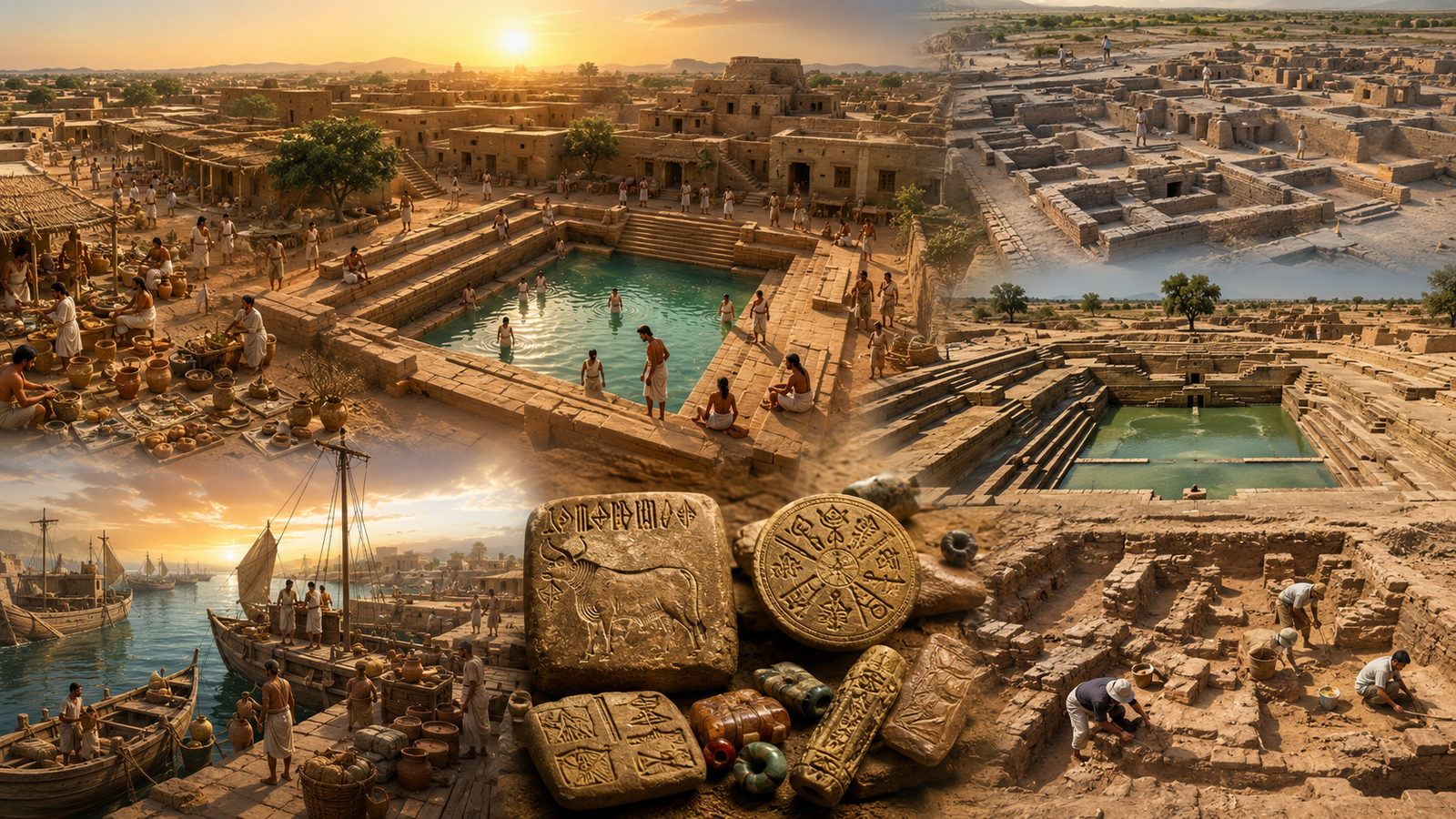
SECTION 1: Ancient History MCQs for UPSC Prelims: Prehistory, Indus Valley Civilization, & Harappan Settlements (Questions 1–20)
To begin your practice, this first module focuses on prehistoric tools and Indus Valley sites, providing essential Ancient History MCQs for UPSC Prelims that target the roots of Indian civilization.
Q1. Which of the following sites provides a continuous sequence of culture from the Aceramic Neolithic to the Mature Harappan period?
(a) Kalibangan
(b) Kot Diji
(c) Mehrgarh
(d) Amri
Q2. With reference to the religious practices of the Indus Valley Civilization, consider the following statements:
1. The discovery of fire altars at both Kalibangan and Lothal suggests regional variations in ritual practices.
2. The prevalence of an organized, dominant priestly class is clearly proven by the uniform presence of large monumental temples in every major Harappan city.
3. The “Pashupati Mahadeva” seal depicts a deity seated in a yogic posture, surrounded exclusively by domesticated animals.
**Which of the statements given above is/are correct?**
(a) 1 only
(b) 1 and 2 only
(c) 2 and 3 only
(d) 1, 2, and 3
Q3. In the context of Harappan external trade, the ancient Mesopotamian cuneiform inscriptions mention trade relations with a land called ‘Meluhha’. **Which region does ‘Meluhha’ refer to?**
(a) Dilmun (Bahrain)
(b) Makan (Oman coast)
(c) The Indus Valley Region
(d) The Iranian Plateau
Q4. Consider the following statements regarding the Neolithic site of Burzahom in Jammu and Kashmir:
1. Oval-shaped pit-dwellings dug into the natural soil are a defining architectural feature of this site.
2. The unique practice of burying domestic dogs along with their masters in graves is documented here.
3. The site is entirely devoid of any bone tools, relying strictly on polished stone celts.
**Which of the statements given above are correct?**
(a) 1 and 2 only
(b) 2 and 3 only
(c) 1 and 3 only
(d) 1, 2, and 3
Q5. Which Harappan site has yielded the unique archaeological find of a signboard containing ten large-sized characters of the Harappan script?
(a) Rakhigarhi
(b) Banawali
(c) Dholavira
(d) Chanhudaro
Q6. With reference to Harappan crafts and metallurgy, consider the following statements:
1. The “Lost Wax” technique (*cire perdue*) was widely employed for casting bronze statues.
2. The Harappans were well-versed in the metallurgical properties of iron, which they used extensively to manufacture heavy plowshares.
3. Chanhudaro operated as a specialized center for bead-making, shell-working, and weight-making.
**Which of the statements given above is/are correct?**
(a) 1 only
(b) 1 and 3 only
(c) 2 and 3 only
(d) 1, 2, and 3
Q7. Which of the following statements regarding the urban drainage system of the Harappan civilization is incorrect?
(a) Every house had its own courtyard, bathroom, and a brick-lined drain connecting to the street sewer.
(b) Street drains were entirely left open to the elements to ensure natural evaporation of greywater.
(c) Inspection traps or removable stone slabs were provided at regular intervals for clearing blockages.
(d) Soak pits or sumps were integrated into the drainage channels to collect solid waste before water entered the main sewers.
Q8. The copper-hoard culture of protohistoric India is most frequently associated with which of the following ceramic traditions?
(a) Northern Black Polished Ware (NBPW)
(b) Painted Grey Ware (PGW)
(c) Ochre Coloured Pottery (OCP)
(d) Black and Red Ware (BRW)
Q9. Consider the following pairs of Indus Valley sites and their geographic locations:
1. **Manda** – Jammu and Kashmir
2. **Sutkagendor** – Makran Coast, Pakistan
3. **Alamgirpur** – Uttar Pradesh
4. **Hulas** – Gujarat
**How many of the pairs given above are correctly matched?**
(a) Only one pair
(b) Only two pairs
(c) Only three pairs
(d) All four pairs
Q10. With reference to the internal socio-political administration of the Harappan civilization, **which of the following is the most plausible inference drawn from archaeological data?**
(a) The absolute absence of standard measures and weights suggests highly localized, decentralized barter economies.
(b) The extreme uniformity in brick ratios ($4:2:1$), layout planning, and pottery styles implies some form of centralized civic authority.
(c) The discovery of hundreds of mass royal graves confirms the existence of a highly militarized monarchy.
(d) Written municipal charters found in public squares outline a functioning democratic senate.
Q11. The site of Sanauli, which recently made headlines for the discovery of absolute elite warrior burials, copper-sheeted wheeled carts, and bronze swords, belongs to which phase?
(a) Early Harappan Phase
(b) Late Harappan / Chalcolithic Transition Phase
(c) Early Vedic Period
(d) Northern Black Polished Ware Phase
Q12. Consider the following statements about Harappan agriculture:
1. Evidence from Lothal and Rangpur indicates that rice husk was utilized in pottery making, suggesting early rice cultivation.
2. The Harappans predominantly engaged in winter crop cultivation (*Rabi* cycle) due to dependency on seasonal river inundation.
3. Direct evidence of a canal-based irrigation network has been found carved into stone at Kalibangan.
**Which of the statements given above is/are correct?**
(a) 1 and 2 only
(b) 2 only
(c) 1 and 3 only
(d) 1, 2, and 3
Q13. In the context of ancient Indian history, the site of Attirampakkam near Chennai is globally significant for providing pioneering evidence of:
(a) The earliest domestication of Indian humped cattle (*Bos indicus*).
(b) A continuous evolution from the Lower Paleolithic Acheulian culture down to the Middle Paleolithic.
(c) The production of fine muslin cloth exported to ancient Rome.
(d) The earliest rock-cut cave paintings depicting group dancing.
Q14. Which Harappan site is uniquely characterized by the total absence of a separate fortified Citadel area?
(a) Mohenjo-daro
(b) Harappa
(c) Chanhudaro
(d) Kot Diji
Q15. With reference to Chalcolithic cultures in India, consider the following statements:
1. The Kayatha and Ahar-Banas cultures flourished primarily in Central India and Rajasthan long before the Iron Age.
2. The Daimabad site of the Jorwe culture provides evidence of a massive settlement fortified with a mud wall and bastions.
3. Chalcolithic populations were highly urbanized, successfully building multi-story brick complexes across Central India.
**Which of the statements given above is/are correct?**
(a) 1 only
(b) 1 and 2 only
(c) 2 and 3 only
(d) 1, 2, and 3
Q16. What does the presence of steatite seals featuring a unicorn motif throughout the Harappan sphere indicate?
(a) The existence of a common state religion centered on mythological beast worship.
(b) An administrative or commercial tool used for sealing merchandise or certifying property ownership.
(c) Standardized currency coins minted by a central Mauryan state.
(d) Votive tablets used exclusively for ancestral funerary rituals.
Q17. The archaeological site of Balathal is associated with which protohistoric culture?
(a) Malwa Culture
(b) Ahar-Banas Culture
(c) Jorwe Culture
(d) Savalda Culture
Q18. With reference to the script of the Indus Valley Civilization, **which of the following statements is historically accurate?**
(a) The script was definitively deciphered by John Marshall using a trilingual inscription stone.
(b) It is an alphabetic script consisting of exactly 26 letters similar to ancient Phoenician.
(c) The writing style is logo-syllabic and predominantly follows a Boustrophedon pattern (written from right to left in one line, and left to right in the next).
(d) The script is identical to the early Brahmi script found in Ashokan edicts.
Q19. Which of the following micro-regions is known for its high concentration of “Microlithic” tool manufacturing sites, earning it the label of the *Teri* sites?
(a) Belan Valley, Uttar Pradesh
(b) Hunsgi Valley, Karnataka
(c) Coastal Sand Dunes of Thoothukudi, Tamil Nadu
(d) Didwana, Rajasthan
Q20. The iconic “Priest-King” stone sculpture and the bronze “Dancing Girl” were excavated from which Harappan urban settlement?
(a) Harappa
(b) Dholavira
(c) Mohenjo-daro
(d) Rakhigarhi
ANSWERS & EXPLANATIONS SECTION 1 (1-20): Ancient History MCQs for UPSC Prelims
To help you analyze your score on these **Ancient History MCQs for UPSC Prelims**, review the detailed breakdowns below to identify core gaps in your prehistoric and Harappan conceptual framework.
Q1. **Answer: (c)** **Explanation:** Mehrgarh provides an uninterrupted sequence showing the transition from a pre-pottery aceramic hunting-farming stage (circa 7000 BCE) down to an organized ceramic-producing chalcolithic era that eventually connected into the early Harappan grid.
Q2. **Answer: (a)** **Explanation:** Statement 1 is correct: Fire altars inside clay platforms have been uncovered at Kalibangan and Lothal, pointing toward unique localized sacrificial rituals. Statement 2 is incorrect: No temples or grand religious monuments have been found in IVC sites. Statement 3 is incorrect: The Pashupati seal shows wild and dangerous forest animals (rhino, buffalo, elephant, tiger) along with deer below his seat, not domestic farm animals.
Q3. **Answer: (c)** **Explanation:** Sargon of Akkad’s inscriptions in Mesopotamia refer directly to trade fleets coming from Meluhha, which corresponds geographically and textually to the Indus Valley civilization.
Q4. **Answer: (a)** **Explanation:** Statements 1 and 2 are correct: Burzahom is famous for subterranean pit houses built to combat freezing Himalayan temperatures and unique double-burials of humans alongside domestic dogs. Statement 3 is incorrect: Burzahom is unique precisely for its extensive repertoire of sophisticated bone tools (needles, harpoons, awls) used alongside polished stone.
Q5. **Answer: (c)** **Explanation:** When analyzing core Harappan structural discoveries for Ancient History MCQs for UPSC Prelims, the unique water management and monumental signage elements of the Rann of Kutch region are critical. Excavations at Dholavira brought to light a large wooden board containing 10 symbols of the Harappan script, likely used as an outer city gateway signboard.
Q6. **Answer: (b)** **Explanation:** Statements 1 and 3 are correct: The famous bronze dancing girl shows their mastery of lost-wax casting. Chanhudaro was a pure manufacturing powerhouse specializing in luxury bead crafts. Statement 2 is incorrect: The Harappans lived in a Bronze Age matrix; they were completely oblivious to iron technology, which developed in India centuries later around 1000 BCE.
Q7. **Answer: (b)** **Explanation:** Option (b) is completely false: Street drains were systematically covered with loose brick tiles or flat stone flags to preserve public sanitation, stop smells, and prevent contamination.
Q8. **Answer: (c)** **Explanation:** When addressing ceramic horizons in Ancient History MCQs for UPSC Prelims, it is essential to connect tool types with pottery stratigraphy. The large copper hoards discovered across the Gangetic basin are found in direct archaeological association with Ochre Coloured Pottery (OCP) horizons.
Q9. **Answer: (c)** **Explanation:** Manda (North), Sutkagendor (West), and Alamgirpur (East) are correct geographic boundary markers of the Harappan expanse. Hulas is an important Late Harappan site located in Uttar Pradesh, not Gujarat. Thus, three pairs are matched correctly.
Q10. **Answer: (b)** **Explanation:** When solving these specific Ancient History MCQs for UPSC Prelims, it is vital to note that the presence of highly centralized civic planning forms the core argument against decentralized barter economies. The extreme uniformity in brick ratios ($4:2:1$), highly planned layout grids, standardized pottery styles, and identical cubical stone weights across thousands of miles across the subcontinent leads historians to conclude that an active municipal authority or centralized state machinery existed to regulate daily civic life.
Q11. **Answer: (b)** **Explanation:** Sanauli (Baghpat district, UP) revealed elite burials containing copper-reinforced chariots and shields dating back to the late Harappan/Chalcolithic horizon (circa 2000–1800 BCE).
Q12. **Answer: (a)** **Explanation:** Statements 1 and 2 are correct: Rice husks embedded in clay pottery were discovered at Lothal and Rangpur. Harappans utilized floodwaters to cultivate winter crops like barley, wheat, and mustard. Statement 3 is incorrect: A network of complex rock-cut reservoirs exists at Dholavira, but no stone-carved canal networks exist at Kalibangan (which instead features a ploughed field).
Q13. **Answer: (b)** **Explanation:** Attirampakkam is a world-renowned prehistoric site yielding Acheulian stone tools, demonstrating an uninterrupted Lower to Middle Paleolithic human presence.
Q14. **Answer: (c)** **Explanation:** Unlike Mohenjo-daro or Harappa, Chanhudaro has no high fortified citadel layout; it was structured as an open, industrial artisan town.
Q15. **Answer: (b)** **Explanation:** A recurring theme in Ancient History MCQs for UPSC Prelims is analyzing the socio-economic transitions between rural and urban prehistoric communities. Statements 1 and 2 are correct: Kayatha, Ahar, and Jorwe are critical protohistoric chalcolithic sites. Daimabad features intensive mud fortifications. Statement 3 is incorrect: Chalcolithic cultures were essentially rural agricultural settlements characterized by mud and wattle-and-daub houses; urbanization did not return until the Second Urbanization in the Ganges Valley.
Q16. **Answer: (b)** **Explanation:** Seals were used by long-distance merchants to stamp wet clay tags onto bundles of trade goods, serving as an immutable validation of origin and ownership.
Q17. **Answer: (b)** **Explanation:** Balathal (near Udaipur, Rajasthan) is a core site belonging to the Ahar-Banas chalcolithic culture, known for its early stone structures and domestic kiln technology.
Q18. **Answer: (c)** **Explanation:** The Harappan script remains undeciphered. It contains between 400 to 600 signs and was written in a Boustrophedon pattern (alternating directions line-by-line).
Q19. **Answer: (c)** **Explanation:** The Teri sites located along the coastal sand dunes of Thoothukudi district in Tamil Nadu are famous pre-historic factories that produced millions of tiny quartz microlithic tools.
Q20. **Answer: (c)** **Explanation:** Both the soapstone bust of the bearded “Priest-King” and the iconic bronze figurine of the “Dancing Girl” were unearthed from the ruins of Mohenjo-daro.
If you are revising Ancient Indian civilization for the first time, start with our comprehensive History Syllabus for UPSC Prelims 2027: Important Topics You Should Not Miss to build a strong foundation before solving these MCQs.
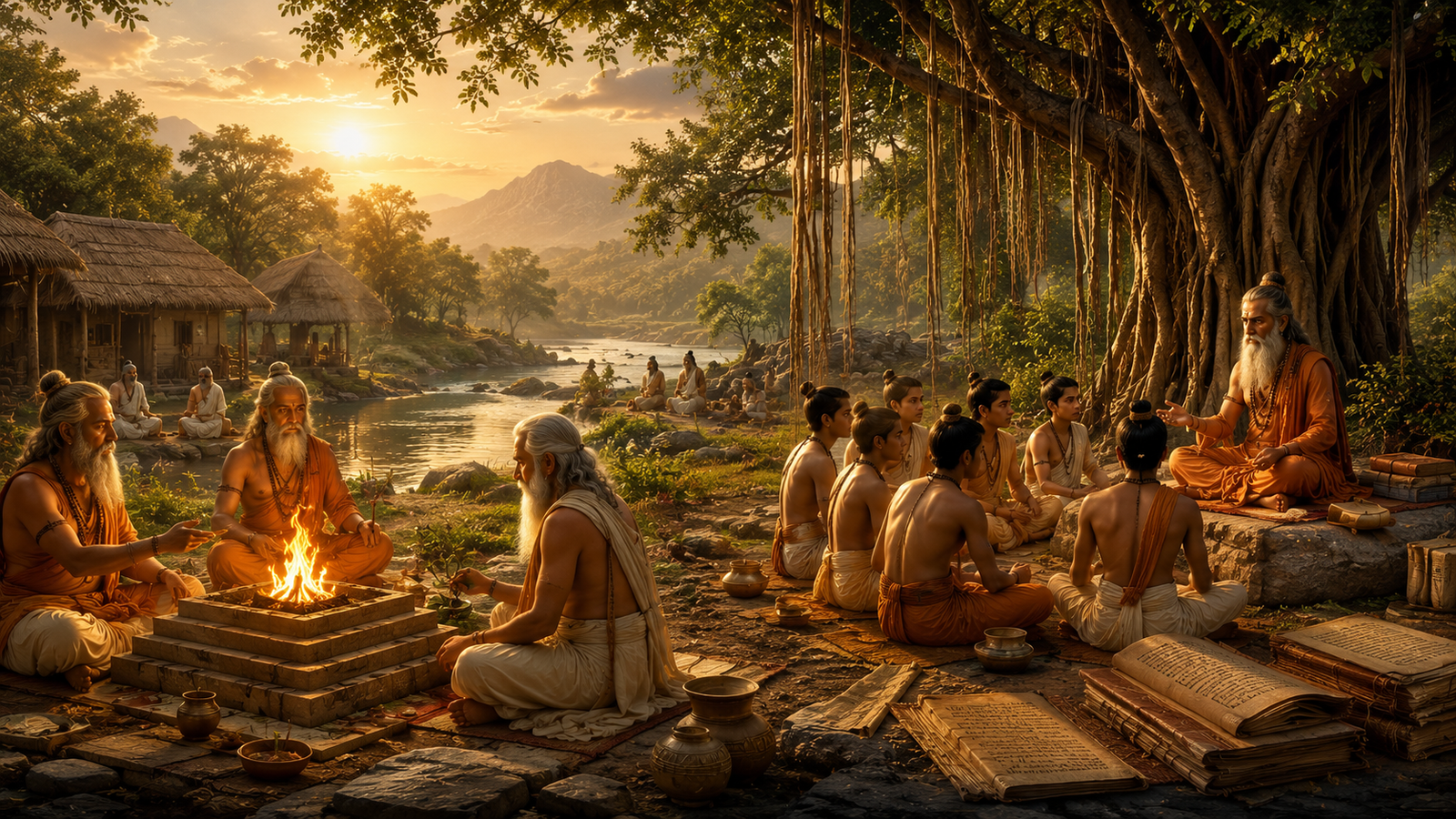
SECTION 2: Ancient History MCQs for UPSC Prelims: The Vedic Period, Upanishadic Philosophy, & The Rise of Mahajanapadas (Questions 21–40)
Moving forward into the iron age transformations, this second set of Ancient History MCQs for UPSC Prelims evaluates your understanding of early tribal polities and the birth of the sixteen great states.
Q21. With reference to the Rig Vedic political structure, **what did the terms *’Sabha’* and *’Samiti’* signify?**
(a) Judicial courts presided over exclusively by the military commander (*Senani*).
(b) Tribal assemblies that exercised control over the chief or king, with the *Sabha* being a smaller elite body and the *Samiti* a broad folk assembly.
(c) Religious bodies responsible for managing the allocation of sacrificial cakes (*Purodasha*).
(d) Revenue boards tasked with collecting mandatory agricultural taxes from the *Vis*.
Q22. The famous ‘Dasarajna Yuddha’ (Battle of the Ten Kings) mentioned in the Seventh Mandala of the Rig Veda was fought on the banks of which ancient river?
(a) Vitasta (Jhelum)
(b) Asikni (Chenab)
(c) Parushni (Ravi)
(d) Sutudri (Sutlej)
Q23. Consider the following statements regarding the socio-economic transition from the Early Vedic Period to the Later Vedic Period:
1. The economy shifted from a predominantly pastoral, nomadic lifestyle to settled agriculture based on iron technology.
2. The position of women improved significantly, granting them the institutional right to attend the *Sabha* and hold independent property.
3. The *Varna* system transformed from an elastic division of labor based on occupation into a rigid, hereditary system based on birth.
**Which of the statements given above are correct?**
(a) 1 and 2 only
(b) 2 and 3 only
(c) 1 and 3 only
(d) 1, 2, and 3
Q24. In the context of Vedic literature, which text is considered the primary foundational source for ancient Indian mathematics, geometry, and sacrificial altar designs?
(a) The Brahmanas
(b) The Sulvasutras
(c) The Aranyakas
(d) The Upanishads
Q25. Which of the following Upanishads contains the earliest clear literary dialogue regarding the doctrine of transmigration of souls (*Samsara*) and the absolute oneness of *Atman* and *Brahman*?
(a) Mundaka Upanishad
(b) Brihadaranyaka Upanishad
(c) Katha Upanishad
(d) Mandukya Upanishad
Q26. Consider the following pairs of Later Vedic administrative officials and their roles:
1. **Bhagadugha** – Collector of the royal tax share
2. **Sangrahitri** – Treasurer
3. **Akshavapa** – Superintendent of the King’s dice/gambling game
4. **Palagala** – Chief Queen and adviser
**How many of the pairs given above are correctly matched?**
(a) Only one pair
(b) Only two pairs
(c) Only three pairs
(d) All four pairs
Q27. The national motto of India, *’Satyameva Jayate’*, inscribed below the State Emblem, is taken from which ancient text?
(a) Chandogya Upanishad
(b) Mundaka Upanishad
(c) Rig Veda
(d) Bhagavad Gita
Q28. With reference to the development of the Mahajanapadas in the 6th Century BCE, which text provides the standard canonical list of the sixteen great Mahajanapadas?
(a) Anguttara Nikaya (Buddhist text) and Bhagavati Sutra (Jain text)
(b) Mahavamsa and Dipavamsa
(c) Indica of Megasthenes
(d) Mudrarakshasa of Vishakhadatta
Q29. Which Mahajanapada was located on the banks of the river Godavari, making it the southernmost of all the 16 Mahajanapadas?
(a) Avanti
(b) Chedi
(c) Assaka (Asmaka)
(d) Matsya
Q30. In the 6th Century BCE, Magadha rose to ultimate dominance among the Mahajanapadas. **Who was the Haryanka dynasty king responsible for laying the foundation of Magadhan supremacy through strategic matrimonial alliances with Kosala and Vaishali?**
(a) Ajatashatru
(b) Bimbisara
(c) Mahapadma Nanda
(d) Shishunaga
Q31. Consider the following statements about the famous ancient Indian physician Jivaka:
1. He served as the personal physician to King Bimbisara of Magadha and was sent to cure King Pradyota of Avanti.
2. He was a contemporary of Gautama Buddha and provided medical care to the Buddhist Sangha.
3. He authored the extensive surgical compendium known as the *Sushruta Samhita*.
**Which of the statements given above is/are correct?**
(a) 1 and 2 only
(b) 2 only
(c) 1 and 3 only
(d) 1, 2, and 3
Q32. During the Age of Mahajanapadas, **what did the term *’Shreni’* signify?**
(a) The judicial council tasked with choosing the king in an oligarchy.
(b) Corporate guilds of merchants, artisans, and craftsmen that regulated quality, prices, and training.
(c) The standard tax levied on agricultural output.
(d) A dynamic unit of the standing army composed entirely of war elephants.
Q33. With reference to the ancient tax system during the Second Urbanization (6th Century BCE onwards), **what was the *’Bhaga’*?**
(a) A voluntary religious offering given to village temples.
(b) The customary one-sixth share of agricultural produce paid by peasants to the king as mandatory tax.
(c) A customs duty collected at the city entry gates from foreign traders.
(d) A unique tax levied exclusively on the consumption of liquor.
Q34. The city of Pataliputra, which became the grand imperial capital of multiple pan-Indian empires, was originally founded as a fortified village (*Pataligrama*) by which ruler?
(a) Chandragupta Maurya
(b) Udayin
(c) Shishunaga
(d) Ashoka
Q35. Consider the following pairs of ancient Indian Vedic rivers and their modern geographical names:
1. **Vitasta** – Jhelum
2. **Asikni** – Chenab
3. **Vipasa** – Beas
4. **Sadanira** – Gandak
**Which of the pairs listed above are correct?**
(a) 1 and 2 only
(b) 3 and 4 only
(c) 1, 2, and 3 only
(d) 1, 2, 3, and 4
Q36. The philosophical text *’Chandogya Upanishad’* is structurally affiliated with which of the following three Vedas?
(a) Rig Veda
(b) Sama Veda
(c) Yajur Veda
(d) Atharva Veda
Q37. In the administrative framework of the early monarchical Mahajanapadas, **who was the *’Gramani’*?**
(a) The commander-in-chief of the imperial royal cavalry.
(b) The village headman responsible for maintaining local order and serving as the direct link to royal officials.
(c) The chief priest who conducted coronation sacrifices like the *Ragasuya*.
(d) The royal record keeper who registered land deeds.
Q38. Why did the western Mahajanapadas like Kamboja and Gandhara develop a distinct socio-cultural identity separate from the core Madhyadesha (Ganges Valley) during the Later Vedic period?
(a) They strictly prohibited any form of trade or interaction with outside cultures.
(b) They were located along major cross-continental trade routes, absorbing Persian and Hellenistic cultural influences.
(c) They completely abandoned the Sanskrit language in favor of Dravidian dialects.
(d) They were the sole regions where no iron technology was permitted to enter.
Q39. The ancient Indian text *’Panini’s Ashtadhyayi’* is a foundational masterwork on which of the following subjects?
(a) Statecraft and Military Tactics
(b) Sanskrit Grammar and Linguistics
(c) Astronomy and Planetary Movements
(d) Ayurvedic Pharmacology
Q40. Which Nanda dynasty ruler is described in Puranic literature as *’Ekarat’* (sole monarch) and *’Sarvakshatrantaka’* (uprooter of all Kshatriyas) due to his vast expansions?
(a) Dhana Nanda
(b) Mahapadma Nanda
(c) Panduka
(d) Shishunaga
Reviewing these **Ancient History MCQs for UPSC Prelims** will help you understand the political shifts of the Vedic and Mahajanapada eras. Pay close attention to the administrative administrative terminology often targeted in the IAS exam.
ANSWERS & EXPLANATIONS SECTION 2 (21-40): Ancient History MCQs for UPSC Prelims
Q21. **Answer: (b)** **Explanation:** The Rig Vedic polity was highly participatory. The Sabha was an elite, close-knit council of tribal elders and nobility (where women, called Sabhavati, could also participate early on). The Samiti was the comprehensive national folk assembly where the entire tribe gathered to elect or validate the chief (Rajan).
Q22. **Answer: (c)** **Explanation:** The epic Battle of the Ten Kings was fought on the banks of the Parushni (modern river Ravi). King Sudas of the Bharata clan successfully defeated a hostile coalition of ten allied tribes led by the Purus.
Q23. **Answer: (c)** **Explanation:** Statements 1 and 3 are correct: The Later Vedic period saw the extensive clearing of thick dense forests in the Gangetic plains using iron axes, transforming society into a settled agricultural model. The Varna system hardened into birth-based exclusions. Statement 2 is incorrect: The position of women declined sharply during the Later Vedic era; they were explicitly stripped of their political rights to attend assemblies like the Sabha and lost their autonomy.
Q24. **Answer: (b)** **Explanation:** The Sulvasutras (appendices to the Shrautasutras) contain complex geometric calculations for constructing intricate brick sacrificial altars, containing the earliest operational formulations of the Pythagorean theorem.
Q25. **Answer: (b)** **Explanation:** As frequently seen in high-yield Ancient History MCQs for UPSC Prelims, the dialogue between Sage Yajnavalkya and the scholar Gargi Vachaknavi serves as a foundational text for conceptual questions. This iconic philosophical debate is recorded deep within the Brihadaranyaka Upanishad, which stands as one of the oldest and most extensive Upanishadic layers. It provides the earliest structured literary treatment of the Samsara cycle (transmigration of souls), the absolute moral law of Karma, and the core monistic realization that the individual soul (Atman) is completely identical with the universal, absolute reality (Brahman).
Q26. **Answer: (c)** **Explanation:** Pairs 1, 2, and 3 are correct: These are the Ratnins (jewels of the bureaucracy). Pair 4 is incorrectly matched: Palagala was the king’s companion or messenger. The Chief Queen was called the Mahishi. Thus, three pairs are matched correctly.
Q27. **Answer: (b)** **Explanation:** Satyameva Jayate (“Truth alone triumphs”) is drawn from the Mundaka Upanishad.
Q28. **Answer: (a)** **Explanation:** When identifying standard textual sources for Ancient History MCQs for UPSC Prelims, look closely at the convergence between heterodox records. The early Buddhist text Anguttara Nikaya (part of the Sutta Pitaka) and the Jain canonical work Bhagavati Sutra concurrently list the identical set of 16 sovereign Mahajanapadas that dominated northern India before the rise of Magadha.
Q29. **Answer: (c)** **Explanation:** Assaka or Asmaka was situated deep in Central-Southern India along the banks of the Godavari River (near modern Maharashtra/Telangana border), with its capital at Potali or Podana.
Q30. **Answer: (b)** **Explanation:** Bimbisara used highly calculated matrimonial ties to secure his borders, marrying the sister of King Prasenajit of Kosala (gaining Kashi as dowry) and a Licchavi princess from Vaishali, positioning Magadha for rapid territorial growth.
Q31. **Answer: (a)** **Explanation:** Statements 1 and 2 are correct: Jivaka was the preeminent medical expert of Rajagriha, treating both King Bimbisara and Gautama Buddha. Statement 3 is incorrect: The Sushruta Samhita was composed by the legendary surgeon Sushruta, not Jivaka.
Q32. **Answer: (b)** **Explanation:** A Shreni was an autonomous professional guild. They acted as banks, maintained strict quality control over manufactured goods, set standard wages, and held separate judicial rights over their members.
Q33. **Answer: (b)** **Explanation:** The Bhaga was the formal, regularized land tax share collected from cultivators by the state, normally set at 1/6th of total agricultural yield.
Q34. **Answer: (b)** **Explanation:** King Udayin (successor to Ajatashatru) realized the immense geopolitical advantage of the confluence of the Ganges, Gandak, and Son rivers, moving the Magadhan capital permanently from the hilly terrain of Rajagriha to Pataliputra.
Q35. **Answer: (d)** **Explanation:** Matching Vedic hydrography with modern topography is a classic requirement in Ancient History MCQs for UPSC Prelims. All four pairs accurately map Rig Vedic rivers to their modern geographic names. These names are key indicators used by historians to trace the eastern movement of Indo-Aryan speakers.
Q36. **Answer: (b)** **Explanation:** The Chandogya Upanishad is embedded within the Sama Veda, famous for its elegant prose and its early mention of Krishna, son of Devaki.
Condition 37. **Answer: (b)** **Explanation:** The Gramani was the vital village administrator who commanded the local militia during conflicts and oversaw tax assessment at the grassroots level.
Q38. **Answer: (b)** **Explanation:** Being located at the crossroads of the Uttarapatha trade route, Kamboja and Gandhara maintained deep structural links with Central Asia and Persia, developing mixed cultural forms that were looked down upon by the puritanical orthodox authors of the mid-Ganges plains.
Q39. **Answer: (b)** **Explanation:** Composed around the 4th Century BCE, the Ashtadhyayi is an advanced linguistic treatise containing 4,000 concise aphorisms (sutras) that permanently regularized Classical Sanskrit grammar.
Q40. **Answer: (b)** **Explanation:** Mahapadma Nanda overthrew the Shishunagas, establishing the Nanda Empire. Puranic records label him Sarvakshatrantaka because he destroyed the independent power bases of old Vedic warrior clans, centralizing imperial control.
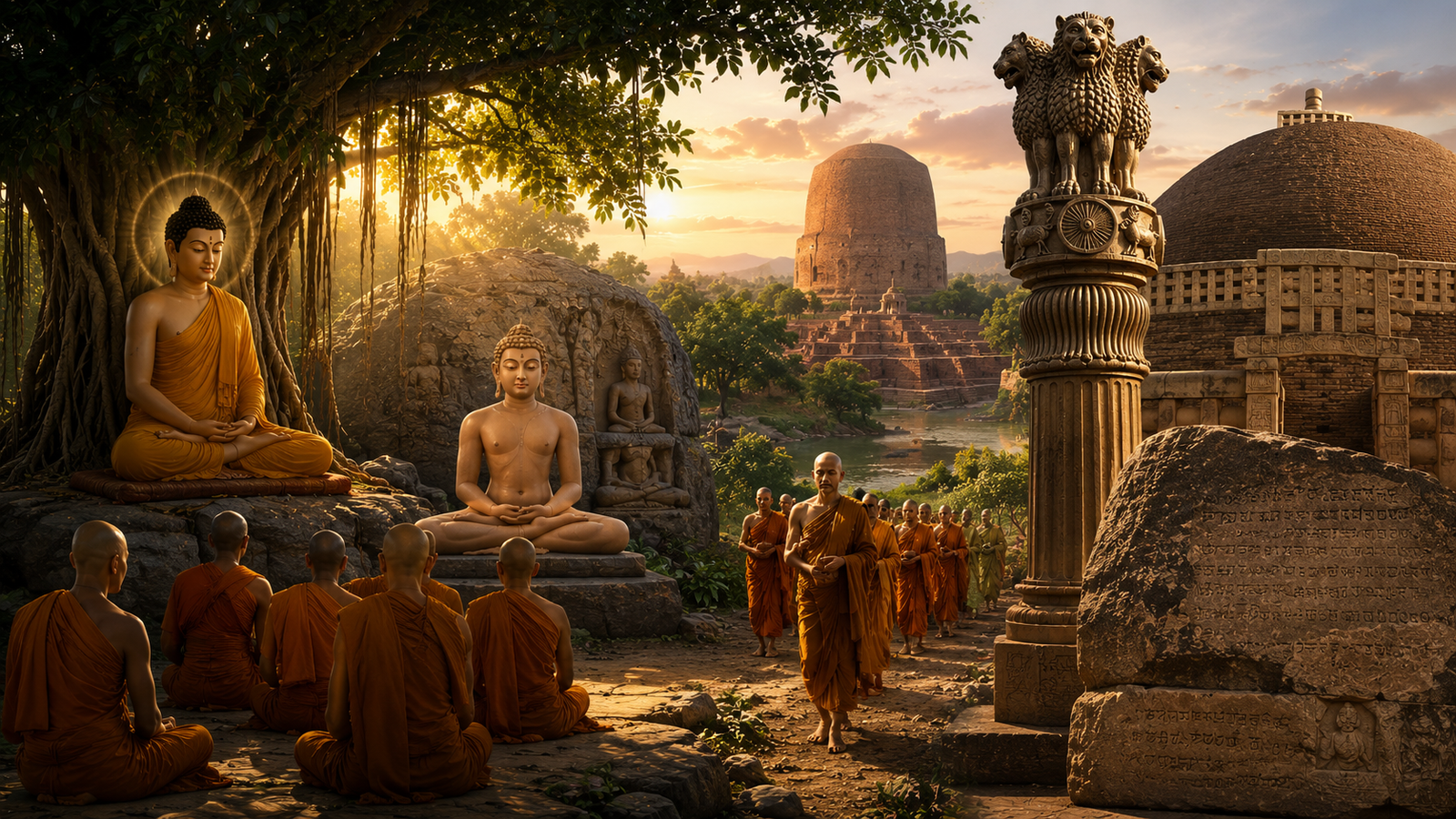
SECTION 3: Ancient History MCQs for UPSC Prelims: Buddhism, Jainism, Heterodox Philosophies, & The Mauryan Empire (Questions 41–60)
This pivotal module covers heterodox movements and Mauryan statecraft. These specific Ancient History MCQs for UPSC Prelims are highly targeted toward the administrative terms frequently tested by the UPSC.
Q41. With reference to the core doctrinal tenets of Early Buddhism, **what does the concept of *’Pratityasamutpada’* signify?**
(a) The absolute visual reality of the physical universe.
(b) The doctrine of Dependent Origination or Cause and Effect (Everything arises in dependence upon multiple conditions).
(c) The structural rules governing the expulsion of monks from the Sangha.
(d) The ritual path required to attain rebirth as a deity.
Q42. Consider the following pairs regarding the Four Major Buddhist Councils:
1. **First Council** – Rajagriha – Patronized by Ajatashatru
2. **Second Council** – Vaishali – Patronized by Kalashoka
3. **Third Council** – Pataliputra – Patronized by Ashoka
4. **Fourth Council** – Kashmir – Patronized by Kanishka
**How many of the pairs given above are correctly matched?**
(a) Only one pair
(b) Only two pairs
(c) Only three pairs
(d) All four pairs
Q43. In the context of Jain philosophy, the doctrine of *’Anekantavada’* asserts that:
(a) The material universe is an illusion created by the human mind.
(b) Truth and reality are complex and multi-faceted, possessing infinite viewpoints that cannot be captured by a single absolute statement.
(c) Ultimate liberation can only be attained through active political warfare.
(d) God is the singular, supreme creator responsible for daily worldly affairs.
Q44. Which early Buddhist text contains the *’Vinaya Pitaka’*, which explicitly regulates the code of conduct and monastic discipline for monks and nuns inside the Sangha?
(a) Sutta Pitaka
(b) Abhidhamma Pitaka
(c) Patimokkha (Pratimoksha)
(d) Jataka Tales
Q45. Consider the following statements regarding the split between Digambara and Shvetambara sects in Jainism:
1. The split was accelerated by a severe 12-year famine in Magadha, leading Acharya Bhadrabahu to migrate south to Shravanabelagola along with his followers.
2. The Digambaras believe that women are fully capable of attaining liberation (*Moksha*) without needing to be reborn as men.
3. The Shvetambaras completely reject the requirement of total nudity, permitting their ascetics to wear simple white garments.
**Which of the statements given above are correct?**
(a) 1 and 2 only
(b) 2 and 3 only
(c) 1 and 3 only
(d) 1, 2, and 3
Q46. Megasthenes, the Greek ambassador sent by Seleucus Nicator to the court of Chandragupta Maurya, noted in his book *’Indica’* that Indian society was divided into how many distinct functional classes?
(a) Four (based strictly on the Varna system)
(b) Seven (based on professional occupations)
(c) Nine (based on wealth brackets)
(d) Three (Patricians, Plebeians, and Slaves)
Q47. With reference to Ashoka’s policy of *Dhamma*, consider the following statements:
1. It was a dogmatic new state religion forced upon all citizens, requiring them to worship Buddha exclusively.
2. It emphasized broad ethical principles like tolerance toward all religious sects, respect for elders, and non-injury (*Ahimsa*) toward living beings.
3. Ashoka created a special cadre of bureaucratic officers called *Dhamma-Mahamattas* to propagate these principles across the empire.
**Which of the statements given above are correct?**
(a) 1 and 2 only
(b) 2 and 3 only
(c) 1 and 3 only
(d) 1, 2, and 3
Q48. In Chanakya’s *Arthashastra*, the state is envisioned as the *’Saptanga’* body consisting of seven distinct limbs. **Which of the following is not one of the seven limbs defined in the Saptanga theory?**
(a) Swami (The Ruler/King)
(b) Amatya (The Ministers/Bureaucrats)
(c) Shreni (The Merchant Guilds)
(d) Durga (The Fortified Capital)
Q49. The rock-cut caves in the Barabar and Nagarjuni hills (Bihar) were excavated and dedicated by Emperor Ashoka and his grandson Dasharatha for the ascetic use of which non-Buddhist heterodox sect?
(a) Jains
(b) Ajivikas
(c) Charvakas
(d) Lokayatas
Q50. Which Ashokan inscription provides a deeply moving personal account of the Kalinga War and explicitly mentions the name of five contemporary Hellenistic Greek kings?
(a) Major Rock Edict XIII
(b) Rummindei Pillar Inscription
(c) Bhabru Rock Edict
(d) Kalingan Separate Edict I
Q51. With reference to Mauryan economic administration, **what did the term *’Vishti’* denote?**
(a) A premium tax collected on maritime commercial shipping.
(b) Forced, unpaid labor extracted by the state from citizens for public works.
(c) A monetary subsidy paid to farmers during drought seasons.
(d) Land revenue collected exclusively from forest-dwelling tribes.
Q52. The *’Rummindei Pillar Inscription’* of Ashoka is of paramount historical importance because it directly records:
(a) The absolute military submission of the Chola and Pandya kingdoms to the Maurya empire.
(b) Ashoka’s personal pilgrimage to the birthplace of Gautama Buddha (Lumbini) and the subsequent reduction of its land tax (*Bhaga*).
(c) The formal split of the Buddhist Sangha into Mahayana and Hinayana divisions.
(d) The code of criminal punishments to be executed by the *Rajukas*.
Q53. Consider the following statements regarding Mauryan art and architecture:
1. The polished, lustrous sheen on monolithic sandstone Ashokan pillars is a distinctive metallurgical and lapidary achievement of the Mauryan period.
2. The architectural template of the Sanchi Stupa was initially constructed out of brick during Ashoka’s reign.
3. Stone architecture completely replaced wood for all imperial palaces, as attested by Megasthenes’ description of Pataliputra.
**Which of the statements given above is/are correct?**
(a) 1 and 2 only
(b) 2 only
(c) 3 only
(d) 1, 2, and 3
Q54. During the Mauryan era, two distinct types of courts handled judicial matters: *’Dharmasthiya’* and *’Kantakasodhana’*. **What was the primary mandate of the *Kantakasodhana* courts?**
(a) Settling civil disputes regarding ancestral property inheritance and boundary rows.
(b) Clearing of thorns/anti-social elements through criminal courts tasked with handling serious crimes against the state and public order.
(c) Regulating the internal maritime trade accounts of foreign guilds.
(d) Supervising the performance of temple rituals.
Q55. According to Jain traditions, which Mauryan Emperor abdicated his throne, embraced Jainism under the guidance of Acharya Bhadrabahu, and performed *Sallekhana* (fasting unto death) at Chandragiri hill in Karnataka?
(a) Bindusara
(b) Chandragupta Maurya
(c) Dasharatha
(d) Samprati
Q56. In the context of ancient trade routes, **what did the term *’Uttarapatha’* signify during the Mauryan Empire?**
(a) The maritime spice route connecting Muziris to Rome.
(b) The grand trans-continental northern land highway linking Pataliputra to Taxila and onwards to Central Asia.
(c) The southern mountain pass cutting through the Western Ghats.
(d) A specialized religious pilgrimage pathway around Bodh Gaya.
Q57. The Buddhist conceptual term *’Therigatha’* forms a part of the Khuddaka Nikaya. **What does it contain?**
(a) Philosophical discourses on atomic materialism.
(b) An anthology of deeply moving poems and verses composed by senior Buddhist nuns (*Theris*) celebrating their spiritual liberation.
(c) The chronological lineage history of the kings of Sri Lanka.
(d) Secret tantric rituals performed to gain miraculous powers.
Q58. Who among the following was the last ruler of the Mauryan Empire, whose assassination by his own commander-in-chief, Pushyamitra Shunga, led to the rise of the Shunga dynasty?
(a) Kunala
(b) Jalauka
(c) Brihadratha
(d) Devavarman
Q59. In the context of ancient Indian materialism, the *Lokayata* or *Charvaka* school of philosophy completely rejected which of the following?
(a) The validity of perception (*Pratyaksha*) as a source of real knowledge.
(b) The existence of an afterlife, the authority of the Vedas, and the concept of an unseen soul.
(c) The practice of enjoying physical sensory pleasure.
(d) The use of standard logic in debates.
Q60. Which important Mauryan administrative official was directly in charge of supervising state weights, measures, and standard marketplace scales?
(a) Pautavadhyaksha
(b) Panyadhyaksha
(c) Lavanadhyaksha
(d) Rupadarshaka
ANSWERS & EXPLANATIONS SECTION 3 (41-60): Ancient History MCQs for UPSC Prelims
This module contains critical **Ancient History MCQs for UPSC Prelims** regarding Mauryan administration and heterodox systems. Use these explanations to create micro-notes for active elimination tactics during the final exam.
Q41. **Answer: (b)** **Explanation:** Pratityasamutpada is the structural core of Buddhist philosophy. It states that nothing exists isolated or causelessly; all physical and mental phenomena appear due to interconnected prior conditions (popularly summarized as “When this exists, that comes to be”).
Q42. **Answer: (d)** **Explanation:** To secure marks on Ancient History MCQs for UPSC Prelims handling early Buddhist history, memorizing council chronologies is mandatory. All four councils are perfectly matched with their venues and political sponsors: First Council (483 BCE under Ajatashatru), Second Council (383 BCE under Kalashoka), Third Council (circa 250 BCE under Ashoka), and Fourth Council (1st Century CE under Kanishka).
Q43. **Answer: (b)** **Explanation:** Anekantavada is the Jain doctrine of many-sidedness. It argues that absolute truth cannot be expressed by a singular viewpoint. It is philosophically expressed via Syadvada (the logic of relative assertions, i.e., “perhaps or in some ways”).
Q44. **Answer: (c)** **Explanation:** While the Vinaya Pitaka is the broader volume name, the Patimokkha is the precise operational core within it, consisting of a list of specific offenses and rules read out bi-monthly during Sangha gatherings for confession.
Q45. **Answer: (c)** **Explanation:** Statements 1 and 3 are correct: The southern migration under Bhadrabahu preserved the orthodox rule of absolute nudity (Digambara). The northern monks under Sthulabhadra adapted to white robes (Shvetambara). Statement 2 is incorrect: Digambaras hold that due to physical and social constraints, women cannot practice absolute ascetic nudity and must be reborn as men to attain ultimate liberation. Shvetambaras, conversely, accept that women can attain liberation directly.
Q46. **Answer: (b)** **Explanation:** Megasthenes observed Indian society through a functional lens, misinterpreting the Varna matrix into Seven occupational classes: Philosophers, Husbandmen (farmers), Herdsmen, Artisans/Traders, Soldiers, Overseers (spies), and Councillors/Assessors.
Q47. **Answer: (b)** **Explanation:** Statements 2 and 3 are correct: This matches the current pattern of Ancient History MCQs for UPSC Prelims which shift focus from political dates to socio-ethical governance. Ashoka’s Dhamma was an ethical civic code aimed at maintaining social harmony across a diverse empire, not a religious dogma. He created Dhamma-Mahamattas to enforce it. Statement 1 is incorrect: He never forced citizens to convert to Buddhism or abandon their ancestors’ faiths.
Q48. **Answer: (c)** **Explanation:** The Saptanga Theory lists: Swami (King), Amatya (Ministers), Janapada (Territory/Population), Durga (Fort), Kosha (Treasury), Danda/Bala (Army), and Mitra (Allies). Shreni (guild) is an economic unit, not a constituent limb of the political state body.
Q49. **Answer: (b)** **Explanation:** In a supreme display of state-sponsored religious pluralism, Ashoka and his successor Dasharatha carved the highly polished granite caves of Barabar and Nagarjuni for the exclusive residence of the Ajivika ascetics.
Q50. **Answer: (a)** **Explanation:** Major Rock Edict XIII is the definitive historical document capturing Ashoka’s deep remorse following the mass casualties of the Kalinga war. It names five contemporary Mediterranean kings (Antiochus, Ptolemy, Antigonus, Magas, and Alexander), locking down Mauryan chronology.
Q51. **Answer: (b)** **Explanation:** Vishti was the institutionalized practice of corvée or forced labor. The state routinely drafted villagers to build dams, military roads, and defensive fortifications without financial compensation.
Q52. **Answer: (b)** **Explanation:** This matches the trend of modern Ancient History MCQs for UPSC Prelims which focus on economic and spiritual policies to analyze the structural changes in imperial revenue administration. The Rummindei Pillar marks the spot where Buddha was born. To honor the spot, Ashoka lowered the agricultural land tax (Bhaga) of the village from 1/6th to 1/8th and waived the Bali (religious cess).
Q53. **Answer: (a)** **Explanation:** Statements 1 and 2 are correct: The signature mirror-like polish on Chunar sandstone pillars is a hallmark of Mauryan craftsmanship. Sanchi’s core was built of brick under Ashoka and later encased in stone by Shungas. Statement 3 is incorrect: Wood remained the primary building material for Mauryan royal palaces, which featured extensive wooden palisades, making them vulnerable to fires.
Q54. **Answer: (b)** **Explanation:** Kantakasodhana (“Removal of thorns”) courts were specialized criminal tribunals presided over by three Pradeshtris to try anti-state conspiracies, thefts, murders, and official corruption. Civil property rows went to Dharmasthiya courts.
Q55. **Answer: (b)** **Explanation:** When tracking royal religious abdications for Ancient History MCQs for UPSC Prelims, Jain epigraphical traditions in South India offer definitive proof. According to the Parishishtaparvan and southern inscriptions, Chandragupta Maurya embraced Jainism during his final years, left Pataliputra during a famine, and traveled to Shravanabelagola, where he died via the ritual fast of Sallekhana.
Q56. **Answer: (b)** **Explanation:** The Uttarapatha was the ancient northern highway connecting eastern Bengal through Pataliputra, Varanasi, and Mathura straight to Taxila, linking Indian commerce into the Silk Road network of Central Asia.
Q57. **Answer: (b)** **Explanation:** The Therigatha (“Verses of the Elder Nuns”) is a classic of early world literature, containing 73 vivid, personally liberated poems written by Buddhist women who broke free from domestic suffering and social expectations.
Q58. **Answer: (c)** **Explanation:** Brihadratha was assassinated around 185 BCE by his own Brahmin general, Pushyamitra Shunga, during an imperial military parade, bringing the Mauryan line to an abrupt end.
Q59. **Answer: (b)** **Explanation:** The Charvaka school was a system of radical empiricism and materialism. It asserted that perception (Pratyaksha) is the only valid source of truth. It rejected heaven, hell, gods, karma, and any disembodied soul, advising people to live fully in the present physical reality.
Q60. **Answer: (a)** **Explanation:** The Pautavadhyaksha was the chief supervisor of weights and measures. Panyadhyaksha handled state commerce, Lavanadhyaksha controlled the salt monopoly, and Rupadarshaka was the currency inspector.
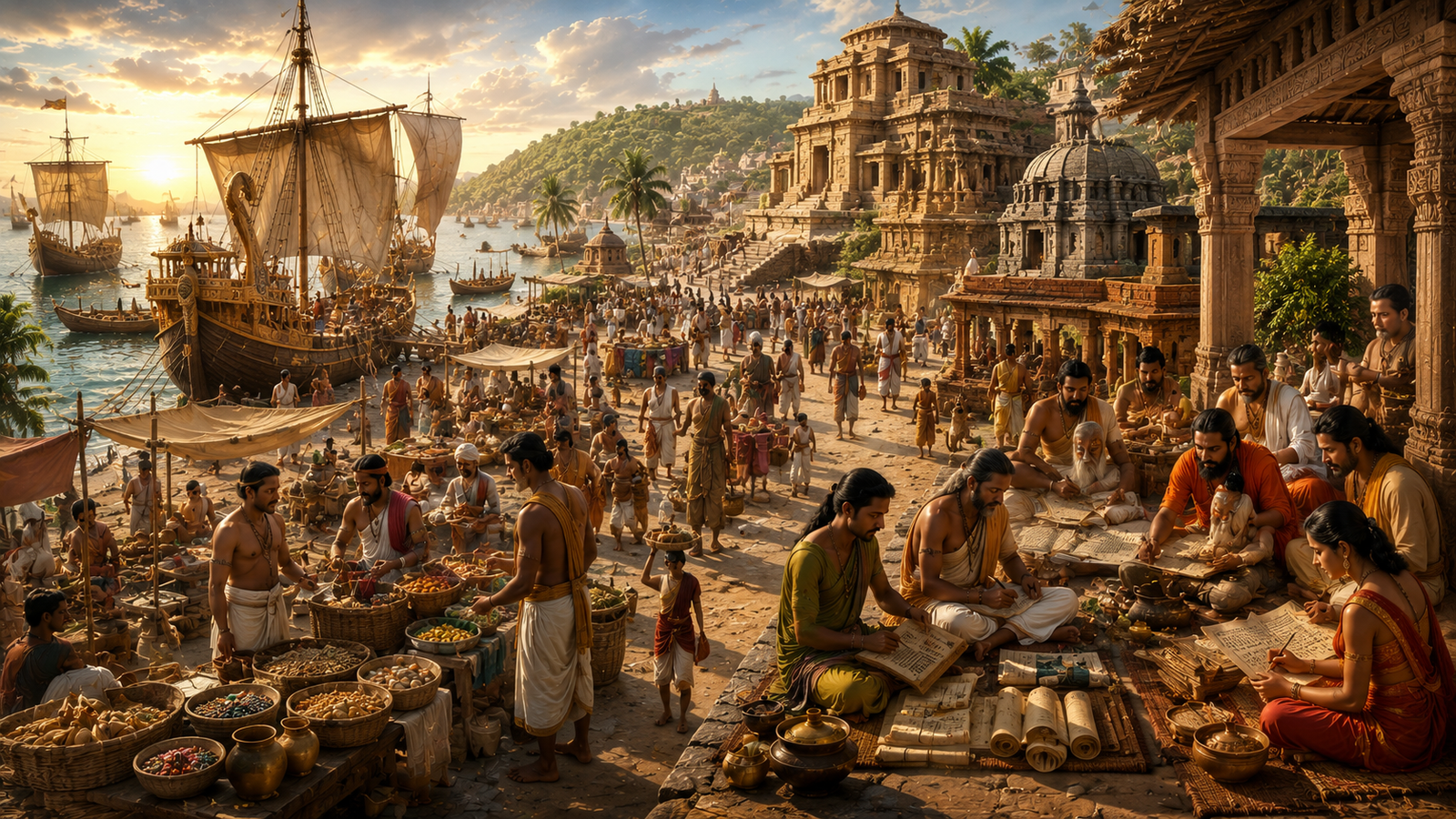
SECTION 4: Ancient History MCQs for UPSC Prelims: Post-Mauryan Innovations, The Sangam Age, & The Rise of the Kushanas and Satavahanas (Questions 61–80)
Shifting focus to regional developments and deep-south trade dynamics, the following Ancient History MCQs for UPSC Prelims break down early classical Tamil poetry and trade routes.
Q61. With reference to the development of early Indian art styles, the Gandhara School of Art is frequently characterized as ‘Greco-Buddhist’. **Which of the following features highlights this fusion?**
(a) The absolute abandonment of Buddhist subjects in favor of Olympian Zeus iconography.
(b) The depiction of Gautama Buddha with distinct wavy hair, realistic muscular anatomy, and heavy Roman-style drapery folds.
(c) The exclusive use of bright red sandstone imported from Mathura.
(d) The complete absence of human forms, relying entirely on aniconic symbols like footprints.
Q62. The landmark Junagadh Rock Inscription, written in pure, classical elegant Sanskrit without any Prakrit influence, was issued by which foreign ruler?
(a) Kanishka the Kushana
(b) Menander I the Indo-Greek
(c) Rudradaman I the Western Kshatrapa (Saka)
(d) Gondophares the Indo-Parthian
Q63. Consider the following statements regarding the Kushana Emperor Kanishka I:
1. He inaugurated the Saka Era in 78 CE, which is today utilized as the basis of the Indian National Calendar.
2. He actively patronized prominent scholars like Asvaghosa (author of *Buddhacharita*), Vasumitra, and the great physician Charaka.
3. He rejected Mahayana Buddhism completely, expelling all image-worshipping monks from his northwestern capital at Purushapura.
**Which of the statements given above are correct?**
(a) 1 and 2 only
(b) 2 and 3 only
(c) 1 and 3 only
(d) 1, 2, and 3
Q64. In the context of the Satavahana dynasty, the *’Nasik Prashasti’* inscription, composed by Gautami Balasri, extols the military exploits and virtues of which iconic king?
(a) Simuka
(b) Satakarni I
(c) Gautamiputra Satakarni
(d) Yajna Sri Satakarni
Q65. During the Sangam Age, three major dynasties ruled the southern far reaches of India: the Cheras, the Cholas, and the Pandyas. Match their respective royal dynastic emblems:
1. **Cheras** – Bow and Arrow
2. **Cholas** – Tiger
3. **Pandyas** – Fish
**Which of the combinations listed above are correct?**
(a) 1 and 2 only
(b) 2 and 3 only
(c) 1 and 3 only
(d) 1, 2, and 3
Q66. The famous early Tamil epic *’Silappatikaram’*, written by Ilango Adigal, revolves around the tragic story of which virtuous heroine and her anklet?
(a) Madhavi
(b) Kannagi
(c) Manimekalai
(d) Sita
Q67. With reference to the Sangam literature, the masterwork *’Tolkappiyam’* composed by Tolkappiyar is fundamentally a treatise on:
(a) Advanced war elephant tactics and archery.
(b) Tamil Grammar, phonetics, and the poetic rules of emotional landscapes (*Tinais*).
(c) Maritime navigation techniques across the Bay of Bengal.
(d) The ritual installation of Murugan idols.
Q68. Who among the following Indo-Greek rulers engaged in a profound philosophical dialogue regarding Buddhism with the monk Nagasena, which was compiled into the text *’Milinda Panha’*?
(a) Demetrius I
(b) Menander I
(c) Antiochus IV
(d) Heliodorus
Q69. The Besnagar Pillar Inscription featuring a Garuda capital was erected by Heliodorus, a Greek ambassador. **Which ancient Bhagavata sect deity did he dedicate it to?**
(a) Shiva
(b) Vasudeva (Krishna)
(c) Kartikeya
(d) Gautama Buddha
Q70. With reference to the economic and maritime trade realities of the Sangam Age, **what was *’Muziris’*?**
(a) The capital city of the early Chola kingdom.
(b) A crucial, thriving ancient emporium port on the Malabar coast (Kerala) that handled massive pepper and gold trade with the Roman Empire.
(c) A tax levied on weaving guilds.
(d) The religious site of northern Jain migration.
Q71. Consider the following statements regarding the Satavahana society and administration:
1. The kings routinely utilized metronymics (naming themselves after their mothers, like Gautamiputra), although succession to the throne remained strictly patrilineal.
2. They issued a unique maritime series of lead coins depicting double-masted ships, highlighting their extensive naval and commercial power.
3. Prakrit was the official language utilized in their court inscriptions rather than Sanskrit.
**Which of the statements given above are correct?**
(a) 1 and 2 only
(b) 2 and 3 only
(c) 1 and 3 only
(d) 1, 2, and 3
Q72. In the context of Post-Mauryan economic life, the term *’Kharavela’* is famous as the third ruler of the Mahameghavahana dynasty. **Which major rock-cut cave inscription details his biographical achievements?**
(a) Hathigumpha Inscription (Udayagiri, Odisha)
(b) Aihole Inscription
(c) Maski Edict
(d) Nanaghat Inscription
Q73. The grand rock-cut Buddhist Chaitya cave hall at Karla (Maharashtra), possessing magnificent ribbing and sculpted couples, was excavated during the zenith of which period?
(a) Mauryan Period
(b) Satavahana Period
(c) Gupta Period
(d) Chola Period
Q74. During the Sangam Age, **what did the term *’Hero Stone’* or *’Viragal’* represent?**
(a) A highly polished gemstone gifted to royal bards.
(b) A commemorative stone stela erected over the graves of warriors who died fighting bravely in battle or cattle raids.
(c) A structural base used for building stone palaces.
(d) A boundary marker separating the Chola and Chera empires.
Q75. The ancient Greek text *’Periplus of the Erythraean Sea’*, written by an anonymous navigator, serves as an invaluable source for understanding:
(a) The overland military routes of Alexander the Great.
(b) The maritime ports, trade routes, imports, and exports operating across the Indian Ocean and the Red Sea.
(c) The internal structural rules of Buddhist monasteries in Nalanda.
(d) The genealogy of the Nanda kings.
Q76. Which Post-Mauryan dynasty, establishing its rule in Central India after the Mauryas, actively renovated the Bharhut Stupa and added grand stone gateways to the Sanchi Stupa?
(a) The Kushana Dynasty
(b) The Saka Dynasty
(c) The Shunga Dynasty
(d) The Kanva Dynasty
Q77. In the context of early South Indian history, **what was the *’Sangam’* assembly?**
(a) A military war council composed of the kings of the Three Crowns.
(b) An academy or college of Tamil poets and bards patronized by the Pandya kings at Madurai.
(c) A religious collective task force aimed at eradicating Jainism from the south.
(d) A specialized assembly of agricultural landlords.
Q78. With reference to the ancient trade item referred to in Roman luxury markets as *’Yavanapriya’*, **what physical commodity did it mean?**
(a) Fine Indian Muslin Silk
(b) Black Pepper
(c) Tortoise Shells
(d) Indigo Dye
Q79. The dynamic *’Mathura School of Art’* that flourished alongside the Gandhara school under the Kushanas primarily utilized which characteristic raw material for its sculptures?
(a) Blue schist stone
(b) White marble
(c) Spotted red sandstone
(d) Terracotta clay exclusively
Q80. The ancient Tamil work *’Manimekalai’*, which serves as a sequel to the Silappatikaram, is highly significant because it incorporates extensive debates and expositions on which philosophical system?
(a) Orthodox Vedic Mimamsa
(b) Buddhist Philosophy and Logic
(c) Ajivika Fatalism
(d) Early Shaivism
ANSWERS & EXPLANATIONS SECTION 4 (61-80): Ancient History MCQs for UPSC Prelims
Understanding southern dynastic emblems and trade emporiums requires a structural approach. These **Ancient History MCQs for UPSC Prelims** explanations trace the commercial map of the post-Mauryan landscape.
Q61. **Answer: (b)** **Explanation:** The Gandhara School combined Mahayana Buddhist themes with Hellenistic Greek and Roman execution techniques. The resulting sculptures represent Buddha with Apollonian features: deep-cut almond eyes, sharp facial features, wavy hair topknots (ushnisha), and realistic drapery lines resembling Roman togas.
Q62. **Answer: (c)** **Explanation:** Saka ruler Rudradaman I issued the Junagadh Inscription (circa 150 CE). It is celebrated by historians as the first major lengthy royal public record written entirely in standard, high classical Sanskrit, detailing the repairs made to the Sudarsana Lake dam.
Q63. **Answer: (a)** **Explanation:** Statements 1 and 2 are correct: Kanishka’s accession marks the start of the Saka Calendar (78 CE). His cosmopolitan court was a brilliant intellectual center featuring Asvaghosa, Vasumitra, and Charaka. Statement 3 is incorrect: Kanishka was a passionate champion of Mahayana Buddhism. He financed the 4th Buddhist Council in Kashmir, which regularized the worship of Buddha in human form.
Q64. **Answer: (c)** **Explanation:** The Nasik Inscription was engraved by Gautami Balasri to honor her deceased son, Gautamiputra Satakarni. It describes him as the destroyer of Sakas, Yavanas, and Pahlavas, and the savior who restored the purity of the four-fold Varna system (Ekabrahmana).
Q65. **Answer: (d)** **Explanation:** Identifying early southern state symbols is a core component of Ancient History MCQs for UPSC Prelims covering the dawn of historical Tamil Nadu. All three royal lineages of the Sangam era are accurately mapped to their specific emblems: The Cheras (Kerala coast) sported the Bow, the Cholas (Cauvery delta) used the Tiger, and the Pandyas (Deep south/Madurai) held the Twin Fish.
Q66. **Answer: (b)** **Explanation:** The Silappatikaram focuses on Kannagi, who tears down the city of Madurai in an absolute fury of righteous grief after the Pandya King mistakenly executes her innocent husband, Kovalan, over a stolen ruby anklet.
Q67. **Answer: (b)** **Explanation:** The Tolkappiyam is the oldest surviving Tamil text. While it functions primarily as an advanced work on grammar, its third section (Porul) provides a detailed analysis of the socio-economic life, emotional classifications (akam and puram), and environmental tracts (Tinais) of ancient South India.
Q68. **Answer: (b)** **Explanation:** Menander I (known to Indian sources as King Milinda) ruled a massive Indo-Greek kingdom from Sagala (Sialkot). His extensive philosophical questioning of the Buddhist sage Nagasena forms the core of the text Milinda Panha (“The Questions of King Milinda”), after which he converted to Buddhism.
Q69. **Answer: (b)** **Explanation:** The Besnagar Pillar (Vidisha, MP) proves the deep assimilation of Greeks into local culture. Heliodorus calls himself a Bhagavata (devotee of Vishnu/Vasudeva) and erected the stone pillar featuring a Garuda vehicle capital to honor Vasudeva.
Q70. **Answer: (b)** **Explanation:** Muziris (modern Pattanam, Kerala) was a world-class ancient port. Roman fleets sailed down using monsoon winds to drop huge hoards of gold coins (denarii) and wine in exchange for cargo loads of premium Malabar black pepper, silk, and beryl stones.
Q71. **Answer: (d)** **Explanation:** Analyzing Deccan societal structures in Ancient History MCQs for UPSC Prelims requires distinguishing between lineage indicators and political successions. All three statements are true. Satavahanas utilized metronymics (e.g., Vashishtiputra Pulumavi) to trace elite lineage, but the crown passed strictly from father to son. Their official public records were written in Prakrit, and their naval power is demonstrated by ship motifs on their currency.
Q72. **Answer: (a)** **Explanation:** The Hathigumpha Inscription, carved inside the Udayagiri caves near Bhubaneswar, is a Year-by-Year chronological record written in Prakrit detailing the military campaigns, public works, and religious donations of the Jain Emperor Kharavela of Kalinga.
Q73. **Answer: (b)** **Explanation:** The Karla Chaitya hall is the largest and deepest rock-cut Buddhist prayer hall in India, excavated into the Western Ghats during the prosperous trading era of the Satavahana dynasty (1st Century BCE to 2nd Century CE).
Q74. **Answer: (b)** **Explanation:** Viragals or Hero Stones were sacred monuments planted in village squares to immortalize local heroes who died defending their community’s cattle or territory, becoming objects of daily ritual worship.
Q75. **Answer: (b)** **Explanation:** When attempting Ancient History MCQs for UPSC Prelims dealing with maritime routes, remember that classical travelogues offer crucial data regarding the subcontinent’s early global integration. The Periplus of the Erythraean Sea is a practical Greco-Roman maritime guidebook that lists Indian port settlements (like Barygaza/Bharuch, Kalyan, Muziris) and catalogs real-time trade currents across the Indian Ocean matrix.
Q76. **Answer: (c)** **Explanation:** Although Pushyamitra Shunga was traditionally viewed as an orthodox anti-Buddhist monarch, archaeological data shows that during the Shunga period, major artistic renovations took place at Bharhut and Sanchi, moving from Mauryan wood/brick to durable stone railings and gate structures.
Q77. **Answer: (b)** **Explanation:** The Sangam was a closed elite academy of creative intellectuals. According to legends, three distinct Sangams occurred over thousands of years, where poets submitted their works to a critical board for selection, creating the foundations of early Tamil classical literature.
Q78. **Answer: (b)** **Explanation:** Yavanapriya translates literally to “Beloved of the Westerners/Greeks/Romans.” In the ancient world, this term referred specifically to Indian black pepper, which was worth its weight in gold across Roman imperial kitchens.
Q79. **Answer: (c)** **Explanation:** The Mathura School drew upon indigenous traditions (like early Yaksha figures). Its sculptors carved religious icons out of the locally available spotted red sandstone quarried from Sikri.
Q80. **Answer: (b)** **Explanation:** The Manimekalai, written by Chithalai Chathanar, tracks the spiritual path of Kovalan and Madhavi’s daughter, Manimekalai, who eventually embraces Buddhism. The text is highly valued for its dense, multi-chapter philosophical debates analyzing early Buddhist logical paradigms.
SECTION 5: Ancient History MCQs for UPSC Prelims: The Gupta Empire, Post-Gupta Feudalism, & The Early Medieval Deccan and South Indian Kingdoms (Questions 81–100)
Our final section covers the classical Gupta period and early medieval decentralized politics. Completing these final Ancient History MCQs for UPSC Prelims will cement your grasp on structural art styles and autonomous village assemblies.
Q81. With reference to the Golden Age of the Gupta Empire, **which of the following statements regarding the cultural and scientific advancements is incorrect?**
(a) Aryabhata authored the *Aryabhatiya*, explaining the scientific causes of solar and lunar eclipses and calculating the value of Pi.
(b) Kalidasa composed masterpieces like *Shakuntala* and *Meghaduta* under the direct patronage of Chandragupta II.
(c) The practice of idol-worship inside structural stone temples completely disappeared, replaced entirely by early Vedic animal sacrifices.
(d) Varahamihira authored the comprehensive scientific encyclopedias *Brihat Samhita* and *Pancha Siddhantika*.
Q82. In the context of Gupta administrative machinery, **the terms *’Kumaramatyas’* and *’Uparikas’* represented:**
(a) Specialized naval commanders who guarded the ports of Tamralipti.
(b) The highest cadre of imperial civil bureaucrats and provincial governors respectively.
(c) Tax auditors who registered the assets of merchant guilds.
(d) Foreign ambassadors stationed at the court of Pataliputra.
Q83. During the Gupta period, the agrarian economy saw the rise of a highly exploitative form of forced labor. **What was the specific administrative term used for this practice in land grant charters?**
(a) Bhaga
(b) Kara
(c) Vishti
(d) Hiranya
Q84. The iron pillar located at Mehrauli (New Delhi), globally celebrated for its advanced metallurgical composition that has resisted rust for over 1,500 years, carries an inscription commemorating the victories of which king?
(a) Chandragupta II (mentioned as ‘Chandra’)
(b) Samudragupta
(c) Ashoka
(d) Harshavardhana
Q85. Consider the following statements regarding the Chinese pilgrim Fa-Hien (Faxian) who visited India during the early 5th Century CE:
1. He traveled to India during the reign of Chandragupta II to collect authentic copies of the Buddhist Vinaya Pitaka texts.
2. He noted that the penal code was mild, capital punishment was rare, and citizens could travel freely without passports.
3. He wrote an exhaustive, multi-chapter biographical account describing the personal daily lifestyle of King Chandragupta II at court.
**Which of the statements given above are correct?**
(a) 1 and 2 only
(b) 2 and 3 only
(c) 1 and 3 only
(d) 1, 2, and 3
Q86. In the early medieval history of Southern India, the grand *’Aihole Inscription’* composed by the court poet Ravikirti serves as the ultimate historical document for the reign of which king?
(a) Pulakeshin II (Chalukya Dynasty)
(b) Mahendravarman I (Pallava Dynasty)
(c) Rajaraja Chola I (Chola Dynasty)
(d) Dantidurga (Rashtrakuta Dynasty)
Q87. The Aihole Inscription explicitly records a monumental military victory of the Western Chalukya King Pulakeshin II on the banks of the river Narmada against which northern emperor?
(a) Chandragupta Maurya
(b) Harshavardhana of Kannauj
(c) Skandagupta
(d) Sasanka of Gauda
Q88. Consider the following pairs of ancient/early medieval Indian authors and their literary creations:
1. **Vishakhadatta** – Mudrarakshasa
2. **Sudraka** – Mricchakatika
3. **Bhanabhatta** – Harshacharita
4. **Mahendravarman I** – Mattavilasa Prahasana
**How many of the pairs given above are correctly matched?**
(a) Only one pair
(b) Only two pairs
(c) Only three pairs
(d) All four pairs
Q89. With reference to the temple architecture of the early medieval Pallava dynasty, match the following development stages with their defining characteristics:
1. **Mahendra Style** – Rock-cut pillared cave temples
2. **Mamalla Style** – Monolithic Rathas (e.g., Five Rathas at Mahabalipuram)
3. **Rajasimha Style** – Freestanding structural stone temples (e.g., Kailasanatha Temple at Kanchipuram)
**Which of the combinations listed above are correct?**
(a) 1 and 2 only
(b) 2 and 3 only
(c) 1 and 3 only
(d) 1, 2, and 3
Q90. During the reign of the Chola Empire, the local village administration enjoyed an unprecedented degree of autonomy. **Which specific stone inscription outlines the exact constitutional rules for electing members to the rural *’Ur’* and *’Sabha’* assemblies?**
(a) Uttaramerur Inscription (Prantaka Chola I)
(b) Tanjore Inscription
(c) Kudumiyanmalai Inscription
(d) Takkolam Inscription
Q91. In the Chola administrative framework, **what did the terms *’Valanadu’* and *’Nadu’* signify?**
(a) The personal private standard guards of the Chola Emperor.
(b) Territorial administrative divisions, where a *Valanadu* was a larger province made up of multiple smaller districts called *Nadus*.
(c) Taxes levied on maritime merchant fleets.
(d) Categories of land grants gifted exclusively to Jain monks.
Q92. The magnificent structural *’Brihadisvara Temple’* located at Thanjavur, featuring a massive stone vimana tower, was built by which powerful Chola monarch?
(a) Rajendra Chola I
(b) Rajaraja Chola I
(c) Kulothunga Chola I
(d) Parantaka I
Q93. Which Rashtrakuta dynasty king is historically credited with composing the *’Kavirajamarga’*, which stands as the earliest surviving masterwork on poetics and rhetoric in the Kannada language?
(a) Amoghavarsha I
(b) Krishna III
(c) Govinda III
(d) Dhruva Dharavarsha
Q94. Consider the following statements regarding the early medieval Tripartite Struggle that lasted for generations over the control of the strategic prize city of Kannauj:
1. The three primary geopolitical contenders were the Gurjara-Pratiharas, the Palas of Bengal, and the Rashtrakutas of the Deccan.
2. The struggle ended in the complete military annihilation of the Rashtrakutas by the Cholas.
3. Kannauj was highly prized because it was the ultimate economic and political gateway to controlling the fertile Gangetic trade routes.
**Which of the statements given above are correct?**
(a) 1 and 2 only
(b) 2 and 3 only
(c) 1 and 3 only
(d) 1, 2, and 3
Q95. In the context of early medieval socio-economic history, **what did the term *’Agrahara’* signify?**
(a) A specialized weapon storehouse located inside frontier forts.
(b) A tax-free land grant gifted by kings to Brahmins, either individually or to a collective community, to generate religious merit.
(c) A commercial marketplace route connecting India to China.
(d) The coronation hall utilized during royal weddings.
Q96. Who among the following Gupta rulers successfully repelled the devastating military invasions of the White Hunas (Hephthalites), preserving the structural integrity of northern India?
(a) Samudragupta
(b) Chandragupta I
(c) Skandagupta
(d) Vishnugupta
Q97. In the context of the early medieval commercial economy, **what were the *’Manigramam’* and the *’Ayyavole-Five Hundred’*?**
(a) Elite units of administrative tax collectors under the Pallavas.
(b) Powerful, highly organized merchant guilds that operated extensive transnational maritime trade networks across Southeast Asia.
(c) Feudal land divisions allocated to royal princes.
(d) Religious monastic factions within early Southern Shaivism.
Q98. The famous philosophical doctrine of *’Advaita Vedanta’* (Absolute Non-Dualism), which posits that the individual soul (*Atman*) and the ultimate cosmic reality (*Brahman*) are entirely identical, was pioneered by which 8th-century scholar?
(a) Ramanujacharya
(b) Madhvacharya
(c) Adi Shankaracharya
(d) Basavanna
Q99. The iconic bronze sculptures of *Nataraja* (the Lord of Dance) showing Shiva executing the cosmic Anandatandava dance were produced under the artistic zenith of which dynasty?
(a) The Cheras
(b) The Chalukyas
(c) The Cholas
(d) The Hoysalas
Q100. Which Chola king launched an ambitious naval expedition across the Bay of Bengal, successfully defeating the Sailendra dynasty of Srivijaya (modern Sumatra/Indonesia) to secure Indian merchant shipping lanes?
(a) Rajaraja Chola I
(b) Rajendra Chola I
(c) Rajadhiraja Chola
(d) Vira Rajendra
ANSWERS & EXPLANATIONS SECTION 5 (81-100): Ancient History MCQs for UPSC Prelims
Completing this final set of **Ancient History MCQs for UPSC Prelims** marks the end of our comprehensive mock test curriculum. Ensure you revise the autonomous local patterns detailed in these final solutions.
Q81. **Answer: (c)** **Explanation:** The Gupta period marks the birth of structural Hindu temple architecture in stone (e.g., the Dashavatara Temple at Deogarh and the brick temple at Bhitargaon). Puranic temple rituals and image-based worship grew in importance during this era.
Q82. **Answer: (b)** **Explanation:** The Kumaramatyas formed the core elite cadre of imperial civil servants from whom ministers, generals, and top advisers were picked. Uparikas were appointed directly by the king to govern the Bhuktis (large administrative provinces).
Q83. **Answer: (c)** **Explanation:** Vishti (forced labor) became heavily linked to the agrarian economy during the Gupta era. Land charters regularly gave grantees the statutory right to extract unpaid labor from local peasants for cultivating state fields or cleaning village channels.
Q84. **Answer: (a)** **Explanation:** The Mehrauli Iron Pillar carries a posthumous inscription honoring a king named “Chandra,” whom historians identify as Chandragupta II. The pillar is a marvel of ancient Indian forge-welding, remaining entirely corrosion-free despite centuries of exposure.
Q85. **Answer: (a)** **Explanation:** Dissecting the specific focus of Chinese travel logbooks is a common requirement in Ancient History MCQs for UPSC Prelims. Statements 1 and 2 are correct: Fa-Hien traveled via land to procure authentic copies of monastic discipline rules. He praised the safety and mildness of public life under the Guptas. Statement 3 is incorrect: Fa-Hien focused strictly on Buddhist religious sites; he did not mention the name of Chandragupta II or provide any details about court life.
Q86. **Answer: (a)** **Explanation:** The Aihole Inscription was composed by the Jain poet Ravikirti at the Meguti Jain Temple. Written in classical Sanskrit, it serves as the primary historical record for the Western Chalukya monarch Pulakeshin II.
Q87. **Answer: (b)** **Explanation:** The Aihole record details the clash between Pulakeshin II and Harshavardhana of Kannauj (circa 618 CE). Pulakeshin blocked Harsha’s southward expansion at the Narmada River, forcing him to accept the river as their permanent boundary.
Q88. **Answer: (d)** **Explanation:** All four pairs are perfectly matched: Vishakhadatta wrote the political drama Mudrarakshasa*; Sudraka wrote the social play Mricchakatika*; Banabhatta authored the biography Harshacharita*; and the Pallava king Mahendravarman I wrote the satire Mattavilasa Prahasana*.
Q89. **Answer: (d)** **Explanation:** Pallava architecture evolved in distinct stages. Mahendravarman I carved rock-cut pillared halls (Mahendra style). His successor Narasimhavarman I founded Mahabalipuram and carved monolithic rock chariots (Mamalla style). Later, Rajasimha built freestanding stone temples like Kanchipuram’s Kailasanatha (Rajasimha style).
Q90. **Answer: (a)** **Explanation:** When tackling administrative questions in Ancient History MCQs for UPSC Prelims, the unique self-governing features of early medieval southern villages require careful study. The twin Uttaramerur Inscriptions provide a detailed record of local government. They outline the qualifications, disqualifications, and the lottery selection system (Kuda-olai) used to elect members to committees managing water, gold, and gardens for the Brahmin village assembly (Sabha).
“A common trap in Ancient History MCQs for UPSC Prelims is confusing the naval expansions of…”
Q91. **Answer: (b)** **Explanation:** The Chola Empire was organized into Mandalams (provinces), which were divided into Valanadus (commissionerships), which were further broken down into Nadus (districts) containing groups of autonomous agricultural villages.
Q92. **Answer: (b)** **Explanation:** The Brihadisvara Temple (or Rajarajeshvaram) was built by Rajaraja Chola I (completed around 1010 CE). It is a classic example of Dravidian architecture, featuring a 216-foot vimana tower crowned by a monolithic stone capstone.
Q93. **Answer: (a)** **Explanation:** Rashtrakuta King Amoghavarsha I (who ruled for over 60 years from Manyakheta) was a dedicated patron of literature. He wrote the Kavirajamarga, a foundational work for Kannada grammar and poetic styles.
Q94. **Answer: (c)** **Explanation:** Evaluating regional conflicts over trade routes is a critical skill for answering Ancient History MCQs for UPSC Prelims covering the early medieval transition. Statements 1 and 3 are correct: The Tripartite struggle over Kannauj involved the Pratiharas, Palas, and Rashtrakutas, as the city symbolized dominance over the trade networks of the Gangetic plain. Statement 2 is incorrect: The struggle ended as all three dynasties exhausted their treasuries, clearing the way for smaller Rajput clans to assume local control. The Cholas played no part in this northern conflict.
Q95. **Answer: (b)** **Explanation:** An Agrahara was a plot of agricultural land or an entire village granted to Brahmins. These lands were exempt from state taxes and royal interference, allowing the residents to focus on scholarship and rituals.
Q96. **Answer: (c)** **Explanation:** Around 455 CE, Skandagupta faced the first major invasions of the Hunas. He successfully repelled them through military campaigns, preserving the empire for a generation, though the financial strain weakened the Gupta economy.
Q97. **Answer: (b)** **Explanation:** Manigramam and Ayyavole-Five Hundred were powerful, autonomous merchant corporations. They maintained private armies to protect their caravans and conducted maritime trade across Sumatra, Java, Sri Lanka, and China.
Q98. **Answer: (c)** **Explanation:** Adi Shankaracharya regularized the Advaita Vedanta system. He argued that the material world is a relative illusion (Maya) caused by ignorance, and that real knowledge (Jnana) reveals that the individual soul is identical to the absolute Brahman.
Q99. **Answer: (c)** **Explanation:** The Chola metalworkers perfected the art of cire-perdue (lost-wax) bronze casting. Their Nataraja sculptures are recognized worldwide for their balanced proportions and symbolic depiction of Shiva’s five activities: creation, protection, destruction, illusion, and liberation.
Q100. **Answer: (b)** **Explanation:**A common trap in Ancient History MCQs for UPSC Prelims is confusing the naval expansions of the early Chola rulers with their late medieval trade expeditions. In 1025 CE, Rajendra Chola I launched a large-scale naval expedition against the kingdom of Srivijaya. His forces captured ports along the Straits of Malacca to stop harassment of Indian merchant fleets trading with Song Dynasty China.
Recommended Posts
Indus Valley Civilization Notes UPSC 2027: Complete & Important Guide
100 Most Important Indus Valley Civilization MCQs for UPSC
100 Modern History MCQs UPSC Prelims 2027
History Syllabus for UPSC Prelims 2027
Most Important Resources for UPSC Prelims 2027
- Current Affairs For UPSC Prelims 2027
- Polity for UPSC Prelims 2027
- Economy for UPSC Prelims 2027
- History for UPSC Prelims 2027
- Science and Technology for UPSC Prelims 2027
- Geography for UPSC Prelims 2027
The questions are fantastic and extremely useful for UPSC preparation. This 100 questions excercise should be confined to one chapter or topic at a time so that a compete understanding of the subject can be attained by the aspirants.