The Indus Valley Civilization Notes UPSC 2027 are essential for aspirants preparing for the Civil Services Examination. This topic is one of the most important parts of Ancient Indian History and is frequently asked in the UPSC Prelims exam in the form of factual and conceptual questions.
The Indus Valley Civilization, also known as the Harappan Civilization, represents one of the earliest urban cultures in the world, known for its advanced town planning, drainage system, and trade networks. Understanding key features, important sites, and unique characteristics of this civilization is crucial for scoring well in the exam.
In this article, we provide completeIndus Valley Civilization Notes UPSC 2027 including important facts, major sites, and practice MCQs for quick revision.
These Indus Valley Civilization Notes UPSC 2027 cover all important topics required for Prelims preparation.
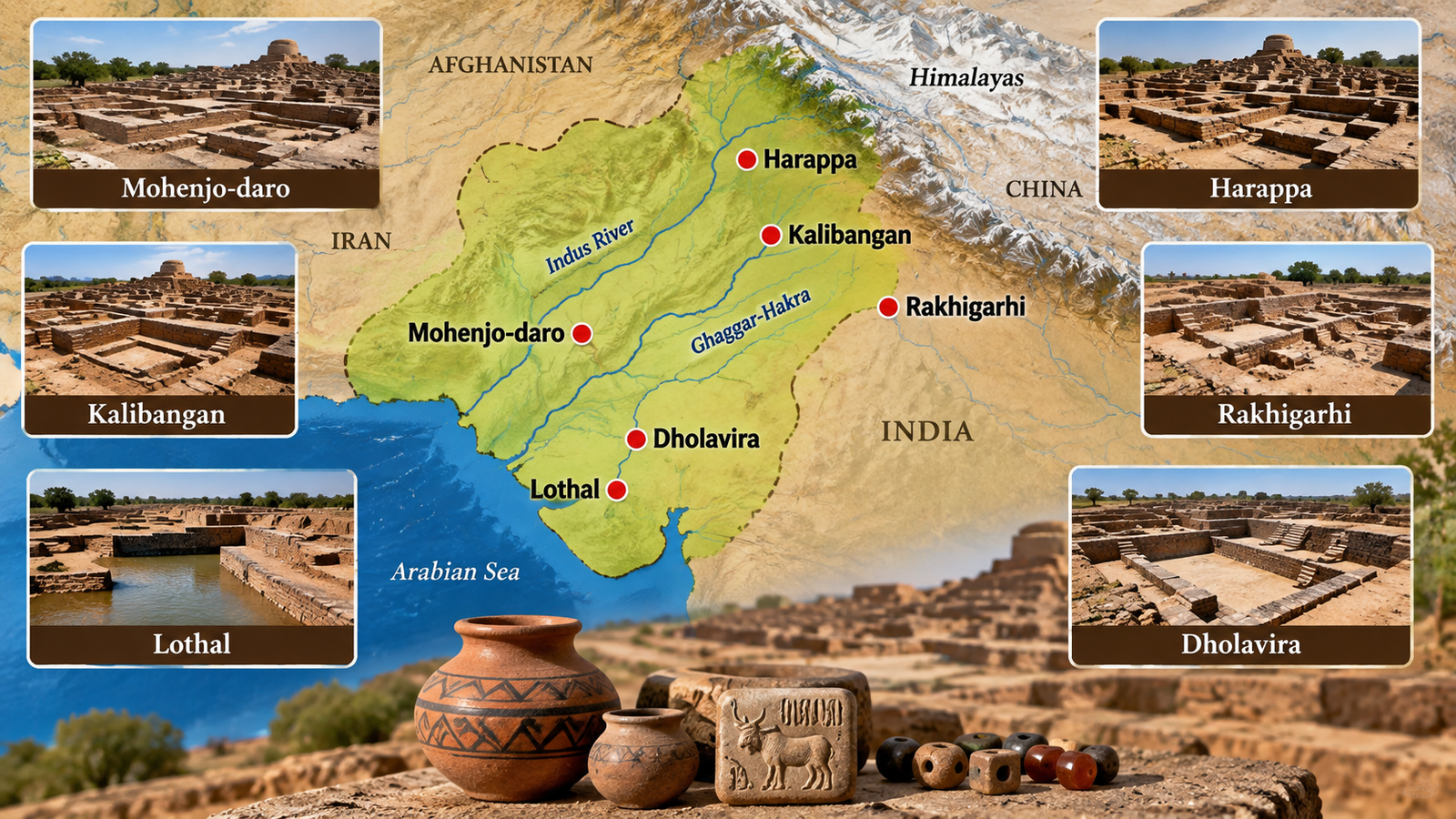
🗺️ Major Sites of Indus Valley Civilization
Understanding these sites is an important part of Indus Valley Civilization Notes UPSC 2027.
These Indus Valley Civilization Notes UPSC 2027 are designed to help aspirants focus on the most important exam-oriented concepts.
🏛️ Harappa
- First discovered site (1921) by Dayaram Sahni; located in present-day Pakistan (Punjab).
- Known for large granaries, indicating organized storage and food management.
- Evidence of seals and script, showing trade and administrative control.
- Well-planned layout with standardized bricks and drainage system.
🏙️ Mohenjo-daro
- One of the largest and most advanced cities of IVC (Sindh, Pakistan).
- Famous for the Great Bath, possibly used for ritual purposes.
- Highly developed drainage system, showcasing advanced urban planning.
- Structures like the Great Granary and Assembly Hall indicate civic organization.
🏜️ Dholavira
- Located in Gujarat (Rann of Kutch); one of the most prominent Indian IVC sites.
- Known for its advanced water management system with reservoirs and channels.
- Unique three-part city division: Citadel, Middle Town, Lower Town.
- Evidence of a large inscription board, indicating use of script.
⚓ Lothal
- Located in Gujarat; considered an important port city of IVC.
- Famous for the dockyard, suggesting maritime trade.
- Evidence of bead-making industry and craft specialization.
- Trade links with Mesopotamia, indicating international commerce.
🔥 Kalibangan
- Located in Rajasthan along the Ghaggar river.
- Known for fire altars, suggesting ritual practices.
- Evidence of ploughed agricultural field (earliest known example).
- Distinct grid pattern city planning with fortified structures.
🎯 UPSC TIP
👉 Clues to memorise-
- Harappa → Granary
- Mohenjo-daro → Great Bath
- Dholavira → Water system
- Lothal → Dockyard
- Kalibangan → Fire altar

🏙️ Key Features of Indus Valley Civilization
These features are frequently asked in exams and form a key part of Indus Valley Civilization Notes UPSC 2027.
🔹 Town Planning:
- Grid system (well-planned cities)
- Drainage system (advanced sanitation)
- Citadel and Lower Town
🔹 Economy:
- Agriculture (wheat, barley)
- Trade with Mesopotamia
- Use of weights and measures
🔹 Society:
- Urban civilization
- No clear evidence of kings
- Equality in housing structures
🔹 Religion:
- Worship of Mother Goddess
- Pashupati Seal (proto-Shiva)
- Tree and animal worship
⏳ Timeline (Quick Revision)
- 3300 BCE – Early Harappan Phase
- 2600–1900 BCE – Mature Harappan Phase
- 1900 BCE – Decline begins
The timeline is essential for quick revision of Indus Valley Civilization Notes UPSC 2027.
🎯 Important Facts for UPSC
- First urban civilization in India
- No iron used
- Script undeciphered
- Standardized bricks
- No temples found
📊 Why Important for UPSC Prelims
- Frequently asked topic
- Map-based questions
- Fact-based MCQs
- Linked with Art & Culture
❓ UPSC Prelims Practice MCQs (Indus Valley Civilization)
Important MCQs on Indus Valley Civilization Notes UPSC 2027
Q1. Which site is known for the dockyard?
A. Harappa
B. Lothal
C. Kalibangan
D. Dholavira
✅ Answer: B
Q2. The Great Bath is located at:
A. Harappa
B. Mohenjo-daro
C. Lothal
D. Rakhigarhi
✅ Answer: B
Q3. Which metal was NOT known to Indus people?
A. Copper
B. Bronze
C. Iron
D. Gold
✅ Answer: C
Q4. Which site is associated with fire altars?
A. Lothal
B. Kalibangan
C. Harappa
D. Dholavira
✅ Answer: B
Q5. Indus Valley script is:
A. Fully deciphered
B. Partially understood
C. Undeciphered
D. Sanskrit based
✅ Answer: C
Q6. Which of the following animals is NOT depicted on Indus seals?
A. Tiger
B. Elephant
C. Horse
D. Bull
✅ Answer: C
Q7. Which crop was NOT cultivated by Indus people?
A. Wheat
B. Barley
C. Rice
D. Maize
✅ Answer: D
Q8. The Indus Valley Civilization was mainly:
A. Rural
B. Tribal
C. Urban
D. Nomadic
✅ Answer: C
Q9. Which site is located in Gujarat?
A. Harappa
B. Mohenjo-daro
C. Lothal
D. Chanhudaro
✅ Answer: C
Q10. Standardized weights in IVC indicate:
A. Religious practice
B. Trade system
C. Military control
D. Agriculture
✅ Answer: B
Q11. The Indus Valley Civilization belongs to:
A. Neolithic Age
B. Chalcolithic Age
C. Iron Age
D. Paleolithic Age
✅ Answer: B
Q12. Which river is associated with Mohenjo-daro?
A. Ganga
B. Yamuna
C. Indus
D. Saraswati
✅ Answer: C
Q13. Which of the following is NOT a feature of IVC?
A. Drainage system
B. Iron tools
C. Grid pattern
D. Urban planning
✅ Answer: B
Q14. The term “Pashupati Seal” is related to:
A. Agriculture
B. Trade
C. Religion
D. Administration
✅ Answer: C
Q15. Which site is known for bead-making industry?
A. Harappa
B. Lothal
C. Kalibangan
D. Rakhigarhi
✅ Answer: B
Q16. Which is the largest IVC site in India?
A. Lothal
B. Kalibangan
C. Dholavira
D. Rakhigarhi
✅ Answer: D
Q17. Which of the following statements is correct?
A. Iron was widely used
B. Script is deciphered
C. Cities were well planned
D. Kings ruled strongly
✅ Answer: C
Q18. Trade with Mesopotamia indicates:
A. Isolation
B. Foreign relations
C. Agriculture
D. Religion
✅ Answer: B
Q19. Which structure indicates water management?
A. Granary
B. Reservoir
C. Citadel
D. Seal
✅ Answer: B
Q20. Which site is in Rajasthan?
A. Lothal
B. Kalibangan
C. Dholavira
D. Harappa
✅ Answer: B
Q21. The bricks used in IVC were:
A. Irregular
B. Standardized
C. Wooden
D. Circular
✅ Answer: B
Q22. Which animal is most commonly found on seals?
A. Horse
B. Bull
C. Lion
D. Dog
✅ Answer: B
Q23. The decline of IVC is associated with:
A. Industrialization
B. Climate change
C. Space impact
D. Nuclear war
✅ Answer: B
Q24. Which is NOT an IVC site?
A. Harappa
B. Mohenjo-daro
C. Taxila
D. Lothal
✅ Answer: C
Q25. The main occupation of IVC people was:
A. Hunting
B. Agriculture
C. Fishing
D. Mining
✅ Answer: B
Most Important Resources for UPSC Prelims 2027
- Current Affairs For UPSC Prelims 2027
- Polity for UPSC Prelims 2027
- Economy for UPSC Prelims 2027
- History for UPSC Prelims 2027
- Science and Technology for UPSC Prelims 2027
- Geography for UPSC Prelims 2027
📌 Conclusion
The Indus Valley Civilization provides an important foundation for understanding the early urban development of the Indian subcontinent. Its major sites, town planning, drainage systems, trade networks, craft traditions and cultural practices are important areas for UPSC Prelims preparation.
Use theseIndus Valley Civilization Notes UPSC 2027 for structured revision and combine them with previous-year questions and MCQ practice. Whenever a factual point requires deeper understanding, refer to standard Ancient History resources and reliable archaeological sources.
Recommended Posts
- 100 Ancient History MCQs for UPSC Prelims 2027
- 100 Most Important Indus Valley Civilization MCQs
- 10 Powerful Key Features of Harappan Culture
- History Syllabus for UPSC Prelims 2027
For official syllabus and updates, visit the UPSC Official Website
NCERT books are essential for understanding Ancient History concepts. You can explore them on the NCERT Website
⚠️ Disclaimer
This article is for educational purposes and may contain simplified explanations for better understanding.
11 thoughts on “Indus Valley Civilization Notes UPSC 2027: Complete & Important Guide”