Introduction
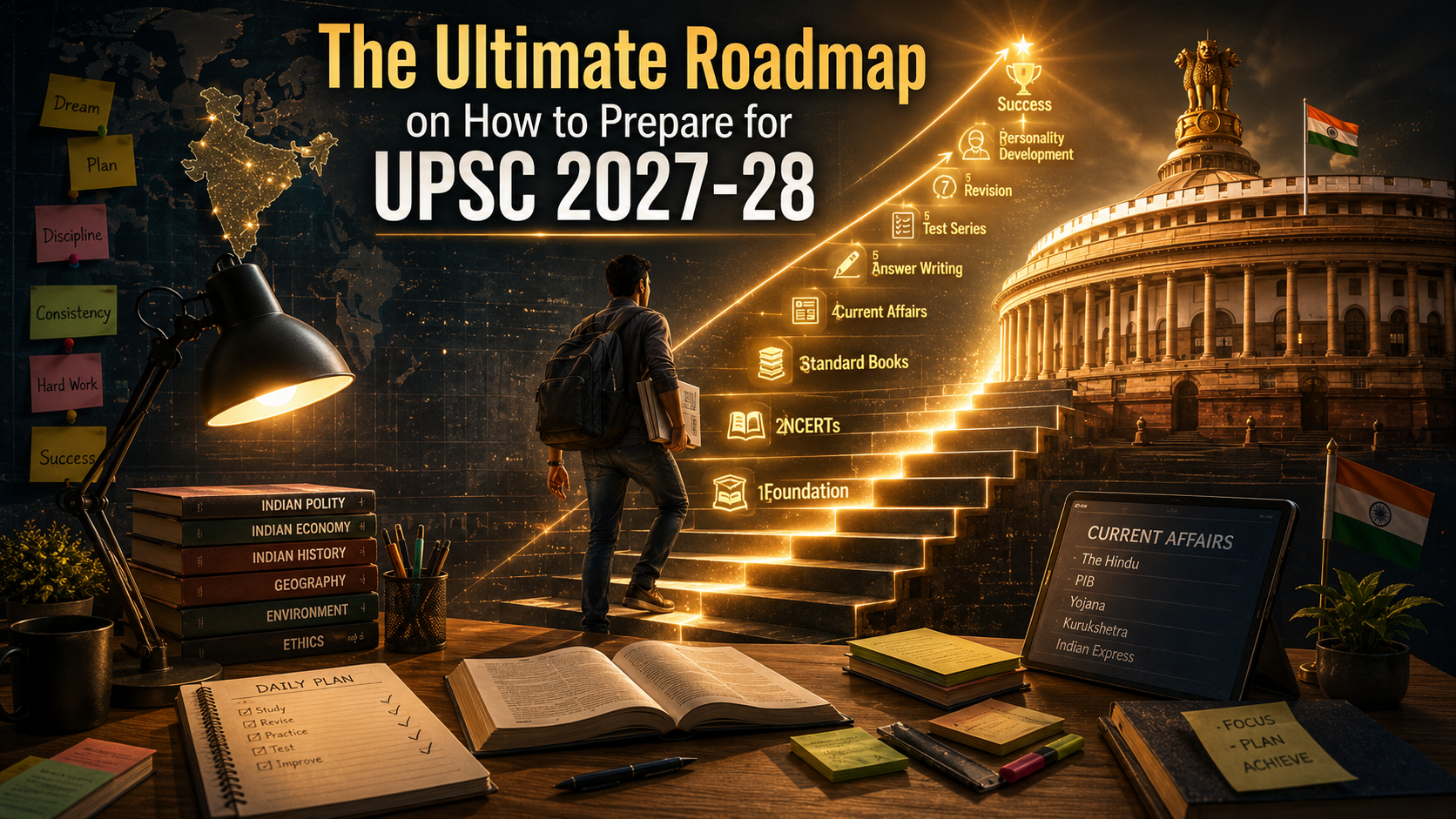
Learning how to prepare for upsc 2027-28 requires a radical shift away from traditional, short-term cramming and toward a highly structured, multi-layered strategy. The latest trends from recent Preliminary and Mains papers reveal a clear message from the commission: superficial knowledge is being aggressively penalized, while deep conceptual clarity and real-time analytical application are highly rewarded.
If you are targeting the UPSC 2027 or 28 examination cycle, you possess a major strategic asset—time. However, a two-to-three-year preparation window can be a double-edged sword; without a disciplined, phased blueprint, it is easy to fall into the trap of directionless reading or premature burnout. This ultimate guide breaks down a scientifically designed roadmap to transform you from an absolute beginner into a top-tier contender capable of clearing the cutoff on your very first attempt.
If you want to evaluate your current dynamic knowledge base alongside this multi-year blueprint, complement your foundational roadmap with our high-yield Science And Technology 100 MCQs for UPSC 2026 with Answers | Important Practice challenge.
Phase 1: Foundations of How to Prepare for UPSC 2027-28 (Months 1–6)
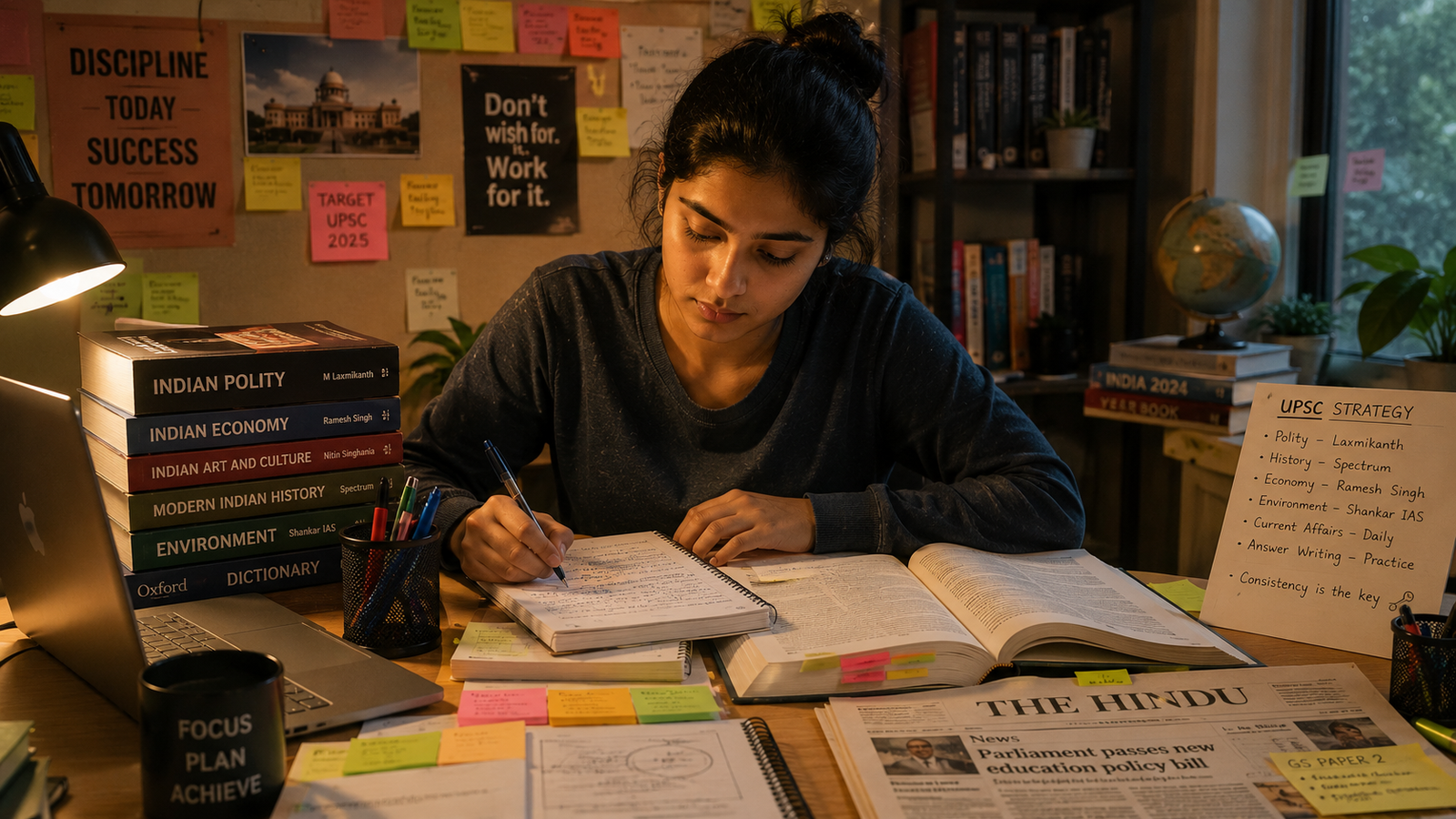
Objective: Build conceptual clarity and cultivate the “UPSC mindset.”
Before buying a mountain of reference books, you must master the fundamental grammar of the exam.
Deconstruct the Syllabus: Print out the official UPSC Prelims and Mains syllabus. Paste it where you study. Your goal is to understand what not to read. If a news item cannot be mapped directly to a syllabus header (e.g., GS-3: Inclusivity and issues arising from it), skip it.
The NCERT Substructure: Do not skip this step. Read the New NCERTs from Class 6 to 12 for History, Geography, Polity, Economy, and General Science.
Tip: Do not make notes during your first reading. Just read to understand the narrative. Write concise notes only during your second pass.
The Newspaper Habit: Start reading either The Hindu or The Indian Express. At this stage, do not try to compile exhaustive notes. Focus simply on understanding the background of ongoing national and global issues.
To access the complete list of mandatory texts and download your copies directly, visit the official repository at the National Council of Educational Research and Training (NCERT).
While preparing GS Paper 1, don’t miss Top 100 Art & Culture MCQs UPPCS Prelims 2026 | Complete Practice Set, a comprehensive resource for Indian Art & Culture revision.
Phase 2: Core Syllabus Strategy on How to Prepare for UPSC 2027-28 (Months 7–18)
Objective: Complete the standard reference books for GS Layers 1 through 4.
This is the heavy-lifting phase where you bridge basic concepts with advanced, analytical applications.
+-----------------------------------------------------------------------+
|                       THE CORE UPSC GS MATRIX                         |
+-----------------------------------------------------------------------+
|  GS-1: Foundations       | History, Geography, Indian Society         |
|  GS-2: Governance        | Indian Polity, Constitution, IR            |
|  GS-3: Development       | Economy, Environment, S&T, Security       |
|  GS-4: Aptitude          | Ethics, Integrity, Case Studies            |
+-----------------------------------------------------------------------+
1. Polity & Governance (GS-2)
Resource: M-Laxmikanth (Indian Polity) and PM Bakshi (Constitution).
Focus Area: Move beyond memorizing articles. Focus on constitutional philosophy, federal friction points, and judicial overreach versus activism.
2. Indian Economy (GS-3)
Resource: Mrunal Patel’s Notes / Vivek Singh (Indian Economy).
Focus Area: Master core macroeconomics—banking, monetary policy transmission, inflation, and fiscal deficits. UPSC rarely asks pure data; it asks about the systemic impact of structural policies.
Gaining a solid handle on these volatile fiscal indicators is a non-negotiable step as you map out how to prepare for upsc 2027-28 effectively.
3. History & Art and Culture (GS-1)
Resource: Modern History (Spectrum), Ancient/Medieval (Old NCERTs), and Art & Culture (Nitin Singhania)
Focus Area: Focus heavily on chronological frameworks, the socio-economic drivers behind historical movements, and cultural shifts rather than just names of rulers.
Memorizing raw facts won’t suffice; learning how to prepare for upsc 2027-28 requires decoding the systemic socio-economic changes behind historical events.
While planning your GS Paper 1 preparation, don’t forget to study The Ultimate Guide to Bharatanatyam UPSC Notes: Master GS 1 Art & Culture, one of the most important resources for Indian Art & Culture.
To enhance your preparation, don’t miss our complete UPSC Mains 2026 GS1 Art and Culture Notes: Complete Study Guide for Success, one of the most comprehensive resources for UPSC Art & Culture.
4. Geography & Environment (GS-1 & GS-3)
Resource: Class 11 & 12 Physical Geography NCERTs, PMF IAS or Shankar IAS for Environment.
Focus Area: Map-based questions are highly rewarding. Track ecological hotspots, changing climate patterns, and newly declared biosphere reserves.
Developing map-based shortcuts early will make your long-term ecology prep seamless, so test your environmental baseline using our targeted Environment MCQs 2026: 100 Most Important Questions for UPSC Prelims repository.
To analyze evolving policy patterns and trace official socioeconomic data points, cross-reference your foundational studies with the Press Information Bureau (PIB) daily news releases.
Phase 3: The Optional Subject Strategy for How to Prepare for UPSC 2027-28 (Months 12–18)
Objective: Secure 300+ marks in your chosen academic domain.
Your Optional subject accounts for 500 marks in the Mains exam and is often the single biggest differentiator in the final merit list.
When figuring out how to prepare for upsc 2027-28 at an advanced level, selecting your optional subject early stands as the ultimate strategic pivot point.
How to Choose: Do not pick an optional based purely on “trending” scores. Evaluate your educational background, personal comfort with the material, and the availability of quality study material or mentorship.
Completion Timeline: Dedicate 3 to 4 hours daily for 6 months exclusively to your optional. Aim to finish the entire Paper 1 and Paper 2 syllabus, including a first round of topic-wise previous year questions (PYQs), before your dedicated Prelims revision window opens.
Phase 4: Testing & Execution Mastery on How to Prepare for UPSC 2027-28 (Last 8–10 Months)
Objective: Transition from consumption to aggressive application.
As you draw closer to the exam year (2027 or 2028), shift your focus to rigorous testing and refining your output delivery.
       THE APPLICATION PROGRESSION

  [ Answer Writing ] ---> Daily practice of 2 questions from core GS modules
         │
         ▼
  [ Prelims Mock Tests ] -> 40+ comprehensive tests to refine target elimination
         │
         ▼
  [ CSAT Simplification ] -> Weekly systematic practice of math and reading logical sets
Daily Answer Writing: Mains answers are won on structure. Practice introducing concepts elegantly, using clear bullet points for the body section, and ending with forward-looking, constructive conclusions.
Prelims Mock Drilling: Solve a minimum of 40 to 50 sectional and full-length mock tests. Do not just look at your score; thoroughly analyze the answer keys to decode the traps set by examiners.
CSAT Strategy: The Civil Services Aptitude Test (Paper-2) has become a major roadblock for thousands of aspirants due to its rising difficulty. Dedicate weekly slots to quantitative aptitude, data interpretation, and logical reading comprehension, regardless of your academic background.
Here is the comprehensive, highly specific weekly study hour allocation template to add to your post. It is tailored for both university students and working professionals to show them exactly how to balance their schedules over a long-term horizon.
Developing structural speed at this stage is exactly how to prepare for upsc 2027-2028 for a high-scoring Mains performance.

Phase 2.5: The Micro-Scheduling Blueprint (Weekly Hour Allocation)
Having a long-term plan is useless without a weekly execution framework. When you are preparing over a 2- to 3-year horizon, your schedule needs to be sustainable to avoid burnout.
Here is exactly how to structure your weekly study hours based on your current profile.
Track A: College Student Blueprint for How to Prepare for UPSC 2027-28 (Target: 35–40 Hours/Week)
As a college student, your main advantage is access to a campus ecosystem, library blocks, and predictable semester cycles. Your goal is to maximize your weekends and utilize gaps between lectures.
| Day Type | Daily Study Target | Focus Areas & Subjects |
| Weekdays (Mon–Fri) | 4 Hours/day | 1.5 hours: Standard GS Textbook (Polity/History)
1.5 hours: Newspaper + Basic Note-making
1 hour: NCERT Revision / Backlog |
| Weekends (Sat–Sun) | 8–10 Hours/day | 4 hours: Optional Subject Core Modules
3 hours: Weak areas consolidation + Answer Writing
2 hours: Weekly Current Affairs Compilation |
The College Student Micro-Habit:
The 45-Minute Window: Use empty slots between your college lectures to read editorial pages on your tablet or phone. Clearing your daily newspaper analysis during college hours frees up your entire evening for heavy GS reference books.
Track B: Working Professional Guide on How to Prepare for UPSC 2027-28(Target: 25–28 Hours/Week)
As a working professional, your primary constraint is time energy. You cannot study like a full-time aspirant, so you must substitute quantity with absolute, distraction-free quality.
| Day Type | Daily Study Target | Focus Areas & Subjects |
| Weekdays (Mon–Fri) | 3 Hours/day | Split Shift Strategy:
Morning (1.5 hrs): High-energy GS core subjects (Economy/Polity)
Night (1.5 hrs): Newspaper Analysis + Relaxed NCERT reading |
| Weekends (Sat–Sun) | 6–7 Hours/day | Saturday: Dedicated Optional Subject (4 hours) + CSAT (2 hours)
Sunday: Full Week Review + Mains Answer Structure Practice (5 hours) |
The Working Professional Micro-Habit:
The Commute Leverage: Do not listen to music during your daily office commute. Use this time to listen to analytical audio explainers, Rajya Sabha TV debates, or scroll through curated current affairs summaries. This ensures you step into your house at night with your basic current affairs updates already checked off.

The Non-Negotiable Rule of Multi-Year Preparation
        THE SUSTAINABILITY EQUATION

 [ Consistent 4 Hours/Day ]   >>>   [ Erratic 12 Hours/Day ]
     (For 2-3 Years)                     (Followed by Burnout)

Ultimately, mastering how to prepare for upsc 2027-28 is a marathon of compounding daily efforts, not a temporary sprint.
When learning how to prepare for UPSC 2027-2028, remember that consistency beats intensity every single time. Studying for 12 hours a day for a week and then taking a two-week break due to exhaustion will destroy your retention. Stick to your customized track template, protect your sleep cycle, and trust the compounding effect of steady, daily gains.
Once you finalize your weekly study calendar, transition from long-term planning to active testing by reviewing global strategy trends in our breakthrough 100 Powerful Iran Israel War MCQs 2026: Must-Know Questions for UPSC Prelims analysis.
Recommended Reading-
Important World Current Affairs MCQs for UPSC Prelims 2027 with Answers
100 Essential Sports Current Affairs MCQs UPSC 2026
Strait of Hormuz UPSC Prelims 2026
75 Important Polity Questions for UPSC Prelims 2026
4 thoughts on “The Ultimate Roadmap on How to Prepare for UPSC 2027-28 Successfully”