
National Income and GDP UPSC Prelims preparation requires a strong understanding of GDP, GVA, GNP, NDP, NNP, nominal GDP, real GDP, GDP deflator and related concepts. UPSC CSE Prelims generally tests these topics through conceptual, statement-based and application-oriented questions rather than simple definitions.
This practice set contains 100 original MCQs on National Income and GDP, divided into 5 sections of 20 questions each. The questions are designed to follow the conceptual and analytical approach required for the UPSC Civil Services Preliminary Examination, with answers and short explanations provided at the end of each section.
National Income and GDP UPSC Prelims preparation requires a clear understanding of GDP, GVA, GNP, NDP, NNP, nominal GDP, real GDP and the GDP deflator.
Important: These are original practice questions and are not verbatim reproductions of questions asked by UPSC.
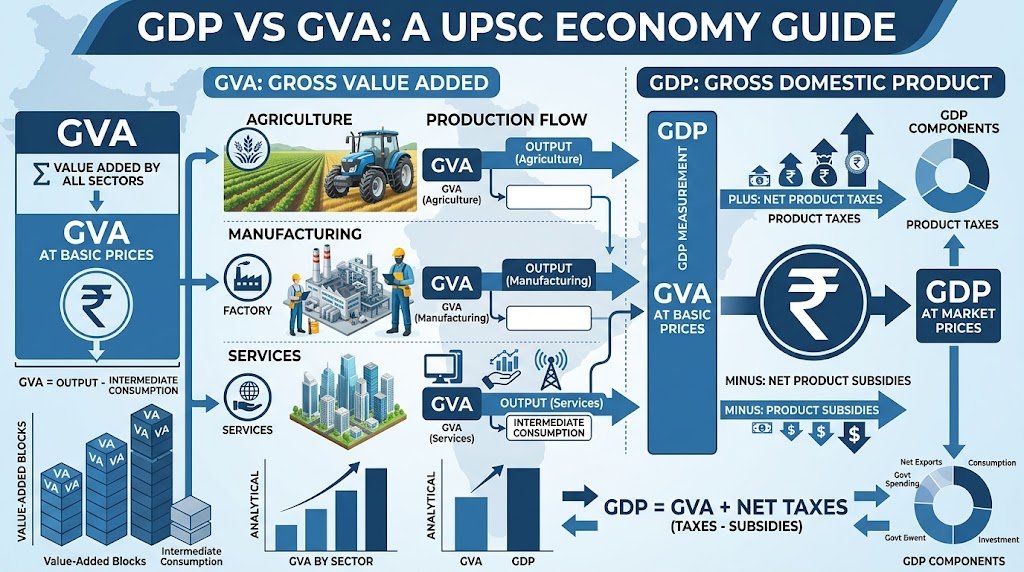
These concepts are particularly important for National Income and GDP UPSC Prelims preparation because UPSC can test the distinction between domestic and national income through statement-based questions.
After attempting these National Income and GDP questions, aspirants should first build a strong foundation in the broader Indian economy, including key concepts, current economic developments and important terminology. For this, you can also read our detailed guide on [Indian Economy for UPSC Prelims 2027: Complete Economy Notes, Concepts & Current Affairs].
Section 1: GDP, GVA and Basic National Income Concepts
These National Income and GDP UPSC Prelims questions focus on the fundamental concepts that candidates need to master before moving to advanced Economy topics.
Q.1. With reference to Gross Domestic Product (GDP), consider the following statements:
- GDP measures the value of final goods and services produced within the domestic territory of an economy during a specified period.
- Production by a foreign-owned company located within India can contribute to India’s GDP.
- Income earned by an Indian resident from production undertaken outside India is necessarily included in India’s GDP.
Which of the statements given above are correct?
(a) 1 and 2 only
(b) 2 and 3 only
(c) 1 and 3 only
(d) 1, 2 and 3
Q.2. Consider the following pairs:
| Concept | Broad meaning |
|---|---|
| 1. GDP | Production within domestic territory |
| 2. GNP | GDP adjusted for net factor income from abroad |
| 3. NDP | GDP adjusted for consumption of fixed capital |
Which of the pairs given above are correctly matched?
(a) 1 and 2 only
(b) 2 and 3 only
(c) 1 and 3 only
(d) 1, 2 and 3
Q.3. Which one of the following best explains why intermediate goods are generally excluded while calculating GDP through the expenditure approach?
(a) Their prices are always more volatile than those of final goods
(b) Their inclusion may result in double counting of the value of production
(c) They are produced only by the manufacturing sector
(d) Their production does not generate income for any factor of production
Q.4. Consider the following statements regarding Gross Value Added (GVA):
- GVA measures the value added by producers during the production process.
- It can be understood as the value of output minus the value of intermediate consumption.
- GVA and GDP are always identical regardless of the treatment of taxes and subsidies on products.
Which of the statements given above are correct?
(a) 1 and 2 only
(b) 2 only
(c) 1 and 3 only
(d) 1, 2 and 3
Q.5. Suppose an economy produces wheat, flour and bread in successive stages. If the value of intermediate wheat and flour is counted along with the final value of bread while measuring total output, which problem is most likely to arise?
(a) Underestimation of depreciation
(b) Double counting
(c) Underestimation of exports
(d) Overestimation of imports
Q.6. Consider the following statements:
- GDP is a flow variable because it measures production over a period of time.
- Wealth accumulated by a household at a particular point of time is a stock variable.
- An increase in the stock of physical capital during a year can contribute to economic production in subsequent periods.
Which of the statements given above are correct?
(a) 1 and 2 only
(b) 2 and 3 only
(c) 1 and 3 only
(d) 1, 2 and 3
Q.7. With reference to GVA and GDP, consider the following statements:
- GVA focuses on value added by individual producers or sectors.
- GDP at market prices incorporates the net effect of taxes and subsidies on products relative to GVA.
- GVA can be used to analyse the contribution of different sectors to economic activity.
Which of the statements given above are correct?
(a) 1 and 2 only
(b) 1 and 3 only
(c) 2 and 3 only
(d) 1, 2 and 3
Q.8. If the value of output of a firm is ₹100 crore and the value of intermediate inputs used by it is ₹60 crore, the firm’s contribution to GVA, ignoring other complications, would be:
(a) ₹40 crore
(b) ₹60 crore
(c) ₹100 crore
(d) ₹160 crore
Q.9. Consider the following statements about GDP:
- GDP can increase even if the physical quantity of production remains unchanged.
- Such an increase can occur because of a rise in the prices of goods and services.
- Real GDP is designed to reduce the influence of price changes when comparing output across periods.
Which of the statements given above are correct?
(a) 1 and 2 only
(b) 2 and 3 only
(c) 1 and 3 only
(d) 1, 2 and 3
Q.10. Which one of the following situations would most directly increase India’s GDP, assuming other factors remain unchanged?
(a) An Indian resident purchases shares of a foreign company in an overseas market
(b) A foreign company produces goods in a factory located in India
(c) An Indian household transfers money to a relative living abroad
(d) An Indian investor purchases an already existing foreign asset
Q.11. Consider the following statements regarding production within domestic territory:
- Nationality of the producer is not the primary criterion for measuring GDP.
- Production by a foreign-owned enterprise located within India contributes to India’s domestic production.
- Production by an Indian-owned enterprise located abroad contributes directly to India’s GDP.
Which of the statements given above are correct?
(a) 1 and 2 only
(b) 2 and 3 only
(c) 1 and 3 only
(d) 1, 2 and 3
Q.12. Which one of the following is most appropriately treated as a final good for the purpose of GDP measurement?
(a) Steel purchased by an automobile manufacturer for producing cars
(b) Flour purchased by a bakery for producing bread
(c) A newly produced car purchased by a household for personal use
(d) Cotton purchased by a textile manufacturer
Q.13. Consider the following statements:
- GDP includes only newly produced final goods and services during the accounting period.
- The resale of a second-hand car, by itself, adds the full value of the car to current GDP.
- Brokerage or service charges associated with the resale of an existing asset can represent current production.
Which of the statements given above are correct?
(a) 1 and 3 only
(b) 1 and 2 only
(c) 2 and 3 only
(d) 1, 2 and 3
Q.14. An economy experiences an increase in GDP while its population increases at a faster rate. Which of the following is most likely to occur?
(a) Real GDP per capita necessarily increases
(b) Nominal GDP per capita necessarily decreases
(c) GDP per capita may decline despite an increase in aggregate GDP
(d) GDP per capita must remain unchanged
Q.15. Consider the following statements:
- GDP per capita is obtained by relating GDP to population.
- An increase in GDP per capita necessarily implies a more equal distribution of income.
- GDP per capita does not by itself reveal how income is distributed among households.
Which of the statements given above are correct?
(a) 1 and 3 only
(b) 1 and 2 only
(c) 2 and 3 only
(d) 1, 2 and 3
Q.16. Which of the following would be counted as part of current GDP?
(a) Purchase of an existing government bond by a household
(b) Purchase of a newly produced machine by a manufacturing firm
(c) Transfer of money from one household to another as a gift
(d) Sale of an existing house between two households, excluding brokerage services
Q.17. Consider the following statements regarding value addition:
- Value addition at each stage of production helps avoid double counting.
- The sum of value added across all production stages can correspond to the value of final output.
- Intermediate consumption is irrelevant when calculating value added.
Which of the statements given above are correct?
(a) 1 and 2 only
(b) 1 and 3 only
(c) 2 and 3 only
(d) 1, 2 and 3
Q.18. A rise in production occurs entirely because a previously unemployed factory begins operating with existing machinery. Which of the following is most directly reflected in GDP?
(a) Increase in the value of current production
(b) Increase in the stock of existing machinery only
(c) Increase in household wealth only
(d) Increase in government debt
Q.19. Which one of the following statements best describes GDP?
(a) It measures the total wealth owned by citizens of a country
(b) It measures the monetary value of economic production within a specified geographical area during a period
(c) It measures only government expenditure during a financial year
(d) It measures the total financial assets held by residents
Q.20. Consider the following statements:
- GDP can be estimated through production, income and expenditure approaches.
- In a consistent national accounting framework, these approaches are conceptually linked to the same economic activity.
- Differences between the estimates can arise because of statistical discrepancies in actual data collection.
Which of the statements given above are correct?
(a) 1 and 2 only
(b) 1 and 3 only
(c) 2 and 3 only
(d) 1, 2 and 3
To strengthen their understanding of government revenue, taxation, expenditure and fiscal management, candidates can also practice our comprehensive Fiscal Policy UPSC Prelims 2027 MCQs.
Answers and Explanations: Section 1 of 100 MCQs on National Income and GDP UPSC Prelims 2027
1. (a) — GDP is based on production within domestic territory. Foreign-owned production inside India contributes to India’s GDP. Income earned abroad by an Indian resident is relevant to national rather than domestic product.
2. (d) — GDP follows the domestic-territory principle. GNP adjusts GDP for net factor income from abroad, while NDP is GDP after deducting consumption of fixed capital.
3. (b) — Intermediate goods are excluded from the final expenditure calculation to prevent the same economic value from being counted more than once.
4. (a) — GVA is output minus intermediate consumption. GDP and GVA are not always identical because taxes and subsidies on products create a distinction between them.
5. (b) — Counting the value of wheat, flour and bread together would repeatedly count value already embodied in the final product.
6. (d) — GDP is measured over a period and is therefore a flow. Wealth at a point in time is a stock. Capital accumulation can contribute to future production.
7. (d) — All three statements are correct. GVA is particularly useful for understanding the contribution of different sectors.
8. (a) — GVA = Output − Intermediate Consumption = ₹100 crore − ₹60 crore = ₹40 crore.
9. (d) — Nominal GDP can increase because of higher prices even when output is unchanged. Real GDP attempts to isolate changes in output from changes in prices.
10. (b) — Production taking place within India’s domestic territory contributes to India’s GDP, irrespective of whether the producer is Indian or foreign-owned.
11. (a) — GDP is based on the location of production. Production by an Indian company abroad is not directly included in India’s GDP.
12. (c) — A newly produced car purchased by a household for personal use is a final good. The other examples are intermediate inputs in the stated circumstances.
13. (a) — Resale of an existing asset does not represent newly produced output. However, brokerage and other newly provided services related to the transaction can be counted.
14. (c) — Aggregate GDP can increase while GDP per capita declines if population growth is faster than GDP growth.
15. (a) — GDP per capita is an average. It does not indicate how income is distributed among different households.
16. (b) — A newly produced machine represents current production and is included as investment expenditure.
17. (a) — Value added at each stage prevents double counting. Intermediate consumption is essential for calculating value added.
18. (a) — The immediate effect is an increase in current production, which contributes to GDP.
19. (b) — GDP measures the value of production within a geographical area over a specified period. It is not a measure of accumulated wealth.
20. (d) — Production, income and expenditure approaches are different ways of measuring the same broad economic activity. Statistical discrepancies can occur in practice.
Once you have understood the basic concepts of GDP and GVA, it becomes easier to connect national income accounting with other important Indian Economy concepts. If you are preparing the broader Economy syllabus for UPSC Prelims 2027, continue your preparation with our Monetary Policy MCQs 2026: Comprehensive Guide for UPSC Prelims
For a deeper understanding of India’s national income estimates, GDP, GVA and related statistical concepts, UPSC aspirants can also refer to the official national accounts resources published by the Ministry of Statistics and Programme Implementation (MoSPI).
Section 2: Nominal GDP, Real GDP and GDP Deflator
Understanding nominal and real GDP is essential for solving National Income and GDP UPSC Prelims questions involving inflation and economic growth.
Q.21. Consider the following statements regarding nominal and real GDP:
- Nominal GDP is measured using prices prevailing during the period being measured.
- Real GDP attempts to remove the effect of price changes from changes in output.
- If nominal GDP rises, real GDP must necessarily rise by the same percentage.
Which of the statements given above are correct?
(a) 1 and 2 only
(b) 2 and 3 only
(c) 1 and 3 only
(d) 1, 2 and 3
Q.22. An economy produces the same quantity of goods and services in two consecutive years, but the prices of all goods rise by 10 per cent. Which of the following is most likely?
(a) Real GDP rises by 10 per cent
(b) Nominal GDP rises while real GDP remains broadly unchanged
(c) Both nominal and real GDP fall
(d) GDP becomes zero in real terms
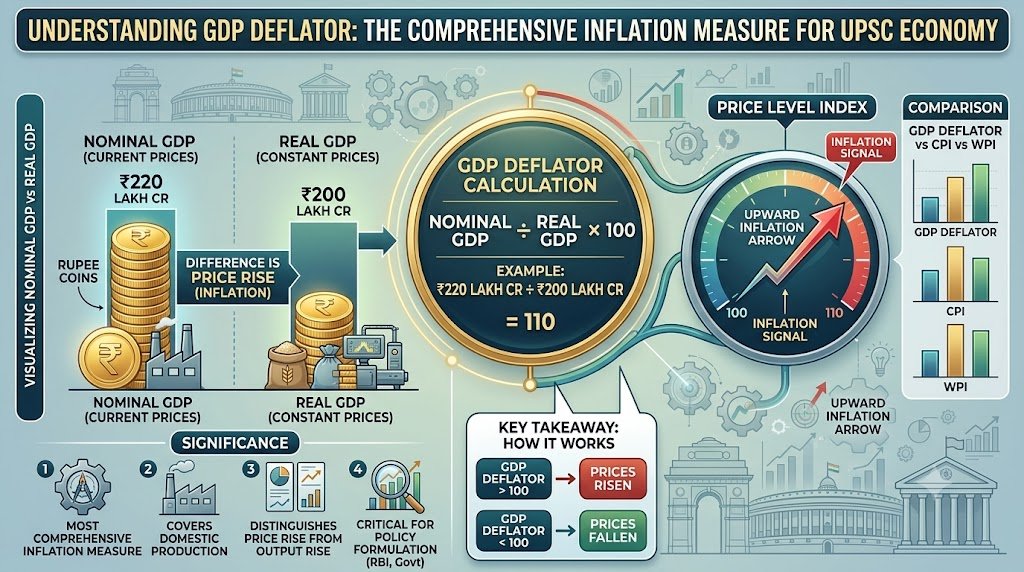
Q.23. Consider the following statements about the GDP deflator:
- It reflects the price level associated with domestically produced final goods and services included in GDP.
- It is obtained by comparing nominal GDP with real GDP.
- It necessarily uses exactly the same fixed basket of goods every year as a consumer price index.
Which of the statements given above are correct?
(a) 1 and 2 only
(b) 1 and 3 only
(c) 2 and 3 only
(d) 1, 2 and 3
Q.24. If nominal GDP is ₹220 lakh crore and real GDP is ₹200 lakh crore, the GDP deflator, expressed as an index with real GDP as the denominator, would be:
(a) 90
(b) 100
(c) 110
(d) 120
Q.25. A country records 12% growth in nominal GDP and 5% growth in real GDP. Which of the following can best explain the difference?
(a) Population declined sharply
(b) Prices of domestically produced final goods and services increased
(c) Imports became zero
(d) Government expenditure necessarily declined
Q.26. Consider the following statements:
- Real GDP growth can be positive even when nominal GDP growth is very low under unusual price conditions.
- Nominal GDP growth incorporates both changes in quantities and prices.
- Real GDP is always equal to nominal GDP in an inflation-free economy only if the relevant price index is appropriately normalised.
Which of the statements given above are correct?
(a) 1 and 2 only
(b) 2 and 3 only
(c) 1 and 3 only
(d) 1, 2 and 3
Q.27. Which one of the following situations illustrates a purely price-driven increase in nominal GDP, assuming no change in quantities produced?
(a) Production rises by 8% while prices remain unchanged
(b) Prices rise by 8% while physical output remains unchanged
(c) Both production and employment fall
(d) Exports increase because domestic production increases
Q.28. Consider the following statements:
- A GDP deflator can change because of changes in prices of domestically produced goods and services.
- Changes in the prices of imported goods can affect the cost of living without necessarily having the same direct effect on the GDP deflator.
- Therefore, the GDP deflator and consumer price inflation can differ significantly.
Which of the statements given above are correct?
(a) 1 and 2 only
(b) 2 and 3 only
(c) 1 and 3 only
(d) 1, 2 and 3
Q.29. An economy’s nominal GDP increases from ₹100 lakh crore to ₹108 lakh crore, while its real GDP increases from ₹100 lakh crore to ₹104 lakh crore. Which conclusion is most appropriate?
(a) Output increased by 8%
(b) Prices and output both contributed to nominal GDP growth
(c) Prices fell by 4%
(d) Real GDP must have fallen because nominal GDP rose
Q.30. Consider the following statements:
- A rise in nominal GDP does not by itself establish an equivalent rise in the volume of economic production.
- Real GDP is more suitable than nominal GDP for comparing changes in output across time when price levels change.
- Nominal GDP is irrelevant for all economic analysis.
Which of the statements given above are correct?
(a) 1 and 2 only
(b) 1 and 3 only
(c) 2 and 3 only
(d) 1, 2 and 3
Q.31. If prices fall substantially while physical output increases moderately, which of the following is possible?
(a) Real GDP increases while nominal GDP decreases
(b) Both real and nominal GDP must increase
(c) Real GDP decreases while physical output increases
(d) Nominal GDP cannot change
Q.32. Consider the following statements regarding base effects:
- A low growth rate in one year can partly reflect comparison with an unusually high base in the previous year.
- A high growth rate can partly reflect comparison with an unusually low base.
- Base effects necessarily indicate manipulation of GDP data.
Which of the statements given above are correct?
(a) 1 and 2 only
(b) 2 and 3 only
(c) 1 and 3 only
(d) 1, 2 and 3
Q.33. Which one of the following best explains why comparing GDP growth rates without considering the price dimension can be misleading?
(a) GDP never includes services
(b) GDP growth can contain both quantity and price effects
(c) GDP is calculated only by the government
(d) GDP excludes all investment
Q.34. Consider the following statements:
- Real GDP is expressed in prices of a chosen reference framework.
- A change in the base year can affect the measured growth rates and relative importance of sectors.
- Changing the base year necessarily changes the actual physical quantity of goods and services produced.
Which of the statements given above are correct?
(a) 1 and 2 only
(b) 2 and 3 only
(c) 1 and 3 only
(d) 1, 2 and 3
Q.35. A country’s nominal GDP rises by 15%, while its GDP deflator rises by approximately 10%. Which broad inference is most reasonable?
(a) Real output likely increased, though by less than nominal GDP
(b) Real output necessarily fell by 10%
(c) There was no change in production
(d) Imports necessarily rose by 15%
Q.36. Which of the following would most directly cause nominal GDP to rise without an increase in real GDP, assuming the composition of output is unchanged?
(a) Increase in labour productivity
(b) Increase in physical production
(c) General increase in prices
(d) Increase in capital formation
Q.37. Consider the following statements:
- The GDP deflator covers the price changes associated with the goods and services included in GDP.
- Because imports are not domestic production, their prices do not enter GDP simply because consumers purchase them.
- CPI and GDP deflator therefore measure exactly the same inflation phenomenon.
Which of the statements given above are correct?
(a) 1 and 2 only
(b) 1 and 3 only
(c) 2 and 3 only
(d) 1, 2 and 3
Q.38. If an economy’s real GDP grows by 6% and its population grows by 2%, which of the following is the most appropriate conclusion, ignoring other measurement issues?
(a) Real GDP per capita tends to increase
(b) Real GDP per capita necessarily falls
(c) Nominal GDP must decline
(d) Population-adjusted GDP must remain unchanged
Q.39. Which one of the following would be the most appropriate indicator for comparing the actual volume of production of an economy over time?
(a) Nominal GDP alone
(b) Real GDP
(c) Money supply alone
(d) Government revenue alone
Q.40. Consider the following statements:
- An increase in the GDP deflator indicates an increase in the overall price level of goods and services covered by the deflator.
- It is possible for real GDP growth to be positive even when inflation is negative.
- Nominal GDP can fall even when real GDP rises if the fall in prices is sufficiently large.
Which of the statements given above are correct?
(a) 1 and 2 only
(b) 2 and 3 only
(c) 1 and 3 only
(d) 1, 2 and 3
Answers and Explanations: Section 2 of 100 MCQs on National Income and GDP UPSC Prelims 2027
21. (a) — Nominal GDP uses current prices, while real GDP adjusts for price changes. Therefore, nominal GDP growth need not equal real GDP growth.
22. (b) — If output remains unchanged but prices rise, nominal GDP rises while real GDP remains broadly unchanged.
23. (a) — The GDP deflator is derived from nominal and real GDP. Unlike a conventional CPI, it is not based on a fixed consumer basket.
24. (c) — GDP Deflator = (Nominal GDP ÷ Real GDP) × 100 = (220 ÷ 200) × 100 = 110.
25. (b) — The difference between nominal and real GDP growth can arise from changes in prices.
26. (d) — All three statements are conceptually correct when the relevant price framework is properly understood.
27. (b) — An increase in prices with unchanged physical production raises nominal GDP without increasing real output.
28. (d) — All three statements correctly explain why CPI and GDP deflator inflation can differ.
29. (b) — Nominal GDP increased by more than real GDP, indicating that both output and prices contributed to nominal growth.
30. (a) — Statements 1 and 2 are correct. Nominal GDP remains useful for analysing the current monetary size of an economy.
31. (a) — Real GDP can increase because output rises, while nominal GDP can fall if the fall in prices is sufficiently large.
32. (a) — Base effects result from comparison with the previous period. They do not automatically imply manipulation.
33. (b) — Nominal GDP can change because of both price and quantity changes.
34. (a) — Real GDP uses a reference price framework. Changing the base year affects measurement but does not change actual production.
35. (a) — If nominal GDP grows by 15% and prices rise by approximately 10%, real output likely increased by a smaller amount.
36. (c) — A general increase in prices can raise nominal GDP without changing real output.
37. (a) — The GDP deflator relates to domestic production, while CPI also reflects consumer prices, including imported goods.
38. (a) — If real GDP grows faster than population, real GDP per capita generally increases.
39. (b) — Real GDP is more appropriate for comparing the volume of production across time.
40. (d) — All three statements are possible under the conditions given.
Section 3: GNP, NDP, NNP and Factor Income
This section strengthens your National Income and GDP UPSC Prelims preparation through questions on GNP, NDP, NNP and factor income.
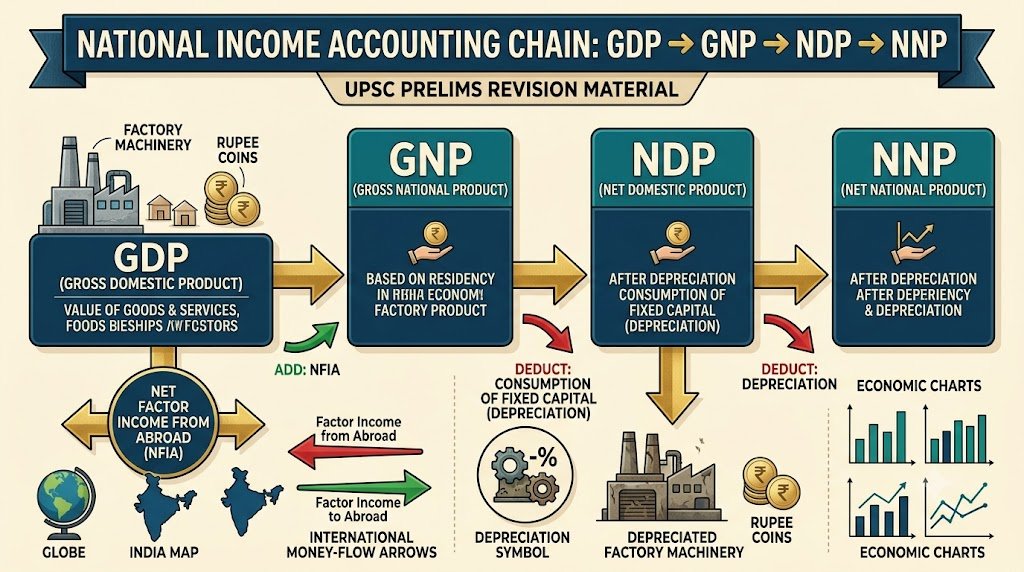
Q.41. Consider the following statements regarding Gross National Product (GNP):
- GNP starts from GDP and adjusts for net factor income from abroad.
- Income earned by residents from factors of production used abroad can contribute to GNP.
- Income earned by foreign residents from production within India can be deducted while moving from GDP to GNP.
Which of the statements given above are correct?
(a) 1 and 2 only
(b) 2 and 3 only
(c) 1 and 3 only
(d) 1, 2 and 3
Q.42. If factor income received from abroad is greater than factor income paid to foreigners, then, other things remaining equal:
(a) GNP will be lower than GDP
(b) GNP will be higher than GDP
(c) GDP will automatically become zero
(d) NDP must become negative
Q.43. Consider the following statements:
- Consumption of fixed capital represents the loss in value of fixed assets due to wear and tear, obsolescence and related factors.
- NDP can be obtained by subtracting consumption of fixed capital from GDP.
- Depreciation is added to GDP to obtain NDP.
Which of the statements given above are correct?
(a) 1 and 2 only
(b) 2 and 3 only
(c) 1 and 3 only
(d) 1, 2 and 3
Q.44. An economy has GDP of ₹500 lakh crore and consumption of fixed capital of ₹50 lakh crore. Ignoring other adjustments, its NDP would be:
(a) ₹450 lakh crore
(b) ₹500 lakh crore
(c) ₹550 lakh crore
(d) ₹50 lakh crore
Q.45. Which one of the following best describes Net National Product (NNP)?
(a) GDP after adding imports
(b) GNP after deducting consumption of fixed capital
(c) GDP after deducting exports
(d) GNP after adding depreciation
Q.46. Consider the following statements:
- Gross measures of production include the amount corresponding to consumption of fixed capital.
- Net measures deduct consumption of fixed capital.
- The distinction between gross and net is unrelated to the geographical boundary of production.
Which of the statements given above are correct?
(a) 1 and 2 only
(b) 2 and 3 only
(c) 1 and 3 only
(d) 1, 2 and 3
Q.47. Net factor income from abroad can broadly be understood as:
(a) Exports minus imports of goods
(b) Factor income received from abroad minus factor income paid abroad
(c) Government revenue minus government expenditure
(d) Foreign exchange reserves minus external debt
Q.48. Consider the following statements:
- Compensation of employees is a component of factor income.
- Rent can represent income accruing to a factor of production.
- Profits earned by enterprises can form part of factor income generated by production.
Which of the statements given above are correct?
(a) 1 and 2 only
(b) 2 and 3 only
(c) 1 and 3 only
(d) 1, 2 and 3
Q.49. A foreign company operates a manufacturing plant in India and earns profits from production there. From the perspective of domestic production and national income, which statement is most appropriate?
(a) The production contributes to India’s GDP, while the relevant factor-income treatment can affect GNP
(b) Neither production nor income is relevant to India’s national accounts
(c) The entire profit automatically becomes India’s GNP
(d) The production is counted only in the country’s imports
Q.50. Consider the following statements:
- GDP and GNP can differ because of cross-border factor-income flows.
- A country with substantial income earned by its residents abroad may have GNP greater than GDP.
- GDP is determined by the nationality of producers rather than location of production.
Which of the statements given above are correct?
(a) 1 and 2 only
(b) 1 and 3 only
(c) 2 and 3 only
(d) 1, 2 and 3
Q.51. Which one of the following would increase NDP, assuming GDP remains unchanged?
(a) Increase in consumption of fixed capital
(b) Decrease in consumption of fixed capital
(c) Increase in imports alone
(d) Increase in population alone
Q.52. Consider the following statements:
- If depreciation increases while GDP remains constant, NDP falls.
- If net factor income from abroad increases while GDP remains constant, GNP rises.
- GDP and NDP must always be equal.
Which of the statements given above are correct?
(a) 1 and 2 only
(b) 1 and 3 only
(c) 2 and 3 only
(d) 1, 2 and 3
Q.53. An Indian resident earns income from a factor of production employed abroad. Such income is most directly relevant when distinguishing:
(a) GDP from GVA
(b) GDP from GNP
(c) Nominal GDP from Real GDP
(d) Gross investment from net investment
Q.54. Which of the following combinations is correct?
(a) GDP − Depreciation = GNP
(b) GDP + Net Factor Income from Abroad = GNP
(c) GDP − Exports = GNP
(d) GDP + Imports = NNP
Q.55. Consider the following statements regarding national income accounting:
- Domestic and national concepts differ mainly because of the treatment of factor-income flows across borders.
- Gross and net concepts differ because of the treatment of consumption of fixed capital.
- Market-price and factor-income concepts can differ because of taxes and subsidies.
Which of the statements given above are correct?
(a) 1 and 2 only
(b) 2 and 3 only
(c) 1 and 3 only
(d) 1, 2 and 3
Q.56. If GNP is ₹800 lakh crore and consumption of fixed capital is ₹80 lakh crore, NNP, ignoring other adjustments, would be:
(a) ₹720 lakh crore
(b) ₹800 lakh crore
(c) ₹880 lakh crore
(d) ₹80 lakh crore
Q.57. Which one of the following is most likely to reduce the difference between GDP and GNP?
(a) A substantial increase in net factor income from abroad
(b) A substantial decrease in net factor income from abroad
(c) Elimination of depreciation
(d) Increase in domestic investment
Q.58. Consider the following statements:
- Income earned by foreign factors operating domestically is relevant to the distinction between domestic and national product.
- Income earned by domestic factors operating abroad is similarly relevant.
- Therefore, national product can be derived from domestic product after an adjustment for net factor income from abroad.
Which of the statements given above are correct?
(a) 1 and 2 only
(b) 2 and 3 only
(c) 1 and 3 only
(d) 1, 2 and 3
Q.59. Which of the following would be classified as a flow rather than a stock?
(a) Wealth held by households at the end of a year
(b) Capital stock of an economy at a particular date
(c) National income earned during a year
(d) Foreign exchange reserves at a particular date
Q.60. Consider the following statements:
- National income accounting attempts to measure economic activity using systematic accounting concepts.
- It provides information useful for analysing growth and structural changes.
- It provides a complete measure of social welfare without any limitations.
Which of the statements given above are correct?
(a) 1 and 2 only
(b) 2 and 3 only
(c) 1 and 3 only
(d) 1, 2 and 3
Answers and Explanations: Section 3 of 100 MCQs on National Income and GDP UPSC Prelims 2027
41. (d) — GNP adjusts GDP for net factor income from abroad. Factor income received from abroad is added and factor income paid abroad is deducted.
42. (b) — Positive net factor income from abroad makes GNP greater than GDP.
43. (a) — NDP is obtained by deducting consumption of fixed capital from GDP.
44. (a) — NDP = GDP − Consumption of Fixed Capital = ₹500 − ₹50 = ₹450 lakh crore.
45. (b) — NNP is obtained by deducting consumption of fixed capital from GNP.
46. (d) — Gross and net concern depreciation, while domestic and national concern the territorial and national basis of production.
47. (b) — Net factor income from abroad is factor income received from abroad minus factor income paid to foreigners.
48. (d) — Compensation of employees, rent and profits can represent returns arising from production.
49. (a) — Production inside India contributes to GDP. Cross-border factor-income flows determine the adjustment when moving from GDP to GNP.
50. (a) — GDP is based on location of production, whereas GNP also incorporates the relevant factor-income relationship with the rest of the world.
51. (b) — NDP = GDP − depreciation. Therefore, lower depreciation increases NDP when GDP is unchanged.
52. (a) — Higher depreciation reduces NDP, while higher net factor income from abroad raises GNP.
53. (b) — Income earned abroad by residents is relevant to the distinction between domestic and national product.
54. (b) — GNP = GDP + Net Factor Income from Abroad.
55. (d) — All three are important conceptual distinctions in national income accounting.
56. (a) — NNP = GNP − Consumption of Fixed Capital = ₹800 − ₹80 = ₹720 lakh crore.
57. (b) — A smaller net factor-income adjustment brings GDP and GNP closer together.
58. (d) — All three statements correctly explain the domestic-national distinction.
59. (c) — National income is measured over a period of time and is therefore a flow.
60. (a) — National accounts are useful for measuring economic activity and structural changes, but they do not constitute a complete measure of social welfare.
Section 4: Expenditure, Income and Production Approaches to GDP
For National Income and GDP UPSC Prelims preparation, candidates should understand how production, income and expenditure approaches are connected.
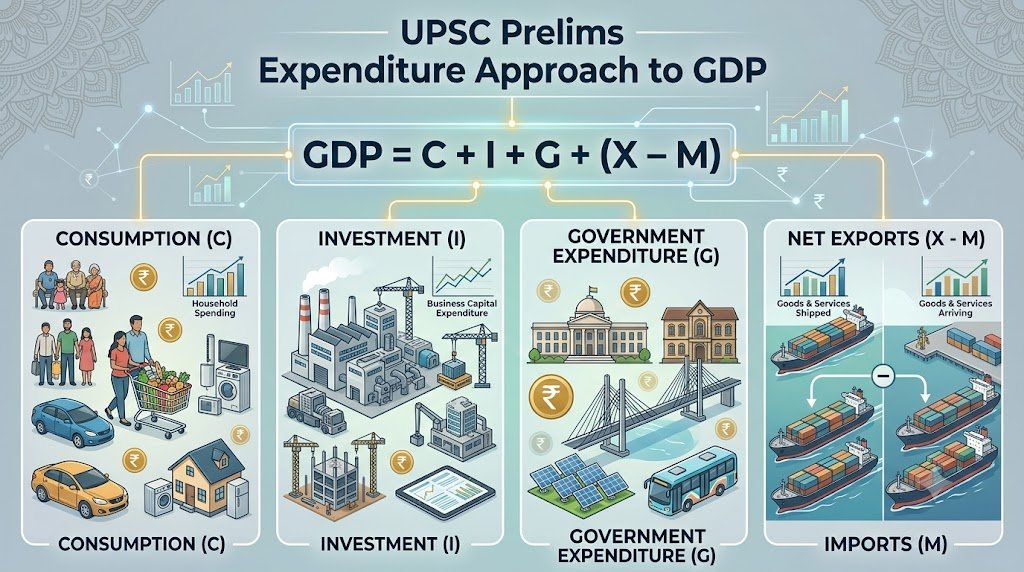
Q.61. Consider the following statements regarding the expenditure approach to GDP:
- Private final consumption expenditure can form part of GDP.
- Government final consumption expenditure can form part of GDP.
- Exports are added and imports are subtracted in the standard expenditure identity for an open economy.
Which of the statements given above are correct?
(a) 1 and 2 only
(b) 2 and 3 only
(c) 1 and 3 only
(d) 1, 2 and 3
Q.62. Which one of the following represents the standard expenditure identity for GDP in an open economy?
(a) C + I + G + X − M
(b) C + I − G + M − X
(c) C + G − I + X + M
(d) C + I + G − X − M
Q.63. Consider the following statements:
- Imports are subtracted in the expenditure approach because they may already be included in consumption, investment or government expenditure but are not domestic production.
- Exports are added because they represent domestically produced goods and services purchased by foreigners.
- An increase in imports always reduces GDP in the same proportion.
Which of the statements given above are correct?
(a) 1 and 2 only
(b) 1 and 3 only
(c) 2 and 3 only
(d) 1, 2 and 3
Q.64. A household purchases a newly produced domestic washing machine. From the expenditure approach, this transaction is primarily reflected in:
(a) Private final consumption expenditure
(b) Government consumption expenditure
(c) Net exports
(d) Depreciation
Q.65. A firm purchases a newly produced machine for use in its factory. Such expenditure is most appropriately classified as:
(a) Private consumption
(b) Investment expenditure
(c) Government transfer
(d) Intermediate consumption of households
Q.66. Consider the following statements:
- An increase in inventories can be treated as investment in national accounting.
- Goods produced but not sold during the accounting period need not disappear from GDP measurement merely because they remain unsold.
- Inventory accumulation has no relationship with investment expenditure.
Which of the statements given above are correct?
(a) 1 and 2 only
(b) 1 and 3 only
(c) 2 and 3 only
(d) 1, 2 and 3
Q.67. Which one of the following transactions is most likely to be treated as a transfer payment rather than payment for current production?
(a) Government purchase of medicines for a public hospital
(b) Government salary paid to a civil servant for services rendered
(c) Pension payment to an eligible beneficiary
(d) Government purchase of construction services
Q.68. Consider the following statements:
- Transfer payments do not directly represent payment for current production.
- Government expenditure on goods and services can contribute to GDP.
- All government expenditure is automatically counted as government final consumption expenditure.
Which of the statements given above are correct?
(a) 1 and 2 only
(b) 2 and 3 only
(c) 1 and 3 only
(d) 1, 2 and 3
Q.69. Under the income approach to measuring economic activity, which of the following may be relevant?
- Compensation of employees
- Operating surplus
- Mixed income
- Certain taxes and adjustments consistent with the accounting framework
Select the correct answer using the code given below.
(a) 1 and 2 only
(b) 1, 2 and 3 only
(c) 2, 3 and 4 only
(d) 1, 2, 3 and 4
Q.70. Consider the following statements:
- The production approach focuses on value added by economic units.
- The income approach focuses on incomes generated through production.
- The expenditure approach focuses on spending on final goods and services.
Which of the statements given above are correct?
(a) 1 and 2 only
(b) 2 and 3 only
(c) 1 and 3 only
(d) 1, 2 and 3
Q.71. A farmer sells wheat to a flour mill, which converts it into flour and sells the flour to a bakery. The bakery uses the flour to produce bread sold to consumers. Which approach would most directly avoid double counting if value added is calculated at each stage?
(a) Counting the gross sales of every stage
(b) Counting only the value added at each stage
(c) Counting only the first transaction
(d) Counting only the value of intermediate inputs
Q.72. Consider the following statements:
- Household production of goods for own consumption can raise conceptual measurement challenges in national accounts.
- All unpaid household services are necessarily captured fully in GDP.
- Marketisation of an activity can affect measured GDP even if the underlying activity existed earlier.
Which of the statements given above are correct?
(a) 1 and 3 only
(b) 1 and 2 only
(c) 2 and 3 only
(d) 1, 2 and 3
Q.73. Which of the following would most likely be included in GDP as a current service?
(a) A person cuts their own hair at home
(b) A person pays a barber for a haircut
(c) A household transfers an old chair to another household without payment
(d) A person sells an existing share in the stock market to another investor
Q.74. Consider the following statements:
- An increase in investment expenditure can contribute to GDP in the period in which the relevant goods and services are produced.
- Investment in national accounting is not limited to purchases of financial securities.
- Purchase of existing shares from another investor is itself equivalent to production of a new physical asset.
Which of the statements given above are correct?
(a) 1 and 2 only
(b) 1 and 3 only
(c) 2 and 3 only
(d) 1, 2 and 3
Q.75. If a country increases exports while domestic consumption and investment remain unchanged, what is the direct effect in the expenditure identity, assuming imports remain unchanged?
(a) GDP tends to increase
(b) GDP necessarily falls
(c) GDP remains unchanged
(d) GDP becomes equal to GNP
Q.76. Consider the following statements:
- A rise in imports can reduce net exports.
- A rise in imports does not necessarily mean that domestic consumption has fallen.
- Imports are subtracted from the expenditure measure to avoid attributing foreign production to domestic GDP.
Which of the statements given above are correct?
(a) 1 and 2 only
(b) 2 and 3 only
(c) 1 and 3 only
(d) 1, 2 and 3
Q.77. Which of the following best illustrates the difference between an intermediate good and a final good?
(a) A laptop purchased by a student for personal use versus a processor purchased by a computer manufacturer for assembling laptops
(b) Two identical products sold at different prices
(c) Domestic goods versus imported goods
(d) Goods produced by private firms versus public firms
Q.78. Consider the following statements:
- The same physical product can be classified differently depending on its use.
- A product purchased for final consumption is not treated in the same way as an intermediate input used for further production.
- Classification as intermediate or final depends only on whether the product is manufactured or agricultural.
Which of the statements given above are correct?
(a) 1 and 2 only
(b) 2 and 3 only
(c) 1 and 3 only
(d) 1, 2 and 3
Q.79. A country produces ₹1,000 crore worth of final goods, of which ₹200 crore are exported and ₹150 crore are purchased by the government. Which statement is most appropriate?
(a) Exports are excluded because they are consumed abroad
(b) Government purchases are excluded because they do not involve households
(c) Both can form part of expenditure on domestic final output
(d) Neither contributes to GDP
Q.80. Consider the following statements:
- GDP measurement through different approaches provides different perspectives on the same underlying economic activity.
- The expenditure approach can capture spending by households, firms, government and foreigners on domestic output.
- The income generated through production should, conceptually, correspond to the value of production.
Which of the statements given above are correct?
(a) 1 and 2 only
(b) 2 and 3 only
(c) 1 and 3 only
(d) 1, 2 and 3
Answers and Explanations: Section 4 of 100 MCQs on National Income and GDP UPSC Prelims 2027
61. (d) — Consumption, investment and government expenditure form important components of the expenditure approach, while exports are added and imports subtracted.
62. (a) — The standard identity is C + I + G + X − M.
63. (a) — Imports represent foreign production and are therefore subtracted. Exports represent domestically produced output sold abroad.
64. (a) — A newly produced washing machine purchased by a household for personal use is private final consumption expenditure.
65. (b) — A newly produced machine used for productive purposes is investment expenditure.
66. (a) — Inventory accumulation is treated as investment. Unsold production can enter inventories rather than being excluded automatically from GDP.
67. (c) — Pension payments are transfers and are not direct payments for current production.
68. (a) — Government purchases of goods and services can contribute to GDP, but not every government expenditure item is final consumption expenditure.
69. (d) — All listed elements can be relevant depending on the precise national accounting framework.
70. (d) — All three statements correctly describe the broad approaches to measuring economic activity.
71. (b) — Adding value at each stage prevents the repeated counting of intermediate inputs.
72. (a) — Unpaid household activity creates measurement challenges, while marketisation can result in measured GDP even when the underlying activity existed previously.
73. (b) — A paid haircut is a market-based service and represents current production.
74. (a) — Investment includes newly produced capital goods and inventory accumulation; purchases of existing financial assets are not equivalent to current physical production.
75. (a) — With other variables unchanged, higher exports increase net exports and therefore GDP.
76. (d) — All three statements are correct.
77. (a) — The same broad type of product can be final or intermediate depending on how it is used.
78. (a) — Use determines whether a product is final or intermediate; the distinction does not depend simply on the sector producing it.
79. (c) — Both exports and government purchases can represent expenditure on domestically produced final output.
80. (d) — Production, income and expenditure approaches provide different perspectives on the same underlying economic activity.
Section 5: GDP, Economic Growth, Welfare and Application-Based Questions
These application-based questions provide additional practice for National Income and GDP UPSC Prelims and test your ability to apply concepts rather than simply recall definitions.
Q.81. Consider the following statements regarding GDP as a measure of economic welfare:
- GDP can provide information about the scale of economic activity.
- A rise in GDP necessarily means that income inequality has declined.
- GDP does not by itself fully capture environmental degradation.
Which of the statements given above are correct?
(a) 1 and 3 only
(b) 1 and 2 only
(c) 2 and 3 only
(d) 1, 2 and 3
Q.82. Which one of the following best explains why GDP growth may not necessarily improve the welfare of every section of society?
(a) GDP excludes all production by firms
(b) GDP is an aggregate measure and does not directly reveal distribution of income
(c) GDP measures only agricultural production
(d) GDP is calculated only at the household level
Q.83. Consider the following statements:
- An increase in expenditure on pollution-control activities can increase measured GDP.
- GDP accounting does not automatically subtract every environmental cost associated with production.
- Therefore, GDP growth can sometimes coexist with deterioration in environmental quality.
Which of the statements given above are correct?
(a) 1 and 2 only
(b) 2 and 3 only
(c) 1 and 3 only
(d) 1, 2 and 3
Q.84. A country experiences rapid GDP growth, but the increase is concentrated in a capital-intensive sector that generates relatively few jobs. Which conclusion is most appropriate?
(a) GDP growth automatically guarantees proportional employment growth
(b) GDP growth and employment growth can diverge in magnitude
(c) GDP must fall whenever employment growth is low
(d) Capital-intensive production is excluded from GDP
Q.85. Consider the following statements:
- Per capita GDP is an average and can increase even when some households experience declining incomes.
- Per capita GDP provides information about the distribution of income across households.
- An increase in population, other things being equal, can reduce GDP per capita.
Which of the statements given above are correct?
(a) 1 and 3 only
(b) 1 and 2 only
(c) 2 and 3 only
(d) 1, 2 and 3
Q.86. Which of the following situations can result in an increase in measured GDP without necessarily implying an equivalent improvement in quality of life?
- Greater expenditure on repairing damage caused by a natural disaster
- Higher spending on defensive measures against pollution
- Increased production of goods and services accompanied by worsening income inequality
Select the correct answer using the code given below.
(a) 1 only
(b) 1 and 2 only
(c) 2 and 3 only
(d) 1, 2 and 3
Q.87. Consider the following statements about economic growth:
- Real GDP growth is generally more useful than nominal GDP growth for assessing changes in the volume of output.
- Sustained real GDP growth can contribute to higher employment and incomes, though the relationship is not automatic.
- Economic growth and economic development are identical concepts.
Which of the statements given above are correct?
(a) 1 and 2 only
(b) 1 and 3 only
(c) 2 and 3 only
(d) 1, 2 and 3
Q.88. An economy’s GDP increases from ₹200 lakh crore to ₹220 lakh crore, while its population increases from 100 crore to 120 crore. Which of the following is correct?
(a) GDP per capita increases because GDP increased
(b) GDP per capita decreases because population increased proportionately more than GDP
(c) GDP per capita remains unchanged
(d) GDP per capita cannot be calculated from the given information
Q.89. Consider the following statements:
- A rise in unpaid household work does not necessarily produce a corresponding increase in measured GDP.
- If the same activity is shifted from unpaid household production to a market-based service, measured GDP can increase.
- This demonstrates one of the limitations of using GDP as a complete measure of economic welfare.
Which of the statements given above are correct?
(a) 1 and 2 only
(b) 1 and 3 only
(c) 2 and 3 only
(d) 1, 2 and 3
Q.90. Which one of the following would most likely increase both real GDP and productive capacity in the longer term?
(a) Purchase of an existing financial asset
(b) Investment in newly produced productive machinery
(c) Transfer payment to a household
(d) Sale of an existing house
Q.91. Consider the following statements:
- An increase in productivity can raise real output without a proportional increase in the use of all inputs.
- Productivity growth can contribute to economic growth.
- Productivity growth necessarily reduces the incomes of all workers.
Which of the statements given above are correct?
(a) 1 and 2 only
(b) 2 and 3 only
(c) 1 and 3 only
(d) 1, 2 and 3
Q.92. A country’s GDP rises by 4%, population rises by 5%, and prices rise substantially. Which indicator would be most useful for determining whether the average volume of goods and services available per person has increased?
(a) Nominal GDP alone
(b) Real GDP per capita
(c) Total government expenditure
(d) Money supply
Q.93. Consider the following statements:
- A country may experience GDP growth while real GDP per capita declines.
- Such a situation can occur if population growth exceeds real GDP growth.
- Therefore, aggregate GDP growth alone does not reveal changes in average output per person.
Which of the statements given above are correct?
(a) 1 and 2 only
(b) 2 and 3 only
(c) 1 and 3 only
(d) 1, 2 and 3
Q.94. Which of the following is most likely to be excluded from conventional GDP measurement when no market transaction or separately measurable production is involved?
(a) Paid medical consultation
(b) Government purchase of defence equipment
(c) Unpaid household care provided by a family member
(d) Market sale of agricultural produce
Q.95. Consider the following statements regarding green national accounting:
- It attempts to incorporate environmental considerations into measures of economic activity or income.
- It seeks to address some limitations of conventional national income measures.
- It implies that conventional GDP automatically accounts for all environmental degradation.
Which of the statements given above are correct?
(a) 1 and 2 only
(b) 1 and 3 only
(c) 2 and 3 only
(d) 1, 2 and 3
Q.96. A factory increases its output by using the same quantity of labour and capital more efficiently. Which of the following is most likely?
(a) Productivity rises and real output can rise
(b) Nominal GDP must fall
(c) GDP becomes independent of production
(d) Real GDP must remain unchanged
Q.97. Consider the following statements:
- GDP can rise because of an increase in production.
- GDP can rise because of an increase in prices when measured in nominal terms.
- An increase in GDP necessarily means that the country’s external debt has increased.
Which of the statements given above are correct?
(a) 1 and 2 only
(b) 1 and 3 only
(c) 2 and 3 only
(d) 1, 2 and 3
Q.98. Which one of the following combinations would provide the most meaningful assessment of changes in an economy’s material output and average output per person?
(a) Nominal GDP and total money supply
(b) Real GDP and real GDP per capita
(c) Fiscal deficit and exports
(d) Government revenue and foreign exchange reserves
Q.99. Consider the following statements:
- GDP growth can be driven by consumption, investment, government expenditure or net exports.
- The contribution of different components can vary across economic cycles.
- A rise in one component of expenditure necessarily means that all other components must also rise.
Which of the statements given above are correct?
(a) 1 and 2 only
(b) 1 and 3 only
(c) 2 and 3 only
(d) 1, 2 and 3
Q.100. A country reports strong nominal GDP growth, but inflation is also high and population growth is significant. Which combination would provide a better basis for assessing the change in average real economic output?
(a) Nominal GDP alone
(b) Real GDP per capita
(c) Nominal GDP plus money supply alone
(d) Fiscal deficit as a percentage of GDP alone
Answers and Explanations: Section 5 of 100 MCQs on National Income and GDP UPSC Prelims 2027
81. (a) — GDP provides information about economic activity but does not directly establish income equality or fully account for environmental costs.
82. (b) — GDP is an aggregate measure and does not reveal how income is distributed among different sections of society.
83. (d) — Expenditure on pollution control can represent economic activity, while conventional GDP does not automatically deduct all environmental damage.
84. (b) — The employment effect of economic growth depends on the nature and labour intensity of production.
85. (a) — Per capita GDP is an average and does not show income distribution. If population rises faster than GDP, GDP per capita can fall.
86. (d) — All three situations can increase measured economic activity without guaranteeing a corresponding improvement in welfare.
87. (a) — Real GDP is more useful for assessing changes in output volume. Growth can support employment and income, but economic growth is not synonymous with economic development.
88. (b) — Initial GDP per capita is ₹2 lakh. Final GDP per capita is approximately ₹1.83 lakh. Therefore, GDP per capita declines.
89. (d) — All three statements illustrate limitations of GDP in capturing unpaid activity and broader welfare.
90. (b) — Newly produced productive machinery is investment and can increase productive capacity.
91. (a) — Higher productivity allows more output from given inputs and can support economic growth. It does not necessarily reduce the incomes of all workers.
92. (b) — Real GDP per capita accounts for both changes in prices and changes in population.
93. (d) — Aggregate GDP can rise while real GDP per capita falls when population growth exceeds real GDP growth.
94. (c) — Unpaid household care without a market transaction is generally not fully captured in conventional GDP.
95. (a) — Green accounting attempts to incorporate environmental considerations and address limitations of conventional national accounting.
96. (a) — More efficient use of labour and capital represents higher productivity and can increase real output.
97. (a) — GDP can increase through greater production or, in nominal terms, through higher prices. GDP growth does not necessarily imply higher external debt.
98. (b) — Real GDP measures changes in output volume, while real GDP per capita additionally accounts for population.
99. (a) — Consumption, investment, government expenditure and net exports can contribute to GDP growth, and their relative contributions can change over time.
100. (b) — Real GDP per capita provides a better indication of changes in average real output because it accounts for both inflation and population.
Quick Revision Table: National Income & GDP
| Concept | Key Point |
|---|---|
| GDP | Value of final goods and services produced within domestic territory |
| GVA | Value of output minus intermediate consumption |
| GNP | GDP + Net Factor Income from Abroad |
| NDP | GDP − Consumption of Fixed Capital |
| NNP | GNP − Consumption of Fixed Capital |
| Nominal GDP | GDP measured at current prices |
| Real GDP | GDP adjusted for price changes |
| GDP Deflator | Broad measure of prices associated with GDP |
| GDP Per Capita | GDP divided by population |
| Final Good | Good intended for final use in the stated context |
| Intermediate Good | Good used as an input for further production |
| Flow | Measured over a period of time |
| Stock | Measured at a particular point in time |
| Value Added | Output minus intermediate consumption |
| NFIA | Factor income received from abroad minus factor income paid abroad |
Use this revision table to strengthen your National Income and GDP UPSC Prelims preparation before moving to other Economy topics.
How to Prepare National Income & GDP for UPSC Prelims 2027
For UPSC Prelims 2027, do not prepare this topic by memorising isolated definitions. The better approach is to understand the relationships among concepts.
Remember the following chain:
GDP → GNP → NDP → NNP
Then connect it with:
Nominal GDP → Real GDP → GDP Deflator → Real GDP Per Capita
You should particularly practise questions involving:
- Domestic vs national
- Gross vs net
- Nominal vs real
- GDP vs GVA
- Final vs intermediate goods
- Stock vs flow
- Factor income vs transfer payments
- Exports vs imports
- Investment vs financial transactions
- GDP growth vs welfare
A Simple UPSC Elimination Strategy
Whenever a question contains words such as “always,” “necessarily,” “only,” “completely” or “must”, examine the statement carefully.
UPSC frequently uses absolute wording to create conceptual traps.
For example:
“An increase in GDP necessarily means that income inequality has declined.”
This should immediately raise suspicion because GDP is an aggregate measure and does not itself provide information about distribution.
Similarly:
“An increase in nominal GDP necessarily means that real production has increased.”
This is incorrect because nominal GDP can increase simply because prices have increased.
Final Takeaway
Regular practice of conceptual MCQs is one of the most effective ways to improve accuracy in National Income and GDP UPSC Prelims questions.
The most important thing to remember is that National Income and GDP are relationship-based topics.
Instead of memorising:
GDP = X
try to understand:
GDP → Domestic production
GNP → GDP + Net Factor Income from Abroad
NDP → GDP − Depreciation
NNP → GNP − Depreciation
Real GDP → Removes the effect of price changes
GDP per capita → GDP ÷ Population
This conceptual approach makes it much easier to solve the statement-based and elimination-oriented questions that are characteristic of UPSC CSE Prelims.
For UPSC Prelims 2027, use these 100 MCQs as a revision and practice tool. After every wrong answer, revise the underlying concept rather than simply memorising the correct option. That approach will be much more useful when UPSC presents the same concept through an unfamiliar statement or application-based question.
1 thought on “National Income and GDP UPSC Prelims 2027: 100 Essential MCQs for Success”