UPSC Mains GS Paper II: Indian Constitution, Polity, Governance & Separation of Powers
Basic Structure Doctrine UPSC Mains is one of the most important topics for understanding the relationship between Parliament, the Judiciary and the Constitution of India. It is particularly relevant for UPSC Mains GS Paper II because it connects constitutional amendments with judicial review, separation of powers, democracy and constitutional supremacy.
The Indian Constitution is neither completely rigid nor completely flexible. It provides Parliament with the power to amend the Constitution under Article 368 so that the constitutional framework can respond to changing social, economic and political circumstances.
However, an important constitutional question emerged: Can Parliament amend any part of the Constitution without any limitation?
This question led to a prolonged constitutional debate between Parliament and the Judiciary and eventually resulted in the evolution of the Basic Structure Doctrine.
The doctrine was formally established by the Supreme Court in Kesavananda Bharati v. State of Kerala (1973). The Court held that Parliament has wide powers to amend the Constitution, but it cannot alter or destroy its basic structure or essential identity.
In simple terms: The Constitution can be amended, but its basic identity cannot be destroyed.
The doctrine has since become one of the most important safeguards of constitutional supremacy, democracy, judicial review and the rule of law.
For aspirants, Basic Structure Doctrine UPSC Mains is an important topic because it connects constitutional amendments with judicial review, separation of powers and constitutional supremacy.
Before moving into advanced constitutional doctrines, aspirants should strengthen their understanding of important constitutional provisions. You can revise these concepts through our 100 Important Constitutional Articles MCQs: Must-Know Questions for Competitive Exams.
Why Did the Basic Structure Doctrine Emerge?
The doctrine emerged from a fundamental conflict concerning the scope of Parliament’s amending power.
The central questions were:
- How extensive is Parliament’s power under Article 368?
- Can Fundamental Rights be amended?
- Can Parliament restrict judicial review through a constitutional amendment?
- Is Parliament’s amending power unlimited?
- Who has the final authority to protect the Constitution?
- Can a temporary political majority fundamentally alter the constitutional system?
These questions resulted in a series of landmark Supreme Court judgments.
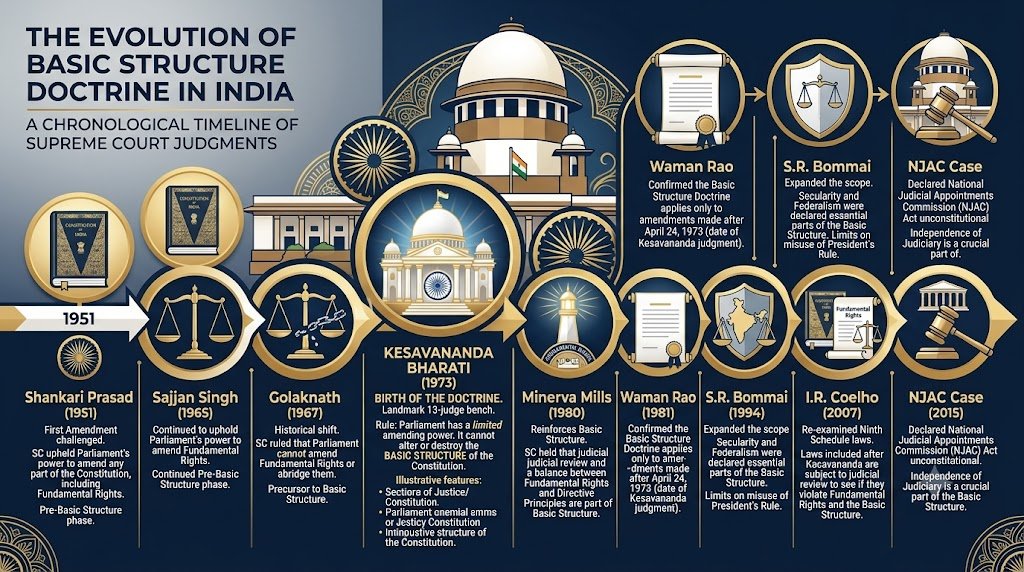
The evolution can be understood through the following sequence:
Shankari Prasad → Sajjan Singh → Golaknath → 24th Amendment → Kesavananda Bharati → Indira Gandhi v. Raj Narain → Minerva Mills → Waman Rao → S.R. Bommai → I.R. Coelho → NJAC Case
2. Evolution of the Basic Structure Doctrine
The evolution of the Basic Structure Doctrine UPSC Mains topic can be understood through a series of landmark constitutional judgments, beginning with Shankari Prasad and culminating in Kesavananda Bharati.
Shankari Prasad v. Union of India (1951)
This was one of the earliest cases concerning Parliament’s power to amend Fundamental Rights.
Supreme Court’s position
- Parliament could amend Fundamental Rights.
- A constitutional amendment was not treated as ordinary “law” for the purpose of Article 13.
- Parliament’s amending power was interpreted broadly.
Significance
The judgment initially gave Parliament considerable freedom to amend the Constitution.
Sajjan Singh v. State of Rajasthan (1965)
The Supreme Court broadly continued the approach taken in Shankari Prasad.
Key points
- Parliament’s power to amend the Constitution was largely upheld.
- However, some judges expressed concerns about allowing unrestricted changes to Fundamental Rights.
Importance
These concerns later contributed to the reconsideration of Parliament’s amending power.
I.C. Golaknath v. State of Punjab (1967)
This judgment marked a major turning point.
The Supreme Court held, by majority, that Parliament could not amend Fundamental Rights.
Why was it important?
It placed a significant limitation on Parliament’s constitutional amending power.
Result
The judgment intensified the constitutional conflict between:
Parliamentary authority vs. judicial protection of Fundamental Rights
Parliament subsequently attempted to clarify and strengthen its amending power through constitutional amendments.
Constitutional Amendments Before Kesavananda Bharati
Several constitutional amendments became part of the broader constitutional controversy.
24th Constitutional Amendment, 1971
It sought to affirm Parliament’s power to amend the Constitution, including Fundamental Rights.
25th Constitutional Amendment, 1971
It strengthened the protection given to certain Directive Principles against challenges based on Fundamental Rights.
29th Constitutional Amendment, 1972
It placed certain Kerala land reform laws in the Ninth Schedule.
These developments eventually contributed to the landmark Kesavananda Bharati case.

Kesavananda Bharati Case, 1973 — The Turning Point
Kesavananda Bharati v. State of Kerala
The judgment delivered in 1973 is regarded as the foundation of the Basic Structure Doctrine.
A 13-judge Constitution Bench of the Supreme Court heard the case, making it one of the largest constitutional benches in Indian judicial history.
The judgment was delivered by a 7:6 majority.
Supreme Court’s Core Ruling
The Court held that:
- Parliament has a wide power to amend the Constitution.
- Parliament can amend Fundamental Rights.
- However, Parliament cannot destroy or alter the basic structure of the Constitution.
This created a balance between constitutional adaptability and constitutional continuity.
The Core Principle
Amendment is permitted; destruction of the Constitution’s basic identity is not.
For primary-source reference, aspirants can read the Kesavananda Bharati v. State of Kerala judgment available on the official website of the Supreme Court of India.
What Is the Basic Structure?
The Constitution itself does not provide an exhaustive list of what constitutes its “basic structure.”
Instead, the Supreme Court has identified various elements through subsequent judgments.
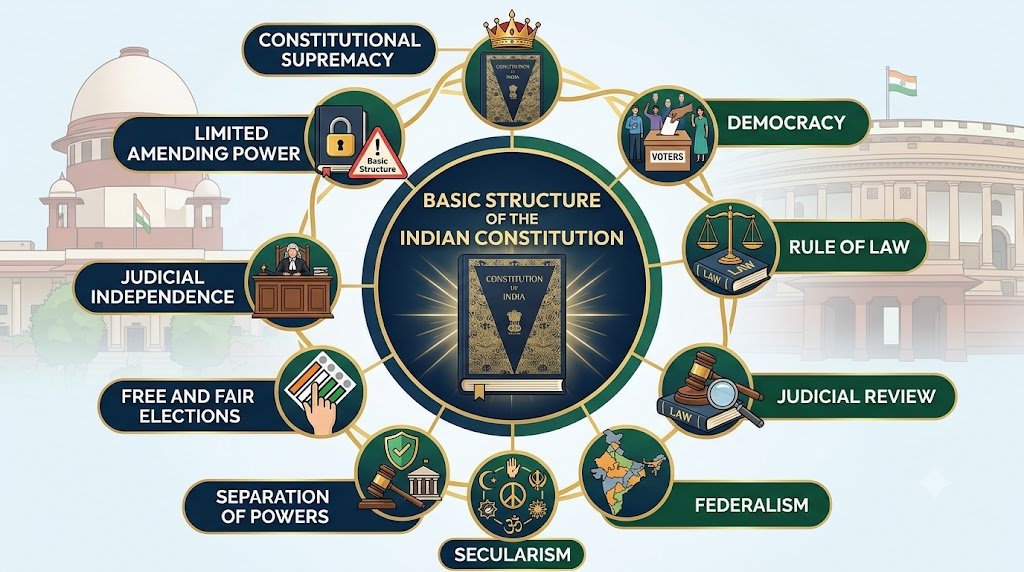
Important features recognised as part of the basic structure include:
- Supremacy of the Constitution
- Rule of Law
- Judicial Review
- Separation of Powers
- Republican and democratic form of government
- Secularism
- Federalism
- Parliamentary democracy
- Free and fair elections
- Dignity and freedom of the individual
- Unity and integrity of the nation
- Independence of the Judiciary
- Limited amending power
- Balance between Fundamental Rights and Directive Principles
Important UPSC Point
Do not write that the Constitution contains a fixed list of basic features.
A better statement is:
The Basic Structure is an evolving judicial doctrine whose specific elements have been identified through constitutional adjudication over time.
Indira Nehru Gandhi v. Raj Narain (1975)
This case was closely connected with electoral democracy and constitutional amendments.
Key significance
The Supreme Court examined constitutional amendments affecting the judicial scrutiny of elections involving high constitutional offices.
The Court reinforced the importance of free and fair elections and constitutional limitations on Parliament’s amending power.
UPSC relevance
This case demonstrates that:
Democracy + Free and Fair Elections + Judicial Review
are closely connected to constitutionalism.
The constitutional importance of free and fair elections also makes electoral governance an important area of study for UPSC aspirants. Read our detailed guide on Electoral Reforms in India: Critical Issues, Criminalization & ECI Role for a deeper understanding of electoral challenges and reforms.
Minerva Mills v. Union of India (1980)
Minerva Mills is one of the most important judgments in the development of the Basic Structure Doctrine.
Supreme Court’s position
The Court held that:
- Parliament’s amending power is not unlimited.
- The limited amending power itself is part of the Constitution’s basic structure.
- The Constitution requires a balance between Fundamental Rights and Directive Principles.
Why is this significant?
If Parliament could use Article 368 to give itself unlimited power, it could potentially destroy the Constitution through the amendment process itself.
Therefore:
The power to amend the Constitution cannot be converted into a power to destroy the Constitution.
Waman Rao v. Union of India (1981)
This case dealt significantly with the relationship between the Ninth Schedule and the Basic Structure Doctrine.
Importance
The Supreme Court developed a temporal distinction relating to laws placed in the Ninth Schedule.
The date 24 April 1973, the date of the Kesavananda Bharati judgment, became particularly important.
UPSC takeaway
The case demonstrates the continuing expansion of judicial scrutiny over constitutional amendments and protected legislation.
S.R. Bommai v. Union of India (1994)
The judgment is particularly important for understanding:
- Federalism
- Secularism
- Article 356
- Centre-State relations
- Constitutional governance
Basic Structure relevance
The judgment strengthened the understanding of federalism and secularism as fundamental constitutional principles.
UPSC Connection
This case can be used to connect:
Federalism + Secularism + Constitutional Supremacy + Judicial Review
in a GS Paper II answer.
I.R. Coelho v. State of Tamil Nadu (2007)
This judgment further developed the relationship between the Ninth Schedule and the Basic Structure Doctrine.
Key principle
Placing a law in the Ninth Schedule does not automatically place it beyond judicial scrutiny.
If such a law damages or destroys basic features of the Constitution, it can be subjected to judicial review.
Significance
The judgment reinforced:
- Constitutional supremacy
- Judicial review
- Protection of fundamental constitutional values
The Supreme Court’s judgment in I.R. Coelho v. State of Tamil Nadu is particularly useful for understanding how Ninth Schedule laws can be examined against the Basic Structure Doctrine.
NJAC Case (2015)
The National Judicial Appointments Commission (NJAC) case is another important development.
The Supreme Court struck down the constitutional framework establishing the NJAC.
Basic Structure relevance
The Court considered judicial independence to be an essential constitutional principle.
Larger debate
The case highlights the continuing tension between:
Judicial independence vs. judicial accountability
and
Parliamentary reform vs. constitutional limitations
Why Is the Basic Structure Doctrine Important?
1. Protects Constitutional Supremacy
The doctrine ensures that Parliament remains subject to the Constitution.
The Constitution, rather than Parliament, remains supreme.
2. Prevents Majoritarian Excess
An elected government may enjoy a large parliamentary majority, but that majority cannot legitimately use constitutional amendments to eliminate fundamental democratic principles.
3. Protects Democracy
The doctrine protects important democratic features such as:
- Free and fair elections
- Representative government
- Rule of Law
- Judicial review
- Constitutional accountability
4. Protects Fundamental Constitutional Values
The doctrine acts as a safeguard for:
- Liberty
- Equality
- Secularism
- Federalism
- Judicial independence
- Democratic governance
5. Maintains Constitutional Continuity
The Constitution must be capable of adapting to changing circumstances.
At the same time, its fundamental identity must remain protected.
Thus, the doctrine creates a balance between:
Constitutional change + Constitutional continuity
Basic Structure Doctrine and Parliamentary Power
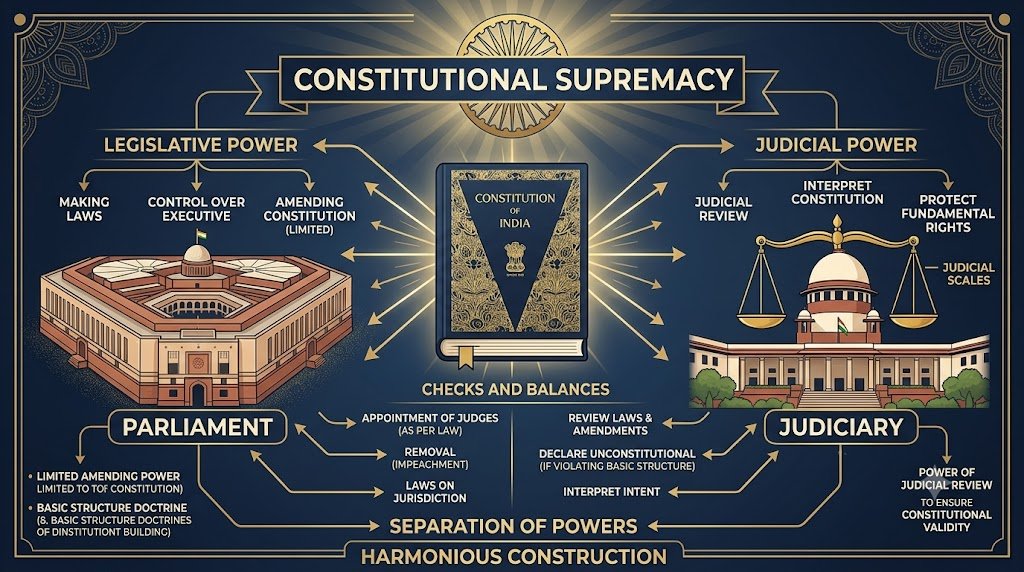
Parliament has substantial constitutional authority.
It can:
- Amend constitutional provisions.
- Respond to changing circumstances.
- Reform constitutional institutions.
- Modify institutional arrangements.
- Adapt the Constitution to emerging needs.
However, its power is not unlimited.
Parliament cannot:
- Destroy the basic structure.
- Eliminate judicial review completely.
- Abolish democracy.
- Destroy constitutional supremacy.
- Remove the essential federal character of the Constitution.
- Convert its limited amending power into an unlimited one.
Core Principle
Parliament can modify the Constitution, but it cannot use the Constitution’s amendment mechanism to destroy the Constitution’s essential character.
Candidates preparing for other government examinations can also explore our SSC CPO 2026 Exam Guide for a comprehensive overview of the examination, eligibility, syllabus and selection process.
Judicial Activism and the Basic Structure Doctrine
From the perspective of Basic Structure Doctrine UPSC Mains preparation, the relationship between judicial activism and constitutional limitations is particularly important.
Judicial activism refers broadly to an approach where courts interpret constitutional provisions dynamically to protect constitutional values and rights.
The Basic Structure Doctrine represents one of the most significant examples of the Judiciary playing an active role in constitutional protection.
Through this doctrine, the Judiciary has:
- Limited excessive use of Parliament’s amending power.
- Protected judicial review.
- Protected constitutional democracy.
- Strengthened constitutional supremacy.
- Preserved institutional checks and balances.
This is particularly relevant to UPSC GS Paper II, where questions often require analysis of the relationship between the Legislature, Executive and Judiciary.
Arguments in Favour of Judicial Activism
Constitutional Protection
The Judiciary acts as a constitutional guardian.
Protection of Rights
Judicial interpretation can protect Fundamental Rights from majoritarian excesses.
Protection of Constitutional Democracy
Courts can prevent institutions from exceeding constitutional boundaries.
Accountability
Judicial review can ensure that constitutional authorities remain accountable to the Constitution.
Protection of Minorities
Constitutional safeguards can protect groups that may lack sufficient political representation.
Criticism: Judicial Overreach
The Basic Structure Doctrine has also generated significant debate.
Major criticisms include:
- The Constitution does not expressly define the Basic Structure.
- There is no exhaustive constitutional list of basic features.
- Judges determine which features constitute the basic structure.
- Excessive judicial intervention may restrict Parliament’s democratic mandate.
- It may blur the separation between constitutional interpretation and policy-making.
Democratic Legitimacy Argument
Parliament is composed of elected representatives, while judges are not directly elected.
Therefore, critics argue that the Judiciary should exercise constitutional power with institutional restraint.
Judicial Activism vs. Judicial Overreach
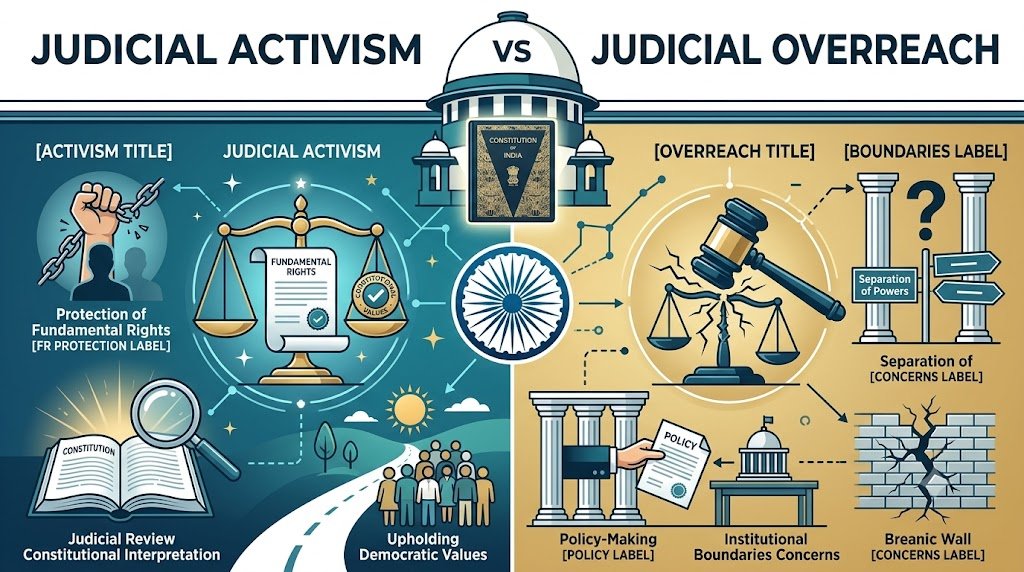
This distinction is extremely useful for UPSC Mains.
| Judicial Activism | Judicial Overreach |
|---|---|
| Protects constitutional values | May enter policy-making territory |
| Strengthens Fundamental Rights | Can undermine institutional boundaries |
| Enforces constitutional limitations | May substitute judicial preferences for policy choices |
| Supports accountability | Can create concerns about separation of powers |
| Uses judicial review | May excessively expand judicial intervention |
Balanced Approach
The issue should not be framed simply as:
Judiciary vs Parliament
Instead, it should be viewed as:
Constitutional supremacy + democratic legitimacy + institutional restraint
Constitutional and political institutions also form an important part of General Awareness preparation across competitive examinations. Aspirants can also refer to our Updated General Awareness Syllabus for SSC CGL 2026 for a broader overview of the relevant areas.
Basic Structure Doctrine and the Executive
Although the doctrine primarily concerns the limits of Parliament’s constitutional amending power, it has wider implications for executive authority.
The Executive:
- Is subject to the Constitution.
- Must operate within the framework of law.
- Is subject to judicial review.
- Must respect Fundamental Rights.
- Must uphold the Rule of Law.
- Must respect constitutional institutions.
Therefore:
Constitutional supremacy places both legislative and executive authority within constitutional limits.
Basic Structure and Separation of Powers
The doctrine is closely connected with the principle of separation of powers.
Legislature
- Makes laws.
- Exercises constitutional amendment power within prescribed limits.
Executive
- Implements laws.
- Formulates and executes public policy.
Judiciary
- Interprets the Constitution.
- Exercises judicial review.
- Protects constitutional boundaries.
Fundamental Principle
No organ of the State is above the Constitution.
This principle is central to India’s constitutional system.
Strengths of the Basic Structure Doctrine
It:
- Protects constitutional identity.
- Prevents authoritarian constitutional amendments.
- Protects judicial review.
- Strengthens democratic institutions.
- Protects federalism.
- Safeguards secularism.
- Maintains separation of powers.
- Prevents unlimited constitutional amendment power.
- Provides long-term constitutional stability.
Concerns Associated with the Doctrine
Despite its importance, certain concerns remain.
1. Lack of Explicit Constitutional Definition
The phrase “Basic Structure” does not appear as a defined term in the Constitution.
2. Judicial Discretion
The Judiciary determines which features qualify as basic.
3. Parliamentary Sovereignty Debate
The doctrine can create tension with the principle of democratic parliamentary authority.
4. Judicial Overreach
Excessive expansion of the doctrine could potentially bring the Judiciary into areas traditionally belonging to the Legislature or Executive.
5. Uncertainty
Since the list is not exhaustive, future constitutional disputes may continue to expand its scope.
Why Is the Doctrine Necessary in India?
India is a large and diverse constitutional democracy.
Governments and parliamentary majorities can change.
Political ideologies can change.
Public policies can change.
However, certain foundational principles need long-term protection.
The doctrine therefore prevents a temporary political majority from permanently altering the fundamental character of the Constitution.
In one line:
A temporary political majority should not have unlimited power to permanently transform the constitutional identity of the Republic.
Basic Structure Doctrine vs. Parliamentary Sovereignty
| Parliamentary Sovereignty | Constitutional Supremacy |
|---|---|
| Emphasises parliamentary authority | Emphasises constitutional authority |
| Majority has significant legislative power | Constitutional limits apply to majority power |
| Political accountability is central | Constitutional accountability is central |
| Parliament plays a dominant role | Constitution remains supreme |
| Greater emphasis on democratic mandate | Greater emphasis on constitutional limitations |
India’s Position
India follows the principle of constitutional supremacy, rather than absolute parliamentary sovereignty.
Parliament is powerful, but its powers operate within the framework of the Constitution.
Major Issues in the Contemporary Debate
The present debate is not simply whether the Basic Structure Doctrine is good or bad.
More important questions include:
- What should qualify as a basic feature?
- How far should judicial review extend?
- Where should judicial activism end?
- When does judicial activism become judicial overreach?
- How should Parliament’s democratic mandate be balanced against constitutional limitations?
- How can institutional independence be maintained?
- How can constitutional morality be interpreted without excessive judicial discretion?
- How can institutional comity be strengthened?
These questions make the doctrine particularly relevant for UPSC Mains GS Paper II.
Way Forward
A balanced constitutional approach requires responsibility from all three organs.
Judiciary
- Protect constitutional supremacy.
- Exercise judicial review responsibly.
- Maintain institutional restraint.
- Avoid unnecessary interference in policy matters.
- Preserve judicial independence.
Parliament
- Exercise its amending power responsibly.
- Respect fundamental constitutional principles.
- Avoid amendments that undermine constitutional checks and balances.
- Maintain transparency and constitutional accountability.
Executive
- Follow the Rule of Law.
- Respect judicial decisions.
- Protect constitutional institutions.
- Ensure that executive action remains within constitutional boundaries.
Overall Approach
India needs:
- Constitutional dialogue
- Institutional comity
- Separation of powers
- Judicial independence
- Parliamentary accountability
- Constitutional morality
The constitutional basis for Parliament’s amending power is provided under Article 368 of the Constitution. Aspirants can refer to the official text of the Constitution for the exact constitutional provisions governing the amendment procedure.
UPSC Mains Answer Writing Framework
Possible Question
“The Basic Structure Doctrine has been a cornerstone of Indian constitutional jurisprudence. Discuss its evolution and significance in preserving constitutional democracy.”
Introduction
- Mention Article 368.
- Explain Parliament’s power to amend the Constitution.
- Define the Basic Structure Doctrine.
Body – Part I: Evolution
Discuss:
- Shankari Prasad
- Sajjan Singh
- Golaknath
- 24th Amendment
- Kesavananda Bharati
- Indira Gandhi v. Raj Narain
- Minerva Mills
- Waman Rao
- S.R. Bommai
- I.R. Coelho
- NJAC Case
Body – Part II: Significance
Discuss:
- Constitutional supremacy
- Judicial review
- Democracy
- Rule of Law
- Federalism
- Secularism
- Separation of powers
- Judicial independence
- Free and fair elections
Body – Part III: Criticism
Discuss:
- Judicial overreach
- Unelected judiciary
- Lack of exhaustive definition
- Parliamentary sovereignty concerns
- Institutional boundaries
Way Forward
- Judicial restraint
- Responsible constitutional amendment
- Institutional comity
- Constitutional morality
- Balance between democratic mandate and constitutional limitations
Conclusion
Conclude by presenting the doctrine as a mechanism for balancing constitutional continuity with democratic change.
UPSC Mains Answer Enrichment
A well-structured Basic Structure Doctrine UPSC Mains answer should combine constitutional principles, landmark judgments, critical analysis and a balanced way forward.
These keywords can add analytical depth to your answer:
- Constitutional supremacy
- Constituent power
- Constitutional identity
- Limited amending power
- Judicial review
- Constitutional morality
- Checks and balances
- Institutional comity
- Majoritarianism vs. constitutionalism
- Judicial activism vs. judicial overreach
- Democratic legitimacy
- Constitutional continuity
- Separation of powers
- Rule of Law
28. Quick Revision: Landmark Cases
| Case | Year | Key Contribution |
|---|---|---|
| Shankari Prasad | 1951 | Broad amendment power |
| Sajjan Singh | 1965 | Continued broad interpretation |
| Golaknath | 1967 | Parliament’s power over Fundamental Rights restricted |
| Kesavananda Bharati | 1973 | Basic Structure Doctrine |
| Indira Gandhi v. Raj Narain | 1975 | Free and fair elections and constitutional limitations |
| Minerva Mills | 1980 | Limited amending power |
| Waman Rao | 1981 | Ninth Schedule and constitutional amendments |
| S.R. Bommai | 1994 | Federalism and secularism |
| I.R. Coelho | 2007 | Ninth Schedule subject to basic structure review |
| NJAC Case | 2015 | Judicial independence |
UPSC PYQ Connection
The topic has direct relevance to UPSC Mains.
UPSC Mains 2014 – GS Paper II
UPSC asked candidates to examine the role of judicial activism in developing India as a thriving democracy, beginning with the evolution of the Basic Structure Doctrine.
UPSC Mains 2024 – GS Paper II
UPSC directly asked candidates to discuss the evolution and significance of the Basic Structure Doctrine in preserving constitutional democracy.
What should an aspirant learn from these questions?
Do not prepare this topic merely as a list of judgments.
Prepare it through four analytical dimensions:
Evolution → Significance → Judicial Activism → Judicial Overreach
This framework can help address both direct and indirect questions on constitutionalism, separation of powers and the Legislature-Judiciary relationship.
Model Conclusion for UPSC Mains
The Basic Structure Doctrine represents the Indian Constitution’s unique balance between change and continuity. It allows Parliament to respond to changing social and political realities while preventing constitutional amendments from destroying the foundational identity of the Constitution. The doctrine should therefore not be viewed merely as a restriction on Parliament, but as a constitutional safeguard against majoritarian excess. Its effective functioning ultimately requires a balance between constitutional supremacy, democratic legitimacy, judicial independence and institutional restraint.
Quick Revision Box
Basic Structure Doctrine
Article 368
↓
Parliament’s broad but limited amending power
↓
Kesavananda Bharati (1973)
↓
Protection of constitutional identity
↓
Judicial Review + Democracy + Federalism + Secularism + Separation of Powers
↓
Constitutional supremacy over temporary political majorities
For effective Basic Structure Doctrine UPSC Mains preparation, aspirants should focus not only on landmark judgments but also on the broader issues of constitutional supremacy, judicial review, separation of powers and institutional balance.
Final Takeaway for UPSC Aspirants
The Basic Structure Doctrine is one of the most important topics for UPSC GS Paper II because it connects several core areas of the syllabus:
Indian Constitution + Parliament + Judiciary + Fundamental Rights + Judicial Review + Separation of Powers + Federalism + Democracy + Constitutional Governance
A high-quality Mains answer should therefore avoid merely listing cases. The stronger approach is to trace the evolution of the doctrine, explain its constitutional significance, examine judicial activism and critically discuss concerns of judicial overreach, followed by a balanced way forward.
1 thought on “Basic Structure Doctrine UPSC Mains GS Paper II: Evolution, Landmark Cases & Judicial Activism”