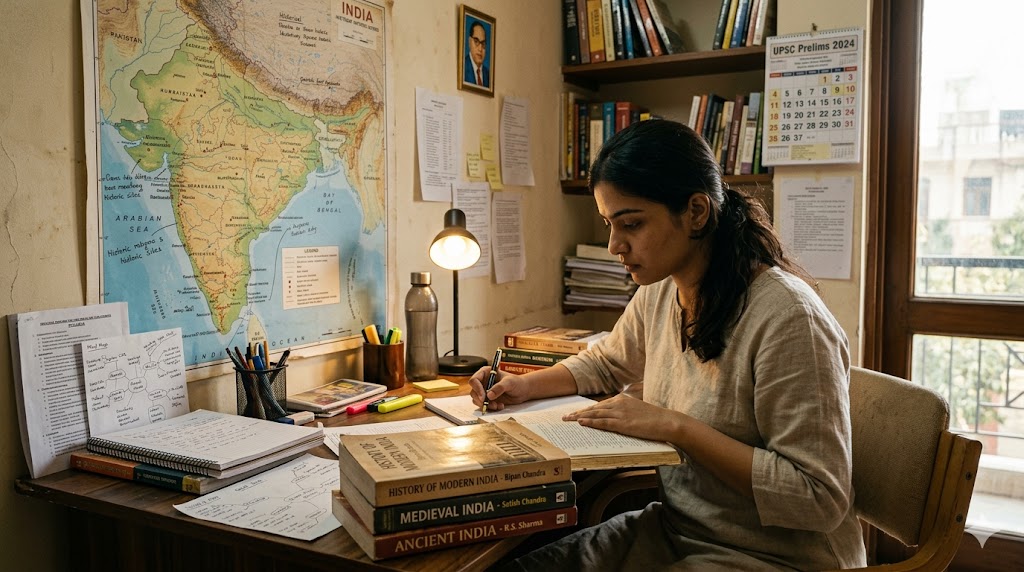
The History syllabus for UPSC Prelims 2027 is an important part of the examination, covering Ancient, Medieval, Modern History, and Art & Culture. Understanding the syllabus helps aspirants focus on high-weightage topics and prepare effectively.
As per the Union Public Service Commission, the Prelims syllabus includes “History of India and Indian National Movement.” For better understanding, it can be divided into the following sections.

Overview of History Syllabus
The History syllabus for UPSC Prelims is vast and requires a clear understanding of different time periods. It includes Ancient, Medieval, and Modern History along with Art and Culture. Each section plays a significant role in building conceptual clarity and answering both factual and analytical questions in the exam.
🏛️ Ancient Indian History

Key Topics:
Indus Valley Civilization
Vedic Period (Rigvedic & Later Vedic)
Mahajanapadas and Rise of Magadha
Jainism and Buddhism
Mauryan Empire (Ashoka)
Gupta Empire
📌 Importance of Ancient History
Ancient Indian History helps aspirants understand the early development of Indian civilization, culture, and religious philosophies. Topics like the Indus Valley Civilization, Vedic Age, and Mauryan Empire are frequently asked in the exam.
After completing the Ancient History portion of the syllabus, test your preparation with our 100 Ancient History MCQs for UPSC Prelims 2027: Master Question Bank, featuring topic-wise questions and detailed explanations.
Recommended Books for History Preparation
To cover the History syllabus for UPSC Prelims 2027 effectively, aspirants should refer to standard books for conceptual clarity and revision. Books are given below-
2. PW UPSC Books 2027: Ancient & Medieval Indian History Handwritten Notes for UPSC Prelims & Mains GS Paper 1
Ancient History is an important part of the UPSC syllabus. To practice this section effectively, you should attempt Indus Valley Civilization MCQs which cover one of the most important topics in this section.
🏯 Medieval Indian History
Delhi Sultanate
Mughal Empire
Bhakti Movement
Sufi Movement
Vijayanagar Empire

📌 Importance of Medieval History
Although Medieval History has relatively lower weightage compared to Modern History, it is still important for understanding cultural developments, architecture, and religious movements such as Bhakti and Sufi traditions.
🇮🇳 Modern Indian History (Most Important)
Key Topics:
Advent of Europeans
Revolt of 1857
Social Reform Movements
Indian National Movement
Constitutional Developments
To cover the Modern History syllabus for UPSC Prelims 2027 effectively, aspirants should refer to-
A Brief History of Modern India By Spectrum – 2027

📌 Importance of Modern History
Modern Indian History is the most important section for UPSC Prelims. Questions are frequently asked from the Indian National Movement, British policies, and key events like the Revolt of 1857 and Gandhian movements.
🎭 Art & Culture (Highly Important)

Art & Culture remains an important component of the UPSC syllabus. Aspirants should also attempt Top 100 Art & Culture MCQs UPPCS Prelims 2026 | Complete Practice Set for structured revision.
Key Topics:
Indian Architecture
Classical Dances
Paintings
Literature
UNESCO Heritage Sites

📌 Importance of Art & Culture
Art and Culture is a dynamic and scoring area in UPSC Prelims. Questions are often based on classical dances, temple architecture, paintings, and cultural heritage of India.
📊 Why History is Important for UPSC Prelims
Every year 12–15 questions are asked
Modern History has high weightage
Art & Culture questions are increasing
Helps in both Prelims and Mains
The History syllabus for UPSC Prelims 2027 covers important topics from Ancient, Medieval and Modern India.
Understanding the History syllabus for UPSC Prelims 2027 helps in focused preparation.
A clear strategy based on the History syllabus for UPSC Prelims 2027 can improve your score.
📚 Best Books for History Preparation
NCERT (Class 6–12) – Foundation
Spectrum – Modern History
Nitin Singhania – Art & Culture
👉 NCERT books can be accessed from National Council of Educational Research and Training
🎯 Preparation Strategy
Start with NCERT books
Focus on Modern History (Spectrum)
Revise Art & Culture regularly
Practice previous year questions
Use maps and timelines
🔗 Recommended Posts
100 Modern History MCQs UPSC Prelims 2027: Important Questions with Answers
Indus Valley Civilization Notes UPSC 2027: Complete & Important Guide
10 Powerful Key Features of Harappan Culture (UPSC Prelims 2027 Guide)
📌 Conclusion
The History syllabus for UPSC Prelims 2027 plays a crucial role in exam preparation. A clear understanding of Ancient, Medieval, Modern History, and Art & Culture can significantly improve your score.
Regular revision and practice are key to mastering History for UPSC.
Regular revision and consistent practice are essential for mastering the History syllabus for UPSC Prelims 2027.
For official details, visit the UPSC official website.
❓ Frequently Asked Questions (FAQs)
Q. How many questions are asked from History in UPSC Prelims?
Around 12–15 questions are asked every year from History.
Q. Which part of History is most important for UPSC Prelims?
Modern History is considered the most important, followed by Art and Culture.
Q. Is NCERT enough for History preparation?
NCERT books are essential for building a strong foundation, but additional books like Spectrum are required for advanced preparation.
11 thoughts on “History Syllabus for UPSC Prelims 2027: Important Topics You Should Not Miss”