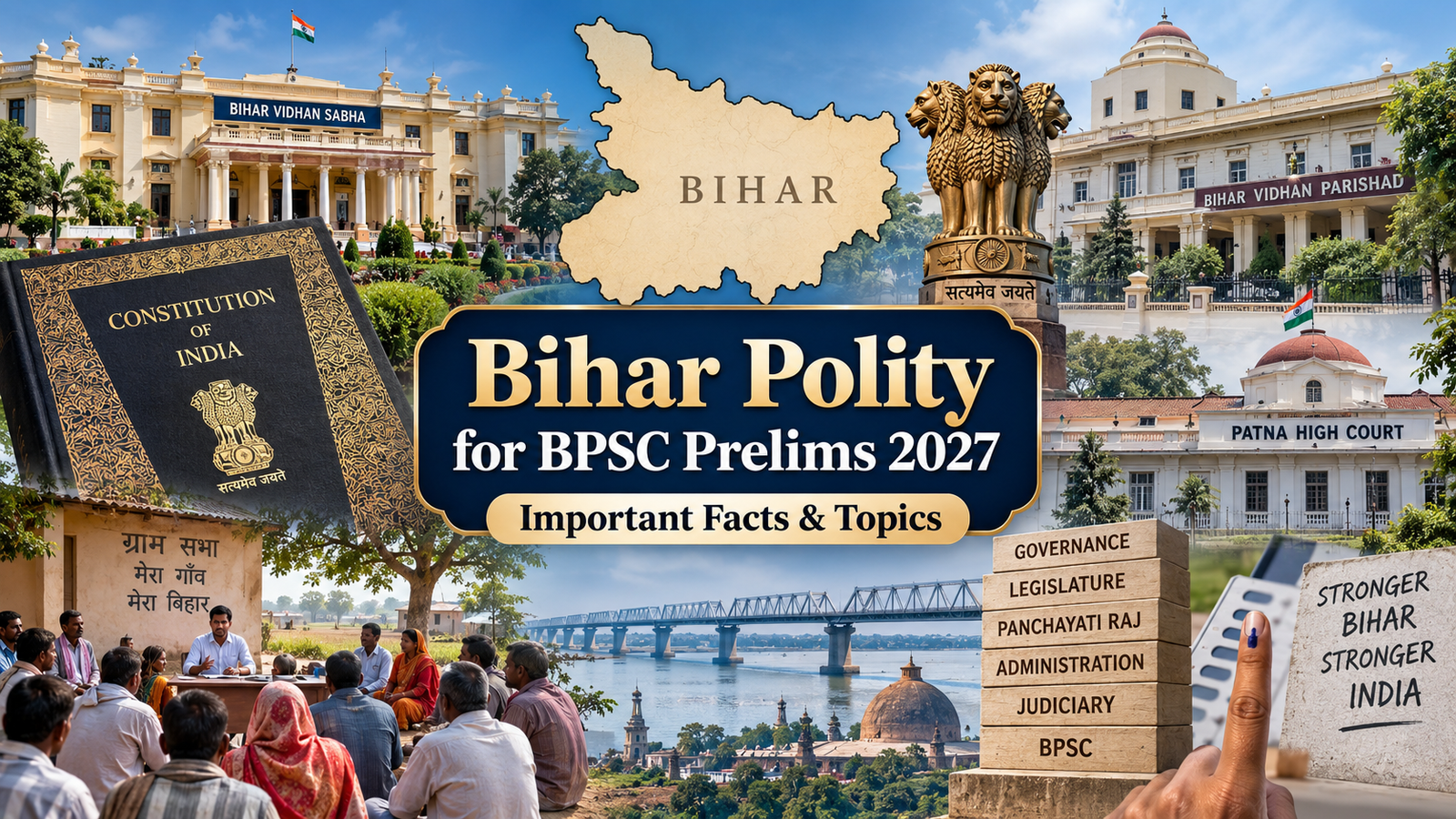
Bihar Polity for BPSC Prelims 2027 is an important part of Bihar-specific preparation for the Bihar Public Service Commission examination. Along with Indian Polity, candidates should have a clear understanding of Bihar’s constitutional institutions, state government, legislature, judiciary, local self-government, Panchayati Raj system, elections and administrative structure.
The official BPSC syllabus covers the Indian political system, Constitution, Fundamental Rights, Directive Principles, Union and State Government, Indian federalism, Centre-State relations, Governor’s role and Panchayati Raj, including the Panchayati Raj System in Bihar.
For BPSC Prelims, Bihar Polity should not be studied only through general Indian Polity books. Candidates should also prepare Bihar-specific facts, constitutional institutions, state legislature, local government and Panchayati Raj.
This article provides a complete and exam-oriented overview of Bihar Polity for BPSC Prelims 2027, including important facts, topics, articles, institutions and a practical revision strategy.
Candidates preparing Bihar Polity for BPSC should combine standard Indian Polity concepts with Bihar-specific facts and institutions.
Bihar History is only one part of the overall examination preparation. For a complete subject-wise strategy, candidates can also follow our Perfect BPSC Exam Pattern 2026: Latest Prelims, Mains & Interview Framework guide covering the syllabus, books, study plan and preparation approach.
Bihar Polity and the BPSC Prelims Syllabus
BPSC candidates should first understand how Bihar-specific polity fits into the larger Indian Polity syllabus.
The important areas include:
- Indian Constitution
- Fundamental Rights
- Directive Principles of State Policy
- Fundamental Duties
- Union Government
- State Government
- Governor
- Chief Minister
- Council of Ministers
- State Legislature
- Legislative Assembly
- Legislative Council
- High Court
- Centre-State relations
- Constitutional bodies
- Elections
- Panchayati Raj
- Local self-government
- Political parties
- Bihar’s administrative structure
The official BPSC syllabus specifically includes State Government, the role of the Governor, Panchayati Raj and the Panchayati Raj System in Bihar.
Therefore, candidates should prepare both constitutional concepts and Bihar-specific institutions.
A focused approach to Bihar Polity for BPSC Prelims 2027 will help candidates cover both constitutional concepts and Bihar-specific political institutions.
Before starting preparation, candidates should first check the Official BPSC Syllabus to understand how State Government, Panchayati Raj and other polity topics fit into the examination.
Historical Development of Bihar’s Legislature
The development of Bihar’s legislative institutions is an important topic for BPSC.
The Bihar and Orissa province was created in 1912, and legislative development continued during the colonial period.
The Bihar Legislative Council was formed during this period, and its first meeting was held on 20 January 1913 at Patna College in Bankipore. Bihar later became a separate province in 1936, and the legislature developed into a bicameral structure.
This historical background is useful because BPSC may ask questions linking:
Bihar’s formation → Legislative development → Bihar Legislature
This makes Bihar Polity BPSC preparation especially important for candidates targeting Bihar-specific questions in the Prelims.
Bihar Has a Bicameral Legislature
One of the most important facts for Bihar Polity is that Bihar has a bicameral state legislature.
The Bihar Legislature consists of:
- Bihar Legislative Assembly
- Bihar Legislative Council
The Bihar Legislative Assembly has 243 seats, while the Bihar Legislative Council has 75 members. The current strength of 243 Assembly seats has remained unchanged since the creation of Jharkhand in 2000.
Quick Revision:
| Institution | Strength |
|---|---|
| Bihar Legislative Assembly | 243 |
| Bihar Legislative Council | 75 |
BPSC Tip: Remember 243 + 75.
The Bihar Legislature is therefore a high-priority area of Bihar Polity for BPSC Prelims 2027, particularly the Assembly and Legislative Council.
Bihar Legislative Assembly
The Legislative Assembly is the directly elected House of the Bihar Legislature.
The state is divided into 243 Assembly constituencies.
The Assembly performs several important functions:
- Makes laws on subjects within its legislative competence.
- Discusses government policies.
- Approves the state budget.
- Exercises financial control over the executive.
- Holds the Council of Ministers accountable.
- Debates matters of public importance.
The official Bihar Legislative Assembly website maintains information about the Assembly and its members and provides access to legislative proceedings and related resources.
Reserved Seats in Bihar Legislative Assembly
The Bihar Legislative Assembly has 243 seats.
According to the Bihar Legislative Assembly’s official historical information, among these seats:
- 38 seats are reserved for Scheduled Castes
- 2 seats are reserved for Scheduled Tribes
The remaining seats are unreserved.
Prelims Fact:
Bihar Assembly → 243 seats → 38 SC + 2 ST reserved seats
Bihar Legislative Council
Bihar is one of the Indian states that has a Legislative Council in addition to the Legislative Assembly.
The Legislative Council is the Upper House of the state legislature.
Its present strength is 75 members. The Council’s official historical information records that its strength was reduced to 75 following the creation of Jharkhand in 2000.
The current composition includes members representing different categories of constituencies and nominated members.
According to the official Bihar Legislative Council information, the 75 members include:
- 27 from Legislative Assembly constituencies
- 6 from Teachers’ constituencies
- 6 from Graduates’ constituencies
- 24 from Local Authorities’ constituencies
- 12 nominated members
This is a high-value BPSC Prelims fact.
For the latest information about the Assembly, its members and legislative activities, candidates can also refer to the Official Bihar Legislative Assembly website.
Legislative Assembly vs Legislative Council
Candidates should understand the basic difference between the two Houses.
| Feature | Legislative Assembly | Legislative Council |
|---|---|---|
| House | Lower House | Upper House |
| Bihar strength | 243 | 75 |
| Nature | Directly elected House | Partly indirectly elected and partly nominated |
| Term | Normally 5 years | Permanent House |
| Dissolution | Can be dissolved | Cannot be dissolved |
| Financial Bills | Greater role | Limited role |
BPSC Tip: Do not confuse the Legislative Council with the Rajya Sabha. The Council is the Upper House of the state legislature, while Rajya Sabha is the Upper House of Parliament.
Governor of Bihar
The Governor is the constitutional head of the state.
The Governor is appointed by the President of India.
Important constitutional functions include:
- Appointing the Chief Minister.
- Appointing other ministers on the advice of the Chief Minister.
- Summoning and proroguing the state legislature.
- Giving assent to Bills.
- Addressing the legislature.
- Promulgating ordinances when the legislature is not in session.
- Performing certain discretionary functions under the Constitution.
The Governor’s role is especially important in questions relating to:
Governor → Chief Minister → Council of Ministers → State Legislature
The Governor’s constitutional position is an important concept to understand while preparing Bihar Polity for BPSC Prelims 2027.
The official Bihar constitutional and government portals should be checked for current office-holder information because such positions can change.
Chief Minister of Bihar
The Chief Minister is the real executive head of the state government in the parliamentary system.
The Chief Minister:
- Heads the Council of Ministers.
- Advises the Governor regarding the appointment of ministers.
- Allocates portfolios among ministers.
- Coordinates the functioning of the state government.
- Acts as the main link between the Governor and the Council of Ministers.
Under the Constitution, the Council of Ministers is collectively responsible to the Legislative Assembly.
Important Article:
Article 164 deals with the appointment of the Chief Minister and other provisions relating to state ministers.
Council of Ministers in Bihar
The Council of Ministers assists and advises the Governor in the exercise of constitutional functions.
The Chief Minister leads the Council of Ministers.
Important concepts for BPSC include:
- Collective responsibility
- Individual responsibility
- Cabinet
- Council of Ministers
- Appointment of ministers
- Allocation of portfolios
- Resignation of ministers
Prelims Tip: Remember that the Council of Ministers is collectively responsible to the Legislative Assembly, not the Legislative Council.
Bihar State Legislature: Important Constitutional Articles
The Bihar Legislature is particularly important because Bihar has a bicameral legislative system consisting of the Assembly and Legislative Council.
Candidates should revise the following Articles related to state legislatures:
| Article | Subject |
|---|---|
| Article 168 | Constitution of State Legislatures |
| Article 169 | Abolition or creation of Legislative Councils |
| Article 170 | Composition of Legislative Assemblies |
| Article 171 | Composition of Legislative Councils |
| Article 172 | Duration of State Legislatures |
| Article 173 | Qualification for membership |
| Article 174 | Sessions, prorogation and dissolution |
| Article 175 | Governor’s right to address and send messages |
| Article 176 | Special address by Governor |
| Article 200 | Assent to Bills |
| Article 201 | Bills reserved for consideration of President |
| Article 213 | Governor’s ordinance-making power |
Exam Strategy: Do not try to memorise every constitutional Article. Prioritise Articles that directly relate to the Governor, Legislature, Chief Minister, Council of Ministers and state administration.
Bihar High Court
The Patna High Court is the highest judicial institution in the state of Bihar.
For BPSC, candidates should remember:
- Location: Patna
- Established in 1916
- It is the High Court for Bihar.
- It exercises judicial and constitutional jurisdiction according to the Constitution.
Questions may connect the High Court with:
- Writ jurisdiction
- Judicial review
- Constitutional remedies
- Appointment of judges
- Subordinate judiciary
BPSC Tip: Remember the basic distinction:
Supreme Court → Highest court of India
Patna High Court → Highest court in Bihar
High Court and Writ Jurisdiction
The High Court has important powers under Article 226 of the Constitution.
It can issue writs for the enforcement of Fundamental Rights and also for other purposes within its constitutional jurisdiction.
Important writs include:
- Habeas Corpus
- Mandamus
- Prohibition
- Certiorari
- Quo Warranto
Prelims Tip: A common question is the difference between Article 32 and Article 226.
Article 32 relates to the Supreme Court’s jurisdiction for enforcement of Fundamental Rights, while Article 226 gives High Courts a broader writ jurisdiction.
Panchayati Raj in Bihar.
The Bihar Panchayati Raj system is one of the most important Bihar-specific areas for BPSC because local self-government is explicitly covered in the syllabus.
The 73rd Constitutional Amendment gave constitutional status to Panchayati Raj institutions.
Bihar’s Panchayati Raj system should be studied through:
- Gram Panchayat
- Panchayat Samiti
- Zila Parishad
- Gram Sabha
- Panchayat elections
- Reservation
- Functions of local bodies
- Devolution of powers
- 3Fs — Funds, Functions and Functionaries
The Bihar Panchayati Raj Department maintains official information relating to the state’s Panchayati Raj institutions, Acts, Rules, notifications and devolution of the three Fs.
Panchayati Raj deserves special attention in Bihar Polity for BPSC Prelims 2027 because Bihar-specific local governance is directly relevant to BPSC preparation.
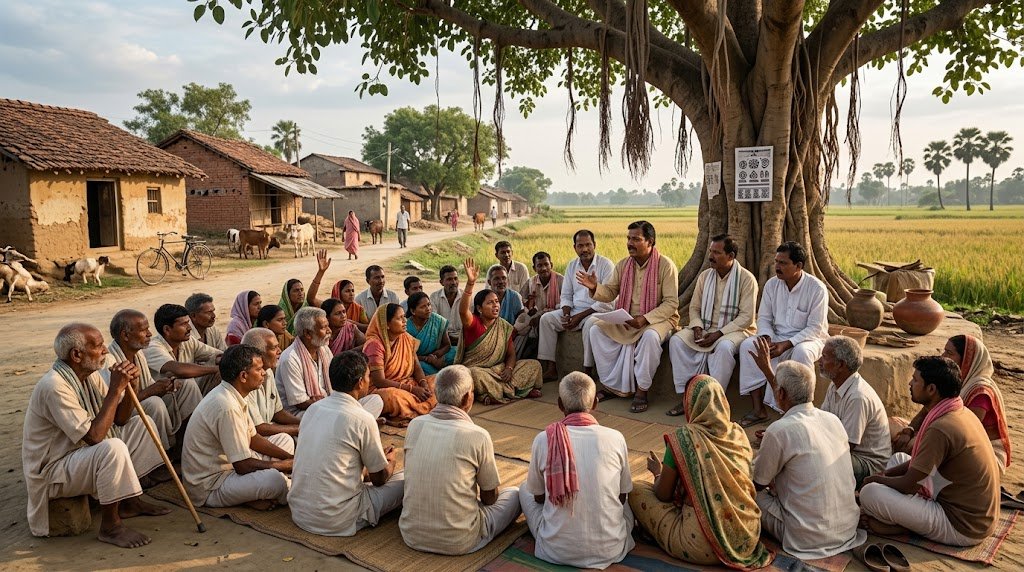
Three-Tier Panchayati Raj System in Bihar
The rural local-government structure can be understood through three main levels:
1. Gram Panchayat
Village-level institution.
2. Panchayat Samiti
Block/intermediate-level institution.
3. Zila Parishad
District-level institution.
The Gram Sabha is an important foundation of grassroots democracy.
Quick Revision:
Village → Gram Panchayat
Block → Panchayat Samiti
District → Zila Parishad
Gram Sabha
The Gram Sabha consists of persons registered in the electoral rolls relating to a village or group of villages covered by the Panchayat area.
It provides a mechanism for direct participation of citizens in local governance.
Important functions and roles can include:
- Discussing local development issues
- Participating in local planning
- Social accountability
- Reviewing local development activities
- Supporting grassroots democracy
BPSC Tip: Do not confuse Gram Sabha with Gram Panchayat.
Gram Sabha is the broader body of registered voters, whereas Gram Panchayat is the elected local-government institution.
Bihar Panchayati Raj Act
The Bihar Panchayat Raj Act, 2006 is an important state-specific law for BPSC preparation.
The Bihar government has published the Act and related amendments through its official Panchayati Raj Department resources.
Candidates should focus on:
- Structure of Panchayati Raj institutions
- Functions
- Elections
- Reservation
- Powers and responsibilities
- Local governance
- State-level supervision
Reservation in Bihar Panchayati Raj Institutions
Reservation is an important topic in Bihar’s local governance system.
Candidates should study reservation for:
- Scheduled Castes
- Scheduled Tribes
- Extremely Backward Classes
- Backward Classes
- Women
Bihar’s Panchayati Raj system is particularly important from the perspective of women’s political participation and social representation.
For exact reservation percentages or current legal provisions, candidates should rely on the latest Bihar Panchayati Raj Department notifications and applicable rules rather than memorising outdated figures.
State Election Commission of Bihar
The State Election Commission is responsible for conducting elections to local bodies such as:
- Panchayats
- Municipal bodies
The State Election Commission is a constitutional body under Article 243K for Panchayat elections and Article 243ZA for municipal elections.
BPSC Tip: Do not confuse the State Election Commission with the Election Commission of India.
Election Commission of India → Parliament and State Legislature elections
State Election Commission → Local-body elections
Urban Local Government in Bihar
Urban local governance is another important part of Bihar Polity.
Urban local bodies include institutions such as:
- Municipal Corporations
- Municipal Councils
- Nagar Panchayats
Their functions generally include:
- Urban planning
- Water supply
- Sanitation
- Roads
- Public health
- Waste management
- Local development
The 74th Constitutional Amendment provides the constitutional framework for urban local bodies.

Bihar’s Administrative Structure
Bihar’s administration is organised at several levels.
For examination purposes, candidates should understand:
State → Division → District → Subdivision → Block → Local Government
Important administrative officials include:
- Governor
- Chief Minister
- Chief Secretary
- Divisional Commissioner
- District Magistrate
- Sub-Divisional Officer
- Block Development Officer
- Panchayati Raj officials
BPSC Tip: Administrative hierarchy is particularly useful for Bihar-specific General Studies questions.
District Administration in Bihar
The District Magistrate/Collector plays an important role in district administration.
Major responsibilities may include:
- Revenue administration
- Law and order coordination
- Disaster management
- Election-related responsibilities
- Development coordination
- Implementation of government programmes
At the subdivision level, the Sub-Divisional Officer plays an important administrative role.
At the block level, the Block Development Officer is an important functionary associated with rural development administration.
Bihar Public Service Commission
The Bihar Public Service Commission (BPSC) is a constitutional body established under Article 315.
According to the official BPSC website, Bihar Public Service Commission came into existence on 1 April 1949 after its separation from the Commission for the States of Orissa and Madhya Pradesh. Its constitutional status followed the Constitution coming into force in 1950.
Important constitutional provisions include:
- Article 315 — Public Service Commissions
- Article 318 — Power to make regulations regarding conditions of service
- Articles 320–321 — Functions of Public Service Commissions
- Article 323 — Reports of Public Service Commissions
The BPSC’s functions include recruitment through competitive examinations and advising the state government on recruitment, appointments, promotions and disciplinary matters in the situations specified by the Constitution.
Understanding the constitutional position and functions of BPSC is also essential for Bihar Polity for BPSC Prelims 2027.
Candidates who want to verify the constitutional basis, composition and functions of the Commission can refer to the BPSC’s Official Constitutional Provisions page.
Constitutional Bodies Relevant to Bihar Polity
BPSC candidates should know the major constitutional bodies operating at the state level.
Important examples include:
| Institution | Important Constitutional Provision |
|---|---|
| Governor | Articles 153 onwards |
| State Public Service Commission | Article 315 |
| State Election Commission | Articles 243K and 243ZA |
| State Finance Commission | Article 243-I and 243-Y |
| High Court | Articles 214 onwards |
| Advocate General | Article 165 |
Understanding the constitutional basis of each institution is more useful than simply memorising names.
Bihar State Finance Commission
The State Finance Commission is connected with local government finances.
Under the Constitution, State Finance Commissions are constituted to review the financial position of:
- Panchayats
- Municipalities
The Commission makes recommendations regarding distribution of financial resources and other financial matters concerning local bodies.
BPSC Tip: Link:
73rd Amendment → Panchayats
74th Amendment → Municipalities
State Finance Commission → Local-body finances
Advocate General of Bihar
The Advocate General is the highest law officer of the state.
The office is provided under Article 165 of the Constitution.
The Advocate General:
- Advises the state government on legal matters.
- Performs legal duties assigned by the Governor.
- Has the right to speak and take part in proceedings of the state legislature, subject to constitutional provisions, but does not have the right to vote merely by virtue of that office.
Quick Revision:
Attorney General → Union
Advocate General → State
Centre-State Relations and Bihar
Centre-State relations are an important part of Indian Polity and can be applied to Bihar-specific questions.
Important areas include:
- Legislative relations
- Administrative relations
- Financial relations
- Inter-State Council
- Governor’s role
- All India Services
- Finance Commission
- Central assistance to states
For BPSC, candidates should understand how constitutional federalism operates between the Union and Bihar.
Understanding these relationships also helps candidates develop a broader understanding of Bihar Government and Polity.
Bihar and Cooperative Federalism
Bihar’s development involves cooperation between:
- Union Government
- State Government
- Local Governments
Areas such as:
- Infrastructure
- Agriculture
- Health
- Education
- Rural development
- Disaster management
- Welfare schemes
often involve multiple levels of government.
This makes cooperative federalism relevant for both Prelims and Mains preparation.
Important Political Institutions in Bihar
Candidates should be familiar with the major institutions of Bihar’s political system:
- Governor
- Chief Minister
- Council of Ministers
- Legislative Assembly
- Legislative Council
- High Court
- Bihar Public Service Commission
- State Election Commission
- State Finance Commission
- Panchayati Raj Institutions
- Urban Local Bodies
- Advocate General
The Parliamentary Affairs Department of Bihar also deals with important legislative processes such as sessions of the Assembly and Council, legislative business, debates, questions and government business.
Bihar Polity: Important Articles for BPSC
These Constitutional Articles form an important revision area for Bihar Polity for BPSC Prelims 2027.
Here is a quick revision table:
| Article | Topic |
|---|---|
| 153 | Governor |
| 154 | Executive power of Governor |
| 163 | Council of Ministers to aid and advise Governor |
| 164 | Chief Minister and Ministers |
| 165 | Advocate General |
| 168 | State Legislature |
| 169 | Legislative Council |
| 170 | Legislative Assembly |
| 171 | Legislative Council composition |
| 172 | Duration of State Legislature |
| 174 | Sessions and dissolution |
| 175 | Governor’s address/messages |
| 176 | Special address |
| 200 | Governor’s assent to Bills |
| 213 | Governor’s ordinance |
| 214 | High Court for each State |
| 226 | High Court writ jurisdiction |
| 243K | State Election Commission |
| 243-I | State Finance Commission |
| 243ZA | Municipal elections |
| 315 | Public Service Commission |
| 320 | Functions of Public Service Commission |
Bihar Polity: Important Numbers to Remember
Some numbers are particularly useful for Prelims revision.
| Fact | Number |
|---|---|
| Bihar Legislative Assembly seats | 243 |
| Bihar Legislative Council members | 75 |
| SC-reserved Assembly seats | 38 |
| ST-reserved Assembly seats | 2 |
| Bihar became separate province | 1936 |
| Bihar and Orissa province created | 1912 |
| Bihar Legislative Council first meeting | 20 January 1913 |
| Bihar PSC established | 1 April 1949 |
| Bihar Panchayat Raj Act | 2006 |
The Assembly and Council figures are supported by official Bihar Legislature sources, while the BPSC’s own constitutional-provisions page confirms the Commission’s establishment and constitutional basis.
What BPSC Candidates Should Study First
For BPSC Bihar Polity preparation, candidates should first prioritise the Legislature, Governor, Panchayati Raj and constitutional bodies.
If you have limited preparation time, prioritise these areas:
Very High Priority
- Bihar Legislative Assembly
- Bihar Legislative Council
- Governor
- Chief Minister and Council of Ministers
- Bihar High Court
- Panchayati Raj in Bihar
- Bihar Panchayat Raj Act, 2006
- State Election Commission
- State Finance Commission
- Bihar Public Service Commission
- Bihar’s administrative structure
- Important constitutional Articles
Second Priority
- Urban local government
- Centre-State relations
- Cooperative federalism
- Advocate General
- State Legislature procedure
- Budget and financial control
- Historical development of Bihar’s legislature
- Political parties and pressure groups
How to Prepare Bihar Polity for BPSC Prelims 2027
A smart strategy is to combine Indian Polity concepts with Bihar-specific facts.
Step 1: Read the Constitution-related basics
First understand:
- Governor
- Chief Minister
- Legislature
- Judiciary
- Local Government
- Constitutional Bodies
Step 2: Prepare Bihar-specific facts
Create separate notes for:
- Assembly
- Council
- Panchayati Raj
- Local government
- BPSC
- High Court
- State Election Commission
Step 3: Memorise important numbers
Make a one-page revision sheet containing:
243 → Assembly
75 → Legislative Council
38 → SC Assembly seats
2 → ST Assembly seats
2006 → Bihar Panchayat Raj Act
1949 → BPSC
1916 → Patna High Court
Step 4: Practise PYQs
After completing every major topic, solve previous BPSC questions.
Look for questions based on:
- Article + institution
- Institution + function
- Number + institution
- Constitutional body + appointment
- Bihar-specific law
- Panchayati Raj
- Legislature
Step 5: Revise current Bihar polity
Political office-holders, government departments, legislative developments, new laws and important administrative changes can change over time. Therefore, candidates should verify current information from official Bihar government and legislature websites before the examination.
Along with static Polity, candidates should regularly follow GK related to Bihar through our Powerful Bihar GK for BPSC 2026–27: Complete Notes, MCQs, One-Liners & PYQs
Regular revision and PYQ practice can make your Bihar Polity preparation much more effective before the Prelims.
The most effective way to prepare Bihar Polity for BPSC Prelims 2027 is to combine basic Constitutional concepts with Bihar-specific facts and previous-year questions.
While preparing, maintain concise Bihar Polity Notes containing important Articles, institutions, functions and Bihar-specific facts.
Common Mistakes in Bihar Polity Preparation
Mistake 1: Studying only Indian Polity
BPSC requires Bihar-specific preparation as well.
Mistake 2: Ignoring Panchayati Raj
Panchayati Raj is explicitly included in the BPSC syllabus, including the Panchayati Raj System in Bihar.
Mistake 3: Confusing Assembly and Council
Remember:
Assembly → 243
Council → 75
Mistake 4: Memorising Articles without understanding institutions
Do not simply memorise Article numbers. Understand what each Article actually deals with.
Mistake 5: Using outdated current-affairs information
Current office-holders and political developments can change. Always verify the latest information from official sources.
Mistake 6: Ignoring Bihar-specific laws
The Bihar Panchayat Raj Act and other state-specific provisions can be important for BPSC.
Bihar Polity Quick Revision Table
| Topic | Key Fact |
|---|---|
| State Legislature | Bicameral |
| Legislative Assembly | 243 seats |
| Legislative Council | 75 members |
| Assembly reserved SC seats | 38 |
| Assembly reserved ST seats | 2 |
| Governor | Constitutional head of state |
| Chief Minister | Real executive head |
| High Court | Patna High Court |
| Panchayati Raj Act | Bihar Panchayat Raj Act, 2006 |
| BPSC | Article 315 |
| BPSC established | 1 April 1949 |
| State Election Commission | Articles 243K & 243ZA |
| State Finance Commission | Articles 243-I & 243-Y |
| Advocate General | Article 165 |
| Governor’s Ordinance | Article 213 |
| High Court Writ | Article 226 |
Bihar Polity One-Liner Facts for BPSC Prelims
Bihar has a bicameral legislature.
The Bihar Legislative Assembly has 243 seats.
The Bihar Legislative Council has 75 members.
The Bihar Legislative Assembly has 38 SC-reserved seats and 2 ST-reserved seats.
Bihar’s Legislative Council is a permanent House.
The Governor is the constitutional head of Bihar.
The Chief Minister heads the Council of Ministers.
The Council of Ministers is collectively responsible to the Legislative Assembly.
Article 165 deals with the Advocate General of a State.
Article 168 deals with State Legislatures.
Article 169 deals with creation or abolition of a Legislative Council.
Article 170 deals with the composition of Legislative Assemblies.
Article 171 deals with the composition of Legislative Councils.
Article 200 deals with the Governor’s assent to Bills.
Article 213 deals with the Governor’s ordinance-making power.
Article 214 provides for a High Court for each State.
Article 226 deals with High Court writ jurisdiction.
Article 315 deals with Public Service Commissions.
Bihar Public Service Commission came into existence on 1 April 1949.
Bihar’s Panchayati Raj system is an important BPSC-specific topic.
The Bihar Panchayat Raj Act was enacted in 2006.
Final Takeaway
Bihar Polity for BPSC Prelims 2027 should be prepared by combining Indian Constitution concepts with Bihar-specific political and administrative institutions.
The highest-priority areas are:
- Bihar Legislative Assembly
- Bihar Legislative Council
- Governor
- Chief Minister
- Council of Ministers
- Patna High Court
- Panchayati Raj
- Bihar Panchayat Raj Act, 2006
- State Election Commission
- State Finance Commission
- BPSC
- Bihar’s administrative structure
- Important Constitutional Articles
The most useful approach is to remember each topic through the combination of:
Institution + Article + Function + Bihar-specific fact
For example:
BPSC → Article 315 → Constitutional body → Established in Bihar on 1 April 1949
Similarly:
Bihar Legislature → Bicameral → Assembly 243 + Council 75
And:
Panchayati Raj → 73rd Amendment → Gram Panchayat + Panchayat Samiti + Zila Parishad
This approach makes Bihar Polity for BPSC Prelims 2027 easier to understand, revise and apply to objective questions.
Disclaimer: Constitutional provisions and historical facts are relatively stable, but current office-holders, administrative arrangements, state laws, rules and government notifications can change. Candidates should verify current information from the latest official BPSC, Bihar Government and Bihar Legislature sources before the examination.
1 thought on “Bihar Polity for BPSC Prelims 2027: Important Facts & Topics”