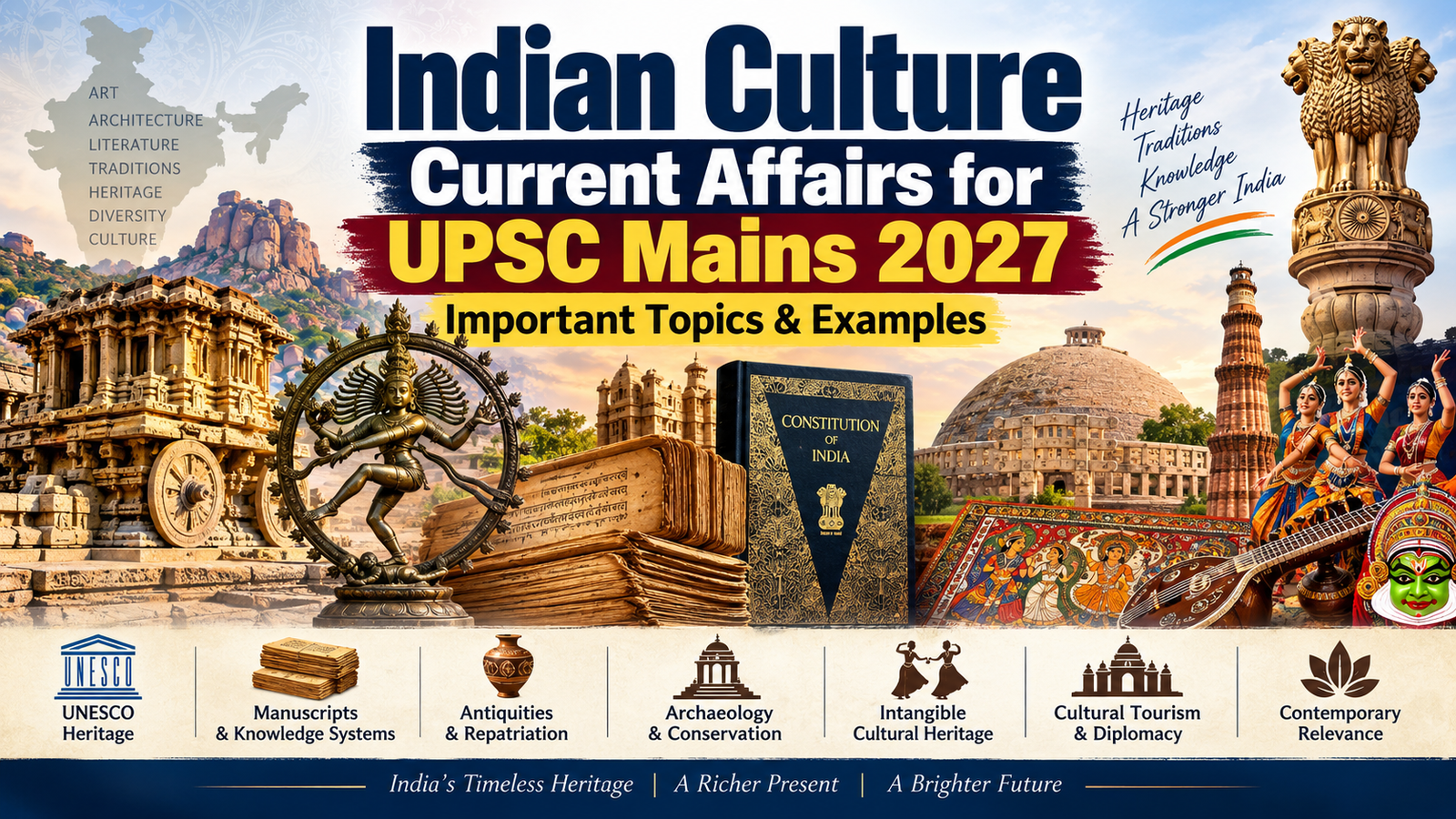
Indian Culture Current Affairs for UPSC Mains 2027 is an important part of preparation for GS Paper 1, especially for questions related to Indian heritage, art forms, literature, architecture, cultural traditions, conservation and India’s cultural diplomacy.
The official UPSC syllabus places Indian culture under General Studies Paper 1 and specifically mentions the salient aspects of Art Forms, literature and Architecture from ancient to modern times.
For Mains preparation, culture should not be studied only as static facts. Aspirants should connect current developments with historical background, cultural significance, conservation challenges and contemporary relevance.
This article covers important Indian Culture Current Affairs for UPSC Mains 2027, with examples that can be used in answers, essays and value addition.
Indian Culture Current Affairs for UPSC Mains 2027 should be prepared by connecting recent cultural developments with India’s historical heritage, art forms, architecture, literature and conservation challenges.
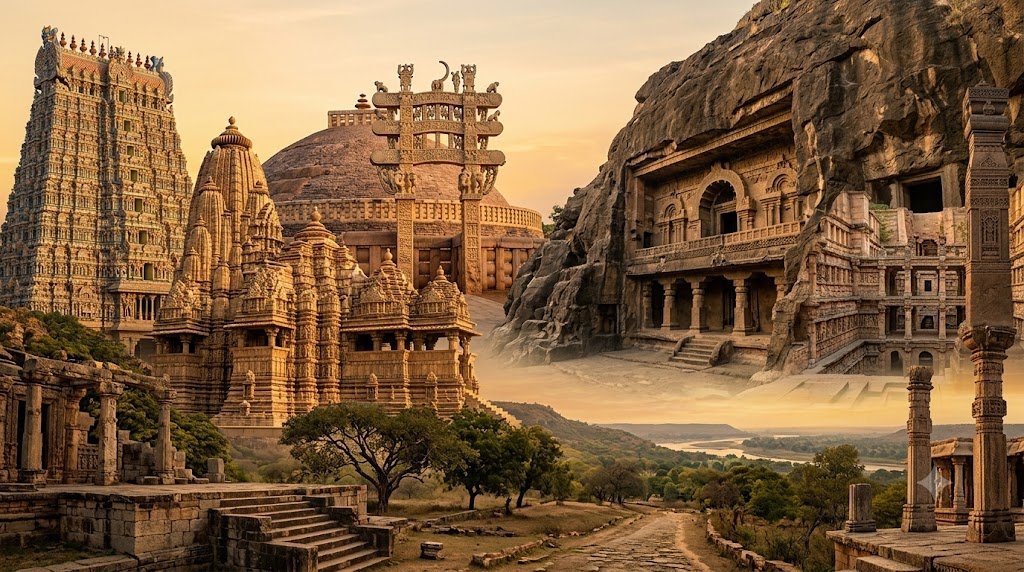
Why Indian Culture Current Affairs Matter for UPSC Mains
UPSC can connect culture with several dimensions of General Studies Paper 1, including:
- Art and architecture
- Literature and languages
- Intangible cultural heritage
- Archaeology
- Heritage conservation
- Buddhism and Jainism
- Temple architecture
- Museums and manuscripts
- Cultural institutions
- UNESCO heritage recognition
- Cultural diplomacy
- Repatriation of antiquities
- Digital preservation of heritage
- Tourism and heritage conservation
- Community participation
The important strategy is to move from “What happened?” to “Why does it matter?”
For example:
Current Event: Sarnath received UNESCO World Heritage recognition.
Mains Link: Buddhist heritage + archaeology + religious tourism + conservation + cultural diplomacy + India’s civilisational heritage.
Indian Culture becomes easier to prepare when it is studied alongside the broader requirements of UPSC Mains GS Paper 1.
Indian Culture Current Affairs 2026: Major Developments
Ancient Buddhist Site of Sarnath Added to UNESCO World Heritage List
One of the most important cultural developments of 2026 was the inscription of the Ancient Buddhist Site of Sarnath on the UNESCO World Heritage List.
The inscription took place during the 48th Session of the World Heritage Committee at Busan, South Korea, in July 2026. India consequently reached 45 World Heritage properties.
Aspirants can refer to the Official UNESCO World Heritage listing for Sarnath to understand its Outstanding Universal Value and the basis of its inscription.
Why it matters for UPSC
Sarnath can be linked with:
- Buddhism
- Buddhist art and architecture
- Stupas and monasteries
- Ashokan heritage
- Ancient Indian history
- Religious tourism
- Archaeological conservation
- UNESCO World Heritage Convention
- India’s cultural diplomacy
Mains Value Addition
Sarnath demonstrates how India’s archaeological heritage can simultaneously represent religious history, artistic development, cultural continuity and international cultural recognition.
Sarnath is one of the most important examples to include in Indian Culture Current Affairs for UPSC Mains 2027 because it connects Buddhism, archaeology, architecture and UNESCO heritage recognition.
India’s UNESCO World Heritage Presence
As of 2026, India has 45 properties inscribed on the UNESCO World Heritage List, following the inscription of the Ancient Buddhist Site of Sarnath. UNESCO’s India profile lists the country’s cultural, natural and mixed heritage properties.
This is important because UNESCO recognition provides an opportunity to discuss:
- Heritage conservation
- International cultural cooperation
- Sustainable tourism
- Local community participation
- Conservation financing
- Protection against urbanisation and environmental pressures
UPSC Connection
UNESCO Recognition → Cultural Diplomacy → Heritage Conservation → Tourism → Sustainable Development
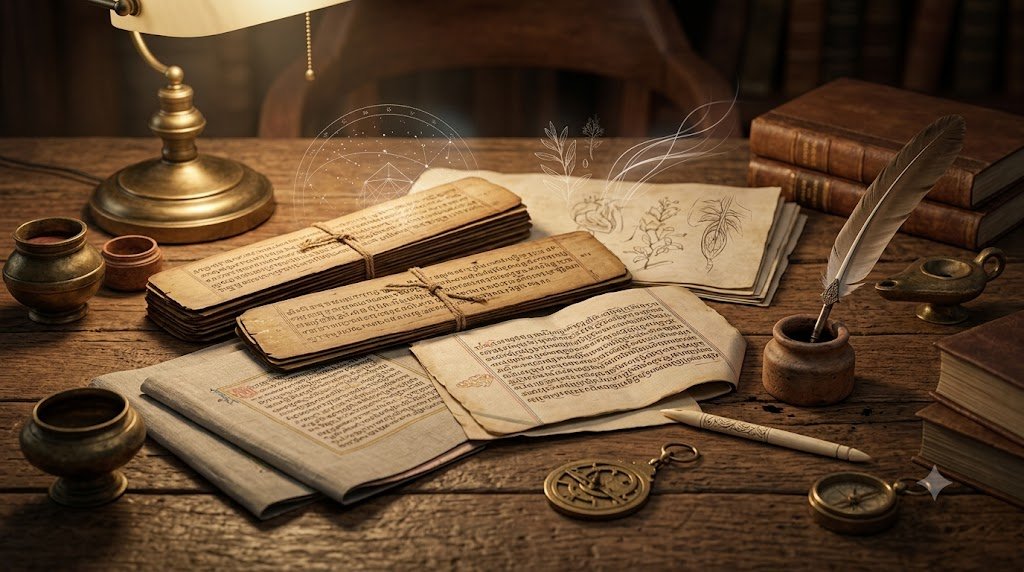
Gyan Bharatam Mission and Manuscript Heritage
One of the most important developments for Indian Culture Current Affairs for UPSC Mains 2027 is the expansion of the Gyan Bharatam Mission.
The Mission was announced in Union Budget 2025–26 and is being implemented by the Ministry of Culture to survey, document, conserve, digitise and make India’s manuscript heritage more accessible. The government has sanctioned ₹491.66 crore for 2025–2031 for manuscript-related activities.
The Mission covers manuscripts located in:
- Academic institutions
- Museums
- Libraries
- Private collections
- Other repositories
Its broad areas include:
- Survey and cataloguing
- Conservation
- Capacity building
- Technology and digitisation
- Linguistics and translation
- Research and publication
- Outreach
The Gyan Bharatam Mission adds an important manuscript-preservation dimension to Indian Culture Current Affairs for UPSC Mains 2027.
National Manuscript Survey
Under the Gyan Bharatam Mission, the National Manuscript Survey was launched across States and Union Territories to identify and document manuscript holdings, repositories and custodians representing different languages and scripts.
By July 2026, more than 1.19 crore manuscripts had been reported through the survey.
This is significant because manuscripts contain information relating to:
- Philosophy
- Science
- Medicine
- Mathematics
- Literature
- Religion
- Astronomy
- Linguistics
- Social history
UPSC Mains Angle
The issue can be used to discuss the importance of digitisation as a tool of cultural preservation.
Digitisation can protect fragile knowledge systems while simultaneously improving accessibility for researchers, students and future generations.
Indian Culture Portal 2.0
The Indian Culture Portal (ICP) Version 2.0 was launched in March 2026 as an upgraded digital platform for India’s cultural resources.
The upgraded portal uses a modern architecture designed to improve performance, scalability, security and access to India’s cultural resources.
The initiative is relevant to the broader idea of digital cultural heritage.
Importance
Digital platforms can help:
- Preserve cultural information
- Improve public access
- Support researchers
- Promote regional traditions
- Document intangible heritage
- Increase cultural awareness among young people
- Strengthen India’s cultural outreach
Mains Link
Technology + Heritage Conservation + Public Access = Digital Cultural Preservation
Repatriation of Indian Antiquities
The return of Indian antiquities from foreign countries is another important cultural issue.
In 2026, the government highlighted India’s efforts to bring back cultural objects taken abroad. By August 2026, 669 antiquities had been repatriated to India, including 656 since 2014. A significant recent development involved the return of 657 Indian art objects handed over by US law-enforcement authorities to the Embassy of India.
Among the notable objects mentioned were:
- Chola-period Shiva Nataraja
- Saint Sundarar with Paravai
- Somaskanda
UPSC Mains Relevance
The issue connects with:
- Cultural heritage
- Illicit trafficking of antiquities
- International cooperation
- Cultural diplomacy
- Museums
- Ownership and provenance
- Protection of archaeological heritage
Mains Example
The repatriation of antiquities illustrates how cultural diplomacy can complement domestic heritage conservation.
The repatriation of antiquities is another important theme within Indian Culture Current Affairs for UPSC Mains 2027, particularly for questions on cultural diplomacy and heritage conservation.
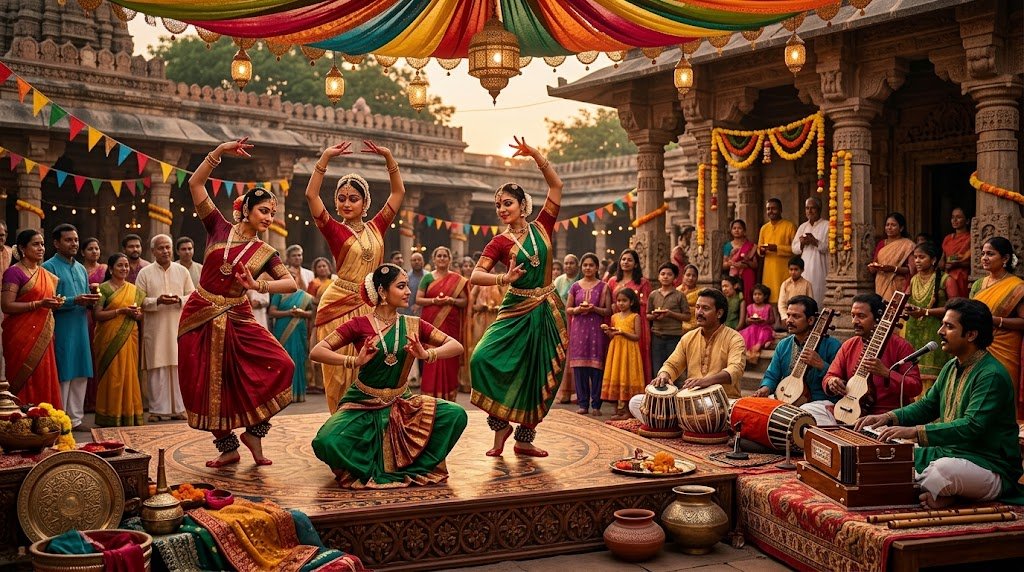
Chhath Mahaparv and UNESCO Intangible Cultural Heritage
The nomination of Chhath Mahaparv for the 2026–27 UNESCO Intangible Cultural Heritage cycle is another useful example for UPSC preparation.
The nomination dossier was prepared by the Sangeet Natak Akademi, which acts as the nodal agency for matters relating to India’s intangible cultural heritage.
Chhath is particularly significant from the perspective of:
- Community participation
- Ritual traditions
- Nature worship
- Sun worship
- Water bodies
- Ecological awareness
- Regional cultural identity
- Living heritage
UPSC Mains Angle
Chhath can be used to demonstrate that Indian culture is not limited to monuments.
Intangible heritage represents living traditions transmitted through communities, rituals, knowledge systems, performing arts and craftsmanship.
Deepavali and UNESCO Intangible Cultural Heritage
Deepavali was inscribed on UNESCO’s Representative List of the Intangible Cultural Heritage of Humanity in December 2025.
UNESCO placed it under the domain of “Social practices, rituals and festive events.” It became the 16th element from India on UNESCO’s Intangible Cultural Heritage lists.
This is highly relevant for 2027 preparation because it provides an example of how festivals can be studied as:
- Living cultural traditions
- Social practices
- Community participation
- Intergenerational transmission
- Cultural identity
Understanding Intangible Cultural Heritage
UNESCO broadly identifies five domains of intangible cultural heritage:
- Oral traditions and expressions
- Performing arts
- Social practices, rituals and festive events
- Knowledge and practices concerning nature and the universe
- Traditional craftsmanship
This classification is extremely useful for UPSC Mains answers.
Examples from India
Yoga → Knowledge and practices
Garba → Performing arts / cultural tradition
Deepavali → Social practices, rituals and festive events
Traditional crafts → Traditional craftsmanship
Such developments are particularly useful for Indian Culture Current Affairs for UPSC Mains 2027 because they connect living traditions with UNESCO’s intangible cultural heritage framework.
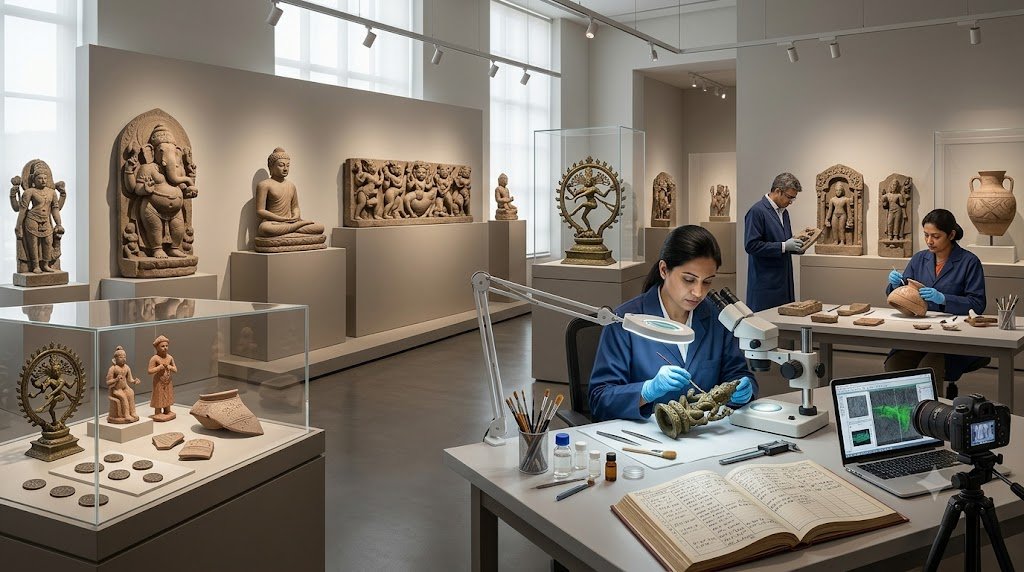
National Mission on Monuments and Antiquities
The National Mission on Monuments and Antiquities (NMMA) is another important area for culture preparation.
The mission aims to create a comprehensive national database of monuments and antiquities to support conservation planning and management.
As of March 2026, NMMA had documented approximately:
- 1.84 lakh monuments
- 17.20 lakh antiquities
UPSC Relevance
This development highlights the importance of:
- Documentation
- Digital databases
- Scientific conservation
- Heritage management
- Archaeological research
- Protection of antiquities
Archaeological Survey of India and Heritage Conservation
The Archaeological Survey of India (ASI) remains a central institution for the protection and conservation of India’s centrally protected monuments.
The government reported that ASI safeguards 3,686 centrally protected monuments/sites across India.
ASI also operates archaeological site museums and undertakes documentation and conservation of archaeological collections.
Major Conservation Challenges
India’s heritage faces challenges such as:
- Urbanisation
- Pollution
- Encroachment
- Climate-related risks
- Visitor pressure
- Lack of specialised conservation expertise
- Inadequate documentation
- Illegal trafficking of antiquities
Way Forward
A stronger conservation framework should combine:
Scientific conservation + Digital documentation + Local participation + Sustainable tourism + Adequate funding
Maratha Military Landscapes: Important Background Example
The Maratha Military Landscapes of India were inscribed on UNESCO’s World Heritage List in 2025 and remain highly relevant for 2026–27 culture preparation.
The serial property contains 12 fortifications, primarily in Maharashtra, with Gingee Fort in Tamil Nadu. UNESCO recognises the system under criteria (iv) and (vi).
The property demonstrates how military architecture interacted with:
- Mountains
- Plateaus
- Coastal landscapes
- Strategic routes
- Trade protection
- Territorial control
UPSC Mains Use
It can be used to show that Indian architecture cannot be studied separately from its geographical and political context.
Heritage Cities and Cultural Tourism
Heritage conservation is increasingly connected with tourism and urban development.
The government has highlighted programmes such as Swadesh Darshan and Swadesh Darshan 2.0, with the latter adopting a more destination-centric approach.
As of March 2026, 76 projects had been sanctioned under the earlier Swadesh Darshan framework, while Swadesh Darshan 2.0 had sanctioned 53 projects at different stages of implementation.
Mains Angle
Cultural tourism can:
- Generate local employment
- Support artisans
- Promote heritage conservation
- Improve infrastructure
- Increase awareness
- Strengthen local economies
However, uncontrolled tourism can also cause:
- Overcrowding
- Commercialisation
- Environmental degradation
- Damage to monuments
- Loss of authenticity
Therefore:
Sustainable cultural tourism should balance conservation with economic development.
Indian Culture and Cultural Diplomacy
Culture is increasingly becoming an instrument of India’s international engagement.
India’s cultural diplomacy can draw upon:
- Buddhism
- Yoga
- Indian classical music
- Dance traditions
- Ayurveda
- Handicrafts
- Textiles
- Cuisine
- Festivals
- Literature
- Archaeological heritage
UNESCO recognition of Indian cultural traditions provides an additional platform for international cultural engagement.
UPSC Mains Link
Culture → Soft Power → People-to-People Relations → Tourism → International Image
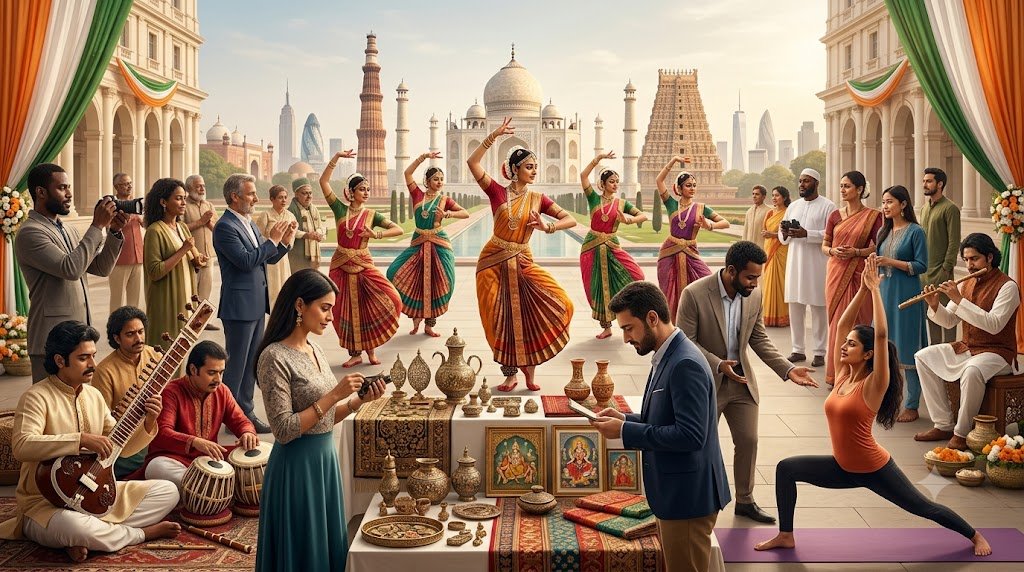
Important Cultural Themes for UPSC Mains 2027
Aspirants should particularly revise the following themes:
1. UNESCO World Heritage Sites
Focus on:
- Sarnath
- Maratha Military Landscapes
- Existing Indian cultural sites
- Tentative List sites
2. Intangible Cultural Heritage
Focus on:
- Deepavali
- Chhath Mahaparv
- Garba
- Yoga
- Traditional crafts
- Performing arts
3. Manuscript Heritage
Focus on:
- Gyan Bharatam Mission
- National Manuscript Survey
- Digitisation
- Conservation
- Translation
4. Archaeological Heritage
Focus on:
- ASI
- NMMA
- Scientific conservation
- Documentation
- Antiquities
5. Repatriation of Antiquities
Focus on:
- Cultural diplomacy
- Illegal trafficking
- Provenance
- International cooperation
6. Digital Heritage
Focus on:
- Indian Culture Portal 2.0
- Digital museums
- Digital archives
- Manuscript digitisation
7. Heritage and Tourism
Focus on:
- Sustainable tourism
- Heritage cities
- Local communities
- Carrying capacity
How to Use Indian Culture Current Affairs in UPSC Mains Answers
Do not simply write:
“Sarnath was added to the UNESCO World Heritage List.”
Instead, use it as an example within an analytical argument.
Example
Recent recognition of Sarnath by UNESCO highlights the international significance of India’s Buddhist heritage and demonstrates how archaeological conservation can contribute simultaneously to cultural diplomacy, sustainable tourism and preservation of civilisational memory.
This approach converts a current-affairs fact into Mains value addition.
Current Affairs → Static Linkage Strategy
| Current Development | Static Topic to Revise | Mains Use |
|---|---|---|
| Sarnath UNESCO inscription | Buddhism, stupas, Ashokan heritage | Buddhist heritage |
| Gyan Bharatam Mission | Manuscripts, literature, knowledge systems | Knowledge preservation |
| Chhath nomination | Folk traditions, rituals | Intangible heritage |
| Deepavali UNESCO recognition | Festivals and social practices | Living heritage |
| Antiquities repatriation | Archaeology and heritage laws | Cultural diplomacy |
| NMMA | Archaeological conservation | Heritage management |
| Indian Culture Portal 2.0 | Digital preservation | Technology and culture |
| Maratha Military Landscapes | Fort architecture | Military architecture |
| Heritage tourism initiatives | Heritage cities | Sustainable tourism |
Important Keywords for UPSC Mains
Use these terms naturally in your answers:
- Cultural Heritage
- Intangible Cultural Heritage
- Tangible Heritage
- Living Heritage
- Cultural Continuity
- Cultural Diversity
- Civilisational Heritage
- Heritage Conservation
- Scientific Conservation
- Digital Preservation
- Cultural Diplomacy
- Cultural Soft Power
- Community Participation
- Sustainable Cultural Tourism
- Archaeological Heritage
- Manuscript Heritage
- Repatriation of Antiquities
- Cultural Documentation
- Intergenerational Transmission
Model UPSC Mains Introduction
India’s cultural heritage represents a continuum of tangible monuments, artistic traditions, literature, manuscripts, performing arts, festivals and knowledge systems. Recent developments such as the UNESCO recognition of Sarnath, the Gyan Bharatam Mission and renewed efforts towards digital preservation demonstrate that cultural heritage is not merely a legacy of the past but a living resource for India’s social, intellectual and diplomatic future.
Model UPSC Mains Conclusion
India’s cultural heritage can be effectively preserved only when conservation is combined with community participation, modern technology, scientific documentation and sustainable tourism. The objective should not merely be to preserve monuments and traditions as relics of the past, but to ensure their continued relevance and transmission to future generations.
Quick Revision: Indian Culture Current Affairs for UPSC Mains 2027
The following points provide a quick revision of the most relevant Indian Culture Current Affairs for UPSC Mains 2027.
Sarnath → UNESCO World Heritage Site → 2026 → Buddhist heritage → Criteria (iii), (vi)
India’s UNESCO World Heritage Properties → 45 after Sarnath’s inscription in 2026.
Gyan Bharatam Mission → Manuscript heritage → Survey + Conservation + Digitisation + Research
Gyan Bharatam Funding → ₹491.66 crore → 2025–2031.
National Manuscript Survey → Launched in 2026 → More than 1.19 crore manuscripts reported by July 2026.
Indian Culture Portal 2.0 → Launched in March 2026 → Digital cultural heritage access.
Chhath Mahaparv → UNESCO ICH nomination → 2026–27 cycle.
Deepavali → UNESCO Intangible Cultural Heritage → 2025 → 16th Indian element on UNESCO’s ICH lists.
NMMA → 1.84 lakh monuments + 17.20 lakh antiquities documented as of March 2026.
ASI → 3,686 centrally protected monuments/sites.
Antiquities Repatriation → 669 returned to India, including 656 since 2014, as highlighted in August 2026.
Maratha Military Landscapes → 12 fortifications → UNESCO 2025 → Criteria (iv), (vi).
Recommended Posts
Current Affairs for UPSC Mains 2027: Proven Guide, Sources & Answer Writing
August 2026 Sports Current Affairs MCQs for UPSC, PCS, SSC & Other Competitive Exam
US-China Summit 2026: Shocking Global Power Shift & India’s Powerful Strategic Future
National Supercomputing Mission (NSM): Powerful AI Revolution in India | UPSC 2026
Final Takeaway
Therefore, Indian Culture Current Affairs for UPSC Mains 2027 should be studied through the combined lens of current developments, static knowledge, cultural significance and analytical answer writing.
For UPSC Mains 2027, Indian Culture Current Affairs should be prepared through a Current Affairs + Static Knowledge + Analytical Examples approach.
The most useful framework is:
Current Event → Historical Background → Cultural Significance → Conservation Challenge → Contemporary Relevance → Way Forward
This approach helps transform culture from a fact-heavy subject into a high-value GS Paper 1 answer-writing area.
The latest available UPSC syllabus specifically places Indian Heritage and Culture within GS Paper 1, covering art forms, literature and architecture from ancient to modern times.
Official UPSC Previous Year Question Papers can also be used to identify how culture-related themes have actually been tested in Mains.
1 thought on “Indian Culture Current Affairs for UPSC Mains 2027: Important Topics & Examples”