Introduction
Defense & Space Current Affairs MCQs have become an incredibly high-yield segment in the UPSC Preliminary Examination, with the commission shifting heavily toward practical, application-based questions. As geopolitical alignments evolve and technological indigenization accelerates under Aatmanirbhar Bharat, relying on superficial factual summaries is no longer enough to clear the cutoff.
To help you secure these critical marks, this ultimate guide compiles Defense & Space Current Affairs MCQs curated specifically for the UPSC 2026 cycle. Divided into ten structured sections, this resource moves beyond simple rote memorization to test your analytical understanding of maritime chokepoints, strategic missile vectors, private aerospace breakthroughs, and planetary exploration timelines. Whether you are analyzing a multi-module lunar sample-return mission or a trilateral security pact, these targeted practice sets will fine-tune your elimination skills and elevate your prelims readiness.
For a broader understanding of global geopolitics and its impact on India, check out US-China Summit 2026: Shocking Global Power Shift & India’s Powerful Strategic Future.

Section 1: Bilateral & Multilateral Joint Military Exercises: Defense & Space Current Affairs MCQs UPSC 2026
1. Consider the following pairs of Joint Military Exercises and Participating Nations:
Exercise ‘SADA TANSEEQ’ : India and Saudi Arabia
Exercise ‘DESERT CYCLONE’ : India and UAE
Exercise ‘MITRA SHAKTI’ : India and Maldives
Which of the pairs given above are correctly matched?
A) 1 and 2 only
B) 2 and 3 only
C) 1 and 3 only
D) 1, 2 and 3
2. The ‘MILAN’ exercise, frequently featured in defense current affairs, is best described as a:
A) Bilateral army exercise between India and Oman
B) Multilateral naval exercise hosted by the Indian Navy
C) Joint air defense drill of the Quad nations
D) Counter-terrorism exercise under the Shanghai Cooperation Organisation (SCO)
3. Consider the following statements regarding ‘Exercise Nomadic Elephant’:
It is a bilateral military exercise conducted between India and Mongolia.
The exercise alternates annually between India and Mongolia, focusing on counter-terrorism operations.
Which of the statements given above is/are correct?
A) 1 only
B) 2 only
C) Both 1 and 2
D) Neither 1 nor 2
4. The ‘Exercise MALABAR 2025-26’, a high-profile maritime drill aimed at ensuring a free and open Indo-Pacific, features the navies of which group of countries?
A) India, USA, Japan, and Australia
B) India, France, UAE, and Singapore
C) India, UK, Australia, and New Zealand
D) USA, UK, Australia, and Japan
5. Consider the following pairs:
Exercise ‘KHAN QUEST’ : Multinational Peacekeeping exercise in Mongolia
Exercise ‘SAMPRITI’ : India and Bangladesh
Exercise ‘DHARMA GUARDIAN’ : India and South Korea
Which of the pairs given above are correctly matched?
A) 1 and 2 only
B) 2 and 3 only
C) 1 and 3 only
D) 1, 2 and 3
6. ‘Exercise SIMBEX’ is an annual maritime bilateral exercise conducted continuously since 1994 between India and:
A) Sri Lanka
B) Singapore
C) Seychelles
D) Saudi Arabia
7. Which of the following exercises is/are correctly matched with its specific branch of the armed forces?
Exercise Garuda : Indian Air Force and French Air and Space Force
Exercise Varuna : Indian Navy and French Navy
Exercise Shakti : Indian Army and French Army
Select the correct code:
A) 1 and 2 only
B) 2 and 3 only
C) 1 and 3 only
D) 1, 2 and 3
8. The multilateral air exercise ‘Tarang Shakti’, hosted recently to demonstrate international cooperation, was organized by:
A) The Indian Air Force
B) The United States Air Force
C) NATO Allied Air Command
D) The Royal Australian Air Force
9. Consider the following statements regarding ‘Exercise DUSTLIK’:
It is a joint military exercise between India and Uzbekistan.
The focus of this exercise is heavily directed toward counter-terrorism operations in mountainous terrain.
Which of the statements given above is/are correct?
A) 1 only
B) 2 only
C) Both 1 and 2
D) Neither 1 nor 2
10. ‘Exercise Surya Kiran’ is a periodic joint military training exercise conducted between the armies of India and:
A) Sri Lanka
B) Nepal
C) Bhutan
|D) Myanmar
Explanatory Answers: Section 1: Defense & Space Current Affairs MCQs UPSC 2026
Ans: A. Pairs 1 and 2 are correctly matched. Exercise Mitra Shakti is conducted between India and Sri Lanka (Exercise Ekuverin is conducted between India and Maldives).
Ans: B. MILAN is a biennial multilateral naval exercise conceived by the Indian Navy in 1995. It brings together friendly navies from across the Indo-Pacific and beyond to enhance interoperability.
Ans: C. Both statements are correct. Nomadic Elephant is a crucial bilateral training event between India and Mongolia focusing on counter-insurgency and counter-terrorism.
Ans: A. MALABAR began as a bilateral exercise between India and the US in 1992, but has expanded to include all four Quad members: India, USA, Japan, and Australia.
Ans: A. Pair 3 is incorrectly matched. Exercise Dharma Guardian is conducted between India and Japan, not South Korea. Khan Quest and Sampriti are correctly matched.
Ans: B. SIMBEX stands for Singapore-India Maritime Bilateral Exercise. It is India’s longest uninterrupted bilateral maritime exercise with any foreign navy.
Ans: D. The triad of exercises with France includes Garuda (Air Force), Varuna (Navy), and Shakti (Army). All are correctly matched.
Ans: A. Exercise Tarang Shakti is the largest multinational air exercise hosted by the Indian Air Force (IAF), featuring participation from several global air wings.
Ans: C. Both statements are correct. DUSTLIK is an army-to-army joint exercise between India and Uzbekistan, focusing on tactical-level counter-terror operations.
Ans: B. Exercise Surya Kiran is an annual military exercise conducted alternatingly between India and Nepal.
11. Consider the following statements regarding the indigenous aircraft carrier INS Vikrant:
It is the first aircraft carrier to be completely designed and built indigenously in India.
It was designed by the Indian Navy’s Warship Design Bureau and constructed by Cochin Shipyard Limited.
Which of the statements given above is/are correct?
A) 1 only
B) 2 only
C) Both 1 and 2
D) Neither 1 nor 2
12. Project 75i (Project 75 India), frequently mentioned in strategic defense news, is aimed at the indigenous construction of which of the following?
A) Stealth guided-missile destroyers
B) Diesel-electric attack submarines with Air-Independent Propulsion (AIP)
C) Nuclear-powered ballistic missile submarines (SSBN)
D) Unmanned Underwater Vehicles (UUVs)
13. Consider the following pairs of Indigenously Developed Systems and their Type:
LCA Tejas : Fourth-generation supersonic fighter aircraft
INS Arighat : Nuclear-powered ballistic missile submarine
Prachand : Light Combat Helicopter (LCH)
Which of the pairs given above are correctly matched?
A) 1 and 2 only
B) 2 and 3 only
C) 1 and 3 only
D) 1, 2 and 3
14. The ‘Air-Independent Propulsion’ (AIP) system, being integrated into Indian conventional submarines, primarily serves to:
A) Increase the maximum speed of the submarine underwater
B) Enable the submarine to remain submerged for longer durations without surfacing
C) Allow the submarine to launch nuclear ballistic missiles
D) Reduce the weight of the propulsion system by replacing heavy batteries
15. With reference to Indian Navy’s ‘Project 15B’, consider the following statements:
It involves the construction of Visakhapatnam-class stealth guided-missile destroyers.
INS Surat and INS Imphal are warships constructed under this specific project.
Which of the statements given above is/are correct?
A) 1 only
B) 2 only
C) Both 1 and 2
D) Neither 1 nor 2
16. ‘Zorawar’, which has been undergoing rigorous trials, is best described as India’s indigenously developed:
A) Anti-submarine warfare shallow water craft
B) High-altitude Light Tank for mountain warfare
C) Next-generation Main Battle Tank (MBT) to replace Arjun
D) Autonomous unmanned combat aerial vehicle (UCAV)
17. Consider the following statements regarding the ‘TAPAS BH-201’ (Rustom-II):
It is an indigenous Medium Altitude Long Endurance (MALE) Unmanned Aerial Vehicle (UAV).
It has been completely developed by Bharat Electronics Limited (BEL) for the Indian Army.
Which of the statements given above is/are correct?
A) 1 only
B) 2 only
C) Both 1 and 2
D) Neither 1 nor 2
18. The term ‘Astra Mk-1’, which has successfully completed several user trials, refers to an indigenously developed:
A) Beyond-Visual-Range Air-to-Air Missile (BVRAAM)
B) Surface-to-Air missile defense system
C) Anti-radiation missile used for destroying enemy radars
D) Anti-tank guided missile with fire-and-forget capability
19. Which of the following shipyards built India’s Nilgiri-class stealth frigates under the strategic ‘Project 17A’?
Mazagon Dock Shipbuilders Limited (MDL)
Garden Reach Shipbuilders & Engineers (GRSE)
Hindustan Shipyard Limited (HSL)
Select the correct code:
A) 1 and 2 only
B) 2 and 3 only
C) 1 and 3 only
D) 1, 2 and 3
20. ‘Swathi’, inducted to enhance the battlefield surveillance capabilities of the Indian Armed Forces, is an indigenously built:
A) Weapon Locating Radar (WLR)
B) Mine-Countermeasure Vessel (MCMV)
C) Handheld thermal imaging device
D) Tactical secure communication satellite
Explanatory Answers: Section 2: Defense & Space Current Affairs MCQs UPSC 2026
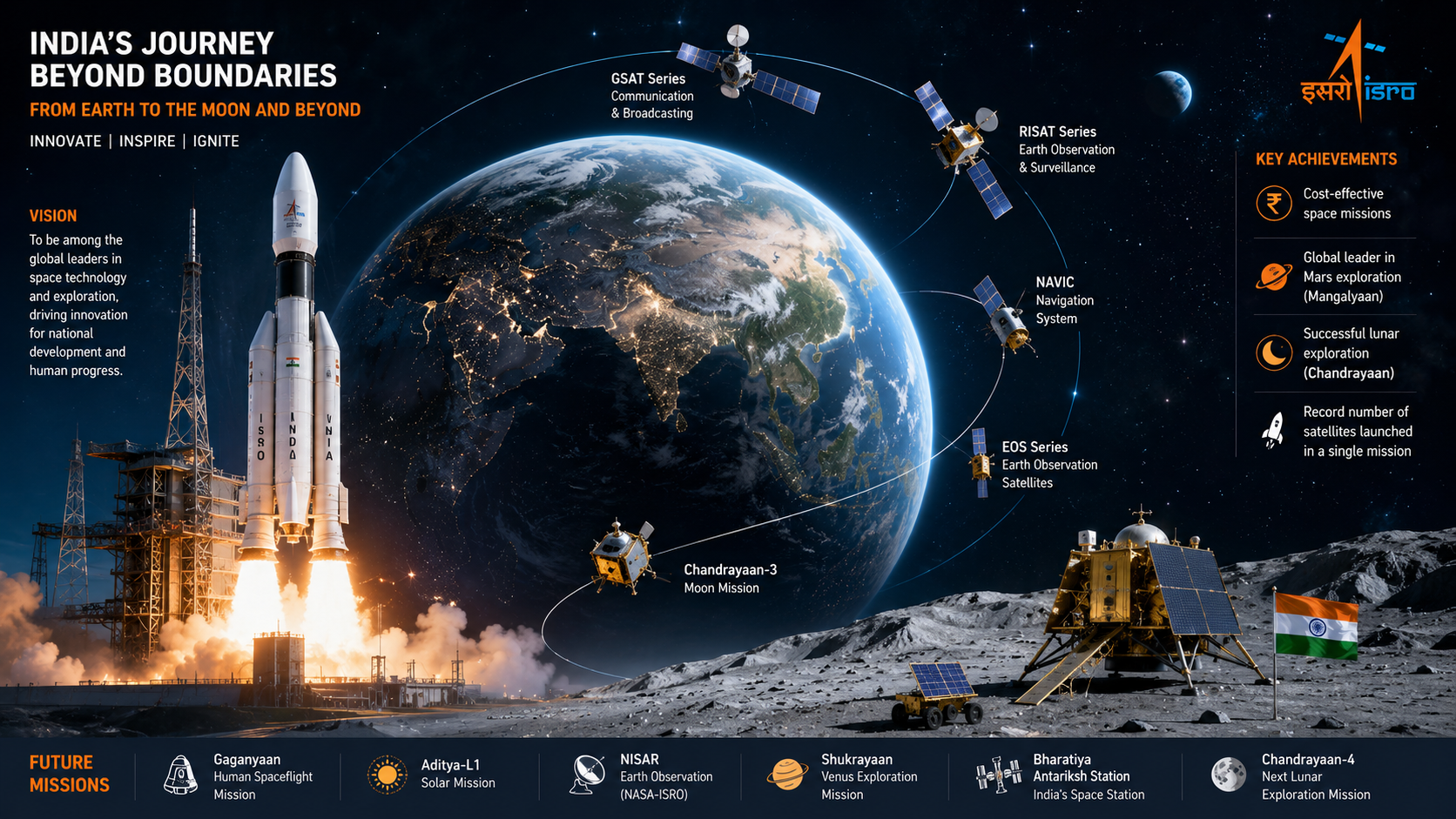
Ans: C. Both statements are correct. INS Vikrant is India’s first indigenous aircraft carrier (IAC-1). It marks a massive leap in indigenous warship design and manufacturing capacity, built entirely at Cochin Shipyard.
Ans: B. Project 75i is a follow-on to Project 75. It focuses on building six advanced conventional submarines equipped with Air-Independent Propulsion (AIP) technology to enhance stealth and underwater endurance.
Ans: D. All pairs are correctly matched. Tejas is India’s flagship LCA; INS Arighat is the second Arihant-class nuclear submarine commissioned into service; Prachand is the only attack helicopter globally capable of landing and taking off at altitudes above 5,000 meters.
Ans: B. Conventional diesel-electric submarines need to surface or snorkel every few days to charge their batteries using air. AIP technology allows them to generate oxygen/power internally, keeping them submerged for weeks and reducing their vulnerability to radar detection.
Ans: C. Both statements are correct. Project 15B consists of four stealth guided-missile destroyers: INS Visakhapatnam, INS Mormugao, INS Imphal, and INS Surat. They are highly advanced warships built by MDL.
Ans: B. Zorawar is an indigenous Light Tank designed by DRDO in collaboration with Larsen & Toubro (L&T) specifically for deployment in high-altitude regions like Eastern Ladakh to counter heavy deployment across the LAC.
Ans: A. Statement 1 is correct. Statement 2 is incorrect because TAPAS BH-201 has been developed by the Defence Research and Development Organisation (DRDO), specifically its Aeronautical Development Establishment (ADE), not BEL.
Ans: A. Astra Mk-1 is India’s first indigenous Beyond-Visual-Range Air-to-Air Missile (BVRAAM), integrated onto Sukhoi-30 MKI and LCA Tejas fighter jets to engage high-speed aerial targets.
Ans: A. Project 17A stealth frigates were split-constructed between two premier defense public sector shipyards: Mazagon Dock Shipbuilders (MDL) in Mumbai and Garden Reach Shipbuilders & Engineers (GRSE) in Kolkata.
Ans: A. Swathi is an indigenous Weapon Locating Radar (WLR) developed by DRDO. It automatically detects and tracks incoming artillery shells, mortars, and rockets, tracing their trajectory back to locate the exact position of enemy launchers.
Section 3: Missile Systems, Air Defense & Artillery – Defense & Space Current Affairs MCQs UPSC 2026
21. With reference to the ‘Agni-V’ missile system, consider the following statements:
It is an Intercontinental Ballistic Missile (ICBM) with a range exceeding 5,000 kilometers.
It utilizes Multiple Independently Targetable Re-entry Vehicle (MIRV) technology, allowing a single missile to deliver multiple warheads to different targets.
Which of the statements given above is/are correct?
A) 1 only
B) 2 only
C) Both 1 and 2
D) Neither 1 nor 2
22. The ‘S-400 Triumf’, operationalized by the Indian Armed Forces along strategic borders, is best classified as a:
A) Long-range surface-to-air missile (LR-SAM) defense system
B) Deep-penetration nuclear-capable cruise missile
C) Anti-satellite (ASAT) kinetic weapon system
D) Low-altitude tactical radar network
23. Consider the following pairs of Missile Systems and their Class:
Pralay : Short-Range Ballistic Missile (SRBM)
BrahMos : Supersonic Cruise Missile
Pinaka : Multi-Barrel Rocket Rocket Launcher System
Which of the pairs given above are correctly matched?
A) 1 and 2 only
B) 2 and 3 only
C) 1 and 3 only
D) 1, 2 and 3
24. What is the fundamental technological difference between a ‘Ballistic Missile’ and a ‘Cruise Missile’?
A) Ballistic missiles are entirely unguided, whereas cruise missiles use active GPS guidance throughout their flight.
B) Ballistic missiles follow a high, arched sub-orbital trajectory driven by gravity, while cruise missiles fly at lower altitudes parallel to the earth’s surface using jet engine propulsion.
C) Cruise missiles are always nuclear-armed, whereas ballistic missiles can only carry conventional payloads.
D) Ballistic missiles travel slower than the speed of sound, while cruise missiles are inherently hypersonic.
25. Consider the following statements regarding the ‘Akash Next Generation’ (Akash-NG) missile system:
It is a short-range surface-to-air missile system developed for the Indian Air Force to intercept high-speed, low-RCS aerial threats.
It uses a solid propellant rocket motor and is equipped with an indigenously developed active Radio Frequency (RF) seeker.
Which of the statements given above is/are correct?
A) 1 only
B) 2 only
C) Both 1 and 2
D) Neither 1 nor 2
26. The ‘Iron Dome’ air defense system, frequently discussed in international security updates, utilizes which of the following mechanisms to neutralize threats?
A) Blinding incoming threats using high-energy laser beams
B) Cyber-interception to jam the internal navigation of enemy drones
C) Firing interceptor missiles to detonate incoming short-range rockets in mid-air
D) Launching high-altitude EMP pulses to disable artillery electronics
27. ‘Helina’, which has undergone successful validation trials at high-altitude ranges, is the airborne version of which indigenous weapon system?
A) Akash air defense missile
B) Nag anti-tank guided missile (ATGM)
C) Pinaka guided rocket system
D) Astra beyond-visual-range missile
28. Consider the following statements regarding ‘VSHORADS’ (Very Short Range Air Defence System) developed by DRDO:
It is a Man-Portable Air Defence System (MANPAD) designed to neutralize low-altitude aerial threats at short ranges.
It incorporates a dual-thrust solid motor and a highly advanced passive infrared homing guidance system.
Which of the statements given above is/are correct?
A) 1 only
B) 2 only
C) Both 1 and 2
D) Neither 1 nor 2
29. The ‘K9-Vajra-T’, which has been actively deployed in high-altitude northern border sectors, is a:
A) Tracked Self-Propelled Howitzer artillery gun
B) Wheeled armored personnel carrier
C) Light amphibious tank for river crossings
D) Remote-controlled mine clearing vehicle
30. Which of the following describes ‘Project Kusha’, a strategic project initiated by India’s DRDO?
A) Development of an indigenous long-range air defense system akin to the Iron Dome or S-400
B) Manufacturing of next-generation hypersonic glide vehicles
C) Establishing a permanent undersea surveillance network in the Indian Ocean
D) Interceptors designed specifically to target hypersonic cruise missiles
Explanatory Answers: Section 3: Defense & Space Current Affairs MCQs UPSC 2026
Ans: C. Both statements are correct. India successfully tested Agni-V with MIRV technology under Mission Divyastra. It can strike multiple targets thousands of kilometers away simultaneously using independent re-entry vehicles, significantly strengthening India’s nuclear deterrence.
Ans: A. The S-400 Triumf is a mobile, long-range Surface-to-Air Missile (SAM) system acquired from Russia. It can engage incoming aircraft, UAVs, and ballistic/cruise missiles at ranges up to 400 km.
Ans: D. All pairs are correctly matched. Pralay is a conventional quasi-ballistic missile; BrahMos is a joint venture with Russia and is the world’s fastest supersonic cruise missile; Pinaka is an indigenous artillery rocket system capable of launching 12 rockets in 44 seconds.
Ans: B. Ballistic missiles are powered initially by a rocket but follow an unpowered, gravity-driven elliptical arc outside or in the upper limits of the atmosphere. Cruise missiles behave like unmanned aircraft, remaining within the atmosphere and using continuous jet propulsion to fly low and evade radar.
Ans: C. Both statements are correct. Akash-NG is a next-generation variant that vastly improves on the legacy Akash system, utilizing a quicker reaction time and an indigenous active RF seeker to lock onto stealthier, agile targets.
Ans: C. Israel’s Iron Dome is a combat-proven air defense system designed to intercept and destroy short-range rockets and artillery shells fired from distances of 4 to 70 kilometers via kinetic interceptor missiles (Tamir).
Ans: B. Helina (Helicopter-launched Nag) is a third-generation, fire-and-forget Anti-Tank Guided Missile (ATGM) system mounted on advanced light helicopters (ALH).
Ans: C. Both statements are correct. VSHORADS is a lightweight, man-portable system crucial for ground forces to rapidly deploy against low-flying enemy helicopters, drones, and aircraft using heat-seeking infrared guidance.
Ans: A. The K9-Vajra-T is a 155mm, 52-caliber Self-Propelled Tracked Howitzer built by Larsen & Toubro using technology from South Korea’s K9 Thunder. Originally meant for deserts, its deployment in Ladakh proved highly effective.
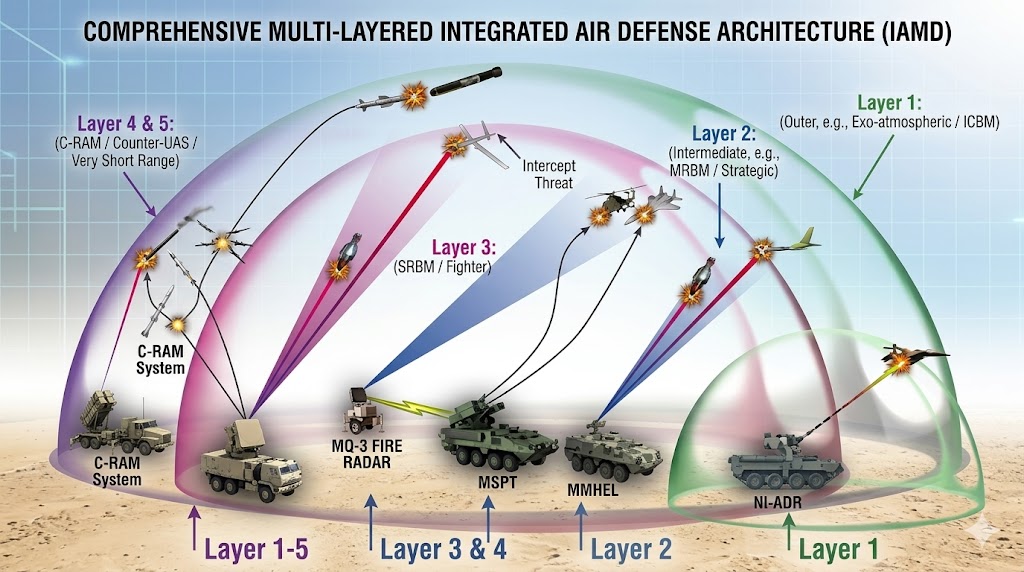
Ans: A. Project Kusha is the code name for India’s ambitious indigenous Long-Range Surface-to-Air Missile (LR-SAM) system. It aims to deploy an air defense umbrella capable of intercepting stealth fighters, cruise missiles, and precision-guided munitions at ranges up to 350 km, mirroring capabilities of advanced global defense shields.
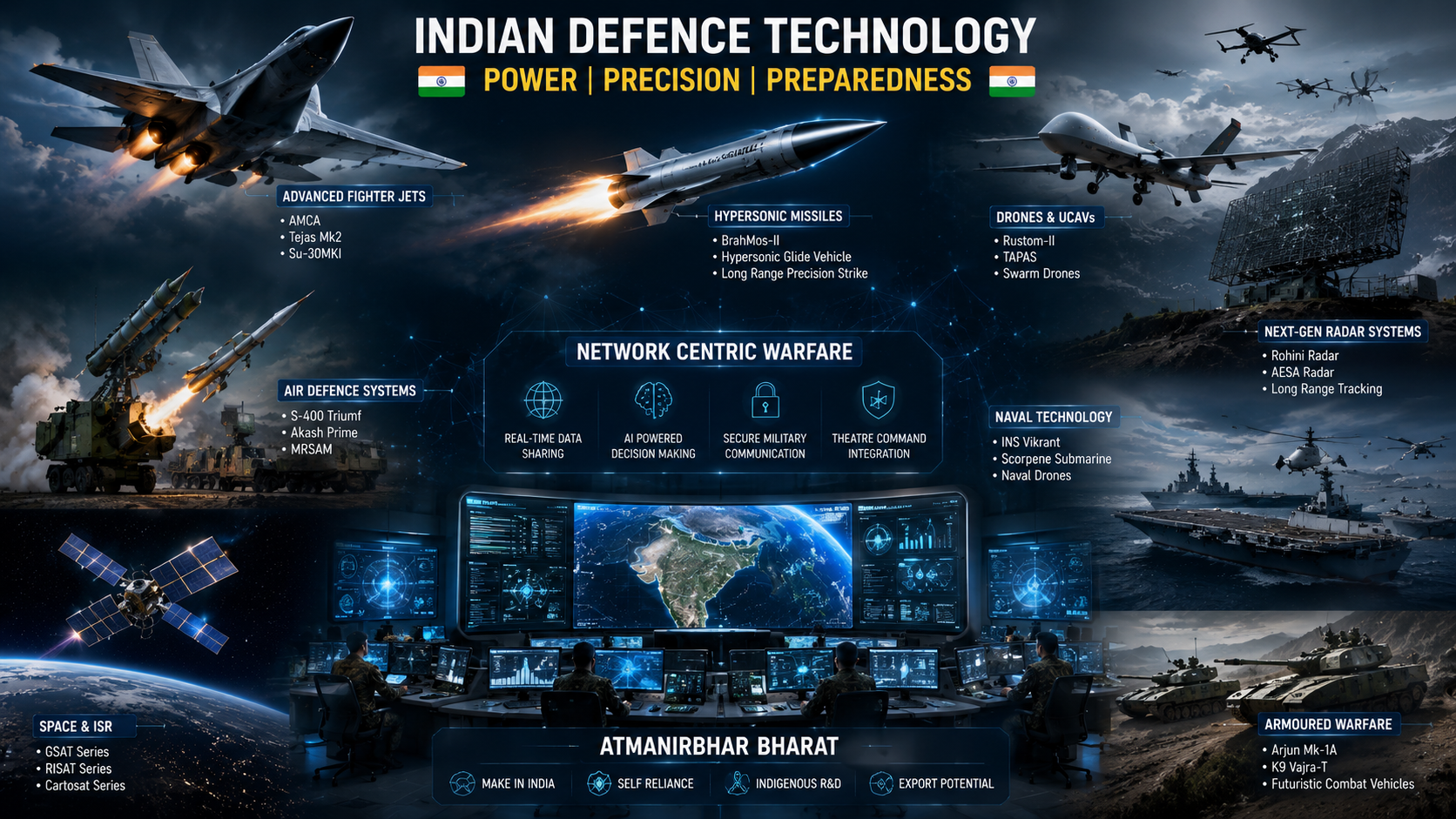
Here is Section 4, focusing on ISRO Lunar & Planetary Space Missions. This section covers India’s highly ambitious exploration roadmap, including the complex multi-module architecture of upcoming missions and crucial deep-space infrastructure.
Section 4: ISRO Lunar & Planetary Space Missions – Defense & Space Current Affairs MCQs UPSC 2026
31. With reference to the upcoming Chandrayaan-4 mission approved by the Union Cabinet, consider the following statements:
It is designed as a lunar sample-return mission to collect and bring lunar soil back to Earth.
Unlike Chandrayaan-3, it will utilize a dual-launch strategy involving two separate LVM3 rockets.
The mission requires on-orbit docking maneuvers to assemble its five distinct modules in space.
Which of the statements given above are correct?
A) 1 and 2 only
B) 2 and 3 only
C) 1 and 3 only
D) 1, 2 and 3
32. ISRO has finalized ‘Mons Mouton’ as the primary landing site for Chandrayaan-4. This feature is located near which region of the Moon?
A) Mare Tranquillitatis (Sea of Tranquility)
B) Lunar South Pole
C) Far Side of the Moon (Dark Side)
D) Oceanus Procellarum (Ocean of Storms)
33. Consider the following pairs of Chandrayaan-4 Modules and their primary functions:
Ascender Module : Ejects from the lunar surface to carry collected samples back into low-lunar orbit.
Transfer Module : Collects the sample container from the ascender and guides the journey back to Earth orbit.
Re-entry Module : Houses the lunar regolith samples and survives atmospheric friction to land safely on Earth.
Which of the pairs given above are correctly matched?
A) 1 and 2 only
B) 2 and 3 only
C) 1 and 3 only
D) 1, 2 and 3
34. Consider the following statements regarding the ‘Gaganyaan’ human spaceflight programme:
It aims to demonstrate indigenous human spaceflight capability by launching a crew into a 400 km Low Earth Orbit (LEO) for a 3-day mission.
The crewed spacecraft will be launched using a specialized configuration called the Human-Rated LVM3 (HLVM3).
Which of the statements given above is/are correct?
A) 1 only
B) 2 only
C) Both 1 and 2
D) Neither 1 nor 2
35. With reference to India’s planetary exploration roadmap, the ‘Shukrayaan’ or Venus Orbiter Mission (VOM) aims to study which atmospheric phenomenon unique to Venus?
A) High-velocity planetary dust storms
B) Dense sulfuric acid clouds and runaway greenhouse dynamics
C) Sub-surface liquid water oceans using high-frequency radar
D) Rapid magnetic reversals caused by solar wind interactions
36. The ‘Aditya-L1’ spacecraft, India’s first dedicated solar observatory, utilizes a specific orbit around the Lagrange Point 1 (L1). What is the primary advantage of this location?
A) It allows the spacecraft to remain completely hidden from solar radiation.
B) It provides a continuous, unobstructed view of the Sun without any occultation or eclipses.
C) It requires zero fuel consumption to maintain its stationary position.
D) It positions the spacecraft within the Earth’s protective magnetosphere.
37. Consider the following statements regarding the ‘Lunar Polar Exploration’ (LUPEX) mission:
It is a joint collaborative lunar venture between India’s ISRO and Japan’s JAXA.
JAXA will provide the launch vehicle and the lunar rover, while ISRO is responsible for developing the lander system.
Which of the statements given above is/are correct?
A) 1 only
B) 2 only
C) Both 1 and 2
D) Neither 1 nor 2
38. The ‘Network for Space Object Tracking and Analysis’ (NETRA) project established by ISRO serves as an independent system for:
A) Deep-space communication with interplanetary probes
B) Space Situational Awareness (SSA) to detect and track space debris threatening Indian satellites
C) Intercepting enemy reconnaissance satellites using kinetic weapons
D) Mapping natural resources on Earth using hyperspectral imaging
39. For the tracking and telemetry support of its upcoming uncrewed and crewed Gaganyaan missions, ISRO has established a new ground station terminal at which strategic international location?
A) Reunion Island (France)
B) Seychelles
C) Cocos (Keeling) Islands (Australia)
D) Svalbard (Norway)
40. Which of the following technologies is being developed for the first time by ISRO to support the long-term goal of building an Indian Space Station (Bharatiya Antariksha Station) by 2035?
A) Solid-fuel booster aggregation
B) Autonomous Spacecraft Docking and Rendezvous (SPADEX)
C) Ion-propulsion deep space tracking
D) Cryogenic upper stage deceleration
Explanatory Answers: Section 4: Defense & Space Current Affairs MCQs UPSC 2026
Ans: D. All three statements are correct. Chandrayaan-4 is vastly more complex than Chandrayaan-3. Because a single LVM3 rocket cannot carry the massive fuel load required for both landing and returning, ISRO is executing a dual-launch strategy. The components will be launched separately and will dock autonomously in Earth orbit before heading to the Moon.
Ans: B. Mons Mouton is a flat-topped mountain located in the lunar south polar region. It was selected due to its gentle slopes, high elevation, and proximity to Permanently Shadowed Regions (PSRs) where water ice is expected to be trapped.
Ans: D. All pairs are correctly matched. The five modules function as a precise relay chain: The Propulsion and Descender modules handle the journey and landing; the Ascender shoots up from the Moon; the Transfer module grabs the sample container in lunar orbit; and the Re-entry module drops it safely through Earth’s atmosphere.
Ans: C. Both statements are correct. Gaganyaan is India’s flagship crewed orbital mission. Uncrewed validation flights (like G1) pave the way for the eventual crewed flight, launching astronauts into low Earth orbit via the heavily modified and safety-certified Human-Rated LVM3 (HLVM3) launcher.
Ans: B. The Venus Orbiter Mission (VOM) focuses on analyzing the hostile, toxic atmosphere of Venus, dominated by a runaway greenhouse effect and thick, reflective clouds of sulfuric acid. It features radar instruments to penetrate this shroud and map the surface topography.
Ans: B. Lagrange Point 1 (L1) is a gravitational equilibrium point located roughly 1.5 million km from Earth toward the Sun. A spacecraft placed in a halo orbit here enjoys a continuous, 24/7 view of the Sun without Earth or the Moon blocking its sightline, which is critical for real-time solar storm monitoring.
Ans: C. Both statements are correct. The LUPEX mission (often considered Chandrayaan-5 in terms of chronology) is a collaborative effort with Japan (JAXA). JAXA is building the sophisticated rover and providing the H3 launch vehicle, while ISRO leverages its soft-landing expertise to build the landing platform.
Ans: B. Project NETRA is India’s dedicated Space Situational Awareness (SSA) system. It monitors space debris, defunct satellites, and other orbital hazards to safeguard operational Indian space assets from catastrophic collisions.
Ans: C. To ensure unbroken tracking and communications as the spacecraft passes over the Indian Ocean and the Pacific, ISRO executed agreements to establish a critical ground station terminal at the Cocos (Keeling) Islands, administered by Australia.
Ans: B. Building a space station or conducting sample return missions requires multiple spacecraft to locate each other and join together seamlessly while traveling at thousands of miles per hour. ISRO’s Space Docking Experiment (SPADEX) is the foundational technology test designed to master this autonomous rendezvous and docking capability.
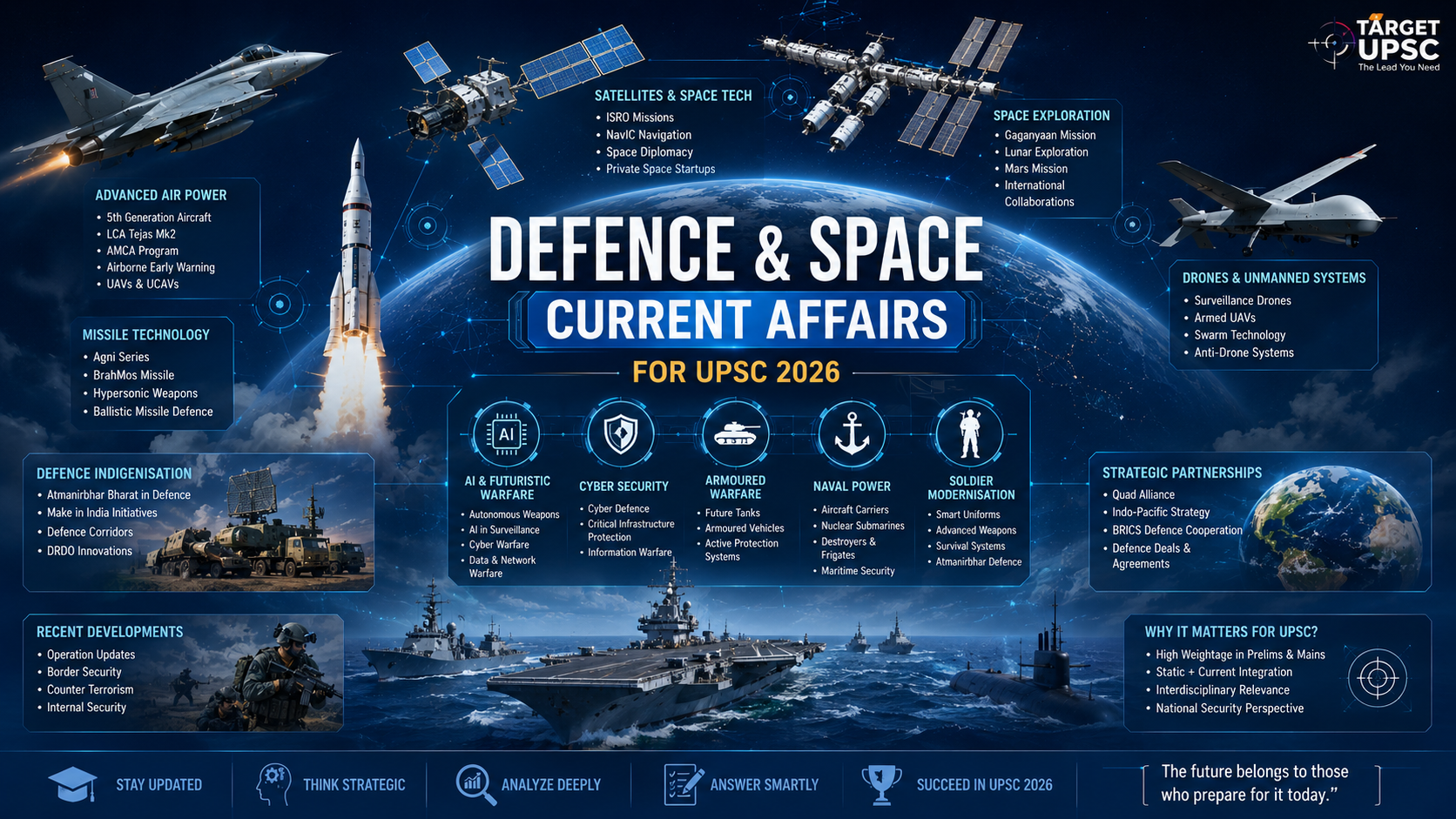
Section 5: International Deep Space Programs & Astronomy Platforms – Defense & Space Current Affairs MCQs UPSC 2026
41. With reference to the ‘Artemis Accords’, an international agreement on space exploration, consider the following statements:
It is a legally binding treaty signed by all United Nations members to prevent the militarization of space.
India became a signatory to the Artemis Accords, aligning its space program with NASA’s lunar exploration architecture.
Which of the statements given above is/are correct?
A) 1 only
B) 2 only
C) Both 1 and 2
D) Neither 1 nor 2
42. The ‘Europa Clipper’ mission, launched to investigate the habitability of an icy moon suspected of harboring a sub-surface ocean, belongs to which space agency?
A) European Space Agency (ESA)
B) National Aeronautics and Space Administration (NASA)
C) Japan Aerospace Exploration Agency (JAXA)
D) China National Space Administration (CNSA)
43. Consider the following pairs of Space Observatories and their primary Spectrum Focus:
James Webb Space Telescope (JWST) : Infrared Spectrum
Hubble Space Telescope : Primarily Visible and Ultraviolet Spectrum
Chandra X-ray Observatory : X-ray Spectrum
Which of the pairs given above are correctly matched?
A) 1 and 2 only
B) 2 and 3 only
C) 1 and 3 only
D) 1, 2 and 3
44. The ‘Square Kilometre Array’ (SKA) project, in which India has formally joined as a full member, is best described as:
A) A constellation of micro-satellites for global high-speed internet
B) The world’s largest multinational radio telescope network
C) An international initiative to map space debris in Low Earth Orbit
D) A deep-space planetary defense shield against asteroid impacts
45. Consider the following statements regarding NASA’s ‘DART’ (Double Asteroid Redirection Test) mission:
It successfully demonstrated the “kinetic impactor” technique by intentionally crashing a spacecraft into an asteroid to alter its orbital path.
The target of the mission was the binary asteroid system of Didymos and its moonlet, Dimorphos.
Which of the statements given above is/are correct?
A) 1 only
B) 2 only
C) Both 1 and 2
D) Neither 1 nor 2
46. The term ‘Lucy Mission’, frequently appearing in deep-space exploration updates, refers to a NASA probe launched to study which of the following cosmic bodies?
A) The polar ice caps of Mars
B) The Jupiter Trojan asteroids
C) The volcanic plumes of Saturn’s moon Enceladus
D) Comets originating from the Oort Cloud
47. Which of the following space agencies successfully executed the ‘JUICE’ (Jupiter Icy Moons Explorer) mission to study Ganymede, Callisto, and Europa?
A) ISRO (India)
B) ESA (Europe)
C) Roscosmos (Russia)
D) CNES (France)
48. Consider the following statements regarding the ‘Kuiper Belt’:
It is a circum-stellar disc in the outer Solar System, extending beyond the orbit of Neptune.
NASA’s New Horizons was the first spacecraft to fly directly through this region and provide close-up images of Pluto and Arrokoth.
Which of the statements given above is/are correct?
A) 1 only
B) 2 only
C) Both 1 and 2
D) Neither 1 nor 2
49. The ‘Nancy Grace Roman Space Telescope’, slated for an upcoming launch, is being built primarily to investigate:
A) Internal volcanic heat patterns on Venus
B) Dark Energy, Dark Matter, and infrared exoplanet exploration
C) Solar flares and coronal mass ejections in real-time
D) Sub-surface liquid water networks on Mars
50. The ‘Outer Space Treaty of 1967’, which forms the bedrock of international space law, explicitly prohibits which of the following activities?
A) Commercial mining of minerals from asteroids
B) Private aerospace companies launching satellites without state permits
C) Placing nuclear weapons or weapons of mass destruction in Earth orbit or on celestial bodies
D) Launching crewed military surveillance flights in Low Earth Orbit
Explanatory Answers: Section 5: Defense & Space Current Affairs MCQs UPSC 2026
Ans: B. Statement 1 is incorrect because the Artemis Accords are a set of non-legally binding political principles based on the Outer Space Treaty of 1967, rather than a UN-wide binding treaty. Statement 2 is correct; India joined the US-led accords to foster deeper technical interoperability in lunar and deep-space missions.
Ans: B. Europa Clipper is a flagship NASA mission. It is explicitly designed to fly past Jupiter’s moon Europa dozens of times to determine if its subsurface liquid water ocean possesses conditions suitable to sustain microbial life.
Ans: D. All pairs are correctly matched. JWST observes cosmic history primarily in the infrared spectrum to look through dust clouds and see the earliest stars. Hubble focuses on visible/UV light, and Chandra captures high-energy cosmic events via X-rays.
Ans: B. The Square Kilometre Array (SKA) is a mega-science project constructing the world’s largest radio telescope, distributed across sites in Australia and South Africa. India joined as a full member, contributing significantly to its software development and digital processing engines.
Ans: C. Both statements are correct. NASA’s DART mission was humanity’s first active planetary defense test. It proved that crashing a kinetic spacecraft into an asteroid (Dimorphos) could successfully deflect its trajectory by shortening its orbit around its parent body (Didymos).
Ans: B. NASA’s Lucy mission is a long-duration voyage to study the Jupiter Trojan asteroids. These asteroids are primitive remnants of our early solar system trapped in stable gravitational pockets (Lagrange points L4 and L5) along Jupiter’s orbital path.
Ans: B. The JUICE mission was launched by the European Space Agency (ESA). It is performing detailed observations of giant gaseous planet Jupiter and its three large, ocean-bearing moons: Ganymede, Callisto, and Europa.
Ans: C. Both statements are correct. The Kuiper Belt is a vast ring of icy bodies beyond Neptune. NASA’s New Horizons probe revolutionized planetary science by sending back historic, close-up images of Pluto and the distant, primitive planetesimal Arrokoth.
Ans: B. The Nancy Grace Roman Space Telescope is NASA’s next-generation wide-field infrared observatory. It is optimized to unearth the mysteries of Dark Energy and Dark Matter, map large swathes of the universe, and directly image distant exoplanets.
Ans: C. The Outer Space Treaty forms the foundational framework for international space law. While it allows for peaceful space exploration and scientific study, it strictly bans nations from deploying weapons of mass destruction (WMDs) or nuclear payloads into Earth’s orbit, on the moon, or on any other celestial body.
If you are looking to round out your dynamic section prep after mastering this guide, make sure to also test your knowledge with our high-traffic companion resource, the 100 Essential Sports Current Affairs MCQs UPSC 2026: Comprehensive Guide.
Section 6: Unmanned Aerial Vehicles (UAVs), Robotics & Cyber Warfare – Defense & Space Current Affairs MCQs UPSC 2026
51. India has finalized a deal to procure MQ-9B SeaGuardian and SkyGuardian drones. These assets are best classified as:
A) Short-range tactical kamikaze drones
B) Medium-Altitude Long-Endurance (MALE) Remotely Piloted Aircraft Systems
C) High-Altitude Long-Endurance (HALE) Unmanned Aerial Vehicles
D) Autonomous underwater stealth drones
52. Consider the following pairs of Military Robotic/UAV systems and their developers:
Daksh : Remotely Operated Vehicle (ROV) for bomb disposal by DRDO
ALS-50 : Indigenous Loitering Munition (Kamikaze drone) by Tata Advanced Systems
Heron TP : Medium-Altitude Long-Endurance UAV procured from Israel
Which of the pairs given above are correctly matched?
A) 1 and 2 only
B) 2 and 3 only
C) 1 and 3 only
D) 1, 2 and 3
53. The term ‘Pegasus’, which frequently dominates discussions on international cyber security and privacy laws, is a type of:
A) Open-source encryption software for defense communications
B) Zero-click spyware developed by a private intelligence firm
C) Decentralized blockchain protocol used to secure military networks
D) Advanced ransomware targeting critical infrastructure power grids
54. With reference to ‘Loitering Munitions’, a technology transforming modern asymmetric warfare, consider the following statements:
They act as a hybrid between a cruise missile and an unmanned aerial vehicle, capable of searching for a target before striking.
Once launched, they must be manually steered to their destination and cannot abort their strike mission.
Which of the statements given above is/are correct?
A) 1 only
B) 2 only
C) Both 1 and 2
D) Neither 1 nor 2
55. The Indian Armed Forces have been inducting ‘Swarm Drone’ systems. What is the fundamental operational principle of a drone swarm?
A) Every drone is independently controlled by a separate ground pilot via satellite links.
B) Multiple drones communicate with each other using distributed artificial intelligence to execute a collective mission autonomously.
C) The drones fly in a rigid, fixed physical formation to mimic traditional manned aircraft radars.
D) A single large mother-drone mechanically drops smaller unguided quadcopters over a target.
56. Consider the following statements regarding the ‘Indian Cyber Crime Coordination Centre’ (I4C):
It is an initiative established under the Ministry of Electronics and Information Technology (MeitY).
It acts as a nodal point to counter cybercrime in the country through coordinated efforts among law enforcement agencies.
Which of the statements given above is/are correct?
A) 1 only
B) 2 only
C) Both 1 and 2
D) Neither 1 nor 2
57. The terms ‘WannaCry’, ‘Petya’, and ‘LockBit’, seen frequently in technology modules, are examples of:
A) Advanced military communication satellites
B) Ransomware variations used in global cyber attacks
C) AI-driven cybersecurity firewalls developed by NATO
D) Simulation software used for electronic warfare training
58. In the context of drone defense, what does a ‘Counter-UAV (C-UAS) Soft Kill’ mechanism involve?
A) Utilizing kinetic interceptor missiles to destroy the physical structure of the drone
B) Using high-energy laser weapons to physically melt the drone’s rotors
C) Employing radio-frequency jamming or GPS spoofing to disrupt the drone’s control links
D) Deploying trained birds of prey to intercept the drone mid-air
59. Consider the following statements regarding ‘Stuxnet’, historically significant in the study of cyber warfare:
It was a malicious computer worm explicitly designed to target and cause physical damage to industrial supervisory control and data acquisition (SCADA) systems.
It was famously deployed to disrupt the uranium enrichment facilities of Iran.
Which of the statements given above is/are correct?
A) 1 only
B) 2 only
C) Both 1 and 2
D) Neither 1 nor 2
60. The Indian Army has established a specialized agency called the ‘Signals Technology Evaluation and Adaptation Group’ (STEAG). Its primary objective is to:
A) Track low-earth orbit spy satellites of adversarial nations
B) Research and evaluate next-generation communication technologies like 6G, AI, and Quantum computing for military use
C) Formulate tactical doctrines for high-altitude mountain artillery warfare
D) Standardize the manufacturing of conventional communication wires
Continue your streak by tackling our comprehensive question bank on Science And Technology 100 MCQs for UPSC 2026 with Answers | Important Practice to ensure 100% syllabus coverage.
Explanatory Answers: Section 6: Defense & Space Current Affairs MCQs UPSC 2026
Ans: C. The MQ-9B (variants include SeaGuardian for maritime surveillance and SkyGuardian for land operations) is a premier High-Altitude Long-Endurance (HALE) UAV capable of flying above 40,000 feet for over 35 hours, providing persistent intelligence, surveillance, and reconnaissance (ISR).
Ans: D. All pairs are correctly matched. Daksh is an indigenous automated ROV utilized safely by bomb disposal squads. ALS-50 is a vertical take-off and landing loitering munition that can precisely strike targets via kamikaze dives. Heron TP is an advanced long-endurance system leased/procured from Israel Aerospace Industries (IAI).
Ans: B. Pegasus is an incredibly sophisticated zero-click spyware developed by the Israeli firm NSO Group. It can infect mobile phones without any action from the user (such as clicking a link) and harvest encrypted messages, photos, and location data secretly.
Ans: A. Statement 1 is correct. Statement 2 is incorrect because advanced loitering munitions feature “man-in-the-loop” abort capabilities, allowing operators to call off a strike or change targets even seconds before impact if non-combatants enter the target area.
Ans: B. Swarm drone technology utilizes advanced algorithms to allow dozens of small UAVs to interact dynamically, share computational tasks, and change paths as a cohesive unit autonomously, overwhelming enemy air defenses through sheer numbers and distributed decision-making.
Ans: B. Statement 1 is incorrect because the Indian Cyber Crime Coordination Centre (I4C) was established and operates under the Ministry of Home Affairs (MHA), not MeitY. Statement 2 is entirely correct regarding its role as the national nodal agency for law enforcement coordination against cyber threats.
Ans: B. These are notorious examples of Ransomware, a type of malware that infects computer networks, encrypts critical data, and demands payment (usually in cryptocurrency) from the victims to restore access.
Ans: C. In drone counter-measures, a “Hard Kill” involves physical destruction (lasers, nets, or missiles). A “Soft Kill” targets the electromagnetic spectrum, utilizing jamming tech to sever the signal between the drone and its pilot or spoofing its GPS coordinates to force it to land safely or return to its origin.
Ans: C. Both statements are correct. Stuxnet revolutionized cyber warfare by proving that a digital code could inflict devastating physical destruction on critical infrastructure. It targets specific industrial PLC controllers to manipulate the rotational speeds of enrichment centrifuges until they break physically.
Ans: B. STEAG is a forward-looking unit set up by the Indian Army to identify, evaluate, and adapt disruptive digital technologies like Quantum computing, 6G communication networks, Machine Learning, and Cryptographic systems to ensure Indian defense communications remain future-ready and secure against advanced digital espionage.
Section 7: Nuclear Technology & Strategic Weapon Assets – Defense & Space Current Affairs MCQs UPSC 2026
61. India’s strategic ‘Nuclear Triad’ capability is officially completed when the country possesses the ability to launch nuclear weapons from which of the following platforms?
A) High-altitude bombers, underground silos, and mobile rail launchers
B) Strategic aircraft, land-based ballistic missiles, and nuclear-powered submarines
C) Tactical fighter jets, aircraft carriers, and stealth destroyers
D) Intercontinental ballistic missiles, cruise missiles, and loitering munitions
62. Consider the following statements regarding ‘INS Arihant’:
It is India’s first indigenously designed and built nuclear-powered ballistic missile submarine (SSBN).
It operates using a pressurized water reactor (PWR) powered by enriched uranium.
Which of the statements given above is/are correct?
A) 1 only
B) 2 only
C) Both 1 and 2
D) Neither 1 nor 2
63. The core technological objective of India’s Stage-2 Nuclear Power Programme, which involves the Prototype Fast Breeder Reactor (PFBR) at Kalpakkam, is to:
A) Utilize natural uranium to generate electricity while producing heavy water
B) Breed more fissile plutonium-239 from fertile uranium-238 while generating power
C) Convert thorium-232 directly into uranium-233 using pressurized heavy water reactors
D) Utilize enriched uranium imported under civil nuclear agreements to sustain long-term operations
64. Consider the following pairs of Indian Nuclear Power Plants/Facilities and their corresponding States:
Kakrapar Atomic Power Station : Gujarat
Gorakhpur Haryana Anu Vidyut Pariyojana : Haryana
Kaiga Generating Station : Maharashtra
Which of the pairs given above are correctly matched?
A) 1 and 2 only
B) 2 and 3 only
C) 1 and 3 only
D) 1, 2 and 3
65. What is the precise function of ‘Heavy Water’ ($D_2O$) when utilized in conventional Pressurized Heavy Water Reactors (PHWRs), which form the backbone of India’s Stage-1 nuclear program?
A) It acts exclusively as a chemical catalyst to speed up the enrichment process.
B) It serves both as a neutron moderator to slow down fast neutrons and as a coolant to transfer heat from the reactor core.
C) It is used to enrich natural uranium before it is packed into fuel assemblies.
D) It acts as a safety shield to absorb dangerous gamma radiation within the containment dome.
66. The term ‘K-4 Missile’, which has undergone successful series trials from underwater pontoon platforms, is best described as a:
A) Surface-to-surface tactical cruise missile with a low radar cross-section
B) Submarine-Launched Ballistic Missile (SLBM) capable of carrying a nuclear warhead
C) Deep-penetration air-launched missile designed to destroy underground military bunkers
D) Long-range anti-submarine rocket launched from naval destroyers
67. Consider the following statements regarding the ‘Maitri’ and ‘Apsara-U’ research reactors operating in India:
Unlike commercial power reactors, research reactors are primarily utilized for scientific testing, material analysis, and the production of medical radioisotopes.
‘Apsara-U’ is an upgraded swimming-pool-type research reactor that uses low-enriched uranium (LEU) as fuel.
Which of the statements given above is/are correct?
A) 1 only
B) 2 only
C) Both 1 and 2
D) Neither 1 nor 2
68. India’s official Nuclear Doctrine, formulated in 2003, is strictly anchored around which core operational principle?
A) Massive First Strike capability against any nation showing hostile military posturing
B) Credible Minimum Deterrence coupled with a strict ‘No First Use’ (NFU) policy
C) Comprehensive Pre-emptive Strike strategy utilizing tactical nuclear weapons
D) Proportional Retaliation utilizing conventional weapons before resorting to atomic options
69. Which of the following institutions is directly responsible for the operational control, command, and execution of India’s strategic nuclear weapons stockpile?
A) Defence Research and Development Organisation (DRDO)
B) Atomic Energy Commission (AEC)
C) Strategic Forces Command (SFC) under the Nuclear Command Authority (NCA)
D) Integrated Defence Staff (IDS)
70. With reference to international civil nuclear frameworks, consider the following statements:
The ‘Wassenaar Arrangement’ explicitly regulates the export of dual-use goods, conventional arms, and technologies that could be diverted for military programs.
India is a formal member of the Wassenaar Arrangement, the Missile Technology Control Regime (MTCR), and the Australia Group, but is not a member of the Nuclear Suppliers Group (NSG).
Which of the statements given above is/are correct?
A) 1 only
B) 2 only
C) Both 1 and 2
D) Neither 1 nor 2
Explanatory Answers: Section 7: Defense & Space Current Affairs MCQs UPSC 2026
Ans: B. A Nuclear Triad means a country has the capability to launch nuclear weapons from three fronts: land (ballistic missiles like Agni), air (strategic bombers or modified fighter wings like Mirage 2000/Rafale), and sea (nuclear-powered ballistic submarines like INS Arihant).
Ans: C. Both statements are correct. INS Arihant is India’s first indigenous nuclear-powered ballistic missile submarine (SSBN). It is propelled by an 83 MW compact Pressurized Water Reactor (PWR) that runs on enriched uranium, allowing it to stay underwater for long periods, limited only by food supplies and crew endurance.
Ans: B. India’s three-stage nuclear power strategy (conceived by Dr. Homi Bhabha) aims to eventually tap into the country’s vast thorium reserves. Stage-2 utilizes Fast Breeder Reactors (FBRs). These reactors run on a mixed oxide fuel (MOX) and use a blanket of fertile Uranium-238 to “breed” more Plutonium-239 than they consume, which is necessary to jumpstart Stage 3.
Ans: A. Pairs 1 and 2 are correctly matched. Pair 3 is incorrectly matched because the Kaiga Generating Station is located in Karnataka, not Maharashtra (Tarapur is located in Maharashtra).
Ans: B. In Pressurized Heavy Water Reactors (PHWRs), Heavy Water ($D_2O$) serves a dual purpose. It slows down fast-moving neutrons produced during nuclear fission so they can successfully split more Uranium-235 atoms (acting as a moderator), and it absorbs heat from the reactor core to transfer it to steam generators (acting as a coolant).
Ans: B. The K-4 belongs to India’s secret family of Submarine-Launched Ballistic Missiles (SLBMs). It has a range of roughly 3,500 km and is custom-built to arm the Arihant-class nuclear submarines, completing India’s survivable second-strike nuclear capability.
Ans: C. Both statements are correct. Research reactors do not feed electricity into the national grid. Instead, they produce a steady supply of neutrons for physics experiments and manufacture crucial medical radioisotopes (like Iodine-131) used in cancer treatments. Apsara-U is the upgraded version of India’s very first research reactor, utilizing low-enriched uranium.
Ans: B. India’s nuclear doctrine is based on Credible Minimum Deterrence and a strict “No First Use” (NFU) policy. This means India will never use nuclear weapons first against any country, but if struck with nuclear, biological, or chemical weapons, its retaliation will be massive, punitive, and designed to inflict unacceptable damage.
Ans: C. While the political council of the Nuclear Command Authority (headed by the Prime Minister) is the sole body that can authorize a nuclear strike, the actual operational handling, deployment, and execution of the strategic assets rest with the Strategic Forces Command (SFC).
Ans: C. Both statements are correct. India is a member of three out of the four major global export control regimes: MTCR, Wassenaar Arrangement, and the Australia Group. However, China continues to block India’s entry into the Nuclear Suppliers Group (NSG) due to India not being a signatory to the Non-Proliferation Treaty (NPT).
Take the ultimate test on West Asian mapping and regional geopolitics with our latest breakdown: 100 Powerful Iran Israel War MCQs 2026: Must-Know Questions for UPSC Prelims.”
Section 8: Global Defense Alliances, Space Treaties & Geopolitical Pacts – Defense & Space Current Affairs MCQs UPSC 2026
71. Consider the following statements regarding the ‘AUKUS’ trilateral security pact:
It is a strategic security partnership formed by Australia, the United Kingdom, and the United States.
The primary pillar of the pact involves supporting Australia in acquiring conventionally armed, nuclear-powered submarines.
Which of the statements given above is/are correct?
A) 1 only
B) 2 only
C) Both 1 and 2
D) Neither 1 nor 2
72. The ‘North Atlantic Treaty Organization’ (NATO) operates on the principle of collective defense. This foundational clause is enshrined in which specific article of the Washington Treaty?
A) Article 3
B) Article 5
C) Article 7
D) Article 10
73. Consider the following pairs of Security Groupings and their Member Combinations:
QUAD : India, USA, Japan, Australia
I2U2 : India, Israel, USA, UAE
Five Eyes Alliance : USA, UK, Canada, Australia, New Zealand
Which of the pairs given above are correctly matched?
A) 1 and 2 only
B) 2 and 3 only
C) 1 and 3 only
D) 1, 2 and 3
74. The ‘Interstellar Treaty Framework’ is a term occasionally used in academic space security discussions. However, the foundational international treaty governing state activities on the Moon and other celestial bodies to ensure they are used exclusively for peaceful purposes is known as the:
A) Moon Agreement of 1979
B) Outer Space Treaty of 1967
C) Cape Town Convention
D) Geneva Space Protocol
75. With reference to the ‘Shanghai Cooperation Organisation’ (SCO), consider the following statements:
It is a permanent intergovernmental international organization focused heavily on regional security and counter-terrorism.
India and Pakistan formally became full members of the SCO at the same summit.
Which of the statements given above is/are correct?
A) 1 only
B) 2 only
C) Both 1 and 2
D) Neither 1 nor 2
76. The ‘Montreux Convention Regarding the Regime of the Straits’, highly relevant in maritime current affairs, regulates the passage of naval warships through which strategic waterways?
A) The Bosporus and Dardanelles Straits
B) The Strait of Malacca and Sunda Strait
C) The Bab-el-Mandeb and Strait of Hormuz
D) The Panama Canal and Suez Canal
77. Consider the following statements regarding the ‘Missile Technology Control Regime’ (MTCR):
It is an informal political understanding among member states that seeks to limit the proliferation of missiles and unmanned aerial vehicle technology capable of carrying a 500 kg payload for at least 300 km.
India is a full member of the MTCR, which has allowed it to procure advanced high-altitude drones and co-develop long-range missiles with foreign nations.
Which of the statements given above is/are correct?
A) 1 only
B) 2 only
C) Both 1 and 2
D) Neither 1 nor 2
78. The ‘Reciprocal Exchange of Logistics Agreement’ (RELOS), signed by India to expand its naval and military footprint in the Arctic and polar regions, is a strategic logistics pact with:
A) The United States
B) Japan
C) Russia
D) France
79. Which of the following foundational defense agreements has India signed with the United States to facilitate the exchange of encrypted, high-end communication security equipment and real-time geospatial intelligence?
LEMOA (Logistics Exchange Memorandum of Agreement)
COMCASA (Communications Compatibility and Security Agreement)
BECA (Basic Exchange and Cooperation Agreement)
Select the correct code:
A) 1 and 2 only
B) 2 and 3 only
C) 1 and 3 only
D) 1, 2 and 3
80. The ‘Open Skies Treaty’, which faced structural challenges after the withdrawal of major military powers, was originally designed to:
A) Standardize international commercial aviation flight paths over conflict zones
B) Allow member states to conduct short-notice, unarmed surveillance flights over each other’s entire territories to collect data on military forces
C) Prevent the deployment of weather-modifying technologies during active warfare
D) Ensure free and open access to satellite imagery for environmental monitoring
Explanatory Answers: Section 8: Defense & Space Current Affairs MCQs UPSC 2026
Ans: C. Both statements are correct. AUKUS is a landmark trilateral security partnership designed to counter expanding naval capabilities in the Indo-Pacific. Its first major initiative (Pillar I) focuses on equipping Australia with a fleet of conventionally armed, nuclear-powered submarines utilizing top-tier propulsion technology from the US and UK.
Ans: B. Article 5 of the Washington Treaty is the core of NATO’s collective defense architecture. It states that an armed attack against one or more member states in Europe or North America shall be considered an attack against them all, triggering mutual military assistance.
Ans: D. All pairs are correctly matched. The Quad addresses Indo-Pacific maritime security; I2U2 focuses on joint investments in water, energy, transportation, and space; and the Five Eyes Alliance is an elite intelligence-sharing network tracking global security data.
Ans: A. While the Outer Space Treaty lays down general principles for space law, the Moon Agreement of 1979 specifically outlines that the Moon and its natural resources are the common heritage of mankind and should be used exclusively for peaceful purposes, banning military bases or weapons testing on it.
Ans: C. Both statements are correct. The SCO places immense structural emphasis on regional security through its Tashkent-based Regional Anti-Terrorist Structure (RATS). India and Pakistan both formally joined the SCO as full members during the Astana Summit in 2017.
Ans: A. The Montreux Convention of 1936 grants Turkey full control over the Bosporus and Dardanelles Straits. Crucially, it regulates the passage of naval warships, allowing Turkey to restrict the entry of non-Black Sea military vessels during times of war to prevent regional escalation.
Ans: C. Both statements are correct. The MTCR acts as an export control club. India’s entry into the MTCR in 2016 was a major diplomatic breakthrough; it removed export restrictions, allowing India to buy advanced systems like Predator drones and lift the range limits on the co-developed BrahMos supersonic cruise missile.
Ans: C. RELOS is a reciprocal military logistics pact signed between India and Russia. It grants the Indian Navy access to Russian port facilities in the Arctic region and Vladivostok, significantly boosting India’s polar research and geopolitical presence.
Ans: D. India has signed all four foundational defense pacts with the US. LEMOA allows mutual access to military bases for refueling and supplies; COMCASA enables the transfer of secure, encrypted military communication links; and BECA allows the sharing of classified, high-accuracy geospatial maps and satellite data.
Ans: B. The Open Skies Treaty was signed to build military trust and transparency. It allowed member nations to fly unarmed aerial surveillance missions over the territory of other signatories to verify military movements and arms control agreements, though its efficacy declined following the exits of the US and Russia.
Test your concepts on environment with our Environment MCQs 2026
Section 9: Private Space Sector, Satellite Constellations & Satellite Technology – Defense & Space Current Affairs MCQs UPSC 2026
81. Consider the following statements regarding ‘Vikram-S’, a milestone in India’s private space sector:
It is India’s first privately developed sub-orbital rocket, launched under Mission Prarambh.
It was designed and manufactured by the Hyderabad-based aerospace startup Skyroot Aerospace.
Which of the statements given above is/are correct?
A) 1 only
B) 2 only
C) Both 1 and 2
D) Neither 1 nor 2
82. The ‘Agnibaan SOrTeD’ (Sub-Orbital Technological Demonstrator) achieved a global milestone by utilizing which advanced manufacturing technology?
A) Fully 3D-printed single-piece semi-cryogenic rocket engine
B) Carbon-nanotube-based solid booster casing
C) Shape-memory alloy structural landing fins
D) Autonomous AI-guided thermal grid fins
83. Consider the following pairs of Satellite Constellations and their primary Applications:
Starlink (SpaceX) : Low-Earth Orbit (LEO) global satellite internet
Project Kuiper (Amazon) : Global broadband internet connectivity
OneWeb (Eutelsat OneWeb) : Low-latency commercial communications
Which of the pairs given above are correctly matched?
A) 1 and 2 only
B) 2 and 3 only
C) 1 and 3 only
D) 1, 2 and 3
84. What is the primary operational advantage of positioning a communication satellite constellation in Low Earth Orbit (LEO) compared to a traditional Geostationary Earth Orbit (GEO)?
A) LEO satellites remain stationary relative to a specific point on the Earth’s surface.
B) LEO constellations offer significantly lower signal latency and require less power for data transmission.
C) A single LEO satellite can provide continuous coverage to an entire hemisphere.
D) LEO satellites are completely immune to cosmic radiation and solar flares.
85. Consider the following statements regarding ‘Astraea’ and ‘Agnilet’, which have featured in commercial space tech updates:
‘Agnilet’ is the world’s first single-piece 3D-printed engine designed to run on semi-cryogenic propellants.
These innovations are driven entirely by state-owned defense public sector undertakings (DPSUs) to replace ISRO’s liquid propulsion systems.
Which of the statements given above is/are correct?
A) 1 only
B) 2 only
C) Both 1 and 2
D) Neither 1 nor 2
86. The space agency ‘IN-SPACe’ (Indian National Space Promotion and Authorization Centre) acts as an independent nodal agency under the Department of Space to:
A) Monitor military spy satellite telemetry across the Indian Ocean
B) Promote, enable, authorize, and supervise space activities of non-governmental private entities in India
C) Negotiate bilateral civil nuclear treaties with international atomic agencies
D) Manage the commercial tracking payloads of state-owned PSLV launches
87. Which of the following statements best describes ‘Kessler Syndrome’, a major structural threat discussed in satellite technology modules?
A) The gradual degradation of satellite solar panels caused by intense solar wind friction.
B) A cascading chain reaction where the density of space debris in Low Earth Orbit becomes high enough that collisions between objects create more debris, rendering space exploration hazardous.
C) The complete loss of satellite synchronization due to periodic geomagnetic field reversals.
D) The structural failure of space payloads when transitioning through the Van Allen radiation belts.
88. Consider the following statements regarding ‘Electric Propulsion’ technology being integrated into modern small satellites:
It utilizes electrical energy to accelerate propellants at high speeds, offering much higher fuel efficiency than conventional chemical rockets.
While highly efficient, it produces very low thrust compared to chemical systems, making it suitable for orbit correction rather than heavy launches.
Which of the statements given above is/are correct?
A) 1 only
B) 2 only
C) Both 1 and 2
D) Neither 1 nor 2
89. The term ‘CubeSats’, which has democratized access to space for universities and private startups, refers to a class of miniaturized research satellites based on a standard unit of:
A) $10 \text{ cm} \times 10 \text{ cm} \times 10 \text{ cm}$ cubes weighing approximately 1.33 kilograms per unit
B) Meter-wide spheres optimized for atmospheric drag measurements
C) Cylindrical modular payloads that deploy exclusively from space stations
D) Hexagonal micro-capsules designed for deep-sea and deep-space telemetry
90. ‘NewSpace India Limited’ (NSIL), established as a commercial arm of the Department of Space, is primarily mandated to:
A) Conduct basic academic research on interstellar dark matter
B) Commercially exploit the research and development outputs of ISRO, handle launch vehicle production, and transfer space technologies to Indian industries
C) Formulate defensive cyber-warfare protocols for strategic satellites
D) Supervise the recruitment of civilian astronauts for the Gaganyaan mission
Explanatory Answers: Section 9: Defense & Space Current Affairs MCQs UPSC 2026
Ans: C. Both statements are correct. Vikram-S made history as India’s first privately engineered sub-orbital rocket. Developed by Skyroot Aerospace, its successful launch under Mission Prarambh signaled the arrival of India’s private sector on the global aerospace stage.
Ans: A. Agnibaan SOrTeD, developed by Chennai-based space startup AgniKul Cosmos, achieved a world-first by successfully flying a fully 3D-printed, semi-cryogenic engine (Agnilet). This technology slashes manufacturing times and component complexity by printing the entire engine unit out of a single piece of copper alloy.
Ans: D. All pairs are correctly matched. Giant commercial mega-constellations like Starlink, Project Kuiper, and OneWeb are deploying thousands of satellites into low altitudes to bridge the global digital divide with high-speed internet.
Ans: B. Traditional Geostationary (GEO) satellites sit roughly 36,000 km away, creating a noticeable delay (latency) in data transmission. LEO satellites operate at altitudes between 500 km and 1,200 km. Because they are much closer, signal latency drops dramatically (from ~600ms to under 30ms), making them ideal for modern broadband communication and real-time cloud computing.
Ans: A. Statement 1 is correct. Statement 2 is incorrect because these innovations are driven by private spacetech startups (like AgniKul Cosmos), supported by government frameworks to foster private space entrepreneurship, rather than legacy DPSUs.
Ans: B. IN-SPACe serves as a single-window, autonomous nodal agency to level the playing field for private industries. It allows non-governmental entities to utilize ISRO’s world-class facilities, launches private satellites, and ensures safety regulations are met.
Ans: B. Kessler Syndrome is a worst-case space debris scenario. If LEO becomes too crowded with defunct satellites and spent rocket stages, a single collision can trigger a runaway domino effect, generating clouds of hyper-velocity shrapnel that could destroy active satellite networks and trap humanity on Earth.
Ans: C. Both statements are correct. Electric propulsion (like Hall-effect thrusters) uses electrical energy to ionize gas propellants (like Xenon). While it cannot generate the massive, explosive force needed to break out of Earth’s gravity, its high efficiency allows small satellites to sustain minute adjustments and stay in orbit for years using very little fuel.
Ans: A. CubeSats use a standardized design layout measured in “Units” or “U”. A standard 1U CubeSat is a $10 \text{ cm}$ cube. Startups and academic groups can stack these units together (e.g., 3U, 6U) to build highly customized, low-cost satellites that hitch rides on commercial launches.
Ans: B. NSIL is the dedicated commercial arm of ISRO. Its role is to scale up the Indian space ecosystem by manufacturing workhorse rockets like the PSLV through industrial consortia, commercializing satellite tracking/data services, and transferring mature ISRO technologies to domestic companies.
Test your concepts on Middle East with our Middle East Crisis MCQs 2026
Section 10: Mixed Bag, Emerging Technologies & Defense/Space Refresher – Defense & Space Current Affairs MCQs UPSC 2026
91. Consider the following statements regarding ‘Quantum Key Distribution’ (QKD) technology, which is being actively developed for secure defense networks:
It utilizes the principles of quantum mechanics to ensure completely secure communication that cannot be intercepted without detection.
If an unauthorized third party attempts to eavesdrop on the quantum key exchange, the quantum states alter instantly, alerting the users.
Which of the statements given above is/are correct?
A) 1 only
B) 2 only
C) Both 1 and 2
D) Neither 1 nor 2
92. In the context of hypersonic weaponry, what distinguishes a ‘Hypersonic Glide Vehicle’ (HGV) from a conventional ballistic missile?
A) HGVs travel slower than supersonic cruise missiles but are completely invisible to radar networks.
B) HGVs fly inside the atmosphere at hypersonic speeds and possess high maneuverability, making their flight trajectory highly unpredictable compared to the fixed arc of ballistic missiles.
C) HGVs rely exclusively on liquid oxygen propellants to exit and re-enter the Earth’s orbit multiple times.
D) HGVs are strictly unguided kinetic rods dropped from low-Earth orbit satellites.
93. Consider the following pairs of Emerging Tech Terms and their Military/Space Applications:
Directed Energy Weapons (DEWs) : High-energy lasers or microwaves used to neutralize targets like drones or missiles.
Anti-Satellite (ASAT) Weapons : Kinetic or non-kinetic weapons designed to incapacitate or destroy operational satellites.
Railgun technology : Electromagnetic launchers that fire projectiles at hyper-velocity speeds without using gunpowder.
Which of the pairs given above are correctly matched?
A) 1 and 2 only
B) 2 and 3 only
C) 1 and 3 only
D) 1, 2 and 3
94. The term ‘Dual-Use Technology’, which heavily shapes export control regulations and geopolitical sanctions, refers to technologies that:
A) Can be operated simultaneously by two separate military branches.
B) Have legitimate commercial and civilian applications as well as potential military or proliferation uses.
C) Rely on two distinct fuel sources to increase operational range.
D) Are co-developed by exactly two sovereign nations under a bilateral pact.
95. Consider the following statements regarding ‘Project Kusha’ and its correlation with India’s long-range air defense architecture:
It is designed to act as an indigenous layered air defense system capable of intercepting stealth fighters, cruise missiles, and drones.
It is intended to function at ranges comparable to advanced international systems like the S-400 and Patriot.
Which of the statements given above is/are correct?
A) 1 only
B) 2 only
C) Both 1 and 2
D) Neither 1 nor 2
96. The ‘Outer Space Treaty of 1967’ forms the foundation of international space law. Which of the following is an explicit provision of this treaty?
A) Private space corporations are entirely banned from owning commercial assets on the Moon.
B) Outer space, including the Moon and other celestial bodies, is not subject to national appropriation by claim of sovereignty.
C) Sovereign states must pay taxes to the United Nations for every commercial satellite deployed in orbit.
D) Military personnel are strictly prohibited from participating in scientific research inside space stations.
97. Consider the following statements regarding ‘Scramjet’ engines, which are critical for the development of indigenous hypersonic cruise missiles:
A scramjet engine is an improvement over a ramjet engine because it efficiently operates at hypersonic speeds by allowing combustion to take place in a supersonic airflow.
Unlike conventional jet engines, scramjets do not have rotating turbomachinery to compress incoming air.
Which of the statements given above is/are correct?
A) 1 only
B) 2 only
C) Both 1 and 2
D) Neither 1 nor 2
98. The indigenous software platform ‘SANCHALAN’, which has featured in strategic defense modernization updates, is primarily developed to serve as:
A) An AI-driven navigation framework for deep-sea mapping submarines.
B) A secure, unified, and automated command and control system for coordinating joint military operations across the armed forces.
C) A specialized encryption firewall protecting ISRO’s deep-space tracking telemetry.
D) A simulator software designed to train combat pilots for fourth-generation fighter aircraft.
99. Which of the following best describes the technology behind ‘Nuclear Thermal Propulsion’ (NTP) being researched for future crewed deep-space missions to Mars?
A) Utilizing controlled nuclear fusion reactions to generate massive solar flares that push the spacecraft forward.
B) Using a nuclear fission reactor to heat a liquid propellant (like hydrogen), converting it into a high-temperature gas that expands through a nozzle to generate high thrust.
C) Harnessing radioactive decay to power low-thrust ion engines over decades.
D) Using ground-based laser arrays to ignite tiny thermonuclear capsules packed inside the spacecraft’s tail.
100. India’s ‘Mission Divyastra’, executed successfully, marked the country’s technological entry into an elite club of nations possessing:
A) Hypersonic glide vehicles with air-breathing scramjet propulsion.
B) Multiple Independently Targetable Re-entry Vehicle (MIRV) technology integrated onto an intercontinental ballistic missile.
C) Undersea autonomous drone swarms optimized for tracking foreign submarines.
D) Quantum-encrypted satellite communication networks spanning the entire Indian Ocean.
Explanatory Answers: Section 10: Defense & Space Current Affairs MCQs UPSC 2026
Ans: C. Both statements are correct. Quantum Key Distribution (QKD) provides unconditional security. It uses individual photons to transmit a cryptographic key. Due to the fundamental principles of quantum mechanics (like the No-Cloning Theorem), any attempt to intercept or observe the key alters the delicate quantum states, instantly breaking the connection and alerting the communicating parties of an intruder.
Ans: B. Unlike conventional ballistic missiles that follow a predictable, fixed arc out of the atmosphere and back down under gravity, Hypersonic Glide Vehicles (HGVs) are launched via a rocket but released early to glide through the upper atmosphere. Because they can maneuver dynamically at speeds exceeding Mach 5, modern radar tracking networks cannot accurately predict their final target, rendering traditional missile defense shields ineffective.
Ans: D. All pairs are correctly matched. DEWs use focused electromagnetic energy (like lasers) to disable targets cost-effectively. ASAT capabilities (like India’s Mission Shakti) ensure space deterrence. Railguns use high-power electromagnetic Lorentz forces instead of explosive propellants to launch kinetic rounds at incredible hyper-velocities.
Ans: B. Dual-use technology represents tools, software, or machinery designed for commercial purposes but easily adaptable for military use. Classic examples include night-vision components, specific carbon fibers, and high-precision GPS sensors, all of which face strict international export controls to prevent unauthorized military diversion.
Ans: C. Both statements are correct. Project Kusha is the code name for India’s upcoming indigenous Long-Range Surface-to-Air Missile (LR-SAM) system. Developed by DRDO, it aims to establish a reliable, multi-tiered defensive umbrella capable of tracking and neutralizing advanced threats at ranges up to 350 km.
Ans: B. The Outer Space Treaty establishes that space belongs to all humanity. It explicitly bars nations from claiming sovereignty over the Moon or any planet, banning any colonial-style land grabs or territorial annexations beyond Earth.
Ans: C. Both statements are correct. Traditional Ramjets slow incoming air to subsonic speeds inside the engine for combustion, losing efficiency past Mach 5. Scramjets (Supersonic Combustion Ramjets) keep the internal airflow supersonic, allowing them to operate efficiently at hypersonic speeds. They feature no moving parts, relying on the vehicle’s forward speed to compress incoming air.
Ans: B. SANCHALAN is a vital step toward theaterisation and jointness in the Indian Armed Forces. It provides a secure, digital, and automated Command and Control (C2) network, enabling real-time battlefield visibility and flawless tactical communication between the Army, Navy, and Air Force.
Ans: B. Nuclear Thermal Propulsion (NTP) systems offer double the propellant efficiency of conventional chemical rockets. An onboard nuclear fission reactor generates extreme heat, rapidly expanding a lightweight liquid propellant into a high-pressure gas. This gives deep-space probes the high thrust needed to slash travel times to Mars by months.
Ans: B. Conducted under Mission Divyastra, India successfully flight-tested the Agni-V missile armed with Multiple Independently Targetable Re-entry Vehicle (MIRV) technology. This places India among a select few nations capable of packing a single missile with multiple nuclear warheads, each capable of hitting separate, distant targets independently.
Recommended Reading
100 Important World Current Affairs MCQs for UPSC Prelims 2027
100 Most Important Indus Valley Civilization MCQs for UPSC 2026
100 Essential Current Affairs MCQs UPSC Prelims 2026
Strait of Hormuz UPSC Prelims 2026
CSAT 2026 Strategy to Clear UPSC Prelims Paper 2
For the latest official updates on joint training schedules, strategic asset inductions, and bilateral maritime operations, refer directly to the Ministry of Defence, Government of India press releases.
Detailed technical parameters and development milestones of indigenous defense systems like Agni-V MIRV and Project Kusha can be tracked via the official Defence Research and Development Organisation (DRDO) technology portal.
You can track the official timelines, mission parameters, and structural updates for the upcoming Gaganyaan human spaceflight and Chandrayaan-4 sample-return architecture via the Indian Space Research Organisation (ISRO) mission dashboard.