Banking and Financial System UPSC Prelims MCQs 2027 is an important area of Indian Economy preparation for the UPSC Civil Services Preliminary Examination. Questions from banking and finance can test a candidate’s understanding of the Reserve Bank of India, monetary policy, commercial banks, financial markets, financial institutions, digital payments, financial inclusion and related concepts.
UPSC does not usually test banking concepts through simple definitions alone. Candidates are expected to understand how financial institutions and monetary instruments work, identify the implications of policy changes and analyse carefully framed statements. This 100-MCQ practice set is designed to develop those conceptual and elimination-based skills.
This Banking and Financial System UPSC Prelims MCQs 2027 practice set is designed to improve conceptual clarity, statement analysis and elimination skills for the Civil Services Preliminary Examination.
Candidates should also build a strong foundation with UPSC Economy along with practising advanced banking and financial-system questions.
What the Actual UPSC Prelims Pattern Shows
Recent UPSC questions demonstrate several recurring patterns in Banking and the Financial System.
In 2019, UPSC asked candidates to identify which item was not included in the assets of a commercial bank, testing the distinction between bank assets and liabilities.
In 2020, UPSC tested understanding of an expansionary monetary policy by asking what the RBI would not do, involving SLR, MSF, Bank Rate and Repo Rate.
In 2021, questions covered the money multiplier, lender of last resort, Urban Cooperative Banks and the appointment/powers of the RBI Governor.
In 2022, UPSC tested the relationship between inflation, RBI’s open-market operations and foreign-exchange intervention, requiring candidates to understand the direction of monetary and forex operations rather than memorise terminology.
In 2023, questions included Self-Help Groups and their relationship with banks, again using multiple statements and asking candidates to assess each one.
In 2024, UPSC tested foreign-bank regulations, digital rupee and syndicated lending. The digital-rupee question, for example, required understanding its status as a sovereign currency, its appearance as a liability on the RBI balance sheet and its convertibility with commercial-bank money and cash.
These questions show that serious preparation requires:
Conceptual understanding + statement analysis + application + elimination + awareness of institutional relationships.
The 100 questions below are original practice questions, not reproduced UPSC questions. They are deliberately designed in the style of the CSE Prelims, with statement-based questions, matching, conceptual applications and carefully worded alternatives.
The Banking and Financial System UPSC Prelims MCQs 2027 approach should therefore focus on understanding relationships between institutions, instruments and policy actions.
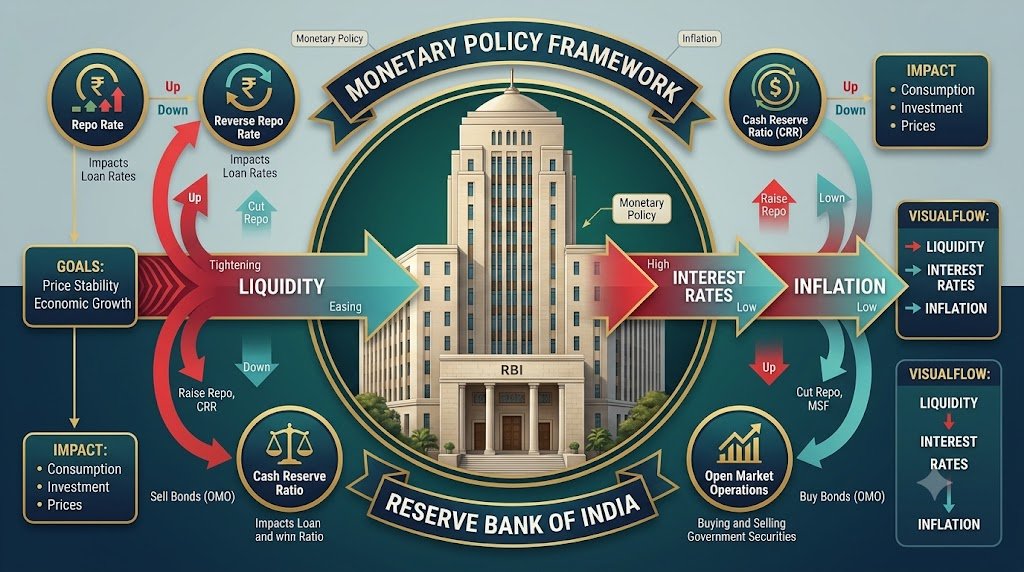
Section 1: RBI, Money and Monetary Policy
For Banking and Financial System UPSC Prelims MCQs 2027, candidates should first understand the RBI, monetary policy instruments and their effect on liquidity and credit.
- Consider the following statements regarding the Reserve Bank of India:
- The RBI is India’s central bank and performs functions relating to monetary policy, currency management and regulation of parts of the financial system.
- The Governor of the RBI is appointed by the Central Government.
- The RBI derives all of its powers directly from the Constitution of India.
Which of the statements given above is/are correct?
(a) 1 and 2 only
(b) 2 only
(c) 1 and 3 only
(d) 1, 2 and 3
- With reference to the Monetary Policy Committee (MPC), consider the following statements:
- It is responsible for determining the policy repo rate under the monetary-policy framework.
- The Governor of the RBI is its ex-officio chairperson.
- The Union Finance Minister is a permanent member of the Committee.
Which of the statements given above is/are correct?
(a) 1 and 2 only
(b) 2 and 3 only
(c) 1 only
(d) 1, 2 and 3
- Consider the following statements regarding an expansionary monetary policy:
- It generally seeks to increase liquidity and support economic activity.
- A reduction in the policy repo rate can be an expansionary measure.
- An increase in the Marginal Standing Facility rate is normally an expansionary measure.
Which of the statements given above is/are correct?
(a) 1 and 2 only
(b) 1 and 3 only
(c) 2 and 3 only
(d) 1, 2 and 3
- If the RBI wants to reduce excess liquidity in the banking system, which of the following measures can serve this objective?
- Sale of government securities under open-market operations
- Increase in reserve requirements, subject to the applicable framework
- Purchase of government securities from the market
Select the correct answer using the code given below.
(a) 1 and 2 only
(b) 2 and 3 only
(c) 1 and 3 only
(d) 1, 2 and 3
- Consider the following statements regarding the Cash Reserve Ratio (CRR):
- Banks are required to maintain a specified proportion of their liabilities in the form prescribed by the RBI as CRR.
- An increase in CRR can reduce the funds available with banks for lending.
- CRR is maintained entirely in the form of corporate bonds.
Which of the statements given above is/are correct?
(a) 1 and 2 only
(b) 1 only
(c) 2 and 3 only
(d) 1, 2 and 3
- With reference to the Statutory Liquidity Ratio (SLR), consider the following statements:
- It requires banks to maintain a prescribed proportion of their liabilities in specified liquid assets.
- Government securities can form part of such liquid assets.
- An increase in SLR necessarily increases the lending capacity of banks.
Which of the statements given above is/are correct?
(a) 1 and 2 only
(b) 1 and 3 only
(c) 2 and 3 only
(d) 1, 2 and 3
- Consider the following statements regarding the repo rate:
- It is a rate at which the RBI provides short-term liquidity to eligible entities against eligible collateral under the monetary-policy framework.
- A reduction in the repo rate can lower the cost of funds for banks, depending on transmission.
- An increase in the repo rate is normally intended to encourage rapid expansion of credit.
Which of the statements given above is/are correct?
(a) 1 and 2 only
(b) 1 only
(c) 2 and 3 only
(d) 1, 2 and 3
- Which one of the following best describes the Marginal Standing Facility (MSF)?
(a) A facility through which households can obtain long-term housing loans directly from the RBI
(b) A standing facility through which eligible banks can obtain overnight funds from the RBI subject to specified conditions
(c) A mechanism through which the Government issues long-term bonds directly to households
(d) A facility through which exporters obtain foreign-exchange grants from the RBI
- Consider the following statements:
- Open Market Operations involve the purchase or sale of government securities by the central bank.
- When the RBI purchases government securities from the market, it generally injects liquidity into the banking system.
- When the RBI sells government securities, it generally absorbs liquidity from the market.
Which of the statements given above is/are correct?
(a) 1 and 2 only
(b) 2 and 3 only
(c) 1 and 3 only
(d) 1, 2 and 3
- If inflationary pressures are considered excessive and demand in the economy is strong, which combination would be more consistent with a contractionary monetary stance?
(a) Lower repo rate and purchase of government securities
(b) Higher repo rate and sale of government securities
(c) Lower CRR and purchase of government securities
(d) Lower policy rates and reduction in liquidity absorption
- Consider the following statements regarding the money multiplier:
- It represents the relationship between the monetary base and the broader money supply in a simplified banking framework.
- Greater use of banking facilities can strengthen the deposit-creation process.
- An increase in the CRR, other things remaining equal, tends to increase the money multiplier.
Which of the statements given above is/are correct?
(a) 1 and 2 only
(b) 2 and 3 only
(c) 1 and 3 only
(d) 1, 2 and 3
- Which of the following is most likely to increase the ability of commercial banks to create deposits and credit, other things remaining equal?
(a) Higher reserve requirements
(b) Greater currency leakage by the public
(c) Greater preference for keeping savings outside the banking system
(d) Greater use of banking channels by households
- Consider the following statements regarding lender of last resort:
- The central bank may provide liquidity assistance to banks facing temporary liquidity stress.
- The function is intended to help contain systemic disruption arising from liquidity shortages.
- It means that the central bank routinely finances every fiscal deficit of the government.
Which of the statements given above is/are correct?
(a) 1 and 2 only
(b) 2 and 3 only
(c) 1 only
(d) 1, 2 and 3
- Consider the following statements:
Statement-I: An increase in the repo rate can contribute to tighter financial conditions.
Statement-II: A higher policy interest rate can raise the cost of short-term funds for banks and other market participants.
Which one of the following is correct in respect of the above statements?
(a) Both Statement-I and Statement-II are correct and Statement-II explains Statement-I
(b) Both Statement-I and Statement-II are correct, but Statement-II does not explain Statement-I
(c) Statement-I is correct, but Statement-II is incorrect
(d) Statement-I is incorrect, but Statement-II is correct
- With reference to inflation and monetary policy, consider the following statements:
- Monetary policy can influence aggregate demand.
- A tighter monetary stance can work to moderate demand-side inflationary pressures.
- Monetary policy can directly eliminate supply-side disruptions such as crop failure.
Which of the statements given above is/are correct?
(a) 1 and 2 only
(b) 1 and 3 only
(c) 2 and 3 only
(d) 1, 2 and 3
- Consider the following statements about the RBI’s foreign-exchange intervention:
- The RBI may buy or sell foreign currency in the foreign-exchange market.
- When the RBI sells US dollars to counter excessive rupee depreciation, it supplies dollars to the market.
- Such intervention necessarily causes India’s foreign-exchange reserves to rise.
Which of the statements given above is/are correct?
(a) 1 and 2 only
(b) 1 only
(c) 2 and 3 only
(d) 1, 2 and 3
- Suppose the rupee is experiencing rapid depreciation because of strong demand for US dollars. If the RBI intervenes by selling US dollars from its reserves, the immediate direct effect is most likely to be:
(a) An increase in the supply of dollars in the market
(b) An increase in domestic fiscal expenditure
(c) A reduction in the supply of dollars in the market
(d) An automatic increase in India’s current-account surplus
- Consider the following statements regarding monetary transmission:
- A change in the policy rate may influence lending and deposit rates in the financial system.
- The transmission to borrowers can depend on the structure of bank liabilities, competition and other financial conditions.
- A change in the policy rate always changes every loan rate immediately and by exactly the same amount.
Which of the statements given above is/are correct?
(a) 1 and 2 only
(b) 2 only
(c) 1 and 3 only
(d) 1, 2 and 3
- Consider the following statements:
- The RBI’s monetary-policy operations can affect liquidity conditions in the banking system.
- Monetary policy and fiscal policy are identical because both are implemented by the RBI.
- Fiscal policy primarily concerns government taxation and expenditure decisions.
Which of the statements given above is/are correct?
(a) 1 and 3 only
(b) 1 and 2 only
(c) 2 and 3 only
(d) 1, 2 and 3
- Which one of the following situations is most consistent with the RBI pursuing an accommodative monetary stance?
(a) Persistent liquidity absorption combined with sharply higher policy rates
(b) Measures designed to support liquidity and lower financing costs when inflation conditions permit
(c) Simultaneous tightening of credit conditions and reduction of banking liquidity
(d) A deliberate reduction in money supply irrespective of economic conditions
A clear understanding of RBI Monetary Policy is essential for solving questions related to repo rate, CRR, SLR, liquidity and inflation.
Answers & Explanations: Section 1 of Banking and Financial System UPSC Prelims MCQs 2027
1. (a) — The RBI is the central bank and its Governor is appointed by the Central Government. Its principal statutory powers arise from legislation, especially the RBI Act, rather than directly from the Constitution.
2. (a) — The MPC determines the policy repo rate required to achieve the inflation target. The RBI Governor chairs the Committee. The Finance Minister is not a permanent MPC member.
3. (a) — Expansionary policy generally supports liquidity and economic activity. Lowering the repo rate can be expansionary, while raising the MSF rate is normally associated with tighter, not easier, financial conditions.
4. (a) — Sale of securities and higher reserve requirements can absorb or constrain liquidity. Purchase of securities generally injects liquidity.
5. (a) — CRR is a reserve requirement prescribed by the RBI. A higher CRR can reduce lendable resources. Corporate bonds are not the prescribed form of CRR maintenance.
6. (a) — SLR requires maintenance of specified liquid assets, including eligible government securities. A higher SLR does not increase banks’ lending capacity; it can constrain it.
7. (a) — Repo is a key policy rate associated with short-term liquidity provision. Higher repo rates generally tighten financial conditions rather than encourage rapid credit expansion.
8. (b) — MSF is an overnight standing liquidity facility for eligible banks subject to prescribed conditions.
9. (d) — All three correctly describe the usual liquidity effect of RBI open-market purchases and sales.
10. (b) — Higher policy rates and sale of securities are broadly contractionary measures.
11. (a) — Greater banking participation can strengthen deposit creation. Higher reserve requirements generally reduce rather than increase the money multiplier.
12. (d) — Greater use of bank accounts and formal banking channels can increase the deposit base and strengthen credit creation.
13. (a) — Lender-of-last-resort assistance is fundamentally about liquidity support to banks facing temporary stress. It is not routine financing of government deficits.
14. (a) — Higher policy rates tend to tighten financial conditions, and the increased cost of short-term funds is one channel through which this occurs.
15. (a) — Monetary policy influences demand and can moderate demand-side inflation. It cannot directly remove physical supply disruptions such as crop failures.
16. (a) — RBI intervention can involve buying or selling foreign currencies. Selling dollars supplies them to the market and generally reduces reserves through that transaction, other things equal.
17. (a) — The RBI supplies dollars to the market by selling them from its reserves, thereby addressing excessive dollar demand.
18. (a) — Monetary transmission is real but not instantaneous or uniform across all borrowers and financial products.
19. (a) — Monetary policy affects monetary and financial conditions, while fiscal policy concerns government revenues and expenditures.
20. (b) — An accommodative stance generally seeks to support liquidity and financing conditions when consistent with macroeconomic objectives.
To strengthen their understanding of government revenue, taxation, expenditure and fiscal management, candidates can also practice our comprehensive Fiscal Policy UPSC Prelims 2027 MCQs.
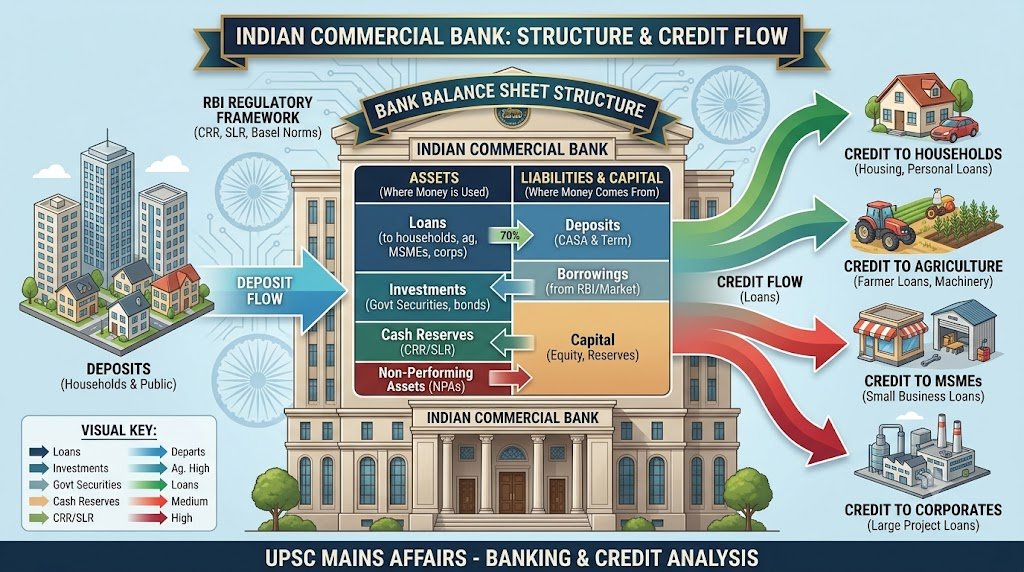
Section 2: Commercial Banks, Bank Balance Sheets and Regulation
Commercial banking concepts form another important part of Banking and Financial System UPSC Prelims MCQs 2027, especially bank balance sheets, NPAs, capital adequacy and banking regulation.
- Consider the following statements regarding a commercial bank’s balance sheet:
- Loans and advances generally constitute assets of a bank.
- Customer deposits generally constitute liabilities of a bank.
- Equity capital of the bank is a liability owed to depositors.
Which of the statements given above is/are correct?
(a) 1 and 2 only
(b) 2 and 3 only
(c) 1 only
(d) 1, 2 and 3
- Which one of the following is most appropriately classified as an asset of a commercial bank?
(a) Savings deposits accepted from customers
(b) Current-account deposits accepted from businesses
(c) Loans and advances extended to borrowers
(d) Equity capital contributed by shareholders
- Consider the following statements:
- When a bank accepts a deposit, its cash or reserve position may increase while its deposit liability also increases.
- When a bank extends a loan, the loan is recorded as an asset of the bank.
- Every bank loan immediately reduces the total deposits of the banking system.
Which of the statements given above is/are correct?
(a) 1 and 2 only
(b) 1 only
(c) 2 and 3 only
(d) 1, 2 and 3
- With reference to Non-Performing Assets (NPAs), consider the following statements:
- A loan can become an NPA when interest or principal remains overdue beyond the prescribed period.
- Recognition of NPAs helps banks reflect deterioration in the quality of their loan portfolios.
- Every loan that is overdue for one day is classified as an NPA.
Which of the statements given above is/are correct?
(a) 1 and 2 only
(b) 2 only
(c) 1 and 3 only
(d) 1, 2 and 3
- Consider the following statements regarding gross and net NPAs:
- Gross NPA represents the overall stock of non-performing assets before certain adjustments.
- Net NPA takes into account provisions and other permitted adjustments against gross NPAs.
- Net NPA can never be lower than gross NPA.
Which of the statements given above is/are correct?
(a) 1 and 2 only
(b) 1 only
(c) 2 and 3 only
(d) 1, 2 and 3
- Consider the following statements regarding bank capital:
- Capital acts as a cushion against losses.
- Higher-quality capital improves the resilience of a banking institution.
- Bank capital and customer deposits are identical in their economic role.
Which of the statements given above is/are correct?
(a) 1 and 2 only
(b) 2 only
(c) 1 and 3 only
(d) 1, 2 and 3
- The Capital Adequacy Ratio (CAR) of a bank is most closely associated with:
(a) The relationship between regulatory capital and risk-weighted assets
(b) The relationship between deposits and branch numbers
(c) The relationship between currency in circulation and GDP
(d) The relationship between exports and foreign-exchange reserves
- Consider the following statements regarding risk-weighted assets:
- Different categories of bank assets can carry different regulatory risk weights.
- Risk weighting attempts to reflect differences in credit and other risks associated with assets.
- Every rupee of a bank’s asset is necessarily given the same risk weight.
Which of the statements given above is/are correct?
(a) 1 and 2 only
(b) 2 only
(c) 1 and 3 only
(d) 1, 2 and 3
- Which one of the following best describes a bank run?
(a) A situation in which banks increase their lending to productive sectors
(b) A situation in which a large number of depositors seek to withdraw funds because of concerns about bank solvency or liquidity
(c) A situation in which the central bank reduces the policy rate
(d) A situation in which the government issues new currency
- Consider the following statements regarding Deposit Insurance:
- Deposit insurance can protect eligible depositors against loss arising from failure of an insured bank, subject to the applicable limit and conditions.
- The Deposit Insurance and Credit Guarantee Corporation (DICGC) provides deposit insurance in India.
- Every financial investment made by a depositor is automatically covered under deposit insurance.
Which of the statements given above is/are correct?
(a) 1 and 2 only
(b) 1 only
(c) 2 and 3 only
(d) 1, 2 and 3
- With reference to the deposit-insurance framework in India, which one of the following is correct?
(a) It guarantees unlimited protection for all bank deposits.
(b) It covers eligible deposits subject to the prescribed insurance limit and rules.
(c) It insures equity shares held through banks.
(d) It guarantees that no bank can ever fail.
- Consider the following statements regarding Scheduled Commercial Banks:
- The expression “scheduled” is linked to inclusion in the Second Schedule of the RBI Act, subject to applicable conditions.
- Being a scheduled bank does not mean that the bank is owned by the Central Government.
- All scheduled banks are foreign-owned banks.
Which of the statements given above is/are correct?
(a) 1 and 2 only
(b) 2 only
(c) 1 and 3 only
(d) 1, 2 and 3
- Consider the following statements regarding public sector banks:
- The government has a significant ownership stake in public sector banks under the applicable framework.
- Public sector banks are completely outside the regulatory jurisdiction of the RBI.
- Their lending decisions can be influenced by prudential and regulatory norms applicable to banks.
Which of the statements given above is/are correct?
(a) 1 and 3 only
(b) 1 only
(c) 2 and 3 only
(d) 1, 2 and 3
- With reference to Small Finance Banks, consider the following statements:
- Their broad objective includes financial inclusion.
- They can undertake banking activities subject to the regulatory framework.
- They are established primarily to replace the RBI as the monetary authority.
Which of the statements given above is/are correct?
(a) 1 and 2 only
(b) 2 only
(c) 1 and 3 only
(d) 1, 2 and 3
- Consider the following statements regarding Payments Banks:
- They are intended to promote payments, remittances and financial inclusion.
- They cannot undertake lending activities in the manner of conventional commercial banks.
- They can function as the country’s monetary authority.
Which of the statements given above is/are correct?
(a) 1 and 2 only
(b) 1 only
(c) 2 and 3 only
(d) 1, 2 and 3
- With reference to Regional Rural Banks (RRBs), consider the following statements:
- They were created with a focus on the rural economy and underserved sections.
- They are owned exclusively by State Governments.
- A sponsor bank plays a role in their institutional structure.
Which of the statements given above is/are correct?
(a) 1 and 3 only
(b) 1 only
(c) 2 and 3 only
(d) 1, 2 and 3
- Consider the following statements regarding bank mergers and consolidation:
- A bank merger can be undertaken to strengthen the financial position or operational scale of institutions.
- Consolidation automatically eliminates all risks associated with banking.
- A larger bank can still face credit, market, liquidity and operational risks.
Which of the statements given above is/are correct?
(a) 1 and 3 only
(b) 1 only
(c) 2 and 3 only
(d) 1, 2 and 3
- Consider the following statements:
Statement-I: A bank can remain profitable while simultaneously facing deterioration in asset quality.
Statement-II: Profitability and asset quality represent different dimensions of a bank’s financial condition.
Which one of the following is correct in respect of the above statements?
(a) Both Statement-I and Statement-II are correct and Statement-II explains Statement-I
(b) Both Statement-I and Statement-II are correct, but Statement-II does not explain Statement-I
(c) Statement-I is correct, but Statement-II is incorrect
(d) Statement-I is incorrect, but Statement-II is correct
- Which one of the following best explains the concept of “moral hazard” in banking?
(a) Borrowers always repay their loans before maturity.
(b) An institution may take greater risks when it expects that losses could be partly borne by others.
(c) Banks maintain capital against unexpected losses.
(d) Depositors diversify their bank accounts.
- Consider the following statements regarding prudential regulation:
- Capital requirements can help banks absorb losses.
- Provisioning against stressed assets can improve financial transparency and resilience.
- Prudential regulation is designed only to maximise banks’ short-term profits.
Which of the statements given above is/are correct?
(a) 1 and 2 only
(b) 2 only
(c) 1 and 3 only
(d) 1, 2 and 3
Answers & Explanations: Section 2 of Banking and Financial System UPSC Prelims MCQs 2027
21. (a) — Loans and advances are assets because borrowers owe money to the bank. Deposits are liabilities because the bank owes the deposited funds to customers.
22. (c) — Loans and advances are assets of the bank.
23. (a) — Accepting deposits increases both an asset/reserve position and a corresponding liability. A loan does not necessarily reduce system-wide deposits; bank credit can create deposits.
24. (a) — NPA classification follows prescribed recognition norms. One day of delay does not automatically make a loan an NPA.
25. (a) — Gross NPA is before specified provisions/adjustments; net NPA incorporates such deductions. Therefore net NPA may be lower.
26. (a) — Capital provides a loss-absorbing cushion. Customer deposits, by contrast, are liabilities and have a different role.
27. (a) — CAR links regulatory capital with risk-weighted assets.
28. (a) — Risk weights differentiate assets according to regulatory assessment of risk. Assets do not necessarily receive identical weights.
29. (b) — A bank run occurs when many depositors attempt withdrawals because of concerns about liquidity or solvency.
30. (a) — DICGC provides deposit insurance for eligible deposits within the prescribed framework. It does not insure every financial asset.
31. (b) — Deposit insurance is subject to the applicable limit and conditions; it is not unlimited protection.
32. (a) — Scheduled status is linked to inclusion in the Second Schedule of the RBI Act. It says nothing about government or foreign ownership.
33. (a) — Public sector banks have significant government ownership but remain subject to banking regulation and prudential norms.
34. (a) — Small Finance Banks are designed primarily to promote financial inclusion and provide banking services under the RBI framework.
35. (a) — Payments Banks focus on deposits and payments/remittances and are not conventional lending banks. Monetary authority functions remain with the RBI.
36. (a) — RRBs serve rural and underserved sections and have sponsor-bank participation. They are not exclusively owned by State Governments.
37. (a) — Consolidation can produce scale or strengthen institutions, but larger banks still face multiple forms of risk.
38. (a) — Profitability and asset quality measure different aspects of financial health. A bank can report profit while stressed loans are increasing.
39. (b) — Moral hazard arises when protection or expectations of support can encourage risk-taking.
40. (a) — Capital and provisioning are major prudential tools. Regulation is not designed simply to maximise short-term bank profits.
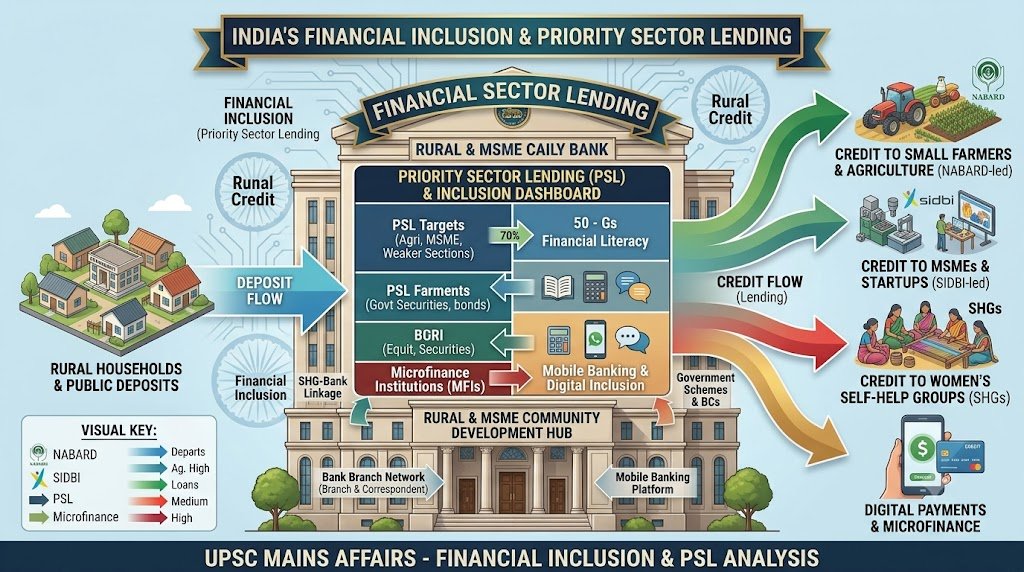
Section 3: Financial Institutions, Financial Inclusion and Priority Sector Lending
Financial inclusion and development institutions are important themes within Banking and Financial System UPSC Prelims MCQs 2027 because UPSC can test both institutional roles and policy objectives.
- Consider the following statements regarding financial inclusion:
- It involves improving access to appropriate financial services for underserved sections.
- Opening a bank account alone guarantees complete financial inclusion.
- Access to credit, payments, savings and insurance can contribute to financial inclusion.
Which of the statements given above is/are correct?
(a) 1 and 3 only
(b) 1 only
(c) 2 and 3 only
(d) 1, 2 and 3
- With reference to Priority Sector Lending (PSL), consider the following statements:
- It seeks to ensure adequate credit flow to sectors considered important for socio-economic development.
- Agriculture and MSMEs are among the broad categories covered under the current PSL framework.
- PSL is applicable only to foreign banks operating in India.
Which of the statements given above is/are correct?
(a) 1 and 2 only
(b) 1 only
(c) 2 and 3 only
(d) 1, 2 and 3
- Consider the following statements regarding the current RBI Priority Sector Lending framework:
- Renewable energy is included among the priority-sector categories.
- Education can qualify under specified priority-sector provisions.
- All loans to every large corporation automatically qualify as priority-sector loans.
Which of the statements given above is/are correct?
(a) 1 and 2 only
(b) 2 only
(c) 1 and 3 only
(d) 1, 2 and 3
- Which one of the following best explains Priority Sector Lending?
(a) Mandatory lending by banks to any borrower selected by the government without regard to eligibility criteria
(b) A regulatory framework designed to channel adequate credit towards specified underserved or economically important sectors
(c) A mechanism under which only the RBI can provide agricultural loans
(d) A system for converting all private loans into government loans
- Consider the following statements regarding Self-Help Groups (SHGs):
- SHGs can facilitate savings and credit among members.
- Banks can support SHGs through credit linkage.
- SHGs necessarily function only as informal savings groups and can never access formal financial institutions.
Which of the statements given above is/are correct?
(a) 1 and 2 only
(b) 1 only
(c) 2 and 3 only
(d) 1, 2 and 3
- Consider the following statements regarding microfinance:
- It seeks to provide relatively small-value financial services to underserved borrowers.
- It can include credit and other financial services depending on the institutional model.
- It is synonymous with corporate investment banking.
Which of the statements given above is/are correct?
(a) 1 and 2 only
(b) 2 only
(c) 1 and 3 only
(d) 1, 2 and 3
- Which one of the following institutions is primarily associated with agricultural and rural development finance?
(a) NABARD
(b) SEBI
(c) IRDAI
(d) PFRDA
- Consider the following statements regarding NABARD:
- It is an apex development financial institution for agriculture and rural development.
- It has a role in refinancing and supporting rural financial institutions.
- It performs the monetary-policy functions of the RBI.
Which of the statements given above is/are correct?
(a) 1 and 2 only
(b) 1 only
(c) 2 and 3 only
(d) 1, 2 and 3
- With reference to SIDBI, consider the following statements:
- It is primarily associated with the development and financing needs of the MSME sector.
- Its functions are related to promotion, financing and development of MSMEs.
- It is India’s central monetary authority.
Which of the statements given above is/are correct?
(a) 1 and 2 only
(b) 2 only
(c) 1 and 3 only
(d) 1, 2 and 3
- Which one of the following institutions is specifically associated with export-import finance and promotion of India’s international trade?
(a) NABARD
(b) EXIM Bank
(c) SIDBI
(d) DICGC
- Consider the following statements regarding development financial institutions:
- Their objective can include providing long-term or specialised finance for sectors important to economic development.
- They necessarily function in exactly the same manner as deposit-taking commercial banks.
- Their activities may complement, rather than replace, the commercial banking system.
Which of the statements given above is/are correct?
(a) 1 and 3 only
(b) 1 only
(c) 2 and 3 only
(d) 1, 2 and 3
- Consider the following pairs:
Institution — Principal area of association
- NABARD — Agriculture and rural development
- SIDBI — MSME sector
- EXIM Bank — International trade finance
- DICGC — Deposit insurance
How many of the above pairs are correctly matched?
(a) Only two
(b) Only three
(c) All four
(d) Only one
- Consider the following statements regarding Financial Technology (FinTech):
- FinTech can reduce transaction costs and expand access to financial services.
- FinTech automatically eliminates all risks associated with finance.
- Data protection and cybersecurity are relevant to digital financial services.
Which of the statements given above is/are correct?
(a) 1 and 3 only
(b) 1 only
(c) 2 and 3 only
(d) 1, 2 and 3
- Consider the following statements regarding financial inclusion and digital payments:
- Digital payment systems can facilitate access to formal financial services.
- Digital access by itself guarantees that vulnerable groups will never face exclusion.
- Financial literacy can complement digital financial infrastructure.
Which of the statements given above is/are correct?
(a) 1 and 3 only
(b) 1 only
(c) 2 and 3 only
(d) 1, 2 and 3
- Consider the following statements:
Statement-I: Expansion of formal financial access can reduce dependence on informal credit in some circumstances.
Statement-II: Formal financial institutions can provide regulated savings and credit products to eligible customers.
Which one of the following is correct in respect of the above statements?
(a) Both Statement-I and Statement-II are correct and Statement-II explains Statement-I
(b) Both Statement-I and Statement-II are correct, but Statement-II does not explain Statement-I
(c) Statement-I is correct, but Statement-II is incorrect
(d) Statement-I is incorrect, but Statement-II is correct
- With reference to banking correspondents, consider the following statements:
- They can help extend certain banking services beyond conventional bank branches.
- They can be relevant to financial inclusion in areas with limited physical banking infrastructure.
- They perform all central-bank functions on behalf of the RBI.
Which of the statements given above is/are correct?
(a) 1 and 2 only
(b) 2 only
(c) 1 and 3 only
(d) 1, 2 and 3
- Consider the following statements regarding credit information:
- Credit information can help lenders assess a borrower’s credit history.
- Better credit information can reduce information asymmetry between lenders and borrowers.
- Credit scores guarantee that a borrower will never default.
Which of the statements given above is/are correct?
(a) 1 and 2 only
(b) 1 only
(c) 2 and 3 only
(d) 1, 2 and 3
- Which one of the following best describes “information asymmetry” in credit markets?
(a) Borrowers and lenders always possess identical information.
(b) One party to a transaction has relevant information that the other party does not possess to the same extent.
(c) All banks charge the same interest rate.
(d) The government fixes the price of every loan.
- Consider the following statements regarding cooperative banks:
- They are organised on cooperative principles.
- Their regulatory and supervisory arrangements may involve different authorities depending on the type of cooperative bank and the issue concerned.
- They are completely outside the Banking Regulation Act.
Which of the statements given above is/are correct?
(a) 1 and 2 only
(b) 1 only
(c) 2 and 3 only
(d) 1, 2 and 3
- With reference to Urban Cooperative Banks (UCBs), consider the following statements:
- They form part of India’s cooperative banking sector.
- Their regulation involves the RBI under the applicable banking framework.
- They have no relationship whatsoever with the cooperative legal framework of the State concerned.
Which of the statements given above is/are correct?
(a) 1 and 2 only
(b) 2 only
(c) 1 and 3 only
(d) 1, 2 and 3
Candidates should also revise Indian Economy UPSC Prelims 2027 to strengthen their understanding of financial markets, institutions and economic concepts.
Answers & Explanations: Section 3 of Banking and Financial System UPSC Prelims MCQs 2027
41. (a) — Financial inclusion is broader than account opening. Meaningful access to credit, payments, savings, insurance and other appropriate services matters.
42. (a) — PSL is designed to support specified sectors and includes agriculture and MSMEs. It applies to a range of regulated banks, not only foreign banks.
43. (a) — Renewable energy and education are among PSL categories under applicable conditions. Large corporate loans do not automatically qualify.
44. (b) — PSL is a regulatory mechanism designed to improve credit flow to specified sectors and underserved segments.
45. (a) — SHGs encourage savings and mutual credit and can be linked with formal banks.
46. (a) — Microfinance serves underserved borrowers through small-scale financial services. It is entirely different from corporate investment banking.
47. (a) — NABARD is associated with agriculture and rural development.
48. (a) — NABARD is an apex development institution for agriculture and rural development and supports rural finance. Monetary policy remains an RBI function.
49. (a) — SIDBI focuses on MSME development and finance. It is not the central monetary authority.
50. (b) — EXIM Bank is associated with export-import finance and international trade.
51. (a) — Development financial institutions may provide specialised or long-term finance. They do not necessarily perform identical functions to deposit-taking commercial banks.
52. (c) — All four pairs are correctly matched.
53. (a) — FinTech can improve efficiency and access, but it introduces or leaves risks such as cybersecurity, fraud and data-protection concerns.
54. (a) — Digital infrastructure can support inclusion, but digital literacy, accessibility and consumer protection remain important.
55. (a) — Formal regulated savings and credit can reduce dependence on informal lenders under suitable conditions.
56. (a) — Banking correspondents can extend banking services geographically. They do not perform central-bank functions.
57. (a) — Credit information improves assessment and reduces information asymmetry, but cannot guarantee repayment.
58. (b) — Information asymmetry occurs when one side possesses relevant information that the other side does not have to the same extent.
59. (a) — Cooperative banks operate on cooperative principles and are subject to applicable regulatory arrangements. They are not outside banking law.
60. (a) — UCBs are part of the cooperative banking sector and are subject to RBI banking regulation under the applicable framework.
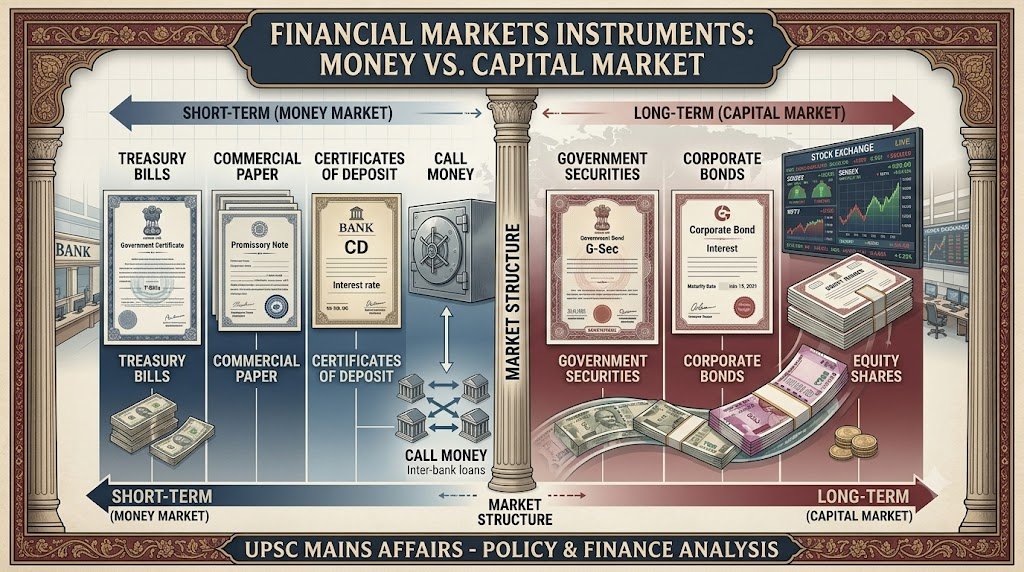
Section 4: Money Market, Capital Market and Financial Instruments
A strong Banking and Financial System UPSC Prelims MCQs 2027 preparation strategy should also distinguish between money-market instruments, capital-market instruments and different forms of financial intermediation.
- Consider the following statements regarding the money market:
- It deals primarily with short-term funds and instruments.
- Treasury Bills are money-market instruments.
- Equity shares are normally classified as money-market instruments.
Which of the statements given above is/are correct?
(a) 1 and 2 only
(b) 2 only
(c) 1 and 3 only
(d) 1, 2 and 3
- Which one of the following is a money-market instrument?
(a) Equity share
(b) Treasury Bill
(c) Perpetual preference share
(d) Long-term corporate equity
- Consider the following statements regarding Treasury Bills:
- They are short-term instruments issued by the Government of India.
- They are generally issued at a discount to face value and redeemed at face value.
- They pay a regular coupon like conventional dated government securities.
Which of the statements given above is/are correct?
(a) 1 and 2 only
(b) 1 only
(c) 2 and 3 only
(d) 1, 2 and 3
- With reference to government securities, consider the following statements:
- Dated government securities can carry a specified coupon rate.
- Treasury Bills are short-term government securities.
- State Governments can issue State Development Loans.
Which of the statements given above is/are correct?
(a) 1 and 2 only
(b) 2 and 3 only
(c) 1 and 3 only
(d) 1, 2 and 3
- Consider the following statements regarding Commercial Paper (CP):
- It is a short-term money-market instrument.
- It is generally an unsecured promissory note issued by eligible corporate entities subject to regulations.
- It is issued by the RBI as a substitute for banknotes.
Which of the statements given above is/are correct?
(a) 1 and 2 only
(b) 2 only
(c) 1 and 3 only
(d) 1, 2 and 3
- Consider the following statements regarding Certificates of Deposit (CDs):
- They are negotiable money-market instruments.
- They may be issued by eligible banks and certain financial institutions under the applicable framework.
- They are equity shares of the issuing bank.
Which of the statements given above is/are correct?
(a) 1 and 2 only
(b) 1 only
(c) 2 and 3 only
(d) 1, 2 and 3
- Which one of the following is the most appropriate distinction between a Treasury Bill and an equity share?
(a) Both represent ownership in the government.
(b) A Treasury Bill is a short-term debt instrument, whereas an equity share represents ownership in a company.
(c) An equity share is always a money-market instrument.
(d) A Treasury Bill gives voting rights in a company.
- Consider the following statements about call money:
- It refers to very short-term funds, particularly in the interbank market.
- It is normally associated with liquidity management by financial institutions.
- It represents a long-term infrastructure loan.
Which of the statements given above is/are correct?
(a) 1 and 2 only
(b) 2 only
(c) 1 and 3 only
(d) 1, 2 and 3
- With reference to the capital market, consider the following statements:
- It facilitates mobilisation of medium- and long-term capital.
- Equity and longer-term debt instruments can form part of the capital market.
- Treasury Bills are the principal long-term equity instruments of the capital market.
Which of the statements given above is/are correct?
(a) 1 and 2 only
(b) 2 only
(c) 1 and 3 only
(d) 1, 2 and 3
- Consider the following statements regarding the primary and secondary markets:
- New securities are issued to investors in the primary market.
- Existing securities are traded among investors in the secondary market.
- The secondary market eliminates the need for a primary market.
Which of the statements given above is/are correct?
(a) 1 and 2 only
(b) 2 and 3 only
(c) 1 and 3 only
(d) 1, 2 and 3
- Which one of the following best explains the role of the secondary market?
(a) It enables trading of existing securities among investors and contributes to liquidity and price discovery.
(b) It allows only governments to issue new securities.
(c) It eliminates all investment risk.
(d) It converts every bond into an equity share.
- Consider the following statements regarding bond prices and yields:
- Generally, when market yields rise, prices of existing fixed-coupon bonds tend to fall.
- Generally, when market yields fall, prices of existing fixed-coupon bonds tend to rise.
- Bond prices and yields normally move in the same direction.
Which of the statements given above is/are correct?
(a) 1 and 2 only
(b) 1 only
(c) 2 and 3 only
(d) 1, 2 and 3
- Consider the following statements:
Statement-I: An existing fixed-coupon bond may lose market value when interest rates rise.
Statement-II: Newly issued comparable bonds may offer higher yields, making the existing lower-coupon bond relatively less attractive.
Which one of the following is correct in respect of the above statements?
(a) Both Statement-I and Statement-II are correct and Statement-II explains Statement-I
(b) Both Statement-I and Statement-II are correct, but Statement-II does not explain Statement-I
(c) Statement-I is correct, but Statement-II is incorrect
(d) Statement-I is incorrect, but Statement-II is correct
- Consider the following statements regarding Commercial Paper and Certificates of Deposit:
- Both are associated with the money market.
- Commercial Paper is primarily a corporate short-term borrowing instrument.
- Certificate of Deposit is issued by eligible banks and financial institutions as a negotiable time-deposit instrument.
Which of the statements given above is/are correct?
(a) 1 and 2 only
(b) 2 and 3 only
(c) 1 and 3 only
(d) 1, 2 and 3
- Consider the following statements regarding corporate bonds:
- They represent debt obligations of the issuing company.
- Bondholders normally have a creditor relationship with the company.
- Bondholders necessarily become equity shareholders of the company.
Which of the statements given above is/are correct?
(a) 1 and 2 only
(b) 1 only
(c) 2 and 3 only
(d) 1, 2 and 3
- With reference to a zero-coupon bond, consider the following statements:
- It does not make periodic coupon payments in the conventional manner.
- It can be issued at a price below its redemption value.
- Its return can arise from the difference between purchase price and redemption value.
Which of the statements given above is/are correct?
(a) 1 and 2 only
(b) 2 and 3 only
(c) 1 and 3 only
(d) 1, 2 and 3
- Consider the following statements regarding Government Securities:
- They can be used by financial institutions for investment and liquidity management.
- They are generally considered sovereign-backed instruments.
- Their prices cannot change in the secondary market.
Which of the statements given above is/are correct?
(a) 1 and 2 only
(b) 2 only
(c) 1 and 3 only
(d) 1, 2 and 3
- Which one of the following best describes syndicated lending?
(a) A single household borrowing from multiple informal lenders without an agreement
(b) A loan in which multiple lenders participate in financing a single borrower under a common arrangement
(c) A government grant given to every commercial bank
(d) An equity issue made by the RBI
- Consider the following statements regarding syndicated loans:
- They can spread the credit exposure of a large borrower across multiple lenders.
- They can be structured as term loans or, depending on the arrangement, as credit facilities.
- Participation of multiple lenders means that default risk disappears completely.
Which of the statements given above is/are correct?
(a) 1 and 2 only
(b) 1 only
(c) 2 and 3 only
(d) 1, 2 and 3
- Consider the following statements regarding securitisation:
- It can involve pooling financial assets and issuing securities backed by the cash flows from those assets.
- It can transfer or redistribute certain credit exposures depending on the structure.
- It means converting every form of bank deposit into physical cash.
Which of the statements given above is/are correct?
(a) 1 and 2 only
(b) 2 only
(c) 1 and 3 only
(d) 1, 2 and 3
Answers & Explanations: Section 4 of Banking and Financial System UPSC Prelims MCQs 2027
61. (a) — Money market deals in short-term instruments. Treasury Bills are money-market instruments; equity shares belong to the capital market.
62. (b) — Treasury Bills are short-term money-market instruments.
63. (a) — Treasury Bills are short-term government securities issued at a discount and redeemed at face value. They do not pay regular coupons like conventional dated securities.
64. (d) — All three are correct.
65. (a) — Commercial Paper is a short-term corporate debt instrument. It is not issued by the RBI as currency.
66. (a) — CDs are negotiable money-market instruments issued by eligible institutions. They are debt instruments, not equity shares.
67. (b) — Treasury Bills represent short-term government debt, while equity shares represent ownership in a company.
68. (a) — Call money is very short-term funding, particularly useful for interbank liquidity management.
69. (a) — Capital markets mobilise longer-term capital. Treasury Bills are short-term debt instruments, not equity instruments.
70. (a) — Primary markets deal with new issues; secondary markets deal with existing securities. The two markets complement each other.
71. (a) — Secondary markets provide liquidity and help determine market prices through trading.
72. (a) — Fixed-coupon bond prices and market yields generally move inversely.
73. (a) — Higher market yields make existing lower-coupon bonds relatively less attractive, causing their prices to adjust downward.
74. (d) — All three statements are correct.
75. (a) — Bondholders are creditors. They do not automatically receive ownership rights as shareholders.
76. (d) — All three describe the basic characteristics of zero-coupon bonds.
77. (a) — Government securities are widely used for investment and liquidity management, but their market prices can change.
78. (b) — Syndicated lending involves multiple lenders financing a common borrower under a coordinated arrangement.
79. (a) — Multiple lenders distribute credit exposure, but they do not eliminate default risk.
80. (a) — Securitisation pools financial assets and may create securities backed by their cash flows; it is not a currency-conversion process.
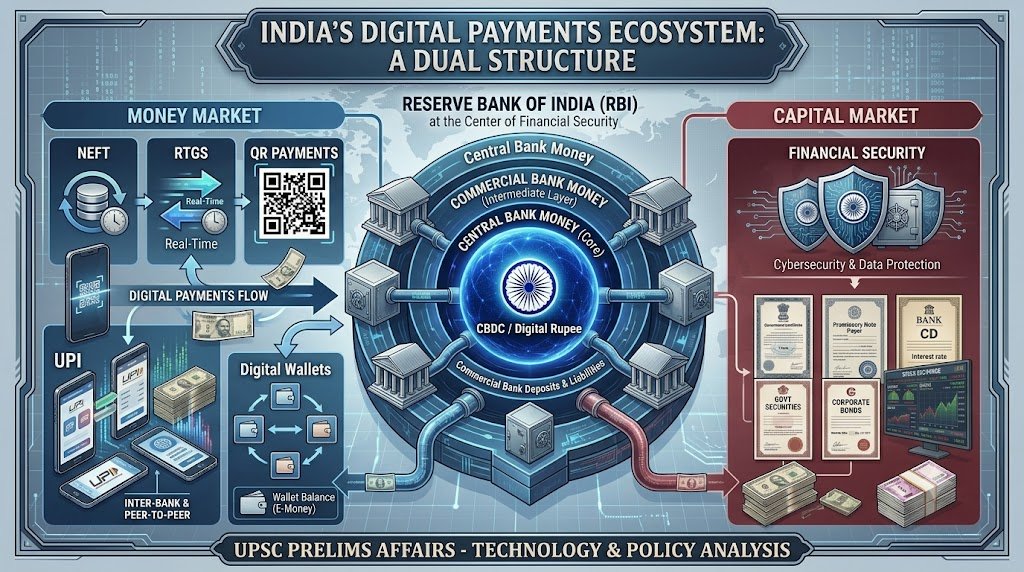
Section 5: Digital Banking, Payments, CBDC, Financial Markets and Integrated Questions
Digital payments, CBDC and financial-market regulation have become increasingly relevant to Banking and Financial System UPSC Prelims MCQs 2027 preparation.
- Consider the following statements regarding the digital rupee:
- It is a sovereign currency issued by the Reserve Bank of India.
- It appears as a liability on the RBI’s balance sheet.
- It is inherently protected from inflation merely because it is digital.
Which of the statements given above is/are correct?
(a) 1 and 2 only
(b) 1 and 3 only
(c) 2 and 3 only
(d) 1, 2 and 3
- Consider the following statements regarding Central Bank Digital Currency (CBDC):
- A CBDC is a digital form of sovereign money issued by a central bank.
- A retail CBDC is designed for use by members of the public in permitted transactions.
- A CBDC issued by the central bank is identical to a private cryptocurrency merely because both use digital technology.
Which of the statements given above is/are correct?
(a) 1 and 2 only
(b) 1 only
(c) 2 and 3 only
(d) 1, 2 and 3
- Consider the following statements regarding the relationship between CBDC and commercial-bank money:
- A sovereign CBDC can be designed to be convertible with other forms of the national currency under the applicable system.
- Commercial-bank deposits and central-bank liabilities are institutionally identical.
- Digital form alone does not determine whether money is a liability of the central bank or a commercial bank.
Which of the statements given above is/are correct?
(a) 1 and 3 only
(b) 1 only
(c) 2 and 3 only
(d) 1, 2 and 3
- With reference to UPI, consider the following statements:
- It is a payment system that enables interoperable bank-account-based transactions.
- It can facilitate instant or near-instant retail payments.
- It is a substitute for the RBI as India’s central bank.
Which of the statements given above is/are correct?
(a) 1 and 2 only
(b) 2 only
(c) 1 and 3 only
(d) 1, 2 and 3
- Which one of the following most appropriately distinguishes RTGS from NEFT?
(a) RTGS is designed around real-time gross settlement, whereas NEFT operates through a batch-based settlement mechanism.
(b) NEFT can transfer only foreign currency, whereas RTGS handles only domestic currency.
(c) RTGS is exclusively a card-payment system, whereas NEFT is a stock exchange.
(d) Both are identical systems with no operational distinction.
- Consider the following statements regarding payment systems:
- Digital payment infrastructure can reduce the need for physical cash in some transactions.
- Cybersecurity is an important concern for digital payment systems.
- Digital payments eliminate all possibilities of fraud.
Which of the statements given above is/are correct?
(a) 1 and 2 only
(b) 1 only
(c) 2 and 3 only
(d) 1, 2 and 3
- Consider the following statements regarding financial market regulators in India:
- RBI regulates the banking system and has important responsibilities in money and government-securities markets.
- SEBI regulates the securities market under its statutory framework.
- PFRDA regulates pension-related activities under its statutory framework.
Which of the statements given above is/are correct?
(a) 1 and 2 only
(b) 2 and 3 only
(c) 1 and 3 only
(d) 1, 2 and 3
- Consider the following pairs:
Regulator — Principal area
- RBI — Banking and monetary policy
- SEBI — Securities market
- IRDAI — Insurance sector
- PFRDA — Pension sector
How many of the above pairs are correctly matched?
(a) Only two
(b) Only three
(c) All four
(d) Only one
- Consider the following statements regarding mutual funds:
- They pool money from investors and invest according to stated investment objectives.
- Investors receive units representing their participation in the fund.
- Mutual funds guarantee positive returns under all market conditions.
Which of the statements given above is/are correct?
(a) 1 and 2 only
(b) 2 only
(c) 1 and 3 only
(d) 1, 2 and 3
- Consider the following statements regarding exchange-traded funds (ETFs):
- ETFs are traded on stock exchanges.
- Many ETFs seek to track an index or a specified basket of assets.
- Every ETF is guaranteed to outperform its benchmark index.
Which of the statements given above is/are correct?
(a) 1 and 2 only
(b) 1 only
(c) 2 and 3 only
(d) 1, 2 and 3
- With reference to REITs and InvITs, consider the following statements:
- REITs are associated with real-estate assets and related income streams.
- InvITs are associated with infrastructure assets.
- Both instruments eliminate all investment risk because their underlying assets are physical.
Which of the statements given above is/are correct?
(a) 1 and 2 only
(b) 2 and 3 only
(c) 1 and 3 only
(d) 1, 2 and 3
- Consider the following statements regarding financial markets:
- Financial markets facilitate mobilisation and allocation of savings.
- Price discovery is one of their important functions.
- Well-developed financial markets make financial risk completely impossible.
Which of the statements given above is/are correct?
(a) 1 and 2 only
(b) 1 only
(c) 2 and 3 only
(d) 1, 2 and 3
- Consider the following statements regarding liquidity and solvency:
- Liquidity refers broadly to the ability to meet financial obligations as they fall due.
- Solvency refers broadly to the ability to meet liabilities over the longer term and maintain sufficient net worth.
- A bank facing a temporary liquidity problem must necessarily be insolvent.
Which of the statements given above is/are correct?
(a) 1 and 2 only
(b) 2 only
(c) 1 and 3 only
(d) 1, 2 and 3
- Consider the following statements:
Statement-I: A financially solvent bank can still face a liquidity crisis.
Statement-II: Valuable assets may not always be immediately convertible into cash without significant delay or loss in stressed conditions.
Which one of the following is correct in respect of the above statements?
(a) Both Statement-I and Statement-II are correct and Statement-II explains Statement-I
(b) Both Statement-I and Statement-II are correct, but Statement-II does not explain Statement-I
(c) Statement-I is correct, but Statement-II is incorrect
(d) Statement-I is incorrect, but Statement-II is correct
- Consider the following statements regarding systemic risk:
- Financial institutions can be interconnected through lending, borrowing and financial markets.
- Distress in one institution can sometimes transmit to other institutions.
- Systemic risk refers only to the risk faced by a single household.
Which of the statements given above is/are correct?
(a) 1 and 2 only
(b) 2 only
(c) 1 and 3 only
(d) 1, 2 and 3
- Consider the following statements regarding shadow banking:
- The term is commonly used for credit intermediation occurring outside the traditional commercial-banking model.
- Non-Banking Financial Companies can form part of India’s broader non-bank financial system.
- Every NBFC is identical to a commercial bank in its ability to accept deposits and perform all banking functions.
Which of the statements given above is/are correct?
(a) 1 and 2 only
(b) 2 only
(c) 1 and 3 only
(d) 1, 2 and 3
- Consider the following statements regarding Non-Banking Financial Companies (NBFCs):
- They perform a range of financial activities but are not identical to commercial banks.
- Some NBFCs can play an important role in credit provision.
- All NBFCs are authorised to issue currency.
Which of the statements given above is/are correct?
(a) 1 and 2 only
(b) 1 only
(c) 2 and 3 only
(d) 1, 2 and 3
- Consider the following situations:
- The central bank purchases government securities from the market.
- A commercial bank increases its lending.
- Households deposit more of their cash savings into banks.
Which of the above can contribute to an expansion of bank-system liquidity or deposit creation, depending on the circumstances?
(a) 1 and 2 only
(b) 2 and 3 only
(c) 1 and 3 only
(d) 1, 2 and 3
- Consider the following statements:
- A rise in market interest rates can reduce the market value of existing fixed-rate bonds.
- A bank with a high proportion of non-performing assets can face pressure on profitability and capital.
- Greater financial inclusion necessarily means that financial stability risks disappear.
Which of the statements given above is/are correct?
(a) 1 and 2 only
(b) 2 only
(c) 1 and 3 only
(d) 1, 2 and 3
- Consider the following statements regarding India’s banking and financial system:
- The RBI performs functions relating to monetary policy, currency and banking regulation.
- Commercial banks play an important role in financial intermediation by mobilising deposits and extending credit.
- Financial markets help mobilise savings, facilitate investment and provide mechanisms for price discovery and risk transfer.
- Financial inclusion means that only government-owned banks can provide services to low-income households.
Which of the statements given above are correct?
(a) 1, 2 and 3 only
(b) 1 and 2 only
(c) 2, 3 and 4 only
(d) 1, 2, 3 and 4
Answers & Explanations: Section 5 of Banking and Financial System UPSC Prelims MCQs 2027
81. (a) — The digital rupee is sovereign money issued by the RBI and is a liability of the central bank. Being digital does not protect it from inflation.
82. (a) — A CBDC is sovereign digital money issued by a central bank. It differs institutionally and legally from privately issued cryptocurrencies.
83. (a) — CBDC can be convertible with other forms of national currency under the applicable design. Commercial-bank deposits are liabilities of commercial banks, whereas CBDC is a central-bank liability.
84. (a) — UPI is an interoperable retail-payment infrastructure. It does not replace the RBI.
85. (a) — RTGS means Real Time Gross Settlement. NEFT uses a batch-based settlement architecture.
86. (a) — Digital payments can reduce cash dependence, but cybersecurity, fraud and operational risks remain.
87. (d) — RBI, SEBI and PFRDA have the respective regulatory responsibilities described.
88. (c) — All four pairs are correctly matched.
89. (a) — Mutual funds pool investors’ money and issue units. Returns are market-linked and are not guaranteed in every circumstance.
90. (a) — ETFs trade on exchanges and often track specified indices or baskets. They do not guarantee outperformance.
91. (a) — REITs are associated with real estate and InvITs with infrastructure. Physical assets do not eliminate market, operational or other investment risks.
92. (a) — Financial markets mobilise savings and facilitate price discovery. They do not eliminate risk.
93. (a) — Liquidity and solvency are distinct concepts. A solvent institution can experience a temporary liquidity crisis.
94. (a) — An institution may possess adequate assets overall but still lack immediately available cash to meet sudden withdrawals.
95. (a) — Interconnectedness can transmit financial stress across institutions and markets. Systemic risk concerns the financial system rather than an individual household alone.
96. (a) — Shadow banking refers broadly to credit intermediation outside traditional banking. NBFCs form an important part of the non-bank financial ecosystem but are not identical to banks.
97. (a) — NBFCs perform various financial activities and can be significant credit providers, but they do not issue currency.
98. (d) — Securities purchases by the central bank can inject liquidity; increased bank lending can expand deposits; depositing cash into banks also brings money into the banking system.
99. (a) — Higher market rates generally reduce the prices of existing fixed-rate bonds, and stressed assets can weaken bank profitability and capital. Financial inclusion does not eliminate financial-stability risks.
100. (a) — Statements 1, 2 and 3 correctly describe the financial system. Financial inclusion is not restricted to government-owned banks.
Quick Revision Table: Banking & Financial System for UPSC Prelims
| Topic | Key Point |
|---|---|
| RBI | India’s central bank |
| Monetary Policy | Influences inflation, liquidity and economic activity |
| MPC | Determines the policy repo rate |
| CRR | Reserve requirement for banks |
| SLR | Requirement to maintain specified liquid assets |
| Repo Rate | Key short-term policy rate |
| MSF | Overnight standing liquidity facility |
| OMO | RBI purchase/sale of government securities |
| Lender of Last Resort | Emergency liquidity support |
| NPA | Stressed/non-performing loan under prescribed recognition norms |
| CAR | Capital relative to risk-weighted assets |
| DICGC | Deposit insurance |
| RRBs | Rural-focused banking institutions |
| Small Finance Banks | Financial inclusion-oriented banks |
| Payments Banks | Payments, deposits and remittance-oriented banking |
| PSL | Credit to specified priority sectors |
| NABARD | Agriculture and rural development |
| SIDBI | MSME development and finance |
| EXIM Bank | Export-import finance |
| Treasury Bills | Short-term government securities |
| Commercial Paper | Short-term corporate debt |
| Certificate of Deposit | Negotiable money-market instrument |
| Call Money | Very short-term/interbank funds |
| Primary Market | New securities |
| Secondary Market | Existing securities |
| Bond Price/Yield | Generally inverse relationship |
| Syndicated Loan | Multiple lenders to one borrower |
| CBDC | Sovereign digital currency issued by central bank |
| UPI | Interoperable retail-payment system |
| RTGS | Real-time gross settlement |
| NEFT | Batch-based electronic funds transfer |
| SEBI | Securities-market regulator |
| IRDAI | Insurance-sector regulator |
| PFRDA | Pension-sector regulator |
How to Prepare Banking & Financial System for UPSC Prelims 2027
The most effective approach is concept-first rather than terminology-first.
When studying a monetary-policy instrument, do not simply memorise its definition. Ask:
Who operates it?
What does it do to liquidity?
What happens to bank lending?
What happens to interest rates?
What happens if the RBI wants to fight inflation?
For banking questions, repeatedly practise the distinction between:
Asset vs Liability
Liquidity vs Solvency
Money Market vs Capital Market
Primary Market vs Secondary Market
Central Bank Money vs Commercial Bank Money
NPA vs Performing Asset
CRR vs SLR
Repo vs MSF
Commercial Paper vs Certificate of Deposit
Bank vs NBFC
This approach is particularly important because UPSC has repeatedly used statement-based questions in which one apparently familiar statement is subtly incorrect. The 2019 commercial-bank-assets question, 2020 monetary-policy question, 2021 money-multiplier and lender-of-last-resort questions, 2022 RBI intervention question and 2024 digital-rupee/foreign-bank questions demonstrate this pattern.
The RBI’s current Priority Sector Lending Directions also show why candidates should keep their conceptual preparation updated rather than relying exclusively on old notes; the 2025 directions, effective from April 1, 2025, cover agriculture, MSMEs, export credit, education, housing, social infrastructure, renewable energy and other specified categories.
Most Important Resources for UPSC Prelims 2027
- Current Affairs For UPSC Prelims 2027
- Polity for UPSC Prelims 2027
- Economy for UPSC Prelims 2027
- History for UPSC Prelims 2027
- Science and Technology for UPSC Prelims 2027
- Geography for UPSC Prelims 2027
Final Takeaway
For Banking & Financial System UPSC Prelims 2027, memorising definitions is not enough.
The better strategy is:
Understand the institution → understand the instrument → understand the direction of impact → test the statement → eliminate the incorrect options.
UPSC’s actual questions show that even familiar concepts such as CRR, monetary policy, bank assets, digital currency and financial institutions can be tested through indirect wording and multiple-statement reasoning.
These 100 questions are therefore best used in three rounds:
First Round: Solve without looking at the answers.
Second Round: Read every explanation, including explanations for questions you answered correctly by guesswork.
Third Round: Revise the concepts behind every incorrect answer and attempt the questions again after a few days.
That process is much closer to the kind of conceptual elimination skill required in the UPSC CSE Preliminary Examination.
Regular revision of Banking and Financial System UPSC Prelims MCQs 2027 concepts, along with previous-year questions, can help candidates improve accuracy in statement-based Economy questions.
After completing these questions, revise the UPSC Prelims 2027 Subject Wise Weightage: Previous Year Trends & Strategy to understand how economic and banking concepts are tested through statement-based questions.
2 thoughts on “Banking and Financial System UPSC Prelims MCQs 2027: 100 Proven MCQs with Explanations”