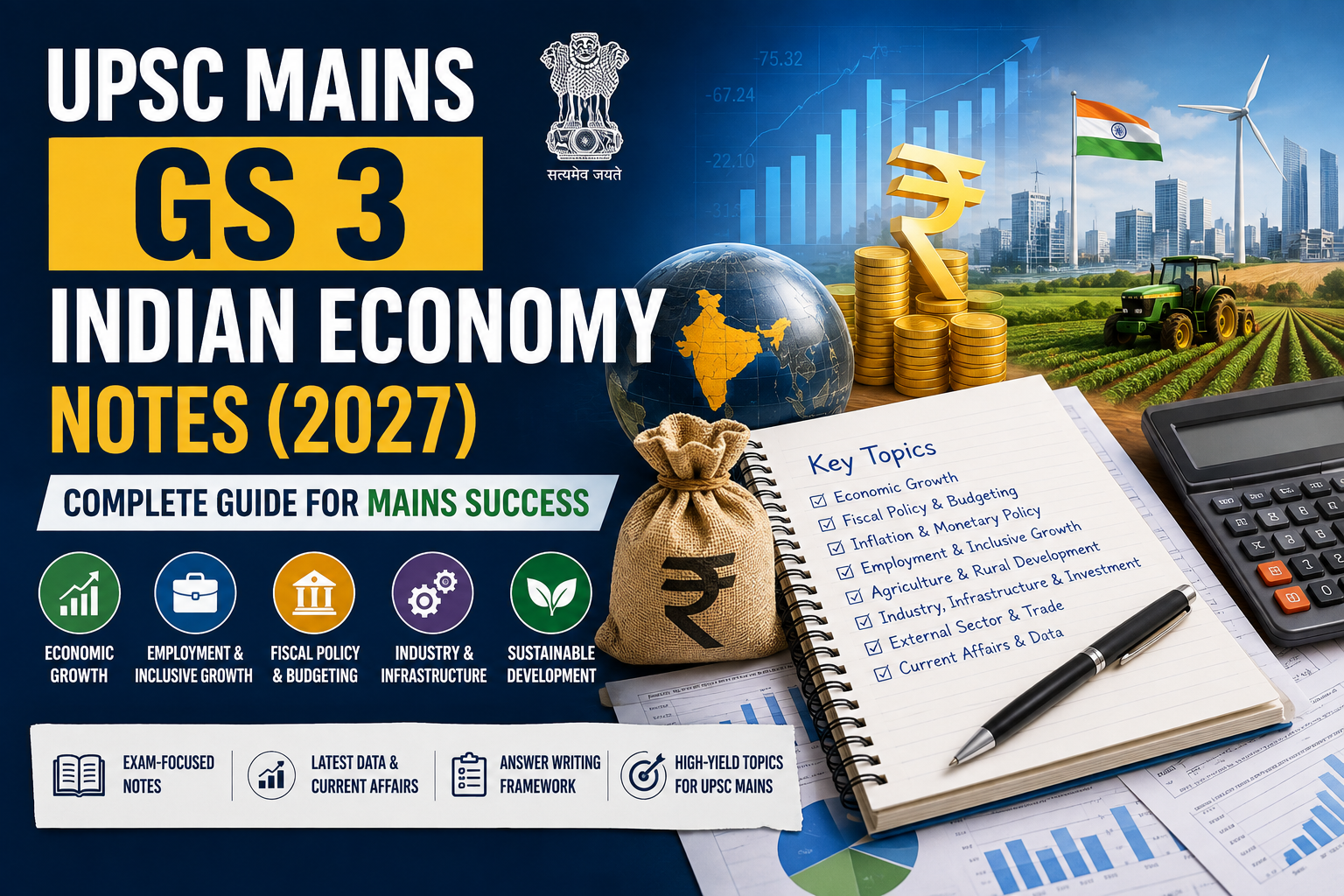
This guide brings together the static Indian Economy topics, latest available 2026-27 economic developments, important data, government initiatives, answer-writing frameworks and probable areas of focus for UPSC Mains 2027.
These UPSC Mains GS 3 Indian Economy Notes cover the core concepts, latest economic developments, important data and analytical frameworks required for effective GS Paper 3 preparation.
2027 Update: As of August 2026, the UPSC has released the Annual Calendar 2027, but the detailed CSE 2027 examination notification has not yet been released. The calendar schedules the Civil Services (Main) Examination to begin on 20 August 2027. The detailed notification is scheduled for 13 January 2027. Therefore, aspirants should use the latest officially notified GS Paper III syllabus as the working syllabus and verify the final 2027 notification when released.
Indian Economy is only one major component of GS Paper 3. For a complete overview of the paper, syllabus and other important areas, read our detailed UPSC Mains GS Paper 3 2027 Guide.
Indian Economy in UPSC Mains GS Paper 3
The economy component of GS Paper III broadly covers:
- Indian Economy
- Economic growth and development
- Planning
- Resource mobilisation
- Employment
- Inclusive growth
- Government budgeting
- Liberalisation
- Industrial policy
- Infrastructure
- Investment models
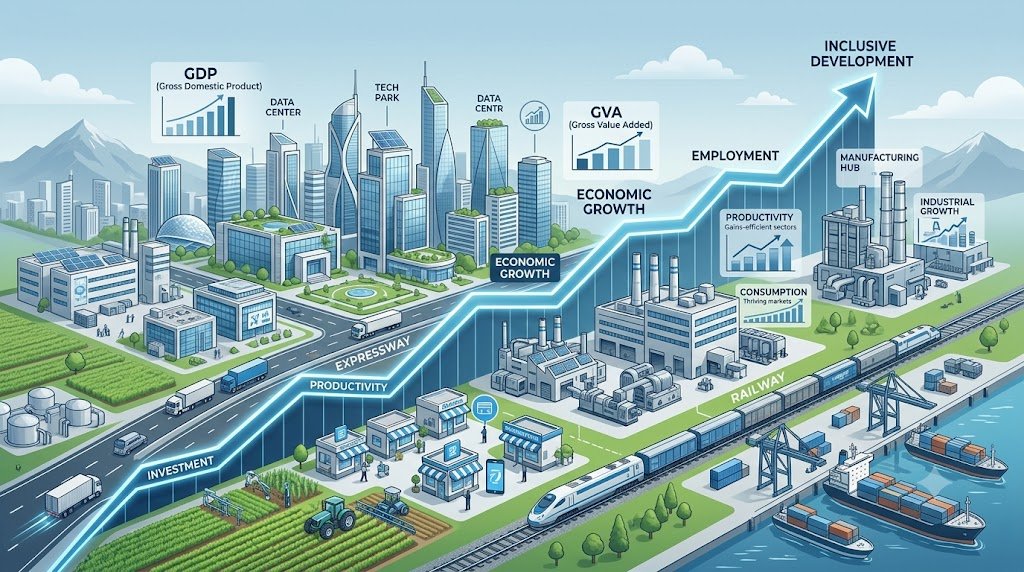
UPSC Mains GS 3 Indian Economy Syllabus
The core areas that aspirants should cover include:
Economic Growth and Development
Prepare:
- Economic growth vs economic development
- GDP and GVA
- Real and nominal GDP
- Per capita income
- Productivity
- Structural transformation
- Human capital
- Sustainable development
- Regional disparities
- Inclusive development
After revising GDP, GVA, national income and related economic concepts, you can test your understanding with our National Income & GDP for UPSC Prelims 2027.
Planning and Resource Mobilisation
Focus on:
- Planning in India
- Resource mobilisation
- Tax revenue
- Non-tax revenue
- Public borrowing
- Private investment
- Foreign investment
- Public-private partnerships
- Capital formation
- Financial markets
Employment
Important areas include:
- Employment generation
- Unemployment
- Labour-force participation
- Female labour-force participation
- Informal employment
- Gig and platform economy
- Skill development
- Labour productivity
- Employment-intensive growth
- Impact of technology and AI on jobs
Inclusive Growth
Prepare:
- Financial inclusion
- Poverty reduction
- Social security
- Access to credit
- Rural development
- Regional inequality
- Gender inequality
- Digital inclusion
- Inclusive infrastructure
- Access to education and healthcare
Government Budgeting
Cover:
- Revenue receipts
- Capital receipts
- Revenue expenditure
- Capital expenditure
- Revenue deficit
- Fiscal deficit
- Primary deficit
- Public debt
- Fiscal consolidation
- FRBM framework
- Subsidies
- Tax reforms
Liberalisation and Industrial Policy
Prepare:
- 1991 economic reforms
- Liberalisation
- Privatisation
- Globalisation
- Ease of doing business
- Industrial policy
- Manufacturing
- MSMEs
- Production-linked incentives
- Supply-chain resilience
- Strategic sectors
Infrastructure and Investment Models
Important areas:
- Transport infrastructure
- Roads
- Railways
- Ports
- Airports
- Energy
- Digital infrastructure
- Urban infrastructure
- Logistics
- PPP models
- Infrastructure financing
- Asset monetisation
- Investment trusts
Aspirants should use these UPSC Mains GS 3 Indian Economy Notes alongside the official syllabus and previous-year questions to understand the depth of preparation required.
Latest Indian Economy Updates for UPSC Mains 2027
The most important update for UPSC Mains 2027 preparation is that candidates now have the Economic Survey 2025-26 and Union Budget 2026-27 as the latest complete official annual economic documents available as of August 2026.
The Economic Survey 2025-26 covers the state of the economy, fiscal developments, monetary management, external sector, inflation, agriculture, services, industry, infrastructure, employment, rural development, AI and urbanisation.
The Union Budget 2026-27 was presented on 1 February 2026.
These two documents should form the backbone of your current-affairs notes.
Economic Growth: Latest Data
According to the Economic Survey 2025-26 and the accompanying official fiscal documents, India’s real GDP was estimated to grow by 7.4% in FY 2025-26, while nominal GDP growth was estimated at 8%. Services remained a major growth driver, while manufacturing and construction also recorded strong growth. (India Budget)
The Economic Survey’s statistical tables show real GVA growth of 7.3% in FY 2025-26 (First Advance Estimates). The corresponding sectoral figures include:
- Agriculture, forestry and fishing: 2.7%
- Manufacturing, construction, electricity, gas and water supply: 6.6%
- Trade, hotels, transport and communication: 7.5%
- Financing, real estate and professional services: 9.9%
- Public administration, defence and other services: 9.9% (India Budget)
Mains Significance
These figures can be used in answers on:
- Growth
- Structural transformation
- Services-led growth
- Manufacturing
- Employment
- Investment
- Productivity
Services-Led Growth in India
India’s growth model continues to show a strong services orientation.
The Economic Survey 2025-26 notes that services contribute more than half of Gross Value Added and remain a major driver of exports and employment. India’s share in global services trade increased from around 2% in 2005 to 4.3% in 2024, according to the Survey.
Opportunities
- IT and IT-enabled services
- Global Capability Centres
- Financial services
- Tourism
- Healthcare
- Education
- Digital services
- Professional services
Challenges
- Skill gaps
- AI-driven disruption
- Data protection requirements
- Global immigration restrictions
- Uneven access to high-quality jobs
- Limited manufacturing absorption
Way Forward
India needs to combine its services strengths with:
- Manufacturing expansion
- Skill development
- Innovation
- Research and development
- Better logistics
- Global market integration
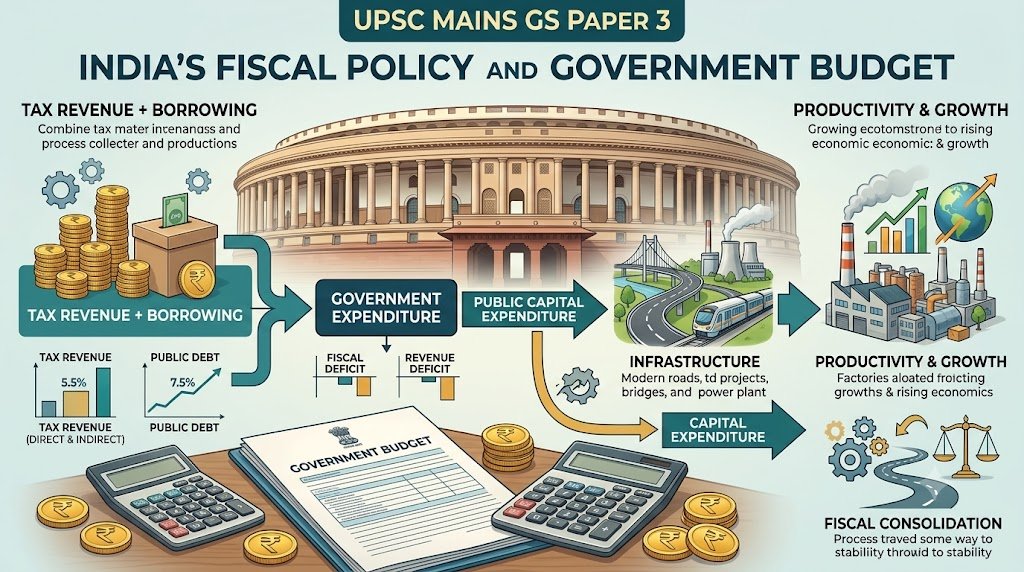
Fiscal Policy and Fiscal Consolidation
Fiscal policy is one of the most important areas for GS Paper III.
The Union Budget 2026-27 estimates the fiscal deficit at 4.3% of GDP, compared with a revised estimate of 4.4% for 2025-26. The Budget also estimates the primary deficit at 0.7% of GDP and central government debt at 55.6% of GDP for 2026-27.
Why Fiscal Consolidation Matters
Fiscal consolidation can:
- Improve macroeconomic stability
- Reduce borrowing pressure
- Create fiscal space
- Support investor confidence
- Improve debt sustainability
However, excessive fiscal tightening can affect:
- Public investment
- Social spending
- Employment
- Demand
- Growth
Therefore, the ideal approach is credible consolidation without compromising productive public investment.
Public Capital Expenditure
Public capital expenditure remains a major instrument for supporting infrastructure and long-term growth.
The Union Budget 2026-27 proposes public capex of ₹12.2 lakh crore, up from ₹11.2 lakh crore in the 2025-26 Budget Estimates.
Why Public Capex Matters
Public investment can:
- Create infrastructure
- Improve productivity
- Crowd in private investment
- Reduce logistics costs
- Generate employment
- Improve competitiveness
Mains Angle
A good answer should discuss the crowding-in effect of public investment while also examining:
- Financing constraints
- Project delays
- Land acquisition
- State capacity
- Quality of expenditure
Sixteenth Finance Commission and Fiscal Federalism
The Sixteenth Finance Commission is an important current-affairs topic for UPSC Mains 2027.
Its recommendations have implications for:
- Vertical fiscal imbalance
- Horizontal devolution
- State finances
- Fiscal discipline
- Local governments
- Centre-State financial relations
The Commission’s report includes a fiscal deficit roadmap under which the Union government’s fiscal deficit is projected at 4.2% of GDP for 2026-27, while the states’ fiscal deficit limit is retained at 3% of GSDP in the Commission’s roadmap.
Mains Question Angle
“Fiscal consolidation in India requires greater coordination between the Union and State governments.” Discuss.
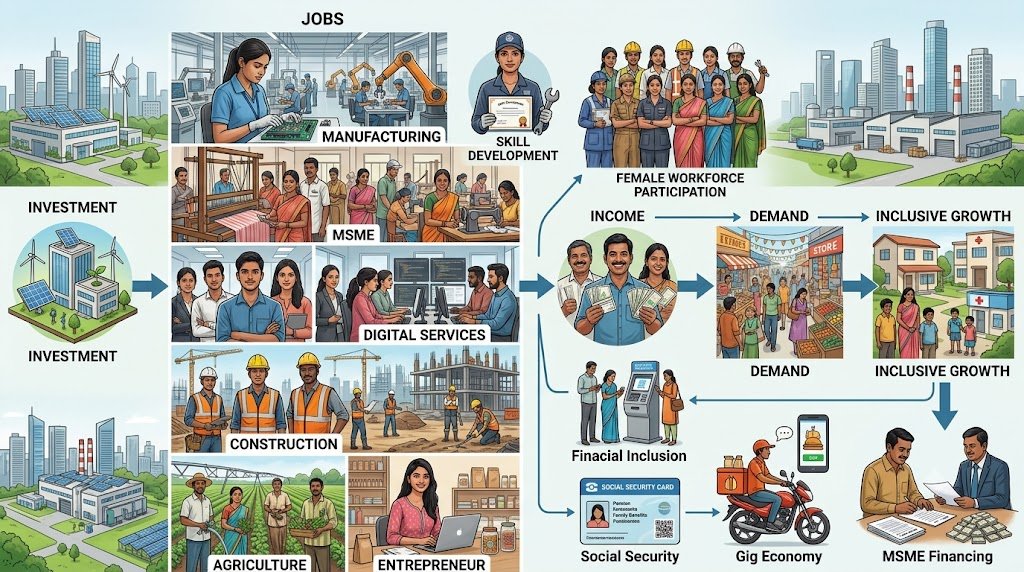
Employment and Labour Market
Employment should be prepared as a separate sub-topic rather than simply as part of growth.
Focus on:
- Jobless growth
- Labour-force participation
- Female employment
- Informal employment
- Gig economy
- Platform workers
- Manufacturing jobs
- Services employment
- Skill mismatch
- AI and automation
Key Challenges
- High informal employment
- Low productivity in parts of the informal sector
- Skill mismatch
- Gender gaps
- Regional disparities
- Limited high-quality manufacturing employment
Way Forward
- Labour-intensive manufacturing
- Skill development
- Apprenticeships
- Women’s workforce participation
- MSME expansion
- Formalisation
- Social security for informal workers
- Digital and technological skills
Inclusive Growth in India
Inclusive growth means ensuring that economic progress translates into broad-based opportunities and improved living standards.
Major Dimensions
- Income
- Employment
- Education
- Healthcare
- Financial inclusion
- Digital access
- Infrastructure
- Gender equality
- Regional development
Major Challenges
- Inequality
- Regional disparities
- Unequal access to opportunities
- Informal employment
- Rural-urban gaps
- Digital divide
Way Forward
India needs an approach based on:
Growth + Employment + Human Capital + Social Protection + Financial Inclusion
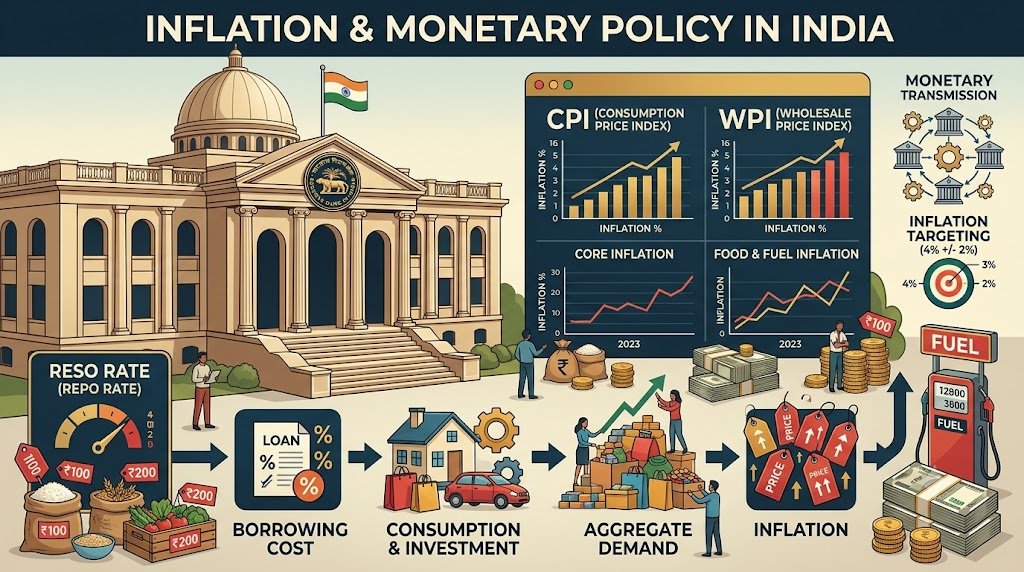
Inflation in India
Inflation is an important topic for both conceptual and current-affairs preparation.
Key Concepts
Understand:
- CPI
- WPI
- Headline inflation
- Core inflation
- Food inflation
- Demand-pull inflation
- Cost-push inflation
- Imported inflation
- Inflation expectations
Causes
- Food supply shocks
- Energy prices
- Supply-chain disruptions
- Demand pressures
- Exchange-rate movements
- Global commodity prices
Policy Response
The response can involve:
- Monetary policy
- Supply-side measures
- Buffer stocks
- Import/export management
- Logistics improvements
- Agricultural productivity
A balanced answer should explain that monetary policy alone cannot permanently solve supply-side inflation.
Monetary Policy and RBI
A GS Paper III aspirant should understand:
- Repo rate
- Reverse repo
- Standing Deposit Facility
- Marginal Standing Facility
- Cash Reserve Ratio
- Statutory Liquidity Ratio
- Open Market Operations
- Inflation targeting
- Monetary transmission
- Liquidity management
Important Mains Theme
Balancing inflation control with economic growth remains a recurring policy challenge.
Candidates should understand the relationship:
Policy Rate → Borrowing Cost → Consumption & Investment → Aggregate Demand → Inflation
Banking Sector and Financial Sector
Prepare:
- Banking reforms
- NPAs
- Capital adequacy
- Bank consolidation
- Financial inclusion
- Digital banking
- FinTech
- NBFCs
- Corporate bond market
- Development finance
The Union Budget 2026-27 proposes a High-Level Committee on Banking for Viksit Bharat to review the banking sector’s next phase of development while considering financial stability, inclusion and consumer protection.
Mains Dimensions
A good answer should balance:
Credit Growth + Financial Stability + Consumer Protection + Inclusion
MSMEs and India’s Industrial Growth
MSMEs are important for:
- Employment
- Exports
- Regional development
- Entrepreneurship
- Supply chains
- Manufacturing
The 2026-27 Budget proposes a ₹10,000 crore SME Growth Fund and additional support for micro enterprises through the Self-Reliant India Fund. It also proposes measures to expand the use of TReDS for MSME receivables and financing.
Major Challenges
- Access to finance
- Delayed payments
- Technology gaps
- Compliance burden
- Market access
- Low productivity
- Skill shortages
Manufacturing and Industrial Policy
India’s manufacturing strategy should be prepared around:
- Make in India
- Production-linked incentives
- Supply-chain resilience
- Critical minerals
- Semiconductors
- Electronics
- Defence manufacturing
- Green manufacturing
- Export competitiveness
The 2026-27 Budget proposes expansion of semiconductor-related capabilities through India Semiconductor Mission 2.0 and an increase in the Electronics Components Manufacturing Scheme outlay to ₹40,000 crore.
Mains Approach
Do not write only about schemes.
Analyse:
Policy → Investment → Technology → Productivity → Employment → Exports
Infrastructure and Investment
Infrastructure remains a major growth multiplier.
Prepare:
- Roads
- Railways
- Ports
- Airports
- Logistics
- Power
- Digital infrastructure
- Urban infrastructure
- Water infrastructure
Investment Models
Understand:
- EPC
- PPP
- BOT
- HAM
- TOT
- InvITs
- REITs
- Asset monetisation
The Budget 2026-27 also proposes an Infrastructure Risk Guarantee Fund to provide partial credit guarantees for infrastructure-related lending.
Digital Economy and AI
Technology is changing India’s economic structure.
Prepare:
- Digital public infrastructure
- UPI
- FinTech
- Digital payments
- E-commerce
- AI
- Automation
- Platform economy
- Data economy
AI and the Economy
AI can:
- Improve productivity
- Reduce transaction costs
- Improve public service delivery
- Support healthcare
- Transform agriculture
- Improve logistics
But it may also create:
- Job displacement
- Skill mismatches
- Algorithmic bias
- Data privacy concerns
- Market concentration
The 2026-27 Budget recognises emerging technologies including AI and links them with India’s development and productivity objectives.
The growing role of AI, digital infrastructure and emerging technologies also makes Science and Technology an important part of GS Paper 3 preparation. You can explore our detailed Science and Technology for UPSC guide for further preparation.
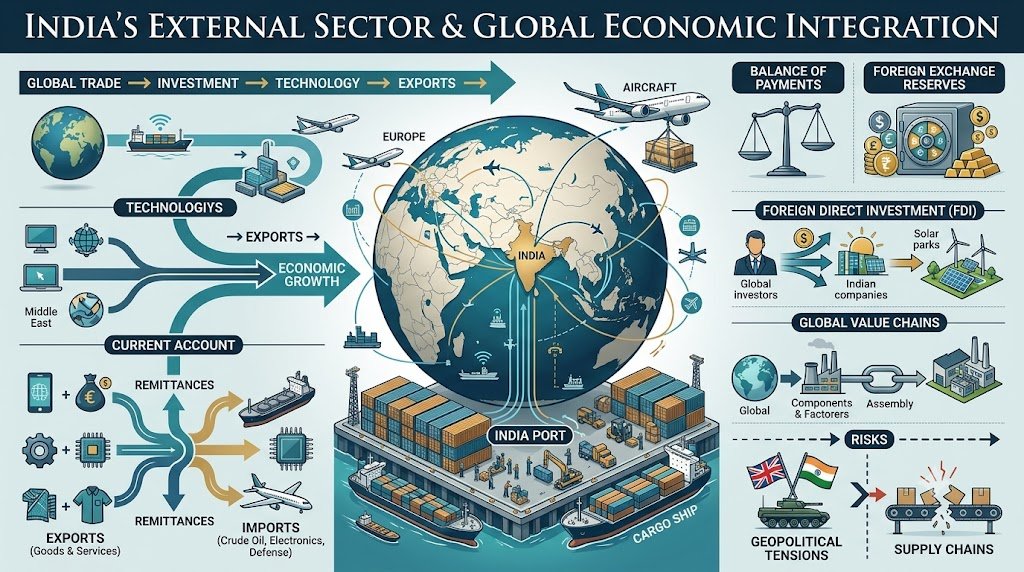
External Sector
Important topics include:
- Balance of Payments
- Current Account Deficit
- Capital Account
- Foreign Direct Investment
- Foreign Portfolio Investment
- Exchange rate
- Foreign exchange reserves
- Exports
- Imports
- Remittances
- Global value chains
Current Challenges
India’s external sector is influenced by:
- Global trade fragmentation
- Geopolitical tensions
- Commodity prices
- Supply-chain disruptions
- Protectionism
- Exchange-rate volatility
The Economic Survey 2025-26 specifically highlights the changing global trade environment and the need for India to build resilience while remaining integrated with global markets.
Agriculture–Economy Linkages
Even in an Indian Economy article, agriculture should not be ignored.
Important linkages include:
Agricultural Productivity → Rural Income → Consumption → Demand → Investment → Growth
Also prepare:
- Food inflation
- Agricultural exports
- Rural employment
- Food processing
- Supply chains
- Irrigation
- Climate-resilient agriculture
The Economic Survey 2025-26 estimates agriculture growth at 2.7% in FY 2025-26, according to its statistical appendix.
Green Growth and the Economy
Economic development increasingly has to be compatible with environmental sustainability.
Prepare:
- Green growth
- Renewable energy
- Green hydrogen
- Carbon markets
- Energy transition
- Electric mobility
- CCUS
- Sustainable finance
- Climate-resilient infrastructure
The 2026-27 Budget proposes ₹20,000 crore over five years for Carbon Capture, Utilisation and Storage (CCUS) across sectors including power, steel, cement, refineries and chemicals.
Economic growth is increasingly linked with environmental sustainability, climate action and energy transition. For a broader understanding of these issues, also refer to our Environment MCQs 2027: 100 Most Important Questions for UPSC Prelims preparation resources.
Important Government Initiatives to Revise
For UPSC Mains 2027, candidates should understand the objective, mechanism, achievements, limitations and way forward of major economic initiatives.
Important areas include:
- GST
- Insolvency and Bankruptcy Code
- PLI schemes
- National Logistics Policy
- PM Gati Shakti
- Digital Public Infrastructure
- Jan Dhan-Aadhaar-Mobile
- MUDRA
- Stand-Up India
- Financial inclusion initiatives
- National Infrastructure Pipeline
- National Monetisation Pipeline
- Skill development programmes
- MSME support
- Manufacturing initiatives
- Infrastructure financing
Economic Survey 2025-26: Chapters You Should Not Ignore
For UPSC Mains GS 3 Indian Economy Notes (2027), the Economic Survey 2025-26 deserves special attention.
Its major chapters include:
- State of the Economy
- Fiscal Developments
- Monetary Management and Financial Intermediation
- External Sector
- Inflation
- Agriculture and Food Management
- Services
- Industry
- Investment and Infrastructure
- Environment and Climate Change
- Employment and Skill Development
- Rural Development
- AI Ecosystem
- Urbanisation
The official Economic Survey portal provides the complete chapter-wise Survey and statistical appendix.
Union Budget 2026-27: Important Economy Themes
For Mains 2027, do not simply memorise Budget announcements. Convert them into analytical themes.
High-Priority Themes
- Fiscal consolidation
- Public capital expenditure
- Manufacturing
- MSMEs
- Infrastructure
- Banking reforms
- Services-led growth
- AI and emerging technologies
- Employment
- Energy security
- Urbanisation
- Investment
- Ease of doing business
- Green technologies
The official Budget documents provide detailed fiscal estimates and policy proposals for 2026-27.
Data Bank for UPSC Economy Answers
Maintain a small Economy Data Bank rather than memorising hundreds of figures.
Useful categories:
| Theme | Data/Source to Track |
|---|---|
| GDP Growth | Economic Survey / MoSPI |
| Inflation | RBI / MoSPI |
| Fiscal Deficit | Union Budget |
| Public Debt | Budget / FRBM documents |
| Employment | PLFS |
| Banking | RBI |
| External Sector | RBI |
| Agriculture | Economic Survey / Agriculture Ministry |
| Infrastructure | Union Budget / Economic Survey |
| Poverty & Inclusion | NITI Aayog / official reports |
| Global Economy | IMF / World Bank |
| Trade | Ministry of Commerce |
The Economic Survey 2025-26 statistical appendix is particularly useful because it provides tables covering prices, banking, balance of payments, external debt, human development and other indicators.
How to Write Economy Answers in UPSC Mains
A strong economy answer should normally follow this structure:
Introduction
Use one of:
- Definition
- Recent data
- Economic concept
- Current development
- Relevant report
Body
Divide the answer into logical dimensions:
- Current situation
- Causes
- Challenges
- Economic impact
- Social impact
- Government initiatives
- Gaps
- Way Forward
Conclusion
Link the answer with:
- Inclusive growth
- Sustainable development
- Employment
- Productivity
- Competitiveness
- Resilience
- Viksit Bharat
Example: Answer-Writing Framework
Question
“India’s strong economic growth needs to be accompanied by greater employment generation. Discuss.”
Introduction
Mention India’s strong recent growth performance and establish the distinction between output growth and employment generation.
Body
Why growth may not automatically create enough jobs
- Capital-intensive production
- Skill mismatch
- Automation
- Informal employment
- Services-led growth
What India needs
- Labour-intensive manufacturing
- MSME expansion
- Skill development
- Apprenticeships
- Female labour participation
- Infrastructure
- Export-oriented manufacturing
Conclusion
India needs employment-intensive, inclusive and productivity-enhancing growth rather than focusing on GDP expansion alone.
While revising UPSC Mains GS 3 Indian Economy Notes, focus on converting facts and concepts into arguments, examples, diagrams and practical solutions.
Important Diagrams for Economy Answers
Simple diagrams can improve presentation.
Growth–Employment Link
Investment → Production → Productivity → Growth → Employment → Income → Demand → Further Investment
Inflation Transmission
Supply Shock → Higher Input Costs → Higher Prices → Inflation → Monetary/Policy Response
Fiscal Policy
Revenue + Borrowing → Government Expenditure → Public Investment → Productivity → Growth
Use diagrams only when they genuinely improve clarity.
Most Important Indian Economy Topics for UPSC Mains 2027
Very High Priority
- Economic growth
- Inclusive growth
- Employment
- Fiscal deficit
- Fiscal consolidation
- Government budgeting
- Inflation
- Monetary policy
- Banking reforms
- Infrastructure
- Manufacturing
- MSMEs
- Services sector
- External sector
High Priority
- Financial inclusion
- Digital economy
- AI and employment
- Investment models
- PPP
- Asset monetisation
- Industrial policy
- FDI
- Trade
- Logistics
- Urbanisation
- Green growth
Current-Affairs Priority
- Economic Survey 2025-26
- Union Budget 2026-27
- Sixteenth Finance Commission
- Banking sector reforms
- AI and jobs
- Manufacturing and semiconductors
- Infrastructure financing
- Global trade disruptions
- Energy security
- Fiscal consolidation
Regularly updating your UPSC Mains GS 3 Indian Economy Notes with Economic Survey, Union Budget, RBI developments and official statistics will make your preparation more relevant.
90-Day Indian Economy Preparation Plan
Days 1–30: Build the Foundation
Cover:
- Basic economic concepts
- GDP/GVA
- Growth and development
- Inflation
- Monetary policy
- Fiscal policy
- Budget
- Employment
Days 31–60: Advanced Topics
Cover:
- Banking
- Infrastructure
- Investment
- Manufacturing
- MSMEs
- Agriculture-economy linkages
- External sector
- Inclusive growth
Days 61–75: Current Affairs
Revise:
- Economic Survey
- Union Budget
- RBI developments
- Finance Commission
- Major economic reforms
- Important government initiatives
- Current economic data
Days 76–90: Mains Practice
Practise:
- Previous-year questions
- 10-mark answers
- 15-mark answers
- Data-based answers
- Diagrams
- Introductions
- Conclusions
- Full-length tests
Common Mistakes in Economy Preparation
Studying only theory
Economic concepts must be connected with current affairs.
Memorising data without understanding
Data should support an argument, not replace it.
Ignoring government documents
The Economic Survey and Budget are among the most valuable sources for GS-III economy preparation.
Writing only government achievements
UPSC expects balanced analysis. Discuss both achievements and limitations.
Giving generic solutions
The Way Forward should be specific, feasible and linked to the problem.
Ignoring employment
Growth, productivity and employment should frequently be analysed together.
Final Strategy for UPSC Mains GS 3 Indian Economy Notes (2027)
Consistent revision of UPSC Mains GS 3 Indian Economy Notes, combined with PYQ analysis and answer writing, can make your Economy preparation more structured and effective.
The best approach is:
Static Concepts + Current Affairs + Economic Survey + Budget + Data + Examples + PYQs + Answer Writing
For every major economic topic, prepare a one-page revision note containing:
- Definition
- Current status
- Key data
- Causes
- Challenges
- Government initiatives
- Examples
- Committee/Report references
- Way Forward
- One probable Mains question
As of August 2026, the latest major official economic references available for this preparation are the Economic Survey 2025-26, Union Budget 2026-27 and Sixteenth Finance Commission report. The 2027 Union Budget and Economic Survey will obviously become important updates later, so this article should be updated when those documents are released.
For the examination timeline, UPSC’s official Annual Calendar 2027 schedules CSE Prelims for 23 May 2027 and CSE Mains from 20 August 2027. The detailed CSE 2027 notification is scheduled for 13 January 2027. (UPSC)
Frequently Asked Questions
Is Indian Economy important for UPSC Mains GS Paper 3 2027?
Yes. Indian Economy is one of the core components of GS Paper III and covers growth, development, employment, inclusive growth, budgeting, industrial policy, infrastructure and investment.
What should I read for Indian Economy UPSC Mains 2027?
Build your preparation around basic economic concepts, a standard economy source, Economic Survey, Union Budget, RBI publications, official statistics, government reports and UPSC previous-year questions.
Which current-affairs documents are most important for Economy?
As of August 2026, give priority to the Economic Survey 2025-26, Union Budget 2026-27 and Sixteenth Finance Commission report, along with RBI and other official economic data.
What are the most important economy topics for UPSC Mains 2027?
Prioritise:
- Economic growth
- Inclusive growth
- Employment
- Inflation
- Fiscal policy
- Monetary policy
- Banking
- Infrastructure
- Manufacturing
- MSMEs
- External sector
- Investment
- Digital economy
- Green growth
When will UPSC Mains 2027 be held?
According to the UPSC Annual Calendar 2027, the Civil Services (Main) Examination is scheduled to commence on 20 August 2027 and is listed for five days.
Official Resources
For the latest updates, candidates should rely primarily on the UPSC Annual Calendar 2027, Economic Survey 2025-26 and Union Budget 2026-27 documents. UPSC’s Previous Question Papers should also be used to understand the actual nature of GS Paper III questions.
4 thoughts on “UPSC Mains GS 3 Indian Economy Notes 2027: Essential Topics, Data & Success Strategy”