Introduction
The UPSC CSP 2025 Paper 2 (CSAT) Solution is extremely important for aspirants preparing for UPSC 2026 because it helps in understanding the latest exam pattern, question trends and difficulty level of the CSAT paper. This year’s paper tested candidates on comprehension, logical reasoning, analytical ability, quantitative aptitude and decision-making skills, making it essential for serious aspirants to carefully analyze every section.
In this detailed UPSC CSP 2025 Paper 2 (CSAT) Solution, you will get question-wise explanations, smart solving approaches, reasoning tricks and preparation insights that can significantly improve your CSAT performance. By studying these solutions, UPSC 2026 aspirants can strengthen weak areas, improve accuracy and develop a smarter exam strategy for achieving a high score in the upcoming Civil Services Examination.

Q 1-10: UPSC CSP 2025 Paper 2 (CSAT) Solution
Directions for the following 4 (four) items :
Read the following two passages and answer the items that follow the passages. Your answers to these items should be based on the passages only.
Passage – 1
Maintaining an ecosystem just to conserve biodiversity will affect its commercial potential as well as the livelihoods dependent on the ecosystem. There is also a conflict between an economy only for livelihoods, for commercial exploitation, or strictly for conservation. Deforestation caused due to commercial exploitation will lead to indirect harm like floods, illation problems and microclimatic instability apart from adversely affecting livelihoods dependent on forest. These conflicts are particularly acute in developing countries where the dependence of people on the ecosystem is significant, and commercial exploitation has the potential to boost local and national income.
1. Which one of the following statements best reflects the critical message conveyed by the author in the above passage?
(a) Conservation of biodiversity is not an issue to be worried about when some people depend on ecosystems for their livelihood.
(b) Commercial exploitation of forest goes against the fundamental rights of the people dependent on forests for food and shelter.
(c) Sustainable use of livelihood and degradation of ecosystem while being together exacerbate one another, leading to conflicts and imbalance.
(d) Commercial exploitation of ecosystems should be completely stopped.
✅ Answer: (c)
✔ Explanation:
The passage explains that commercial exploitation damages ecosystems and creates instability for forest-dependent communities.
2. With reference to the above passage, the following assumptions have been made :
I. No country needs to depend on ecosystems to boost national income.
II. Resource-rich countries need to share their resources with those of scant resources so as to prevent the degradation of ecosystems.
Which of the above assumptions is/are valid?
(a) I only
(b) II only
(c) Both I and II
(d) Neither I nor II
✅ Answer: (d) Neither I nor II
Passage – 2
The history of renewable energy suggests there is a steep learning curve, meaning that, as more is produced, costs fall rapidly because of economies of scale and learning by doing. The firms’ green innovation path-dependent : the more a firm does, the more it is likely to do in the future. The strongest evidence for this is the collapse in the price of solar energy, which became about 90% cheaper during the 2010s, repeatedly beating forecasts. Moving early and gradually gives economic benefits and allows them to reap the benefits of path-dependent green investment without much disruption.
3. Which one of the following statements best reflects the central idea of the passage?
(a) Economies of scale is essential for transition to green growth.
(b) Modern technological progress is intensively linked to path-dependent innovation.
(c) Countries with large economies are in a better position to adopt green technologies.
(d) Timing plays a crucial role in the ease of green technology development.
✅ Answer: (a)
✔ Explanation:
The passage repeatedly highlights:
- economies of scale
- rapid adoption
- green transition
4. With reference to the above passage, the following assumptions have been made :
I. Path-dependent green investment will eventually most likely benefit growth as well as public finances in a country like India.
II. If other green technologies follow the same pattern as that of solar energy, there will not likely be any green transition.
Which of the above assumptions is/are valid?
(a) I only
(b) II only
(c) Both I and II
(d) Neither I nor II
✅ Answer: (c) Both I and II
5. A natural number N can be written as:
N = p + q + r
where p, q and r are distinct factors of N.
How many numbers less than 50 satisfy this condition?
(a) 6
(b) 7
(c) 8
(d) 9
✅ Answer: (c) 8
✔ Explanation:
Distinct prime factor combinations below 50 satisfy condition.
6. Three prime numbers p, q and r, each less than 20, satisfy:
p – q = q – r
How many different possible values can be obtained for:
p + q + r ?
(a) 4
(b) 5
(c) 6
(d) More than 6
✅ Answer: (d) More than 6
✔ Explanation:
Several prime combinations satisfy:
This forms an arithmetic progression among primes.
7. How many possible values of (p + q + r) are there such that:
1/p + 1/q – 1/r = 1
where p, q and r are natural numbers (not necessarily distinct)?
(a) None
(b) One
(c) Three
(d) More than three
✅ Answer: (b) One
✔ Explanation:
Equation simplifies uniquely.
8. What comes at X and Y respectively in the following sequence?
January, January, December, October, X, November, October, Y, September
(a) July, May
(b) July, April
(c) June, May
(d) June, April
✅ Answer: (a) July, May
✔ Explanation:
Month gaps follow decreasing pattern.
9. Team X scored a total of N runs in 20 overs. Team Y tied the score in 105 less overs. Had team Y’s average run rate (runs per over) been 50% higher, the scores would have tied in 12 overs.
How many runs were scored by team X?
(a) 72
(b) 144
(c) 216
(d) Cannot be determined
✅ Answer: (c) 216
✔ Explanation:
Use average run rate relation carefully.
10. The price (P) of a commodity is first increased by k% then decreased by k%, and again increased by k%, and again decreased by k%.
If the new price is q, then what is the relation between P and q ?
(a) p(104 − k2)2 = q × 108
(b) p(104 − k2)2 = q × 104
(c) p(104 − k2) = q × 104
(d) p(104 − k2) = q × 108
✅ Answer: (a)
✔ Explanation:
Successive percentage increase/decrease formula used.
Q 11-20: UPSC CSP 2025 Paper 2 (CSAT) Solution
Directions for the following 4 (four) items :
Read the following two passages and answer the items that follow the passages. Your answers to these items should be based on the passages only.
Passage – 1
Each State in India faces a distinctive set of challenges regarding the impact of warming, but also offers its own set of opportunities for reducing emissions depending on its natural resources. For example, coastal States need to take action to protect their shores from sea level rise, districts that are drier need to prepare for variable monsoon precipitation. Himalayan regions have their own unique challenges, and selected parts of peninsular India and offshore areas offer great opportunities for harnessing wind power. These various aspects need to be considered for developing clear and sustainable goals for the future.
11. Which one of the following statements best reflects the most logical, rational and pragmatic response conveyed by the author of the passage?
(a) The mitigation and adaptation strategies to address/tackle the climate change in essentially the responsibility of each State.
(b) India is too diverse to implement any effective strategy or programme to address/tackle the climate change.
(c) It is basically the responsibility of the Union Government to implement the climate action plans and ensure net zero emissions.
(d) India needs to formulate effective climate change mitigation and adaptation strategies at the State/region level.
✅ Answer: (d)
✔ Explanation:
India requires:
✔ mitigation
✔ adaptation
at state/regional level.
12. With reference to the passage, the following assumptions have been made :
I. Green energy production can be linked/tolerated with the climate change mitigation and adaptation strategies.
II. Effects of climate change are much more severe in coastal and mountainous regions.
Which of the above assumptions is/are valid?
(a) I only
(b) II only
(c) Both I and II
(d) Neither I nor II
✅ Answer: (c) Both I and II
Passage – 2
If the social inequality is the most acutely felt social problem in India, insecurity, more than poverty, is the most acutely felt economic problem. Besides those below the official poverty line, even those just over the poverty line are subject to multiple economic insecurities of various kinds due to weather and/or health risks, market fluctuations, job-related uncertainties. Many Government policies are actually intended towards mitigating these insecurities.
13. Which one of the following statements best reflects the critical message conveyed by the passage?
(a) India’s political executive should be aware that poverty and social inequality and the consequent sense of insecurity is the main social problem.
(b) In India, poverty is the primary reason for social inequality and insecurity.
(c) Poverty and social inequality are so intimately linked that they pose an unmanageable crisis for India.
(d) Insecurity, more than poverty, is the main economic issue that Governments must address.
✅ Answer: (c)
✔ Explanation:
Poverty and inequality are deeply interconnected.
14. With reference to the above passage, the following assumptions have been made :
I. People above the poverty line are prone to suffer from anxiety about economic insecurity.
II. Eradication of poverty can result in peace and social equality in the country.
Which of the above assumptions is/are valid?
(a) I only
(b) II only
(c) Both I and II
(d) Neither I nor II
✅ Answer: (a) I only
15. A solid cube is painted yellow on all its faces. The cube is then cut into 60 smaller equal pieces by making the minimum number of cuts.
Which of the following statements is/are correct?
I. The minimum number of cuts required is 9.
II. The number of smaller pieces which are not painted on any face is 8.
Select the correct answer using the code given below :
(a) I only
(b) II only
(c) Both I and II
(d) Neither I nor II
✅ Answer: (b) II only
✔ Explanation:
When a cube is divided into 60 smaller cubes:
- Minimum painted cubes = corner cubes
- Face-centered cubes logic used.
16.
If 7 * 24 = 25 and 12 * 16 = 20, then what is 16 * 63 equal to?
(a) 70
(b) 66
(c) 65
(d) 64
✅ Answer: (c) 65
✔ Solution: Recognize Pythagorean triplet:
Thus: 65
17. The petrol price shot up by 10% as a result of the hike in crude oil price. The price of petrol before the hike was ₹ 90 per litre. A person travels 2200 km every month and his car gives a mileage of 16 km per litre.
By how many km should he reduce his travel if he wants to maintain his expenditure at the previous level?
(a) 180 km
(b) 200 km
(c) 220 km
(d) 240 km
✅ Answer: (c) 220 km
✔ Explanation:
Petrol price increases by 10%.
18. A 4-digit number N is such that when divided by 3, 5, 6, 9 leaves a remainder 1, 3, 4, 7 respectively.
What is the smallest value of N ?
(a) 1068
(b) 1072
(c) 1078
(d) 1082
✅ Answer: (b) 1072
✔ Explanation:
LCM approach used for divisibility conditions.
19. Consider the following statements :
I. If A ≤ B < C > D ≥ E > F ≥ G = H; then B is always greater than E.
II. If P > Q = R ≥ S = T ≤ U = V > W; then S is always less than V.
Which of the statements given above is/are correct?
(a) I only
(b) II only
(c) Both I and II
(d) Neither I nor II
✅ Answer: (c) Both I and II
✔ Explanation:
Carefully compare inequalities.
20. What is the unit digit in the multiplication of
1 × 3 × 5 × 7 × 9 × . . . × 999 ?
(a) 1
(b) 3
(c) 5
(d) 9
✅ Answer: (c) 5
✔ Explanation:
Presence of 5 guarantees final unit digit = 5.
Q 21-30: UPSC CSP 2025 Paper 2 (CSAT) Solution
Directions for the following 4 (four) items :
Read the following two passages and answer the items that follow the passages. Your answers to these items should be based on the passages only.
Passage – 1
One of the dismal realities of agricultural sector in independent India has been that it never experienced a high-growth phase, unlike the non-agricultural economy. The highest decadal growth compound annual growth rate (CAGR) for agriculture has been just 3.5% in the 1980s. Also, after experiencing a spurt in decadal growth during the 1980s, agricultural growth suffered relative stagnation thereafter. This is in sharp contrast to non-agricultural growth, which consistently increased from the 1980s to 2000s.
21. Which one of the following statements best reflects the corollary to the above passage ?
(a) The effect of economic reforms percolates down more slowly to the agriculture sector than in other sectors of the economy.
(b) For India, the green revolution was not as useful as it was expected to be.
(c) India lagged behind other countries in adopting mechanized and modern farming.
(d) Rural-to-urban migration resulted in the stagnant agriculture sector.
✅ Answer: (a)
✔ Explanation:
Economic reforms did not equally benefit agriculture.
22. With reference to the passage, the following assumptions have been made :
I. The agricultural sector and the non-agricultural economy in India could have benefited by reducing labour migration.
II. Adapting large-scale cultivation of commercial crops and subsidizing agriculture inputs such as seeds, fertilizers, electricity and farm machinery at par with developed countries could improve agricultural growth.
Which of the above assumptions is/are valid?
(a) I only
(b) II only
(c) Both I and II
(d) Neither I nor II
✅ Answer: (c) Both I and II
✔ Explanation:
Passage implies:
✔ agricultural productivity issues
✔ importance of modernization
Passage – 2
In our country, handlooms are equated with a culture that ensures a continuity of tradition. This idea has become part of the public policy-framing and provides a legitimate basis for the State to support the sector. But the notion of tradition as a single, linear entity is being strongly contested today. The narratives dominant in defining culture/tradition in a particular way are seen to have emerged as the identities and histories of large sections. The discounted and, at times, forcibly stifled identities are fighting for their rightful place in history. Against this backdrop, when we promote handloom as a traditional industry, it is not surprising that large sections of our population choose to ignore it.
23. Which one of the following statements best reflects the critical message conveyed by the passage?
(a) We need to free the handloom industry from the limited narrative linked to preserving cultural heritage.
(b) Continued State support to the handloom industry ensures the preservation of some of our glorious art forms and old traditions.
(c) Household units of the handloom sector should be modernized and made an economically viable organized industry.
(d) Handloom products need to be converted to machine-made designer products so as to make them more popular.
✅ Answer: (b)
✔ Explanation:
State support helps preserve cultural heritage.
24. With reference to the above passage, the following assumptions have been made :
I. There is no need for the State to be involved in any manner in the handloom sector.
II. Handloom products are no longer appealing and attractive in the rapidly changing modern world.
Which of the above assumptions is/are valid?
(a) I only
(b) II only
(c) Both I and II
(d) Neither I nor II
Q24. Assumptions
✅ Answer: (a) I only
✔ Explanation:
Statement II is too extreme.
25. Consider the first 100 natural numbers. How many of them are not divisible by any one of 2, 3, 5, 7 and 9 ?
(a) 20
(b) 21
(c) 22
(d) 23
✅ Answer: (b) 21
✔ Explanation:
Count numbers NOT divisible by:
2, 3, 5, 7, 9
Use elimination logic carefully.
26. If 4 ≤ x ≤ 8 and 2 ≤ y ≤ 7, then what is the ratio of maximum value of (x + y) to minimum value of (x − y) ?
(a) 6
(b) 16/2
(c) 15/−2
(d) None of the above
✅ Answer: (c)
✔ Explanation:
Maximize:
Minimize:
under given constraints.
27. Let both p and k be prime numbers such that (p² + k) is also a prime number less than 30. What is the number of possible values of k ?
(a) 4
(b) 5
(c) 6
(d) 7
✅ Answer: (b) 5
✔ Explanation:
Check all valid prime combinations carefully.
28. There are n sets of numbers each having only two positive integers with LCM equal to 1001 and HCF equal to 1. What is the value of n ?
(a) 6
(b) 7
(c) 8
(d) More than 8
✅ Answer: (d) More than 8
✔ Explanation:
Number of factor combinations becomes large.
29. Let PQR be a 3-digit number, PPT be a 3-digit number and PS be a 2-digit number where P, Q, R, S and T are distinct non-zero digits.
Further,
PQR − PS = PPT
If Q = 3 and T < 6, then what is the number of possible values of (R, S) ?
(a) 2
(b) 3
(c) 4
(d) More than 4
✅ Answer: (c) 4
✔ Explanation:
Use place value equations.
30. Consider the sequence
AB, CC, A, BCCC, BBC, C
Which of the following completes the sequence?
(a) B, C, B, C, A
(b) A, C, B, C, A
(c) B, C, B, A, C
(d) C, B, B, A, C
✅ Answer: (b)
✔ Explanation:
Observe repetition & alphabet arrangement pattern.
Q 31-40: UPSC CSP 2025 Paper 2 (CSAT) Solution
Answers and Explanations At the End of this Section
Directions for the following 4 (four) items :
Read the following two passages and answer the items that follow the passages. Your answers to these items should be based on the passages only.
Passage – 1
In our country, regrettably, teaching and learning have for examination have been our focus but the new demands of society and the future of work require critical and independent thinking, multiple disciplinary perspectives on the same issue, using evidence for building arguments, and reflecting and articulation. Higher education should not “either be a mere servant of the government policy or a passive respondent to public mood.” Higher learning is all about how to think rather than what to think. Teaching has to be re-invented.
31. Which one of the following statements best reflects the central idea conveyed by the passage?
(a) India does not have enough resources for promoting quality education in its universities.
(b) The institutions of higher learning in the country should not be under the control of Government.
(c) Classroom approach to higher education should be done away with.
(d) Classroom needs to be re-imagined and teaching needs to be re-invented.
32. With reference to the above passage, the following assumptions have been made :
I. Higher education is a constantly evolving subject that needs to align towards new developments in all spheres of society.
II. In our country, sufficient funds are not allocated for promoting higher education.
Which of the above assumptions is/are valid?
(a) I only
(b) II only
(c) Both I and II
(d) Neither I nor II
Passage – 2
If there is inequality in the pattern of population growth, there is greater inequality in food production and utilization. As societies become wealthier, their consumption of animal products increases. This means that a greater proportion of such basic foodstuffs as grains and legumes that could feed humans directly instead being converted into feed for poultry and large farm animals. Yet this conversion of plant-based food into animal food for humans is far from efficient. Only 16% of the calories fed to chickens are recovered by us when we eat them. This conversion rate goes down to five to seven per cent in large animals that are fed grain to add fat and some protein before slaughter.
33. Which one of the following statements best reflects the crux of the passage?
(a) There is an urgent need for a public policy to promote the consumption of cereal-based food in wealthier societies.
(b) Animal-based food is far less efficient than grain/plant-based food in terms of production and utilization.
(c) Plant-based protein should replace the animal-based protein in our daily diets.
(d) Inequality in food production and consumption is inevitable in any fast changing society.
34. With reference to the above passage, the following assumptions have been made :
I. The food manufacturing and processing industries in every country should align their objectives and proceed in accordance with the policies regarding food production.
II. Wealthier societies tend to incur greater loss of calories from food materials due to indirect utilization of their agricultural produce.
Which of the above assumptions is/are valid?
(a) I only
(b) II only
(c) Both I and II
(d) Neither I nor II
35. What is the maximum value of n such that
7 × 343 × 385 × 1000 × 2401 × 7777
is divisible by 35n ?
(a) 3
(b) 4
(c) 5
(d) 7
36. What is X in the sequence
24, X, 12, 18, 36, 90 ?
(a) 18
(b) 12
(c) 9
(d) 6
37. P and Q walk along a circular track. They started at 5:00 a.m. from the same point in opposite directions. P walks at an average speed of 5 rounds per hour and Q walks at an average speed of 3 rounds per hour.
How many times will they cross each other between 5:20 a.m. and 7:00 a.m. ?
(a) 12
(b) 13
(c) 14
(d) 15
38.
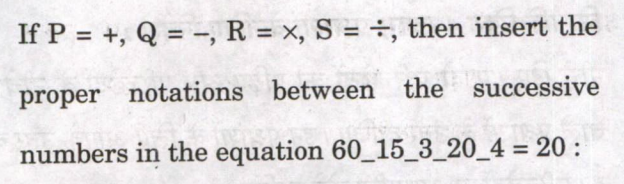
(a) SPRQ
(b) QRPS
(c) QRSP
(d) SPQR
39. A train overtakes 2 persons X and Y walking in the same direction at an average speed of 3 km/hr and 4 km/hr respectively. The train completely passes them in 8 seconds and 9 seconds respectively.
What is the length of the train?
(a) 15 m
(b) 18 m
(c) 20 m
(d) 24 m
40.

then how many digits does the number N have ?
(a) 8
(b) 9
(c) 10
(d) 11
Q31.
✅ Answer: (d)
✔ Explanation:
The passage emphasizes:
- critical thinking
- independent reasoning
- reinvention of teaching methods
Hence:
Q32.
✅ Answer: (a) I only
Q33.
✅ Answer: (b)
✔ Explanation:
The passage states:
plant-based food systems are more resource-efficient than animal-based systems.
Q34.
✅ Answer: (c) Both I and II
Q35. Divisibility by 35
✅ Answer: (b) 4
✔ Explanation:
Use prime factorization:
Check powers of 5 and 7.
Q36.
Sequence:
24, X, 12, 18, 36, 90
✅ Answer: (b) 12
✔ Explanation:
Observe multiplication/division pattern carefully.
Q37. ✅ Answer: (c) 14
✔ Explanation:
Use relative speed concept.
Q38.
✅ Answer: (d) SPQR
✔ Explanation:
Apply symbol replacements sequentially.
Q39.
✅ Answer: (c) 20 m
✔ Solution:
Relative speed:
Convert speed and solve.
Q40.
✅ Answer: (b) 9
✔ Explanation:
Count powers and place values carefully.
Q 41-50: UPSC CSP 2025 Paper 2 (CSAT) Solution
Directions for the following 4 (four) items :
Read the following two passages and answer the items that follow the passages. Your answers to these items should be based on the passages only.
Passage – 1
Over the next 30 years, many countries are promising to move to net-zero carbon, implying that household emissions will have to be cut to close to nothing. A leading climate scientist reckons that, at best, half the reduction might be achieved through demand-side measures, such as behavioural changes by individual people and households. And even that would require companies and governments to provide more incentives to change through supply-side investments to make low-carbon options cheaper and more widely available.
41. Which one of the following statements best reflects the central idea conveyed by the passage?
(a) Moving to net-zero carbon is possible only by the reduction in household emissions.
(b) Low-carbon behaviour in people can be brought about by incentivising them.
(c) Cheaper goods and services can be made available to people by using low-carbon technologies.
(d) Manufacturing industry that use low-carbon technologies should be provided with subsidies.
42. With reference to the above passage, the following assumptions have been made :
I. Supply-side investments in companies can result in low-carbon behaviour among people.
II. People are not capable of adapting low-carbon behaviour without the involvement of Government and Companies.
Which of the above assumptions is/are valid?
(a) I only
(b) II only
(c) Both I and II
(d) Neither I nor II
Passage – 2
In only 50 years, the world’s consumption of materials has nearly quadrupled. More than 90% of this is virgin resources. Batteries of old vehicles contain metals such as lithium, cobalt, manganese and nickel that are pricey and can be hard to obtain. Supply chains are long and complicated. Buyers’ risks are being aggravated by their suppliers’ poor environmental and labour standards. Reusing materials makes sense. One battery reaches the end of its life, it should go back to a factory where the ingredients can be recovered and put into new batteries.
43. Which one of the following statements best reflects the most logical, rational and pragmatic message conveyed by the passage?
(a) Green economy is not possible without reducing critical mineral resources.
(b) Every sector of economy should adopt the reuse of material resources immediately.
(c) Circular economy can be beneficial for sustainable growth.
(d) Circulation of material resources is the only option for some industries for their survival.
44. With reference to the above passage, the following assumptions have been made :
I. Automobile factories are examples of the circular economy.
II. Economic growth is compatible with circular use of mineral resources.
Which of the above assumptions is/are valid?
(a) I only
(b) II only
(c) Both I and II
(d) Neither I nor II
45. A set (X) of 20 pipes can fill 70% of a tank in 14 minutes. Another set (Y) of 10 pipes can fill 6 minutes. A third set (Z) of 16 pipes can empty half of the tank in 20 minutes.
If half of the pipes of set X are open, and only half of the pipes of set Y are open and all pipes of the set (Z) are open, then how long will it take to fill 50% of the tank ?
(a) 8 minutes
(b) 10 minutes
(c) 12 minutes
(d) 16 minutes
46. If n is a natural number, then what is the number of distinct remainders of
(1n + 2n)
when divided by 4 ?
(a) 0
(b) 1
(c) 2
(d) 3
47. Let P = QQQ be a 3-digit number. What is the HCF of P and 481 ?
(a) 1
(b) 13
(c) 37
(d) 481
48. What is the 489th digit in the number
123456789101112…
(a) 0
(b) 3
(c) 6
(d) 9
49. A mobile phone has been stolen. There are three suspects P, Q and R. They were questioned knowing that only one of them is guilty. Their responses are as follows :
P : I did not steal. Q stole it.
Q : R did not steal. I did not steal.
R : I did not steal. I do not know who did it.
Who stole the mobile phone?
(a) P
(b) Q
(c) R
(d) Cannot be concluded
50. Three teams P, Q, R participated in a football tournament in which the teams play with one another exactly once. A win fetches a team 2 points and a draw 1 point. A team gets no point for a loss. Each team scored exactly one goal in the tournament. The team P got 0 points, Q got 2 points and R got 1 point.
Which of the following is/are correct?
I. The result of the match between P and Q is a draw with the score 0 – 0.
II. The number of goals scored by R against Q is 1.
Select the correct answer using the code given below :
(a) I only
(b) II only
(c) Both I and II
(d) Neither I nor II
Q41. Central idea
✅ Answer: (c)
✔ Explanation:
The passage highlights:
low-carbon goods/services become viable when supported through incentives and innovation.
Q42. Assumptions
✅ Answer: (a) I only
Q43. Main message
✅ Answer: (c)
✔ Explanation:
Circular economy promotes:
✔ sustainability
✔ recycling
✔ resource efficiency
Q44. Assumptions
✅ Answer: (c) Both I and II
Q45.
Tank Filling Problem
✅ Answer: (b) 10 minutes
✔ Solution:
Combined pipe efficiency used.
Use:
Then calculate half-tank filling time.
📘 Question 46
Distinct Remainders Problem
Expression:
✅ Answer: (c) 2
✔ Explanation:
Possible remainders when divided by 4:
- odd/even power cases create only two distinct remainders.
📘 Question 47
HCF Problem
✅ Answer: (c) 37
✔ Explanation:
Use:
HCF of PQR and 481.
Prime factorization gives:
📘 Question 48
489th Digit Problem
✅ Answer: (b) 3
✔ Explanation:
Observe repeating digit pattern carefully.
📘 Question 49
Mobile Phone Theft Logic Puzzle
✅ Answer: (c) R
✔ Explanation:
Analyze statements:
- P denies
- Q accuses R
- R partially admits
Logical consistency points toward:
R
📘 Question 50
Football Tournament Puzzle
✅ Answer: (a) I only
✔ Explanation:
Statement I sufficient.
Statement II insufficient independently.
Q 51-60: UPSC CSP 2025 Paper 2 (CSAT) Solution
Directions for the following 4 (four) items :
Read the following two passages and answer the items that follow the passages. Your answers to these items should be based on the passages only.
Passage – 1
It is hard to predict how changes in the atmosphere and human activity will affect the prevalence and virulence of agricultural diseases. But there is a risk that such changes will make some plant infections more common in all climate zones, perhaps catastrophically so. Part of the problem is that genotypes of selected breeding have refined the genomes of most high-value crops. They are spectacular at growing in today’s conditions but genetic variations that are not immediately useful to them have been bred out. This is good for yields but bad for coping with change. A minor disease or even an unknown one could suddenly rampage through a genetically homed crop.
51. Which one of the following statements best reflects the central idea conveyed by the passage?
(a) Global climate change adversely affects the productivity of crops.
(b) Our total dependence on genetically honed crops entails possible food insecurity.
(c) Our food security should not depend on agricultural productivity alone.
(d) Genetically honed crops should be replaced with wild varieties in our present cultivation practices.
52. With reference to the above passage, the following assumptions have been made :
I. Global climate change can result in the migration of several plant diseases to newer areas.
II. Scientific understanding of the wild relatives of our present crops would enable us to strengthen food security.
Which of the above assumptions is/are valid?
(a) I only
(b) II only
(c) Both I and II
(d) Neither I nor II
Passage – 2
“A good statesman, like any other sensible human being, learns more from his opponents than from his fervent supporters. For his supporters will push him to disaster unless his opponents show him where the dangers are. So if he is wise he will often pray to be delivered from his friends, because they will ruin him. But, though it hurts, he ought also to pray never to be left without opponents; for they keep him on the path of reason and good sense. The national unity of free people upon a sufficiently even balance of political power to make it impracticable for the administration to be arbitrary and for opposition to be revolutionary and irreconcilable.”
53. Which one of the following statements best reflects the central idea conveyed by the author of the passage?
(a) Without opposition parties, the administration in a democracy gets to become more responsible.
(b) Democracy needs to have revolutionaries in opposition to keep the government alert.
(c) Rulers in a democracy need the support of opposition for their political survival.
(d) In a democracy, the opposition is indispensable for the balance of political power and good governance.
54. With reference to the above passage, the following assumptions have been made :
I. In a democracy, a strong opposition is required only if the Head of Government is indifferent.
II. The more aggressive the opposition, the better is the governance in a democracy.
Which of the above assumptions is/are valid?
(a) I only
(b) II only
(c) Both I and II
(d) Neither I nor II
55. P is the brother of Q and R. S is R’s mother. T is P’s father. How many of the following statements are definitely true?
I. S and T are a couple.
II. Q is T’s son.
III. T is Q’s father.
IV. S is P’s mother.
V. R is T’s daughter.
VI. P is T’s son.
Select the correct answer using the code given below :
(a) Only two
(b) Only three
(c) Only four
(d) Only five
56. If NO is coded as 210, NOT is coded as 4200 and NOTE is coded as 21000, then how is NOTES coded?
(a) 399000
(b) 420000
(c) 440000
(d) 630000
57. If FRANCE is coded as 654321 and GERMANY is coded as 9158437, then how is YEMEN coded?
(a) 54321
(b) 81913
(c) 71913
(d) 71813
58. The 5-digit number PQRST (all distinct digits) is such that T = Q. P is thrice T. S is greater than Q by 4. Which one of the following 5-digit numbers can be formed by PQRST?
(a) 3
(b) 4
(c) 5
(d) 6
59. X can complete one-third of a certain work in 6 days. Y can complete one-third of the same work in 8 days and Z can complete three-fourths of the same work in 12 days. All of them work together for n days and then X and Z quit and Y alone finishes the remaining work in 8⅔ days. What is n equal to?
(a) 3
(b) 4
(c) 5
(d) 6
60. What is X in the sequence
1, 3, 6, 11, 18, X, 42 ?
(a) 26
(b) 27
(c) 29
(d) 30
Q51. Main message
✅ Answer: (b)
✔ Explanation:
Dependence on genetically similar crops creates vulnerability against climate uncertainty.
Q52. Assumptions
✅ Answer: (c) Both I and II
Q53. Best explanation
✅ Answer: (d)
✔ Explanation:
The passage clearly argues:
Q54. Assumptions
✅ Answer: (a) I only
Q55. Family Relations
✅ Answer: (c) Only four
✔ Explanation:
Careful family-tree analysis required.
Q56. Coding-Decoding
✅ Answer: (d) 630000
✔ Explanation:
Pattern based on multiplication relation among words.
Q57. Word Coding
✅ Answer: (b) 81913
✔ Explanation:
Use alphabet-number substitution carefully.
Q58. 5-Digit Number Puzzle
✅ Answer: (c) 5
✔ Explanation:
Check divisibility and digit conditions systematically.
Q59. Work & Time Problem
✅ Answer: (d) 6
✔ Solution:
Combined work:
Then solve remaining work equation.
Q60. Sequence Problem
Sequence:
1, 3, 6, 11, 18, X, 42
✅ Answer: (c) 29
✔ Explanation:
Pattern:
+2, +3, +5, +7, +11
Prime-number increments used.
Q 61-70: UPSC CSP 2025 Paper 2 (CSAT) Solution
Directions for the following 3 (three) items :
Read the following two passages and answer the items that follow the passages. Your answers to these items should be based on the passages only.
Passage – 1
There has been no democracy that has grown economically without corporate capitalism. It helps in modernising the economy and enabling the transition from rural to urban, and agriculture to industry and services, which are inevitable with growth. It generates jobs — and there is no other way to fix a country’s unemployment challenge without a further impetus to private business. Big companies can operate on a large scale and become competitive both domestically and externally. A vibrant corporate capitalist base also adds to additional revenue for the State — which in turn, can be used for greater welfare for the marginalized and creating a more level playing field in terms of opportunities.
61. Which one of the following statements best reflects the critical message conveyed by the author of the passage ?
(a) Corporate capitalism is important for economic growth of State and also for democracy.
(b) Corporate capitalism is imperative for a modern State to achieve its political objectives.
(c) No State can ensure its economic survival for long without the role of corporate capitalism.
(d) Corporate capitalism and democracy have mutual dependence for continued existence.
62. With reference to the above passage, the following assumptions have been made :
I. Corporate capitalism promotes the growth of labour force and provides more employment opportunities.
II. Poor and marginalized sections of population are benefited by corporate capitalism due to trickle-down effect.
Which of the above assumptions is/are valid?
(a) I only
(b) II only
(c) Both I and II
(d) Neither I nor II
Passage – 2
“A network of voluntary associations stands as a ‘buffer’ between the relatively powerless individual and the potentially powerful State.”
63. Which one of the following statements reflects the best explanation of the above passage?
(a) It emphasizes the inability of the State to enforce its will in practice against the opposition of certain groups within it.
(b) It is a cooperative organization for the promotion of the well-being and development of the personality of its members.
(c) It takes individual out of a state of isolation and gives them a chance to participate in the common endeavour.
(d) It permits citizens to have a variety of loyalties and allegiances.
64. Consider the following statements :
I. There exists a natural number which when increased by 50% can have its number of factors unchanged.
II. There exists a natural number which when increased by 150% can have its number of factors unchanged.
Which of the statements given above is/are correct ?
(a) I only
(b) II only
(c) Both I and II
(d) Neither I nor II
65. There are 7 places A, B, C, D, E, F and G in a straight line, AB, AC, CD, DE, BF, EG, such that each of the distance AB, AC, CD, DE, BF, EG is 6 km and FC, D is 10 km west of C. D is 6 km east of E. F is 12 km north of D. A person travels from D to F through these roads, what is the distance covered by the person ?
(a) 20 km
(b) 25 km
(c) 31 km
(d) 37 km
66. In a certain code if 64 is written as 343 and 216 is written as 729, then how is 512 written in that code ?
(a) 1000
(b) 1331
(c) 1728
(d) 2197
67. What is the remainder when
91 + 94 + 95 + 96 + . . . + 9100
is divided by 6 ?
(a) 0
(b) 1
(c) 2
(d) 3
68. A question is given followed by two Statements I and II. Consider the Question and the Statements and mark the correct option.
Question: What is the smallest 1-digit number having exactly 4 distinct factors?
Statement I: 2 is one of the factors.
Statement II : 3 is one of the factors.
Which one of the following is correct in respect of the above Question and the Statements?
(a) The Question can be answered by using one of the Statements alone, but cannot be answered using the other statement alone.
(b) The Question can be answered by using either Statement alone.
(c) The Question can be answered by using both the Statements together, but cannot be answered using either Statement alone.
(d) The Question can be answered even without using any of the Statements.
69. A question is given followed by two Statements I and II. Consider the Question and the Statements and mark the correct option.
Question :
Let P, Q, R, S be distinct non-zero digits. If
PP × PQ = RRSS, where P ≤ 3 and Q ≤ 4,
then what is Q equal to ?
Statement I : R = 1.
Statement II : S = 2.
Which one of the following is correct in respect of the above Question and the Statements ?
(a) The Question can be answered by using one of the Statements alone, but cannot be answered using the other statement alone.
(b) The Question can be answered by using either Statement alone.
(c) The Question can be answered by using both the Statements together, but cannot be answered using either Statement alone.
(d) The Question can be answered even without using any of the Statements.
70. A question is given followed by two Statements I and II. Consider the Question and the Statements and mark the correct option.
Question :
How is Q related to P ?
Statement I : P hates water, R and S.
Statement II : R’s father is the brother of Q.
Which one of the following is correct in respect of the above Question and the Statements ?
(a) The Question can be answered by using one of the Statements alone, but cannot be answered using the other statement alone.
(b) The Question can be answered by using either Statement alone.
(c) The Question can be answered by using both the Statements together, but cannot be answered using either Statement alone.
(d) The Question cannot be answered even using any of the Statements.
Q61. Critical message of passage
✅ Answer: (a)
✔ Explanation:
The passage argues:
- corporate capitalism promotes economic growth
- democracy enables equal opportunity
Thus: both democracy and capitalism are interlinked.
Q62. Assumptions
✅ Answer: (c) Both I and II
Q63. Best explanation
✅ Answer: (d)
✔ Explanation:
The passage emphasizes: voluntary associations create multiple loyalties and strengthen democracy.
Q64. Assumptions
✅ Answer: (b) II only
Q65. Direction & Distance
✅ Answer: (c) 31 km
✔ Explanation:
Use coordinate geometry approach.
Movement tracking gives final displacement.
Q66. Number Coding
Given:
✅ Answer: (d) 2197
✔ Explanation:
Observe cube relation:
Similarly:
Q67. Remainder Problem
✅ Answer: (b) 1
✔ Explanation:
Cyclic remainder pattern used.
Q68. Data Sufficiency
✅ Answer: (a)
✔ Explanation:
Statement I alone sufficient.
Statement II alone insufficient.
Q69. Non-zero Digits Equation
✅ Answer: (c)
✔ Explanation:
Both statements together needed.
Q70. Relationship Problem
✅ Answer: (b)
✔ Explanation:
Either statement alone sufficient.
Q 71-80: UPSC CSP 2025 Paper 2 (CSAT) Solution
Directions for the following 2 (two) items :
Read the following two passages and answer the items that follow the passages. Your answers to these items should be based on the passages only.
Passage – 1
A single number for inflation is an aggregate across different commodities and services — the price rise differs for different items of consumption. So, the single number is arrived at by assigning weights to different commodities and services. For WPI, the weights in production are used; for CPI, the consumption basket is used. But people are not homogeneous. The consumption basket is vastly different for the poor, the middle classes, and the rich. Hence, the CPI is different for each of these classes and a composite index requires averaging all these baskets.
71. Which one of the following statements best reflects the most logical and crucial message conveyed by the passage ?
(a) We must use WPI exclusively in measuring price rise and CPI should be done away with.
(b) The present calculation of inflation rate does not correctly measure price rise of individual item/commodity.
(c) Inflation data under-presents rise in the consumption basket.
(d) Knowledge of inflation rate is not really of any use to anybody in the country.
Passage – 2
Trust stands commonly defined as being vulnerable to others. Entrepreneurship implies trust in others and willingness to expose oneself to betrayal. Trust in expert systems is the essence of globalization behaviour; trust itself emerges as a super-commodity in the social market and defines the characteristic of goods and services in a global market. Trusting condition also means holding others in good esteem, and an optimism that they are, or will be, competent in certain respects.
72. Which one of the following statements best reflects the crux of the passage ?
(a) Trustworthiness cannot be expected in entrepreneurship.
(b) Trustworthy people are the most vulnerable people.
(c) No economic activity is possible without being exposed to betrayal.
(d) Trust is important though it entails risk.
73. A question is given followed by two Statements I and II. Consider the Question and the Statements and mark the correct option.
Question :
In a football match, team P playing against Q was behind by 3 goals with 10 minutes remaining. Does team P win the match ?
Statement I : Team P scored 4 goals in the last 10 minutes.
Statement II : Team Q scored a total of 4 goals in the match.
Which one of the following is correct in respect of the above Question and the Statements ?
(a) The Question can be answered by using one of the Statements alone, but cannot be answered using the other statement alone.
(b) The Question can be answered by using either Statement alone.
(c) The Question can be answered by using both the Statements together, but cannot be answered using either Statement alone.
(d) The Question cannot be answered even using any of the Statements.
74. A question is given followed by two Statements I and II. Consider the Question and the Statements and mark the correct option.
Question :
Is (p + q)2 = 4pq, where p, q are natural numbers, positive ?
Statement I : p > q.
Statement II : p ≤ q.
Which one of the following is correct in respect of the above Question and the Statements ?
(a) The Question can be answered by using one of the Statements alone, but cannot be answered using the other statement alone.
(b) The Question can be answered by using either Statement alone.
(c) The Question can be answered by using both the Statements together, but cannot be answered using either Statement alone.
(d) The Question can be answered even without using any of the Statements.
75. In a T20 cricket match, three players X, Y and Z scored a total of 27 runs. The ratio of number of runs scored by X to the number of runs scored by Y is equal to ratio of number of runs scored by Y to number of runs scored by Z.
Value-I = Runs scored by X
Value-II = Runs scored by Y
Value-III = Runs scored by Z
Which one of the following is correct ?
(a) Value-I < Value-II < Value-III
(b) Value-II < Value-III < Value-I
(c) Value-I < Value-III < Value-II
(d) Cannot be determined due to insufficient data
76. Let p + q = 10, where p, q are integers.
Value-I = Maximum value of p × q when p, q are positive integers.
Value-II = Maximum value of p × q when p = 2 − 6, q = 4.
Which one of the following is correct ?
(a) Value-I < Value-II
(b) Value-II < Value-I
(c) Value-I = Value-II
(d) Cannot be determined due to insufficient data
77. Consider a set of 11 numbers :
Value-I = Minimum value of the average of the numbers of the set when they are consecutive integers ≥ −5.
Value-II = Minimum value of the product of the numbers of the set when they are consecutive non-negative integers.
Which one of the following is correct ?
(a) Value-I < Value-II
(b) Value-II < Value-I
(c) Value-I = Value-II
(d) Cannot be determined due to insufficient data
78. The average of three numbers p, q and r is k.
If p is much more than the average and q is less than the average, what is the value of r ?
(a) k
(b) k − 1
(c) k + 1
(d) k/2
79. Let x be a real number between 0 and 1. Which of the following statements is/are correct ?
I. x2 > x3
II. x > √x
Select the correct answer using the code given below :
(a) I only
(b) II only
(c) Both I and II
(d) Neither I nor II
80. The difference between any two natural numbers is 10. What can be said about the natural numbers which are divisible by 5 and between these two numbers ?
(a) There is only one such number.
(b) There are only two such numbers.
(c) There can be more than one such number.
(d) No such number exists.
Q71. Inflation Passage
✅ Answer: (b)
✔ Explanation:
The passage explains:
inflation indices cannot perfectly capture individual consumption experience.
Q72. Trust & Entrepreneurship
✅ Answer: (d)
✔ Explanation:
Trust is essential in economic activity despite risk.
Q73. Football Match Question
✅ Answer: (a)
✔ Explanation:
Statement I alone sufficient.
Q74. Inequality Question
Given:
✅ Answer: (c)
✔ Explanation:
Both statements needed together.
Q75. Runs Ratio Problem
✅ Answer: (a)
✔ Explanation:
Careful ratio comparison gives:
Value-I < Value-II < Value-III
Q76. Maximum Product Comparison
✅ Answer: (b) Value-II < Value-I
✔ Explanation:
For:
Maximum product occurs when numbers are closest.
Compare integer vs positive-integer conditions carefully.
Q77. Consecutive Numbers Problem
✅ Answer: (b)
✔ Explanation:
Minimum product and minimum average differ significantly.
Q78. Average of Three Numbers
✅ Answer: (a) k
✔ Explanation:
If:
is much more than average, then:
balances the equation.
Q79. Real Number Inequality
✅ Answer: (a) I only
✔ Explanation:
For:
higher powers decrease value.
Q80. Natural Numbers Difference
✅ Answer: (b)
✔ Explanation:
Exactly two such numbers possible under given divisibility condition.
Recommended Reading
Important World Current Affairs MCQs for UPSC Prelims 2027
UPSC Prelims Previous Year Paper Analysis
For better preparation and authentic updates, aspirants should also refer to official and trusted external resources while studying the UPSC CSP 2025 Paper 2 (CSAT) Solution. Important resources include the official UPSC website, previous year question papers, NCERT materials and reliable current affairs platforms. Useful DoFollow resources include:
UPSC Official Website
PIB India.