
a) Tokyo
b) New Delhi
c) Sydney
d) Washington D.C.
Answer: c) Sydney
2. Which NEW cooperation framework was announced during the March 2026 QUAD Summit?
a) Maritime Security Initiative
b) Technology & Maritime Security Framework
c) Indo-Pacific Defense Alliance
d) Cyber Security Partnership
Answer: b) Technology & Maritime Security Framework
3. The European Union’s expanded partnership agreements in March 2026 were primarily signed with which region?
a) Latin America
b) Southeast Asia
c) African nations
d) Central Asia
Answer: c) African nations
4. Which areas were covered under the EU-Africa partnership agreements of March 2026?
a) Only renewable energy
b) Only digital infrastructure
c) Renewable energy & digital infrastructure
d) Military cooperation
Answer: c) Renewable energy & digital infrastructure
5. The Shanghai Cooperation Organization’s emergency session in March 2026 was convened to address challenges in which region?
a) Southeast Asia
b) Central Asia
c) Middle East
d) Eastern Europe
Answer: b) Central Asia
To better understand global diplomacy and international relations, you can explore official resources provided by the United Nations. These platforms offer detailed insights into global conflicts, peacekeeping efforts, and diplomatic developments relevant for UPSC preparation. 👉 https://www.un.org
6. Which countries participated in the SCO emergency session regarding Central Asian security?
a) India, USA, Japan
b) India, China, Russia
c) China, Pakistan, Afghanistan
d) Russia, Iran, Turkey
Answer: b) India, China, Russia
7. The Abraham Accords framework expansion in March 2026 involved which region primarily?
a) Southeast Asia
b) Africa
c) Middle East
d) Latin America
Answer: c) Middle East
Many of these diplomatic developments are closely linked to ongoing geopolitical tensions. To gain deeper clarity, you should also practice 👉 Iran Israel War MCQs 2026, which explain important conflict-based questions frequently asked in UPSC.
8. How many additional countries joined the Abraham Accords framework in March 2026?
a) 2
b) 3
c) 4
d) 5
Answer: b) 3
9. Which diplomatic initiative gained momentum in the Middle East during March 2026?
a) Camp David Accords renewal
b) New peace initiative based on Abraham Accords
c) Gulf Cooperation Council expansion
d) Arab League restructuring
Answer: b) New peace initiative based on Abraham Accords
10. The March 2026 diplomatic developments in the Middle East are significant for India primarily because of:
a) Military cooperation opportunities
b) Energy partnerships & diaspora interests
c) Technology transfer agreements
d) Educational exchanges
Answer: b) Energy partnerships & diaspora interests
11. Which international organization announced new counterterrorism cooperation protocols in March 2026?
a) United Nations
b) Shanghai Cooperation Organization
c) ASEAN
d) African Union
Answer: b) Shanghai Cooperation Organization
12. The expanded Abraham Accords framework creates opportunities for India in which sectors?
a) Defense & aerospace only
b) Energy & trade routes
c) Agriculture & fisheries
d) Education & culture only
Answer: b) Energy & trade routes
13. Which aspect of India’s foreign policy is most directly impacted by Middle East diplomatic developments?
a) Look East Policy
b) Extended Neighborhood Policy
c) Connect Central Asia Policy
d) South-South Cooperation
Answer: b) Extended Neighborhood Policy
14. The QUAD Summit’s focus on technology cooperation primarily addresses which challenge?
a) Climate change
b) Supply chain resilience
c) Educational gaps
d) Healthcare access
Answer: b) Supply chain resilience
15. EU-Africa partnerships in digital infrastructure development impact India’s interests through:
a) Direct competition in African markets
b) Technology transfer opportunities
c) Influence on global digital standards
d) All of the above
Answer: d) All of the above
16. The SCO’s focus on Central Asian security is important for India’s:
a) Northern border security
b) Energy security arrangements
c) Trade route access
d) All of the above
Answer: d) All of the above
17. Which diplomatic principle was emphasized during the March 2026 Middle East peace initiative?
a) Non-interference
b) Regional cooperation
c) Military deterrence
d) Economic sanctions
Answer: b) Regional cooperation
18. The QUAD’s maritime security framework primarily focuses on which ocean?
a) Atlantic Ocean
b) Indian Ocean
c) Pacific Ocean
d) Indo-Pacific region
Answer: d) Indo-Pacific region
19. India’s participation in the SCO emergency session demonstrates its commitment to:
a) Bilateral diplomacy only
b) Multilateral security cooperation
c) Regional isolation
d) Military alliances
Answer: b) Multilateral security cooperation
20. The diplomatic developments of March 2026 reflect a broader trend toward:
a) Unilateral decision-making
b) Bilateral partnerships only
c) Multilateral cooperation frameworks
d) Regional isolation
Answer: c) Multilateral cooperation frameworks
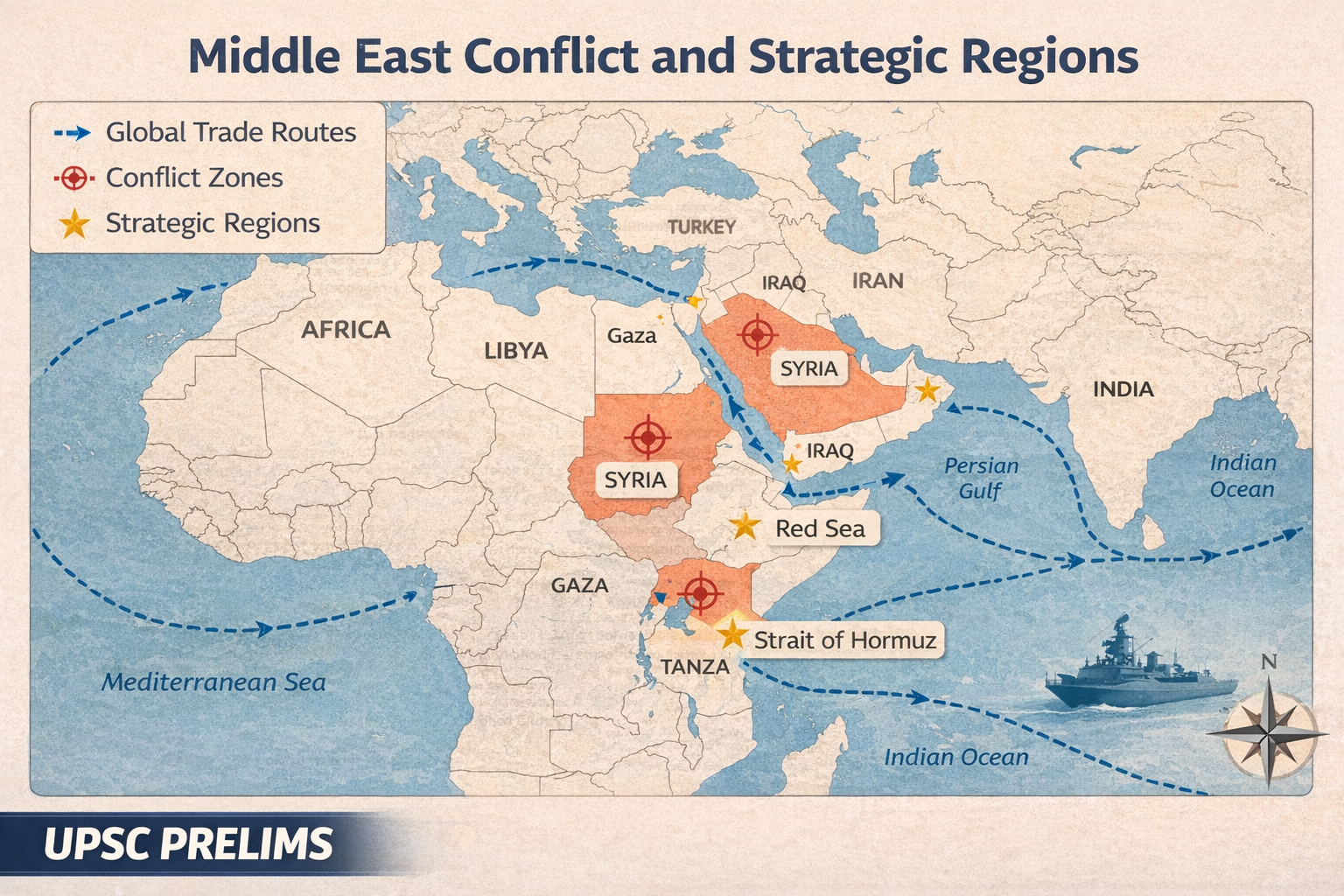
March 2026 Current Affairs MCQs UPSC Prelims: Economic Partnerships & Trade Agreements
This section of March 2026 Current Affairs MCQs UPSC Prelims highlights important economic partnerships and global trade developments.
21. The Indo-Pacific Economic Framework’s implementation protocol was signed by how many countries?
a) 12
b) 14
c) 16
d) 18
Answer: b) 14
22. The IPEF member countries represent approximately what percentage of global GDP?
a) 30%
b) 35%
c) 40%
d) 45%
Answer: c) 40%
23. Unlike traditional trade deals, the Indo-Pacific Economic Framework primarily emphasizes:
a) Tariff reductions only
b) Technology cooperation & clean energy
c) Agricultural trade
d) Manufacturing quotas
Answer: b) Technology cooperation & clean energy
24. The African Continental Free Trade Area achieved which major milestone in March 2026?
a) Tariff elimination
b) Common currency launch
c) Digital payment system launch
d) Infrastructure fund creation
Answer: c) Digital payment system launch
25. AfCFTA’s digital payment system creates the world’s largest free trade zone by:
a) Economic value
b) Geographic area
c) Population size
d) Participating countries
Answer: d) Participating countries
For a deeper understanding of global economic trends and international financial systems, refer to resources from the International Monetary Fund (IMF). It provides valuable information on global trade, economic stability, and financial cooperation. 👉 https://www.imf.org
26. India’s engagement with AfCFTA occurs through which partnership framework?
a) BRICS cooperation
b) India-Africa partnership
c) Commonwealth trade initiative
d) South-South cooperation
Answer: b) India-Africa partnership
27. European carbon border adjustments implemented in March 2026 primarily affect which Indian industries?
a) IT & software
b) Textiles & garments
c) Steel, aluminum & cement
d) Pharmaceuticals
Answer: c) Steel, aluminum & cement
28. Carbon border adjustments represent a new trend linking which two policy areas?
a) Trade & security
b) Environment & trade
c) Technology & diplomacy
d) Energy & defense
Answer: b) Environment & trade
29. The IPEF’s focus on supply chain diversification aims to reduce dependence on:
a) Multiple country supply chains
b) Single-country supply chains
c) Regional trade blocs
d) Multilateral agreements
Answer: b) Single-country supply chains
30. For India, the IPEF represents an opportunity to become a:
a) Technology hub only
b) Financial center
c) Manufacturing hub
d) Agricultural exporter
Answer: c) Manufacturing hub
Economic partnerships and trade agreements are often connected with core economic concepts. To strengthen your fundamentals, you can also solve 👉 Inflation and Monetary Policy MCQs 2026 for UPSC, covering RBI, inflation, and global economy topics.
31. The AfCFTA digital payment system is significant because it:
a) Eliminates all trade barriers
b) Facilitates intra-African trade
c) Replaces national currencies
d) Connects to global banking systems
Answer: b) Facilitates intra-African trade
32. European carbon border adjustments create what type of impact on developing economies?
a) Only positive impacts
b) Only negative impacts
c) Both challenges & opportunities
d) No significant impact
Answer: c) Both challenges & opportunities
33. The IPEF implementation protocol establishes new rules for:
a) Traditional manufacturing only
b) Digital trade & supply chain resilience
c) Agricultural commodities
d) Financial services only
Answer: b) Digital trade & supply chain resilience
34. India’s steel industry must adapt to European carbon border adjustments by:
a) Reducing production
b) Finding alternative markets
c) Improving carbon efficiency
d) Increasing exports
Answer: c) Improving carbon efficiency
35. The economic frameworks established in March 2026 reflect a shift toward:
a) 20th-century trade models
b) Bilateral trade agreements
c) 21st-century strategic partnerships
d) Regional isolation
Answer: c) 21st-century strategic partnerships
36. AfCFTA’s success impacts India’s continental trade strategy by:
a) Creating competition
b) Providing market opportunities
c) Influencing trade patterns
d) All of the above
Answer: d) All of the above
37. The IPEF’s clean energy transition focus aligns with India’s:
a) Manufacturing priorities
b) Renewable energy goals
c) Technology ambitions
d) All of the above
Answer: d) All of the above
38. Carbon border adjustments encourage countries to:
a) Increase carbon emissions
b) Adopt cleaner production methods
c) Reduce trade volumes
d) Ignore environmental concerns
Answer: b) Adopt cleaner production methods
39. The digital payment system in AfCFTA demonstrates the importance of:
a) Traditional banking
b) Digital infrastructure in trade
c) Currency devaluation
d) Import restrictions
Answer: b) Digital infrastructure in trade
40. Economic partnerships in March 2026 emphasized which approach to globalization?
a) Unrestricted free trade
b) Complete protectionism
c) Strategic & sustainable cooperation
d) Regional isolation
Answer: c) Strategic & sustainable cooperation
March 2026 Current Affairs MCQs UPSC Prelims: Security Challenges & Defense Cooperation
Security-related March 2026 Current Affairs MCQs UPSC Prelims help in understanding defence cooperation and emerging global threats.
41. NATO’s new Strategic Concept 2026 expanded collective security to include:
a) Only traditional military threats
b) Cyber attacks & climate-related security
c) Economic warfare only
d) Space-based weapons
Answer: b) Cyber attacks & climate-related security
42. The expansion of NATO’s security definition is significant for India because it:
a) Makes India a NATO member
b) Influences global security cooperation
c) Eliminates regional threats
d) Creates military obligations
Answer: b) Influences global security cooperation
43. New joint patrolling initiatives in March 2026 covered which critical sea lanes?
a) Only Indian Ocean
b) Only South China Sea
c) Indian Ocean, South China Sea & Mediterranean
d) Only Mediterranean Sea
Answer: c) Indian Ocean, South China Sea & Mediterranean
44. Maritime security arrangements are crucial for India’s:
a) Land border security
b) Trade route protection & energy security
c) Aerospace industry
d) Agricultural exports
Answer: b) Trade route protection & energy security
45. The new intelligence sharing protocols for counterterrorism were established between:
a) NATO countries only
b) QUAD members only
c) Multiple countries globally
d) UN Security Council members
Answer: c) Multiple countries globally
46. Enhanced counterterrorism cooperation particularly impacts which region?
a) Southeast Asia
b) South Asia
c) Central Asia
d) West Asia
Answer: b) South Asia
47. Modern security challenges according to March 2026 developments extend beyond traditional threats to include:
a) Only cyber threats
b) Digital & space-based vulnerabilities
c) Economic competition
d) Climate change only
Answer: b) Digital & space-based vulnerabilities
48. India’s participation in maritime security initiatives relates to its:
a) Continental security strategy
b) Naval diplomacy & strategic interests
c) Air defense systems
d) Border management
Answer: b) Naval diplomacy & strategic interests
49. The focus on cybersecurity in international agreements reflects:
a) Decreasing importance of traditional security
b) Growing digital threats to national security
c) Reduced military spending
d) Elimination of physical threats
Answer: b) Growing digital threats to national security
50. Space security cooperation addresses concerns about:
a) Satellite communications only
b) Space exploration funding
c) Space debris & peaceful use of space
d) Commercial space ventures
Answer: c) Space debris & peaceful use of space
51. Cross-border terrorism challenges in South Asia require:
a) Unilateral action only
b) International cooperation & intelligence sharing
c) Military solutions only
d) Economic sanctions
Answer: b) International cooperation & intelligence sharing
52. The Mediterranean Sea patrolling initiatives involve cooperation between:
a) European nations only
b) NATO members only
c) Regional navies from multiple regions
d) UN peacekeeping forces
Answer: c) Regional navies from multiple regions
53. Climate-related security threats include:
a) Natural disasters only
b) Resource conflicts & migration
c) Weather forecasting challenges
d) Agricultural productivity
Answer: b) Resource conflicts & migration
54. India’s defense partnerships with NATO countries like USA & France are influenced by:
a) NATO’s strategic concepts
b) Bilateral defense agreements only
c) UN peacekeeping mandates
d) Regional military alliances
Answer: a) NATO’s strategic concepts
55. The emphasis on space security reflects growing concerns about:
a) Commercial space competition
b) Military use of space assets
c) Satellite collision risks
d) All of the above
Answer: d) All of the above
56. Intelligence sharing protocols help prevent terrorist activities by:
a) Eliminating all security threats
b) Creating effective prevention mechanisms
c) Replacing domestic security agencies
d) Establishing international police force
Answer: b) Creating effective prevention mechanisms
57. Maritime security cooperation demonstrates the importance of:
a) Naval supremacy
b) Collective security approaches
c) Military competition
d) Territorial expansion
Answer: b) Collective security approaches
58. The integration of cyber & space domains in security frameworks shows:
a) Traditional security is obsolete
b) Evolution of security challenges
c) Reduced importance of physical security
d) Complete digitization of warfare
Answer: b) Evolution of security challenges
59. India’s approach to international security cooperation emphasizes:
a) Military alliances
b) Strategic autonomy & partnerships
c) Regional hegemony
d) Isolationist policies
Answer: b) Strategic autonomy & partnerships
60. The comprehensive security approach in March 2026 developments reflects:
a) Single-domain focus
b) Multi-domain security challenges
c) Reduced global cooperation
d) Simplified threat environment
Answer: b) Multi-domain security challenges
These March 2026 Current Affairs MCQs UPSC Prelims are highly important for understanding modern security challenges in UPSC exams.
March 2026 Current Affairs MCQs UPSC Prelims: Climate Diplomacy & Environmental Cooperation
Climate diplomacy is a key area, and these March 2026 Current Affairs MCQs UPSC Prelims cover major environmental agreements and initiatives.
61. The Global Climate Adaptation Summit in March 2026 produced commitments for:
a) Emission reductions only
b) Technology transfer & financial assistance
c) Carbon trading mechanisms
d) Renewable energy targets
Answer: b) Technology transfer & financial assistance
62. India’s role in the Global Climate Adaptation Summit focused on advocating for:
a) Higher emission targets
b) Technology transfer & climate justice
c) Developed country leadership
d) Market-based solutions only
Answer: b) Technology transfer & climate justice
63. The International Solar Alliance announced the addition of how many new member countries in March 2026?
a) 20
b) 22
c) 25
d) 28
Answer: c) 25
64. ISA’s expansion demonstrates India’s growing leadership in:
a) Fossil fuel diplomacy
b) Renewable energy diplomacy
c) Nuclear energy cooperation
d) Energy trading
Answer: b) Renewable energy diplomacy
65. The High Seas Treaty implementation guidelines affect:
a) Coastal waters only
b) National maritime boundaries
c) Marine resources beyond national jurisdictions
d) Inland waterways
Answer: c) Marine resources beyond national jurisdictions66. For India, the High Seas Treaty is significant because of its:
a) Landlocked geography
b) Extensive coastlines & exclusive economic zones
c) Limited maritime interests
d) Focus on river systems
Answer: b) Extensive coastlines & exclusive economic zones
67. New international climate funds launched in March 2026 specifically target:
a) Developed countries only
b) Small island nations
c) Developing countries
d) Industrialized economies
Answer: c) Developing countries
68. These climate funds aim to bridge:
a) Technology gaps
b) The climate finance gap
c) Emission reduction targets
d) Renewable energy capacity
Answer: b) The climate finance gap
69. Ocean conservation agreements in March 2026 influence:
a) Land-based activities only
b) Global fishing, shipping & marine conservation
c) Freshwater management
d) Atmospheric monitoring
Answer: b) Global fishing, shipping & marine conservation
70. India’s engagement with climate financing mechanisms reflects broader themes about:
a) Developed-developing country cooperation
b) Regional competition
c) Technology hoarding
d) Climate denial
Answer: a) Developed-developing country cooperation
71. The ISA’s headquarters being in India provides the country with:
a) Financial benefits only
b) Soft power projection opportunities
c) Technology monopoly
d) Energy independence
Answer: b) Soft power projection opportunities
72. Climate justice principles advocated by India emphasize:
a) Equal responsibility for all countries
b) Historical responsibility & capability differences
c) Market-based solutions only
d) Voluntary commitments
Answer: b) Historical responsibility & capability differences
73. The High Seas Treaty implementation affects global governance of:
a) Terrestrial ecosystems
b) Atmospheric resources
c) Ocean resources & biodiversity
d) Freshwater systems
Answer: c) Ocean resources & biodiversity
74. Green financing mechanisms established in March 2026 focus on:
a) Fossil fuel projects
b) Climate adaptation & mitigation projects
c) Industrial development only
d) Urban infrastructure
Answer: b) Climate adaptation & mitigation projects
75. India’s climate diplomacy approach balances:
a) Economic growth & environmental protection
b) National interests & global cooperation
c) Development needs & climate action
d) All of the above
Answer: d) All of the above
76. The expansion of ISA membership indicates:
a) Declining interest in solar energy
b) Growing global commitment to solar power
c) Technology transfer restrictions
d) Market fragmentation
Answer: b) Growing global commitment to solar power
77. Climate adaptation measures supported by new funds include:
a) Industrial expansion
b) Infrastructure resilience & ecosystem protection
c) Fossil fuel subsidies
d) Technology restrictions
Answer: b) Infrastructure resilience & ecosystem protection
78. Ocean governance frameworks established in March 2026 promote:
a) Unrestricted resource exploitation
b) Sustainable use & conservation
c) National territorial expansion
d) Commercial fishing priority
Answer: b) Sustainable use & conservation
79. The climate finance gap has been a major challenge in:
a) Domestic policy implementation
b) International climate negotiations
c) Technology development
d) Energy pricing
Answer: b) International climate negotiations
80. India’s leadership in renewable energy diplomacy contributes to:
a) Global energy transition
b) South-South cooperation
c) Technology democratization
d) All of the above
Answer: d) All of the above
March 2026 Current Affairs MCQs UPSC Prelims: Regional Organizations & Multilateral Diplomacy
These March 2026 Current Affairs MCQs UPSC Prelims also include important regional organizations and multilateral diplomacy topics.
81. ASEAN announced new cooperation mechanisms with dialogue partners in which areas?
a) Economic integration only
b) Security cooperation only
c) Economic integration & security cooperation
d) Cultural exchanges only
Answer: c) Economic integration & security cooperation
82. India’s Act East Policy makes ASEAN developments crucial for understanding:
a) South Asian regional dynamics
b) Southeast Asian strategic priorities
c) Central Asian cooperation
d) African partnerships
Answer: b) Southeast Asian strategic priorities
83. BRICS discussions in March 2026 focused on:
a) Maintaining current membership
b) Expanding membership & alternative institutions
c) Dissolving the organization
d) Regional trade agreements only
Answer: b) Expanding membership & alternative institutions
84. BRICS expansion discussions reflect broader themes about:
a) Western institutional dominance
b) Global governance reform & emerging economies
c) Regional isolationism
d) Bilateral partnerships only
Answer: b) Global governance reform & emerging economies
85. G20 preparations for the upcoming summit addressed:
a) Regional security issues
b) Global economic challenges & post-pandemic recovery
c) Cultural cooperation
d) Educational exchanges
Answer: b) Global economic challenges & post-pandemic recovery
86. G20 coordination mechanisms influence:
a) Regional policies only
b) Global economic trends & policy coordination
c) Bilateral trade agreements
d) Cultural diplomacy
Answer: b) Global economic trends & policy coordination
87. Regional development banks announced new initiatives focusing on:
a) Military cooperation
b) Infrastructure development & climate adaptation
c) Cultural preservation
d) Educational exchanges
Answer: b) Infrastructure development & climate adaptation
88. These multilateral lending institutions play crucial roles in:
a) Military financing
b) Development financing & technology transfer
c) Political governance
d) Cultural programs
Answer: b) Development financing & technology transfer
89. ASEAN’s enhanced cooperation frameworks benefit India through:
a) Military alliances
b) Trade opportunities & strategic partnerships
c) Cultural dominance
d) Political influence
Answer: b) Trade opportunities & strategic partnerships
90. The discussion about BRICS expansion indicates:
a) Satisfaction with current global institutions
b) Desire for alternative international institutions
c) Rejection of multilateralism
d) Focus on bilateral relationships
Answer: b) Desire for alternative international institutions
91. G20’s focus on sustainable development financing addresses:
a) Military spending priorities
b) Climate change & development needs
c) Cultural preservation funding
d) Educational infrastructure only
Answer: b) Climate change & development needs
92. Multilateral development institutions support India’s goals through:
a) Conditional aid programs
b) Infrastructure financing & capacity building
c) Political conditionalities
d) Cultural requirements
Answer: b) Infrastructure financing & capacity building
93. The emphasis on South-South cooperation in BRICS reflects:
a) Rejection of developed countries
b) Alternative models of international cooperation
c) Regional isolationism
d) Economic protectionism
Answer: b) Alternative models of international cooperation
94. ASEAN dialogue partnerships demonstrate the importance of:
a) Exclusive regional blocs
b) Inclusive & flexible cooperation frameworks
c) Rigid institutional structures
d) Bilateral relationships only
Answer: b) Inclusive & flexible cooperation frameworks
95. Regional organizations’ focus on climate adaptation shows:
a) Local environmental concerns only
b) Integration of global challenges in regional cooperation
c) Separation of climate & development issues
d) Technology transfer restrictions
Answer: b) Integration of global challenges in regional cooperation
96. India’s engagement with multiple regional organizations reflects its:
a) Confused foreign policy
b) Multi-alignment strategy & diverse interests
c) Lack of strategic focus
d) Bilateral preference
Answer: b) Multi-alignment strategy & diverse interests
97. The evolution of multilateral institutions in March 2026 indicates:
a) Declining relevance of international cooperation
b) Adaptation to 21st-century challenges
c) Return to bilateral diplomacy
d) Elimination of global governance
Answer: b) Adaptation to 21st-century challenges
98. Development banks’ infrastructure initiatives support:
a) Developed countries only
b) Emerging economies’ growth needs
c) Military infrastructure
d) Cultural monuments
Answer: b) Emerging economies’ growth needs
99. The coordination between different regional organizations demonstrates:
a) Competitive regionalism
b) Complementary & interconnected regional cooperation
c) Institutional rivalry
d) Exclusive membership benefits
Answer: b) Complementary & interconnected regional cooperation
100. The multilateral diplomacy trends of March 2026 suggest a future characterized by:
a) Unilateral decision-making
b) Complex interdependence & cooperative frameworks
c) Regional isolation
d) Bilateral dominance
Answer: b) Complex interdependence & cooperative frameworks
If you want more practice for UPSC Prelims, you should definitely explore 👉 100 Current Affairs MCQs UPSC 2026, which provide additional high-quality questions based on the latest developments.
Recommended Posts
👉 World Current Affairs MCQs for UPSC Prelims 2027
👉 Indus Valley Civilization MCQs UPSC 2026
👉 Environment MCQs 2026
👉 UPSC Prelims 1000+ Important MCQs for 2026
Most Important Resources for UPSC Prelims 2027
- Current Affairs For UPSC Prelims 2027
- Polity for UPSC Prelims 2027
- Economy for UPSC Prelims 2027
- History for UPSC Prelims 2027
- Science and Technology for UPSC Prelims 2027
- Geography for UPSC Prelims 2027
1 thought on “100 Powerful March 2026 Current Affairs MCQs UPSC Prelims: With Answers”