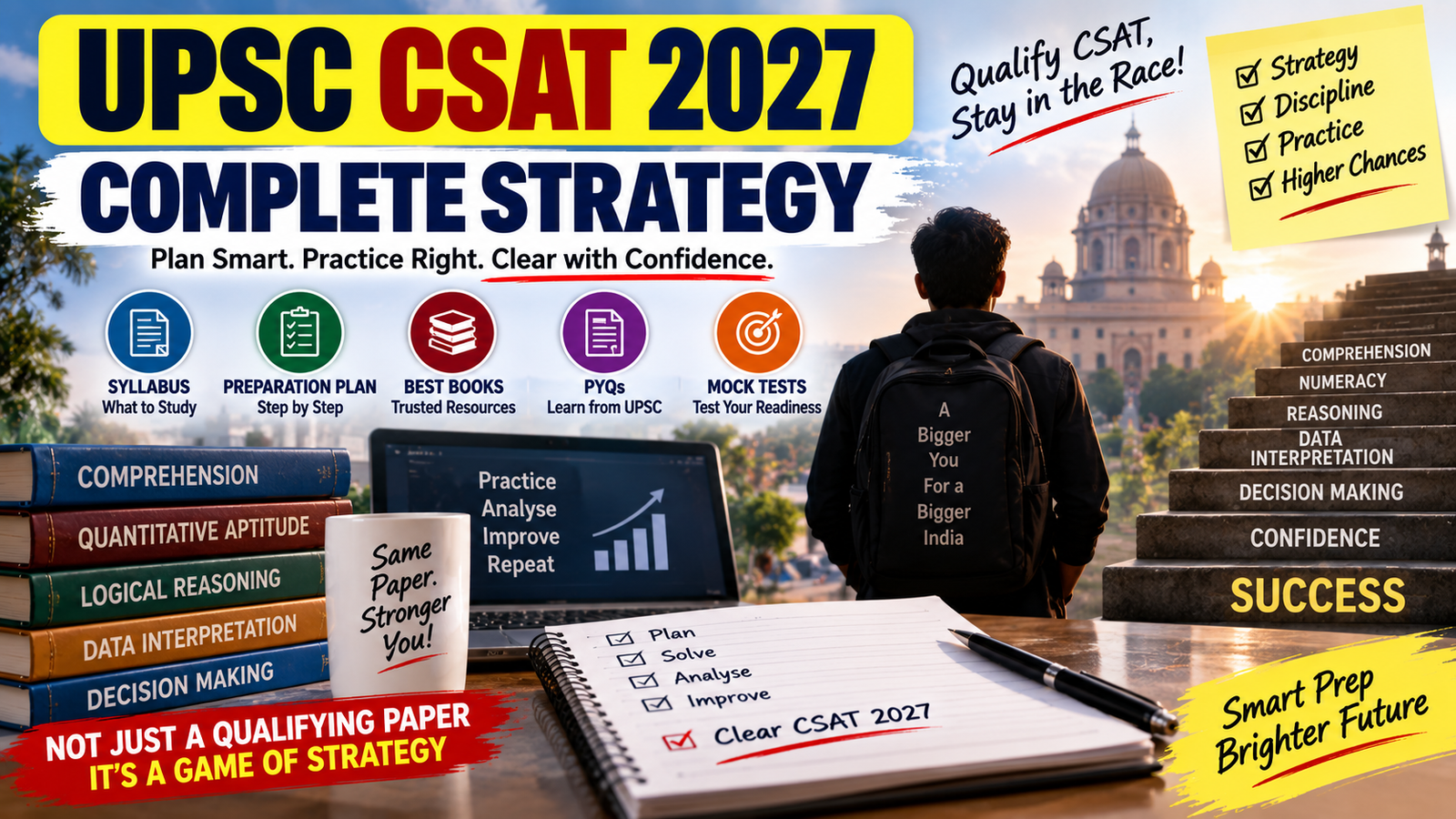
UPSC CSAT 2027 is the General Studies Paper-II of the Civil Services Preliminary Examination. Although CSAT is a qualifying paper, candidates cannot afford to treat it as an afterthought. Under the current UPSC framework, both Preliminary papers are compulsory, each carries 200 marks and has a duration of two hours, while GS Paper-II is qualifying with a minimum requirement of 33%. UPSC also applies negative marking for wrong answers in the Preliminary Examination.
As of September 2026, the UPSC website has the 2026 Civil Services Preliminary Examination as the latest CSE Preliminary examination page and provides its General Studies Paper-II question paper. Therefore, this guide uses the latest officially available framework as the basis for UPSC CSAT 2027 preparation; the eventual 2027 notification should be checked for any change in the scheme or syllabus.
The biggest mistake aspirants make is approaching CSAT as either “just basic maths” or “just a qualifying paper.” Modern CSAT requires a combination of reading ability, logical thinking, quantitative aptitude, time management and accuracy under pressure.
The right objective is not merely to score 66 marks. It is to build enough margin to remain safe despite difficult questions, negative marking and variations in paper difficulty.

What Is UPSC CSAT?
CSAT stands for Civil Services Aptitude Test and corresponds to General Studies Paper-II of the UPSC Civil Services Preliminary Examination.
The official syllabus includes:
- Comprehension
- Interpersonal skills including communication skills
- Logical reasoning and analytical ability
- Decision-making and problem-solving
- General mental ability
- Basic numeracy, including numbers, relations and orders of magnitude, at approximately Class X level
- Data interpretation, including charts, graphs, tables and data sufficiency, at approximately Class X level
The paper is objective and qualifying. The present minimum qualifying standard is 33%, while the marks of GS Paper-II do not determine the Prelims cut-off in the same way as GS Paper-I; UPSC’s 2025 cut-off document explicitly states that the Prelims cut-off was based on GS Paper-I and GS Paper-II was qualifying with 33%.
UPSC CSAT 2027 Exam Pattern
Based on the latest officially available CSE Preliminary framework:
| Feature | CSAT / GS Paper-II |
|---|---|
| Paper | General Studies Paper-II |
| Maximum Marks | 200 |
| Duration | 2 hours |
| Question Type | Objective / MCQ |
| Nature | Qualifying |
| Minimum Qualifying Marks | 33% |
| Language | Hindi and English, subject to the rules applicable to the paper |
| Wrong Answer Penalty | Negative marking applies |
| Main Areas | Comprehension, Reasoning, Decision Making, Mental Ability, Numeracy, Data Interpretation |
UPSC’s examination FAQ states that the Preliminary Examination consists of two compulsory papers of 200 marks each, each of two hours, and that GS Paper-II is qualifying with the current minimum of 33%.
At 33%, the mathematical threshold is 66 marks out of 200. In practice, however, candidates should target a significantly higher score to create a safety margin.
Why CSAT Has Become a Serious Prelims Challenge
The qualifying nature of CSAT sometimes creates a false sense of security.
A candidate may have strong knowledge of History, Polity, Economy and Geography and still fail to qualify if Paper-II performance is inadequate.
The problem becomes more serious when:
Reading speed is low.
The candidate spends too much time on one passage.
Basic arithmetic takes too long.
The candidate attempts difficult questions without an elimination strategy.
Too many guesses lead to negative marks.
There is insufficient mock-test practice.
For this reason, UPSC CSAT 2027 preparation should be treated as a separate skill-building programme, not simply as something to revise during the final month.
According to the official UPSC resources General Studies Paper-II is a compulsory objective paper of 200 marks with a two-hour duration and a minimum qualifying requirement of 33%..
What Actual UPSC Papers Suggest
The best way to understand CSAT is to study actual UPSC question papers rather than relying only on coaching estimates.
UPSC itself maintains the official previous-question-paper archive, and the 2026 Civil Services Preliminary page includes General Studies Paper-II. Earlier papers are also available through the UPSC archive.
Actual papers show that CSAT is not simply a conventional aptitude test.
Candidates are expected to handle:
Long comprehension passages
Inference-based questions
Logical relationships
Multi-step arithmetic
Data interpretation
Time and work
Ratio and proportion
Percentage
Probability and counting-type reasoning in appropriate contexts
Statements and analytical reasoning
The important lesson is that difficulty is often created by the combination of concepts and time pressure, not necessarily by advanced mathematics.

UPSC CSAT 2027 Syllabus: Topic-Wise Breakdown
1. Reading Comprehension
This includes understanding written passages and answering questions based on:
- Central idea
- Inference
- Author’s argument
- Implication
- Tone
- Context
- Statements supported or not supported by the passage
- Logical conclusions
A common mistake is to answer using outside knowledge.
For UPSC-style comprehension, the safest principle is:
Answer according to what the passage supports, not what you personally believe to be true.
2. Interpersonal and Communication Skills
This area is explicitly part of the official syllabus.
The practical preparation requirement is much smaller than that of mathematics or comprehension.
Focus on:
- Communication principles
- Effective communication
- Barriers to communication
- Listening
- Interpersonal interaction
- Situational understanding
3. Logical Reasoning and Analytical Ability
Major areas include:
- Statements and conclusions
- Statements and assumptions
- Cause and effect
- Logical relationships
- Sequencing
- Ordering and ranking
- Directions
- Arrangements
- Basic puzzles
- Analytical reasoning
The objective should be to learn how to structure the information, rather than memorising shortcuts.
4. Decision-Making and Problem-Solving
This section tests whether the candidate can identify the most appropriate action in a situation.
The focus should be on:
- Objectivity
- Practicality
- Prioritisation
- Fairness
- Problem identification
- Appropriate response
- Consequences of different choices
Do not approach such questions like moral-philosophy essays. The correct answer is usually determined by the situation and the principles embedded in the options.
5. General Mental Ability
This includes problems involving logical and numerical thinking.
Useful areas include:
- Series
- Patterns
- Coding-type relationships
- Basic analytical puzzles
- Numerical reasoning
- Logical comparisons
6. Basic Numeracy
The official syllabus places basic numeracy at around Class X level.
Important topics include:
Number System
Divisibility
LCM and HCF
Percentage
Ratio and Proportion
Average
Profit and Loss
Simple and Compound Interest
Time and Work
Pipes and Cisterns
Time, Speed and Distance
Mixtures and Alligation
Basic Algebra
Basic Geometry
Probability and counting concepts where relevant
The goal is not to become a competitive-maths specialist.
The goal is:
Understand → Calculate accurately → Save time
7. Data Interpretation and Data Sufficiency
The official syllabus specifically mentions charts, graphs, tables and data sufficiency at roughly the Class X level.
Focus on:
- Tables
- Bar graphs
- Line graphs
- Pie charts
- Ratios
- Percentages
- Comparisons
- Missing information
- Data sufficiency
How to Start UPSC CSAT 2027 Preparation
Before opening a mathematics book, take one actual UPSC CSAT paper under timed conditions.
Do not worry about your score.
The purpose is diagnosis.
Create four categories:
| Performance | Meaning |
|---|---|
| Correct and confident | Strength |
| Correct but guessed | Risk area |
| Incorrect despite understanding | Accuracy problem |
| Could not understand/solve | Concept gap |
This one exercise is extremely valuable.
A candidate who discovers that comprehension is the weakness should not spend four months solving only arithmetic.
Similarly, someone who can read passages comfortably but cannot solve percentages should not spend most of the preparation time doing comprehension.

The Best UPSC CSAT 2027 Preparation Strategy
The most practical strategy is divided into four phases.
Phase 1: Diagnosis and Foundation
Duration: 2–3 weeks
Take two or three previous-year CSAT papers and identify your weak areas.
Then revise:
- Basic arithmetic
- Number system
- Percentage
- Ratio
- Average
- Basic reasoning
- Reading comprehension
Do not begin with advanced shortcut techniques.
First build conceptual fluency.
Phase 2: Topic-Wise Skill Building
Duration: 2–3 months
Study each major area separately.
A productive sequence is:
Comprehension → Arithmetic → Reasoning → Data Interpretation → Mixed Practice
For mathematics, complete one topic at a time.
For example:
Percentage
→ Ratio
→ Average
→ Profit & Loss
→ Time & Work
→ Time, Speed & Distance
→ Mixtures
→ Algebra
This allows related concepts to reinforce one another.
Phase 3: PYQ Integration
Duration: 2–3 months
After understanding a topic, immediately solve relevant UPSC previous-year questions.
This is important because a topic may look easy in a textbook but behave very differently in the actual UPSC paper.
UPSC’s official archive should be your primary source for previous-year papers.
Create a PYQ notebook containing:
Question
Topic
Method used
Why I got it wrong
Faster method, if available
Time taken
This produces much more useful feedback than simply counting how many questions you solved.
Phase 4: Full-Length Mock Tests
Begin full mocks only after developing basic topic familiarity.
Initially:
1 mock every 2 weeks
Then:
1 mock every week
During the final preparation period:
2 mocks per week, with sufficient analysis time.
The purpose of a mock is not only the score.
Study:
Which questions consumed too much time?
Where did careless mistakes occur?
Which questions should have been skipped?
Were passages taking too long?
Did you panic when mathematics became difficult?
Mock analysis is often more valuable than taking another mock.

How to Prepare Comprehension for UPSC CSAT 2027
Comprehension should be practised consistently.
A useful method is:
Read → Identify argument → Read question → Return to relevant part → Eliminate unsupported choices
Do not automatically choose the most sophisticated-sounding option.
Watch carefully for:
Extreme words
Absolute statements
Information not present in the passage
Statements that are logically possible but not supported
Options that distort the author’s argument
One of the most important habits is distinguishing between:
What the passage says
and
What you already know
The first one controls the answer.
How to Prepare Maths for UPSC CSAT 2027
CSAT mathematics is not about solving every question.
It is about solving the right questions efficiently.
Use the three-step approach:
Concept
Understand the formula and underlying relationship.
Basic Practice
Solve easy and medium questions until the method becomes automatic.
UPSC Application
Move to actual and UPSC-style questions.
For example, while studying percentage, understand its relationship with:
Ratio
Profit and Loss
Discount
Average
Data Interpretation
This reduces the number of separate concepts you need to remember.
Candidates who need additional practice should also work through 100 Powerful CSAT Percentage MCQs 2026 before moving to more difficult quantitative questions.
How to Improve CSAT Speed
Speed does not mean rushing.
Speed comes from:
Recognising the question type
Choosing the shortest reliable method
Avoiding unnecessary calculations
Knowing when to skip
For every question, mentally ask:
Can I solve this confidently within a reasonable time?
If the answer is no, move on.
Return later.
A qualifying paper does not require you to solve every difficult question.

CSAT Time Management Strategy
A candidate should not decide the entire paper strategy for the first time inside the examination hall.
Test different approaches during mocks.
For example:
Strategy A
Comprehension first → Reasoning → Maths
Strategy B
Easy Maths → Reasoning → Comprehension
Strategy C
Easy questions from all sections first → Second round → Difficult questions
There is no universal sequence that works for everybody.
Your mock-test data should decide your order.
How Many Marks Should You Target?
The official qualifying threshold is currently 33%, or 66 marks out of 200.
However, treating 66 as your target is risky.
A better approach is to build a comfortable buffer.
A practical preparation target could be:
80+ = Basic safety zone
90+ = Good working target
100+ = Strong buffer
These are preparation targets, not official cut-offs. Your actual safe score depends on the difficulty of the paper and your accuracy.
The important principle is:
Prepare to score comfortably above the qualifying threshold, not exactly at it.
Should You Attempt All CSAT Questions?
No.
Your aim should be high accuracy, not maximum attempts.
Suppose a paper contains difficult questions and you have only moderate confidence in several of them.
Random guessing can be dangerous because incorrect answers attract negative marking. UPSC explicitly confirms that wrong answers carry a penalty.
A better strategy is:
Sure questions → Attempt
Good elimination → Consider
Pure guess → Usually avoid
Best Books for UPSC CSAT 2027
You do not need a library full of books.
One comprehensive CSAT source + actual PYQs + mock tests is usually enough.
1. General Studies Paper II / CSAT — Pearson
The Pearson CSAT book by Edgar Thorpe and Showick Thorpe covers comprehension, logical reasoning, analytical ability, decision-making, general mental ability, basic numeracy, data interpretation and data sufficiency, along with practice and previous-year material.
Best for: One-book comprehensive preparation.
2. General Studies Paper II — McGraw Hill
McGraw Hill’s General Studies Paper II covers the major CSAT areas and includes practice papers and previous-year material.
Best for: Candidates who prefer a structured, comprehensive course-book format.
3. Quantitative Aptitude — R.S. Aggarwal
Useful primarily for additional arithmetic practice.
Best for: Candidates whose mathematics foundation is weak.
Do not attempt every chapter simply because the book contains it. Select topics relevant to CSAT.
4. Quantitative Aptitude — Arun Sharma
Useful for candidates who want a more structured quantitative-practice approach.
Best for: Candidates who already possess basic mathematical understanding but need practice and speed.
5. Previous-Year UPSC CSAT Papers
This is not optional.
The official UPSC archive should be treated as the most important source for understanding the actual examination standard. UPSC currently provides GS Paper-II papers for recent Civil Services Preliminary examinations through its official archive.
The Most Important “Book” Is the UPSC PYQ
A common mistake is:
Book → Book → Book → Coaching PDF → More Book
Instead, use:
Syllabus → PYQ → Concept Book → PYQ → Mock Test
This cycle prevents over-preparation.
After completing any topic, ask:
How has UPSC actually asked questions from this topic?
That question should decide how deeply you study it.
UPSC CSAT 2027 Daily Study Plan
A working daily schedule could be:
| Time | Activity |
|---|---|
| 30–40 min | Reading comprehension |
| 60 min | Quantitative aptitude |
| 45 min | Logical reasoning |
| 20–30 min | Previous-year questions |
| 15 min | Error-log revision |
This does not mean every aspirant must follow exactly the same timetable.
A candidate with strong mathematics but weak comprehension should shift more time towards reading.
A candidate with strong comprehension but poor arithmetic should do the opposite.
Weekly CSAT Study Plan
Monday
Percentage + comprehension
Tuesday
Ratio & proportion + reasoning
Wednesday
Time & work + comprehension
Thursday
Time, speed & distance + reasoning
Friday
Data interpretation + comprehension
Saturday
Mixed CSAT practice
Sunday
PYQs + timed mini test + error analysis
This creates continuous contact with all major parts of the paper.
The CSAT Error Log
One of the highest-value preparation tools is a simple error notebook.
Create columns:
| Question | Topic | Error Type | Correct Method | Lesson |
|---|---|---|---|---|
| Q1 | Percentage | Calculation | Revised percentage method | Avoid unnecessary steps |
| Q2 | RC | Misread passage | Re-read author’s argument | Don’t use outside knowledge |
| Q3 | Reasoning | Logic error | Diagram method | Structure data first |
| Q4 | DI | Time-consuming | Approximation | Skip if calculation is excessive |
After every mock, classify mistakes as:
Conceptual Error
Calculation Error
Reading Error
Logical Error
Time-Management Error
Careless Error
You will gradually discover that your score is often limited by just two or three recurring weaknesses.
How to Use Previous-Year Questions
Use UPSC PYQs in three stages.
Stage 1 — Learning
Solve immediately after completing a topic.
Stage 2 — Testing
Solve mixed PYQs without knowing the topic beforehand.
Stage 3 — Simulation
Solve complete previous papers under actual time constraints.
Do not merely check whether your answer was correct.
Ask:
Why is the correct option correct?
Why are the other options wrong?
Could I solve it faster?
Would I attempt this question in the actual exam?
This transforms PYQs from question banks into strategic tools.
How to Use Mock Tests Effectively
A mock test without analysis has limited value.
After each mock, record:
Score
Attempted questions
Correct answers
Wrong answers
Questions left unattempted
Average time per question
Comprehension accuracy
Maths accuracy
Reasoning accuracy
Then identify your main problem.
For example:
“I know the concepts but spend too much time on mathematics.”
This requires speed work.
Another candidate may discover:
“I solve maths well but select wrong comprehension options.”
That requires reading and inference practice.
A 6-Month UPSC CSAT 2027 Plan
| Month | Focus |
|---|---|
| Month 1 | Diagnostic test + basic arithmetic + comprehension |
| Month 2 | Percentage, ratio, average, profit-loss + reasoning |
| Month 3 | Time-work, speed-distance, algebra + DI |
| Month 4 | Advanced topic practice + PYQs |
| Month 5 | Full-length mocks + intensive error analysis |
| Month 6 | Revision + PYQs + repeated mocks |
For candidates who already have a strong CSAT background, this can be compressed considerably.
For candidates who struggle with mathematics or comprehension, a longer preparation cycle is safer.
What to Do 90 Days Before Prelims
At this stage, your priorities should shift from learning to performance.
40% — PYQs
30% — Mock Tests
20% — Weak Areas
10% — Formula and method revision
Avoid starting ten new books.
Instead:
Revise → Practise → Analyse → Repeat
What to Do in the Final 30 Days
Do not turn the final month into a mathematics marathon.
Focus on:
Previous-year papers
Full-length mock tests
Comprehension practice
Important arithmetic formulas
Common reasoning patterns
Error-log revision
Time-management practice
The purpose of the final month is to make your performance predictable.
One Week Before the Examination
Reduce experimentation.
Do not suddenly change your attempt strategy.
Do not start a completely new book.
Do not chase difficult questions simply because they appear in coaching material.
Revise:
Your formulas
Your error log
Previous-year questions
Mock-test lessons
Preferred question-order strategy
And protect sleep and concentration.
CSAT Strategy for Non-Maths Background Candidates
You do not need to become a mathematician.
Start with:
Percentage
Ratio
Average
Profit and Loss
Time and Work
Time, Speed and Distance
Basic Number System
Then move towards more mixed questions.
At the same time, practise comprehension every day.
This is important because comprehension can provide a substantial scoring base for candidates who are uncomfortable with mathematics.
The official syllabus itself places numeracy at approximately Class X level, so the emphasis should be on mastery of fundamentals rather than advanced mathematics.
CSAT Strategy for Strong-Maths Candidates
Strong mathematical candidates often make the opposite mistake.
They assume the paper will be easy because the mathematics is at school level.
But CSAT can still become difficult because of:
Time pressure
Long passages
Reasoning traps
Unexpected question selection
Negative marking
Therefore, even strong mathematics candidates should practise comprehension and complete full-length papers.
10 Common CSAT Mistakes
1. Treating CSAT as unimportant
Qualifying does not mean optional.
2. Starting preparation very late
Weak fundamentals cannot always be repaired in a few weeks.
3. Solving only mathematics
Comprehension and reasoning also matter.
4. Ignoring PYQs
This disconnects preparation from the actual UPSC standard.
5. Doing difficult questions first
The objective is not to prove mathematical ability.
6. Excessive guessing
Negative marking can turn uncertain attempts into losses.
7. Not tracking time
A correct solution that takes excessively long may still be strategically poor.
8. Taking mocks without analysis
The lesson is hidden inside the mistakes.
9. Using too many books
More resources often produce less revision.
10. Preparing only for the 66-mark threshold
A safety margin is essential.
A Simple CSAT Decision Framework
During preparation and in the examination, classify questions into three groups:
Category A — Sure
You know the method and can solve it efficiently.
Category B — Possible
You can eliminate options or understand the method but need additional time.
Category C — Risky
You do not understand the method or the question is consuming too much time.
Your first priority should always be:
A → B → C
This simple classification can dramatically improve paper management.
UPSC CSAT 2027 Preparation Checklist
Before the examination, you should be able to say:
I have completed the basic CSAT syllabus.
I have solved recent UPSC CSAT PYQs.
I know my strongest and weakest sections.
I have taken full-length timed mocks.
I have analysed my mistakes.
I can maintain accuracy under time pressure.
I have a clear attempt strategy.
I can safely score above the qualifying threshold in multiple mocks.
That is a much better measure of readiness than simply finishing a book.
Best Strategy in One Line
The entire UPSC CSAT 2027 strategy can be reduced to:
Build fundamentals → Solve PYQs → Practise topic-wise → Take timed mocks → Analyse mistakes → Improve speed and accuracy → Repeat.
CSAT does not require endless resources.
It requires consistent practice and controlled performance.
The official UPSC question-paper archive should remain the foundation of your preparation, because it gives you the actual examination standard rather than an assumed one. UPSC currently provides recent Civil Services Preliminary GS Paper-II papers through its official archive.
Recommended Posts
UPSC CSAT Comprehension 2027: Remarkable Strategy & Question-Solving Techniques
UPSC CSP 2025 Paper 2 (CSAT) Solution | Ultimate UPSC 2026 Rank Booster
CSAT 2026 Strategy to Clear UPSC Prelims Paper 2 (Beginner to Advanced Guide)
100 Powerful CSAT Percentage MCQs 2026 : Boost Your UPSC Prelims Score Fast
Most Important Resources for UPSC Prelims 2027
- Current Affairs For UPSC Prelims 2027
- Polity for UPSC Prelims 2027
- Economy for UPSC Prelims 2027
- History for UPSC Prelims 2027
- Science and Technology for UPSC Prelims 2027
- Geography for UPSC Prelims 2027
Final Takeaway
UPSC CSAT 2027 should be approached as a qualifying paper that nevertheless deserves serious preparation.
The minimum requirement under the present framework is 33%, but the sensible target is to build a comfortable buffer above that level.
The strongest preparation model is:
Understand the official syllabus.
Start with a diagnostic paper.
Identify your weak areas.
Build basic arithmetic and reasoning.
Practise comprehension regularly.
Solve UPSC PYQs repeatedly.
Take full-length mocks.
Maintain an error log.
Improve speed without sacrificing accuracy.
Enter the examination with a pre-tested attempt strategy.
The difference between merely “clearing CSAT” and clearing it comfortably is usually not another book. It is practice quality, time management and the ability to recognise which questions are worth attempting.
For the 2027 examination, keep checking the Official UPSC Website for the final notification and any change in the scheme or syllabus before locking your strategy. As of September 2026, the official CSE Preliminary page available is for 2026, while UPSC’s question-paper archive provides the latest official papers for practice.
1 thought on “UPSC CSAT 2027 Complete Strategy: Syllabus, Books, PYQs & Mock Tests”