Introduction: August Last Week Current Affairs 2026 (Complete One-Liner Revision)
August Last Week Current Affairs 2026 revision becomes easier when important developments of the week are converted into concise, factual one-liners.
This compilation covers 24 August to 31 August 2026 and focuses on current affairs that can support UPSC Civil Services Preliminary Examination 2027 preparation.
The coverage includes Polity, Governance, International Relations, Economy, Environment, Geography, Science & Technology, Defence, Agriculture, Health, Culture, Sports, Awards, Reports, Schemes and Important Places in News.
August Last Week Current Affairs 2026 covers the most important developments from 24 to 31 August 2026 for UPSC Prelims 2027 preparation.
The objective is not to cover every news story of the week, but to filter the developments that have a reasonable possibility of becoming Prelims-oriented factual or conceptual questions.
These August Last Week Current Affairs 2026 are selected with a focus on factual and conceptual areas relevant to the UPSC Prelims examination.
If you are building your UPSC Prelims 2027 preparation around both static concepts and current events, you can also revise our detailed Indian Rivers and Drainage System for UPSC Prelims 2027 guide to strengthen the geography concepts behind several water-related developments.
National Affairs, Polity & Governance
The following August Last Week Current Affairs 2026 cover important developments in Indian polity, governance and national affairs.
- Andhra Pradesh became the first Indian state to formulate a dedicated Pedestrian Safety and Universal Accessibility Policy in 2026.
- The Andhra Pradesh Pedestrian Safety Policy focuses on road-safety audits, pedestrian infrastructure and behavioural change measures.
- The Andhra Pradesh policy invokes Section 198A of the Motor Vehicles Act, 1988, relating to responsibility for infrastructure-related pedestrian deaths or disabilities.
- The Union Ministry of Home Affairs constituted a high-level committee to work towards a permanent political solution to the Gorkha issue.
- The demand for a separate administrative identity for the Gorkha population in the Darjeeling region dates back to the early twentieth century.
- The Ganges Water Sharing Treaty of 1996 regulates the sharing of Ganga waters between India and Bangladesh during the dry season.
- The India-Bangladesh Ganges Water Sharing Treaty was signed on 12 December 1996.
- The Ganges Water Sharing Treaty is scheduled to expire in December 2026.
- The Farakka Barrage was commissioned in 1975 primarily to divert Ganga water towards the Hooghly River and help maintain the navigability of Kolkata Port.
- The 1996 Ganges Water Sharing Treaty does not contain a minimum-flow guarantee clause similar to the earlier 1977 arrangement.
- India rejected concerns raised by the UN Committee on the Elimination of Racial Discrimination regarding alleged discrimination against various groups.
- The International Convention on the Elimination of All Forms of Racial Discrimination is monitored by the UN Committee on the Elimination of Racial Discrimination.
- The Supreme Court directed the Union government to conduct a fresh survey of elephant corridors.
- Elephant corridors are ecological linkages that allow elephants to move between fragmented habitats.
- India’s principal elephant landscapes include the Western Ghats; North-Eastern Hills and Brahmaputra floodplains; Shivalik Hills and Gangetic plains; and Central India and Eastern Ghats.
- The Supreme Court’s observations on elephant corridors underline the importance of maintaining wildlife connectivity.
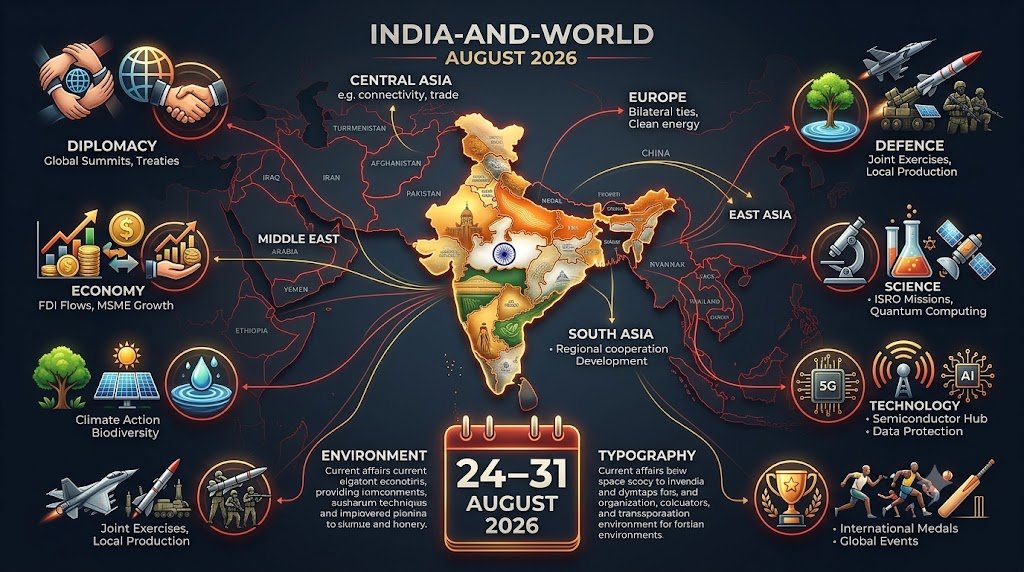
International Relations
- Prime Minister Narendra Modi visited Uzbekistan from 29–30 August 2026.
- India and Uzbekistan elevated their bilateral relationship to a Comprehensive Strategic Partnership.
- India and Uzbekistan set a bilateral trade target of US$5 billion by 2030.
- India and Uzbekistan discussed a framework for long-term uranium supplies to India.
- India announced a US$1 million grant for ecological rehabilitation and afforestation in the Aral Sea region.
- India and Uzbekistan agreed to strengthen UPI–UZQR interoperability for cross-border merchant payments.
- India and Uzbekistan reaffirmed cooperation through Exercise Dustlik, their bilateral military exercise.
- India and Uzbekistan agreed to cooperate on critical minerals such as lithium, copper and rare earth elements.
- India and Uzbekistan discussed defence co-development and co-production.
- India and Uzbekistan signed an agreement concerning conservation and digitisation of ancient Buddhist sites at Fayaz Tepa and Karatepa in Termez.
- A total of 11 agreements or pacts were signed during the India-Uzbekistan state visit.
- India announced 100 Lal Bahadur Shastri scholarships for Hindi-language studies in Uzbekistan.
- An ICCR Sanskrit Chair was announced at Tashkent State University of Oriental Studies.
- India-Uzbekistan bilateral trade during 2025–26 was close to US$1 billion.
- Prime Minister Narendra Modi received Uzbekistan’s highest state honour for foreign leaders, the Oliy Darajali Do’stlik Order.
- The 17th Conference of Parties to the UN Convention to Combat Desertification, UNCCD COP17, was held in Ulaanbaatar, Mongolia.
- The theme of UNCCD COP17 was “Restoring Land. Restoring Hope.”
- UNCCD is the international framework specifically addressing desertification, land degradation and drought.
- India launched its first Guide to Grasslands and Other Open Natural Ecosystems of India at UNCCD COP17.
- India advocated a shift from reactive drought relief towards proactive, technology-enabled drought resilience.
Students can also consult the official Ministry of External Affairs website for India’s bilateral relations and major international agreements.
Economy & Financial Sector
For UPSC Prelims 2027, these August Last Week Current Affairs 2026 provide important facts related to the Indian economy and financial sector.
- SEBI introduced the IT Resilience Index for Market Infrastructure Institutions.
- The IT Resilience Index is intended to measure the technology and cyber resilience of Market Infrastructure Institutions.
- Market Infrastructure Institutions include entities such as stock exchanges and clearing corporations.
- The SEBI IT Resilience Index framework contains multiple parameters covering areas such as availability, security, integrity, governance, reliability, monitoring, modularity, flexibility, business continuity and scalability.
- Availability and security carry major weight in the IT Resilience Index framework.
- The IT Resilience Index framework is scheduled to become operational from early 2027.
- Market Infrastructure Institutions will calculate the IT Resilience Index on a half-yearly basis.
- The Government appointed Annie George Mathew, Janmejaya Kumar Sinha and Syed Akbaruddin as part-time non-official directors on the RBI Central Board.
- The new RBI Central Board appointments are for a four-year term.
- The appointments were made under Section 8(1)(c) of the Reserve Bank of India Act, 1934.
- The RBI’s August assessment highlighted domestic demand, manufacturing, services recovery, monsoon conditions and capital inflows as important growth-supporting factors.
- The RBI Monetary Policy Committee retained the repo rate at 5.25%.
- The RBI raised its FY2026–27 growth projection to 6.7%.
- The RBI lowered its FY2026–27 inflation projection to 5%.
- The term “chipflation” refers to rising consumer-electronics prices associated with shortages and rising prices of semiconductor memory chips.
- Rising demand from the AI industry has contributed to pressure on global memory-chip supplies.
- India’s real GDP grew by 7.8% in Q1 FY2026–27.
- India’s Q1 FY2026–27 GDP growth was stronger than several earlier expectations.
- India’s real GDP for Q1 FY2026–27 was approximately ₹81.36 lakh crore at constant prices.
- Multi-Lane Free Flow technology enables barrier-less electronic toll collection.
- MLFF can use technologies such as RFID and Automatic Number Plate Recognition.
- MLFF allows vehicles to pass through tolling points without stopping at conventional toll plazas.
- MLFF is intended to reduce congestion and waiting time at toll plazas.
These economic developments become much easier to understand when current affairs are studied alongside fundamental concepts of the Indian economy. Students preparing for UPSC Prelims 2027 can therefore continue with our Indian Economy Notes for a structured revision of the core concepts.
Many of the economic, environmental, infrastructure and technology developments covered in this weekly revision are also relevant to the broader GS Paper 3 syllabus. Aspirants preparing simultaneously for Mains can refer to our UPSC Mains GS 3 2027 Complete Syllabus, Important Topics, Notes & Current Affairs guide.
For authoritative information on monetary policy, the repo rate and other central banking developments, students can refer to the official RBI website.
Environment, Ecology & Geography
Environment and geography remain important areas of the August Last Week Current Affairs 2026 revision for UPSC Prelims 2027.
- Severe flash floods affected the Nepal–Tibet border region on 26 August 2026.
- The affected river systems included the Lhende Khola and Bhotekoshi.
- The disaster damaged roads, bridges, houses and other infrastructure.
- The Nepal flash-flood disaster was associated with an ice-rock avalanche in the upper reaches of the Bhotekoshi river system.
- The Bhotekoshi is associated with the larger Himalayan river system connected with the Trishuli.
- The Trishuli River forms part of the larger Gandaki-Narayani-Ganga drainage system.
- Climate-resilient agriculture involves measures such as crop diversification, resilient storage systems and adaptation to changing climate conditions.
- Meghalaya’s uranium-mining debate involves issues related to energy security, environmental protection and customary tribal land rights.
- The Drought Resilience Index and Investment Facility emerged as a relevant concept in discussions on drought resilience.
- The Black-necked Stork showed breeding activity in the Khijadia wetland landscape of Gujarat.
- Khijadia Bird Sanctuary is located in Gujarat.
- Khijadia lies along the Central Asian Flyway.
- The Black-necked Stork is an important wetland bird species found in India.
- A new subterranean fish species named Gangaichthys indonepalicus was reported from Bihar.
- Gangaichthys indonepalicus was reported near the Nepal border in Pashchim Champaran district.
- Gangaichthys indonepalicus belongs to the Chaudhuriidae family.
- The Zoological Survey of India is headquartered in Kolkata.
- The Zoological Survey of India functions under the Ministry of Environment, Forest and Climate Change.
- A new plant species named Doronicum sanctum was reported from Tawang district of Arunachal Pradesh.
- Doronicum sanctum was recorded at an altitude of approximately 4,000 metres.
- The discovery represented the first documentation of the Doronicum genus in Northeast India.
- Lake Ontario is one of the five Great Lakes shared by the United States and Canada.
- The five Great Lakes are Superior, Michigan, Huron, Erie and Ontario.
- The Great Lakes form one of the world’s largest freshwater systems.
- Dolma La Pass is a high-altitude mountain pass associated with the Kailash-Mansarovar pilgrimage route in Tibet.
- The Paracel Islands are a disputed archipelago in the South China Sea.
- The Paracel Islands are claimed by China, Vietnam and Taiwan.
Environmental current affairs frequently connect with static concepts such as ecosystems, biodiversity, climate change, land degradation and conservation. For comprehensive UPSC preparation, students can also revise our dedicated Environment MCQs 2027: 100 Most Important Questions for UPSC Prelims.
Students can refer to the official UNCCD website for information about the Convention, its objectives and global initiatives.
Science & Technology
- The Pradhan Mantri Surya Sarovar Yojana aims to promote floating solar capacity and battery storage.
- The scheme targets 5,000 MW of floating solar capacity.
- The scheme also targets 10,000 MWh of battery storage.
- The approved outlay for the scheme is approximately ₹5,070 crore.
- Floating solar photovoltaic systems are installed on reservoirs, lakes and other inland water bodies.
- India’s estimated technical potential for floating solar has been assessed at more than 100 GWp.
- The Nationwide Cloud and AI Skilling Initiative was highlighted as an important technology-skilling initiative.
- Gnani Artha is a sovereign artificial-intelligence stack.
- Gnani Artha comprises Evon 3.3 and Plexus.
- The Department of Telecommunications and C-DOT signed an agreement for an end-to-end optical network testbed.
- The optical network testbed is being established at the C-DOT campus in New Delhi.
- The Digital Personal Data Protection Act, 2023 remains an important framework for India’s personal-data protection regime.
- DAANVEER was highlighted as a computer-crowdsourcing initiative.
- SCADA stands for Supervisory Control and Data Acquisition.
- SCADA systems are widely used for monitoring and controlling industrial infrastructure.
- Vacuum birefringence is a quantum-electrodynamic phenomenon associated with strong electromagnetic fields.
- Vacuum birefringence refers to changes in the optical properties of vacuum under sufficiently strong electromagnetic fields.
- Hanging glaciers are particularly relevant to Himalayan disaster-risk discussions because glacier instability can trigger ice-rock avalanches.
Defence & Security
- India signed an agreement with the United States for procurement of the FGM-148 Javelin anti-tank guided missile system.
- The reported Javelin procurement package is worth approximately US$93 million.
- The package involves nearly 100 Javelin missile systems.
- The Javelin is a man-portable, fire-and-forget anti-tank guided missile.
- The Javelin uses infrared guidance.
- The Javelin can operate in top-attack and direct-attack modes.
- The Javelin system is manufactured by a joint venture involving Lockheed Martin and RTX Corporation.
- Defence Minister Rajnath Singh approved the transfer of technology for several DRDO-developed conventional missile systems to Indian defence industry.
- Missile systems associated with the technology-transfer initiative include Astra, Rudram, VSHORADS and NAG.
- Agni and K-series missiles were excluded from the conventional missile technology-transfer plan because of their strategic character.
- HAL and Safran Helicopter Engines agreed to jointly develop the Aravalli high-power helicopter engine.
- The Aravalli engine is intended for India’s next-generation 13-tonne helicopters.
- The engine is intended for the Indian Multi-Role Helicopter and naval Deck-Based Multi-Role Helicopter.
- The Indian Coast Guard received ICGS Ajit, a Fast Patrol Vessel.
- ICGS Ajit was built by Goa Shipyard Limited.
- ICGS Ajit is associated with the Adamya-class Fast Patrol Vessels.
- The Indian Navy commissioned INS Nipun at the Naval Dockyard in Mumbai.
- INS Nipun is a Diving Support Vessel.
- INS Nipun belongs to the Nistar-class Diving Support Vessel series.
- India secured Dialogue Partner status in the Global Combat Air Programme.
- GCAP is associated with development of a sixth-generation fighter aircraft.
- The CISF signed an MoU with the Drone Federation of India to strengthen counter-drone capabilities.
- Counter-drone technology is increasingly relevant for protecting critical infrastructure and strategic installations.
- The Indian Coast Guard decommissioned ICGS Meera Behn and ICGS Subhadra Kumari Chauhan.
- The YJ-18A is a Chinese anti-ship cruise missile associated with naval platforms.
- The YJ-18A has been associated with Type 052D and Type 055 Chinese destroyers.
Agriculture, Health & Social Sector
- India launched a non-GMO high-expansion popcorn maize hybrid seed in Andhra Pradesh.
- The popcorn maize hybrid was launched at Musunuru in Eluru district of Andhra Pradesh.
- Periyar Kullan is an indigenous dwarf cattle breed associated with Kerala.
- Periyar Kullan has been registered by ICAR-NBAGR.
- The Garbhini Mitra Course was highlighted in the context of maternal healthcare and training.
- The government examined concerns relating to certain chlorpheniramine and phenylephrine fixed-dose combinations in paediatric use.
- A Parliamentary Standing Committee examined issues related to affordability and accessibility of healthcare.
- The difference in treatment costs between public and private hospitals remains an important issue in India’s healthcare-access debate.
- Health is a State subject under the Indian Constitution.
- The Clinical Establishments Act, 2010 is relevant to regulation of clinical establishments.
- The e-Shram Portal completed five years as an important database and social-security platform for India’s unorganised workforce.
Culture, History & Important Days
- Rajghat archaeological site is located near the confluence of the Ganga and Varuna rivers near Varanasi.
- Archaeological remains at Rajghat were first discovered in 1939 during expansion of the Kashi railway station.
- Rajghat contains evidence belonging to multiple cultural periods.
- World Sanskrit Day 2026 was observed on 28 August.
- World Sanskrit Day is associated with Shravana Purnima.
- The International Day against Nuclear Tests is observed on 29 August.
- The United Nations General Assembly established the International Day against Nuclear Tests through Resolution A/RES/64/35.
- The date 29 August commemorates the closure of the Semipalatinsk Nuclear Test Site in Kazakhstan in 1991.
- The Semipalatinsk Nuclear Test Site witnessed hundreds of nuclear tests during the Soviet period.
- The Mediation Council of India was notified with its headquarters in New Delhi.
- The Mediation Council of India is intended to strengthen India’s mediation ecosystem.
Sports Current Affairs
- Grandmaster R Praggnanandhaa became the first Indian to win the Grand Chess Tour.
- Praggnanandhaa defeated Fabiano Caruana in the Grand Chess Tour Finals.
- The 2026 Grand Chess Tour Finals were held at the Saint Louis Chess Club in Missouri, USA.
- Praggnanandhaa won a US$200,000 winner’s prize from the Grand Chess Tour Finals.
- The Grand Chess Tour includes Classical, Rapid and Blitz formats.
- National Sports Day was observed in India on 29 August.
- National Sports Day commemorates the birth anniversary of Major Dhyan Chand.
- Hockey India announced a ₹50 lakh reward for the Indian women’s hockey team following its 2026 World Cup campaign.
- The Ministry of Youth Affairs and Sports approved a 15-member Indian esports contingent for the 2026 Asian Games.
- India’s esports contingent qualified for League of Legends, Pokémon UNITE, eFootball and Puyo Puyo Champions.
- The BWF World Championships 2026 in New Delhi featured important Indian performances during the week.
- Treesa Jolly and Gayatri Gopichand won a bronze medal in Women’s Doubles at the BWF World Championships.
- The Treesa-Gayatri medal ended India’s long wait for a Women’s Doubles medal at the BWF World Championships.
- India’s previous Women’s Doubles World Championships medal came through Jwala Gutta and Ashwini Ponnappa in 2011.
Sports-related developments can also become useful factual questions in competitive examinations. For students following monthly sports current affairs, our August 2026 Sports Current Affairs MCQs provide an additional practice resource for revision.
Awards, Appointments & Miscellaneous
- Peyman Kargar was appointed CEO and Director of TVS Motor Company with effect from January 2027.
- Yuko Keicho of Japan was appointed Vice President and Auditor General of the World Bank Group.
- The Department of Administrative Reforms and Public Grievances received recognition under the Rajbhasha Utkrishtta Sammaan.
- Vice-President C. P. Radhakrishnan released the book “Sankalp Se Siddhi Ka Modi Yug.”
- The book was authored by Rajya Sabha MP Ghanshyam Tiwari.
- The Banaras Biennale 2026 is scheduled from 27 November to 31 December 2026.
- The theme of the Banaras Biennale 2026 is “KASHI / LIGHT – City as Sensorium.”
- BHU and CII signed MoUs related to the E2EE Career Lounge and Banaras Biennale.
- The Taiwan–India Industrial Collaboration Summit was held in Bengaluru.
- The Taiwan–India summit covered areas including electronics manufacturing, green technologies, smart technologies and automotive components.
- Six MoUs were associated with the Taiwan–India industrial collaboration initiative.
- The Mediation Council of India is intended to strengthen India’s domestic and international mediation ecosystem.
Quick Revision Memory Chain
For a last-minute revision before attempting a UPSC Prelims 2027 current affairs test, remember the following chain:
UNCCD COP17 → Ulaanbaatar → Mongolia → Land Degradation → Drought → “Restoring Land. Restoring Hope.”
India–Uzbekistan → Comprehensive Strategic Partnership → $5 Billion Trade Target → Uranium → Critical Minerals → UPI–UZQR → Dustlik
Ganges Treaty → 1996 → India–Bangladesh → Farakka → Dry-season Water Sharing → December 2026 Expiry
SEBI → IT Resilience Index → Market Infrastructure Institutions → Cyber Resilience → 2027
GDP → Q1 FY2026–27 → 7.8%
RBI → Repo Rate → 5.25%
Javelin → India–USA → Anti-Tank → Fire-and-Forget → Infrared → Top Attack
DRDO → Astra → Rudram → VSHORADS → NAG
HAL + Safran → Aravalli → Helicopter Engine
Nepal → Bhotekoshi → Trishuli → Ice-Rock Avalanche → Flash Floods
Khijadia → Gujarat → Black-necked Stork → Central Asian Flyway
Gangaichthys indonepalicus → Bihar → Subterranean Fish → Chaudhuriidae
Doronicum sanctum → Tawang → Arunachal Pradesh → ~4,000 m
Gnani Artha → Sovereign AI → Evon 3.3 + Plexus
GCAP → India → Dialogue Partner → Sixth-Generation Fighter
Praggnanandhaa → Grand Chess Tour → First Indian Winner
29 August → National Sports Day → Major Dhyan Chand
29 August → International Day against Nuclear Tests → Semipalatinsk
For a more complete UPSC Prelims 2027 preparation strategy, do not study these current affairs in isolation. Combine weekly revision with subject-wise notes, practice questions and static-concept revision. You can continue your preparation with our UPSC-focused study resources and practice materials.
Final Quick Takeaway for UPSC Prelims 2027
These August Last Week Current Affairs 2026 can be used as a quick revision resource before attempting UPSC Prelims 2027 practice questions.
The most important areas to revise are:
- India–Uzbekistan relations
- UNCCD and land degradation
- Ganges Water Sharing Treaty and Farakka
- SEBI and IT Resilience Index
- GDP and RBI monetary policy
- Himalayan floods and river systems
- New species and biodiversity
- Floating solar and AI technology
- Javelin and indigenous defence technology
- GCAP and sixth-generation fighter technology
- National Sports Day
- Praggnanandhaa and Grand Chess Tour
- Important international days
- New appointments and institutions
The article is useful not just as a news roundup, but as a one-week UPSC Prelims revision sheet, where each fact can potentially be connected to a static concept, map-based question, institution, treaty, species, scheme or constitutional provision.