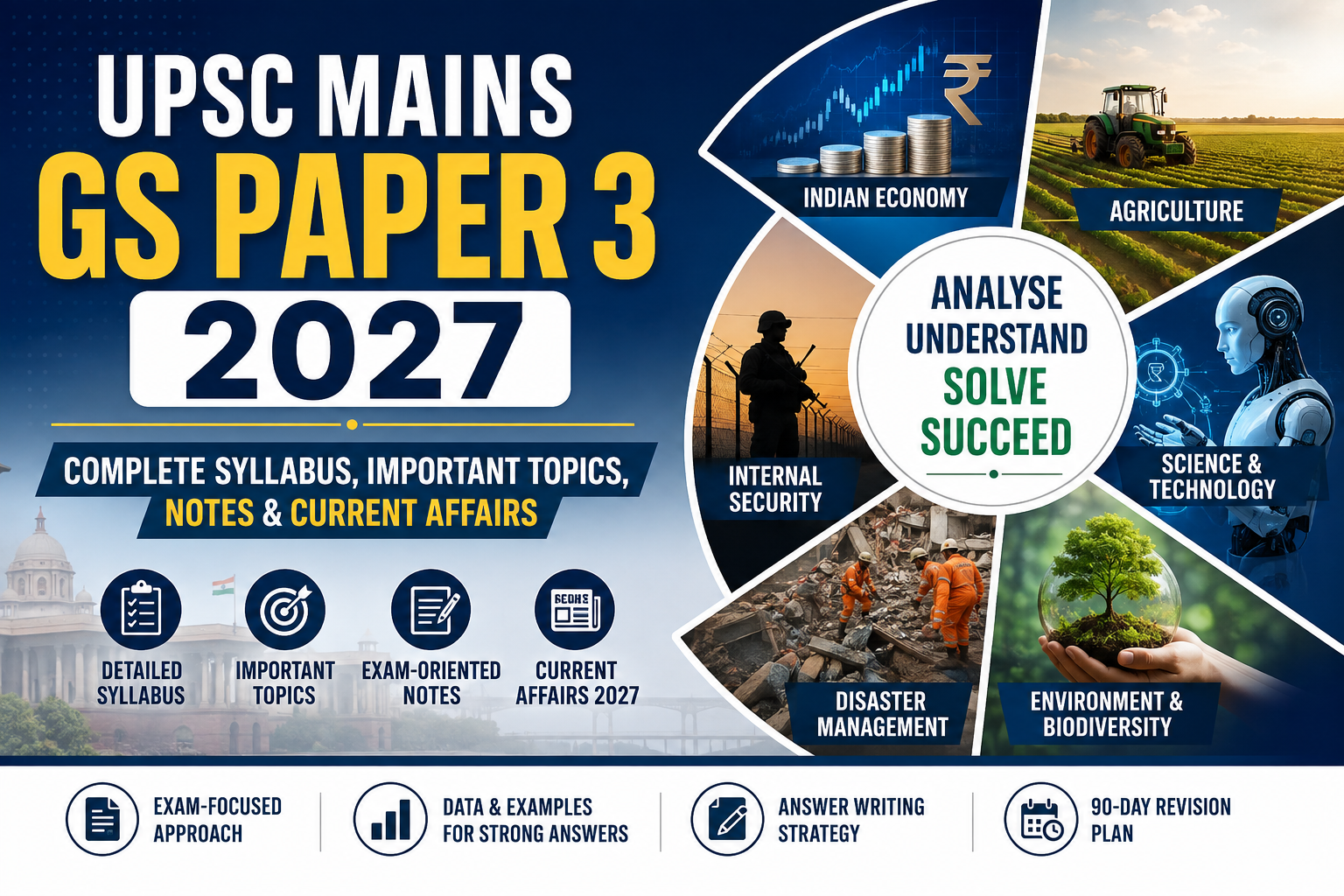
UPSC Mains GS Paper 3 2027 covers some of the most dynamic areas of the Civil Services Examination, including the Indian economy, agriculture, science and technology, environment, disaster management and internal security. The paper tests not only factual knowledge but also the ability to analyse contemporary issues, explain challenges and suggest practical solutions.
The UPSC has already released its Annual Calendar 2027. According to the official calendar, the Civil Services (Main) Examination 2027 is scheduled to commence on 20 August 2027 and is listed for five days.
Important: The detailed CSE 2027 notification is scheduled for 13 January 2027. Therefore, the syllabus framework presented below follows the latest officially notified GS Paper III syllabus available from UPSC and should be cross-checked against the 2027 notification when released.
A well-planned approach to UPSC Mains GS Paper 3 2027 can help aspirants integrate static concepts with current affairs and improve answer-writing quality.
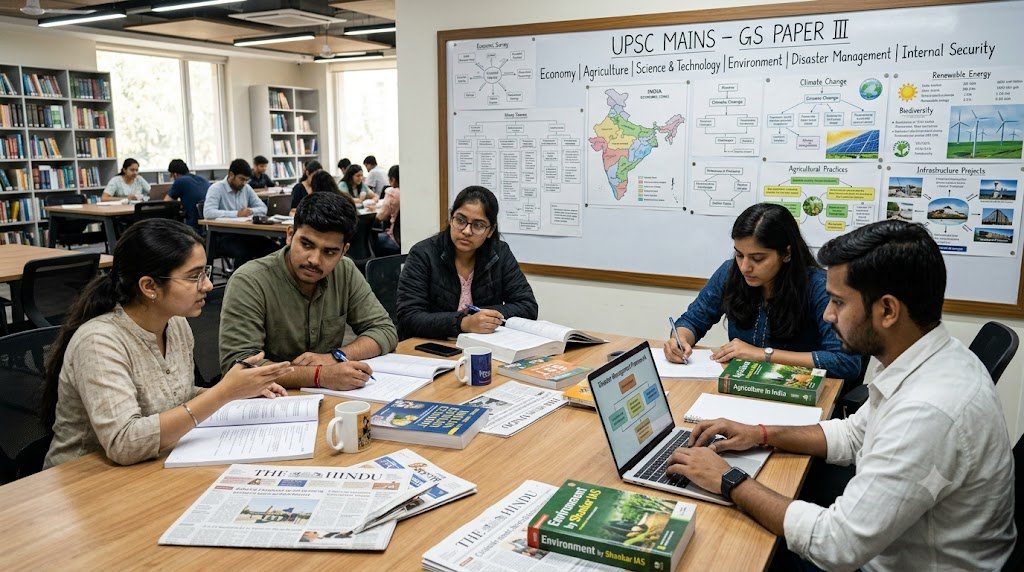
What Is UPSC GS Paper 3?
General Studies Paper III is officially titled:
Technology, Economic Development, Bio-diversity, Environment, Security and Disaster Management
The latest UPSC syllabus covers six broad areas:
- Indian Economy
- Agriculture
- Science & Technology
- Environment & Biodiversity
- Disaster Management
- Internal Security
The official syllabus also specifically mentions issues such as inclusive growth, government budgeting, irrigation, food processing, infrastructure, investment models, emerging technologies, environmental degradation, disaster management, extremism, cyber security and money laundering.
UPSC Mains GS Paper 3 Syllabus 2027
Indian Economy
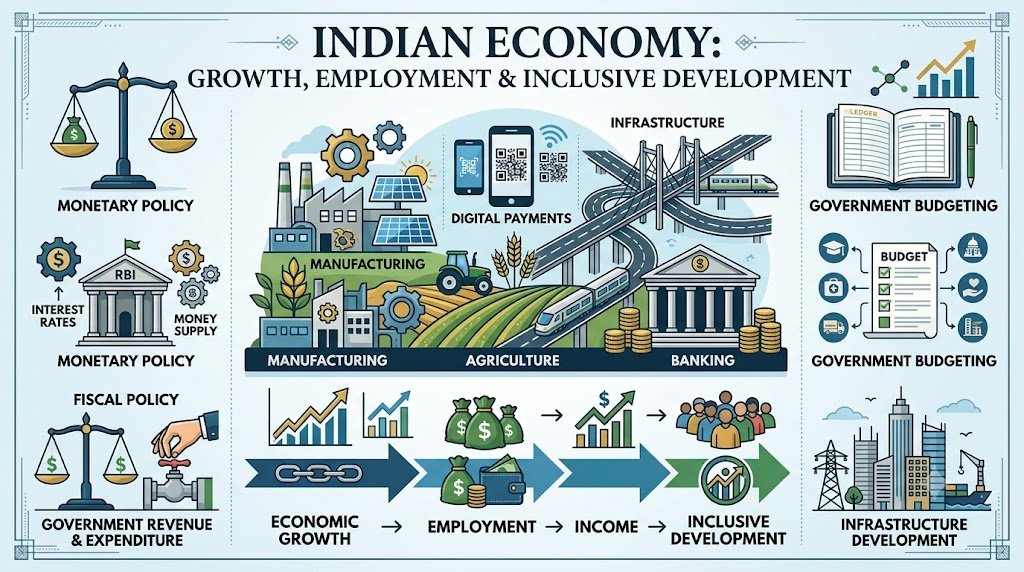
The economy portion includes:
- Indian Economy
- Planning and resource mobilisation
- Mobilisation of resources
- Economic growth
- Economic development
- Employment
- Inclusive growth
- Issues arising from inclusive growth
- Government budgeting
- Effects of liberalisation
- Changes in industrial policy
- Effects of industrial policy on industrial growth
- Infrastructure
- Investment models
The official syllabus specifically places planning, resource mobilisation, growth, development, employment, inclusive growth and government budgeting under GS Paper III.
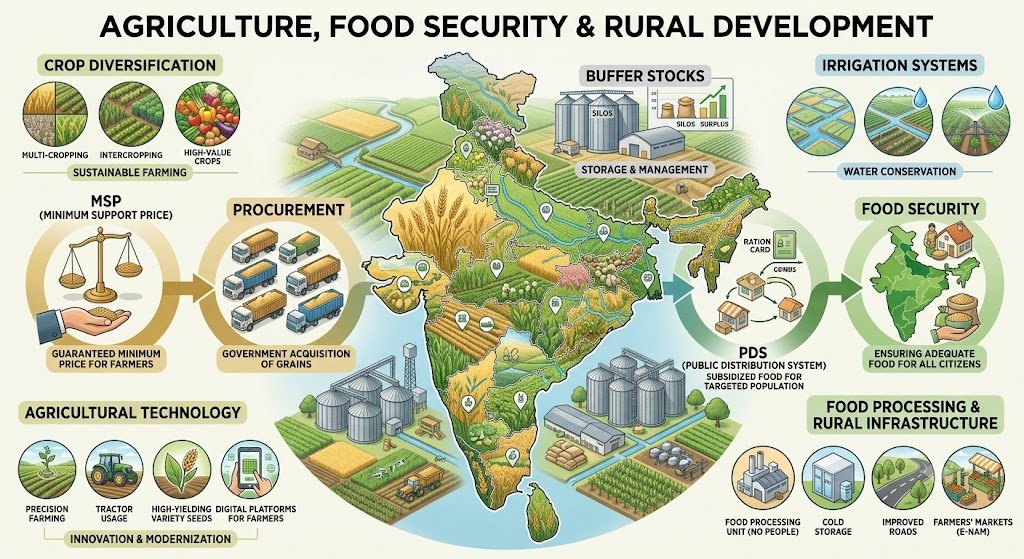
Agriculture
Agriculture is one of the most important areas of GS Paper III.
Prepare:
- Major crops
- Cropping patterns
- Regional cropping patterns
- Different types of irrigation
- Irrigation systems
- Water storage
- Agricultural produce
- Agricultural transport
- Agricultural marketing
- Constraints in agricultural marketing
- E-technology for farmers
- Farm subsidies
- Minimum Support Price
- Public Distribution System
- Buffer stocks
- Food security
- Technology missions
- Economics of animal rearing
- Food processing
- Land reforms
These themes are explicitly included in the official syllabus.
Science & Technology
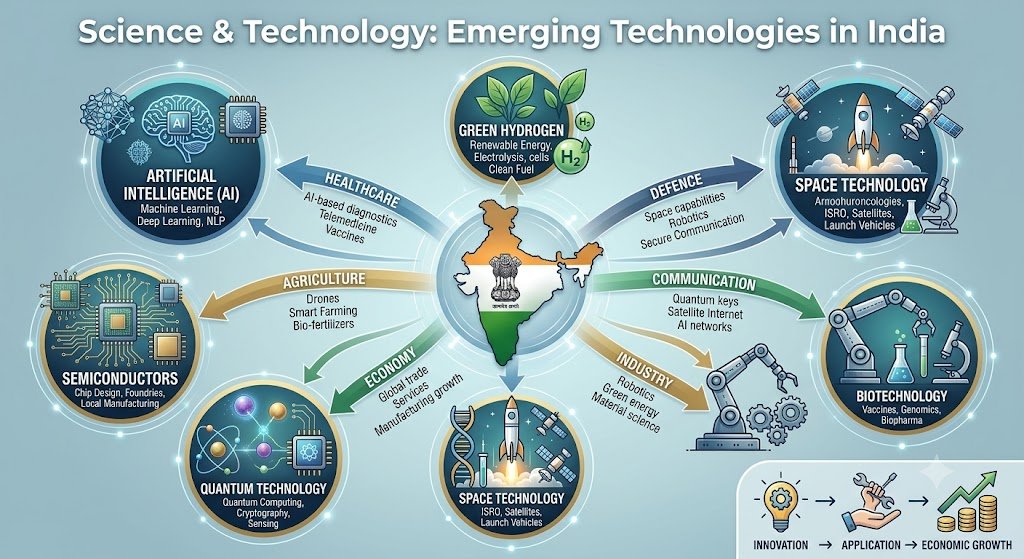
Science and Technology questions in GS Paper III are generally connected with real-world applications and India’s technological capabilities.
Important areas include:
- Developments in Science and Technology
- Applications of science and technology in everyday life
- Achievements of Indians in science and technology
- Indigenisation of technology
- Development of new technologies
- Information Technology
- Space technology
- Computers
- Robotics
- Nanotechnology
- Biotechnology
- Intellectual Property Rights
The syllabus particularly expects candidates to understand the application and impact of technology rather than merely memorise scientific definitions.
Environment, Biodiversity & Conservation
The environment portion should be prepared through both static concepts and current affairs.
Important areas include:
- Biodiversity
- Biodiversity conservation
- Environmental pollution
- Environmental degradation
- Environmental Impact Assessment
- Conservation
- Climate-related challenges
- Sustainable development
- Environmental governance
- Emerging environmental issues
The official GS-III syllabus specifically mentions conservation, environmental pollution and degradation, and Environmental Impact Assessment.
Environment preparation becomes more effective when static concepts are connected with contemporary developments. For additional practice, you can also read our Environment MCQs 2027 for UPSC preparation.
Disaster Management
Disaster Management is a relatively compact but highly answerable portion of GS Paper III.
Important areas include:
- Disaster management
- Disaster preparedness
- Disaster mitigation
- Disaster response
- Disaster recovery
- Institutional mechanisms
- Vulnerability assessment
- Early warning systems
- Community participation
- Disaster-resilient infrastructure
- Climate-related disasters
Candidates should connect theoretical preparation with recent examples of:
- Floods
- Cyclones
- Earthquakes
- Droughts
- Landslides
- Heatwaves
- Urban flooding
- Forest fires
The UPSC syllabus specifically includes “Disaster and disaster management.” (UPSC)
Internal Security
Internal Security is another major component of GS Paper III.
Important areas include:
- Linkages between development and spread of extremism
- External state actors
- Non-state actors
- Challenges to internal security
- Communication networks
- Media and social networking sites
- Cyber security
- Money laundering
- Prevention of money laundering
- Border-related security challenges
- Organised crime and terrorism
- Emerging security threats
The official syllabus specifically highlights the role of external and non-state actors, communication networks, media and social media, cyber security and money laundering.
Understanding the syllabus is the first step towards effective UPSC Mains GS Paper 3 2027 preparation because it helps candidates identify the exact scope of each subject.
Most Important GS Paper 3 Topics for UPSC Mains 2027
For UPSC Mains GS Paper 3 2027, priority should be given to topics that combine static knowledge with contemporary developments.
Instead of treating every topic equally, aspirants should prioritise areas that combine static concepts + current affairs + analytical potential.
Economy — High Priority
Focus particularly on:
- Inclusive growth
- Employment and unemployment
- Inflation
- Fiscal deficit
- Government budgeting
- Monetary policy
- Banking sector
- Financial inclusion
- Digital economy
- Manufacturing
- Industrial policy
- Infrastructure
- Investment
- External sector
- Economic reforms
- Resource mobilisation
Agriculture — High Priority
Give special attention to:
- MSP
- Agricultural marketing
- Crop diversification
- Irrigation
- Water management
- Food security
- PDS
- Agricultural subsidies
- Farmer Producer Organisations
- Food processing
- Natural farming
- Climate-resilient agriculture
- Agricultural technology
- Land reforms
Science & Technology — High Priority
For 2027 preparation, maintain current-affairs notes on:
- Artificial Intelligence
- Semiconductors
- Quantum technology
- Space technology
- Biotechnology
- Genetic technologies
- Nanotechnology
- Robotics
- Cyber technology
- Green technology
- Renewable energy
- Green hydrogen
- Nuclear technology
- Emerging digital technologies
The key is to prepare each technology through:
What → Applications → Benefits → Challenges → Ethical issues → India’s initiatives → Way Forward
Environment — High Priority
Focus on:
- Climate change
- Biodiversity conservation
- Pollution
- Air pollution
- Water pollution
- Plastic pollution
- Forest conservation
- Renewable energy
- Energy transition
- Environmental Impact Assessment
- Sustainable development
- Climate adaptation
- Climate-resilient infrastructure
Disaster Management — High Priority
Prepare:
- Flood management
- Urban flooding
- Cyclones
- Heatwaves
- Earthquakes
- Drought
- Landslides
- Forest fires
- Early warning systems
- Disaster-resilient infrastructure
- Community-based disaster management
Internal Security — High Priority
Focus on:
- Cyber security
- Cybercrime
- Terrorism
- Left-Wing Extremism
- Border management
- Coastal security
- Maritime security
- Organised crime
- Money laundering
- Terror financing
- Social media and internal security
- Role of technology in national security
How to Prepare UPSC GS Paper 3 Notes
GS Paper III should not be prepared like a conventional factual subject.
A better approach is to prepare every major topic using a fixed framework.
Use the 7-Point Framework
For every topic, prepare:
- Definition / Introduction
- Current status
- Importance
- Major challenges
- Government initiatives
- Examples / Data / Reports
- Way Forward
For example, if you are preparing AI in India, your notes should contain:
Introduction → Applications → Economic potential → Employment impact → Risks → Ethical concerns → Government initiatives → Global comparison → Way Forward
This structure can directly become a Mains answer.
Current Affairs Strategy for GS Paper 3 2027
Current affairs are extremely important because many GS-III questions require candidates to connect static knowledge with contemporary developments.
Current affairs should be linked directly with the syllabus to make UPSC Mains GS Paper 3 2027 preparation more analytical and answer-oriented.
Instead of collecting thousands of news articles, divide current affairs into six folders.
Economy
Track:
- RBI policies
- Inflation
- GDP and growth
- Employment
- Budget
- Economic Survey
- Banking
- External sector
- Fiscal policy
- Infrastructure
If you want to build a stronger foundation in Indian Economy before moving to Mains-level analysis, you can also read our detailed guide Indian Economy for UPSC Prelims 2027
Agriculture
Track:
- MSP
- Agricultural reforms
- Food security
- PDS
- Agricultural exports
- Crop patterns
- Irrigation
- Farmer income
- Agri-tech
- Climate-resilient agriculture
Science & Technology
Track:
- ISRO
- AI
- Semiconductors
- Biotechnology
- Quantum technology
- Space missions
- Nuclear technology
- Cyber technology
- Emerging technologies
For a deeper understanding of emerging technologies and their applications, aspirants can also explore our detailed Science and Technology for UPSC preparation resources.
Environment
Track:
- Climate reports
- COP developments
- Biodiversity
- Pollution
- Renewable energy
- Environmental regulations
- Conservation initiatives
- International environmental agreements
Disaster Management
Track:
- Major disasters in India
- Government responses
- Early-warning systems
- Disaster-resilient infrastructure
- NDMA initiatives
- Climate-linked disasters
Internal Security
Track:
- Cybersecurity
- Terrorism
- LWE
- Border security
- Maritime security
- Organised crime
- Money laundering
- Terror financing
- Emerging technological threats
Reports & Data That Can Improve GS Paper 3 Answers
Good data can significantly strengthen a Mains answer.
Candidates should regularly look at credible sources such as:
- Economic Survey
- Union Budget
- RBI reports
- NITI Aayog reports
- MoSPI data
- Government ministry reports
- Parliamentary committee reports
- NDMA publications
- ISRO publications
- IPCC reports
- UN reports
- World Bank reports
- IMF reports
- FAO reports
The objective is not to memorise dozens of statistics.
Instead, maintain a small collection of reliable figures, trends, examples and case studies that can be used repeatedly.
How to Write a High-Scoring GS Paper 3 Answer
A good GS-III answer should be:
- Analytical
- Structured
- Data-backed
- Balanced
- Solution-oriented
- Connected with current affairs
Recommended Structure
Introduction
Give a definition, recent development, constitutional/economic context or relevant data.
Body
Use subheadings such as:
- Present Scenario
- Key Challenges
- Causes
- Impacts
- Government Initiatives
- Gaps
- Way Forward
Conclusion
End with:
- Sustainable development
- Inclusive growth
- Technological innovation
- Institutional reform
- Cooperative federalism
- Resilience
- Long-term national interest
Choose the conclusion according to the question rather than using the same sentence everywhere.
GS Paper 3 Answer Writing Formula
For a 10-marker, aim for a concise and well-structured answer.
For a 15-marker, add:
- More dimensions
- Relevant examples
- Government initiatives
- Data/report references
- Challenges
- Way Forward
Use diagrams whenever appropriate
Useful diagrams include:
- Flowcharts
- Cycles
- Cause-effect diagrams
- Simple maps
- Process diagrams
- Tables
- Pyramid structures
For example:
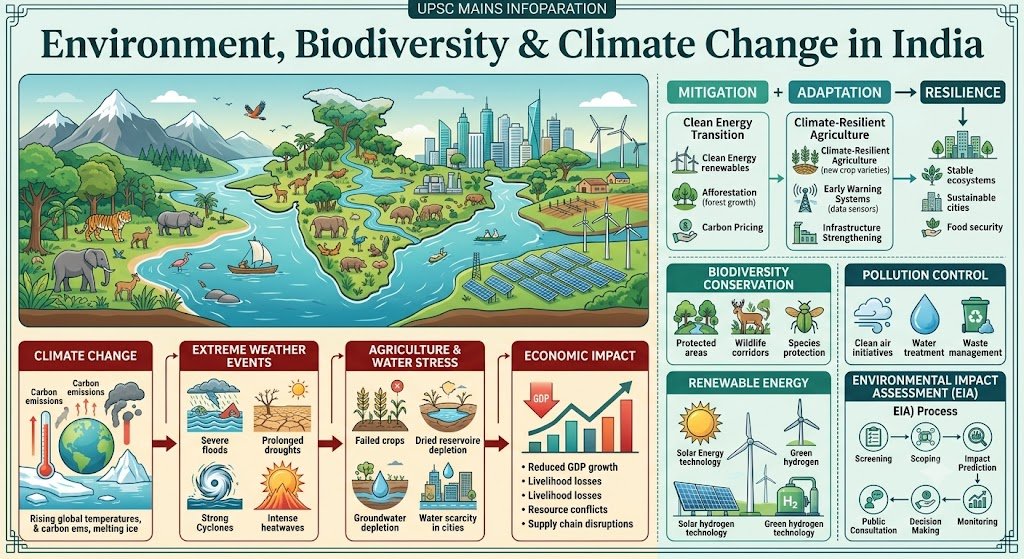
Climate Change → Extreme Weather → Agricultural Loss → Rural Distress → Food Inflation
A simple flowchart can communicate the relationship more effectively than several lines of text.
GS Paper 3 Preparation Strategy for 2027
Phase 1: Build Static Foundation
Start with:
- Economy basics
- Agriculture basics
- Science & Technology basics
- Environment basics
- Disaster Management basics
- Internal Security basics
Do not start by collecting current-affairs PDFs.
Phase 2: Integrate Current Affairs
Once the static foundation is clear, connect every important current development with the syllabus.
For example:
Current Event → Relevant Syllabus Topic → Background → Challenges → Government Response → Way Forward
This prevents current affairs from becoming disconnected facts.
Since GS Paper 3 questions often connect static concepts with contemporary developments, regular current-affairs revision is essential. You can also follow our [UPSC Current Affairs] resources for topic-wise preparation.
Phase 3: Previous Year Questions
UPSC previous-year questions should become the backbone of preparation.
Analyse questions according to:
- Topic
- Directive
- Demand of the question
- Static component
- Current-affairs component
- Examples required
- Possible dimensions
UPSC itself provides previous examination question papers through its official website.
UPSC Previous Question Papers – Official Website
Phase 4: Answer Writing
Begin with:
- 2 answers per week
- Then 3–4 answers per week
- Eventually a complete GS Paper III test
The focus should be on quality and structure before speed.
Important Books & Resources for GS Paper 3
Rather than collecting too many books, aspirants should build preparation around a limited number of reliable sources.
Economy
- Standard Indian Economy source
- Economic Survey
- Union Budget
- RBI publications
- NITI Aayog reports
Agriculture
- Basic agriculture source
- Government agriculture reports
- Economic Survey
- Ministry of Agriculture resources
Science & Technology
- Basic NCERT-level science understanding
- Government science and technology releases
- ISRO resources
- Current affairs
Environment
- Standard environment source
- Government reports
- Current environmental developments
- International reports
Security
- Standard internal security source
- Government reports
- MHA-related developments
- Current affairs
UPSC GS Paper 3 2027: Topic-Wise Revision Checklist
| Area | Must-Prepare Topics |
|---|---|
| Economy | Growth, employment, inflation, budgeting, inclusive growth, infrastructure |
| Agriculture | MSP, irrigation, subsidies, PDS, food security, diversification |
| Food Processing | Supply chain, storage, value addition, exports |
| Science & Technology | AI, space, biotech, semiconductors, quantum technology |
| Environment | Climate change, biodiversity, pollution, EIA, conservation |
| Disaster Management | Floods, cyclones, heatwaves, earthquakes, resilience |
| Internal Security | Cybersecurity, terrorism, LWE, border security, money laundering |
UPSC Mains GS Paper 3 2027: Common Mistakes
Avoid these mistakes:
1. Studying only current affairs
Current affairs cannot replace static concepts.
2. Writing only facts
Mains answers require analysis, not a collection of facts.
3. Ignoring agriculture
Agriculture has significant syllabus coverage and should not be treated as a minor topic.
4. Overloading answers with statistics
Use relevant and credible data, not statistics for decoration.
5. Ignoring the Way Forward
Most GS-III questions benefit from practical and implementable solutions.
6. Not practising diagrams
Simple diagrams can improve clarity and presentation.
7. Ignoring previous-year questions
PYQs reveal the actual level and nature of UPSC’s demand.
GS Paper 3 2027: 90-Day Revision Strategy
Days 1–30: Economy + Agriculture
Focus on:
- Economy fundamentals
- Budgeting
- Growth
- Employment
- Agriculture
- MSP
- Food security
- Irrigation
- Infrastructure
Days 31–60: Science & Technology + Environment
Cover:
- Emerging technologies
- Space
- Biotechnology
- AI
- Climate change
- Biodiversity
- Pollution
- Renewable energy
Days 61–75: Security + Disaster Management
Focus on:
- Cybersecurity
- Terrorism
- LWE
- Border management
- Disaster preparedness
- Disaster mitigation
- Climate-linked disasters
Days 76–90: Revision + Answer Writing
Focus on:
- PYQs
- Current affairs
- Data
- Reports
- Diagrams
- Model introductions
- Conclusions
- Full-length tests
How to Build Your GS Paper 3 Current Affairs Notes
A very effective format is:
Topic: Artificial Intelligence in India
Current Event: What happened?
Background: What is the issue?
Importance: Why does it matter?
Challenges: What are the major problems?
Government Initiatives: What has India done?
Examples: Indian/global examples
Data: 1–2 reliable figures
Way Forward: 4–5 practical measures
Mains Question: Create one possible UPSC-style question.
This transforms one news event into a complete Mains-ready note.
Final Strategy for UPSC Mains GS Paper 3 2027
Consistent revision, PYQ analysis and answer writing can significantly strengthen your UPSC Mains GS Paper 3 2027 preparation.
GS Paper III should be approached as a combination of:
Static Knowledge + Current Affairs + Data + Examples + Analysis + Answer Writing
Do not try to memorise the entire internet.
Instead:
- Understand the syllabus.
- Analyse previous-year questions.
- Build topic-wise notes.
- Connect current affairs with static concepts.
- Maintain a small database of data and examples.
- Practise diagrams and flowcharts.
- Write answers regularly.
- Revise repeatedly.
The UPSC CSE 2027 calendar is already available, with Prelims scheduled for 23 May 2027 and Mains scheduled to commence on 20 August 2027. This gives aspirants a clear timeline for building their GS Paper III preparation well in advance.
For the most authoritative updates, candidates should always verify the final CSE 2027 notification and syllabus on the official UPSC website when the notification is released in January 2027.
UPSC Annual Calendar 2027 – Official Website
Frequently Asked Questions
Is GS Paper 3 important for UPSC Mains 2027?
Yes. GS Paper III covers Economy, Agriculture, Science & Technology, Environment, Disaster Management and Internal Security, making it a broad and highly dynamic paper.
When will UPSC Mains 2027 begin?
According to the UPSC Annual Calendar 2027, the Civil Services (Main) Examination is scheduled to begin on 20 August 2027 and is listed for five days.
When will the UPSC CSE 2027 notification be released?
The official UPSC calendar schedules the CSE 2027 notification for 13 January 2027, with applications closing on 2 February 2027.
What are the major subjects in GS Paper 3?
The major areas are:
- Indian Economy
- Agriculture
- Science & Technology
- Environment and Biodiversity
- Disaster Management
- Internal Security
How should I prepare current affairs for GS Paper 3?
Link current events with the static syllabus. For every major issue, prepare its background, significance, challenges, government initiatives, examples, data and way forward.
Should I prepare GS Paper 3 separately from Prelims?
Not completely. Economy, Environment, Agriculture, Science & Technology and Disaster-related preparation can support both examinations. However, Mains preparation must additionally focus on analysis, answer writing, examples, data and solutions.
3 thoughts on “UPSC Mains GS Paper 3 2027: Complete Syllabus, Important Topics, Notes & Current Affairs”