UPSC Civil Services Mains GS Paper II: Governance, Constitution & Polity
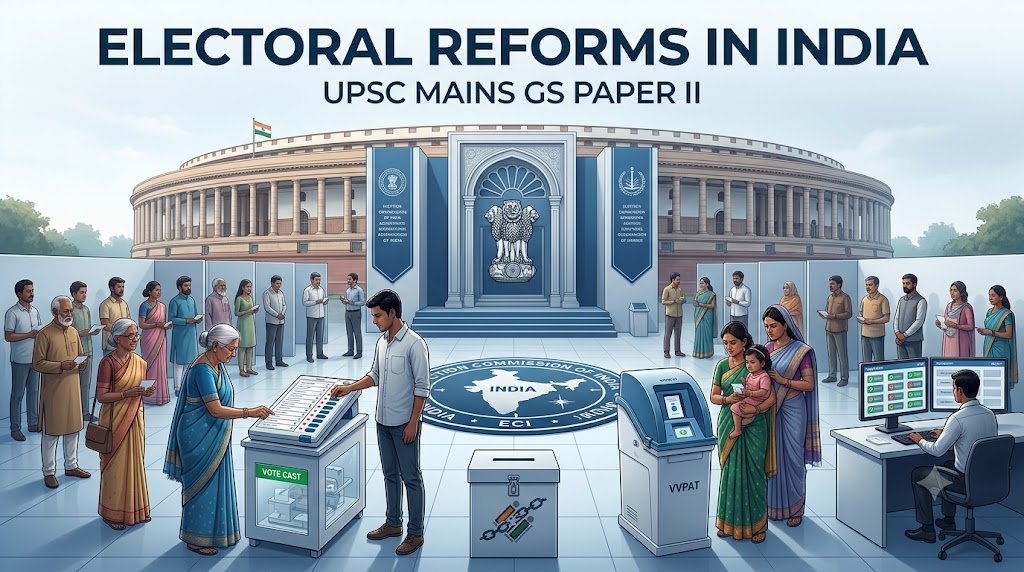
Electoral Reforms in India are essential for ensuring that elections remain free, fair, transparent, inclusive and genuinely representative. For UPSC Mains, this topic should not be treated merely as a list of reforms. A high-quality answer should connect constitutional provisions, Representation of the People Acts, criminalisation of politics, electoral finance, political parties, Election Commission, judicial interventions and democratic accountability.
The Election Commission of India (ECI) itself identifies electoral reforms as an evolving area involving the Constitution, the Representation of the People Acts, subordinate legislation and judicial decisions.
What Are Electoral Reforms?
- Electoral reforms refer to measures aimed at improving the electoral system and making elections:
- Free and fair
- Transparent
- Inclusive
- Accountable
- Accessible
- Representative
- Less vulnerable to money and muscle power
- They may involve changes in:
- Constitutional provisions
- Election laws
- Rules and procedures
- Election administration
- Political-party regulation
- Campaign finance
- Candidate selection
- Voter participation
- Electoral technology
- Electoral reforms may therefore be introduced through:
- Parliament
- Election Commission
- Judiciary
- Government
- Law Commission
- Political parties and civil society
The Law Commission has separately examined electoral reforms through major reports, including Report No. 170 (1999), Report No. 244 (2014) and Report No. 255 (2015).
Constitutional Framework of Elections in India
The constitutional framework provides an important foundation for Electoral Reforms in India.
Article 324
- Provides for the Election Commission of India.
- Vests in the Commission the:
- Superintendence
- Direction
- Control
of elections.
- It covers elections to:
- Lok Sabha
- Rajya Sabha
- State Legislative Assemblies
- President
- Vice-President
The ECI is an autonomous constitutional authority responsible for administering these electoral processes.
Article 325
- Provides for one general electoral roll.
- No person can be excluded from an electoral roll on grounds only of:
- Religion
- Race
- Caste
- Sex
Article 326
- Provides for elections to Lok Sabha and State Legislative Assemblies on the basis of adult suffrage.
- Voting eligibility is based on the constitutional and statutory requirements.
Article 327
- Gives Parliament power to make laws relating to elections.
Article 328
- Gives State Legislatures power to make provisions relating to elections to State Legislatures, subject to parliamentary law.
Article 329
- Provides constitutional restrictions concerning interference by courts in electoral matters, subject to the constitutional scheme.
A strong understanding of important constitutional provisions is essential for UPSC preparation. Candidates can reinforce their knowledge by practising our 100 Important Constitutional Articles MCQs: Must-Know Questions for Competitive Exams.
Major Objectives of Electoral Reforms
Electoral reforms should aim at:
- Clean politics
- Reducing criminal influence.
- Financial transparency
- Improving transparency in political funding and campaign expenditure.
- Level playing field
- Preventing misuse of government machinery.
- Political accountability
- Making political parties and candidates more accountable.
- Voter empowerment
- Improving access to information.
- Inclusive representation
- Increasing participation of women and marginalised groups.
- Administrative efficiency
- Strengthening election management.
- Technological integrity
- Ensuring secure and trustworthy use of electoral technology.
- Reduction of electoral malpractice
- Preventing bribery, intimidation, impersonation and other corrupt practices.
Major Issues in India’s Electoral System
A. Criminalisation of Politics
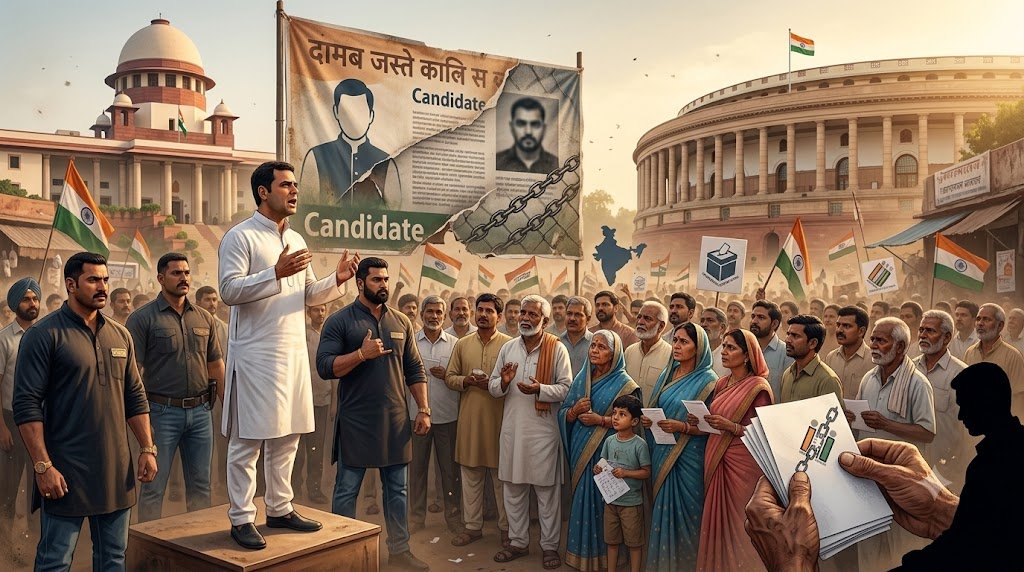
Criminalisation of politics remains one of the major challenges associated with Electoral Reforms in India.
One of the most important electoral challenges is the increasing presence of candidates with criminal antecedents.
Meaning
- Criminalisation of politics refers broadly to the increasing participation and influence of persons with criminal backgrounds in electoral politics and political institutions.
Why is it a concern?
- Weakens public trust in democratic institutions.
- Can encourage:
- Political violence
- Intimidation
- Corruption
- Abuse of power
- Creates a perception that electoral success depends upon:
- Money power
- Muscle power
- Criminal networks
- Can weaken the rule of law.
Important constitutional concern
- A person facing an allegation is not automatically a person convicted of a crime.
- Therefore, electoral reform must balance:
- Clean politics
- Presumption of innocence
- Right to political participation
- Fair trial
Criminalisation: Existing Legal Position
- Under existing law, certain electoral disqualifications operate following conviction.
- The Representation of the People Act, 1951 contains provisions relating to disqualification of persons convicted of specified offences.
Important distinction for UPSC
Pending criminal case ≠ conviction
Therefore:
- Mere registration of an FIR does not automatically result in disqualification.
- Mere pendency of a criminal case does not necessarily mean that a person is legally disqualified from contesting.
- Conviction can trigger statutory disqualification in specified circumstances.
This distinction is extremely important in a UPSC Mains answer because an overly simplistic statement such as “all candidates with criminal cases should be banned” ignores constitutional and legal safeguards.
Supreme Court & Criminalisation of Politics
The judiciary has played a significant role in increasing voter access to information about candidates.
Voter’s Right to Know
- The Supreme Court has recognised the importance of voters knowing relevant information about candidates.
- This includes information concerning:
- Criminal antecedents
- Assets and liabilities
- Educational qualifications
The ECI records that judicial intervention led to disclosure requirements relating to criminal antecedents, assets, liabilities and educational qualifications.
Why is disclosure important?
- Enables informed voting.
- Promotes transparency.
- Creates reputational accountability.
- Allows voters to evaluate candidates beyond party symbols.
Election Commission’s Measures Against Criminalisation
The Election Commission has taken measures requiring political parties and candidates to publish information concerning criminal antecedents.
According to the ECI:
- Political parties fielding candidates with criminal antecedents have to comply with Supreme Court-directed disclosure requirements.
- Candidates contesting elections are also required to publish details of criminal antecedents in prescribed formats.
Significance
- Improves voter awareness.
- Makes candidate information publicly accessible.
- Places greater responsibility on political parties.
- Strengthens electoral transparency.
Limitation
Disclosure alone may not eliminate criminalisation because:
- Voters may continue to support candidates for various reasons.
- Political parties may continue selecting candidates considered electorally advantageous.
- Criminalisation has deeper socio-economic and political roots.
Money Power in Elections
Addressing money power is therefore an important component of Electoral Reforms in India.
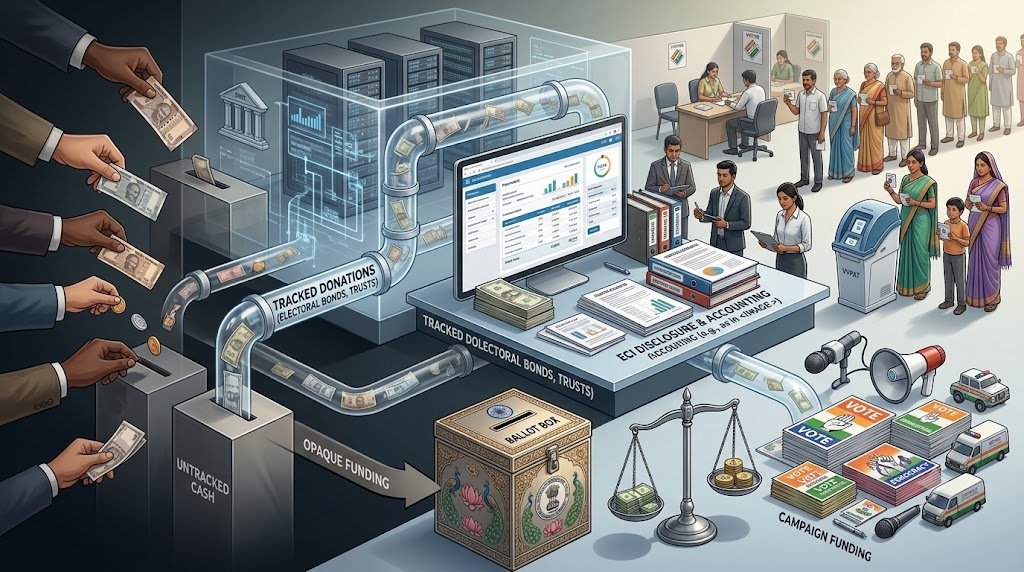
Money power is another major electoral challenge.
Problems
- Excessive campaign expenditure can create an unequal contest.
- Wealthier candidates or parties may gain greater visibility.
- Unaccounted expenditure can encourage:
- Black money
- Vote buying
- Undisclosed political funding
- Illicit influence
Consequences
- Distorts political competition.
- Creates unequal opportunities.
- Increases the influence of wealthy interests.
- Can contribute to corruption after elections.
The ECI has emphasised election expenditure monitoring and the need to prevent illegal use of money and other inducements for buying votes.
Political Funding: Key Concerns
Important concerns include:
- Transparency of political donations.
- Disclosure of sources of funds.
- Corporate and individual donations.
- Anonymous or opaque funding mechanisms.
- Expenditure by political parties.
- Expenditure by candidates.
- Third-party campaign expenditure.
- Digital and social-media campaign spending.
Way Forward
A comprehensive approach to Electoral Reforms in India must combine institutional, legal and political measures.
- Greater transparency in political funding.
- Stronger disclosure requirements.
- Independent auditing of political-party accounts.
- Greater public scrutiny of political finances.
- Effective enforcement of expenditure limits.
The ECI has previously advocated stronger transparency concerning political-party accounts, including annual auditing and publication of accounts in the public domain.
Role of the Election Commission of India
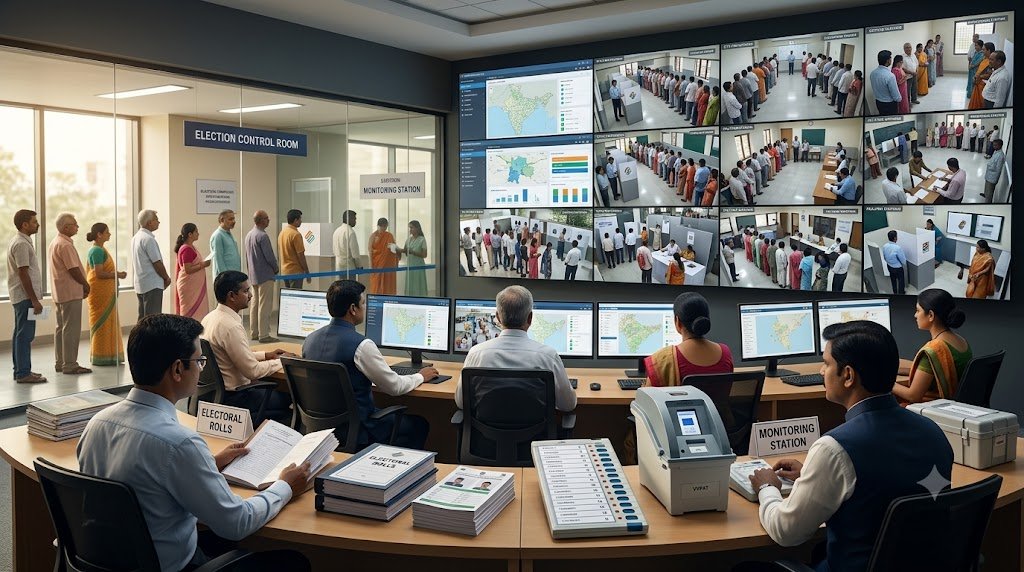
The Election Commission of India plays a central role in implementing and facilitating Electoral Reforms in India.
Constitutional Role
Under Article 324, it exercises:
- Superintendence
- Direction
- Control
over the electoral process within its constitutional mandate.
Major Functions
- Preparation and revision of electoral rolls.
- Conduct of elections.
- Election scheduling.
- Monitoring electoral expenditure.
- Enforcing the Model Code of Conduct.
- Voter awareness.
- Candidate-related disclosures.
- Monitoring electoral malpractices.
- Advising on certain disqualification matters.
- Registration of political parties under applicable law.
The ECI states that it also performs advisory and quasi-judicial functions in certain election-related disqualification matters.
Model Code of Conduct
The Model Code of Conduct (MCC) is an important instrument for maintaining electoral fairness.
Objectives
- Prevent misuse of official machinery.
- Promote a level playing field.
- Restrict inflammatory campaigning.
- Prevent appeals based on caste and communal feelings.
- Regulate conduct of political parties and candidates.
- Prevent bribery and voter intimidation.
The ECI describes the MCC as a set of norms evolved through consensus among political parties.
Important MCC Provisions
Political parties and candidates should:
- Avoid activities creating hatred between communities.
- Avoid appeals to caste or communal feelings.
- Avoid bribery and intimidation.
- Avoid misuse of places of worship for election propaganda.
- Avoid unverified allegations against opponents.
- Follow prescribed restrictions around polling.
Paid News
Meaning
- Paid news refers to the presentation of paid political publicity as if it were independent news.
Why is it problematic?
- Misleads voters.
- Creates an uneven playing field.
- Undermines media credibility.
- Gives financially stronger candidates an unfair advantage.
Reform Required
- Stronger monitoring.
- Clear legal classification.
- Greater disclosure of political advertising.
- Effective penalties.
- Greater media accountability.
The ECI has identified paid news as a concern affecting the fairness of elections and has advocated stronger legal action.
Misuse of Government Machinery
Problem
The ruling party may have access to:
- Government resources
- Official communication channels
- Publicity machinery
- Administrative infrastructure
Risks
- Blurs the distinction between government and party.
- Can create an uneven electoral field.
- May influence voter perception.
Reform
- Strict enforcement of MCC.
- Clear separation between government publicity and political campaigning.
- Greater scrutiny of government advertisements before elections.
Weak Regulation of Political Parties
Political parties are central to democracy, but their internal functioning can raise concerns.
Issues
- Lack of internal democracy.
- Concentration of power within party leadership.
- Candidate selection dominated by a small leadership group.
- Limited transparency in political funding.
- Weak internal accountability.
- Dynastic tendencies.
Possible Reforms
- Regular internal organisational elections.
- Transparent candidate-selection mechanisms.
- Greater financial disclosure.
- Independent auditing.
- Stronger internal grievance mechanisms.
Election Commission and Political Party Regulation
The ECI registers political parties under the Representation of the People Act, 1951.
However, an important reform debate concerns:
- Powers relating to deregistration.
- Financial transparency.
- Internal democracy.
- Auditing of party accounts.
- Compliance with statutory requirements.
The ECI has itself identified the question of power to deregister political parties as an electoral reform issue.
Electoral Roll Issues
Challenges
- Duplicate entries.
- Incorrect names or details.
- Migration-related changes.
- Exclusion of eligible voters.
- Difficulties faced by:
- Migrant workers
- Homeless persons
- Persons with disabilities
- Remote communities
Reforms Needed
- Continuous improvement of electoral rolls.
- Easy correction mechanisms.
- Better voter facilitation.
- Greater accessibility.
- Protection against wrongful exclusion.
The ECI has also introduced four qualifying dates for electoral-roll enrolment, enabling eligible citizens turning 18 on 1 January, 1 April, 1 July or 1 October to seek enrolment during the relevant period.
Electoral Technology
Technology has transformed election management.
Benefits
- Faster election administration.
- Better electoral-roll management.
- Greater accessibility.
- Faster transmission of information.
- Reduction of certain manual errors.
Concerns
- Cybersecurity.
- Data protection.
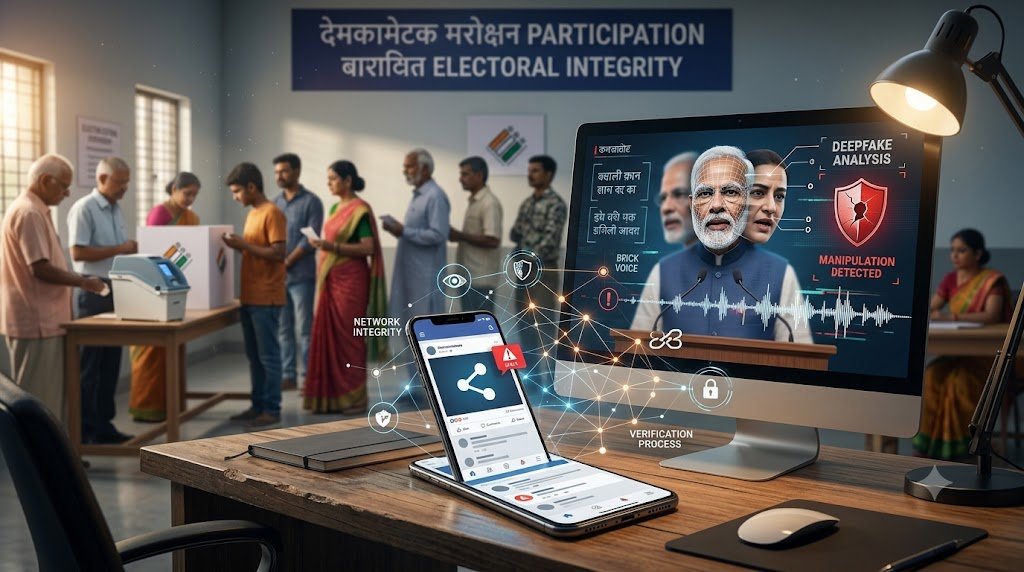
- Digital misinformation.
- Deepfakes.
- Public trust.
- Transparency and auditability.
Way Forward
- Strong cybersecurity standards.
- Independent technical audits.
- Transparent procedures.
- Voter education.
- Effective response to misinformation.
Social Media & Elections
Emerging Challenges
- Fake news.
- Deepfakes.
- Micro-targeting.
- Coordinated disinformation.
- Manipulated videos.
- Anonymous political advertising.
- Artificial amplification of content.
Impact
- Can influence voter perception.
- Can polarise society.
- Can spread misinformation rapidly.
- Can undermine informed electoral choice.
Reforms
- Stronger transparency requirements for political advertising.
- Clear identification of sponsored political content.
- Rapid response mechanisms against demonstrably false information.
- Digital literacy.
- Greater coordination among election authorities and platforms.
Representation of Women
Concern
Women remain underrepresented in elected political institutions compared with their population share.
Why does representation matter?
Greater representation can:
- Improve inclusiveness.
- Bring diverse policy perspectives.
- Strengthen political legitimacy.
- Improve democratic participation.
Constitutional Development
The Constitution (One Hundred and Sixth Amendment) Act, 2023 provides for reservation of seats for women in the Lok Sabha, State Legislative Assemblies and the Legislative Assembly of the National Capital Territory of Delhi, subject to the constitutional framework and conditions concerning delimitation and census.
UPSC Angle
In an answer, connect women’s representation with:
- Political empowerment
- Substantive equality
- Inclusive democracy
- Local-level reservation experience
Delimitation: An Electoral Reform Issue
Meaning
Delimitation involves:
- Determining boundaries of constituencies.
- Reorganising electoral constituencies according to the constitutional and statutory framework.
Challenges
- Balancing population representation.
- Federal concerns.
- Regional interests.
- Political representation.
- Demographic changes.
UPSC Perspective
Delimitation involves a tension between:
“One person, one vote”
and
“Federal balance among States.”
Therefore, delimitation is not merely an administrative exercise; it has significant political and federal implications.
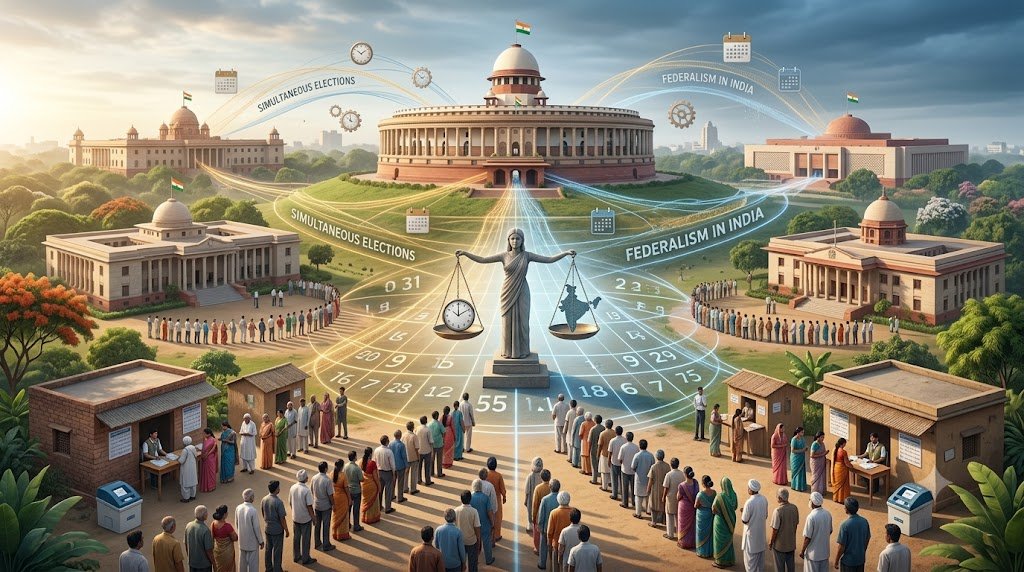
Simultaneous Elections
Concept
- Holding Lok Sabha and State Assembly elections together or in a synchronised cycle.
Arguments in Favour
- Reduces frequent election expenditure.
- Minimises repeated disruption of governance.
- Reduces prolonged application of MCC.
- Allows governments greater policy continuity.
- Potentially reduces campaign expenditure.
Arguments Against
- May weaken State-specific political issues.
- Can affect federal political dynamics.
- May favour larger national parties.
- Requires complex constitutional and statutory changes.
- Questions arise regarding premature dissolution of legislatures.
- Could affect the accountability cycle of State governments.
UPSC Approach
Do not simply write “One Nation, One Election is good/bad.”
Instead write:
It should be evaluated through the twin principles of electoral efficiency and federal democratic accountability.
Important Electoral Reforms Suggested by Committees and Institutions
Law Commission
The Law Commission has examined:
- Electoral disqualification.
- Criminalisation of politics.
- Political-party regulation.
- Election finance.
- Electoral administration.
Its 255th Report on Electoral Reforms (2015) is an important reference for UPSC preparation.
Election Commission
The ECI has suggested reforms concerning:
- Criminalisation of politics.
- Political parties.
- Election expenditure.
- Paid news.
- Campaign regulation.
- Electoral administration.
- Candidate disclosure.
Key Electoral Reforms Required
Reform 1: Address Criminalisation
- Fast-track trials involving elected representatives.
- Greater transparency regarding criminal antecedents.
- Stronger party-level accountability.
- Consider carefully designed disqualification mechanisms for serious offences, while protecting due process.
Reform 2: Improve Political Funding Transparency
- Transparent political donations.
- Independent auditing.
- Public disclosure of party accounts.
- Better monitoring of campaign expenditure.
Reform 3: Strengthen Political Parties
- Internal democracy.
- Transparent candidate selection.
- Regular organisational elections.
- Financial accountability.
Reform 4: Strengthen the ECI
- Adequate institutional autonomy.
- Sufficient manpower and resources.
- Greater enforcement capacity.
- Stronger mechanisms for timely action.
Reform 5: Regulate Digital Campaigning
- Transparent political advertisements.
- Stronger safeguards against deepfakes.
- Digital campaign expenditure monitoring.
- Greater platform accountability.
Reform 6: Protect Voter Choice
- Better candidate disclosure.
- Accessible voter information.
- Stronger voter education.
- Protection against intimidation and inducements.
Reform 7: Make Elections More Inclusive
- Better accessibility for persons with disabilities.
- Improved migrant-voter participation.
- Easier enrolment and correction.
- Greater participation of women and marginalised groups.
Challenges in Implementing Electoral Reforms
Even well-designed reforms face several challenges:
- Political resistance.
- Constitutional constraints.
- Federal concerns.
- Administrative complexity.
- Risk of excessive regulation.
- Balancing voter freedom with electoral integrity.
- Privacy concerns.
- Misuse of criminal-law mechanisms.
- Technology-related uncertainties.
- Difficulty in regulating political parties without undermining political freedom.
Way Forward
A balanced electoral reform agenda should focus on:
- Transparency
- Political funding and candidate information.
- Accountability
- Political parties and candidates.
- Institutional independence
- Strengthening election-management institutions.
- Rule of law
- Fast and fair adjudication of serious criminal cases involving politicians.
- Technology with safeguards
- Secure and transparent electoral technology.
- Digital democracy
- Regulation of political advertising and misinformation.
- Internal party democracy
- More transparent party structures.
- Inclusive elections
- Easier participation for women, migrants, persons with disabilities and marginalised groups.
- Voter awareness
- Encourage issue-based rather than identity- or inducement-based voting.
UPSC Mains Answer Framework
For a 10-marker, use:
Introduction
- Define electoral reforms.
- Mention Article 324 and the need for free and fair elections.
Body
Issues:
- Criminalisation
- Money power
- Political funding
- Paid news
- Misuse of government machinery
- Weak internal democracy
- Digital misinformation
Reforms:
- Candidate disclosure
- Political-finance transparency
- Stronger ECI
- Fast-track trials
- Party reforms
- Digital campaign regulation
Conclusion
- Connect electoral reforms with constitutional democracy, accountability and citizen sovereignty.
UPSC Mains 15-Marker Answer Structure
Introduction
Elections are the principal mechanism through which citizens translate political preferences into representative government. Therefore, electoral integrity is essential to the constitutional promise of representative democracy.
Constitutional Foundation
- Article 324 → Election Commission
- Article 325 → Non-discriminatory electoral rolls
- Article 326 → Adult suffrage
- Articles 327–328 → Legislative power regarding elections
Major Challenges
1. Criminalisation
- Criminal antecedents among candidates.
- Political incentives for selecting candidates with electoral strength.
2. Money Power
- Campaign expenditure.
- Vote buying.
- Opaque political funding.
3. Political Party Reform
- Weak internal democracy.
- Candidate-selection concerns.
- Financial transparency.
4. Campaign Regulation
- Paid news.
- Hate speech.
- Misuse of government machinery.
- Digital misinformation.
5. Institutional Challenges
- Need for timely and effective enforcement.
- Administrative and technological challenges.
Reforms
- Candidate disclosure.
- Fast-track trials.
- Political-finance transparency.
- Stronger auditing.
- Internal party democracy.
- Effective MCC enforcement.
- Digital-election safeguards.
- Greater voter awareness.
Conclusion
Electoral reform should not merely seek to make elections administratively efficient; it must make political competition more transparent, inclusive, accountable and representative, thereby deepening constitutional democracy.
Value-Addition for UPSC Answers
Use these phrases in your Mains answers:
- “Level playing field”
- “Free, fair and credible elections”
- “Informed voter choice”
- “Criminalisation of politics”
- “Money and muscle power”
- “Political accountability”
- “Institutional autonomy”
- “Electoral integrity”
- “Internal democracy within political parties”
- “Transparency in political finance”
- “Digital misinformation and deepfakes”
- “Constitutional morality”
- “Representative and participatory democracy”
Prelims vs Mains: How to Prepare This Topic
For UPSC Prelims
Focus on:
- Article 324
- Article 325
- Article 326
- Article 327
- Article 328
- Article 329
- Representation of the People Acts
- Election Commission
- Model Code of Conduct
- Electoral rolls
- Election-related constitutional provisions
Aspirants preparing for multiple competitive examinations can also review our Updated General Awareness Syllabus for SSC CGL 2026 to understand the broader General Awareness areas covered in SSC examinations.
For UPSC Mains
Focus on:
- Why electoral reforms are needed
- Criminalisation
- Money power
- Political funding
- Role and limitations of ECI
- Political-party reforms
- Paid news
- Digital misinformation
- Women’s representation
- Simultaneous elections
- Delimitation
- Way forward
Candidates preparing for other government recruitment examinations can also explore our comprehensive SSC CPO 2026 Exam guide covering eligibility, syllabus, physical requirements, salary and the selection process.
Conclusion
Electoral reforms are ultimately reforms of democratic representation itself. India has developed a strong constitutional and institutional framework for conducting elections, but challenges such as criminalisation of politics, money power, opaque political funding, weak internal party democracy and digital misinformation continue to affect electoral integrity. The way forward lies in strengthening the Election Commission, improving political-finance transparency, ensuring timely justice, empowering voters with reliable information and promoting greater internal democracy within political parties. Such reforms can make Indian democracy not merely electoral, but more accountable, inclusive and genuinely representative.
Ultimately, Electoral Reforms in India should strengthen transparency, accountability and democratic representation.
Official Sources for Further Reference
- Election Commission of India — Electoral Laws
- Election Commission of India — About ECI
- Law Commission of India — Electoral Reforms
- Law Commission Report No. 255 — Electoral Reforms
This topic directly fits the UPSC GS-II domain of Governance, Constitution and Polity, while the electoral-reform dimension also allows candidates to connect constitutional institutions, representation, accountability and democratic governance in a single answer. The UPSC GS-II syllabus explicitly covers constitutional provisions, Parliament and State Legislatures, constitutional bodies and governance-related issues.
You can visit the official UPSC Website for more information.
1 thought on “Electoral Reforms in India: Critical Issues, Criminalization & ECI Role | UPSC Mains GS Paper II”