Artificial Intelligence MCQs 2026 are important for UPSC CSE Prelims preparation because Artificial Intelligence and emerging technologies are increasingly connected with current affairs, governance, cybersecurity, quantum technology, semiconductors and digital transformation. This practice set contains 100 Artificial Intelligence MCQs 2026 designed in the UPSC Prelims pattern, with statement-based questions, conceptual traps and elimination-oriented options.
The questions cover the IndiaAI Mission, BharatGen, Generative AI, Large Language Models, AI safety, deepfakes, quantum technology, semiconductor technology, 6G, blockchain and other emerging technologies. Each section is followed by answers with short explanations to help aspirants revise important concepts efficiently.
These Artificial Intelligence MCQs 2026 are designed to help aspirants practise conceptual, statement-based and current-affairs questions for UPSC CSE Prelims.

Section 1: Artificial Intelligence MCQs 2026: Fundamentals & Core Concepts
This section of Artificial Intelligence MCQs 2026 focuses on the fundamental concepts required to understand modern AI systems.
These AI MCQs 2026 cover the fundamental concepts of machine learning, Generative AI, Large Language Models, RAG, AI agents and other important technologies.
Q.1 With reference to different approaches used in machine learning, consider the following statements:
- Supervised learning generally uses labelled examples during training.
- Unsupervised learning can be used to identify previously unknown patterns or groups in data.
- Reinforcement learning requires every training example to have a pre-assigned correct output.
Which of the statements given above is/are correct?
(a) 1 and 2 only
(b) 2 and 3 only
(c) 1 and 3 only
(d) 1, 2 and 3
Q.2 Consider the following statements regarding Generative Artificial Intelligence:
- It can generate new text, images, audio or video based on patterns learned from data.
- It necessarily produces content that is factually correct because it is trained on large datasets.
- Large language models are one category of generative AI systems.
Which of the statements given above is/are correct?
(a) 1 and 3 only
(b) 2 only
(c) 1 and 2 only
(d) 1, 2 and 3
Q.3 With reference to Large Language Models (LLMs), consider the following statements:
- LLMs learn statistical relationships among tokens during training.
- Their outputs can depend on the probability distribution generated for possible next tokens.
- An LLM necessarily understands the factual truth of every statement it generates.
Which of the statements given above is/are correct?
(a) 1 and 2 only
(b) 2 and 3 only
(c) 1 only
(d) 1, 2 and 3
Q.4 Consider the following statements about Generative AI hallucination:
- It refers to the generation of information that may appear plausible but is unsupported or incorrect.
- Increasing the size of a model completely eliminates hallucinations.
- Retrieval-augmented generation can sometimes reduce hallucinations by grounding responses in retrieved information.
Which of the statements given above is/are correct?
(a) 1 and 3 only
(b) 1 and 2 only
(c) 2 and 3 only
(d) 1, 2 and 3
Q.5 With reference to Retrieval-Augmented Generation (RAG), consider the following statements:
- RAG can retrieve relevant information from an external knowledge source before generating an answer.
- RAG necessarily requires retraining the underlying language model whenever the external knowledge base changes.
- RAG can be useful where responses need to be grounded in domain-specific or updated information.
Which of the statements given above is/are correct?
(a) 1 and 3 only
(b) 2 only
(c) 1 and 2 only
(d) 1, 2 and 3
Q.6 Which one of the following best describes the principal role of the attention mechanism in Transformer-based models?
(a) It permanently stores every training example in the model
(b) It allows the model to weigh relationships among different parts of an input sequence
(c) It converts all numerical data into images before processing
(d) It eliminates the requirement for training data
Q.7 With reference to the training of AI models, consider the following statements:
- Pre-training generally involves learning broad patterns from large datasets.
- Fine-tuning can adapt a pre-trained model to a particular task or domain.
- Fine-tuning always requires training a model from the beginning without using pre-existing parameters.
Which of the statements given above is/are correct?
(a) 1 and 2 only
(b) 2 and 3 only
(c) 1 only
(d) 1, 2 and 3
Q.8 Consider the following statements regarding multimodal AI:
- A multimodal AI system may process more than one type of data such as text, images or audio.
- Multimodal systems are necessarily limited to processing written language.
- Combining different modalities can enable applications such as image understanding followed by natural-language responses.
Which of the statements given above is/are correct?
(a) 1 and 3 only
(b) 1 only
(c) 2 and 3 only
(d) 1, 2 and 3
Q.9 With reference to AI inference, consider the following statements:
- Inference refers to using a trained model to generate predictions or outputs.
- Inference is distinct from the process of initially training a model.
- An AI model cannot perform inference unless it is simultaneously being retrained.
Which of the statements given above is/are correct?
(a) 1 and 2 only
(b) 2 and 3 only
(c) 1 only
(d) 1, 2 and 3
Q.10 Which one of the following best explains Edge AI?
(a) Training all AI models exclusively on government-owned supercomputers
(b) Processing AI tasks closer to where data is generated rather than sending all data to a distant central cloud
(c) Using AI only for satellite-based applications
(d) Using blockchain to replace machine-learning algorithms
Q.11 With reference to federated learning, consider the following statements:
- It can allow models to be trained across distributed devices or institutions without necessarily transferring all raw data to a central server.
- Model updates can be aggregated centrally.
- It completely eliminates all privacy and security risks associated with machine learning.
Which of the statements given above is/are correct?
(a) 1 and 2 only
(b) 2 and 3 only
(c) 1 and 3 only
(d) 1, 2 and 3
Q.12 Consider the following statements regarding synthetic data:
- It is artificially generated data designed to resemble characteristics of real-world data.
- It can sometimes be used to supplement real datasets for AI development.
- Its use automatically guarantees that the resulting AI model will be free from bias.
Which of the statements given above is/are correct?
(a) 1 and 2 only
(b) 1 and 3 only
(c) 2 and 3 only
(d) 1, 2 and 3
Q.13 With reference to Explainable AI (XAI), consider the following statements:
- It seeks to make the reasoning or factors behind certain AI outputs more understandable to humans.
- It is particularly relevant in high-stakes applications where decisions may affect individuals.
- Explainability necessarily means that every internal mathematical operation of a model can be presented in simple human language.
Which of the statements given above is/are correct?
(a) 1 and 2 only
(b) 2 and 3 only
(c) 1 only
(d) 1, 2 and 3
Q.14 Consider the following statements about adversarial attacks on AI systems:
- An adversarial input may be deliberately designed to cause a machine-learning model to make an incorrect prediction.
- Such attacks are relevant to areas such as image recognition and autonomous systems.
- Adversarial attacks are possible only when an attacker has complete access to the model’s source code.
Which of the statements given above is/are correct?
(a) 1 and 2 only
(b) 1 and 3 only
(c) 2 and 3 only
(d) 1, 2 and 3
Q.15 With reference to machine unlearning, consider the following statements:
- It seeks to remove the influence of specified data or information from a trained model.
- It can have relevance for privacy and responsible AI.
- It is identical to deleting the original training dataset while leaving the trained model unchanged.
Which of the statements given above is/are correct?
(a) 1 and 2 only
(b) 2 and 3 only
(c) 1 and 3 only
(d) 1, 2 and 3
Q.16 Which one of the following best describes a deepfake?
(a) A conventional encrypted database
(b) Synthetic or manipulated media generated or altered using AI techniques to imitate real persons, events or voices
(c) A quantum encryption protocol
(d) A semiconductor manufacturing process
Q.17 Consider the following statements regarding algorithmic bias:
- Bias in training data can contribute to biased AI outputs.
- Increasing computational power necessarily eliminates algorithmic bias.
- Bias can arise from choices made during data collection, model development or deployment.
Which of the statements given above is/are correct?
(a) 1 and 3 only
(b) 1 only
(c) 2 and 3 only
(d) 1, 2 and 3
Q.18 The Turing Test, associated with the study of Artificial Intelligence, is primarily concerned with:
(a) measuring the electrical efficiency of a computer
(b) assessing whether a machine can exhibit behaviour indistinguishable from human responses in a specified interaction
(c) measuring the number of transistors in a processor
(d) testing the encryption strength of a blockchain
Q.19 With reference to AI agents, consider the following statements:
- An AI agent can be designed to perceive information, reason about a task and take actions toward a specified objective.
- Agentic AI may involve greater autonomy than a conventional question-answering system.
- Every AI chatbot is necessarily an autonomous agent capable of independently executing actions in the physical world.
Which of the statements given above is/are correct?
(a) 1 and 2 only
(b) 1 and 3 only
(c) 2 and 3 only
(d) 1, 2 and 3
Q.20 Consider the following applications:
- Disease diagnosis
- Text-to-speech conversion
- Image generation
- Predictive maintenance of industrial equipment
Which of the above can involve Artificial Intelligence?
(a) 1, 2 and 3 only
(b) 2 and 4 only
(c) 1, 3 and 4 only
(d) 1, 2, 3 and 4
This first set of Artificial Intelligence MCQs for UPSC focuses on the conceptual foundations that candidates should understand before moving to current developments.
Answers & Short Explanations: Section 1 of 100 Artificial Intelligence MCQs 2026
1. (a) — Supervised learning uses labelled data, while unsupervised learning can discover patterns or clusters. Reinforcement learning learns through interaction and rewards.
2. (a) — Generative AI can create different forms of content, and LLMs are an important class of generative models. Large datasets do not guarantee factual accuracy.
3. (a) — LLMs learn statistical patterns and generate tokens probabilistically. They do not inherently guarantee factual understanding.
4. (a) — Hallucinations are plausible but unsupported outputs. RAG can improve grounding but does not eliminate hallucinations completely.
5. (a) — RAG retrieves external information and can help answer questions using updated or specialised sources.
6. (b) — Attention helps models determine the relative importance and relationships among elements of an input.
7. (a) — Pre-training learns broad patterns, while fine-tuning adapts an existing model.
8. (a) — Multimodal systems can work across text, audio, images and other modalities.
9. (a) — Inference is the use of a trained model to produce an output.
10. (b) — Edge AI performs computation near the data source, potentially reducing latency and bandwidth requirements.
11. (a) — Federated learning can distribute training while aggregating model updates. It does not eliminate every security risk.
12. (a) — Synthetic data can supplement real data but does not automatically remove bias.
13. (a) — XAI aims to improve human understanding of AI decisions, particularly where accountability matters.
14. (a) — Adversarial examples can exploit weaknesses in models without requiring source-code access.
15. (a) — Machine unlearning attempts to remove the effect of selected information from a trained model.
16. (b) — Deepfakes use AI-based generation or manipulation to create convincing synthetic media.
17. (a) — Data and design choices can introduce bias. Greater computing power alone does not remove it.
18. (b) — The Turing Test concerns machine behaviour and whether it can convincingly imitate human responses.
19. (a) — AI agents may perceive, reason and act toward objectives. Not every chatbot has autonomous action capabilities.
20. (d) — All four are established or potential AI application areas.

Section 2: Artificial Intelligence MCQs 2026: IndiaAI Mission, BharatGen & AI Ecosystem
These Emerging Technology MCQs 2026 connect Artificial Intelligence with quantum technology, semiconductor manufacturing, 6G, blockchain and the Internet of Things.
The Government approved the IndiaAI Mission in March 2024 with an outlay of ₹10,371 crore over five years. The mission includes seven major pillars covering compute infrastructure, foundation models, datasets, applications, skills, startup financing and safe and trusted AI.
These Artificial Intelligence MCQs 2026 cover India’s rapidly developing AI ecosystem, including the IndiaAI Mission and BharatGen.
Q.21 With reference to the IndiaAI Mission, consider the following statements:
- It was approved by the Government of India in 2024.
- It seeks to develop a comprehensive AI ecosystem in India.
- Its scope is restricted to developing large language models and does not include AI compute infrastructure.
Which of the statements given above is/are correct?
(a) 1 and 2 only
(b) 2 only
(c) 1 and 3 only
(d) 1, 2 and 3
Q.22 Which of the following are pillars of the IndiaAI Mission?
- IndiaAI Compute
- Foundation Models
- AIKosh
- IndiaAI FutureSkills
- Safe & Trusted AI
Select the correct answer using the code given below:
(a) 1, 2 and 3 only
(b) 2, 3 and 5 only
(c) 1, 2, 3, 4 and 5
(d) 1, 4 and 5 only
Q.23 With reference to AIKosh, consider the following statements:
- It is associated with India’s AI datasets ecosystem.
- It is intended to provide access to datasets, models and tools.
- It is exclusively a semiconductor fabrication platform.
Which of the statements given above is/are correct?
(a) 1 and 2 only
(b) 1 only
(c) 2 and 3 only
(d) 1, 2 and 3
Q.24 Consider the following statements regarding IndiaAI Compute:
- It seeks to make high-end computing resources more accessible for AI development.
- GPUs can be used for AI model training and inference.
- IndiaAI Compute is intended only for foreign technology companies and not for Indian startups or researchers.
Which of the statements given above is/are correct?
(a) 1 and 2 only
(b) 1 and 3 only
(c) 2 and 3 only
(d) 1, 2 and 3
Q.25 With reference to the IndiaAI FutureSkills pillar, which of the following are relevant?
- Development of AI talent
- Fellowships for students and researchers
- Data and AI laboratories
- Semiconductor wafer fabrication exclusively
Select the correct answer using the code given below:
(a) 1 and 2 only
(b) 1, 2 and 3 only
(c) 3 and 4 only
(d) 1, 2, 3 and 4
Q.26 Consider the following statements regarding the Safe & Trusted AI pillar:
- It addresses responsible development and deployment of AI.
- Issues such as bias, privacy and deepfakes can fall within its scope.
- It seeks to ensure that AI systems are automatically free from every possible risk.
Which of the statements given above is/are correct?
(a) 1 and 2 only
(b) 1 only
(c) 2 and 3 only
(d) 1, 2 and 3
Q.27 As of July 2026, the IndiaAI Mission had identified indigenous sovereign model proposals comprising:
(a) 12 LLMs and 8 SLMs
(b) 8 LLMs and 12 SLMs
(c) 20 LLMs only
(d) 20 SLMs only
Q.28 With reference to BharatGen, consider the following statements:
- It is a government-supported sovereign AI initiative.
- It is designed for Indian languages and societal contexts.
- Its capabilities include text, speech and vision-related applications.
- It is restricted exclusively to English-language text generation.
Which of the statements given above are correct?
(a) 1 and 2 only
(b) 1, 2 and 3 only
(c) 2, 3 and 4 only
(d) 1, 2, 3 and 4
Q.29 BharatGen is particularly significant for India because:
- India has substantial linguistic diversity.
- Multilingual AI can potentially improve access to digital services.
- Sovereign AI capabilities can reduce dependence on foreign models for certain applications.
Select the correct answer using the code given below:
(a) 1 only
(b) 1 and 2 only
(c) 2 and 3 only
(d) 1, 2 and 3
Q.30 With reference to India’s AI application-development initiatives, consider the following statements:
- They support AI applications addressing sector-specific challenges.
- Healthcare, agriculture and governance can be among their application areas.
- They are limited to theoretical AI research and exclude pilot deployment.
Which of the statements given above is/are correct?
(a) 1 and 2 only
(b) 2 only
(c) 1 and 3 only
(d) 1, 2 and 3
Q.31 As of July 2026, the Government had reported the establishment of how many AI Centres of Excellence across States and Union Territories under the IndiaAI ecosystem?
(a) 27
(b) 38
(c) 58
(d) 75
Q.32 With reference to IndiaAI Data & AI Labs, consider the following statements:
- They are associated with the FutureSkills pillar.
- They are intended to strengthen AI-related skills and applied data capabilities.
- Their establishment is restricted to metropolitan cities.
Which of the statements given above is/are correct?
(a) 1 and 2 only
(b) 2 only
(c) 1 and 3 only
(d) 1, 2 and 3
Q.33 Consider the following statements regarding India’s AI governance approach:
- It includes concerns relating to algorithmic bias.
- Deepfakes and misinformation can form part of AI governance concerns.
- AI governance is limited only to the technical performance of AI models.
Which of the statements given above is/are correct?
(a) 1 and 2 only
(b) 1 only
(c) 2 and 3 only
(d) 1, 2 and 3
Q.34 With reference to AI-driven governance initiatives in India, consider the following statements:
- AI can be used for intelligent document processing.
- AI-based systems can support face authentication and verification.
- AI cannot be applied to public-service delivery because government datasets are necessarily unsuitable for machine learning.
Which of the statements given above is/are correct?
(a) 1 and 2 only
(b) 2 and 3 only
(c) 1 only
(d) 1, 2 and 3
Q.35 Which one of the following best describes a sovereign AI capability?
(a) Exclusive use of AI for military purposes
(b) The ability of a country to develop and control important AI capabilities, infrastructure, data or models according to its strategic requirements
(c) A system in which AI models cannot interact with foreign languages
(d) An AI system that operates without any human oversight
Q.36 As of July 2026, IndiaAI’s Safe & Trusted AI initiatives included projects dealing with:
- Bias mitigation
- Machine unlearning
- Privacy-preserving AI
- Deepfake detection
Select the correct answer using the code given below:
(a) 1 and 2 only
(b) 1, 2 and 3 only
(c) 2, 3 and 4 only
(d) 1, 2, 3 and 4
Q.37 Consider the following statements about AI compute:
- Training large AI models can require substantial computational resources.
- GPUs are widely used for parallel mathematical operations involved in AI workloads.
- AI inference always requires greater computing resources than model training.
Which of the statements given above is/are correct?
(a) 1 and 2 only
(b) 1 and 3 only
(c) 2 and 3 only
(d) 1, 2 and 3
Q.38 With reference to the IndiaAI Mission, consider the following statements:
- Startup financing is one of its pillars.
- The mission seeks to encourage development of indigenous foundation models.
- The mission excludes academic institutions from participation.
Which of the statements given above is/are correct?
(a) 1 and 2 only
(b) 1 only
(c) 2 and 3 only
(d) 1, 2 and 3
Q.39 Which of the following can contribute to making AI systems more inclusive in India?
- Multilingual models
- Speech-based interfaces
- Access to AI compute for researchers and startups
- Development of datasets representing Indian contexts
Select the correct answer using the code given below:
(a) 1 and 2 only
(b) 1, 2 and 3 only
(c) 1, 2, 3 and 4
(d) 2 and 4 only
Q.40 Consider the following statements regarding AI and India’s public administration:
- AI can support document processing and classification.
- AI can assist in identifying patterns in large administrative datasets.
- AI-based decision support automatically replaces the legal responsibility of the concerned public authority.
Which of the statements given above is/are correct?
(a) 1 and 2 only
(b) 2 and 3 only
(c) 1 only
(d) 1, 2 and 3
For a broader understanding of the Science and Technology areas covered in UPSC preparation, also read our UPSC Science and Technology Syllabus 2027
Answers & Short Explanations: Section 2 of 100 Artificial Intelligence MCQs 2026
21. (a) — IndiaAI was approved in 2024 and includes compute infrastructure along with foundation models, datasets, applications, skills, financing and responsible AI.
22. (c) — All five listed are among the seven pillars.
23. (a) — AIKosh is associated with datasets, models and tools for the AI ecosystem.
24. (a) — IndiaAI Compute aims to improve access to AI computing resources, including for Indian startups and researchers.
25. (b) — FutureSkills covers talent development, fellowships and Data & AI Labs.
26. (a) — Safe & Trusted AI deals with responsible AI and risks such as bias, privacy and deepfakes.
27. (a) — The July 2026 update reported 12 LLM and 8 SLM indigenous model proposals.
28. (b) — BharatGen is multilingual and multimodal, covering text, speech and vision-related capabilities.
29. (d) — Linguistic diversity, inclusion and technological sovereignty all contribute to its importance.
30. (a) — AI application development includes practical sector-specific applications rather than only theoretical research.
31. (c) — 58 AI Centres of Excellence were reported.
32. (a) — Data & AI Labs are associated with FutureSkills and applied AI capability development.
33. (a) — Bias, deepfakes and misinformation are important AI-governance concerns.
34. (a) — AI can support document processing and authentication while remaining subject to institutional oversight.
35. (b) — Sovereign AI concerns national capacity and strategic control over important AI capabilities.
36. (d) — All four are part of the Safe & Trusted AI ecosystem.
37. (a) — Large-model training can require substantial compute, and GPUs are well suited to parallel workloads.
38. (a) — Startup financing and foundation models are pillars of IndiaAI; academic participation is not excluded.
39. (c) — All four can improve inclusiveness.
40. (a) — AI can support administrative analysis and processing, but it does not automatically transfer legal responsibility from public authorities.
For the latest official information on India’s national AI ecosystem, aspirants can refer to the IndiaAI Mission official website.
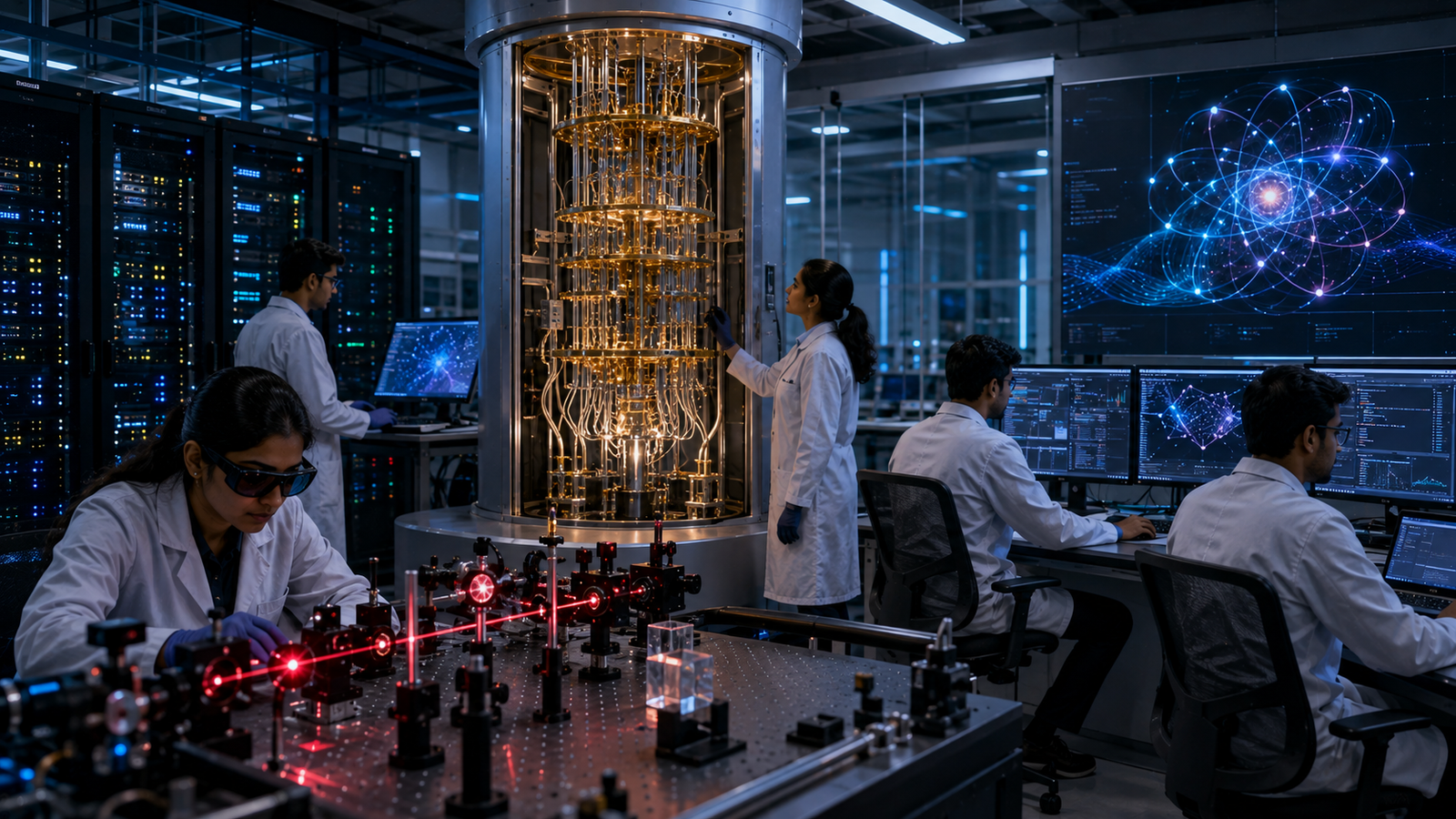
Section 3: Artificial Intelligence MCQs 2026: Quantum Technology, Semiconductors & 6G
These Emerging Technology MCQs 2026 connect Artificial Intelligence with quantum technology, semiconductor manufacturing, 6G, blockchain and the Internet of Things.
The following Artificial Intelligence MCQs 2026 connect AI with other emerging technologies.
Q.41 With reference to the National Quantum Mission, consider the following statements:
- It aims to develop intermediate-scale quantum computers.
- Its targets include quantum communication and quantum sensing.
- It is concerned exclusively with quantum computing and has no component relating to quantum materials.
Which of the statements given above is/are correct?
(a) 1 and 2 only
(b) 2 only
(c) 1 and 3 only
(d) 1, 2 and 3
Q.42 Which of the following are the four thematic areas of the National Quantum Mission?
- Quantum Computing
- Quantum Communication
- Quantum Sensing and Metrology
- Quantum Materials and Devices
Select the correct answer using the code given below:
(a) 1 and 2 only
(b) 1, 2 and 3 only
(c) 2, 3 and 4 only
(d) 1, 2, 3 and 4
Q.43 Consider the following statements regarding quantum computing:
- A qubit can exist in a quantum superposition of basis states.
- Quantum entanglement is a quantum phenomenon relevant to quantum information science.
- A qubit is simply a conventional bit capable of storing infinitely many classical values simultaneously.
Which of the statements given above is/are correct?
(a) 1 and 2 only
(b) 1 and 3 only
(c) 2 and 3 only
(d) 1, 2 and 3
Q.44 With reference to quantum communication, consider the following statements:
- Quantum communication can use properties such as quantum entanglement.
- Quantum key distribution aims to enable secure key exchange based on quantum principles.
- Quantum communication necessarily means transmitting ordinary digital data without using any classical communication infrastructure.
Which of the statements given above is/are correct?
(a) 1 and 2 only
(b) 2 and 3 only
(c) 1 only
(d) 1, 2 and 3
Q.45 Which one of the following best explains quantum sensing?
(a) Use of quantum phenomena to achieve highly sensitive measurements
(b) Use of blockchain to secure sensor data
(c) Use of conventional sensors only in quantum computers
(d) Conversion of all sensor outputs into cryptocurrencies
Q.46 With reference to India’s National Quantum Mission, consider the following statements:
- The Quantum Computing thematic hub is led by IISc Bengaluru.
- The Quantum Communication thematic hub is associated with IIT Madras and C-DOT.
- Quantum Sensing and Metrology is associated with IIT Bombay.
- Quantum Materials and Devices is associated with IIT Delhi.
Which of the statements given above are correct?
(a) 1 and 2 only
(b) 1, 2 and 3 only
(c) 2, 3 and 4 only
(d) 1, 2, 3 and 4
Q.47 With reference to semiconductor manufacturing, consider the following statements:
- Fabrication refers to manufacturing semiconductor devices on wafers.
- OSAT relates to outsourced semiconductor assembly and testing.
- Semiconductor packaging has no role in the performance or reliability of an electronic device.
Which of the statements given above is/are correct?
(a) 1 and 2 only
(b) 1 only
(c) 2 and 3 only
(d) 1, 2 and 3
Q.48 Which of the following are important stages or components of a semiconductor ecosystem?
- Chip design
- Wafer fabrication
- Assembly and testing
- Semiconductor packaging
Select the correct answer using the code given below:
(a) 1 and 2 only
(b) 1, 2 and 3 only
(c) 2, 3 and 4 only
(d) 1, 2, 3 and 4
Q.49 With reference to the India Semiconductor Mission, consider the following statements:
- It aims to develop a semiconductor and display ecosystem in India.
- It includes support mechanisms for semiconductor fabs and packaging facilities.
- Its objective is limited to importing advanced chips rather than developing domestic manufacturing.
Which of the statements given above is/are correct?
(a) 1 and 2 only
(b) 1 only
(c) 2 and 3 only
(d) 1, 2 and 3
Q.50 In July 2026, the Union Cabinet approved Semicon 2.0. Consider the following statements:
- It seeks to strengthen India’s semiconductor design and manufacturing ecosystem.
- It has a total budget outlay of ₹1,27,500 crore.
- It focuses only on importing finished semiconductor chips.
Which of the statements given above is/are correct?
(a) 1 and 2 only
(b) 2 only
(c) 1 and 3 only
(d) 1, 2 and 3
Q.51 With reference to Bharat 6G Alliance, consider the following statements:
- It is a collaborative platform involving industry and academia.
- It works on research, innovation and standardisation related to 6G.
- It is exclusively a government department and does not include private or academic stakeholders.
Which of the statements given above is/are correct?
(a) 1 and 2 only
(b) 2 only
(c) 1 and 3 only
(d) 1, 2 and 3
Q.52 As of July 2026, the Bharat 6G Alliance had constituted working groups covering areas such as:
- Spectrum
- 6G technologies
- Applications and use cases
- Green and sustainability aspects
Which of the above are correct?
(a) 1 and 2 only
(b) 2 and 3 only
(c) 1, 2, 3 and 4
(d) 1, 3 and 4 only
Q.53 Consider the following statements regarding 6G technology:
- 6G is expected to build upon advanced capabilities beyond existing 5G networks.
- Research into 6G can involve areas such as advanced spectrum use, sensing and AI-enabled networks.
- 6G technology has already been universally deployed as a commercial network across India.
Which of the statements given above is/are correct?
(a) 1 and 2 only
(b) 1 only
(c) 2 and 3 only
(d) 1, 2 and 3
Q.54 With reference to blockchain technology, consider the following statements:
- Blockchain is a form of distributed ledger technology.
- A blockchain can use cryptographic techniques to link records.
- Every blockchain must necessarily be completely public and permissionless.
Which of the statements given above is/are correct?
(a) 1 and 2 only
(b) 2 and 3 only
(c) 1 only
(d) 1, 2 and 3
Q.55 Consider the following statements about a permissioned blockchain:
- Participation in validating or accessing certain functions can be restricted.
- It can be useful where participating institutions require controlled access.
- It is necessarily identical to a completely public blockchain.
Which of the statements given above is/are correct?
(a) 1 and 2 only
(b) 1 and 3 only
(c) 2 and 3 only
(d) 1, 2 and 3
Q.56 With reference to Central Bank Digital Currency (CBDC), consider the following statements:
- A CBDC is a digital form of central bank money.
- It is distinct from a cryptocurrency issued privately without being a liability of a central bank.
- CBDC necessarily operates only through mining-based proof-of-work.
Which of the statements given above is/are correct?
(a) 1 and 2 only
(b) 2 and 3 only
(c) 1 only
(d) 1, 2 and 3
Q.57 Which one of the following best describes tokenisation of real-world assets?
(a) Converting physical assets into digital representations or tokens, often using distributed ledger technology
(b) Converting all physical currency into coins
(c) Converting a semiconductor into a cryptocurrency
(d) Encrypting a physical document without creating any digital representation
Q.58 Consider the following statements regarding the Internet of Things (IoT):
- IoT involves interconnected physical devices capable of collecting, exchanging or processing data.
- Sensors can form an important component of IoT systems.
- IoT devices necessarily operate without any network connectivity.
Which of the statements given above is/are correct?
(a) 1 and 2 only
(b) 2 only
(c) 1 and 3 only
(d) 1, 2 and 3
Q.59 With reference to RISC-V, consider the following statements:
- It is an open-standard instruction set architecture.
- It can be used as a basis for designing processors.
- It is itself a semiconductor fabrication plant.
Which of the statements given above is/are correct?
(a) 1 and 2 only
(b) 1 only
(c) 2 and 3 only
(d) 1, 2 and 3
Q.60 Consider the following statements:
- AI workloads can increase demand for advanced semiconductor chips.
- Quantum computing research can require specialised hardware.
- 6G infrastructure is completely independent of semiconductor technologies.
Which of the statements given above is/are correct?
(a) 1 and 2 only
(b) 2 and 3 only
(c) 1 and 3 only
(d) 1, 2 and 3
Artificial Intelligence is only one part of the rapidly changing technology landscape. You can also revise other important developments through our 100 Essential Science and Technology Current Affairs 2026 MCQs.
Answers & Short Explanations: Section 3 of 100 Artificial Intelligence MCQs 2026
41. (a) — NQM covers computing, communication, sensing/metrology and quantum materials/devices.
42. (d) — All four are thematic areas.
43. (a) — Superposition and entanglement are fundamental quantum phenomena.
44. (a) — Quantum communication can use quantum properties, while QKD is an important application.
45. (a) — Quantum sensing exploits quantum effects for highly sensitive measurements.
46. (d) — All four institutional associations correspond to the four thematic hubs.
47. (a) — Fabrication and OSAT are important parts of the semiconductor value chain.
48. (d) — All four are components of the semiconductor ecosystem.
49. (a) — ISM seeks to develop domestic semiconductor and display capabilities.
50. (a) — Semicon 2.0 strengthens India’s semiconductor ecosystem and has a ₹1,27,500 crore outlay.
51. (a) — Bharat 6G Alliance involves industry, academia and research stakeholders.
52. (c) — All four areas are covered by its working groups.
53. (a) — 6G remains a research and development area rather than a universally deployed network.
54. (a) — Blockchain is a distributed ledger technology and can use cryptographic mechanisms.
55. (a) — Permissioned blockchains restrict participation or access according to defined rules.
56. (a) — CBDC is digital central-bank money and is distinct from private cryptocurrencies.
57. (a) — Tokenisation creates digital representations of real-world assets.
58. (a) — IoT involves connected physical devices and sensors.
59. (a) — RISC-V is an open-standard instruction-set architecture.
60. (a) — AI, quantum and 6G all depend to varying degrees on advanced semiconductor technologies.
Aspirants can also refer to the Department of Science & Technology’s National Quantum Mission page for official information about India’s quantum technology initiatives and the four thematic hubs.
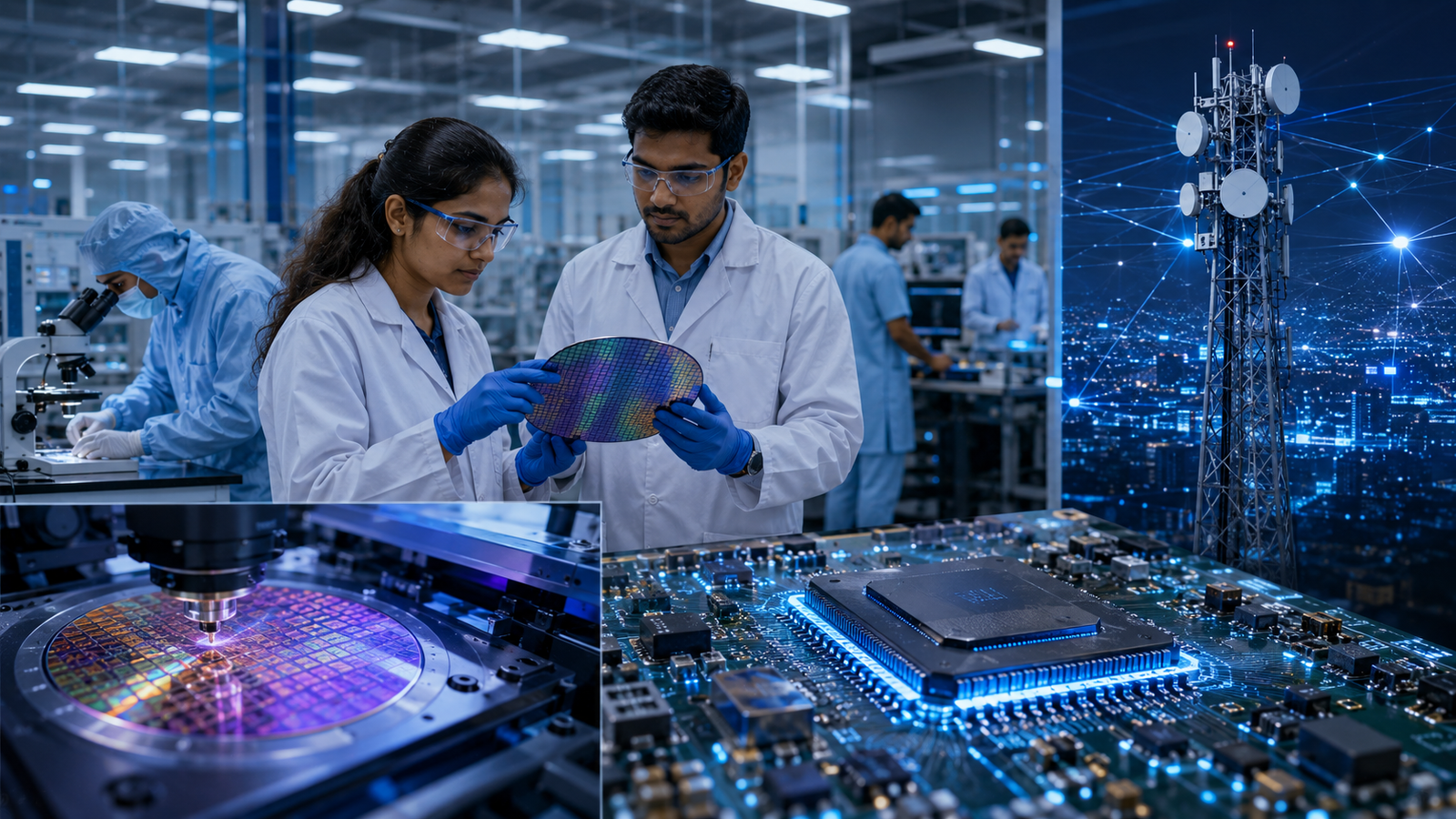
Section 4: Artificial Intelligence MCQs 2026: AI Governance, Cybersecurity & Privacy
This section of Artificial Intelligence MCQs 2026 focuses on AI governance, cybersecurity, privacy and practical applications.
These AI Questions for UPSC Prelims also focus on deepfakes, algorithmic bias and other applications of Artificial Intelligence.
Q.61 With reference to the Digital Personal Data Protection framework in India, consider the following statements:
- It deals with the processing of digital personal data.
- Purpose limitation and data minimisation are relevant principles.
- It completely prohibits all processing of personal data.
Which of the statements given above is/are correct?
(a) 1 and 2 only
(b) 1 only
(c) 2 and 3 only
(d) 1, 2 and 3
Q.62 Consider the following statements regarding privacy-preserving AI:
- Federated learning can reduce the need to centralise raw training data.
- Differential privacy can introduce controlled statistical noise to protect information about individuals.
- Privacy-preserving AI guarantees that no information about an individual can ever be inferred.
Which of the statements given above is/are correct?
(a) 1 and 2 only
(b) 1 and 3 only
(c) 2 and 3 only
(d) 1, 2 and 3
Q.63 With reference to AI-generated deepfakes, consider the following statements:
- They can be used to manipulate audio or visual content.
- They can create risks relating to misinformation and identity fraud.
- Detection systems can use AI-based techniques to identify manipulated content.
Which of the statements given above are correct?
(a) 1 and 2 only
(b) 2 and 3 only
(c) 1 and 3 only
(d) 1, 2 and 3
Q.64 Which of the following can be considered potential applications of AI in healthcare?
- Medical image analysis
- Drug discovery
- Clinical decision support
- Hospital resource management
Select the correct answer using the code given below:
(a) 1 and 2 only
(b) 1, 2 and 3 only
(c) 2, 3 and 4 only
(d) 1, 2, 3 and 4
Q.65 With reference to AI in agriculture, consider the following statements:
- AI can be used to analyse satellite or remote-sensing data.
- AI can support crop-yield prediction.
- AI-based systems can potentially assist in identifying crop diseases.
- AI cannot be used in agriculture because agricultural data is necessarily non-digital.
Which of the above are correct?
(a) 1 and 2 only
(b) 1, 2 and 3 only
(c) 2, 3 and 4 only
(d) 1, 2, 3 and 4
Q.66 Consider the following statements regarding algorithmic auditing:
- It can examine whether an AI system produces systematically different outcomes for different groups.
- It can be relevant to fairness and accountability.
- It necessarily involves checking only the speed of an algorithm.
Which of the statements given above is/are correct?
(a) 1 and 2 only
(b) 1 only
(c) 2 and 3 only
(d) 1, 2 and 3
Q.67 With reference to AI safety, consider the following statements:
- AI safety can include evaluation of potentially harmful model behaviour.
- Red-teaming can be used to identify vulnerabilities or failure modes.
- AI safety is concerned only with physical robots and not software systems.
Which of the statements given above is/are correct?
(a) 1 and 2 only
(b) 2 only
(c) 1 and 3 only
(d) 1, 2 and 3
Q.68 India’s AI governance initiatives involve concerns such as:
- Algorithmic bias
- Misinformation and deepfakes
- AI safety and evaluation
- Responsible deployment of AI
Select the correct answer using the code given below:
(a) 1 and 2 only
(b) 1, 2 and 3 only
(c) 2, 3 and 4 only
(d) 1, 2, 3 and 4
Q.69 With reference to the IndiaAI Safety Institute, consider the following statements:
- It is associated with AI safety, security and trustworthy AI.
- It is intended to support indigenous research and development related to AI safety.
- It is a semiconductor fabrication unit.
Which of the statements given above is/are correct?
(a) 1 and 2 only
(b) 1 only
(c) 2 and 3 only
(d) 1, 2 and 3
Q.70 With reference to AI and cybersecurity, consider the following statements:
- AI can assist in detecting unusual patterns in network traffic.
- AI can also be used by attackers to automate certain malicious activities.
- AI therefore creates both defensive opportunities and new cybersecurity risks.
Which of the statements given above are correct?
(a) 1 and 2 only
(b) 2 and 3 only
(c) 1 and 3 only
(d) 1, 2 and 3
Q.71 Which one of the following best describes Generative Adversarial Networks (GANs)?
(a) A system consisting of two neural networks trained in competition to generate and distinguish synthetic data
(b) A blockchain consensus mechanism
(c) A satellite navigation system
(d) A semiconductor packaging technology
Q.72 With reference to Computer Vision, consider the following statements:
- It enables computers to extract information from images or videos.
- Object detection can identify and locate objects within an image.
- Computer vision is restricted to medical imaging.
Which of the statements given above is/are correct?
(a) 1 and 2 only
(b) 2 only
(c) 1 and 3 only
(d) 1, 2 and 3
Q.73 Consider the following statements regarding Natural Language Processing:
- NLP deals with computational processing of human language.
- Machine translation is an application of NLP.
- Speech recognition and text processing can involve NLP-related technologies.
Which of the statements given above are correct?
(a) 1 and 2 only
(b) 2 and 3 only
(c) 1 and 3 only
(d) 1, 2 and 3
Q.74 With reference to AI model evaluation, consider the following statements:
- Accuracy can be an appropriate metric for some classification problems.
- Different applications may require different evaluation metrics.
- A model with high average accuracy can never exhibit bias affecting a particular subgroup.
Which of the statements given above is/are correct?
(a) 1 and 2 only
(b) 2 only
(c) 1 and 3 only
(d) 1, 2 and 3
Q.75 Which of the following can contribute to AI-related misinformation?
- Synthetic images
- AI-generated audio
- AI-generated text
- Manipulated videos
Select the correct answer using the code given below:
(a) 1 and 2 only
(b) 1, 2 and 3 only
(c) 2, 3 and 4 only
(d) 1, 2, 3 and 4
Q.76 Consider the following statements regarding Human-in-the-Loop AI:
- It involves human intervention in some stages of an AI system’s operation or decision-making.
- It can be useful in high-risk applications requiring human oversight.
- It means that AI has no role in decision support.
Which of the statements given above is/are correct?
(a) 1 and 2 only
(b) 2 only
(c) 1 and 3 only
(d) 1, 2 and 3
Q.77 With reference to AI explainability and accountability, consider the following statements:
- Explainability can help users understand factors influencing an AI decision.
- Accountability determines who is responsible for an AI-supported decision or system.
- Explainability and accountability are exactly the same concept.
Which of the statements given above is/are correct?
(a) 1 and 2 only
(b) 1 only
(c) 2 and 3 only
(d) 1, 2 and 3
Q.78 Consider the following statements regarding AI in public examinations:
- AI-based face verification can potentially assist in candidate authentication.
- Intelligent document processing can assist in handling large volumes of documents.
- Such systems eliminate the need for any institutional oversight.
Which of the statements given above is/are correct?
(a) 1 and 2 only
(b) 1 only
(c) 2 and 3 only
(d) 1, 2 and 3
Q.79 With reference to machine-readable data, consider the following statements:
- Structured data can be easier for computer systems to process than unstructured information.
- Digitisation alone guarantees that data is suitable for every AI application.
- Data quality is important for reliable AI systems.
Which of the statements given above is/are correct?
(a) 1 and 3 only
(b) 1 only
(c) 2 and 3 only
(d) 1, 2 and 3
Q.80 Which one of the following best captures the principle of AI for All in the Indian context?
(a) Restricting AI development to government laboratories
(b) Promoting broad, inclusive and responsible access to AI’s benefits while addressing associated risks
(c) Making AI systems completely autonomous from human institutions
(d) Using AI exclusively for economic growth without considering social consequences
Answers & Short Explanations: Section 4 of 100 Artificial Intelligence MCQs 2026
61. (a) — The framework deals with digital personal data and includes principles such as purpose limitation and data minimisation.
62. (a) — Federated learning and differential privacy can improve privacy protection, but neither provides an absolute guarantee.
63. (d) — Deepfakes can involve audio and visual content and create misinformation and fraud risks.
64. (d) — All four are potential AI applications in healthcare.
65. (b) — AI can analyse remote sensing, predict yields and assist in crop-disease identification.
66. (a) — Algorithmic auditing can examine fairness, bias and differential outcomes.
67. (a) — AI safety covers model behaviour and software systems as well as physical systems.
68. (d) — All four are important areas of responsible AI governance.
69. (a) — The IndiaAI Safety Institute deals with AI safety and trustworthy AI, not chip fabrication.
70. (d) — AI can strengthen cyber defence but can also be misused by attackers.
71. (a) — GANs traditionally involve a generator and discriminator trained in competition.
72. (a) — Computer vision includes image/video understanding and object detection.
73. (d) — NLP covers language processing, translation and several speech-related applications.
74. (a) — Different AI applications require different evaluation metrics, and high overall accuracy does not eliminate subgroup bias.
75. (d) — All four can be manipulated or generated using AI and contribute to misinformation.
76. (a) — Human-in-the-loop systems deliberately retain human involvement.
77. (a) — Explainability and accountability are related but distinct concepts.
78. (a) — AI can support authentication and document processing, but institutional oversight remains necessary.
79. (a) — Structured data is often easier to process, while data quality remains essential.
80. (b) — AI for All emphasises broad and responsible access to AI benefits.
For deeper understanding of India’s preparations for post-quantum cybersecurity, aspirants can read the official Quantum Safe Ecosystem in India report published under the National Quantum Mission.

Section 5: Artificial Intelligence MCQs 2026: Major Current Affairs & Emerging Technologies
The final section of these Artificial Intelligence MCQs 2026 focuses on important AI and emerging-technology developments of 2026.
Q.81 With reference to the India AI Impact Summit 2026, consider the following statements:
- It was hosted in New Delhi.
- Its three foundational Sutras were People, Planet and Progress.
- It was the first global AI summit of its scale to be hosted in the Global South.
Which of the statements given above are correct?
(a) 1 and 2 only
(b) 2 and 3 only
(c) 1 and 3 only
(d) 1, 2 and 3
Q.82 The theme of the India AI Impact Summit 2026 was associated with which of the following?
(a) Sarvajan Hitaya, Sarvajan Sukhaya
(b) One Earth, One Family, One Future
(c) Sabka Saath, Sabka Vikas, Sabka Vishwas
(d) Digital India for a Digital World
Q.83 Consider the following statements regarding the New Delhi Declaration on AI Impact:
- It was adopted during the India AI Impact Summit 2026.
- It emphasised collaborative, trusted, resilient and efficient AI.
- It was endorsed by 92 countries and international organisations.
Which of the statements given above is/are correct?
(a) 1 and 2 only
(b) 1 and 3 only
(c) 2 and 3 only
(d) 1, 2 and 3
Q.84 Which of the following were among the thematic areas associated with the seven Chakras of the India AI Impact Summit 2026?
- Human Capital
- Safe and Trusted AI
- AI for Science
- Democratizing AI Resources
Select the correct answer using the code given below:
(a) 1 and 2 only
(b) 1, 2 and 3 only
(c) 2, 3 and 4 only
(d) 1, 2, 3 and 4
Q.85 With reference to the India AI Impact Summit 2026, consider the following statements:
- The New Delhi Frontier AI Impact Commitments involved leading AI model developers.
- The commitments related to safe and responsible development of frontier AI.
- They created a legally binding global AI treaty applicable to all countries.
Which of the statements given above is/are correct?
(a) 1 and 2 only
(b) 2 and 3 only
(c) 1 and 3 only
(d) 1, 2 and 3
Q.86 As reported following the India AI Impact Summit 2026, which of the following was associated with India’s AI infrastructure?
(a) Expansion of sovereign/shared AI compute capacity
(b) Complete elimination of the need for GPUs
(c) Replacement of all cloud computing by quantum computers
(d) Prohibition on AI model training in India
Q.87 With reference to BharatGen, consider the following statements:
- It was launched in June 2025.
- It is a government-funded, sovereign and multilingual AI initiative.
- It supports multiple modalities including text, speech and vision-related capabilities.
- It is designed only for foreign-language applications.
Which of the statements given above are correct?
(a) 1 and 2 only
(b) 1, 2 and 3 only
(c) 2, 3 and 4 only
(d) 1, 2, 3 and 4
Q.88 With reference to the National Quantum Mission, consider the following statements:
- It aims to develop quantum computers in the intermediate-scale range.
- It includes four thematic hubs.
- Quantum communication is one of its areas of focus.
Which of the statements given above is/are correct?
(a) 1 only
(b) 1 and 2 only
(c) 2 and 3 only
(d) 1, 2 and 3
Q.89 Consider the following statements regarding India’s semiconductor ecosystem in 2026:
- India had approved multiple semiconductor fabrication and packaging projects.
- Semiconductor manufacturing is relevant to AI, telecommunications and advanced electronics.
- India’s semiconductor strategy is restricted to chip design and excludes manufacturing.
Which of the statements given above is/are correct?
(a) 1 and 2 only
(b) 2 only
(c) 1 and 3 only
(d) 1, 2 and 3
Q.90 With reference to Semicon 2.0, consider the following statements:
- It was approved by the Union Cabinet in July 2026.
- It has an outlay of ₹1,27,500 crore.
- It seeks to strengthen India’s semiconductor design and manufacturing capabilities.
Which of the statements given above are correct?
(a) 1 and 2 only
(b) 2 and 3 only
(c) 1 and 3 only
(d) 1, 2 and 3
Q.91 With reference to the Bharat 6G Alliance in 2026, consider the following statements:
- It had expanded to 90 members by 15 July 2026.
- It includes telecom companies, startups, research institutions and academia.
- It is intended to strengthen India’s domestic 6G research and innovation ecosystem.
Which of the statements given above is/are correct?
(a) 1 and 2 only
(b) 1 and 3 only
(c) 2 and 3 only
(d) 1, 2 and 3
Q.92 Which of the following are associated with India’s emerging technology ecosystem in 2026?
- AI compute infrastructure
- Quantum technology
- Semiconductor manufacturing
- 6G research
Select the correct answer using the code given below:
(a) 1 and 2 only
(b) 1, 2 and 3 only
(c) 2, 3 and 4 only
(d) 1, 2, 3 and 4
Q.93 With reference to IndiaAI Mission’s progress reported in July 2026, consider the following statements:
- 58 AI Centres of Excellence were being established.
- 686 fellowships had been awarded across 178 institutions.
- 27 India Data and AI Labs had been established, with additional labs under development.
Which of the statements given above is/are correct?
(a) 1 and 2 only
(b) 2 and 3 only
(c) 1 and 3 only
(d) 1, 2 and 3
Q.94 As of July 2026, the IndiaAI Mission had identified 762 AI-related problem statements from how many Ministries and Departments?
(a) 42
(b) 52
(c) 62
(d) 72
Q.95 Consider the following statements regarding India’s AI governance developments in 2026:
- IndiaAI’s Safe & Trusted AI pillar includes work on deepfake detection.
- Privacy-preserving machine learning is among the areas being supported.
- AI governance in India completely excludes questions relating to algorithmic bias.
Which of the statements given above is/are correct?
(a) 1 and 2 only
(b) 1 only
(c) 2 and 3 only
(d) 1, 2 and 3
Q.96 With reference to BharatGen, which one of the following statements is correct?
(a) It is a semiconductor fabrication initiative
(b) It is a sovereign multilingual and multimodal AI initiative designed around Indian linguistic and societal contexts
(c) It is India’s first commercial 6G network
(d) It is a blockchain-based land-record platform
Q.97 Consider the following pairs:
Technology — Major Indian initiative
- Quantum Technology — National Quantum Mission
- Artificial Intelligence — IndiaAI Mission
- Semiconductor Ecosystem — India Semiconductor Mission
- Advanced Mobile Communication — Bharat 6G Alliance
How many of the above pairs are correctly matched?
(a) Only one
(b) Only two
(c) Only three
(d) All four
Q.98 Which one of the following best explains why AI, semiconductor manufacturing and advanced telecommunications are increasingly interconnected?
(a) AI systems require computational hardware and connectivity infrastructure, while advanced networks and chips increasingly incorporate AI capabilities
(b) AI operates independently of computing hardware
(c) Telecommunications networks do not use semiconductor devices
(d) Semiconductor devices are relevant only to traditional computers
Q.99 Consider the following statements regarding India’s emerging technology policy:
- Increasing domestic compute capacity can support indigenous AI development.
- Semiconductor manufacturing can strengthen technological supply-chain resilience.
- Quantum technology can have applications in sensing, communication and computing.
- 6G research can involve AI, advanced communications and sustainability.
Which of the statements given above are correct?
(a) 1 and 2 only
(b) 1, 2 and 3 only
(c) 2, 3 and 4 only
(d) 1, 2, 3 and 4
Q.100 With reference to India’s Artificial Intelligence and Emerging Technology landscape in 2026, consider the following statements:
- IndiaAI Mission seeks to build a comprehensive AI ecosystem.
- National Quantum Mission covers multiple quantum technology domains.
- Semicon 2.0 seeks to deepen India’s semiconductor capabilities.
- Bharat 6G Alliance seeks to strengthen research and innovation related to 6G.
Which of the statements given above are correct?
(a) 1 and 2 only
(b) 1, 2 and 3 only
(c) 2, 3 and 4 only
(d) 1, 2, 3 and 4
Answers & Short Explanations: Section 5 of 100 Artificial Intelligence MCQs 2026
81. (d) — The Summit was held in New Delhi and was structured around People, Planet and Progress, with India positioning it as a major Global South AI summit.
82. (a) — The theme was “Sarvajan Hitaya, Sarvajan Sukhaya.”
83. (d) — All three statements are correct. The New Delhi Declaration was endorsed by 92 countries and international organisations.
84. (d) — All four listed themes formed part of the Summit’s thematic framework.
85. (a) — The Frontier AI Impact Commitments were voluntary commitments and did not constitute a universally binding treaty.
86. (a) — Expansion of shared and sovereign AI compute capacity was an important infrastructure development.
87. (b) — BharatGen is a government-supported sovereign, multilingual and multimodal AI initiative.
88. (d) — All three statements correctly describe the National Quantum Mission.
89. (a) — India has approved semiconductor fabrication and packaging projects, and semiconductor capability is important to AI and advanced communications.
90. (d) — All three statements are correct regarding Semicon 2.0.
91. (d) — All three statements correctly describe the Bharat 6G Alliance’s 2026 ecosystem.
92. (d) — All four are important components of India’s emerging-technology ecosystem.
93. (d) — All three figures were reported in the July 2026 IndiaAI update.
94. (c) — The IndiaAI Mission reported 762 problem statements from 62 Ministries and Departments.
95. (a) — Deepfake detection and privacy-preserving AI are supported areas; algorithmic bias is also a recognised governance concern.
96. (b) — BharatGen is a sovereign multilingual and multimodal AI initiative focused on Indian contexts.
97. (d) — All four pairs are correctly matched.
98. (a) — AI depends on advanced computing and connectivity, while chips and networks increasingly incorporate AI capabilities.
99. (d) — All four statements accurately describe major aspects of India’s emerging technology strategy.
100. (d) — All four statements correctly identify major components of India’s AI and emerging-technology ecosystem.
The Department of Science & Technology also provides an overview of India’s major national technology missions through its National Missions portal.
Final Revision Checklist for UPSC CSE Prelims 2027
Before the examination, revise these areas particularly carefully:
- IndiaAI Mission and its seven pillars
- IndiaAI Compute
- AIKosh
- BharatGen
- Large Language Models and Small Language Models
- Generative AI and hallucinations
- Retrieval-Augmented Generation
- Machine unlearning
- Federated learning
- Explainable AI
- Deepfakes
- AI safety and responsible AI
- Digital Personal Data Protection framework
- India AI Impact Summit 2026
- New Delhi Declaration on AI Impact
- National Quantum Mission
- Four Quantum Technology Hubs
- Quantum computing and quantum communication
- Semiconductor ecosystem
- Semicon 2.0
- India Semiconductor Mission
- OSAT and semiconductor fabrication
- RISC-V
- Bharat 6G Alliance
- Blockchain and distributed ledgers
- CBDC
- Tokenisation of real-world assets
- Internet of Things
- Edge AI
- AI applications in healthcare, agriculture and governance
Regular practice of Artificial Intelligence MCQs 2026 can help UPSC aspirants improve both conceptual understanding and current-affairs-based elimination skills.
UPSC-oriented takeaway: Do not prepare these topics merely by memorising definitions. The examination increasingly rewards the ability to distinguish between closely related concepts, identify technically incorrect statements, connect current developments with static concepts, and eliminate options logically.
13 thoughts on “100 Powerful Artificial Intelligence MCQs 2026 for UPSC, PCS & SSC Exams”