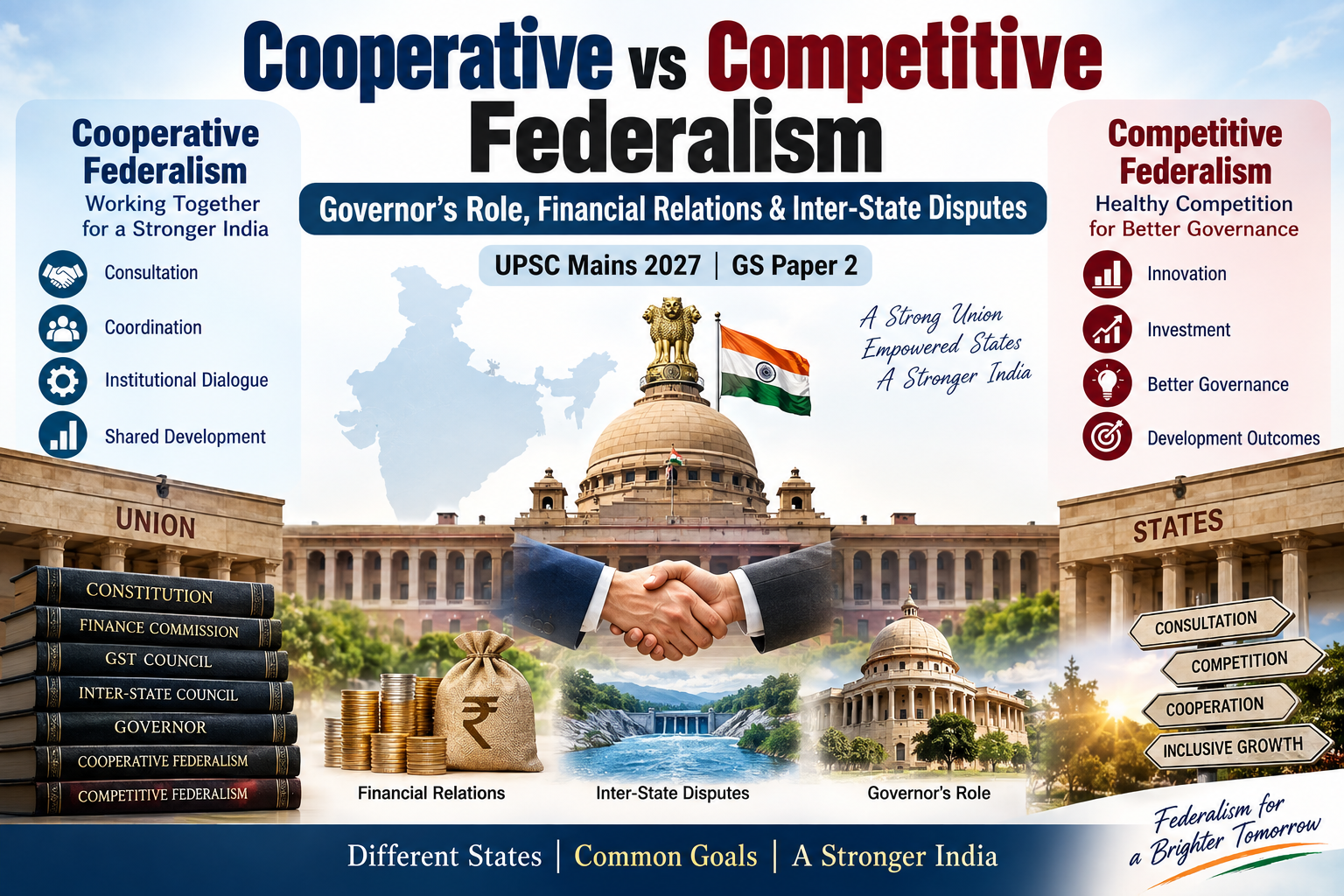
Cooperative vs Competitive Federalism is a highly relevant topic for UPSC Mains GS Paper 2, particularly under the syllabus area dealing with the functions and responsibilities of the Union and the States, issues and challenges pertaining to the federal structure, and devolution of powers and finances.
India’s federal system seeks to balance national unity with State autonomy. While cooperative federalism emphasises consultation and coordination, competitive federalism encourages States to improve governance, investment, innovation and development outcomes.
The contemporary debate has expanded beyond the traditional Centre-State relationship to include the Governor’s role, fiscal federalism, GST, centrally sponsored schemes, inter-State river-water disputes, institutional mechanisms and judicial interventions.
UPSC Mains Approach: Do not treat cooperative and competitive federalism as mutually exclusive. India’s requirement is better described as cooperative competition—States should compete in development while cooperating on matters requiring collective action.
Cooperative vs Competitive Federalism is a highly relevant topic for UPSC Mains GS Paper 2, particularly under the syllabus area dealing with the functions and responsibilities of the Union and the States, issues and challenges pertaining to the federal structure, and devolution of powers and finances.
Aspirants preparing for UPSC Mains GS Paper 2 should also understand Basic Structure Doctrine UPSC Mains GS Paper II: Evolution, Landmark Cases & Judicial Activism to connect federalism with constitutional and institutional issues.
Federalism in the Indian Constitutional Framework
India’s Constitution establishes a federal structure with a relatively strong Union.
The distribution of powers is primarily reflected through:
- Article 245 – Extent of laws made by Parliament and State Legislatures
- Article 246 – Distribution of legislative subjects
- Seventh Schedule – Union, State and Concurrent Lists
- Article 263 – Inter-State Council
- Article 280 – Finance Commission
- Article 279A – GST Council
- Article 200 – Governor’s role regarding State Bills
- Article 262 – Inter-State river-water disputes
- Article 131 – Original jurisdiction of the Supreme Court in specified federal disputes
Thus, Indian federalism combines constitutional division of powers with mechanisms for Union-State coordination.
Understanding Cooperative vs Competitive Federalism is essential for analysing how India’s constitutional framework balances national unity, State autonomy and effective governance.
Cooperative Federalism
Cooperative Federalism
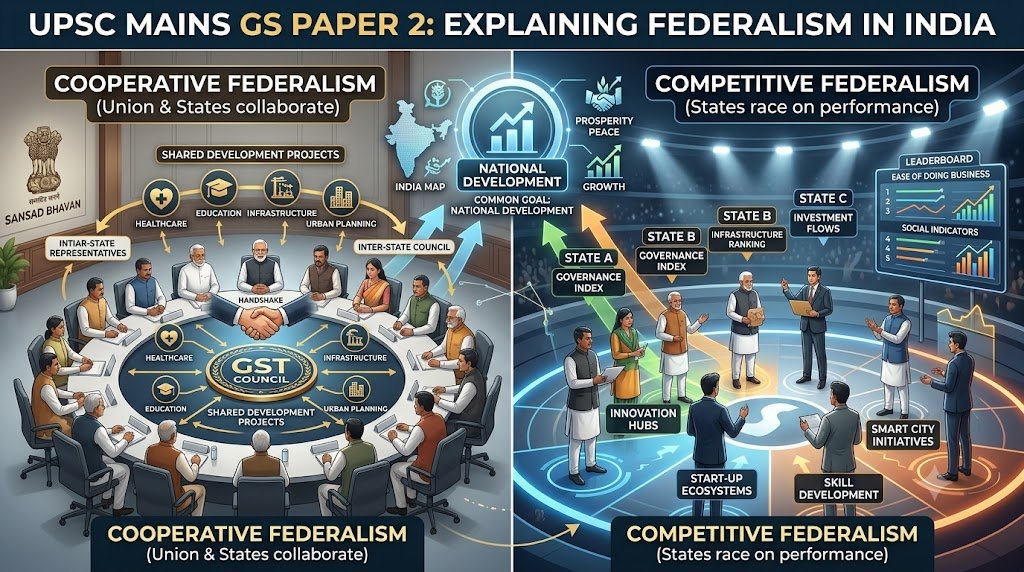
Cooperative federalism refers to a system in which different levels of government work together to address common national and developmental objectives.
It is based on:
- Consultation
- Coordination
- Institutional dialogue
- Fiscal cooperation
- Joint implementation
- Consensus-building
- Information sharing
Major Institutions Supporting Cooperative Federalism
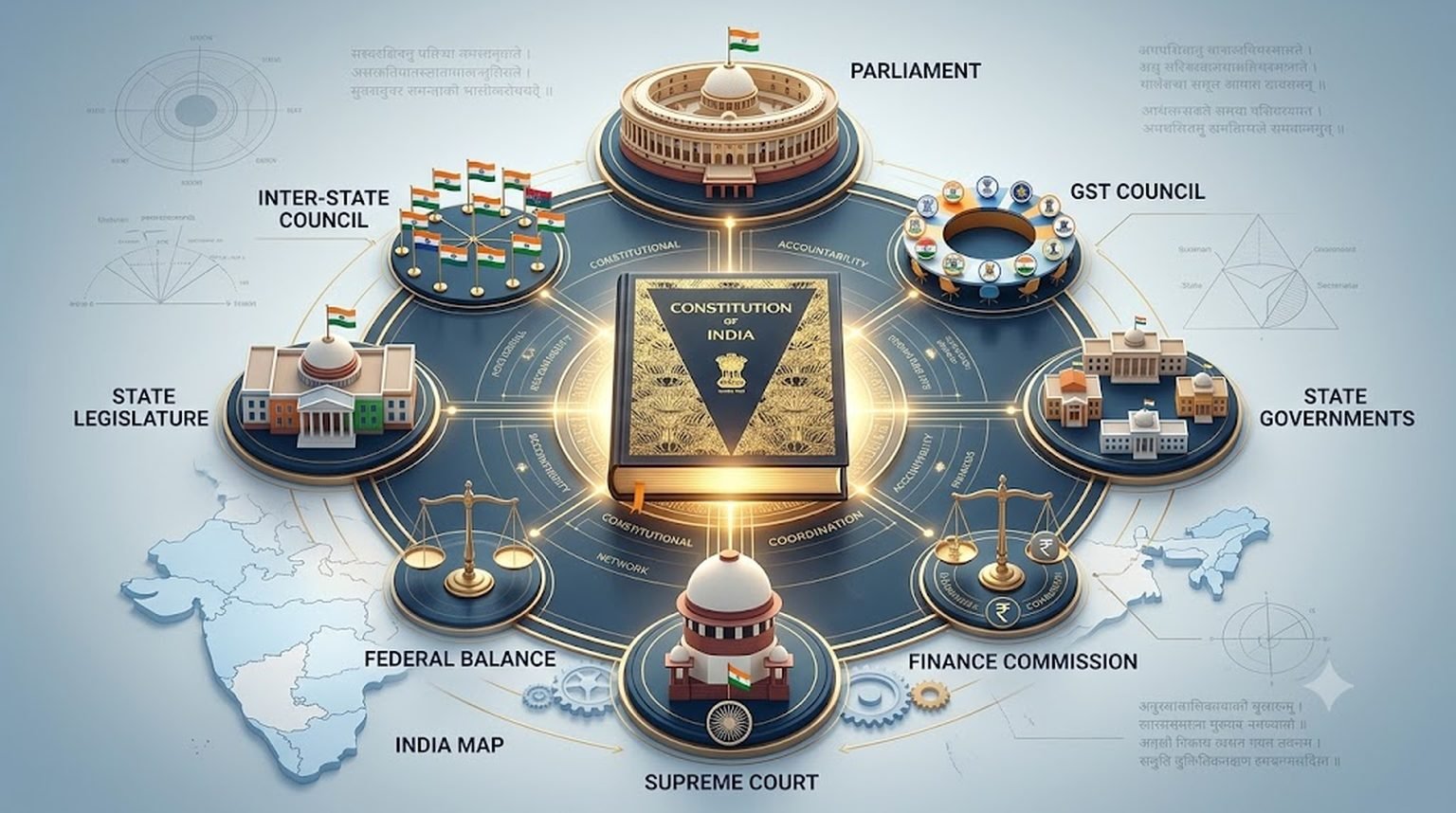
GST Council
The GST Council provides a constitutional platform for the Union and States to participate in GST-related decision-making.
It is an important example of institutionalised fiscal cooperation.
Inter-State Council
Article 263 provides the constitutional basis for an Inter-State Council to facilitate discussion and coordination on issues involving States and the Union.
Finance Commission
The Finance Commission plays a central role in fiscal federalism by recommending tax devolution and principles relating to grants-in-aid.
Centrally Sponsored Schemes
These programmes involve participation by both the Union and States. However, the extent of State flexibility and the conditions attached to funding remain important issues in Centre-State relations.
The cooperative dimension of Cooperative vs Competitive Federalism is particularly important when the Union and States must work together on national and developmental priorities.
Competitive Federalism
Competitive Federalism
Competitive federalism encourages States to compete for:
- Investment
- Infrastructure
- Better governance
- Innovation
- Employment
- Improved public services
- Higher development outcomes
The basic idea is that competition can encourage governments to improve their performance.
Benefits
Healthy competition can:
- Encourage policy innovation
- Improve administrative efficiency
- Promote investment
- Improve service delivery
- Encourage States to adopt successful models
- Create incentives for governance reforms
Concerns
However, excessive competition can produce:
- Regional inequalities
- Unequal competition between fiscally strong and weak States
- Excessive incentives to attract investment
- Possible race-to-the-bottom tendencies
- Greater dependence on fiscal transfers
Therefore, competitive federalism requires a framework of fiscal equalisation and minimum national standards.
The competitive dimension of Cooperative vs Competitive Federalism encourages States to improve governance, attract investment and deliver better development outcomes.
Cooperative vs Competitive Federalism
| Parameter | Cooperative Federalism | Competitive Federalism |
|---|---|---|
| Core idea | Working together | Competing for better outcomes |
| Focus | Coordination | Performance |
| Main objective | Common goals | Innovation and efficiency |
| Mechanism | Consultation | Competition |
| Examples | GST Council, Inter-State Council | Investment, governance and development rankings |
| Major strength | Consensus | Innovation |
| Major concern | Excessive centralisation | Regional inequality |
| Ideal approach | Cooperation | Healthy competition |
UPSC Mains Insight
The two approaches should complement each other.
Cooperation creates the institutional framework; competition creates incentives for better performance.
Governor’s Role in Centre-State Relations
The Governor occupies a sensitive position within India’s federal structure.
The office becomes particularly important when constitutional discretion interacts with:
- State governments
- State legislatures
- Constitutional conventions
- Union-State relations
- Judicial review
Appointment and Removal
The Governor is appointed by the President.
Concerns have periodically emerged regarding:
- Political neutrality
- Perceived partisan behaviour
- Security of tenure
- Timing of appointments and removals
- Relationship with the elected State government
The Sarkaria Commission emphasised the importance of choosing Governors who are detached from active politics and capable of functioning impartially.
Governor and Government Formation
The Governor may have an important role when:
- No party obtains a clear majority
- There is uncertainty regarding majority support
- A government appears to have lost its majority
- Constitutional circumstances require the Governor to exercise a specified function
The key principle should be:
Constitutional discretion + democratic legitimacy + floor test
The floor of the House is generally the appropriate democratic forum for determining legislative majority.
Governor and State Bills
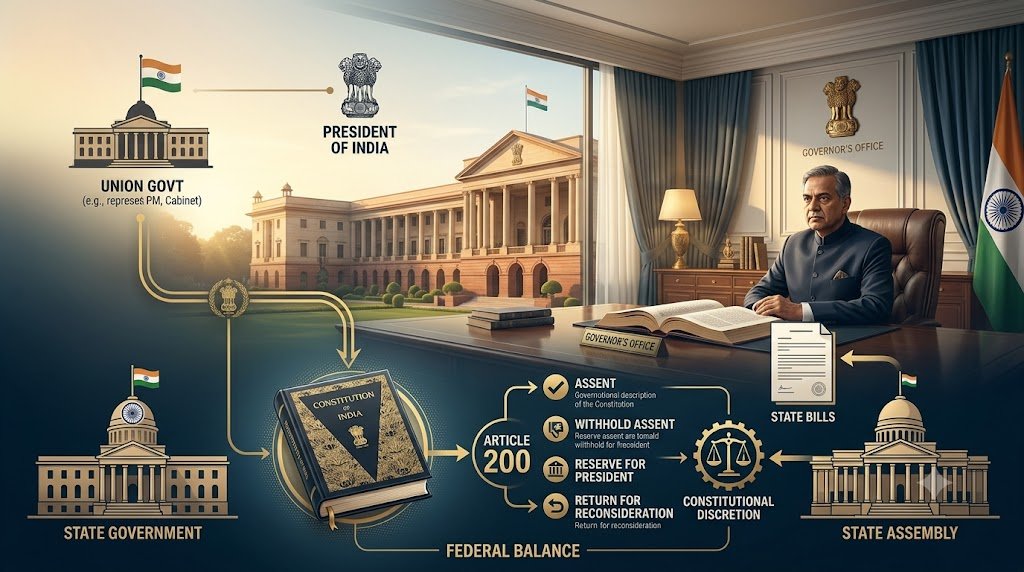
Article 200 is particularly important for UPSC Mains.
When a Bill passed by a State Legislature is presented to the Governor, the constitutional framework provides different courses of action, including:
- Assent
- Withholding assent
- Returning a non-Money Bill for reconsideration
- Reserving a Bill for consideration of the President
This has become an important federalism issue because prolonged uncertainty over Bills can create tension between the elected State government and the Governor.
UPSC Link
Governor → Article 200 → State Legislature → Constitutional Discretion → Judicial Review → Federalism
This is an excellent analytical chain for GS Paper 2 answers.
The Governor’s role adds another important dimension to Cooperative vs Competitive Federalism, particularly when questions of constitutional discretion and State autonomy arise.
Recent Judicial Dimension: Articles 200 and 201
The Governor’s powers regarding State Bills have received significant judicial attention.
The Supreme Court’s Constitution Bench judgment of 20 November 2025 examined the constitutional scheme concerning Articles 200 and 201 and the options available to the Governor and President in relation to State Bills.
For UPSC preparation, the broader significance is more important than simply memorising the judgment:
Constitutional discretion should operate within constitutional accountability and federal balance.
This development can be used as a contemporary example in questions involving:
- Governor
- Federalism
- Constitutional morality
- State legislative autonomy
- Judicial review
Financial Relations Between Centre and States
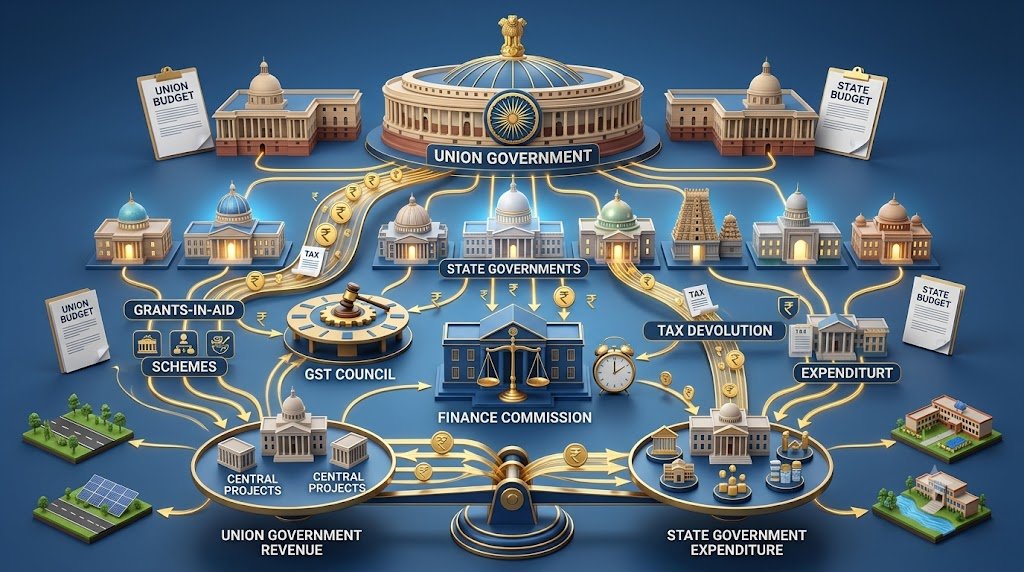
Fiscal federalism is one of the most important dimensions of Indian federalism.
The basic challenge is that:
States have substantial expenditure responsibilities, while the Union has comparatively greater revenue-raising capacity.
This creates vertical fiscal imbalance.
At the same time, States differ considerably in their fiscal capacities, creating horizontal fiscal imbalance.
Tax Devolution
The Finance Commission recommends the distribution of the divisible pool of Union taxes between the Union and the States.
The Sixteenth Finance Commission covers the five-year period from 1 April 2026 to 31 March 2031.
Its recommendations therefore have direct relevance for UPSC Mains 2027.
Horizontal Devolution
After determining the States’ aggregate share, the Finance Commission recommends the distribution among individual States.
The objective is not simply equal distribution but also addressing differences in:
- Fiscal capacity
- Population
- Area
- Forest cover
- Demographic performance
- Economic contribution
This reflects the broader principle of fiscal equalisation.
GST and Fiscal Federalism
The introduction of GST significantly changed India’s indirect-tax framework.
The GST Council provides an institutional mechanism for Union-State participation.
For UPSC answers, GST can be presented as an example of:
Constitutional cooperation + shared taxation framework + institutional federalism
At the same time, debates around revenue predictability, compensation, fiscal autonomy and the Union-State balance make GST relevant to the wider fiscal-federalism discussion.
Major Challenges in Fiscal Federalism
Vertical Fiscal Imbalance
States have major responsibilities in areas such as health, education, agriculture and local infrastructure, while important taxation powers are concentrated at the Union level.
Horizontal Fiscal Imbalance
States have different levels of development and revenue-generating capacity.
Cesses and Surcharges
Their treatment in relation to the divisible pool remains an important issue in debates concerning fiscal devolution.
Centrally Sponsored Schemes
States may seek greater flexibility regarding scheme design and expenditure priorities.
State Borrowing
Balancing State fiscal autonomy with macroeconomic and fiscal stability remains a continuing challenge.
Fiscal relations are therefore a central component of Cooperative vs Competitive Federalism, as financial autonomy and equitable resource distribution directly influence Centre-State relations.
Inter-State Disputes
Federal relations are not limited to Union-State disputes.
States can also face disputes involving:
- River waters
- Boundaries
- Natural resources
- Administrative jurisdictions
- Infrastructure projects
These disputes can directly affect national integration and regional relations.

Inter-State River Water Disputes
Water is particularly sensitive because river basins frequently extend across multiple States.
Article 262 provides the constitutional framework for adjudication of disputes relating to waters of inter-State rivers or river valleys.
Important examples include:
- Cauvery
- Krishna
- Mahanadi
- Ravi-Beas
- Mahadayi/Mandovi
These disputes involve competing considerations:
Upstream interests → Downstream rights → Agriculture → Drinking water → Ecology → Federal cooperation
Why River Disputes Persist
Increasing Demand
Population growth, irrigation, industrialisation and urbanisation increase demand.
Uneven Rainfall
India’s rainfall varies considerably across regions and seasons.
Climate Variability
Changes in rainfall patterns and extreme weather can complicate water availability.
Upstream–Downstream Conflict
Upstream States may prioritise storage and irrigation, while downstream States may demand adequate flows.
Political Sensitivity
Water disputes can become emotionally and politically charged.
Institutional Mechanisms for Cooperative Federalism
GST Council
Promotes fiscal coordination.
Inter-State Council
Provides a platform for Union-State and inter-State dialogue.
Zonal Councils
Promote regional cooperation.
Finance Commission
Supports fiscal devolution and equalisation.
NITI Aayog
Provides a platform for policy coordination and cooperative approaches to development.
Supreme Court
Provides constitutional adjudication in appropriate federal disputes.
Sarkaria Commission and Centre-State Relations
The Sarkaria Commission remains one of the most important sources for UPSC GS Paper 2 answers on federalism.
Its recommendations broadly emphasised:
- Greater consultation
- Strengthening inter-governmental institutions
- Appropriate use of constitutional powers
- Governor’s political neutrality
- Strengthening the Inter-State Council
Its recommendations are valuable because they provide an institutional basis for discussing how Centre-State relations can be improved.
Punchhi Commission and Federalism
The Punchhi Commission on Centre-State Relations provides another important reference point.
Its broader focus included:
- Strengthening federal cooperation
- Clarifying constitutional conventions
- Improving inter-governmental relations
- Examining the role of the Governor
- Improving mechanisms for Centre-State coordination
UPSC Value Addition
A strong GS-II answer can mention:
Sarkaria Commission + Punchhi Commission + Supreme Court jurisprudence
This demonstrates continuity between institutional recommendations, constitutional principles and contemporary developments.
Major Challenges to Indian Federalism
1. Trust Deficit
Political differences between the Union and State Governments can weaken institutional cooperation.
2. Governor-Related Controversies
Questions regarding constitutional discretion and State Bills can create friction.
3. Fiscal Dependence
States may seek greater untied resources and fiscal flexibility.
4. Regional Inequality
Competitive federalism can benefit States with stronger economic and institutional capacities more than weaker States.
5. Inter-State Resource Conflicts
Water and other resources can become prolonged political disputes.
6. Centralisation Concerns
Excessive central direction can reduce the perceived autonomy of States.
7. Institutional Underuse
Institutions such as the Inter-State Council can be more effective when dialogue is regular, structured and followed by implementation.
Way Forward: Towards Collaborative Competitive Federalism
India needs neither purely cooperative nor purely competitive federalism.
It needs collaborative competitive federalism.
1. Strengthen the Inter-State Council
Regular meetings and structured follow-up can improve institutional dialogue.
2. Ensure Governor’s Constitutional Neutrality
The office should function as a constitutional bridge rather than a political fault line.
3. Strengthen Fiscal Federalism
States need predictable and transparent fiscal transfers.
4. Improve Consultation
Major policies affecting States should involve meaningful consultation wherever constitutionally and administratively appropriate.
5. Increase State Flexibility
States should have adequate flexibility in implementing schemes according to local needs.
6. Strengthen River-Basin Governance
River management should increasingly use:
- Scientific data
- Basin-level planning
- Real-time information
- Negotiation
- Ecological sustainability
7. Encourage Healthy Competition
States should compete on:
- Governance
- Human development
- Infrastructure
- Innovation
- Sustainable growth
rather than merely competing through fiscal incentives.
8. Strengthen Constitutional Conventions
Federalism depends not only on constitutional text but also on conventions, restraint and mutual trust.
How to Write a UPSC Mains Answer on This Topic
A 10/15-marker can be structured as:
Introduction
Define federalism and establish the cooperative-competitive relationship.
Body
Part 1: Explain cooperative federalism.
Part 2: Explain competitive federalism.
Part 3: Discuss Governor-related concerns.
Part 4: Discuss fiscal federalism.
Part 5: Discuss inter-State disputes.
Part 6: Give institutional reforms and contemporary examples.
Conclusion
End with:
India’s federalism should evolve from a relationship of command and compliance towards a partnership based on consultation, fiscal fairness, constitutional restraint and healthy competition.
Model UPSC Mains Introduction
Indian federalism is neither purely federal nor purely unitary; it represents a constitutional balance between national unity and regional autonomy. In this framework, cooperative federalism facilitates joint action, while competitive federalism encourages States to improve governance and development outcomes.
Model UPSC Mains Conclusion
The future of Indian federalism lies not in choosing between cooperation and competition, but in institutionalising both. A strong Union, empowered States, constitutionally neutral institutions and predictable fiscal relations can transform federalism from a potential source of conflict into an instrument of inclusive national development.
Quick Revision for UPSC Mains GS Paper 2
Cooperative Federalism → Coordination + Consultation
Competitive Federalism → Competition + Performance
Collaborative Federalism → Cooperation + Healthy Competition
Article 200 → Governor and State Bills
Article 263 → Inter-State Council
Article 262 → Inter-State River-Water Disputes
Article 280 → Finance Commission
Article 279A → GST Council
Article 131 → Supreme Court’s original jurisdiction in specified federal disputes
Sarkaria Commission → Centre-State Relations
Punchhi Commission → Centre-State Relations
Fiscal Federalism → Devolution + Equalisation
Vertical Imbalance → Union-State revenue/expenditure mismatch
Horizontal Imbalance → Differences among States
Sixteenth Finance Commission → Award period 2026–31
Governor + Article 200 → Contemporary federalism issue
UPSC Mains Keywords for Value Addition
Use these terms naturally in answers:
- Cooperative Federalism
- Competitive Federalism
- Collaborative Federalism
- Fiscal Federalism
- Fiscal Equalisation
- Vertical Fiscal Imbalance
- Horizontal Fiscal Imbalance
- Constitutional Morality
- Constitutional Neutrality
- Federal Balance
- State Autonomy
- Inter-Governmental Relations
- Fiscal Devolution
- Democratic Accountability
- Institutional Federalism
- Competitive Governance
- Consensus-Based Federalism
Recommended Posts
Electoral Reforms in India: Critical Issues, Criminalization & ECI Role | UPSC Mains GS Paper II
7 Significant Political Developments of Feb 2026: A Comprehensive Guide
IRGC Explained for UPSC 2026: Critical Facts Behind Iran–Israel Conflict
RTE Act 2009 Social Inclusion Explained: Powerful Strategy & Key Insights for UPSC 2026
Conclusion
A balanced approach to Cooperative vs Competitive Federalism can strengthen India’s federal structure by combining institutional cooperation with healthy competition among States.
Cooperative vs Competitive Federalism is not simply a debate between the Union and States. It is fundamentally about designing institutions that allow India to maintain national coherence while respecting regional diversity and State autonomy.
The Governor’s role, fiscal relations and inter-State disputes show that India’s federal structure requires constitutional restraint, institutional dialogue and predictable financial arrangements.
For UPSC Mains GS Paper 2 2027, aspirants should connect the topic through four layers:
Constitutional Provisions → Institutional Mechanisms → Contemporary Developments → Reform-Oriented Analysis
The Sixteenth Finance Commission’s 2026–31 award period and continuing constitutional questions around the Governor’s handling of State Bills provide particularly useful contemporary dimensions for a 2027 answer.
Aspirants should regularly refer to the official UPSC syllabus and examination resources to understand the scope of topics and align their preparation with the requirements of the Civil Services Examination.