
Introduction
Crack UPSC Prelims 2026 in your first attempt! Get the ultimate roadmap, subject-wise booklist, NCERT strategy, and a 90-day final revision plan. Start your IAS journey today with our expert guide.
The UPSC Civil Services Examination is one of the toughest competitive exams in India. With UPSC Prelims 2026 approaching, aspirants must adopt a focused, structured, and disciplined strategy to secure success.
As competition intensifies, your preparation for UPSC Prelims 2026 must be more strategic than ever before.
To succeed in the highly competitive UPSC Prelims 2026, you need a blend of traditional wisdom and a modern, data-driven approach
This guide provides a complete roadmap to crack UPSC Prelims 2026 effectively.

Understanding the UPSC Prelims 2026 Exam Structure
UPSC Prelims consists of:
- General Studies Paper I
- CSAT (Qualifying – 33%)
High-Yield Focus Areas for UPSC Prelims 2026
- History
- Polity
- Economy
- Geography
- Environment
- Science & Technology
- Current Affairs
History: The Pillar of Continuity
History remains a high-weightage area where accuracy is key. For 2026, the focus is shifting towards “Social History” and “Chronology.”
Modern History: Focus heavily on the 1857–1947 period, specifically the role of lesser-known freedom fighters and the evolution of the Indian National Congress (INC).
Ancient & Medieval: UPSC now loves terms related to administration (like Iqta or Mansabdari) and religious movements like Bhakti and Sufism.
Art & Culture: Prioritize UNESCO World Heritage sites, classical dances, and temple architecture styles (Nagara vs. Dravida).
Ancient History is a crucial area for UPSC Prelims. Practicing Indus Valley Civilization MCQs will help you cover important static questions asked in the exam.
Polity: The Scoring Subject
Polity is where you can aim for 100% accuracy if your concepts are clear.
Core Concepts: Master the “Basic Structure Doctrine,” Fundamental Rights, and DPSP.
Parliament & Judiciary: Focus on the powers of the Speaker, Parliamentary Committees, and the Collegium system.
2026 Trend: Keep an eye on “Electoral Reforms,” the “Delimitation Commission,” and new laws passed in Parliament.
Economy: Conceptual Clarity over Data
Understanding the Indian economy’s volatile nature is crucial for anyone appearing in UPSC Prelims 2026.
Don’t memorise numbers; understand the “Why” and “How.”
Banking & Finance: Understand how RBI controls inflation using tools like Repo Rate and SLR. Focus on Digital Currency (e-Rupee) and UPI evolution.
External Sector: Study the Balance of Payments (BoP) and India’s trade relations with major blocs (G20, ASEAN).
Government Budgeting: Learn the terms like “Fiscal Deficit” and “Capital Expenditure” from the latest Union Budget.
Geography: Map-Based & Conceptual
Geography is no longer just about facts; it is about “Spatial Awareness.”
Physical Geography: Focus on “Climate Change” indicators—El Niño, La Niña, and Jet Streams.
Indian Geography: Map the major river systems (tributaries are crucial!) and the distribution of critical minerals (Lithium, Rare Earth elements).
World Geography: Keep a close watch on “Places in News” (e.g., regions affected by global conflicts or natural disasters).
Mapping is a high-yield area that can decide your fate in the UPSC Prelims 2026 GS paper.
Environment: The Expanding Section
With the integration of the Indian Forest Service (IFoS) exam, this section is now critical.
Biodiversity: Study National Parks and Wildlife Sanctuaries, specifically those where “Species Reintroduction” (like Cheetahs) is happening.
Climate Change: Focus on India’s “Panchamrit” targets from COP summits and the International Solar Alliance (ISA).
International Laws: Master the Kyoto Protocol, Paris Agreement, and the Montreal Protocol.
Science & Technology: Application Based
UPSC rarely asks for formulas; they ask for the application of new tech in daily life.
Space Tech: Follow ISRO’s upcoming missions (Gaganyaan, Chandrayaan series updates).
Biotechnology: Study CRISPR-Cas9, mRNA vaccines, and Genome mapping.
Emerging Tech: Focus on Artificial Intelligence (AI), Web 3.0, and 5G/6G communication.
Current Affairs: The Connecting Link
For the UPSC Prelims 2026 attempt, your focus should strictly be on issues with long-term national and international relevance
This is the “Thread” that ties all other subjects together.
Duration: For 2026, you must cover events from January 2025 to April 2026.
Sources: Stick to The Hindu or The Indian Express and a reliable monthly magazine.
Strategy: Link current news to your static syllabus. If a state is under President’s Rule, go back and revise Article 356 in your Polity book.
Do not get distracted by every news headline; filter your reading specifically for UPSC Prelims 2026 relevance.
Build Strong Foundation (NCERT First)
Building a rock-solid foundation with NCERTs is the first milestone in your UPSC Prelims 2026 journey. Without a strong grip on NCERTs, clearing the UPSC Prelims 2026 GS Paper-1 will be an uphill task.
Start with:
- Class 6–12 NCERTs
- Especially Polity, History, Geography, Economics
Do not jump directly into advanced books.
Why NCERTs are Non-Negotiable
NCERTs are the “Bedrock” of UPSC preparation. They simplify complex topics and provide the fundamental framework required to understand higher-level concepts.
Building Conceptual Clarity: Attempting advanced reference books without a solid base is a common mistake. For instance, understanding the nuances of the Indian Parliament becomes much easier once you have mastered the basics of Democracy and Citizenship from Class 6–8 textbooks.
Source of Direct Questions: Every year, several questions in the UPSC Prelims are framed directly from the text or diagrams within NCERTs. They are the most authentic source of information for the Commission.
Developing a Reading Habit: For beginners, jumping straight into heavy volumes like M. Laxmikanth or Ramesh Singh can be overwhelming. Starting with NCERTs helps build the mental stamina and vocabulary needed for the long preparation journey.
The “Limited Resources” Strategy: Less is More
The biggest mistake UPSC aspirants make is “Resource Hoarding”—buying every new book in the market. To crack Prelims 2026, your mantra should be: Minimum Books, Maximum Revision.
Mastering these resources will ensure you stay ahead of the curve in the UPSC Prelims 2026 cycle.
Indian Polity – M. Laxmikanth
Often called the “Bible of Polity,” this book covers almost 90% of the Prelims syllabus.
Strategy: Don’t just read it; memorize the tables and Appendices. Pay special attention to Fundamental Rights, Parliament, and Local Government.
2026 Tip: Correlate chapters with recent Supreme Court judgments or Constitutional amendments mentioned in the news.
Modern History – Spectrum (A Brief History of Modern India)
While there are many thick volumes on History, Spectrum is preferred for its concise, point-wise approach which is perfect for Prelims.
Strategy: Focus on the “Summary” boxes at the end of each chapter. The timeline from 1857 to 1947 is the most high-yield area.
Why it works: It captures the nuances of the Freedom Struggle in a way that is easy to recall during the exam.
Environment – Shankar IAS
Environment has become a “deal-breaker” subject because of the high number of questions.
Strategy: Focus on Biodiversity, International Conventions (like Ramsar or COP), and Protected Areas (National Parks/Biosphere Reserves).
2026 Tip: Supplement this book with the latest “State of Forest Report” and new species discovered in India.
Economy – Concept Clarity + Current Links
Economy is 70% conceptual and 30% current affairs.
Strategy: Use a base book (like Nitin Singhania or Vivek Singh) to understand terms like Inflation, GDP, and Repo Rate. Once the concepts are clear, switch to the Economic Survey and Budget.
Why it works: UPSC rarely asks static economy questions; they usually ask how a concept (like Repo Rate) affects the real market today.
The Golden Rule of Revision
“It is better to read one book ten times than to read ten books one time.”
By sticking to these four pillars, you ensure that you aren’t overwhelmed by information and have enough time for Mock Tests, which are the final step in your 2026 journey.
Stick to limited resources:
- Polity – Laxmikanth
- Modern History – Spectrum
- Environment – Shankar IAS
- Economy – Basic concept clarity + current link
Revision > New books.
Mastering these core books is the most effective way to guarantee a high score in UPSC Prelims 2026.
Current Affairs Strategy (2025-2026 Focus)
In the evolving pattern of UPSC, Current Affairs is no longer a standalone subject—it is the lens through which you must view the entire syllabus. For the 2026 Prelims, your primary focus should be on events occurring between January 2025 and April 2026.
Government Schemes: Beyond the Names
UPSC has moved past simple “Which ministry launched this?” questions.
What to track: Focus on the target audience, the funding pattern (Centrally Sponsored vs. Central Sector), and the specific objectives.
High-Yield Areas: Schemes related to Health (Ayushman Bharat updates), Agriculture (PM-KISAN), and Digital Infrastructure (Gati Shakti).
International Relations: The “Map-Based” Approach
For 2026, IR is less about theories and more about geography and global impact.
What to track: Places in the news (conflicts in the Middle East, Eastern Europe, or the South China Sea).
Organizations: Study the evolution of groups like BRICS+, G20, and QUAD. Always look for India’s specific role or veto power in these groups.
Practicing Middle East Crisis MCQs 2026 is essential for better preparation.
Reports & Indices: The Data Hierarchy
Don’t memorize every ranking. Focus on “Who published it” and “India’s relative performance.”
Key Players: Reports by the World Bank, IMF, WEF, and UN bodies are priorities.
Internal Reports: Pay close attention to the NITI Aayog indices (like the Sustainable Development Goals India Index).
Environmental Developments: The “Action” Focus
This is the most dynamic part of the Prelims paper.
What to track: New Ramsar Sites added in 2025, changes in the Wild Life (Protection) Act, and outcomes of the latest COP (Conference of Parties) summits.
Species in News: If a specific animal is being translocated or declared endangered, it’s a potential question.
Important Current Affairs for UPSC
👉 Middle East geopolitics is extremely important for UPSC. For example, you can read our detailed guide on
Middle East Crisis UPSC Prelims 2026
👉 Another crucial global chokepoint aspirants must understand is
Strait of Hormuz UPSC Prelims 2026
👉 For practice questions aspirants can also attempt
50 Important Polity Questions for UPSC Prelims
👉 For latest current affairs analysis read
7 Significant Political Developments of Feb 2026
Current affairs play a crucial role in the UPSC examination. Aspirants should regularly solve practice questions to improve accuracy. You can practice important questions in our guide on 100 Essential Current Affairs MCQs UPSC Prelims 2026 (Top Questions with Answers).
Avoid Information Overload: The “Rule of One”
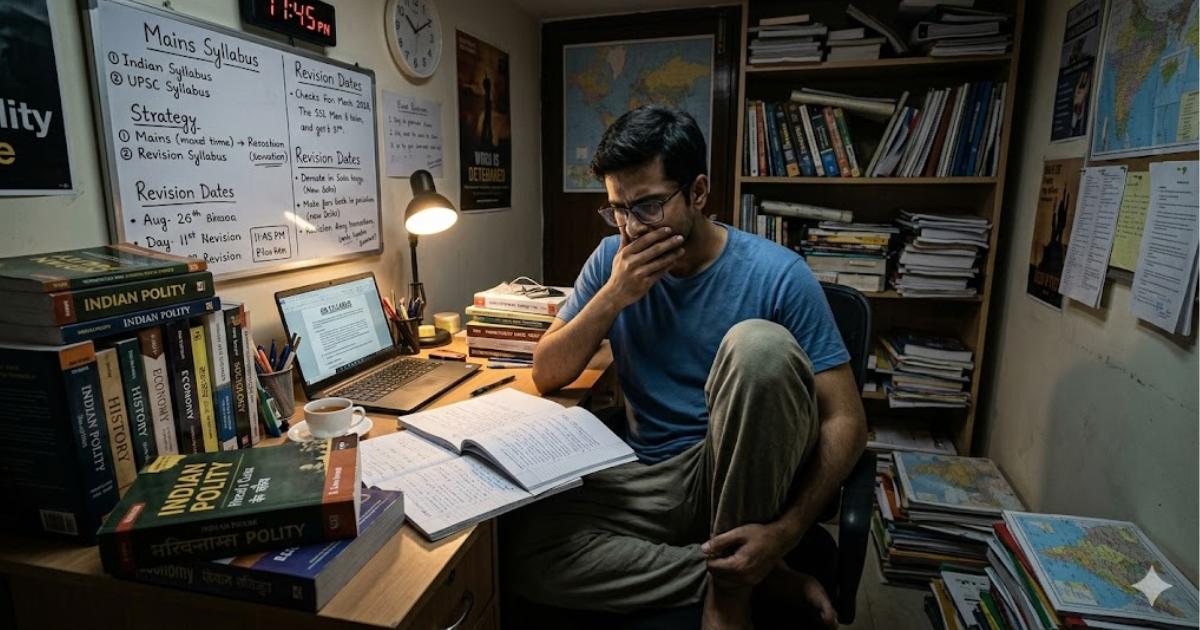
The biggest trap is reading 4 different newspapers and 3 different magazines.
The Strategy: Pick one daily newspaper (The Hindu or The Indian Express) and one reliable monthly current affairs magazine.
The Filter: If a news item doesn’t relate to a keyword in the UPSC syllabus, skip it. You are training to be a civil servant, not a news anchor.
The “Static-Current” Linkage
Example: If the Supreme Court gives a judgment on “Governor’s Powers” in late 2025, do not just read the news. Go back to your Laxmikanth and thoroughly revise the “Governor” chapter. This is how you clear Prelims.
So, Last 1 year current affairs is critical
- Focus on:
- Government schemes
- International relations
- Reports & indices
- Environmental developments
Avoid information overload.
PYQ Analysis – Game Changer
Previous Year Questions reveal:
- Question pattern
- Repeated themes
- Concept depth
Solve at least last 10 years PYQs.
Mock Test Strategy
From January 2026 onwards:
- 2–3 full length mocks per week
- Analyze mistakes
- Maintain error notebook
Attempt smartly — elimination technique is crucial.
Solving at least 40-50 full-length tests is the only way to build the stamina required for UPSC Prelims 2026.
The 3-Stage UPSC Prelims 2026 Smart Revision Formula
A disciplined 3-stage revision is the only way to retain vast information for the UPSC Prelims 2026 exam day.
To succeed in UPSC, your brain needs to move information from short-term to long-term memory. This 3-stage plan ensures you don’t “blank out” on exam day.
Stage 1: The “Deep Dive” (6-4 Months Before)
The goal here is Conceptual Clarity. Read your standard books and NCERTs thoroughly. Do not worry about memorizing dates; instead, focus on the “Why” behind events. If you understand the logic of the Morley-Minto reforms, you won’t need to mug them up.
Stage 2: The “Compression” (4-2 Months Before)
Now, convert your understanding into Short Notes. If a chapter is 50 pages, your notes should be 5 pages. Use flowcharts, mind maps, and bullet points. This stage is also the best time to start subject-specific Mock Tests to identify your weak areas.
Stage 3: The “Precision” (Last 60 Days)
In the final stretch, focus Only on Key Facts & Mistakes. Review high-yield data like National Parks, Constitutional Articles, and Economic indicators. Re-read the solutions to the Mock Tests you failed earlier to ensure you don’t repeat the same errors.
The Golden Rule: No New Sources
Do not pick up a new book in the final 2 months of your UPSC Prelims 2026 preparation. Trust your existing notes and revise them at least 3 times.
In the final 2 months, lock your library. Buying a new “Current Affairs Special” book or a new “Secret Strategy” guide will only create panic and dilute your existing knowledge. Trust your preparation and stick to what you have already practiced.
In recent years, the CSAT (Civil Services Aptitude Test) has emerged as the “silent killer” of UPSC dreams. While it is officially a qualifying paper requiring only 33% (66 out of 200 marks), the increasing difficulty level—often reaching CAT or JEE standards—means you cannot leave it to chance.
The CSAT Survival Strategy: Don’t Ignore CSAT
Many high-scoring GS candidates fail the exam because they underestimate the CSAT requirements for UPSC Prelims 2026.
Given the recent trends, clearing the CSAT paper has become a significant hurdle for many targeting UPSC Prelims 2026.
Reading Comprehension (RC): Don’t rely on intuition. Practice identifying the “Crux,” “Inference,” and “Assumptions” of the author. This is the most time-consuming section but offers high rewards if your vocabulary and logic are sharp.
Basic Numeracy & Maths: UPSC is focusing heavily on Number Systems, Permutations & Combinations, and Probability. Master these “High-Yield” topics first. You don’t need to be a math genius; you just need to be comfortable with 10th-grade logic applied to complex problems.
Logical Reasoning: This is usually the most scoring area. Focus on Syllogisms, Blood Relations, and Seating Arrangements.
The 2026 Warning: Do not wait until after your GS syllabus is finished. Dedicate at least 3–4 hours every weekend to CSAT. Solve the last 10 years of Previous Year Questions (PYQs) to understand the “trap” options UPSC sets. If you can consistently score 90+ in mocks, you are safe; anything less requires immediate intervention.
90-Day Final Strategy Plan
Last 3 months:
- Only revision
- Daily MCQs
- Focus on weak areas
- Sleep discipline
- No panic
- Consistency beats motivation.
Your consistency today will determine your rank in the final list after UPSC Prelims 2026.
Conclusion
Cracking the UPSC Prelims 2026 in your first attempt is not about studying everything under the sun; it is about studying the right things consistently. By building a strong foundation with NCERTs, staying updated with current affairs, and rigorously practicing PYQs and Mock Tests, you can navigate this challenge with confidence. Remember, discipline is the bridge between goals and accomplishment. Start today, stay focused, and keep refining your strategy as you progress.
For more details and the latest updates, you can visit the official UPSC Official Website and check the latest Syllabus here
Stay focused, stay disciplined, and let’s conquer UPSC Prelims 2026 together.
A strong preparation strategy includes both static and dynamic subjects. For Ancient History, check our Indus Valley Civilization Notes UPSC 2026: Complete & Important Guide
Frequently Asked Questions (FAQs)
Q1. When should I start preparing for UPSC Prelims 2026?
Ideally, you should start at least 12–15 months before the exam date. This gives you enough time to cover the basic NCERTs and complete the core syllabus at least twice before you start full-scale revision.
Q2. Is it possible to clear UPSC Prelims without coaching?
Yes, absolutely. With the abundance of high-quality resources available online and a structured self-study plan, many aspirants clear the exam every year without formal coaching.
Q3. How many hours should I study daily?
Consistency matters more than hours. Aim for 6–8 hours of focused study daily. Quality of understanding and retention is far more important than just sitting at a desk.
Q4. How important is the CSAT paper?
While CSAT is qualifying (33% marks required), it should not be ignored. Many candidates fail to clear Prelims because they underestimate CSAT. Dedicate at least 2 days a week to practice math and reasoning if you are not comfortable with these subjects.
Q5: When should I start mock tests for UPSC Prelims 2026? *
Ideally, you should start full-length mocks for UPSC Prelims 2026 by January 2026.
Q6: Is one year enough for UPSC Prelims 2026?
Yes, with a disciplined approach, 12 months is the perfect timeframe to crack UPSC Prelims 2026.
7 thoughts on “Powerful UPSC Prelims 2026 Strategy & Study Plan”