Introduction
The Strait of Hormuz UPSC Prelims topic is extremely important for aspirants preparing for geography and international relations sections of the UPSC Civil Services Examination. This narrow maritime chokepoint connects the Persian Gulf with the Gulf of Oman and plays a crucial role in global oil trade and geopolitical strategy.
If you are preparing seriously for the exam, understanding important geopolitical topics like the Strait of Hormuz is essential. Along with current affairs and international relations, choosing the right study material also plays a crucial role. You can check our detailed guide on 7 Best Books for UPSC Prelims 2026: The Ultimate Topper’s List to select the most recommended resources for preparation.
Why the Strait of Hormuz is the World’s Most Critical Chokepoint in 2026
The Strait of Hormuz UPSC Prelims topic is extremely important because it is one of the most significant maritime chokepoints in global geopolitics.
1. Geographic Foundation and Physical Characteristics
Understanding the geography of the Strait of Hormuz UPSC Prelims topic helps aspirants answer map-based questions in the UPSC examination.
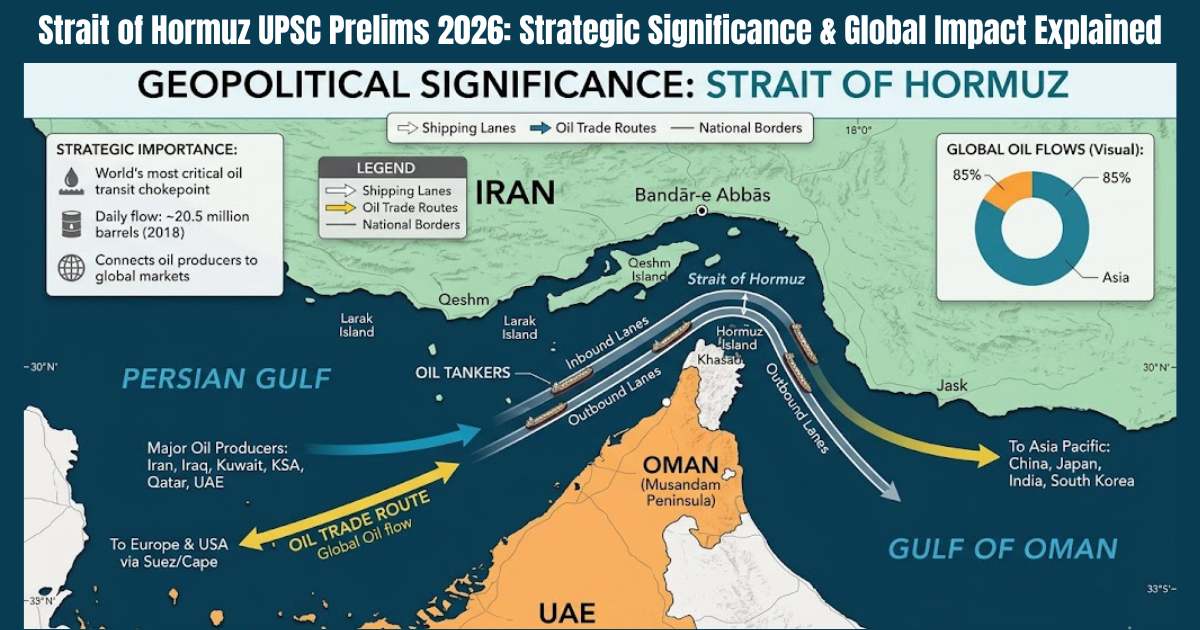
Strategic Location: A narrow maritime artery situated between Iran to the north and Oman (Musandam Peninsula) to the south.
Connecting Link: It serves as the sole sea passage from the Persian Gulf to the open ocean (via the Gulf of Oman and the Arabian Sea).
Critical Dimensions: * At its narrowest point, the strait is approximately 33 km (21 miles) wide.
The actual shipping lanes are even narrower, consisting of two 3 km wide channels (one for inbound and one for outbound traffic) separated by a 3 km buffer zone to prevent collisions.
Geographical Features: Includes strategic islands such as Hormuz, Kish, and Qeshm, which provide vantage points for maritime surveillance and military positioning.
The Strait of Hormuz UPSC Prelims topic is especially important because this narrow waterway connects the Persian Gulf with the Gulf of Oman and plays a key role in global maritime trade.

2. Economic Importance and Energy Security
Nearly one-fifth of the world’s petroleum trade passes through this chokepoint, making the Strait of Hormuz UPSC Prelims topic very relevant for current affairs.
World’s Primary Oil Chokepoint: It is the most important maritime chokepoint globally, with roughly 21 million barrels of oil per day (approx. 21% of global petroleum consumption) passing through it.
LNG Gateway: It is the primary exit route for Liquefied Natural Gas (LNG) exported from Qatar, the world’s leading LNG producer.
Global Trade Impact: Beyond energy, it is a vital route for commercial cargo moving between the industrial hubs of Asia and the resource-rich Middle East.
Understanding the Strait of Hormuz UPSC Prelims topic is essential because UPSC often asks questions related to strategic waterways and global trade routes.
According to the International Energy Agency, a significant portion of global oil trade passes through the Strait of Hormuz.
3. Geopolitical Dynamics and Regional Powers
In the context of the Strait of Hormuz UPSC Prelims topic, tensions between Iran and Western countries often affect global shipping routes.
Iran’s Influence: Due to its long northern coastline, Iran exerts significant military and political leverage over the strait, often using the threat of closure as a diplomatic tool.
Gulf Cooperation Council (GCC) Interests: Major exporters like Saudi Arabia, Kuwait, and the UAE rely heavily on this route to reach international markets.
International Maritime Law: Under the United Nations Convention on the Law of the Sea (UNCLOS), the strait is recognized as an international waterway where all vessels enjoy the right of “Transit Passage.”
According to international reports from BBC Middle East, tensions in the region often affect global shipping routes.

4. Security Challenges and Historical Incidents
The Tanker War (1980s): During the Iran-Iraq War, both nations targeted each other’s oil tankers, leading to international naval intervention.
Modern Confrontations: In recent years, the region has seen seizures of commercial tankers, drone strikes, and “limpet mine” attacks on vessels, often linked to rising tensions between Iran and Western powers.
Asymmetric Threats: The use of fast-attack boats, sea mines, and coastal missile batteries poses a constant security challenge to commercial shipping.
5. India’s Strategic Interests and Policy Framework
The Strait of Hormuz UPSC Prelims topic highlights how a narrow waterway can influence global energy security.
Energy Lifeline: India is highly vulnerable to disruptions here, as a massive portion of its crude oil and LNG imports originate from the Persian Gulf.
Strategic Assets (Chabahar Port): India’s investment in Iran’s Chabahar Port is a strategic move to bypass Pakistan and access Afghanistan/Central Asia, located just outside the strait’s entrance.
Maritime Diplomacy: The Indian Navy maintains a constant presence in the region through “Operation Sankalp” to ensure the safe passage of Indian-flagged vessels during times of tension.
For India, the Strait of Hormuz UPSC Prelims topic is important because a large portion of India’s oil imports passes through this region.
Summary Overview
Therefore, the Strait of Hormuz UPSC Prelims topic remains highly relevant for aspirants because it combines geography, international relations, and global economic security.
| Category | Key Insight |
| Primary Function | Connects the Persian Gulf to the Arabian Sea. |
| Global Significance | Transits ~21% of the world’s daily oil supply. |
| Major Risk | Geopolitical instability and regional conflict. |
| Legal Status | Governed by “Transit Passage” rights under UNCLOS. |
| India’s Role | Focus on energy security and naval protection missions. |
March 2026 Live Update: The Strait of Hormuz Crisis
As of March 11, 2026, the Strait of Hormuz strategic significance 2026 has shifted from a theoretical threat to an active maritime conflict. Following the naval escalations earlier this month, the following “Fresh” data points should be noted:
Shipping Volume Collapse: Maritime data from March 11 indicates that commercial tanker traffic through the Strait has plummeted by 82% compared to February levels. Most major shipping lines, including Maersk and MSC, have suspended transit until international naval escorts are secured.
The “Mine” Incident: In a significant escalation today, the UKMTO (United Kingdom Maritime Trade Operations) confirmed that three merchant vessels, including the Japan-flagged ONE Majesty, reported projectile strikes near the narrowest 21-mile point of the Strait.
Energy Market Shock: Brent Crude oil prices have spiked past $90.50 per barrel this morning. Analysts warn that a prolonged blockade could push prices toward the $110-$120 range by the end of Q1 2026.
Operation Sankalp (India): The Indian Navy has officially moved its stealth frigates into a “High Alert” formation just outside the Gulf of Oman to provide safe passage for Indian-flagged tankers carrying crucial LPG and crude supplies to ports like Jamnagar and Mangalore.
Strategic Military Moves: The U.S. Pentagon confirmed on March 10-11 that 16 Iranian fast-attack minelaying vessels were neutralized in a “preventative strike” to keep the outbound shipping lanes from being permanently blocked.
Apart from Current Affairs, Ancient History is another crucial area for UPSC Prelims. Practicing Indus Valley Civilization MCQs will help you cover important static questions asked in the exam.
Practice Questions: Strait of Hormuz
Many questions related to strategic waterways such as the Strait of Hormuz UPSC Prelims topic have appeared in previous UPSC examinations.
Q1. Which of the following bodies of water are connected by the Strait of Hormuz?
A) Red Sea and Gulf of Aden
B) Persian Gulf and Gulf of Oman
C) Persian Gulf and Red Sea
D) Gulf of Oman and Arabian Sea
Q2. Which two countries share the coastline of the Strait of Hormuz at its narrowest point? A) Iran and UAE
B) Iran and Saudi Arabia
C) Iran and Oman
D) Oman and UAE
Q3. Under the United Nations Convention on the Law of the Sea (UNCLOS), what is the legal status of navigation through the Strait of Hormuz? A) Innocent Passage
B) Internal Waters
C) Transit Passage
D) Exclusive Economic Zone (EEZ)
Q4. Approximately what percentage of the world’s total petroleum liquids consumption passes through this strait daily? A) 10%
B) 21%
C) 45%
D) 60%
Q5. Which strategic island, located within the Strait of Hormuz, is a significant point of interest for Iran’s maritime surveillance? A) Socotra
B) Qeshm
C) Lakshadweep
D) Bahrain
Q6. India’s “Operation Sankalp” is most closely associated with which of the following? A) Evacuation of citizens from Ukraine
B) Counter-piracy in the Gulf of Guinea
C) Maritime security in the Persian Gulf and Strait of Hormuz
D) Humanitarian aid to Sri Lanka
Q7. Which major LNG exporter relies almost exclusively on the Strait of Hormuz for its sea-borne trade? A) Russia
B) Qatar
C) USA
D) Australia
Q8. What is the primary reason the Strait of Hormuz is considered a “chokepoint”? A) High levels of plastic pollution
B) Extreme weather conditions and cyclones
C) Narrow shipping lanes and massive global energy dependency
D) Lack of modern ports in the region
Q9. Which Indian-developed port is located just outside the Strait of Hormuz in the Gulf of Oman? A) Gwadar Port
B) Chabahar Port
C) Duqm Port
D) Salalah Port
Q10. Why are land-based pipelines (like the East-West Pipeline in Saudi Arabia) not a complete solution to a potential closure of the Strait? A) They are too expensive to maintain
B) They do not have enough capacity to handle the full volume of the Strait’s traffic
C) They are only designed for water, not oil
D) They only lead to the Mediterranean Sea
| Question | Answer | Explanation |
| 1 | B | It connects the Persian Gulf to the Gulf of Oman (which leads to the Arabian Sea). |
| 2 | C | Iran is to the north, and the Musandam Peninsula of Oman is to the south. |
| 3 | C | “Transit Passage” allows for continuous and expeditious navigation through international straits. |
| 4 | B | It accounts for roughly 1/5th of the world’s daily oil supply. |
| 5 | B | Qeshm (along with Hormuz and Hengam) is a key strategic island for Iran. |
| 6 | C | Started in 2019, it ensures the safety of Indian vessels following regional tensions. |
| 7 | B | Qatar is one of the world’s top LNG exporters and must pass through Hormuz. |
| 8 | C | Its narrowness (33km) and the volume of oil make it a critical bottleneck. |
| 9 | B | Chabahar is in Iran’s Sistan-Baluchestan province, outside the Strait. |
| 10 | B | Existing pipelines only cover a fraction of the 21 million barrels that move by ship. |
To test your understanding, attempt our Middle East Crisis MCQs 2026 practice set.
Conclusion
Therefore, understanding the Strait of Hormuz UPSC Prelims topic is essential for aspirants preparing for geography and international relations sections of the UPSC examination.
For aspirants preparing for international relations and geography, the Strait of Hormuz UPSC Prelims topic remains highly relevant.
Strategic locations and geopolitical developments often appear in UPSC current affairs questions. Aspirants can practice more questions in 100 Essential Current Affairs MCQs UPSC Prelims 2026.
Frequently Asked Questions (FAQs)
1. Why is the Strait of Hormuz important for UPSC Prelims?
The Strait of Hormuz UPSC Prelims topic is important because it is one of the world’s most critical maritime chokepoints. Nearly one-fifth of global oil trade passes through this narrow waterway connecting the Persian Gulf and the Gulf of Oman. UPSC often asks geography and international relations questions related to strategic waterways like the Strait of Hormuz.
2. Which countries border the Strait of Hormuz?
For the Strait of Hormuz UPSC Prelims topic, it is important to remember that Iran lies on the northern side of the strait, while Oman and the United Arab Emirates lie on the southern side. This strategic location makes it a key maritime route for global energy transportation.
3. Why is the Strait of Hormuz strategically important for global trade?
The Strait of Hormuz UPSC Prelims topic highlights the significance of this chokepoint because a large portion of the world’s petroleum exports passes through it. Any geopolitical tension in this region can disrupt global energy supply chains and affect international oil prices.
4. Why is the Strait of Hormuz important for India?
From the perspective of the Strait of Hormuz UPSC Prelims topic, India’s energy security is closely linked to this region because a major share of India’s crude oil imports travels through this maritime route.
5. Can questions on the Strait of Hormuz appear in UPSC Prelims?
Yes, the Strait of Hormuz UPSC Prelims topic is highly relevant for map-based and current affairs questions. UPSC has previously asked questions related to important straits and global chokepoints.
To understand global maritime chokepoints, read our guide on Important Straits of the World for UPSC Prelims.
For more insights into West Asia geopolitics, see our article on Middle East Crisis for UPSC Prelims.
Sources
BBC Middle East News
International Energy Agency
5 thoughts on “Strait of Hormuz UPSC Prelims 2026: Complete Guide with Map, Importance & MCQs”