Understanding the Islamic Revolutionary Guard Corps for UPSC 2026
The Islamic Revolutionary Guard Corps (IRGC) stands as one of the most influential military organizations in contemporary Middle Eastern politics. For UPSC aspirants preparing for the 2026 examination, mastering the complexities of IRGC becomes essential for understanding modern geopolitical dynamics. This comprehensive guide on IRGC Explained for UPSC 2026 covers everything from its historical origins to its current role in regional conflicts.
Recent developments involving IRGC in Iran-Israel -US War scenarios have thrust this organization into international spotlight, making it a crucial topic for both UPSC Prelims and Mains examinations.
This article on IRGC Explained for UPSC 2026 will help aspirants understand the concept, structure, and current relevance of IRGC in global geopolitics.
To understand the broader geopolitical context of this topic, you can also explore our detailed analysis on Middle East Crisis for UPSC 2026, which explains the ongoing regional tensions in a structured manner.
What is the Islamic Revolutionary Guard Corps (IRGC)?
Understanding IRGC Explained for UPSC 2026 is essential for both prelims and mains preparation.
Historical Foundation and Establishment
The topic IRGC Explained for UPSC 2026 is closely linked with the Iranian Revolution of 1979.
Iran established the Islamic Revolutionary Guard Corps in 1979 immediately following the Iranian Revolution. The new Islamic regime created this parallel military force to safeguard the revolutionary government and ensure ideological loyalty within Iran’s security apparatus.
For a detailed institutional overview, you can refer to the Council on Foreign Relations (CFR), which provides in-depth analysis of global organizations and conflicts.
Core Objectives of IRGC
The organization operates with three fundamental mandates:
- Regime Protection: Safeguards Iran’s Islamic government system
- Internal Security Management: Maintains domestic order and stability
- External Threat Deterrence: Counters foreign military and political pressures
Unlike conventional armed forces, the IRGC functions as both a military organization and an ideological institution, creating a unique power structure within Iran’s governance framework.
Evolution of IRGC: From Revolutionary Force to Regional Power
Post-Revolution Consolidation
Iran’s revolutionary leadership faced immediate concerns about military loyalty after overthrowing the Shah’s regime. Traditional military units might challenge the new Islamic government, prompting leaders to establish an ideologically committed force.
Expansion of Capabilities and Influence
The IRGC systematically expanded its operational scope through several key developments:
- Military Enhancement: Advanced weapons systems and strategic capabilities
- Intelligence Operations: Extensive domestic and international surveillance networks
- Economic Control: Significant involvement in Iran’s business and industrial sectors
Today, analysts frequently describe the IRGC as operating like “a state within a state,” wielding unprecedented influence across multiple sectors of Iranian society.
Organizational Structure of IRGC
For exam preparation, IRGC Explained for UPSC 2026 requires a clear understanding of its internal structure and divisions.
Quds Force: Elite External Operations Unit
The Quds Force serves as the IRGC’s primary external operations division. This elite unit:
- Conducts sophisticated foreign intelligence operations
- Coordinates with allied militant organizations throughout the Middle East
- Manages Iran’s regional proxy network strategies
Basij Force: Internal Security Division
The Basij Force handles domestic security responsibilities:
- Suppresses internal dissent and protest movements
- Maintains ideological control within Iranian society
- Provides grassroots support for government policies
Specialized units manage Iran’s strategic maritime and ballistic capabilities:
- Controls critical waterway access points
- Operates advanced missile and drone warfare systems
- Maintains deterrent capabilities against regional adversaries
IRGC in Iran-Israel -US War: Regional Conflict Dynamics
Proxy Warfare Strategy Implementation
IRGC Explained for UPSC 2026 is highly relevant in understanding ongoing conflicts in the Middle East.
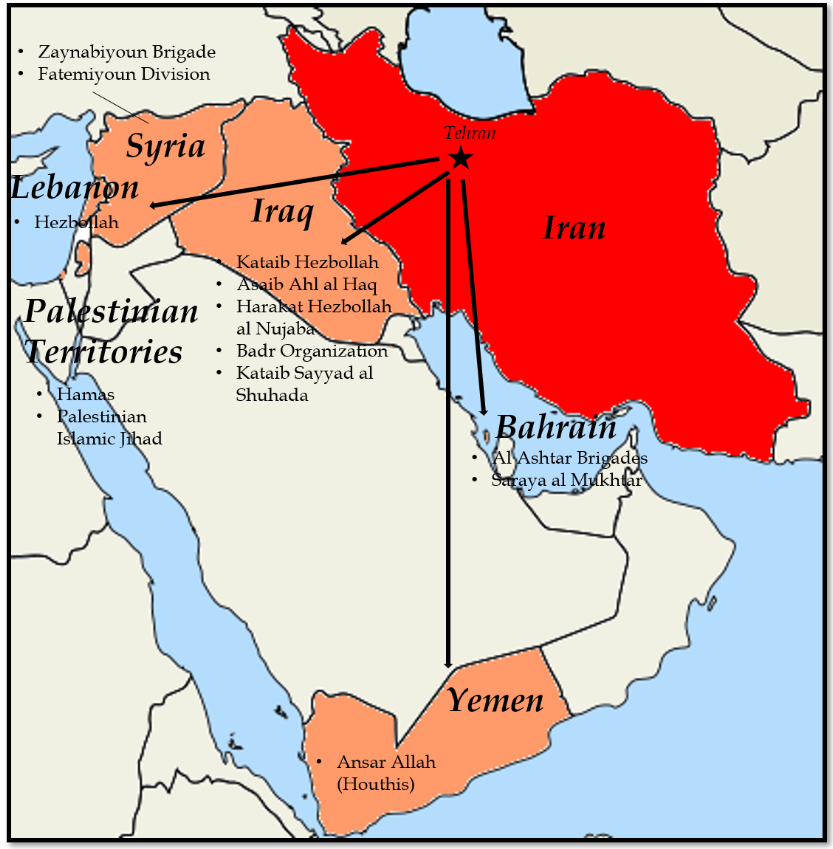
The IRGC in Iran-Israel -US War context demonstrates sophisticated proxy warfare tactics. The organization supports numerous regional allies:
Lebanese Theater: Provides extensive support to Hezbollah forces
Yemeni Operations: Supplies advanced weaponry to Houthi militantsIraqi and Syrian Networks: Coordinates with various militia groups
Anti-Israeli Operations Coordination
The IRGC orchestrates comprehensive opposition to Israeli regional influence through:
- Strategic intelligence sharing with allied organizations
- Operational planning for asymmetric warfare campaigns
- Resource allocation for sustained conflict capabilities
This systematic approach positions the IRGC as a central player in ongoing Iran-Israel tensions.
Advanced Weapons Supply Networks
The organization maintains sophisticated weapons distribution systems:
- Rocket Technology: Long-range precision strike capabilities
- Drone Warfare: Unmanned aerial vehicle operations
- Missile Systems: Ballistic and cruise missile technologies
These capabilities enable Iranian proxies to conduct operations without direct Iranian military involvement.
Modern Warfare Technologies
The IRGC has embraced technological warfare innovations:
- Precision Strike Capabilities: Long-range targeting systems
- Electronic Warfare: Cyber operations and communications disruption
- Asymmetric Tactics: Unconventional military strategies
In current affairs, IRGC Explained for UPSC 2026 is one of the most important topics related to international relations.

Strategic Control: Strait of Hormuz Operations
Global Energy Security Implications
IRGC naval forces maintain operational control over the Strait of Hormuz, one of the world’s most critical energy transportation routes. This strategic position provides Iran with significant leverage in global energy markets.
Economic Warfare Potential
The organization’s ability to disrupt maritime traffic through this vital waterway:
- Affects approximately 20% of global oil shipments
- Creates potential for triggering international energy crises
- Provides Iran with asymmetric deterrent capabilities against superior military forces
You can also check our detailed article on the Strait of Hormuz to understand its strategic importance in global oil trade and geopolitics.
Why Did the USA Declare IRGC a Terrorist Organization?
Questions based on IRGC Explained for UPSC 2026 can be expected in both static and current affairs sections.
Official Classification Rationale
The United States officially designated the IRGC as a terrorist organization based on several key factors:
Support for Militant Networks
The IRGC provides comprehensive assistance to various militant organizations:
- Financial Support: Substantial funding for proxy operations
- Weapons Training: Advanced military instruction programs
- Operational Coordination: Strategic planning and intelligence sharing
Regional Destabilization Activities
IRGC operations contribute to ongoing Middle Eastern conflicts:
- Conflict Escalation: Proxy warfare prolongs regional tensions
- Political Interference: Influence operations in neighboring countries
- Asymmetric Threats: Unconventional warfare against conventional forces
Threats to American Interests
The organization poses direct and indirect challenges to US regional objectives:
- Military Targeting: Operations against American personnel and facilities
- Alliance Disruption: Threats to key US allies including Israel and Gulf states
- Economic Pressure: Energy market manipulation capabilities
UPSC Examination Key Points
Essential Facts for UPSC Preparation
Foundation Year: 1979
Historical Context: Iranian Revolution
Elite Component: Quds Force
Geographic Influence: Middle East region
Strategic Asset: Strait of Hormuz control
Military Strategy: Proxy warfare implementation
Analytical Framework for UPSC Mains
Understanding IRGC Explained for UPSC Exam 2026 requires comprehensive analysis of:
- Hybrid Warfare: Combination of state and non-state strategies
- Technological Integration: Modern warfare techniques including cyber capabilities
- Economic Leverage: Control over global energy security infrastructure
Contemporary Significance in Global Geopolitics
Regional Power Balance
The IRGC significantly influences Middle Eastern power dynamics through:
- Strategic Partnerships: Alliance building with non-state actors
- Deterrent Capabilities: Asymmetric warfare potential
- Economic Integration: Control over critical infrastructure
International Relations Impact
The organization’s activities affect broader international relations:
- Diplomatic Tensions: US-Iran relationship complications
- Alliance Systems: Impact on regional security partnerships
- Global Security: Influence on international terrorism concerns
For better UPSC preparation, aspirants should also practice topic-wise questions. You can attempt our collection of Current Affairs MCQs for UPSC 2026 to strengthen your exam preparation.
Conclusion: IRGC’s Role in Future International Relations
The Islamic Revolutionary Guard Corps has evolved from a revolutionary security force into a sophisticated regional power capable of influencing global geopolitics. For UPSC aspirants studying IRGC Explained for UPSC Exam 2026, understanding this organization provides crucial insights into modern conflict dynamics, proxy warfare strategies, and Middle Eastern regional politics.
The ongoing IRGC in Iran-Israel -US War tensions will continue shaping international relations, energy security, and regional stability. As global powers navigate these complex relationships, the IRGC’s influence on diplomatic, military, and economic dimensions of international affairs will remain a critical factor in contemporary geopolitical analysis.
Mastering these concepts ensures UPSC candidates can effectively analyze current affairs, understand regional conflict dynamics, and demonstrate comprehensive knowledge of modern international relations challenges.
Overall, IRGC Explained for UPSC 2026 is a crucial topic that helps aspirants understand modern geopolitics and conflict strategies.
📚 Recommended Reading:
🔗 UPSC Prelims Practice Questions: 1000+ Important MCQs with Answers for 2026
🔗 75 Important Polity Questions for UPSC Prelims (PYQs + Practice MCQs With Answers)
🔗 Powerful UPSC Prelims 2026 Strategy & Study Plan
🔗 Indus Valley Civilization MCQs