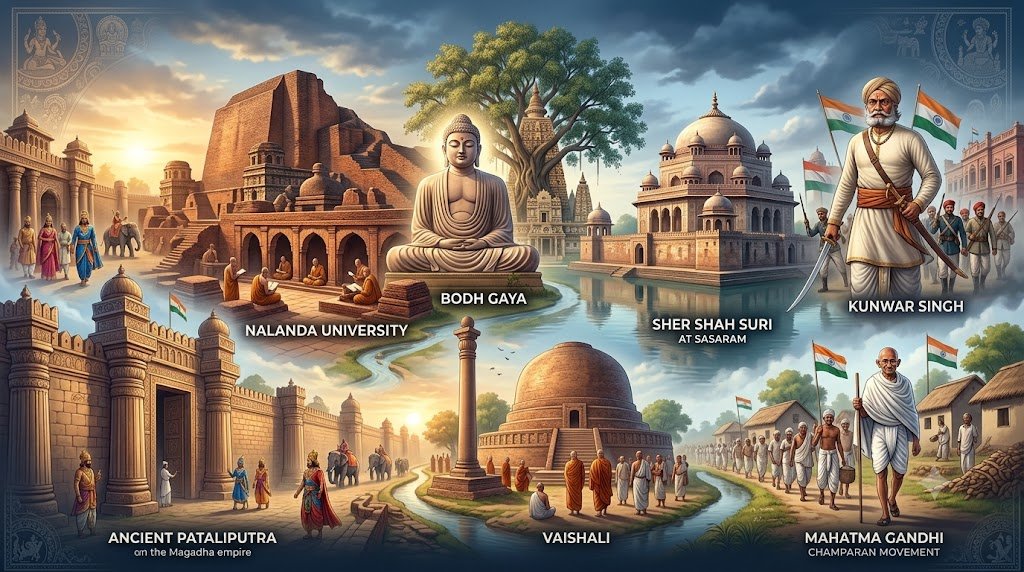
Bihar History for BPSC Prelims 2026 is one of the most important areas of preparation for candidates appearing for the Bihar Public Service Commission examination. Bihar has played a major role in ancient Indian civilisation, Buddhism, Jainism, medieval Indian history, the Revolt of 1857 and the Indian freedom movement.
For BPSC preparation, candidates should not study Bihar history only as a collection of dates and names. The better approach is to understand important events, personalities, places, movements, dynasties and their connections with Bihar.
The official BPSC syllabus includes Indian History and Bihar-related history, while modern Bihar history and Bihar’s role in the freedom struggle receive particular importance in the broader BPSC syllabus.
This article covers the most important areas of Bihar History for BPSC Prelims 2026, along with important facts, timelines and a practical revision strategy.
For serious aspirants, Bihar History for BPSC Prelims 2026 should be studied alongside the broader Indian History syllabus.
Bihar History and the BPSC Prelims Syllabus
BPSC Prelims General Studies covers History along with Geography, Polity, Economy, Science, Current Affairs and General Mental Ability. The official BPSC overview lists Indian History & Bihar History among the major areas of the Prelims syllabus.
For Bihar History preparation, candidates should focus on:
- Ancient Bihar
- Magadha
- Buddhism and Jainism
- Vaishali and the Lichchhavis
- Mauryan period
- Gupta period
- Nalanda
- Vikramshila
- Medieval Bihar
- Sher Shah Suri
- Mughal period in Bihar
- Battle of Buxar
- British rule
- Permanent Settlement
- Indigo cultivation
- Champaran Satyagraha
- Revolt of 1857 in Bihar
- Santhal Uprising
- Birsa Munda Movement
- Bihar’s role in the freedom struggle
- Bihar Provincial Kisan Movement
- Quit India Movement
- Important personalities
- Important historical places
The official BPSC syllabus also specifically mentions topics such as the Santhal Uprising, 1857 in Bihar, Birsa Movement, Champaran Satyagraha and Quit India Movement in the context of modern Bihar history.
Bihar History is only one part of the overall examination preparation. For a complete subject-wise strategy, candidates can also read our Perfect BPSC Exam Pattern 2026: Latest Prelims, Mains & Interview Framework guide covering the syllabus, books, study plan and preparation approach.
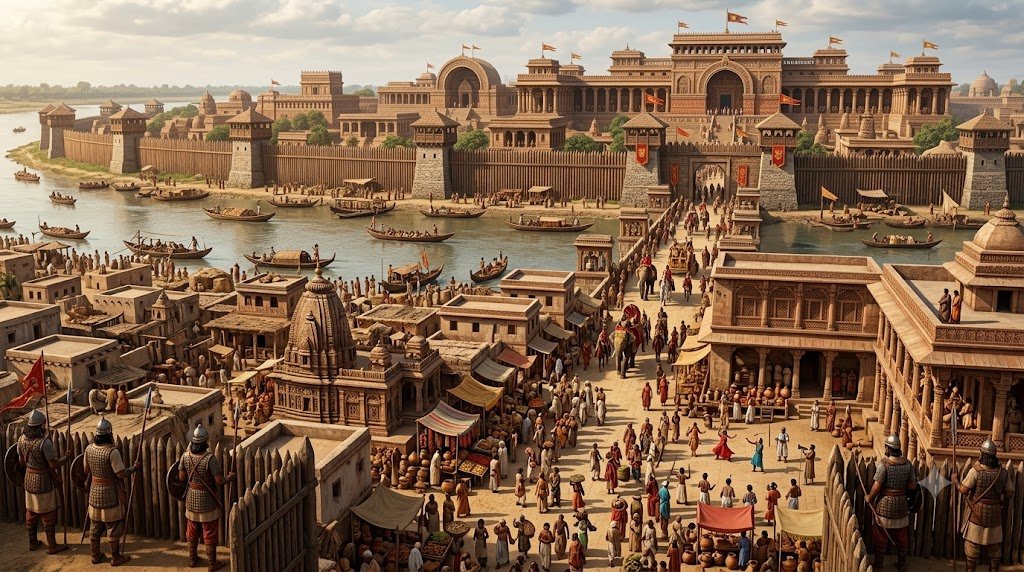
Ancient Bihar: The Rise of Magadha
Understanding the rise of Magadha is essential for building a strong foundation in Bihar History for BPSC Prelims 2026.
Ancient Bihar was one of the most important centres of political, cultural and intellectual development in India.
The region of Magadha emerged as one of the most powerful Mahajanapadas.
Important centres associated with ancient Bihar include:
- Rajgir
- Pataliputra
- Vaishali
- Gaya
- Bodh Gaya
- Nalanda
The geographical location of Magadha was highly favourable because of fertile agricultural land, access to rivers and the availability of natural resources.
Important Magadhan Dynasties
The major dynasties associated with the rise of Magadha include:
- Haryanka Dynasty
- Shishunaga Dynasty
- Nanda Dynasty
- Maurya Dynasty
Important fact: Pataliputra later became one of the most important political centres of ancient India.
Buddhism and Bihar
Buddhism is another high-priority area of Bihar History for BPSC Prelims 2026, especially because of Bihar’s association with Bodh Gaya, Nalanda and Vaishali.
Bihar occupies a central position in the history of Buddhism.
Bodh Gaya is one of the most important Buddhist sites in the world. According to Buddhist tradition, Gautama Buddha attained enlightenment at Bodh Gaya.
Other important Buddhist locations associated with Bihar include:
- Bodh Gaya
- Rajgir
- Nalanda
- Vaishali
Bihar’s connection with Buddhism makes Buddhist sites and personalities important for BPSC preparation.
Prelims Tip: Remember the association:
Bodh Gaya → Enlightenment of Buddha
Vaishali → Buddhist Councils and Licchhavis
Nalanda → Ancient centre of higher learning
Vaishali and the Lichchhavis
Vaishali occupies an important place in ancient Indian political and religious history.
It was associated with the Lichchhavis and the Vajji confederacy.
Vaishali is also important for both Buddhism and Jainism.
Important facts:
- Vaishali was an important centre of the Vajji confederacy.
- The Lichchhavis were associated with Vaishali.
- The Second Buddhist Council is traditionally associated with Vaishali.
- Vaishali has important associations with both Buddha and Mahavira.
Prelims Tip: Questions can connect Vaishali with political institutions, Buddhism, Jainism and the Lichchhavis.
Jainism and Bihar
Bihar is equally important in the history of Jainism.
Mahavira, the 24th Tirthankara of Jainism, is closely associated with the Bihar region.
Important places connected with Jainism include:
- Vaishali
- Rajgir
- Pawapuri
Important fact: Pawapuri is associated with the final liberation or nirvana of Mahavira.
For BPSC, candidates should remember the connection between:
Mahavira → Jainism → Bihar → Vaishali → Pawapuri
Mauryan Bihar
The Mauryan period is one of the most important parts of Bihar’s ancient history.
Chandragupta Maurya established the Mauryan Empire, with Pataliputra becoming its major political centre.
Ashoka further expanded the Mauryan Empire.
Important points:
- Pataliputra was the imperial capital.
- Ashoka is closely associated with Pataliputra.
- Buddhism received major royal patronage under Ashoka.
- Mauryan administration and art are important areas of ancient Indian history.
The Mauryan period is particularly important because Bihar became the centre of one of the largest empires of ancient India.
Gupta Age and Bihar
The Gupta period is generally regarded as an important phase in the development of ancient Indian culture, science, literature and art.
Bihar and the wider eastern Gangetic region were connected with important developments during this period.
For BPSC, candidates should focus on:
- Gupta administration
- Literature
- Science and mathematics
- Art and architecture
- Political expansion
- Important rulers
Prelims Tip: Do not study the Gupta period only from the perspective of rulers. Link it with science, mathematics, literature, art and cultural developments.
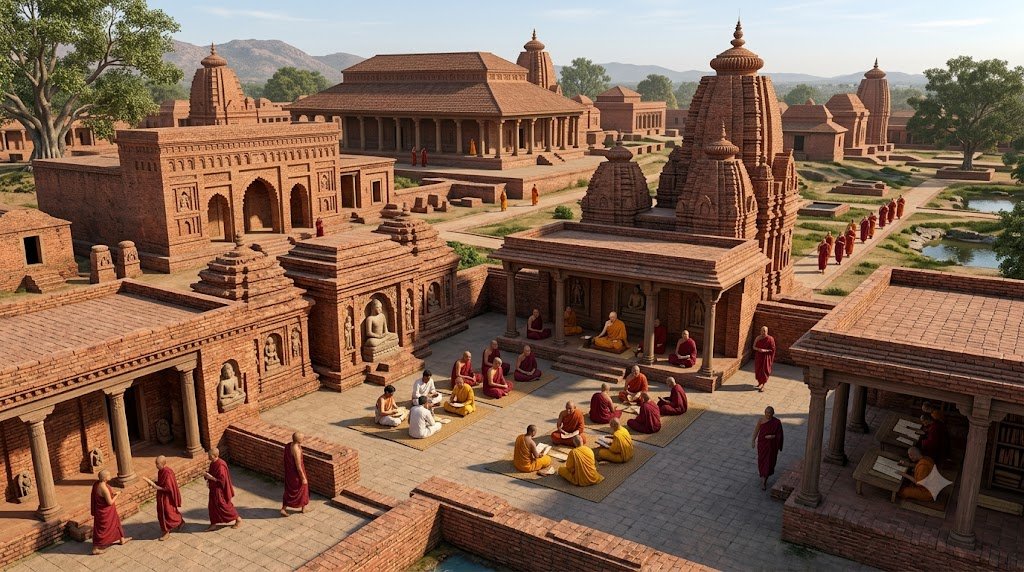
Nalanda: Ancient Centre of Learning
Nalanda is one of the most important topics to revise when preparing Bihar History for BPSC Prelims 2026.
Nalanda is one of the most important historical sites in Bihar.
The ancient Nalanda Mahavihara developed as a major centre of learning and Buddhist scholarship.
The archaeological site of Nalanda represents a major monastic and scholastic institution that remained an important centre of organised knowledge transmission for centuries.
Important points:
- Located in present-day Bihar.
- Major centre of Buddhist learning.
- Attracted scholars from different parts of Asia.
- Associated with ancient higher education.
- Its archaeological remains are of major historical importance.
BPSC Focus: Nalanda should be studied through its history, education system, Buddhist connection and archaeological significance.
Vikramshila University
Vikramshila was another major centre of Buddhist learning in Bihar.
It was established during the Pala period, traditionally associated with King Dharmapala.
Important points:
- Located in present-day Bhagalpur district.
- Associated with the Pala rulers.
- Important centre of Buddhist learning.
- Known for higher studies in Buddhist philosophy and related subjects.
Quick Revision:
Nalanda → Ancient Buddhist learning centre
Vikramshila → Pala period → Dharmapala
Medieval Bihar
Medieval Bihar should not be ignored while preparing Bihar History for BPSC Prelims 2026, particularly the role of Sher Shah Suri.
Bihar remained politically important during the medieval period because of its geographical position in the Gangetic plain.
Important areas of medieval Bihar preparation include:
- Delhi Sultanate influence
- Afghan rule
- Sher Shah Suri
- Mughal administration
- Regional political developments
Among medieval rulers, Sher Shah Suri is especially important for BPSC.
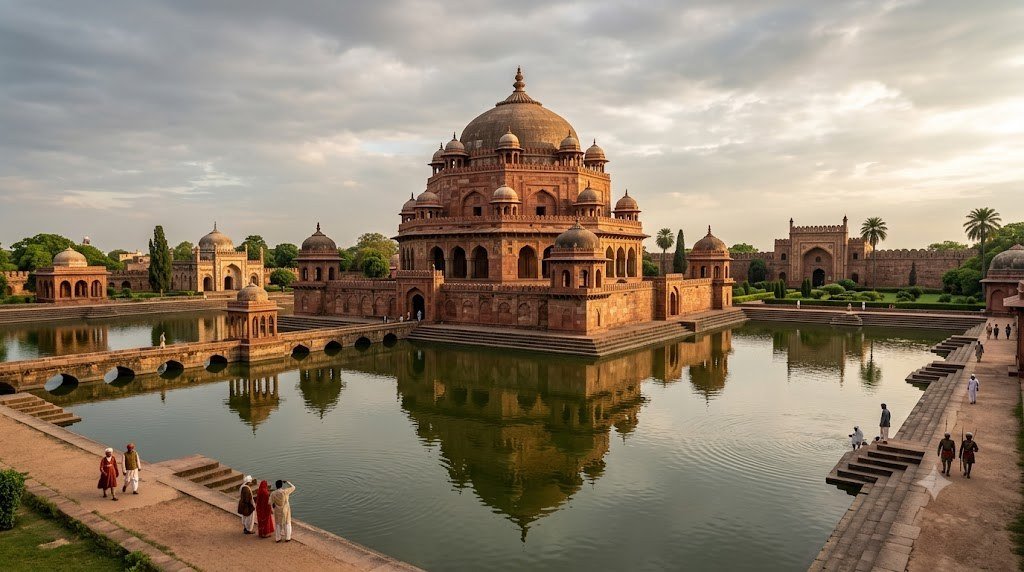
Sher Shah Suri and Bihar
Sher Shah Suri is one of the most important personalities associated with medieval Bihar.
His early political base was closely connected with Bihar.
Important facts:
- Sher Shah Suri was associated with Sasaram.
- His tomb is located at Sasaram.
- He challenged Mughal power under Humayun.
- He established an efficient administrative system.
- His revenue reforms are historically significant.
- His road and communication system is an important part of his legacy.
BPSC Tip: Study Sher Shah through administration, revenue system, roads, currency and military organisation.
Mughal Bihar
Bihar came under Mughal influence after the expansion of Mughal power in North India.
Pataliputra/Patna continued to be economically and strategically important.
During the Mughal period, the region developed as an important centre of:
- Trade
- Agriculture
- Administration
- River-based commerce
For BPSC, Mughal Bihar should be studied in connection with the broader Mughal administrative and economic system.
Battle of Buxar, 1764
The Battle of Buxar is an important modern-history topic for Bihar History for BPSC Prelims 2026.
The Battle of Buxar is one of the most important events in Bihar’s modern history.
The battle was fought in 1764.
The major Indian forces opposing the British East India Company included:
- Mir Qasim
- Shuja-ud-Daula
- Shah Alam II
The British victory at Buxar significantly strengthened the position of the East India Company in eastern India.
Why is Buxar important for BPSC?
Because it is directly connected with:
- British expansion
- Bengal and Bihar
- Mughal authority
- East India Company
- Treaty of Allahabad
- Revenue rights
Remember:
Battle of Plassey → 1757
Battle of Buxar → 1764
British Rule and Bihar
The establishment of British power changed Bihar’s political and economic structure.
Important areas to study include:
- Permanent Settlement
- Zamindari system
- Indigo cultivation
- Revenue administration
- Peasant exploitation
- Tribal resistance
- Freedom movements
These topics connect Bihar’s economic history with its political history.
Permanent Settlement and Bihar
The Permanent Settlement of 1793 was introduced under Lord Cornwallis.
It had a major impact on the agrarian structure of Bengal and Bihar.
Important features included:
- Recognition of zamindars as revenue-collecting intermediaries.
- Fixation of land revenue permanently.
- Growth of zamindari interests.
- Increased pressure on peasants in many areas.
For BPSC, understand the relationship between:
Permanent Settlement → Zamindars → Land Revenue → Peasants
Indigo Cultivation and Champaran
Champaran Satyagraha is one of the highest-priority topics in Bihar History for BPSC Prelims 2026.
Indigo cultivation became a major source of conflict between European planters and peasants.
The Champaran Satyagraha of 1917 was one of the most important events in Bihar’s freedom movement.
Mahatma Gandhi came to Champaran after receiving information about the problems faced by peasants.
The movement is closely associated with the Tinkathia system.
Important personalities connected with the movement include:
- Mahatma Gandhi
- Raj Kumar Shukla
- Rajendra Prasad
- Brajkishore Prasad
- Anugrah Narayan Sinha
Prelims Tip:
Champaran Satyagraha → 1917 → Indigo cultivation → Bihar → Gandhi
This is one of the highest-priority topics in Bihar History for BPSC Prelims 2026.
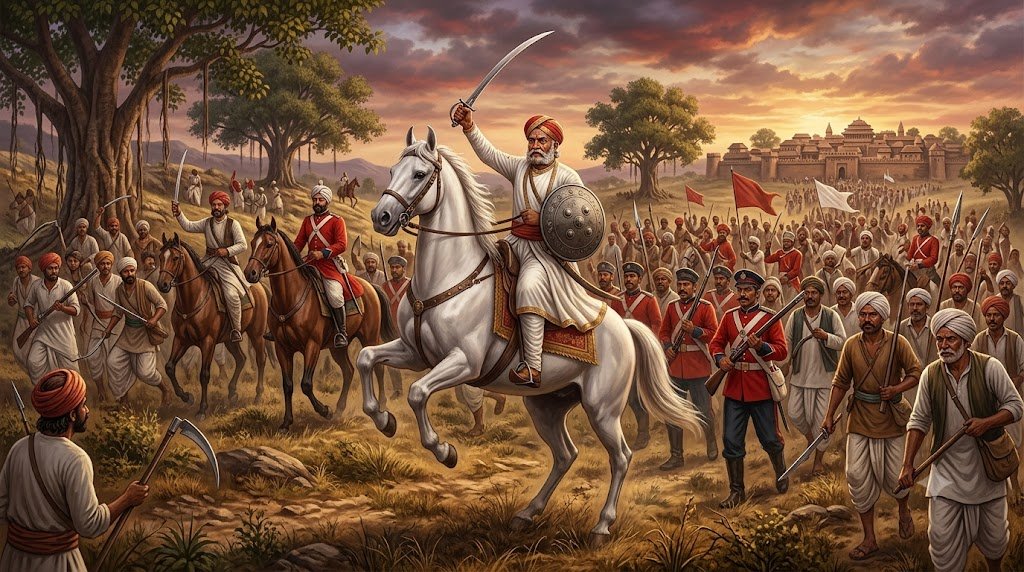
Revolt of 1857 in Bihar
Kunwar Singh and the Revolt of 1857 deserve special attention in Bihar History for BPSC Prelims 2026 preparation.
Bihar played an important role in the Revolt of 1857.
The most prominent personality associated with the revolt in Bihar was Kunwar Singh of Jagdishpur.
Important points:
- Kunwar Singh belonged to Jagdishpur in present-day Bhojpur.
- He became a major leader of the 1857 uprising in Bihar.
- He used guerrilla-style military tactics.
- His resistance continued despite his advanced age.
- Jagdishpur became an important centre of resistance.
Remember:
Kunwar Singh → Jagdishpur → Bhojpur → Revolt of 1857
Santhal Uprising and Bihar-Region History
The Santhal Uprising of 1855–56 is an important topic for BPSC.
It was a major tribal uprising against exploitation and oppressive colonial structures.
Important factors included:
- Exploitation by moneylenders
- Revenue-related pressures
- Zamindari exploitation
- Colonial interference
- Loss of traditional rights
The Santhal Uprising is specifically mentioned in the BPSC syllabus for modern Bihar history.
BPSC Tip: Prepare the causes, leaders, region, nature and consequences of the uprising rather than memorising only the dates.
Birsa Munda Movement
The Birsa Munda Movement is another important topic in the BPSC syllabus.
Birsa Munda emerged as an important tribal leader and became associated with resistance against colonial rule and exploitation.
The movement should be studied through:
- Tribal resistance
- Land rights
- Colonial policies
- Missionary influence
- Social reform
- Birsa Munda’s leadership
The official BPSC syllabus specifically mentions the Birsa Movement as part of modern Bihar-related history.
Bihar and the Indian National Movement
A good understanding of Bihar’s contribution to the national movement is essential for Bihar History for BPSC Prelims 2026.
Bihar made significant contributions to India’s freedom struggle.
Important areas include:
- Champaran Satyagraha
- Non-Cooperation Movement
- Civil Disobedience Movement
- Individual Satyagraha
- Quit India Movement
- Peasant movements
- Revolutionary activities
- Student participation
BPSC candidates should study Bihar’s freedom struggle separately instead of assuming that a general study of the Indian National Movement will be sufficient.
Bihar During the Quit India Movement, 1942
The Quit India Movement of 1942 witnessed strong participation in Bihar.
Students, political workers and ordinary people participated in protests against British rule.
Important personalities and activities associated with Bihar’s 1942 movement should be studied carefully.
One important personality is Jayaprakash Narayan, who became associated with underground resistance during the movement.
BPSC Tip: Questions can ask about personalities, underground activities, important centres and the nature of resistance in Bihar.
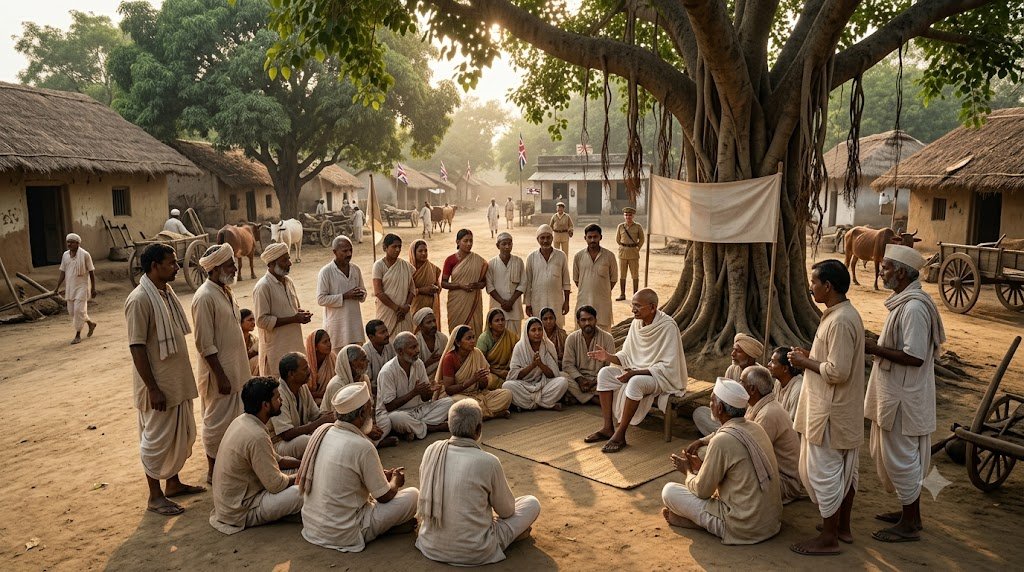
Bihar Provincial Kisan Movement
Peasant movements are an important part of Bihar’s modern history.
The Bihar Provincial Kisan Sabha was an important organisation in the development of organised peasant politics.
Swami Sahajanand Saraswati played a major role in the peasant movement.
Important themes include:
- Zamindari exploitation
- Peasant rights
- Rent and revenue issues
- Agricultural problems
- Organised peasant movements
For BPSC, connect the Bihar peasant movement with the broader development of agrarian politics in colonial India.
Important Personalities from Bihar History
Revising important personalities is an effective way to strengthen your preparation for Bihar History for BPSC Prelims 2026.
A good Bihar History preparation strategy should include a separate list of personalities.
Important personalities include:
| Personality | Major Association |
|---|---|
| Mahavira | Jainism |
| Gautama Buddha | Buddhism and Bodh Gaya |
| Chanakya | Mauryan period |
| Ashoka | Mauryan Empire |
| Aryabhata | Mathematics and astronomy |
| Sher Shah Suri | Medieval Bihar |
| Kunwar Singh | Revolt of 1857 |
| Raj Kumar Shukla | Champaran Satyagraha |
| Rajendra Prasad | Freedom movement and independent India |
| Anugrah Narayan Sinha | Freedom movement and Bihar |
| Swami Sahajanand Saraswati | Peasant movement |
| Jayaprakash Narayan | Freedom movement and later political movement |
| Birsa Munda | Tribal resistance |
Exam Strategy: Make one-page notes for each major personality containing:
- Birthplace
- Period
- Major contribution
- Movement/organisation
- Important associated place
Important Historical Places in Bihar
Historical places are equally important because BPSC can connect a location with an event, personality or movement in Bihar History for BPSC Prelims 2026.
BPSC questions can connect historical events with specific locations.
Important places include:
| Place | Historical Importance |
|---|---|
| Patna/Pataliputra | Mauryan and ancient political centre |
| Bodh Gaya | Buddha’s enlightenment |
| Vaishali | Lichchhavis, Buddhism and Jainism |
| Rajgir | Ancient Magadha |
| Nalanda | Ancient centre of learning |
| Vikramshila | Buddhist learning centre |
| Sasaram | Sher Shah Suri |
| Buxar | Battle of Buxar, 1764 |
| Jagdishpur | Kunwar Singh and 1857 |
| Champaran | Champaran Satyagraha |
| Pawapuri | Mahavira’s nirvana |
Revision Trick: Whenever you study a historical event, immediately connect it with its location.
Bihar History Timeline for BPSC Prelims
A timeline makes Bihar History much easier to revise.
| Period/Year | Important Event |
|---|---|
| Ancient period | Rise of Magadha |
| 6th century BCE | Buddhism and Jainism emerge |
| Mauryan period | Pataliputra becomes imperial centre |
| Gupta period | Major cultural and intellectual developments |
| Pala period | Vikramshila develops as a learning centre |
| Medieval period | Sher Shah Suri’s rise |
| 1764 | Battle of Buxar |
| 1793 | Permanent Settlement |
| 1855–56 | Santhal Uprising |
| 1857 | Revolt of 1857; Kunwar Singh |
| 1917 | Champaran Satyagraha |
| 1942 | Quit India Movement |
| 2000 | Creation of Jharkhand from Bihar |
This timeline should be revised repeatedly before the Prelims examination.
What BPSC Previous Questions Tell You
Previous BPSC papers show that candidates need more than basic factual knowledge.
BPSC’s official question-paper archive provides previous question booklets, and the Commission itself advises candidates to use previous-year papers as part of preparation.
Modern Bihar-related themes have also appeared prominently in BPSC Mains. For example, an official BPSC General Studies Paper I included questions on the Birsa Munda Movement, Indigo Revolt and Patna Kalam, along with broader questions on India’s national movement and Bihar’s colonial educational development.
Therefore, while preparing Bihar History, students should practise questions around:
- Person + event
- Place + event
- Movement + year
- Dynasty + ruler
- Organisation + leader
- Cause + consequence
- Bihar’s contribution to national movements
Most Important Bihar History Topics for BPSC Prelims 2026
If your preparation time is limited, prioritise the following topics:
Very High Priority
- Magadha and its rise
- Buddhism and Bihar
- Jainism and Bihar
- Vaishali and Lichchhavis
- Mauryan Bihar
- Nalanda
- Vikramshila
- Sher Shah Suri
- Battle of Buxar
- Revolt of 1857 in Bihar
- Kunwar Singh
- Champaran Satyagraha
- Santhal Uprising
- Birsa Movement
- Quit India Movement in Bihar
- Bihar Provincial Kisan Movement
Second Priority
- Gupta period
- Mughal Bihar
- Permanent Settlement
- Indigo cultivation
- Bihar’s role in Non-Cooperation Movement
- Bihar’s role in Civil Disobedience Movement
- Important historical personalities
- Important historical places
How to Prepare Bihar History for BPSC Prelims 2026
A topic-wise and timeline-based approach makes Bihar History for BPSC Prelims 2026 easier to revise.
The best strategy is to combine conceptual study + Bihar-specific notes + PYQs + revision.
Step 1: Start with the BPSC syllabus
Before reading books, understand exactly what the Commission expects. The official BPSC website provides the syllabus and previous question papers.
Step 2: Build an Ancient-to-Modern timeline
Study Bihar History chronologically:
Ancient Bihar → Medieval Bihar → British Bihar → Freedom Movement → Modern Bihar
Step 3: Create Bihar-specific short notes
For every topic, write only:
- Date
- Place
- Personality
- Event
- Importance
Step 4: Practise previous-year questions
Do not wait until the end of preparation.
After completing every major topic, solve relevant BPSC questions.
Step 5: Revise repeatedly
A single reading of Bihar History is not enough.
A practical revision cycle can be:
- First revision → within 7 days
- Second revision → after 15 days
- Third revision → after 30 days
- Final revision → before Prelims
Bihar History Quick Revision Table
| Topic | Must Remember |
|---|---|
| Magadha | Major ancient power |
| Pataliputra | Major ancient political centre |
| Vaishali | Lichchhavis and Vajji |
| Bodh Gaya | Buddha’s enlightenment |
| Pawapuri | Mahavira’s nirvana |
| Nalanda | Ancient learning centre |
| Vikramshila | Pala-period learning centre |
| Sher Shah Suri | Sasaram |
| Buxar | Battle of 1764 |
| Kunwar Singh | 1857, Jagdishpur |
| Santhal Uprising | 1855–56 |
| Champaran | 1917 |
| Bihar Provincial Kisan Sabha | Peasant movement |
| Quit India Movement | 1942 |
| Jayaprakash Narayan | Underground resistance |
| Birsa Munda | Tribal movement |
Common Mistakes in Bihar History Preparation
One of the biggest mistakes in Bihar History for BPSC Prelims 2026 preparation is focusing only on ancient Bihar and ignoring modern Bihar.
Many candidates make the same mistakes while preparing Bihar History.
Mistake 1: Studying only ancient history
Ancient Bihar is important, but modern Bihar and Bihar’s role in the freedom struggle are equally important.
Mistake 2: Memorising dates without understanding events
Remember the context behind every important date.
For example:
1917 → Champaran → Indigo → Gandhi
This is much easier to remember than memorising “1917” separately.
Mistake 3: Ignoring Bihar-specific personalities
Kunwar Singh, Raj Kumar Shukla, Rajendra Prasad, Swami Sahajanand Saraswati and Jayaprakash Narayan deserve separate revision.
Mistake 4: Ignoring places
BPSC can connect an event with its location.
Mistake 5: Not solving previous-year questions
PYQs help you understand what type of factual and conceptual connections BPSC expects.
Important Note for BPSC Aspirants
Candidates should always verify the latest BPSC notices before relying on any examination date.
The official BPSC website currently carries an Important Notice regarding the 72nd CCE Preliminary Competitive Examination. Therefore, candidates should not treat an earlier tentative examination date as final until the Commission publishes the revised schedule.
The BPSC FAQ also advises candidates to follow the latest notices published on the official website for examination dates.
Recommended Posts
72nd BPSC CCE 2026: Exam Date, Notification, Vacancy & Effective Preparation Strategy
Powerful Bihar GK for BPSC 2026–27: Complete Notes, MCQs, One-Liners & PYQs
Final Takeaway
Bihar History for BPSC Prelims 2026 should be prepared as a combination of events, personalities, places, movements, timelines and previous-year questions.
The most important areas include:
- Magadha
- Buddhism and Jainism
- Vaishali
- Mauryan Bihar
- Nalanda
- Vikramshila
- Sher Shah Suri
- Battle of Buxar
- Revolt of 1857
- Santhal Uprising
- Champaran Satyagraha
- Bihar Provincial Kisan Movement
- Birsa Movement
- Quit India Movement
- Important personalities and historical places
Instead of trying to memorise hundreds of isolated facts, create connections between person + place + event + year + significance.
That approach will make Bihar History easier to revise and much more useful for BPSC Prelims 2026.
Disclaimer: Historical facts, syllabus references and examination-related information should be cross-checked with the latest official BPSC notification, syllabus and notices before the examination.
1 thought on “Bihar History for BPSC Prelims 2026: Important Topics & Facts”